Chapter 21 – The Evidence for Evolution
Chapter 21
The Evidence for Evolution
Multiple Choice Questions
1. Which statement factors into artificial but not natural selection?
2. A new plant species is introduced to Daphne Major and produces small, thin seeds. This
plant species is highly adapted to drought and after 5 years has replaced over 80% of the
native plants that produce large seeds. How will this change affect the evolution of beak size
in the medium ground finch population?
Chapter 21 – The Evidence for Evolution
Clarify Question
What is the key concept addressed by the question?
What type of thinking is required?
Gather Content
What do you already know about natural selection? What other information is related to
the question?
Choose Answer
Given what you now know, what information is most likely to produce the correct answer?
Reflect on Process
Did your problem-solving process lead you to the correct answer? If not, where did the
process break down or lead you astray? How can you revise your approach to produce a
more desirable result?
Chapter 21 – The Evidence for Evolution
Check All That Apply Questions
3. Which observation(s) of the medium ground finch (Geospiza fortis) by Peter and
Rosemary Grant verify Darwin’s selection hypothesis? Check all that apply.
Multiple Choice Questions
4. In studying the medium ground finch on Daphne Major, the Grants noted that each
generation of finches had beaks
Chapter 21 – The Evidence for Evolution
Check All That Apply Questions
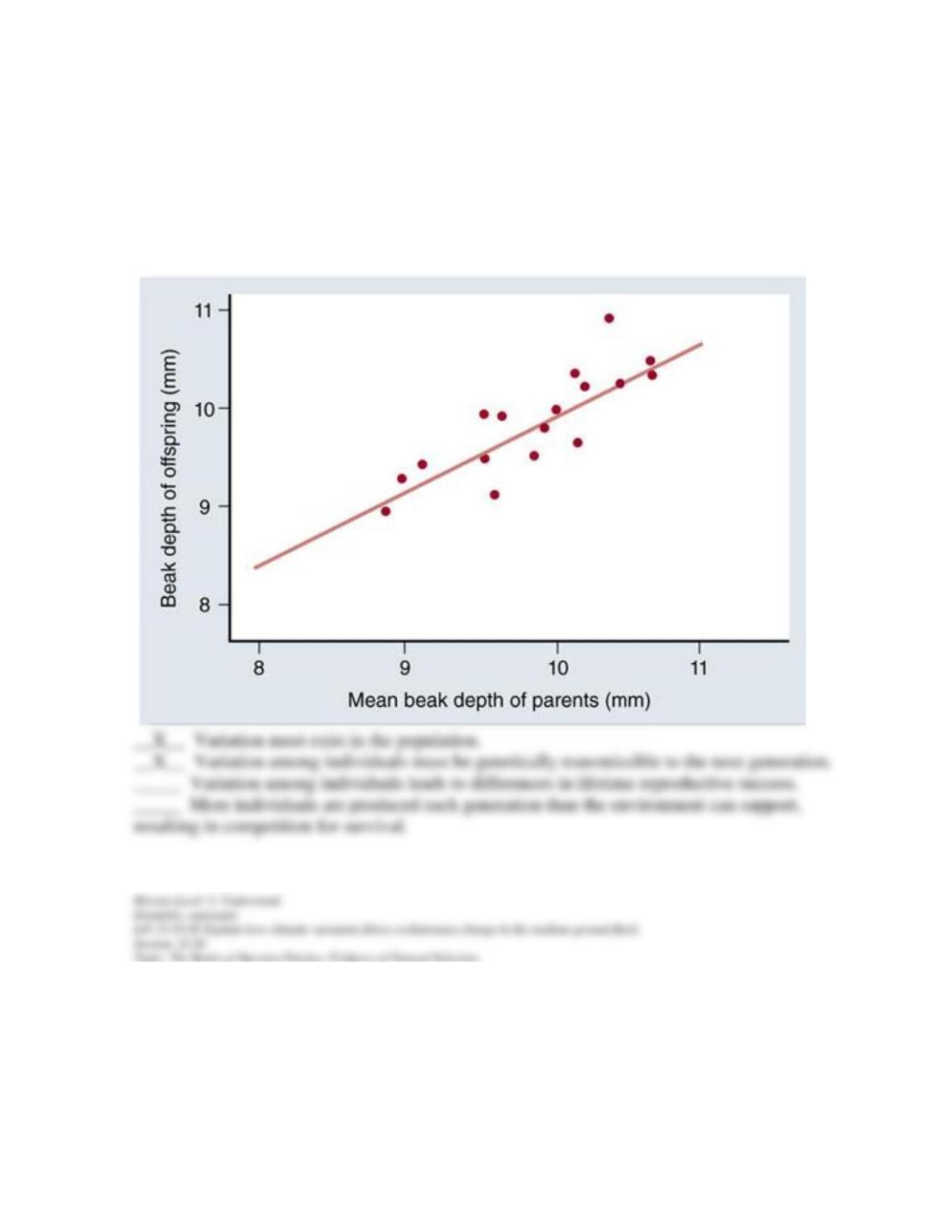
5. Which aspect(s) of natural selection is(are) illustrated by the figure below (21.2b)? Check
all that apply.

Chapter 21 – The Evidence for Evolution
Multiple Choice Questions
6. Industrial melanism is a term
7. The evidence for industrial melanism being caused by an increase in the dark allele was
provided from field tests carried out by
Chapter 21 – The Evidence for Evolution
8. The shape of the beaks of Darwin’s finches and industrial melanism are often cited as
examples of the process of _______________ leading to evolutionary change.
9. Natural selection has favored the dark form of the peppered moth in areas subject to severe
air pollution, perhaps because on darkened trees, moth-eating birds see them less easily. As
pollution abated, the light forms increased in the population because
Chapter 21 – The Evidence for Evolution
10. Industrial melanism involving the peppered moths (Biston sp.) is cited as an example of
natural selection that has been observed in the last one hundred years. Recall that the
peppered moth exhibits two distinct morphological types with dark and light colored wings.
Which of the following statements about changes in these two types of moths as a result of
industrial melanism is true?
11. In a hypothetical study, equal numbers of marked dark and light moths are released in
polluted and unpolluted woodlands and recaptured 10 days later. According to the industrial
melanism hypothesis, which of the following results is unexpected?
Chapter 21 – The Evidence for Evolution
Clarify Question
What is the key concept addressed by the question?
What type of thinking is required?
Gather Content
What do you already know about natural selection? What other information is related to
the question?
Choose Answer
Given what you now know, what information is most likely to produce the correct answer?
Reflect on Process
Did your problem-solving process lead you to the correct answer? If not, where did the
process break down or lead you astray? How can you revise your approach to produce a
more desirable result?
Check All That Apply Questions
Chapter 21 – The Evidence for Evolution
12. Indicate which factors support the industrial melanism hypothesis. Check all that apply.
_____ Pollution inhibits the growth of dark colored lichen.
Multiple Choice Questions
13. Which “alternate” hypothesis might also explain industrial melanism?
Chapter 21 – The Evidence for Evolution
Clarify Question
What is the key concept addressed by the question?
What type of thinking is required?
Gather Content
What do you already know about natural selection? What other information is related to
the question?
Choose Answer
Given what you now know, what information is most likely to produce the correct answer?
Reflect on Process
Did your problem-solving process lead you to the correct answer? If not, where did the
process break down or lead you astray? How can you revise your approach to produce a
more desirable result?
Chapter 21 – The Evidence for Evolution
14. Domestication of dogs has led to
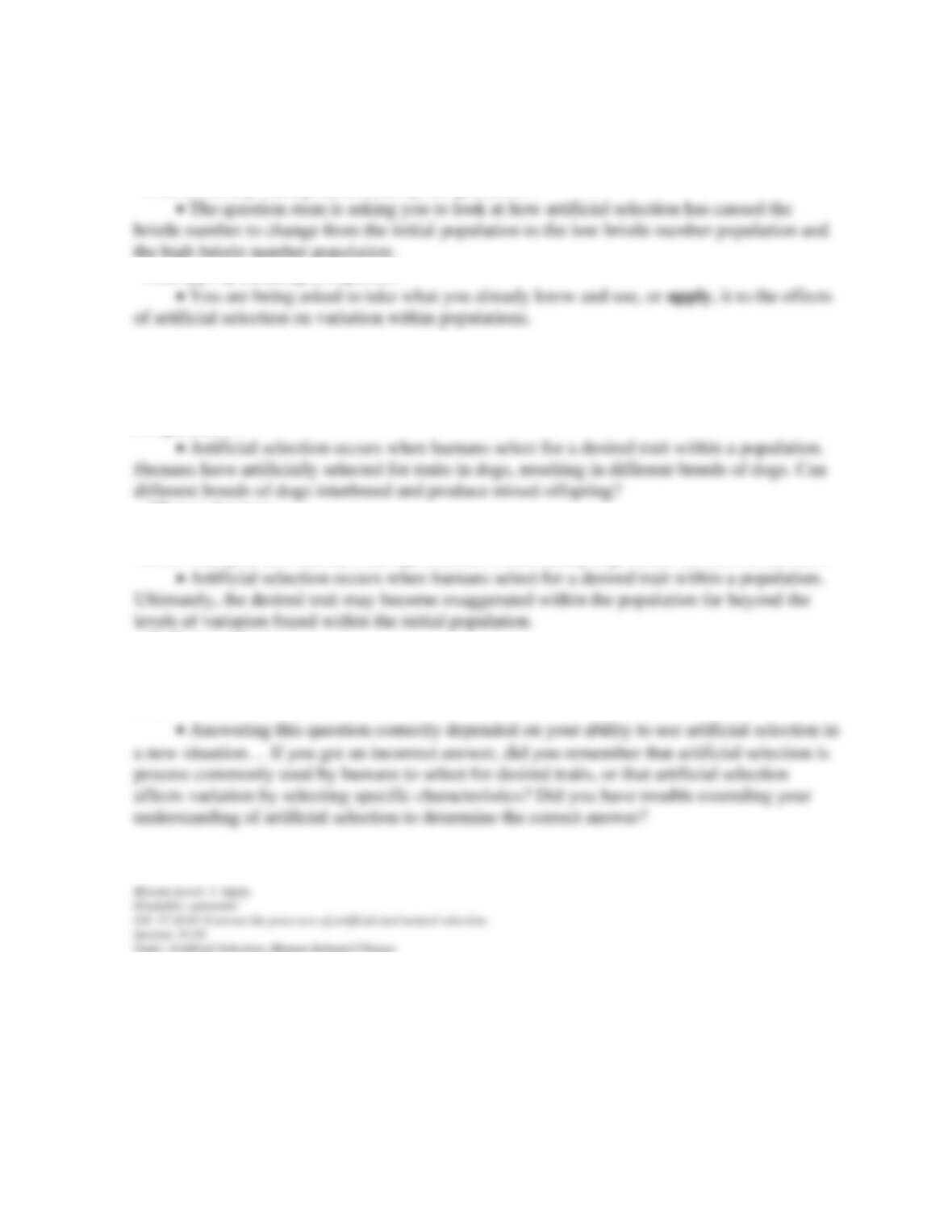
15. The figure below shows results of bristle number in Drosophila flies after 35 generations
of artificial selection. This figure suggests that
Chapter 21 – The Evidence for Evolution
Clarify Question
What is the key concept addressed by the question?
the high bristle number population.
What type of thinking is required?
Gather Content
What do you already know about artificial selection? What other information is related to
the question?
Choose Answer
Given what you now know, what information is most likely to produce the correct answer?
Reflect on Process
Did your problem-solving process lead you to the correct answer? If not, where did the
process break down or lead you astray? How can you revise your approach to produce a
more desirable result?
Chapter 21 – The Evidence for Evolution
16. Comparing the evolution of domesticated dogs to the evolution of wolves over the same
time period illustrates what relationship between artificial and natural selection?
17. Considerably more phenotypic variation exists in domesticated varieties of species like
dogs and cabbages than exists in non-domesticated species like lions and maple trees. Which
one of the following statements best explains why this is true?
18. Some of the most dramatic evidence for evolution has come from human agriculture. One
of the most highly artificially selected crop plants is
Chapter 21 – The Evidence for Evolution
19. A technique used in dating a rock can be used to accurately predict the age of the fossils
occurring in the rocks. This technique involves
20. Today, the fossil record
21. Progressive changes in the fossil record are evidence for evolution because
Chapter 21 – The Evidence for Evolution
22. The most likely explanation for why toothed whales have a blowhole is
23. Radioactive isotopes are used in dating materials from the distant past. Which of the
following statements about radioactive dating techniques is true?
24. A rock contains 18 mg of the radioactive isotope carbon-14. The half-life of carbon-14 is
5,600 years. How many half-lives and years will it take before the carbon-14 decays to less
than 4 mg?
Chapter 21 – The Evidence for Evolution
Clarify Question
What is the key concept addressed by the question?
What type of thinking is required?
Gather Content
What do you already know about half-lives of radioactive isotopes? What other
information is related to the question?
Choose Answer
Given what you now know, what information is most likely to produce the correct answer?
Reflect on Process
Did your problem-solving process lead you to the correct answer? If not, where did the
process break down or lead you astray? How can you revise your approach to produce a
more desirable result?

Chapter 21 – The Evidence for Evolution
25. The half-life of carbon-14 is 5,600 years. A fossil that has one-eighth the normal
proportion of carbon-14 to carbon-12 is probably
Chapter 21 – The Evidence for Evolution
Clarify Question
What is the key concept addressed by the question?
What type of thinking is required?
Gather Content
What do you already know about half-lives of radioactive isotopes? What other
information is related to the question?
Choose Answer
Given what you now know, what information is most likely to produce the correct answer?
Reflect on Process
Did your problem-solving process lead you to the correct answer? If not, where did the
process break down or lead you astray? How can you revise your approach to produce a
Chapter 21 – The Evidence for Evolution
26. Which one of the following features of Archaeopteryx clearly demonstrates that it was on
the evolutionary line leading from dinosaurs to birds?
Check All That Apply Questions
27. Choose the true statement(s) about the evolutionary divergence of horses in North
America. Check all that apply.
Multiple Choice Questions
Chapter 21 – The Evidence for Evolution
28. In 2006, scientists discovered a fossil that had scales and gills, a flat head with eyes on top
like a crocodile, and fin and neck bones that would allow it to prop itself out of the water. The
best explanation for this fossil is that it is
Check All That Apply Questions
29. Which of the following features of ancient horses are adaptations for living on open
grasslands? Check all that apply.
Multiple Choice Questions