Biology: A Guide to the Natural World, 5e (Krogh)
Chapter 21 Viruses, Bacteria, Archaea, and Protists: The Diversity of Life 1
1) Which organisms accomplish most of the work of converting atmospheric nitrogen into a form
usable to green plants?
A) bacteria and archaea
B) viruses
C) protists
D) fungi
2) The main decomposers on Earth are the:
A) viruses and protists.
B) plants and animals.
C) bacteria and fungi.
D) plants and fungi.
3) The material in the core of HIV (AIDS virus) is:
A) protein.
B) xarbohydrate.
C) DNA.
D) RNA.
4) The viral capsid is:
A) a fatty membrane surrounding the virus.
B) the genetic material at the core.
C) a protein coat around the genetic material.
D) the viral offspring that rupture the cell and escape.

2
5) Which of the following is the best description of a virus?
A) A virus is the smallest living thing.
B) A virus is a life-form that can reproduce inside cells or independently.
C) A virus is a tiny spore-producing cell.
D) A virus is a noncellular, replicating entity.
6) The process by which viruses can exchange genetic sequences to come up with a “new” virus
such as H1N1 is:
A) recombination.
B) reassortment.
C) independent assortment.
D) conjugation.
7) The life cycle of viruses involves:
A) production of new virus particles on the outside of a cell.
B) reproducing on the surface of a cell.
C) filling the host cell with viral particles.
D) attaching viral DNA to the surface of a cell.
8) Which phrase most accurately describes the genome of most viruses?
A) surprisingly complex, with tens of thousands of genes
B) surprisingly complex, with around 1 million genes
C) the same as most bacteria, with hundreds of genes
D) relatively simple, with around a dozen genes or fewer
9) The human immunodeficiency virus targets:
A) lymph nodes.
B) all white blood cells.
C) helper T cells.
D) bone marrow cells.
10) A major difference between bacteria and eukaryotes is that bacteria have:
A) a rod-shaped nucleus.
B) no membrane-bound organelles.

C) faster mitosis as their method of sexual reproduction.
D) no ribosomes.
11) Which of the following would support the statement that bacteria represent the most
fundamentally diverse group on Earth?
A) Bacteria exist in varieties with and without cell walls.
B) Bacteria accomplish all characteristics of life as small, single cells.
C) Bacteria are metabolically diverse regarding oxygen and food requirements.
D) Bacteria come in several different shapes.
12) Which statement about the relationship between bacteria and the human body is most
accurate?
A) Although many tissues are kept bacteria-free, around 100 trillion bacteria live on or in us.
B) About one-tenth of our body weights are due to bacteria
C) Bacteria are found in the mouth, stomach, and intestines in about equal amounts.
D) Most bacteria are transient; that is, they come for brief periods and then are gone.
13) Which of the following would support the hypothesis that bacteria have mutually beneficial
relationships with us?
A) Bacteria derive benefit from waste materials in our intestines.
B) Mice that were made “germ free” did not absorb and metabolize nutrients as well.
C) Bacteria can metabolize food using alternate pathways.
D) Most intestinal bacteria cannot live outside the body.
14) Bacteria that benefit from living in or on us while we are unaffected by the relationship are
termed:
A) commensal.
B) pathogenic.
C) mutualistic.
D) probiotic.
15) A bacterium that is pathogenic:
A) is flexible regarding use of metabolic pathways.
B) has genes similar to viruses.
C) is a disease-causing organism.
D) benefits from living inside humans and produces nutrients for us.
16) The botulism bacterium can kill a person by:
A) killing muscle cells.
B) secreting a toxin that paralyzes muscles.
C) causing brain hemorrhages.
D) producing lethally high fevers.
17) If antibiotics seem effective against a human illness, then this illness is probably caused by
a/an:
A) protist.
B) autoimmune disease.
C) virus.
D) bacterium.

5
18) In general, most antibiotics work by:
A) exploiting differences between human and bacterial cells.
B) preventing bacteria from entering human cells.
C) preventing viruses from entering human cells.
D) boosting the human immune system.
19) The antibiotic penicillin inhibits the ability of bacteria to:
A) make cell walls.
B) synthesize protein.
C) copy DNA.
D) undergo respiration.
20) Which of the following is true of Domain Archaea compared to other groups?
A) They are the only anaerobes on Earth.
B) Their cell wall and membrane biochemistry is unique.
C) Most of their genes are similar to those found in bacteria.
D) None of their genes work like those found in eukaryotes.
Refer to the scenario below, and then answer the following question(s).
As part of your field biology independent study, you visit a small lake with an extremely high
salt concentration. Searching with nets and other sampling devices, you find no fish, plants,
algae, or any visible signs of life in the lake. Still, you decide to take a few samples of the water
back to the lab. You find the sample teeming with very small cells, hundreds of times smaller
than a typical human cell. These cells have cell walls, which you analyze chemically and find
they are not made of peptidoglycan or cellulose.
21) Based upon the environment in which you found these life-forms, how would you categorize
them?
A) thermophiles
B) halophiles
C) anaerobes
D) methanogens
22) Based upon the chemical experiments you performed, how would you classify these life-
forms?
A) protists

B) fungi
C) bacteria
D) archaea
23) Which of the following areas/conditions would be favored by thermophiles?
A) anaerobic conditions
B) deep-sea volcanic vents
C) the arctic tundra
D) the stomachs of herbivores
24) In what type of environment would you be most likely to find anaerobes?
A) high temperature
B) high acidity
C) high salt content
D) no oxygen
25) Which statement best describes our current understanding of protist evolution?
A) Protists evolved from the Archaea while other eukaryotes did not.
B) Protists evolved from multicellular eukaryotes.
C) Protists evolved from separate branches off the early eukaryotic line.
D) Protists evolved from eukaryotic parasites.
26) An example of a protist intestinal parasite would be:
A) Clostridium botulinum.
B) Yersinia pestis.
C) Chlamydomonas.
D) Giardia.
27) Plasmodium falciparum is a protozoan that:
A) can switch between plant and animal lifestyles.
B) is closely related to fungi.
C) causes malaria.
D) causes intestinal distress.

28) What is the benefit of sexual reproduction in protists?
A) greater variation among offspring
B) fast increase in numbers
C) availability of more environments
D) ease of finding a mate
29) A protist such as Chlamydomonas may switch to sexual reproduction when:
A) there are numerous predators.
B) there is little nutrition.
C) a 90-day cycle is completed.
D) hormones from nearby members of the species are detected.
30) Chlamydomonas “mating types” differ in what way?
A) chloroplasts
B) flagella structure
C) interlocking male and female parts
D) membrane phospholipids
31) Cells such as those of golden algae that form stable associations but do not take on
specialized roles are described as:
A) incomplete unicellular.
B) selective multicellularity.
C) true multicellularity.
D) colonial multicellularity.
32) Which organisms form the basic foundation of the food chain in the ocean?
A) shrimp
B) krill
C) phytoplankton
D) jellyfish

33) Volvox and Paramecium share which characteristic?
A) photosynthetic ability
B) movement
C) true multicellularity
D) anaerobic respiration
34) Amoeba and phytoplankton differ in that phytoplankton can:
A) perform photosynthesis.
B) eat krill.
C) move with pseudopodia.
D) live on land.
35) Cilia are:
A) the cytoplasmic extensions or false feet that some cell types use for locomotion.
B) different kinds of cells, each designed to perform a different function.
C) the circular chromosomes of bacteria.
D) many short, hair-like cellular extensions that beat to produce movement.
36) Entamoeba histolytica is a/an:
A) photosynthetic protist.
B) protist that moves using flagella.
C) parasitic protist responsible for dysentery.
D) aggregating protist that can form a “slug-like” organism.
37) Organisms called plasmodial slime molds move by which process?
A) beating of cilia
B) cytoplasmic streaming
C) contractile cytoskeleton movements
D) growth in the direction of sunlight
38) Bacteria are the smallest living things known.
39) Microscopic algae and bacteria produce over half of the oxygen in the atmosphere.
40) The core of some viruses is carbohydrate in nature.
41) Scientists do not consider viruses to be alive because viruses cannot metabolize outside a
host cell.
42) When a virus takes over the machinery of a cell, it forces the cell to manufacture more viral
particles.
43) Bacteria are considered to be a type of protist.
44) The simplest eukaryotes are the bacteria.
45) Some bacteria can obtain their nutrition by photosynthesis.
46) Spherical bacteria are called cocci.
47) Rod-shaped bacteria are called spirochetes.
10
48) Bacteria store their DNA within a spherical nucleus.
49) When bacteria undergo binary fission, they produce identical daughter cells.
50) Most bacteria present in the human intestines are pathogenic.
51) Nearly half the antibiotics used in the United States go into animal feed as growth stimulants.
52) Malaria is caused by a bacterium.
53) Most protists are unicellular.
54) A long, whip-like tail found in a protist is called a flagellum.
55) Paramecium is a heterotrophic protist that moves using cilia.
Match the following.
A) rod-shaped bacteria
B) structure found in many viruses, often “borrowed” from the host cell
C) round-shaped bacteria
D) organelle not found in both bacteria and eukaryotes
E) type of organelle found in both bacteria and eukaryotes

56) Nucleus
Topic: Section 21.3
Skill: Application/Analysis
57) Ribosome
Topic: Section 21.3
Skill: Application/Analysis
58) Coccus
Topic: Section 21.3
Skill: Knowledge/Comprehension
59) Fatty membrane called an envelope
Topic: Section 21.2
Skill: Knowledge/Comprehension
60) Bacillus
Topic: Section 21.3
Skill: Knowledge/Comprehension

Match the following.
A) thermophile
B) anaerobe
C) halophile
D) pseudopod
E) heterotroph
61) “Other-eater”
Topic: Section 21.10
Skill: Knowledge/Comprehension
62) Thrives in salty environments
Topic: Section 21.6
Skill: Knowledge/Comprehension
63) Thrives in hot environments
Topic: Section 21.6
Skill: Knowledge/Comprehension
64) “False foot”
Topic: Section 21.10
Skill: Knowledge/Comprehension
65) Lives without oxygen
Topic: Section 21.6
Skill: Knowledge/Comprehension
Match the following.
A) bubonic plague
B) “social amoeba”
C) a Type-A influenza
D) ciliated protist
E) truly multicellular algae
66) H1N1 virus
Topic: Section 21.2
Skill: Knowledge/Comprehension
67) The bacterium Yersinia pestis
Topic: Section 21.5
Skill: Knowledge/Comprehension
68) Dictyostelium discoideum
Topic: Section 21.10
Skill: Knowledge/Comprehension
69) Volvox
Topic: Section 21.9
Skill: Knowledge/Comprehension
70) Paramecium
Topic: Section 21.10
Skill: Knowledge/Comprehension
71) Virus-like entities called viroids lack a ________ and are simply strands of infectious RNA.
72) Overuse of antibiotics has likely produced MRSA. MRSA stands for ________.
73) Methanogens are in the ________ category of extremophile.
74) Photosynthetic aquatic microorganisms, such as some bacteria and protists, are known as
________.
75) Some protists have locomotor extensions called ________ and ________.
76) Scientists mostly agree that viruses are not technically living things. Defend this position
based on what you know about what viruses are and how they work.
77) Defend the position that bacteria are both beneficial and detrimental to humans.
78) Protists are arguably the most diverse of the eukaryotic kingdoms. Defend that statement
using examples to support your ideas.
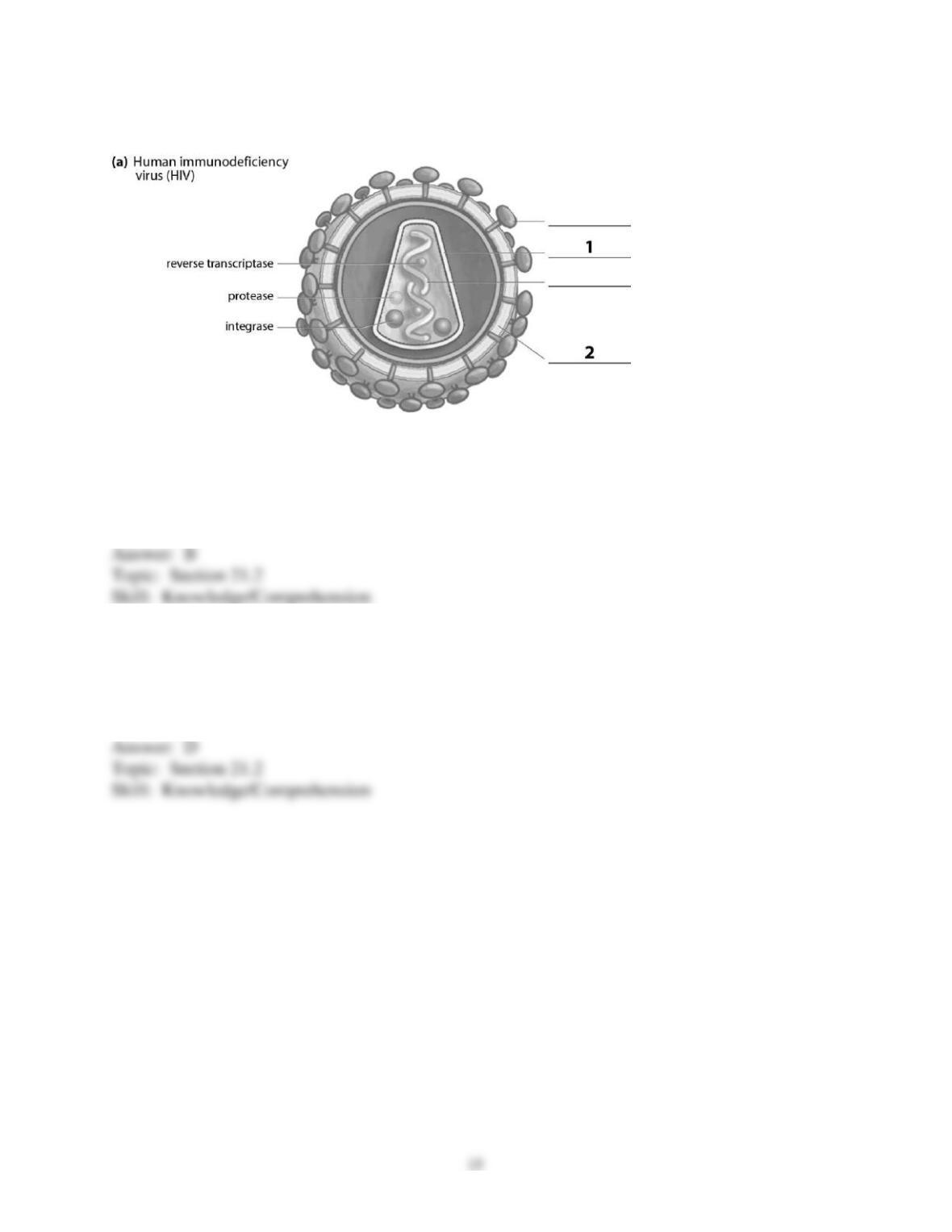
Refer to the figure below, and then answer the following question(s).
79) The missing label indicated by a “1” corresponds to the:
A) receptor.
B) capsid.
C) RNA.
D) envelope.
80) The missing label indicated by a “2” corresponds to the:
A) receptor.
B) capsid.
C) RNA.
D) envelope.