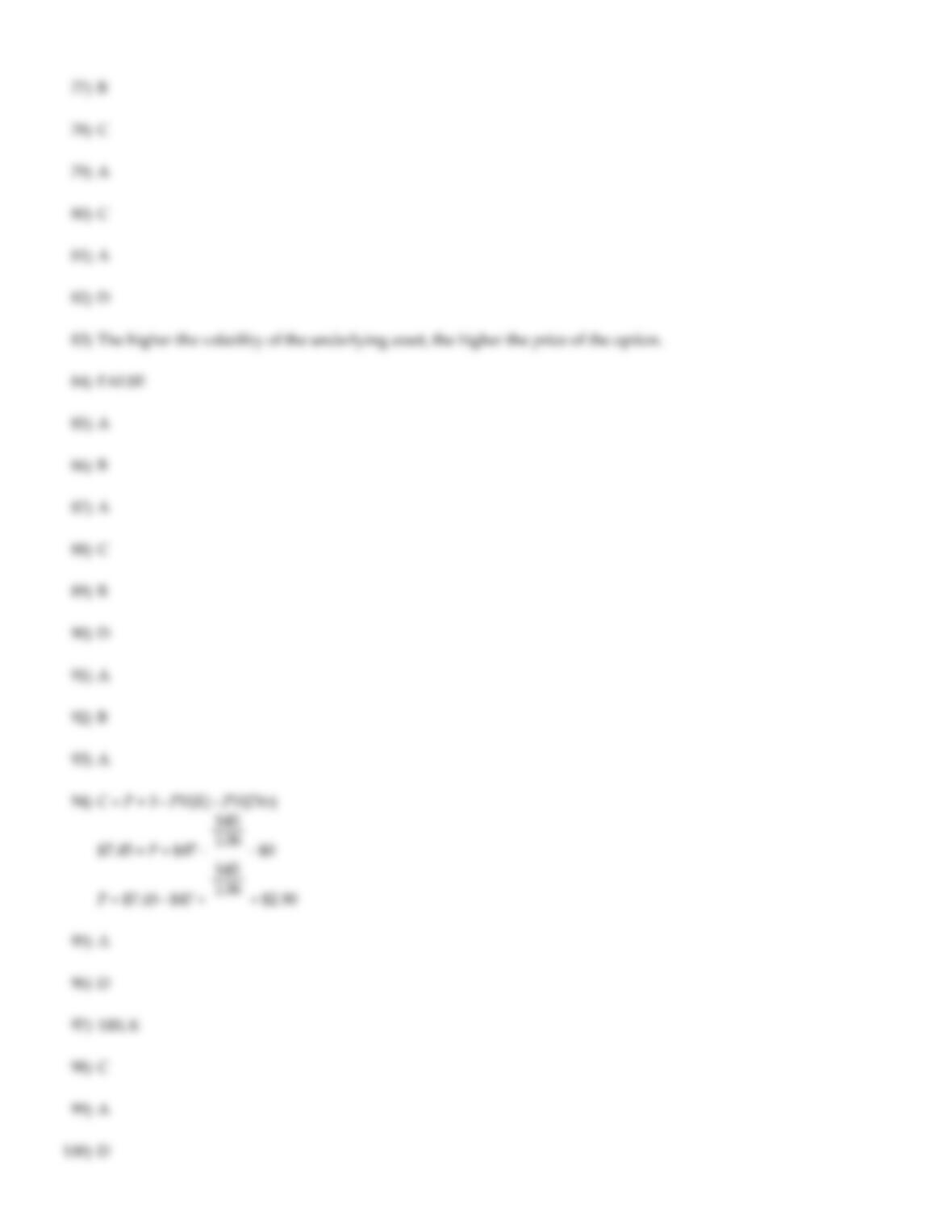
Use the figure for the question(s) below.
60) This graph depicts the payoffs of a
A) a short position in a put option at expiration.
B) short position in a call option at expiration.
C) a long position in a put option at expiration.
D) a long position in a call option at expiration.
Use the figure for the question(s) below.
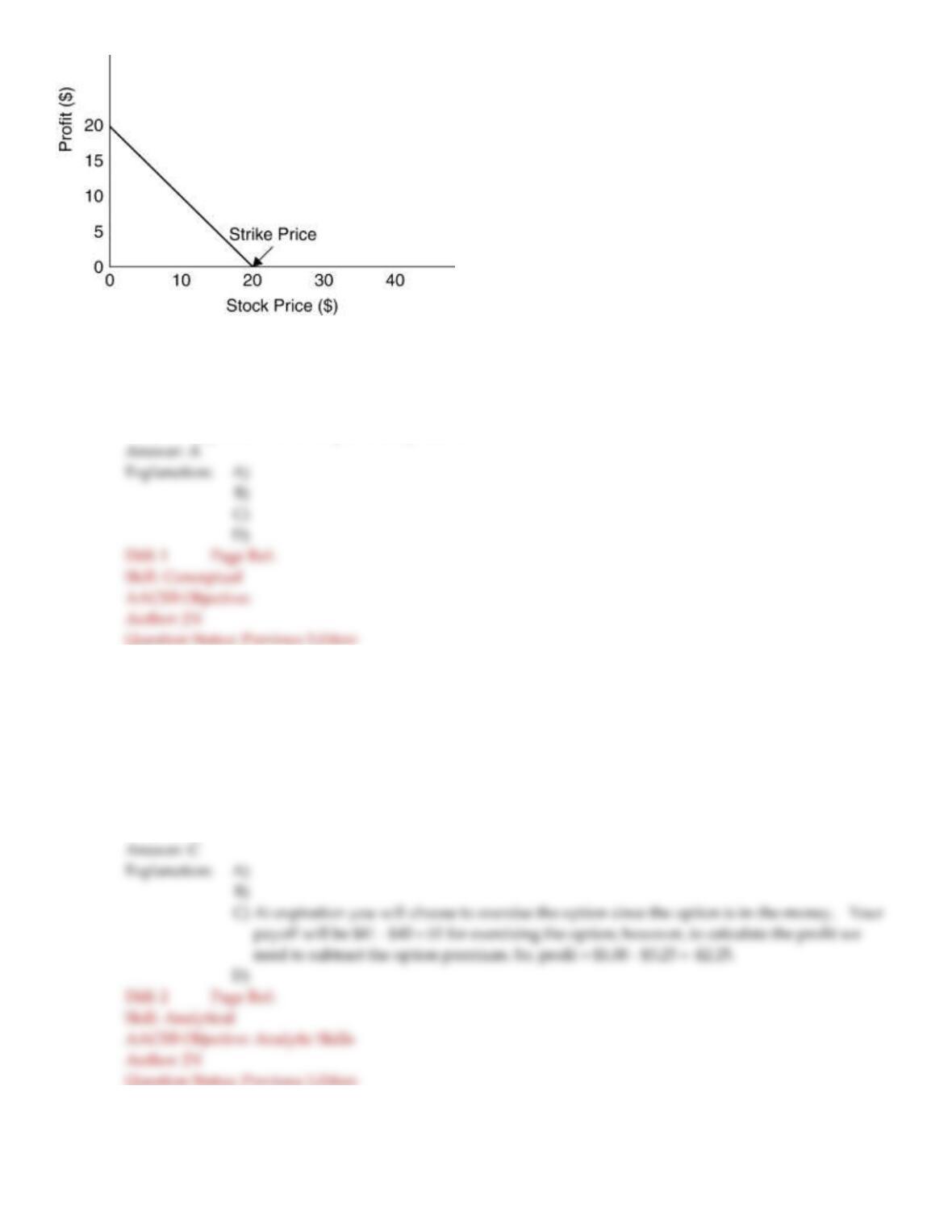
61) This graph depicts the payoffs of a
A) a long position in a put option at expiration.
B) short position in a call option at expiration.
C) a short position in a put option at expiration.
D) a long position in a call option at expiration.
62) You pay $3.25 for a call option on Luther Industries that expires in three months with a strike price of $40.00.
Three months later, at expiration, Luther Industries is trading at $41.00 per share. Your profit per share on
this transaction is closest to:
A) –$1.00
B) $1.00
C) –$2.25
D) $2.25
63) You have shorted a call option on WSJ stock with a strike price of $50. The option will expire in exactly six
months. If the stock is trading at $60 in three months, what will you owe for each share in the contract?
A) $0
B) $60
C) $50
D) $10
64) You have shorted a call option on WSJ stock with a strike price of $50. The option will expire in exactly six
months. If the stock is trading at $45 in three month, what will you owe for each share in the contract?
A) $0
B) $50
C) $60
D) $10
SHORT ANSWER. Write the word or phrase that best completes each statement or answers the question.
65) What is the long position of an options contract?
66) What is the short position of an options contract?
TRUE/FALSE. Write ‘T’ if the statement is true and ‘F’ if the statement is false.
67) A European option on a stock is more valuable than an otherwise similar American option on the same
stock.
68) A European option with a later exercise date may trade potentially for less than an otherwise identical option
with an earlier exercise date.
69) In practice, option prices are not very sensitive to changes in the risk–free rate.
MULTIPLE CHOICE. Choose the one alternative that best completes the statement or answers the question.
70) The value of an otherwise identical call option is ________ if the strike price the holder must pay to buy the
stock is ________.
A) higher, higher
B) lower, lower
C) higher, lower
D) none of the above
71) The value of an otherwise identical call option is ________ if the stock price is ________.
A) higher, higher
B) lower, higher
C) higher, lower
D) none of the above
72) The value of an otherwise identical American call option is ________ if the exercise date is ________.
A) higher, longer
B) lower, longer
C) higher, closer
D) none of the above
73) The value of a call option ________ with the risk–free rate, and the value of a put option ________ with the
risk–free rate.
A) increases, increases
B) decreases, decreases
C) increases, decreases
D) decreases, increases
74) The value of an option ________ with the volatility of the underlying stock.
A) increases
B) decreases
C) unchanged
D) cannot say for sure
75) Which of the following will not increase the value of a put option?
A) an increase in the time to maturity
B) a decrease in the stock price
C) a decrease in the stocks volatility
D) an increase in the exercise price
76) Which of the following statements is FALSE?
A) Put–call parity gives the price of a European call option in terms of the price of a European put, the
underlying stock, and a zero–coupon bond.
B) For a given strike price, the value of a call option is higher if the current price of the stock is higher, as
there is a greater likelihood the option will end up in–the–money.
C) The value of an otherwise identical call option is higher if the strike price the holder must pay to buy
the stock is higher.
D) Because a put is the right to sell the stock, puts with a lower strike price are less valuable.
77) Which of the following statements is FALSE?
A) The intrinsic value of an option is the value it would have if it expired immediately.
B) A European option cannot be worth less than its American counterpart.
C) Put options increase in value as the stock price falls.
D) A put option cannot be worth more than its strike price.
78) Which of the following statements is FALSE?
A) Because an American option cannot be worth less than its intrinsic value, it cannot have a negative time
value.
B) An American option with a later exercise date cannot be worth less than an otherwise identical
American option with an earlier exercise date.
C) The value of an option generally decreases with the volatility of the stock.
D) The intrinsic value is the amount by which the option is currently in–the–money, or 0 if the option is
out–of–the–money.
79) KD Industries stock is currently trading at $32 per share. Consider a put option on KD stock with a strike
price of $30. The intrinsic value of this put option is:
A) $0
B) –$2
C) $2
D) $30
80) KD Industries stock is currently trading at $32 per share. Consider a put option on KD stock with a strike
price of $30. The maximum value of this put option is:
A) $0
B) $32
C) $30
D) $2
81) For a(n) ________ put option, the longer the time to expiration, the greater the value of the option, all other
things held constant.
A) American
B) European
C) Asian
D) A & B
82) For a(n) ________ put option, the higher the stock price, the lower the value of the option
A) American
B) European
C) Asian
D) A & B
SHORT ANSWER. Write the word or phrase that best completes each statement or answers the question.
83) What effect does volatility of the underlying asset have on the price of the option?
TRUE/FALSE. Write ‘T’ if the statement is true and ‘F’ if the statement is false.
84) The Black–Scholes formula gives the price of an American call option.
MULTIPLE CHOICE. Choose the one alternative that best completes the statement or answers the question.
85) The Black–Scholes formula is notable because it does not require us to know
A) the expected return on a stock.
B) the risk–free rate.
C) the volatility of the stock.
D) the dividend rate on the stock.
86) Which of the following is not used in the Black–Scholes option pricing formula?
A) Stock price
B) Dividend yield
C) Strike price
D) Risk–free rate
87) When you purchase a put option while still holding the underlying stock, it is known as a ________.
A) protective put
B) protective call
C) speculative put
D) speculative call
88) ________ is the relationship between the value of a stock, bond and call and put options on the same stock
and the same exercise price.
A) Dividend exclusion
B) Limit law
C) Put–call parity
D) Put option equality
89) Suppose you are looking to exploit opportunities in the options markets. The price of a call option on Apple
computers with a maturity of one year and strike price $150 is $15, and the price of the stock is $140. What
should the price of a put option be to preclude profitable opportunities? The risk–free rate of interest is 5%.
A) $21.45
B) $17.86
C) $25.00
D) $19.63
90) Consider the following equation:
C = P + S – PV(K) – PV(Div)
In this equation, what does the term S represent?
A) the payoff of a zero–coupon bond
B) the strike price of the option
C) the value of the call option
D) the stock’s current price
91) Consider the following equation:
C = P + S – PV(K) – PV(Div)
In this equation, what does the term C represent?
A) the value of the call option
B) the stocks current price
C) the payoff of a zero–coupon bond
D) the strike price of the option
92) Consider the following equation:
C = P + S – PV(K) – PV(Div)
In this equation, what does the term K represent?
A) the value of the call option
B) the strike price of the option
C) the price of a zero–coupon bond
D) the stocks current price
93) Luther Industries is currently trading for $27 per share. The stock pays no dividends. A one–year
European put option on Luther with a strike price of $30 is currently trading for $2.60. If the risk–free
interest rate is 6% per year, then the price of a one–year European call option on Luther with a strike price of
$30 will be closest to:
A) $1.30
B) $7.10
C) $2.60
D) $1.95
ESSAY. Write your answer in the space provided or on a separate sheet of paper.
94) Rose Industries is currently trading for $47 per share. The stock pays no dividends. A one–year European
call option on Luther with a strike price of $45 is currently trading for $7.45. If the risk–free interest rate is
6% per year, then calculate the price of a one–year European put option on Luther with a strike price of $45.
MULTIPLE CHOICE. Choose the one alternative that best completes the statement or answers the question.
95) A protective put written on a portfolio (rather than a single stock) is known as:
A) portfolio insurance.
B) put–call parity.
C) a warrant.
D) Black–Scholes.
96) According to put–call parity, which of the following would cause the value of a call option to decrease?
A) A decrease in the present value of future dividends.
B) A decrease in the present value of the strike price.
C) An increase in the stock price.
D) A decrease in the price of the put price.
TRUE/FALSE. Write ‘T’ if the statement is true and ‘F’ if the statement is false.
97) A share of stock can be thought as the a call option on the assets of the firm with a strike price equal to the
face value of debt.
MULTIPLE CHOICE. Choose the one alternative that best completes the statement or answers the question.
98) A share of stock is a ________ option on the value of assets of the firm with a strike price equal to ________.
A) put option, face value of debt
B) call option, market value of equity
C) call option, face value of debt
D) put option market value of equity
99) Debt holders can be thought as owning the firm but having ________ a call option on the assets of the firm
with a strike price equal to ________.
A) sold, face value of debt
B) bought, face value of debt
C) sold, value of equity
D) bought, value of equity
100) Equity holders have an incentive to ________ the volatility of a firm’s assets because they benefit from such
an increase at a cost to ________.
A) decrease, debt holders
B) decrease, suppliers
C) increase, directors
D) increase, debt holders
101) A ________ in the volatility of assets of the firm benefits ________ at a cost to debt holders.
A) decrease, equity holders
B) increase, equity holders
C) decrease, directors
D) increase, directors
102) Which of the following statements is FALSE?
A) The option price is more sensitive to changes in volatility for at–the–money options than it is for
in–the–money options.
B) A share of stock can be thought of as a put option on the assets of the firm with a strike price equal to
the value of debt outstanding.
C) In the context of corporate finance, equity is at–the money when a firm is close to bankruptcy.
D) Because the price of equity is increasing with the volatility of the firm’s assets, equity holders benefit
from a zero–NPV project that increases the volatility of the firm’s assets.
76) C