Elements of Ecology, 9e (Smith)
Chapter 21 Decomposition and Nutrient Cycling
21.1 Short Answer Questions
1) ________ is the process by which plants absorb a portion of their nutrients from senescing
tissues to be stored and used for the production of new tissues.
2) The breakdown of chemical bonds that were formed during the construction of plant and
animal tissues is called ________.
3) Bacteria and fungi secrete ________ into plant and animal tissues to break down the complex
organic compounds.
4) Animals that feed on bacteria and fungi are called ________.
5) The release of organically bound nutrients into an inorganic form is called ________.
6) The incorporation of mineral nutrients into an organic form is called ________.
7) Litter degrades into a dark brown or black homogeneous organic matter known as ________.
8) In open water, the undissolved remains of dead organisms and other organic material that
drifts toward the bottom is called ________ organic matter.
9) In an estuary, the zone of maximum vertical difference in density is called a(n) ________.
10) In a process known as the ________, the rise and fall of water depth with tidal cycles bring
nutrients into coastal marshes from coastal ocean waters.
21.2 Multiple-Choice Questions
1) The rate of net primary productivity can be limited directly by the availability of
A) organic nutrients in the soil solution.
B) inorganic nutrients in the soil solution.
C) organic carbon in the soil solution.
D) inorganic carbon in the soil solution.
2) What happens to most of the nitrogen in a leaf every autumn?
A) It is resorbed by the tree.
B) It is released as N2 gas.
C) It is broken down in soil.
D) It is consumed by decomposers.
3) The process of decomposition releases ________ to bacteria and fungi.
A) oxygen
B) energy
C) glucose
D) protein
4) In decomposition, fungi generally
A) extend hyphae to invade litter and excrete hypha.
B) break down litter through shredding.
C) consume microbivores on tissues.
D) gain energy directly through photosynthesis.
5) Which of the following are considered decomposer mesofauna?
A) bacteria
B) earthworms
C) millipedes
D) mites
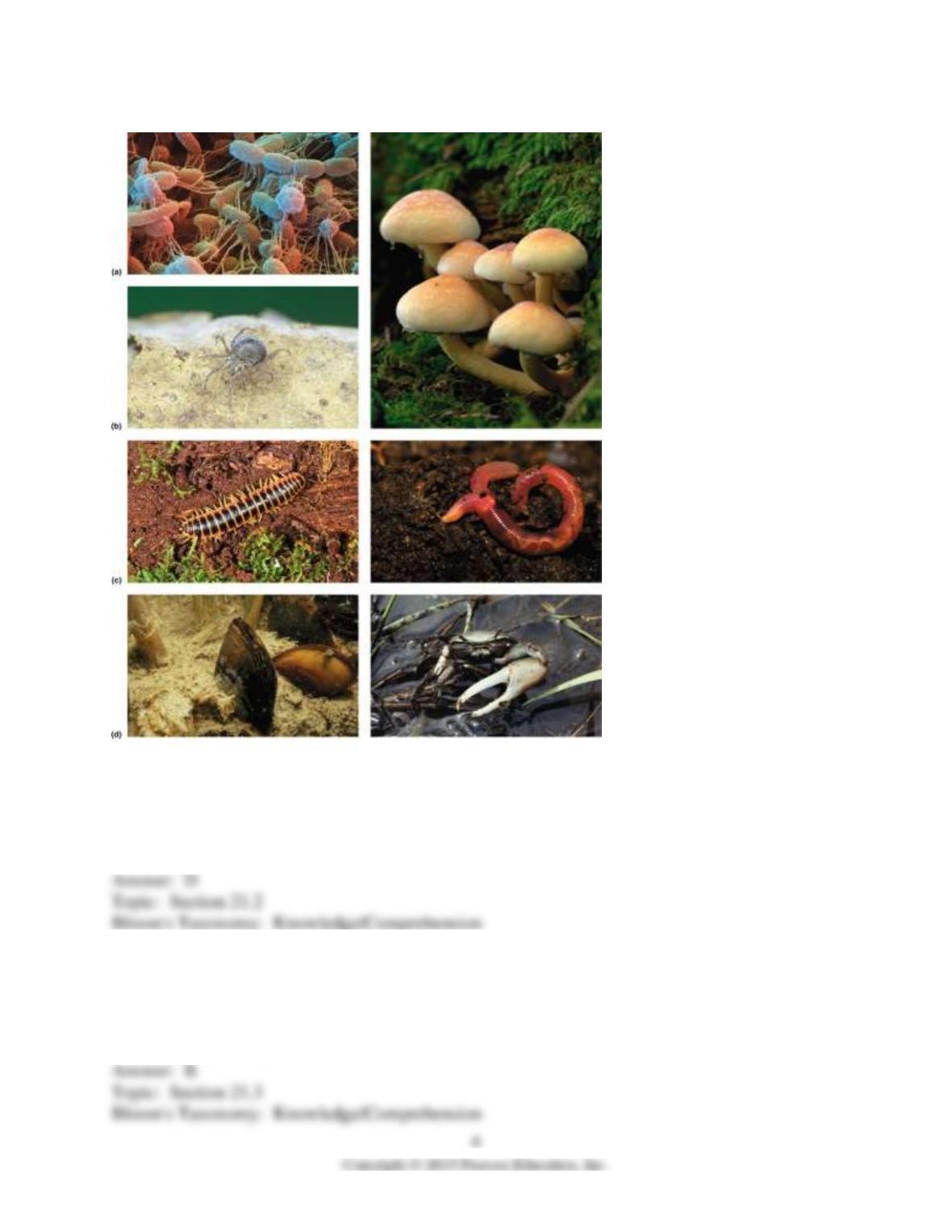
6)
Which of the following are decomposers?
A) mushrooms
B) mites
C) millipedes
D) all of the above
7) When calculating leaf litter decomposition, what must be taken into account?
A) carbon uptake by leaf
B) mass added by decomposers like fungi
C) waste from earthworms
D) water reuptake by the tree
8) As decomposition proceeds, which molecule is lost to the atmosphere?
A) H2O
B) CH4
C) CO2
D) NH3
9) Which of the following breaks down the slowest during decomposition?
A) simple sugars
B) cellulose
C) chitin
D) lignin
10) Given that mass loss is expressed as a negative exponential function (original mass
remaining = e–kt), how much mass would be left after 20 weeks given a decomposition
coefficient k = 0.0167 in units of proportion mass loss per week?
A) 0.203
B) 0.716
C) 0.916
D) 1.390
11) Which of the following variables is the coefficient that estimates decomposition rate?
A) e
B) k
C) t
D) d
12) The rate of decomposition is greatest in
A) cold and moist environments.
B) cold and dry environments.
C) warm and moist environments.
D) warm and dry environments.
13) Which of the following is the slowest to decompose?
A) proteins
B) sugars
C) lignins
D) cellulose
14) The uptake of minerals by decomposers is referred to as
A) mineralization.
B) immobilization.
C) net mineralization rate.
D) decomposition.
15) The process of conversion of nutrients from an organic form into an inorganic form that
plants can use is called
A) immobilization.
B) respiration.
C) transpiration.
D) mineralization.
16) In general, litter with a C/N ratio greater than 30 leads to immobilization, litter with a C/N
ratio less than 20 leads to mineralization, and litter with a C/N ratio of 20-30 leads to a balance
of immobilization and mineralization resulting in no net N production. If garlic mustard leaf
litter collected on the forest floor had 43.2 percent C and 1.16 percent N, this tissue would lead
to
A) immobilization.
B) mineralization.
C) a balance of immobilization and mineralization.
D) preferential consumption.
17) The C/N ratio of litter is important because litter with a
A) high C/N ratio does not contain enough nitrogen for decomposers, resulting in
immobilization.
B) low C/N ratio does not contain enough nitrogen for decomposers, resulting in immobilization.
C) high C/N ratio cannot be utilized by most organisms without extra carbon available.
D) low C/N ratio cannot be utilized by most organisms without extra carbon available.
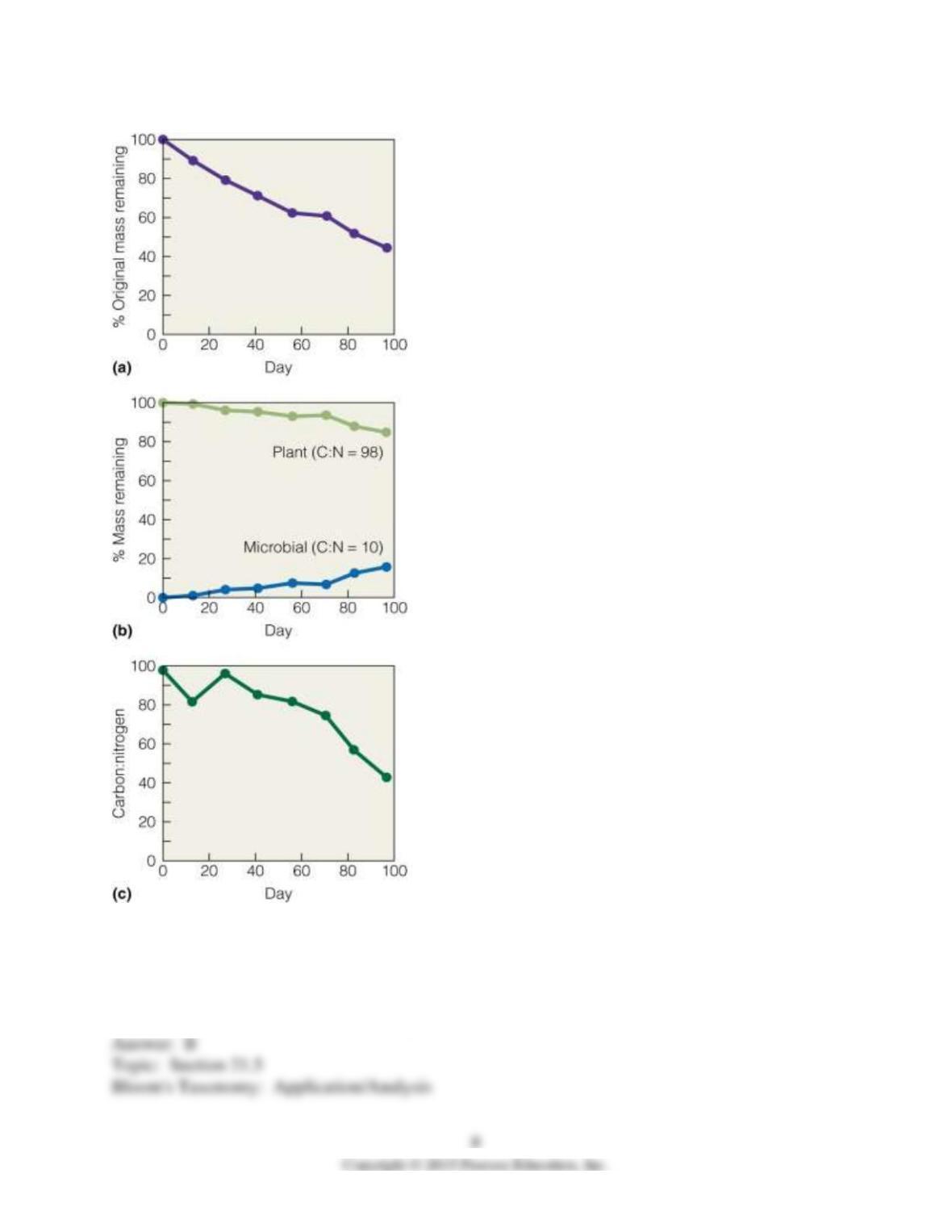
18)
Why does the C/N ratio decline over time?
A) Mass increases over time.
B) Mass is converted into microbes over time.
C) Mass is converted into plants over time.
D) More carbon is introduced into the system.
19) How can minerals captured via immobilization be released back into the soil?
A) via microbivores
B) via fungal absorption of minerals
C) via herbivores
D) via plant reuptake
20) The microbial loop results from
A) fungal attack on litter and subsequent consumption by microbivores.
B) leaching of litter that stimulates detritivores.
C) enhanced decomposition of labile litter materials enhancing food web turnover.
D) exudate release in the rhizosphere stimulating decomposition and nutrient release.
21) Aquatic arthropods that fragment organic particles and also eat bacteria and fungi on the
surface of the litter are called
A) shredders.
B) filtering collectors.
C) gathering collectors.
D) grazers.
22) Which of the following is true regarding POM?
A) It is dissolved organic matter.
B) It consists of living microorganisms.
C) It is heavier than DOM.
D) It exists only in lakes.
23) Why do areas with high NPP typically have a high rate of nutrient cycling?
A) High amounts of productivity increase the number of decomposers.
B) High amounts of productivity increase water production.
C) High amounts of productivity cause low net mineralization rates.
D) High amounts of productivity use low amounts of nutrients.
24) The rate of nutrient cycling in an ecosystem
A) depends only on the rate of photosynthesis.
B) depends only on the rate of decomposition.
C) does not depend on the rate of photosynthesis or the rate of decomposition.
D) depends on both the rate of photosynthesis and the rate of decomposition.
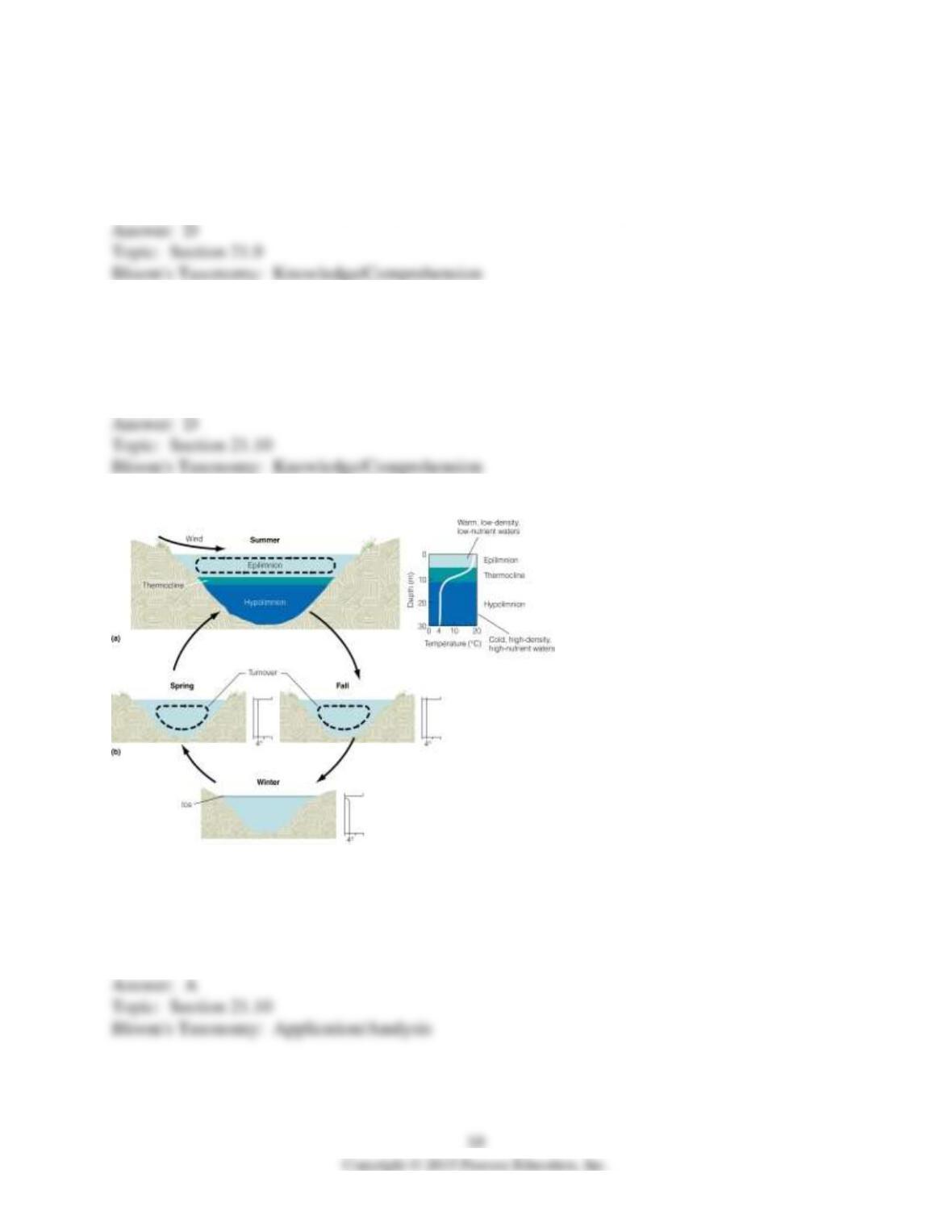
25) In open-water ecosystems, decomposition occurs primarily in the
A) thermocline.
B) hypolimnion.
C) epilimnion.
D) benthic zone.
26)
In which season does lake stratification occur?
A) summer
B) spring
C) fall
D) winter
27) Which of the following is a zone of decomposition?
A) forest canopy
B) photic zone
C) forest floor
D) kelp forest
28) Which of the following processes act to “tighten” the nutrient spiraling in streams?
A) faster flow
B) shredder invertebrates
C) collector invertebrates
D) higher stream gradient
29) In which of the following is the process of nutrient cycling sometimes described as nutrient
spiraling?
A) streams and rivers
B) oceans
C) lakes
D) forests
30) Coastal zones of contact between freshwater from streams and rivers and saltwater from the
ocean are called
A) estuaries.
B) headwaters.
C) deltas.
D) coastal upwelling zones.
31) In an estuary, the zone of maximum vertical difference in density of water layers is called the
A) thermocline.
B) pycnocline.
C) mixing zone.
D) hypolimnion.
32) The salt marsh system is dominated by
A) carnivores.
B) herbivores.
C) secondary consumers.
D) decomposers.
33) In oceans, how does the vertical movement of cold water affect surface organisms?
A) by bringing nutrient-rich water to the surface
B) by bringing oxygen-rich water to the surface
C) by bringing waste down to the sea floor
D) by increasing productivity via warmer temperatures
34) What is the Haber-Bosch process?
A) a farming technique
B) process for creating fertilizers
C) process for organic farming
D) use of burning in agriculture
35) What is swidden agriculture?
A) immediate replanting of crops following harvest
B) clearing and burning a site to be replanted later
C) the use of chemical fertilizers to increase yields
D) the use of organic fertilizers to increase yields
21.3 True/False Questions
1) Most of the nutrients in the leaves of a deciduous plant are lost from the plant when the leaves
senesce and drop to the ground.
2) All heterotrophs to some degree function as decomposers.
3) Bacteria, fungi, and animals are all important in decomposition.
4) The physical fragmentation of organic matter into smaller pieces is achieved primarily by
invertebrate detritivores.
5) Decomposers are primarily autotrophs.
6) Litterbags can be used to estimate the rate of decomposition.
7) The rate of decomposition is faster for proteins, simple sugars, cellulose, and hemicellulose
than it is for lignin.
8) Decomposition proceeds faster in moist environments than in dry environments.
9) During the process of decomposition, carbon quality typically declines.
10) A C/N ratio of 134:1 will usually lead to immobilization.
11) Bacteria and fungi have higher C/N ratios than most of the plant litter they consume.
12) Soil organic matter contains recalcitrant compounds that are of low quality and contain little
energy for decomposers.
13) Aerobic decomposition occurs at a faster rate than anaerobic decomposition.
14) The rate of nutrient cycling in an ecosystem is a function of physical characteristics of the
ecosystem, not biological processes such as photosynthesis and decomposition.
15) In open-water systems such as lakes and oceans, decomposition occurs mostly in the surface
layer.
16) In open-water ecosystems, turnover prevents the movement of nutrients between the bottom
and surface layers.
17) In salt marshes, only a small portion of primary production is consumed by herbivores.
18) Estuaries receive nutrients both from tides and from streams and rivers.
19) The region of the open ocean where the north and south equatorial currents meet is deficient
in nutrients and supports little life.
21.4 Essay Questions
1) Describe the movement of an atom of nitrogen from the leaf of a plant, through the process of
decomposition, and back into the root of another plant.
2) Describe three processes that are important for decomposition. Explain which organisms are
important for each of the processes.
3) Describe how you might go about measuring the rate of decomposition of leaf litter in the
upper layer of a forest soil.
4) Explain how the “quality” of plant-derived organic matter changes during the course of
decomposition.
5) Define mineralization and immobilization, and discuss the differences between them.
6) Define the term rhizosphere, and explain the importance of roots, decomposers, and microbial
grazers in the soil microbial loop.
7) Describe two major differences between decomposition in terrestrial environments and
decomposition in aquatic environments.
8) Describe one major difference between nutrient cycling in a river and nutrient cycling in a
lake.