The Theory of Consumer Choice 5223
10. Refer to Figure 21-18. Bundle C represents a point where
a. MRSxy > Py/Px.
b. MRSxy = Px/Py.
c. MRSxy < Px/Py.
d. MRSxy > Px/Py.
11. Refer to Figure 21-18. Bundle D represents a point where
a. MRSxy > Py/Px.
b. MRSxy = Px/Py.
c. MRSxy < Px/Py.
d. MRSxy < Py/Px.
5224 The Theory of Consumer Choice
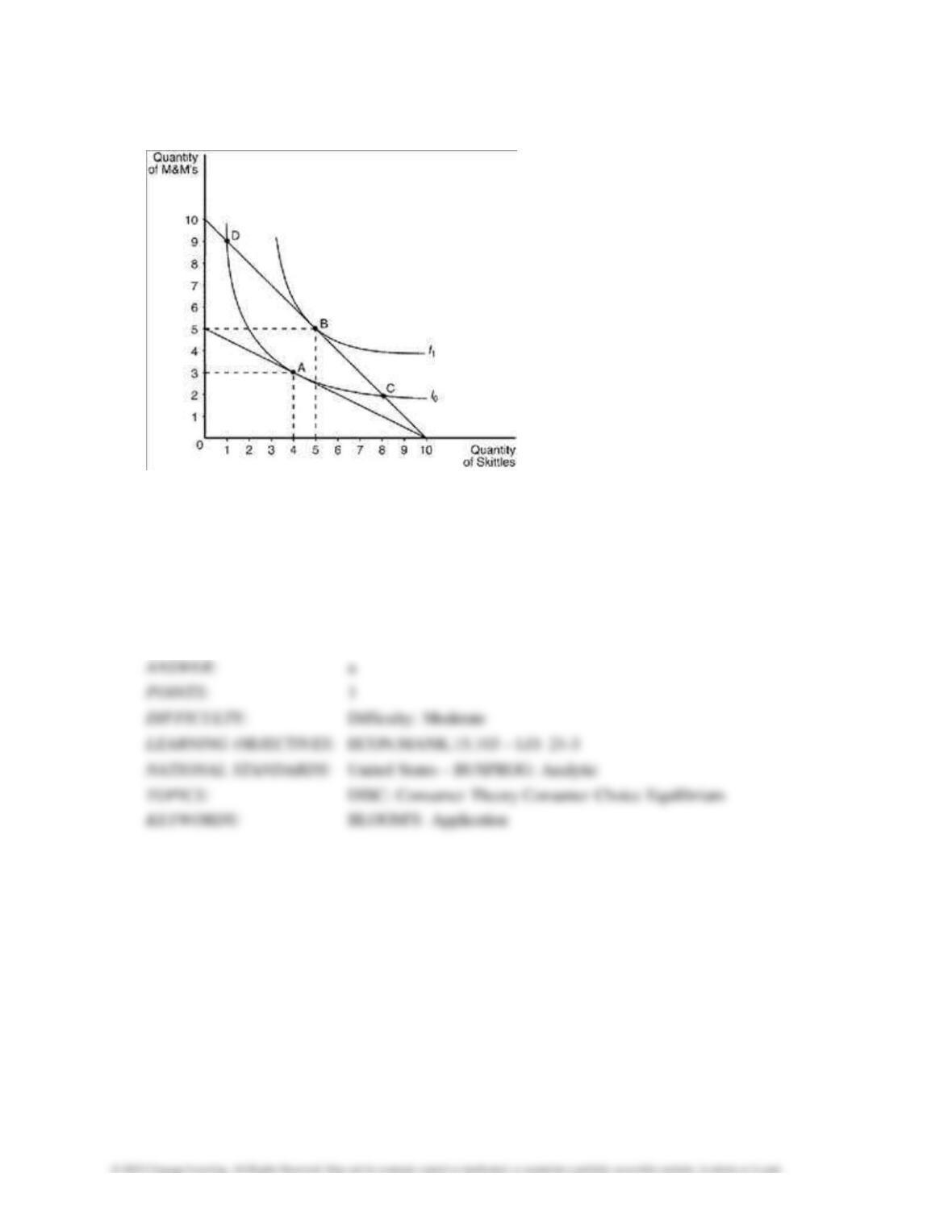
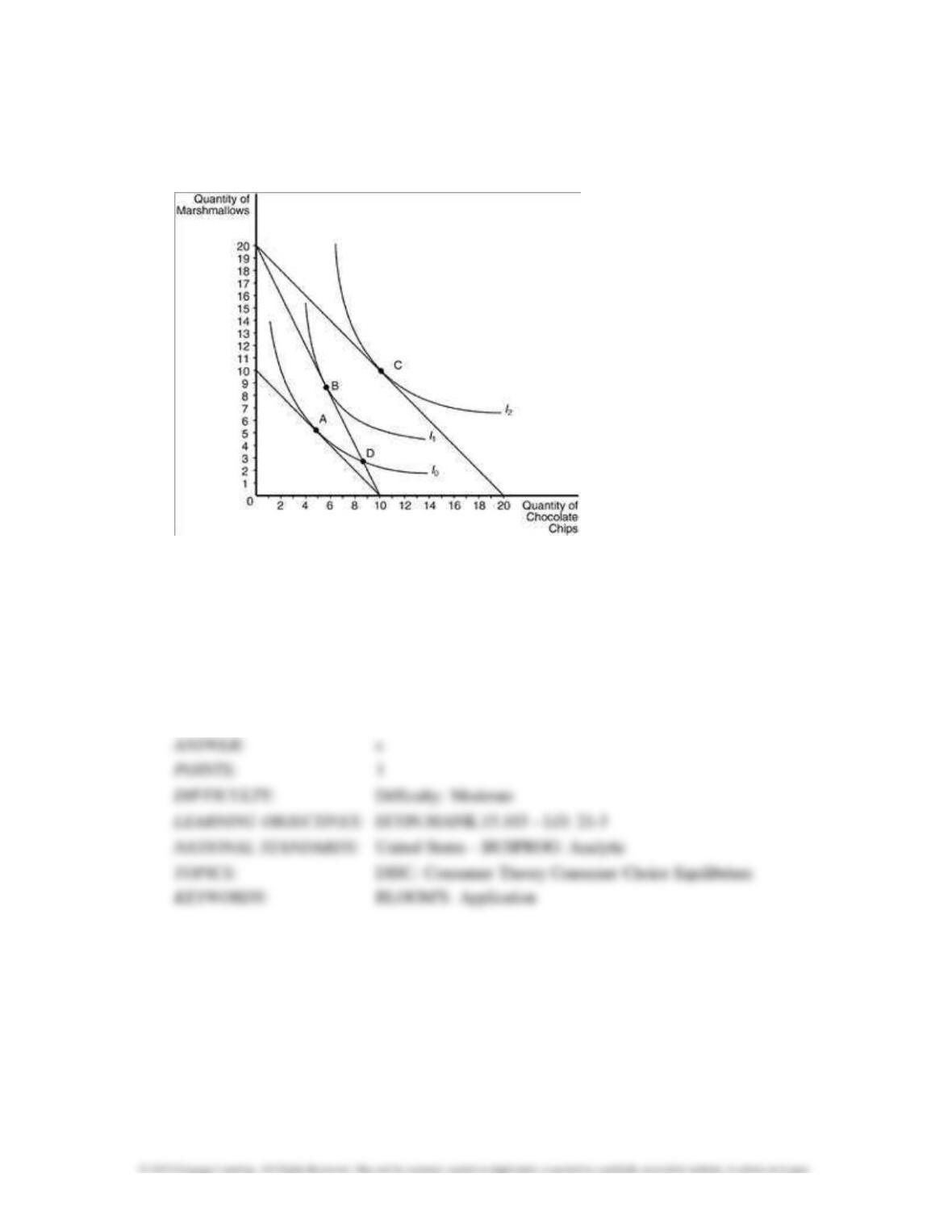
Figure 21–19
12. Refer to Figure 21–19. Assume that the consumer depicted in the figure has an income of $20.
The price of Skittles is $2 and the price of M&M’s is $4. The consumer’s optimal choice is point
a. A.
b. B.
c. C.
d. D.
The Theory of Consumer Choice 5225
13. Refer to Figure 21–19. Assume that the consumer depicted in the figure has an income of $20.
The price of Skittles is $2 and the price of M&M’s is $2. The consumer’s optimal choice is point
a. A.
b. B.
c. C.
d. D.
14. Refer to Figure 21-19. Assume that the consumer depicted in the figure faces prices and
income such that she optimizes at point B. According to the graph, which of the following would
cause the consumer to move to point A?
a. a decrease in the price of Skittles
b. a decrease in the price of M&M’s
c. an increase in the price of Skittles
d. an increase in the price of M&M’s
5226 The Theory of Consumer Choice
15. Refer to Figure 21–19. Assume that the consumer depicted in the figure has an income of $20.
The price of Skittles is $2 and the price of M&M‘s is $4. The consumer will choose a
consumption bundle where the marginal rate of substitution is
a. 2.
b. 2/3.
c. 1/2.
d. 1/3.
16. Refer to Figure 21–19. Assume that the consumer depicted in the figure has an income of $50.
The price of Skittles is $5 and the price of M&M‘s is $5. This consumer will choose a
consumption bundle where the marginal rate of substitution is
a. 10.
b. 5.
c. 1.
d. 1/5.
The Theory of Consumer Choice 5227
Figure 21–20
The following graph illustrates a representative consumer’s preferences for marshmallows and
chocolate chip cookies:
17. Refer to Figure 21-20. Assume that the consumer has an income of $40, the price of a bag of
marshmallows is $2, and the price of a bag of chocolate chips is $2. The optimizing consumer will
choose to purchase which bundle of marshmallows and chocolate chips?
a. A
b. B
c. C
d. D
5228 The Theory of Consumer Choice
18. Refer to Figure 21-20. Assume that the consumer has an income of $100 and currently
optimizes at bundle A. When the price of marshmallows decreases to $5, which bundle will the
optimizing consumer choose?
a. A
b. B
c. C
d. D
19. Refer to Figure 21-20. Assume that the consumer has an income of $40. If the price of
chocolate chips is $4 and the price of marshmallows is $4, the optimizing consumer would choose
to purchase
a. 9 marshmallows and 6 chocolate chips.
b. 10 marshmallows and 10 chocolate chips.
c. 5 marshmallows and 5 chocolate chips.
d. 3 marshmallows and 9 chocolate chips.
The Theory of Consumer Choice 5229
20. Refer to Figure 21-20. Assume that the consumer has an income of $80. If the price of
chocolate chips is $4 and the price of marshmallows is $4, the optimizing consumer would choose
to purchase
a. 9 marshmallows and 6 chocolate chips.
b. 10 marshmallows and 10 chocolate chips.
c. 5 marshmallows and 5 chocolate chips.
d. 3 marshmallows and 9 chocolate chips.
21. Refer to Figure 21–20. Assume that the consumer has an income of $40. Based on the
information available in the graph, which of the following price-quantity combinations would be
on her demand curve for marshmallows if the price of chocolate chips were $4?
a. P=$2, Q=3
b. P=$2, Q=9
c. P=$4, Q=3
d. P=$4, Q=9
5230 The Theory of Consumer Choice
22. Refer to Figure 21-20. Assume that the consumer depicted the figure has an income of $50.
Based on the information available in the graph, which of the following price-quantity combinations
would be on her demand curve for chocolate chips if the price of marshmallows is $2.50?
a. P=$2.50, Q=6
b. P=$2.50, Q=10
c. P=$5.00, Q=3
d. P=$5.00, Q=5
23. The goal of the consumer is to
a. maximize utility.
b. be on the highest indifference curve.
c. maximize satisfaction.
d. All of the above are the goals of the consumer.
The Theory of Consumer Choice 5231
24. The goal of the consumer is to
a. maximize utility.
b. minimize expenses.
c. spend more income in the current time period than in the future.
d. All of the above are the goals of the consumer.
25. When a consumer is purchasing the best combination of two goods, X and Y, subject to a budget
constraint, we say that the consumer is at an optimal choice point. A graph of an optimal choice
point shows that it occurs
a. along the highest attainable indifference curve.
b. where the indifference curve is tangent to the budget constraint.
c. where the marginal utility per dollar spent is the same for both X and Y.
d. All of the above are correct.
5232 The Theory of Consumer Choice
26. When a consumer is purchasing the best combination of two goods, X and Y, subject to a budget
constraint, we say that the consumer is at an optimal choice point. A graph of an optimal choice
point shows that it occurs
a. along the highest indifference curve.
b. along the lowest budget constraint.
c. where the indifference curve is tangent to the budget constraint.
d. All of the above are correct.
27. A consumer chooses an optimal consumption point where the
a. marginal rate of substitution equals the relative price ratio.
b. slope of the indifference curve equals the slope of the budget constraint.
c. ratio of the marginal utilities equals the ratio of the prices.
d. All of the above are correct.
The Theory of Consumer Choice 5233
28. A consumer chooses an optimal consumption point where the
a. marginal rate of substitution equals the relative price ratio.
b. slope of the indifference curve exceeds the slope of the budget constraint.
c. ratios of all the marginal utilities are equal.
d. All of the above are correct.
29. A consumer chooses an optimal consumption point where the
a. marginal rate of substitution exceeds the relative price ratio.
b. slope of the indifference curve equals the slope of the budget constraint.
c. ratio of the prices equals one.
d. All of the above are correct.
5234 The Theory of Consumer Choice
30. A consumer chooses an optimal consumption point where the
a. marginal rate of substitution is maximized.
b. slope of the indifference curve exceeds the slope of the budget constraint by the greatest
amount.
c. ratio of the marginal utilities equals the ratio of the prices.
d. All of the above are correct.
31. Preston goes to the movies every Sunday afternoon. The movie theater offers 4 combinations of
popcorn and beverages: the “minicombo” costs $5 and includes a small popcorn and a small
drink, the “mediumcombo” costs $7 and includes a medium popcorn and a medium drink, the
“valuecombo” also costs $7 and includes a small popcorn and a large drink, and the
“largecombo” costs $9 and includes a large popcorn and a large drink. Preston always purchases
the “valuecombo.” We can conclude that
a. Preston cannot afford the “largecombo.”
b. Preston cannot afford the “mediumcombo.”
c. Preston prefers a combo with a larger popcorn–to-beverage ratio.
d. Preston prefers a combo with a smaller popcorn-to–beverage ratio.
The Theory of Consumer Choice 5235
32. Which of the following equations corresponds to an optimal choice point?
(i) MRS = PX/PY
(ii) MUX/MUY = PX/PY
(iii) MUX/PX = MUY/PY
(iv) MUX/PY = MUY/PX
a. (i) only
b. (i), (ii), and (iii) only
c. (ii) and (iv) only
d. (i), (ii), (iii), and (iv)
33. Bundle J contains 10 units of good X and 5 units of good Y. Bundle K contains 5 units of good X
and 10 units of good Y. Bundle L contains 10 units of good X and 10 units of good Y. Assume
that the consumer’s preferences satisfy the four properties of indifference curves. The price of X
is $1, the price of Y is $2, and the consumer has an income of $20. Which bundle will the
consumer choose?
a. bundle J
b. bundle K
c. bundle L
d. either bundle J or bundle K
5236 The Theory of Consumer Choice
34. A consumer chooses an optimal consumption point where the
a. marginal rate of substitution is maximized.
b. rate at which the consumer is willing to trade one good for another equals the price ratio.
c. price ratio is minimized.
d. All of the above are correct.
35. When considering her budget, the highest indifference curve that a consumer can reach is the
a. one that is tangent to the budget constraint.
b. indifference curve farthest from the origin
c. indifference curve that intersects the budget constraint in at least two places.
d. None of the above is correct.
36. The relationship between the marginal utility that Casey gets from eating ice cream sundaes and
the number of ice cream cones he eats per week is as follows:
Ice Cream Sundaes
1
2
3
4
5
6
Marginal Utility
20
16
12
8
4
0
Casey receives 3 units of utility from the last dollar spent on each of the other goods he
consumes. If ice cream sundaes cost $4 each, how many ice cream sundaes will he consume per
month if he maximizes utility?
a. 2
b. 3
c. 4
d. 5
The Theory of Consumer Choice 5237
37. Jerry consumes two goods, hamburgers and ice cream sandwiches. He has maximized his utility
given his income. Ice cream sandwiches costs $2, and he consumes them to the point where the
marginal utility he receives is 6. Hamburgers cost $4, and the relationship between the marginal
utility that Jerry gets from eating hamburgers and the number he eats per month is as follows:
Hamburgers
1
2
3
4
5
6
Marginal Utility
20
16
12
8
4
0
How many hamburgers does Jerry buy each month?
a. 1
b. 2
c. 3
d. 4
38. An optimizing consumer will select a consumption bundle in which
a. income is maximized, and prices are minimized.
b. utility is maximized, and prices are minimized.
c. utility is maximized, subject to budget constraints.
d. utility is maximized, and indifference curves are linear.
5238 The Theory of Consumer Choice
39. If the consumer‘s income and all prices simultaneously double, then the optimum consumption
bundle will
a. shift outward relative to the original optimum.
b. move leftward along the original budget constraint.
c. not change.
d. shift inward relative to the original optimum.
40. If the consumer’s income and all prices simultaneously decrease by one-half, then the optimum
consumption will
a. shift outward relative to the original optimum.
b. move leftward along the original budget constraint.
c. shift inward relative to the original optimum.
d. not change.
The Theory of Consumer Choice 5239
41. The consumer’s optimum choice is represented by
a. MUx/MUy = Px/Py.
b. MUx/Px = MUy/Py.
c. MRSxy = Px/Py.
d. All of the above are correct.
42. An optimizing consumer will select the consumption bundle in which the
a. ratio of total utilities is equal to the relative price ratio.
b. ratio of income to price equals the marginal rate of substitution.
c. marginal rate of substitution is equal to the relative price ratio of the goods.
d. marginal rate of substitution is equal to marginal utility.
43. An optimizing consumer will select the consumption bundle in which the marginal rate of
substitution
a. is equal to the relative price ratio of the goods.
b. exceeds the marginal utility of each good by the greatest amount.
c. is less than the slope of the budget constraint.
d. All of the above are correct.
5240 The Theory of Consumer Choice
44. An optimizing consumer will select the consumption bundle in which the marginal rate of
substitution
a. is equal to the price of the least-expensive good.
b. exceeds the marginal utility of each good by the greatest amount.
c. is less than the slope of the budget constraint.
d. None of the above is correct.
45. When the indifference curve is tangent to the budget constraint,
a. a consumer cannot be made better off without an increase in her income or a price decrease in
one of the goods she consumes.
b. the consumer is likely to be at a sub-optimal level of consumption.
c. income is at its optimum for a consumer.
d. indifference curves are likely to intersect.
46. At the consumer’s optimum
a. the budget constraint will have a slope of MUx/Px.
b. it is still possible for the consumer to increase his consumption of both goods.
c. the indifference curve will intersect the budget constraint at the midpoint of the budget
constraint.
d. the slope of the indifference curve is equal to the slope of the budget constraint.
The Theory of Consumer Choice 5241
47. At the consumer‘s optimum the
a. budget constraint will have a slope of MUx/Px.
b. slope of the indifference curve is equal to the slope of the budget constraint.
c. indifference curve will intersect the budget constraint at the midpoint of the budget constraint.
d. Both b and c are correct.
48. The consumer’s optimum is where
a. MUx/MUy = Py/Px.
b. MUx/Py = MUy/Px.
c. MUx/MUy = Px/Py.
d. None of the above is correct.
5242 The Theory of Consumer Choice
49. Which of the following represents a consumer’s optimum?
a. MUx/MUy = Py/Px
b. MUx/Py = MUy/Px
c. MUx/Px = MUy/Py
d. MUy/MUx = Px/Py
50. A consumer has preferences over two goods, X and Y. Suppose we graph this consumer’s
preferences (which satisfy the usual properties of indifference curves) and budget constraint on a
diagram with X on the horizontal axis and Y on the vertical axis. At the consumer’s current
consumption bundle, the consumer is spending all available income, and the marginal rate of
substitution is greater than the slope of the budget constraint. We can conclude that the consumer
a. is currently maximizing satisfaction subject to the budget constraint.
b. could increase satisfaction by consuming more X and less Y.
c. could increase satisfaction by consuming less X and more Y.
d. could purchase more X and more Y and increase total satisfaction.