Cost Accounting: A Managerial Emphasis, 6e
Chapter 21 – Capital Budgeting: Methods of Investment Analysis
22) In NPV analysis, if the IRR exceeds the RRR,
A) the project should be rejected.
B) the NPV will be negative (when discounted at the IRR).
C) the NPV is positive when project cash flows are discounted at the IRR.
D) the NPV is positive when project cash flows are discounted at the RRR.
E) the NPV is negative when project cash flows are discounted at the RRR.
23) In situations where the required rate of return is not constant for each year of the project, it is
advantageous to use
A) the adjusted rate of return method.
B) the internal rate of return method.
C) the net present value method.
D) sensitivity analysis.
E) the payback method.
24) The net present value method is better than the internal rate of return because
A) managers generally find the NPV method easier to understand.
B) it always yields the same result as IRR.
C) IRR focuses more on accounting income.
D) it considers the source of cash flows.
E) the NPV’s of different projects can be added together, and investments may have multiple required
rates of return.
25) A “what-if” technique that examines how a result will change if the original predicted data are not
achieved, or if an underlying assumption changes, is called
A) sensitivity analysis.
B) net present value analysis.
C) internal rate of return analysis.
D) adjusted rate of return analysis.
E) payback method.
Cost Accounting: A Managerial Emphasis, 6e
Chapter 21 – Capital Budgeting: Methods of Investment Analysis
26) The method that measures the time it will take to recoup, in the form of cash inflows, the total dollars
invested in a project is called
A) the accrued accounting rate of return method.
B) payback.
C) internal rate of return method.
D) the book-value method.
E) the NPV.
27) The net initial investment for a new mainframe computer is $2,000,000. Annual cash flows are
expected to increase by $800,000 per year. The equipment has a 10-year useful life.
What is the payback period?
A) 4.00 years
B) 2.50 years
C) 2.00 years
D) 1.75 years
E) 0.75 years
28) Problems encountered when the payback method is used may include
A) it is only useful when future cash flows are certain.
B) it promotes long-term projects.
C) it neglects the time value of money.
D) it emphasizes short-term projects.
E) it is easy to use.
29) Which of the following is FALSE concerning the Payback method of capital budgeting?
A) It uses the accrual accounting rate of return.
B) The payback method highlights liquidity.
C) Its major strength is that it that it is easy to use.
D) It does not project cash flows after the recovery of the initial investment.
E) Shorter payback periods give an organization more flexibility.
Cost Accounting: A Managerial Emphasis, 6e
Chapter 21 – Capital Budgeting: Methods of Investment Analysis
30) A company is considering two different purchases from a vendor, for a high-speed photocopier. The
regular model costs $4,500 and the deluxe model costs $6,100. The company has projected cash savings of
$800 for the first year, and then $850 annually thereafter for the regular model, but the vendor is claiming
that the deluxe model is $400 cheaper per year to operate than the regular model. What are the payback
periods for the Regular and Deluxe models, respectively?
A) 4.88 years; 5.63 years
B) 5.08 years; 5.29 years
C) 5.29 years; 4.88 years
D) 5.29 years; 5.63 years
E) 5.35 years; 4.92 years
31) An accounting measure of income divided by an accounting measure of investment is called
A) accrual accounting rate of return.
B) bailout payback.
C) book-value method.
D) rate of return on assets method.
E) net previous value.
32) A rental company replaces its heavy drilling machine every four years (no salvage value). It is
contemplating acquiring a larger machine, at a cost of $70,000, which is guaranteed to last for seven years.
The current machine can be traded-in for a $3,000 down payment on the new machine, and the company
expects annual savings in operating costs of $15,000.
What is the AARR for the new machine?
A) 2.86%
B) 6.85%
C) 7.14%
D) 20.55%
E) 21.43%
Cost Accounting: A Managerial Emphasis, 6e
Chapter 21 – Capital Budgeting: Methods of Investment Analysis
33) Return on investment (ROI) is also known as
A) internal rate of return.
B) accrual accounting rate of return.
C) payback.
D) net present value.
E) time-adjusted rate of return.
34) Alberta Ltd. is considering the purchase of new machinery which costs $147,800. The machine is
expected to save $42,300 in operating costs annually for the next 7 years. By how much can the annual
cost savings fall (to the nearest hundred dollars) and still provide a 16% return? Ignore income taxes.
A) $5,700
B) $36,600
C) $21,200
D) $42,300
E) $0
35) Saturn Ltd. wants to automate one of its production processes. The new equipment will cost $180,000.
In addition, Saturn will incur installation and testing costs of $5,000 and $8,500 respectively. The expected
life of the equipment is 8 years and the salvage value of the equipment is estimated at $18,000. The annual
cash savings are estimated at $32,000. The company’s required rate of return is 14%. Ignore income taxes.
What is the net present value of this investment?
A) ($25,246)
B) $80,500
C) ($11,746)
D) ($45,056)
E) ($38,746)
Cost Accounting: A Managerial Emphasis, 6e
Chapter 21 – Capital Budgeting: Methods of Investment Analysis
36) Saturn Ltd. wants to automate one of its production processes. The new equipment will cost $180,000.
In addition, Saturn will incur installation and testing costs of $5,000 and $8,500 respectively. The expected
life of the equipment is 8 years and the salvage value of the equipment is estimated at $18,000. The annual
cash savings are estimated at $32,000. The company’s required rate of return is 14%. Ignore income taxes.
What is the payback period for this investment?
A) 5.63 years
B) 5.78 years
C) 6.05 years
D) 5.26 years
E) The project does not payback.
37) Neptune Ltd. wants to expand its operations by manufacturing a new product line. New equipment
will cost $225,000. Incremental sales are estimated at $150,000 per year for 6 years. Variable costs of
producing the new product line are 52% of sales and incremental annual fixed costs are $25,000. The
equipment can be salvaged after 6 years for 16% of its original cost. The company’s required rate of return
for new projects is 18%. Ignore income taxes. What is the net present value of this investment?
A) ($26,291)
B) ($47,277)
C) $225,536
D) ($60,613)
E) $93,000
Cost Accounting: A Managerial Emphasis, 6e
Chapter 21 – Capital Budgeting: Methods of Investment Analysis
38) Neptune Ltd. wants to expand its operations by manufacturing a new product line. New equipment
will cost $225,000. Incremental sales are estimated at $150,000 per year for 6 years. Variable costs of
producing the new product line are 52% of sales and incremental annual fixed costs are $25,000. The
equipment can be salvaged after 6 years for 16% of its original cost. The company’s required rate of
return for new projects is 18%. Ignore income taxes. What is the internal rate of return of this investment?
A) 13.62%
B) 12.75%
C) 10.00%
D) 6.86%
E) 18.00%
39) The Zero Machine Company is evaluating a capital expenditure proposal that requires an initial
investment of $20,960 and has predicted cash inflows of $5,000 per year for 10 years. It will have no
salvage value.
Required:
a. Using a required rate of return of 16%, determine the net present value of the investment proposal.
b. Determine the proposal‘s internal rate of return.
Cost Accounting: A Managerial Emphasis, 6e
Chapter 21 – Capital Budgeting: Methods of Investment Analysis
40) Next Service Centre is considering purchasing a new computer network for $82,000. It will require
additional working capital of $13,000. Its anticipated eight-year life will generate additional client
revenue of $33,000 annually with operating costs, excludingdepreciation, of $15,000. At the end of eight
years, it will have a salvage value of $9,500 and return $5,000 in working capital. Taxes are not
considered.
Required:
a. If the company has a required rate of return of 14%, what is the net present value of the proposed
investment?
b. What is the internal rate of return?
Cost Accounting: A Managerial Emphasis, 6e
Chapter 21 – Capital Budgeting: Methods of Investment Analysis
41) Terrain Vehicle has received three proposals for its new vehicle painting machine. Information on
each proposal is as follows:
Proposal X Proposal Y Proposal Z
Initial investment in equipment $180,000 $120,000 $190,000
Working capital needed 0 0 10,000
Annual cash saved by operations:
Year 1 75,000 50,000 80,000
Year 2 75,000 48,000 80,000
Year 3 75,000 44,000 80,000
Year 4 75,000 8,000 80,000
Salvage value end of year:
Year 1 100,000 80,000 60,000
Year 2 80,000 60,000 50,000
Year 3 40,000 40,000 30,000
Year 4 10,000 20,000 15,000
Working capital returned 0 0 10,000
Required: Determine each proposal’s payback.
Cost Accounting: A Managerial Emphasis, 6e
Chapter 21 – Capital Budgeting: Methods of Investment Analysis
42) Fabian Company is considering the purchase of a piece of materials–handling equipment:
Net initial investment $125,000
Estimated Useful life 8 years
Estimated terminal disposal price $10,000
Estimated annual cash operating savings $35,000
Required rate of return 10%
Depreciation method: straight line
Required:
a. Calculate payback.
b. Calculate accrual accounting rate of return based on the initial investment.
43) Jensen Manufacturing is considering buying a laser machine which costs $250,000. It requires working
capital of $25,000. Annual cash savings are anticipated to be $103,000 for five years. The salvage value at
the end of five years is expected to be nil.
Required:
Compute the accrual accounting rate of return based on initial investment.
Cost Accounting: A Managerial Emphasis, 6e
Chapter 21 – Capital Budgeting: Methods of Investment Analysis
44) Fisher Ltd. is considering the purchase of new equipment. Details of the investment follow:
Net initial investment $1,025,000
Estimated Useful life 8 years
Estimated terminal disposal price $120,000
Estimated annual cash sales $520,000
Estimated annual cash operating expenses $295,000
Required rate of return 12%
Depreciation method: straight line
Required:
a. Calculate payback.
b. Calculate accrual accounting rate of return based on the initial investment.
c. Calculate the net present value.
Cost Accounting: A Managerial Emphasis, 6e
Chapter 21 – Capital Budgeting: Methods of Investment Analysis
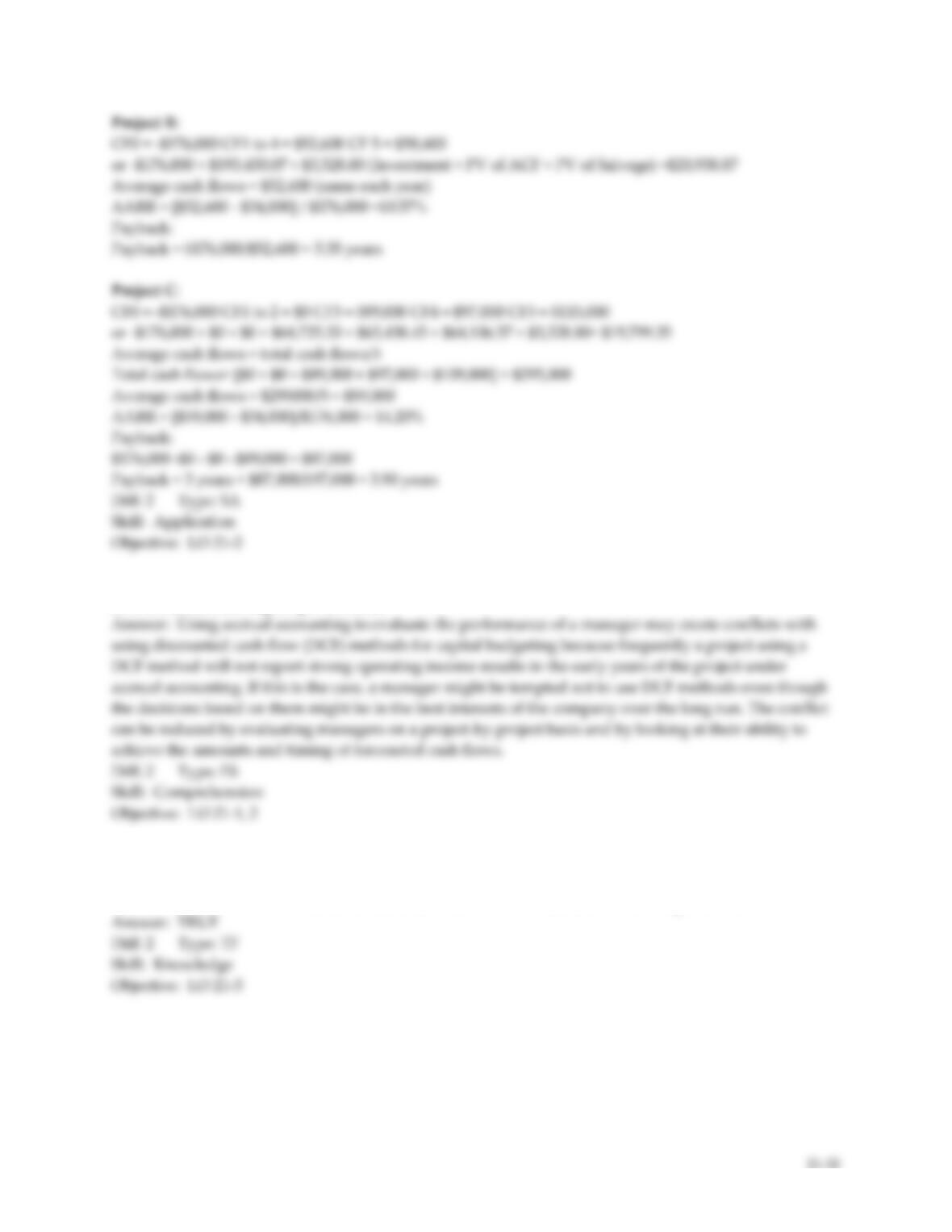
45) Hiroshima Inc. is evaluating 3 investment alternatives. Each alternative requires a cash outflow of
$176,000 and is to be depreciated on a straight line basis ($6,000 salvage value). Ignore income taxes. Cash
flows for the various investments are summarized below:
Project A
Project B
Project C
Year 1
$87,000
$52,600
$0
Year 2
$78,000
$52,600
$0
Year 3
$65,000
$52,600
$89,000
Year 4
$4,000
$52,600
$97,000
Year 5
$2,000
$52,600
$109,000
The company has a required rate of return of 11.2%
Required:
a. Evaluate and rank each alternative based on NPV
b. Calculate and rank each alternative based on IRR.
c. Evaluate and rank each alternative based on Accrual Accounting Return using average annualcash
flows.
d. Evaluate each project based on payback period.
e. Which project do you recommend and why? Address the issue of risk in your response.
Project A
Project B
Project C
NPV
$19,908.99
$20,958.87
$19,799.36
IRR
flows
$47,200
$52,600
Depreciation
$34,000
$34,000
$34,000
Investment
$176,000
$176,000
$176,000
AARR
7.5%
Payback
2.17 years
3.35 years
3.90 years
Cost Accounting: A Managerial Emphasis, 6e
Chapter 21 – Capital Budgeting: Methods of Investment Analysis
46) What conflicts can arise between using discounted cash flow methods for capital budgeting decisions
and accrual accounting for performance
21.3 Apply the concept of relevance to DCF methods of capital budgeting.
1) Initial machine investment costs include cash outflows for installation and transportation.
Cost Accounting: A Managerial Emphasis, 6e
Chapter 21 – Capital Budgeting: Methods of Investment Analysis
2) Relevant cash flows are expected future cash flows that differ among the alternative uses of investment
funds.
3) In determining whether to keep a machine or replace it, the original cost of the machine is always a
relevant factor.
4) In determining whether to keep a machine or replace it, the net book value of the machine is irrelevant.
5) The initial investment in working capital is usually recovered
A) in year 0.
B) in year 1.
C) when the project is terminated.
D) in equal portions, with the recovery of the initial investment, based on the matching of revenues and
all costs.
E) as soon as the RRR is achieved.
6) In capital budgeting decisions, relevant cash flows
A) are actual cash flows that differ between alternatives.
B) are actual cash flows that do not differ between alternatives.
C) are expected future cash flows that differ between alternatives.
D) are expected future cash flows that do not differ between alternatives.
E) are past cash flows lost.
Cost Accounting: A Managerial Emphasis, 6e
Chapter 21 – Capital Budgeting: Methods of Investment Analysis
7) Which of the following is not a major category of cash flows in capital budgeting?
A) initial investment in machines
B) recurring operating cash flows
C) cash flows from dispositions of assets
D) management and labour allocation deductions
E) initial working capital investment
8) A project has a net initial investment of $500,000 and the cash flows cover five years. The project
involves replacing an old machine with a new machine at the same time. Which of the following is true
based on the above assumptions, in NPV analysis?
A) The book value of the old machine is relevant.
B) Recurring operating cash flows cannot be positive and negative.
C) Incremental working capital investment is irrelevant.
D) Any cash received from the disposal of the old machine would be a relevant cash flow for end of year
1.
E) Errors in forecasting the terminal disposal price of the new machine are seldom critical on long–
duration projects.
9) Depreciation charges
A) are not relevant in capital budgeting decisions, because they are not discounted.
B) are not relevant because they are not cash flows.
C) are considered an element of cash flows, and are thus relevant.
D) affect the ending balance of operating income, and are thus relevant.
E) are relevant because they relate to capital items.
10) The terminal disposal price of a replacement machine
A) generally increases cash inflow in the year of disposal.
B) is the total of the salvage values of the old machine and the new machine.
C) is the salvage value of the old machine.
D) is the NPV value of the new machine salvage value.
E) is the NPV of the salvage value of the old machine.
Cost Accounting: A Managerial Emphasis, 6e
Chapter 21 – Capital Budgeting: Methods of Investment Analysis
11) A company is considering purchasing a new machine, at a cost of $50,000. This amount will be written
off over 5 years at $10,000 per year. The company will have to increase its accounts receivable by $4,000 in
the first year. The disposal value of the machine being replaced is $1,500.
What is the initial working capital investment required?
A) $54,000
B) $52,500
C) $36,000
D) $4,000
E) $2,500
12) Which of the following is true concerning capital budgeting analysis?
A) The IRR and AARR consider the time value of money.
B) The Payback method and the AARR both consider profitability.
C) NPV and IRR consider accruals.
D) The Payback method and the AARR both consider profitability, and NPV and IRR do not consider
accruals.
E) NPV and IRR do not consider accruals, and the IRR considers the time value, but AARR does not.
13) A company is considering purchasing new equipment. The equipment will allow the company to
expand into a new product line. The equipment will be installed in the company’s existing facility. Which
of the following cash flows would NOT be relevant to the decision to acquire the new equipment?
A) factory rent allocated to the new product line
B) labour costs to operate the equipment
C) revenues from expanded production
D) annual maintenance cost on the new equipment
E) the salary of the manager hired to oversee the new product line
Cost Accounting: A Managerial Emphasis, 6e
Chapter 21 – Capital Budgeting: Methods of Investment Analysis
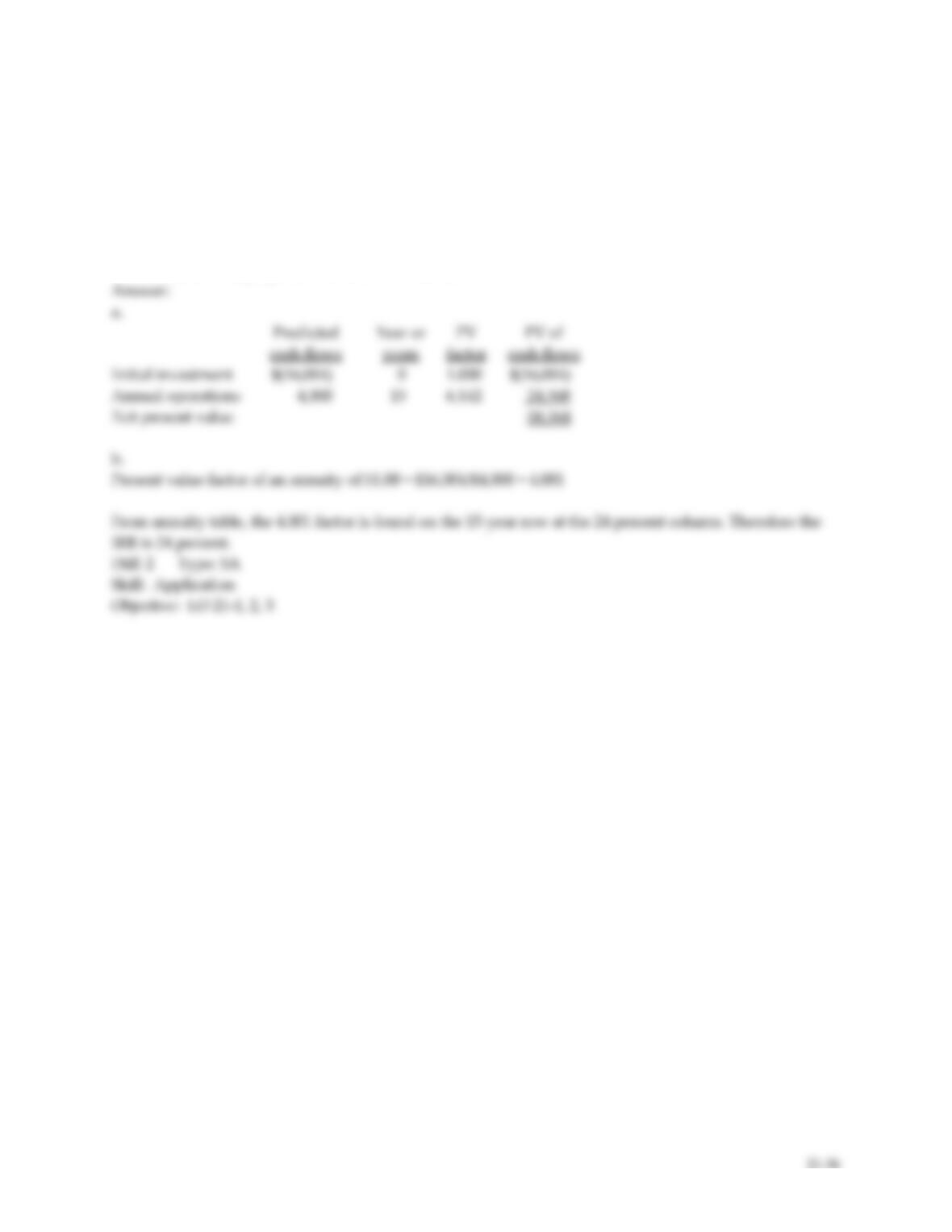
14) Toys and Junk Company is evaluating a capital expenditure proposal that requires an initial
investment of $16,004 and has predicted cash inflows of $4,000 per year for 15 years. It will have no
salvage value.
Required:
a. Using a required rate of return rate of 14 percent, determine the net present value of the investment
proposal.
b. Determine the proposal‘s internal rate of return.