141. Figure 11-7.
Larry Miller, controller for Kipling Company, has been instructed to develop a flexible budget for overhead
costs. The company produces two types of frozen desserts: Icey and Tasty. The two desserts use common raw
materials in different proportions. The company expects to produce 200,000 gallons of each product during the
coming year. Icey requires 0.25 direct labor hour per gallon and Tasty requires 0.30. Larry has developed the
following fixed and variable costs for each of the four overhead items:
Overhead Item
Fixed Cost
Variable Rate per DLH
Maintenance
$52,000
$1.20
Power
1.50
Indirect labor
79,500
4.80
Rent
54,000
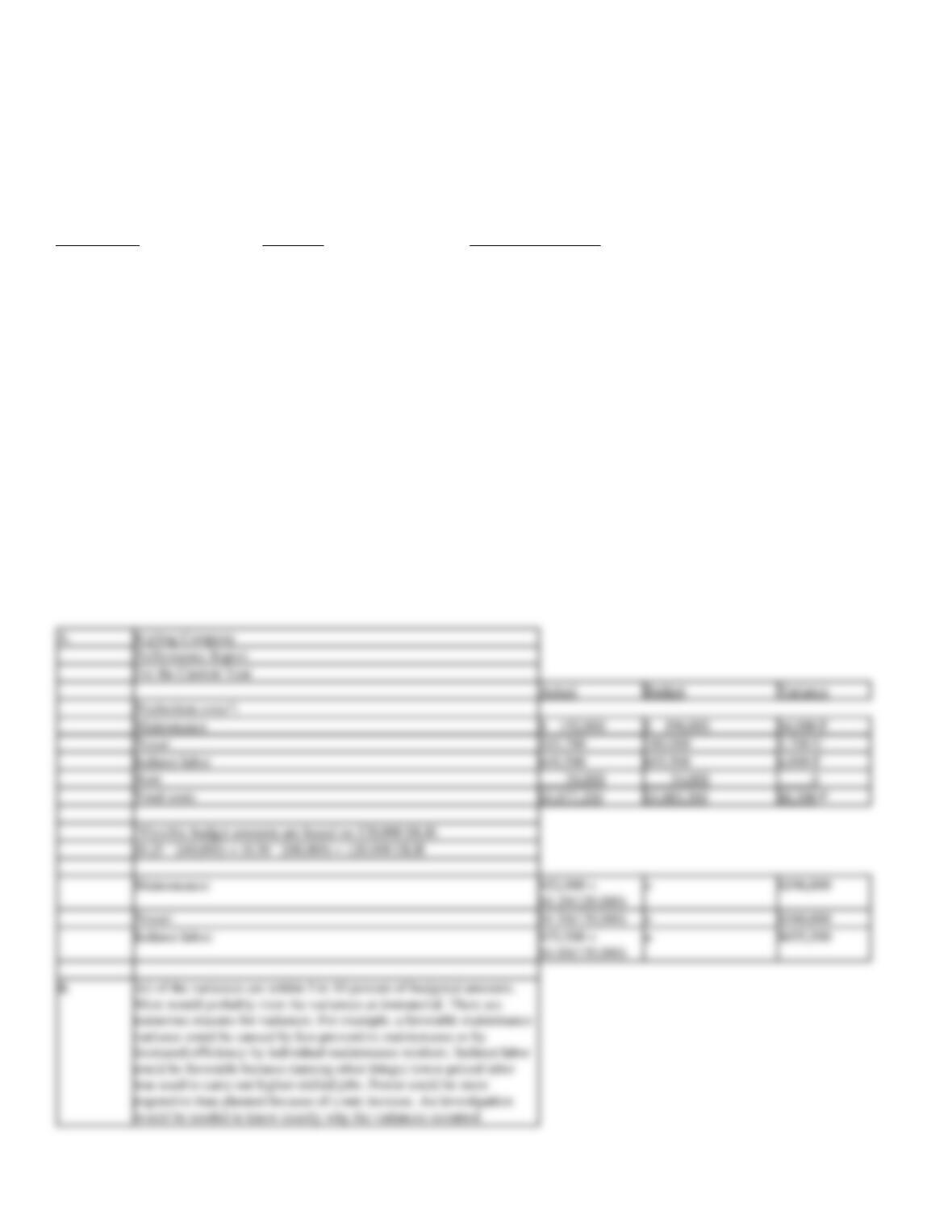
Refer to Figure 11-7. Assume that Kipling actually produced 240,000 gallons of Icey and 200,000 of Tasty. The actual overhead costs incurred
were:
Maintenance
$192,000
Power
181,700
Indirect labor
649,500
Rent
54,000
Required:
A.
Prepare a performance report for the period.
B.
Based on the report, would you judge any of the variances to be significant? Discuss some possible reasons for the variances.
A.
Kipling Company
Performance Report
For the Current Year
Actual
Budget
Variance
Production costs*:
Maintenance
$ 192,000
$ 196,000
$4,000 F
Power
181,700
180,000
1,700 U
Indirect labor
649,500
655,500
6,000 F
Rent
54,000
54,000
0
Total costs
$1,077,200
$1,085,500
$8,300 F
*Flexible budget amounts are based on 120,000 DLH:
(0.25 ´ 240,000) + (0.30 ´ 200,000) = 120,000 DLH
Power:
$1.50(120,000)
=
$180,000
142. Favor Company budgeted the following amounts:
Variable costs of production:
Direct materials
6 pounds @ $1.25 per pound
Direct labor
.75 hours @ $16.00 per hour
Variable overhead
.75 hours @ $2.65
Fixed overhead:
Materials handling
$9,000
Depreciation
$2,300
Required: Prepare a flexible budget for 1,500 units, 1,800 units and 2,100 units.
1,500 units
1,800 units
2,100 units
Direct materials
$11,250
$13,500
$15,750
Direct labor
$18,000
$21,600
$25,200
Variable overhead
$2,981
$3,578
$4,174
Fixed overhead:
Materials handling
$9,000
$9,000
$9,000
Depreciation
$2,300
$2,300
$2,300
Total
$43,531
$49,978
$56,421
143. Vallo Pharmacy operates a home delivery service with more than 2,000 housebound clients. Vallo has a
fleet of vehicles and has invested in a sophisticated computerized communications system to coordinate its
deliveries. Vallo has gathered the following data on last year’s operations:
Deliveries made:
21,000
Direct labor:
15,000 delivery hours at $8
Actual variable overhead:
$145,000
Vallo uses a standard costing system. During the year, the following variable overhead rate was used: $8.10 per delivery hour. The labor standard
requires 0.75 hours per delivery.
Compute the variable overhead spending variance and the variable overhead efficiency variance.
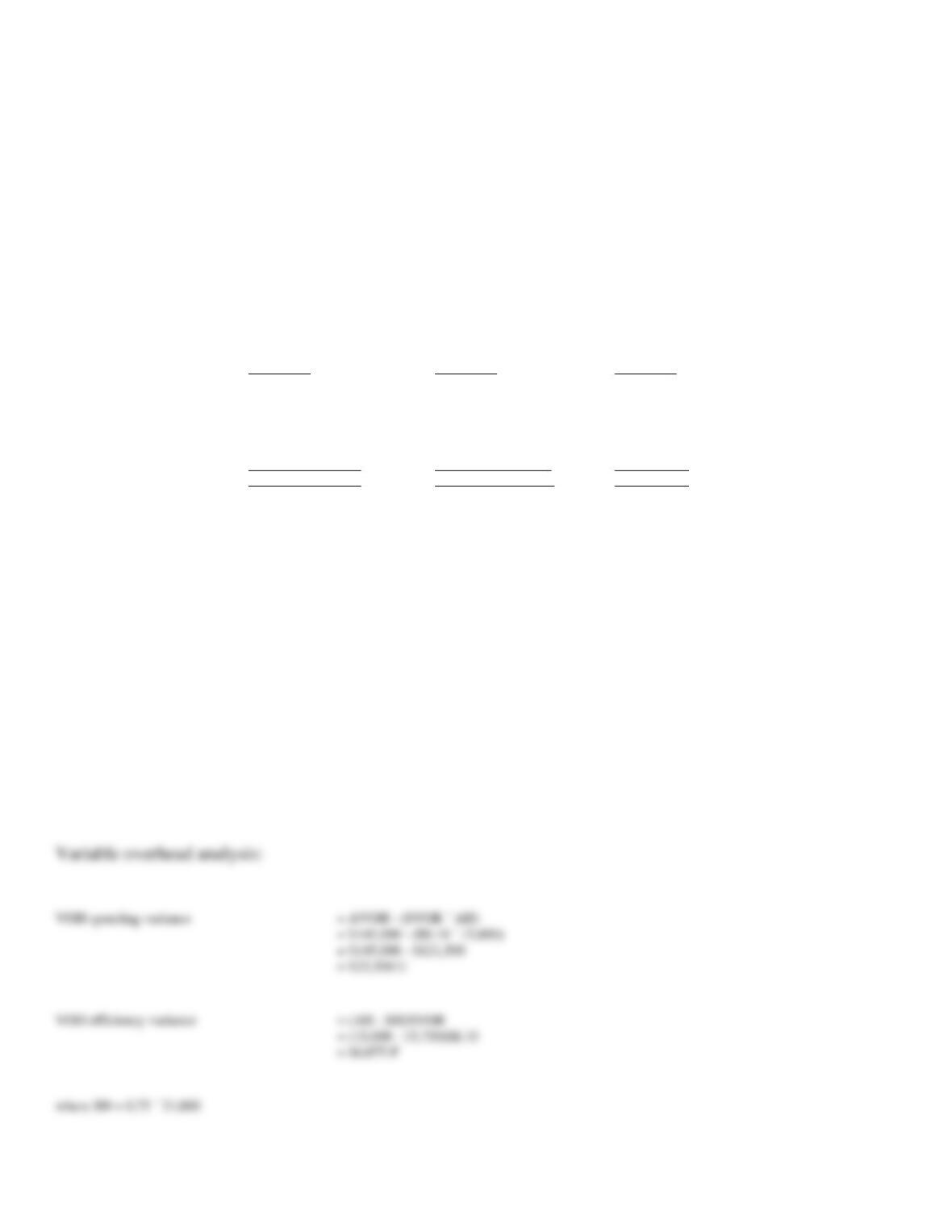
VOH spending variance
= AVOH – (SVOR ´ AH)
= $145,000 – ($8.10 ´ 15,000)
= $145,000 – $121,500
= $23,500 U
= (AH – SH)SVOR
= (15,000 – 15,750)$8.10
= $6,075 F
144. A company had the following information for the year:
Standard variable overhead rate (SVOR) per direct labor hour
$6.75
Standard hours (SH) allowed per unit
4
Actual production
17,400
Actual variable overhead costs
478,000
Actual direct labor hours
69,800
Required:
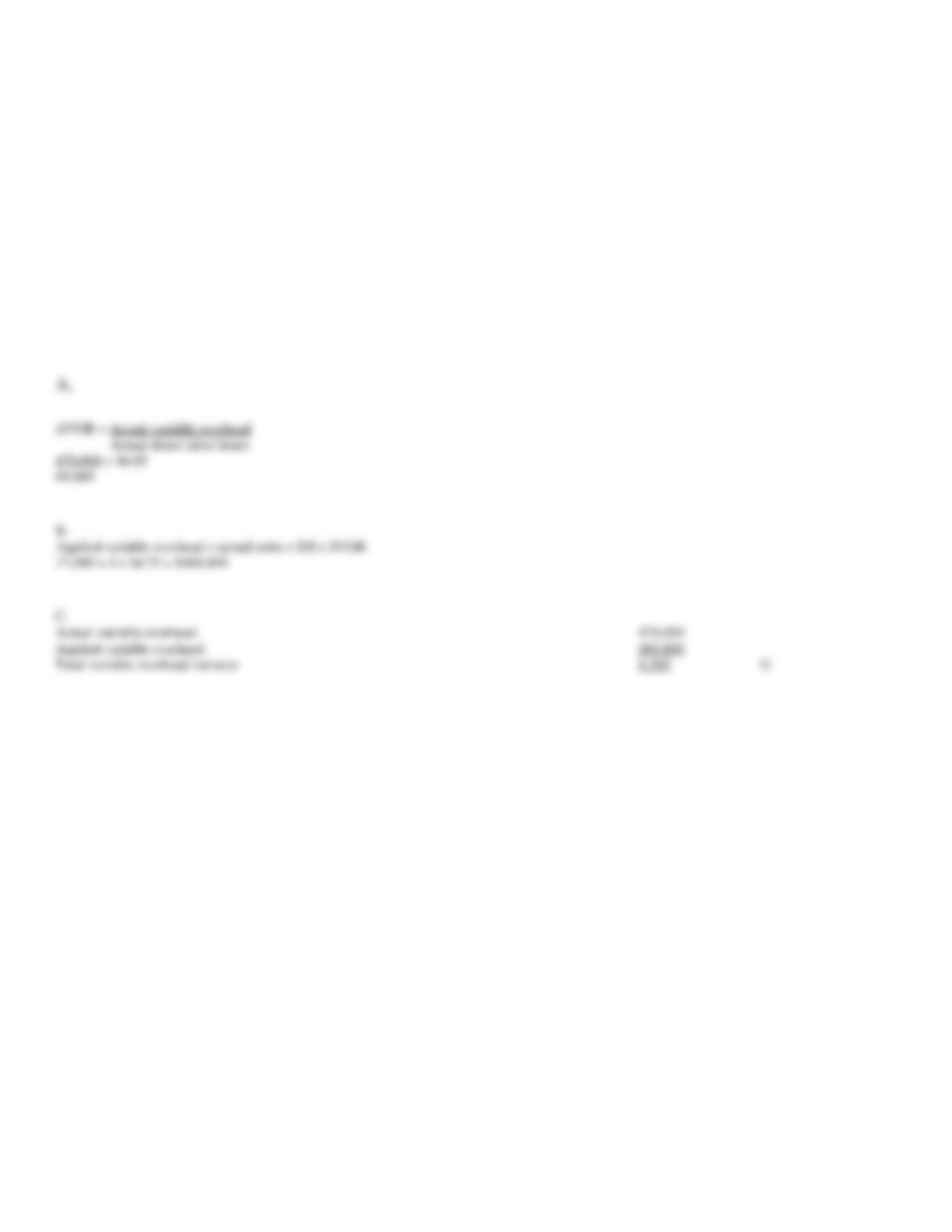
A. Calculate the actual variable overhead rate (AVOR).
B. Calculate the applied variable overhead.
C. Calculate the total variable overhead variance.
AVOR = Actual variable overhead
Actual direct labor hours
478,000 = $6.85
69,800
Applied variable overhead = actual units x SH x SVOR
17,400 x 4 x $6.75 = $469,800
Actual variable overhead
478,000
Total variable overhead variance
8,200
U
145. Gallant Company uses standard costing. Overhead is applied to products on the basis of standard direct
labor hours for actual production. Data for Gallant follows:
Standard direct labor hours allowed for actual output
110,000
Actual direct labor hours
115,000
Direct labor hours budgeted in the master budget
120,000
Budgeted total variable overhead cost
$360,000
Actual variable overhead cost
$328,000
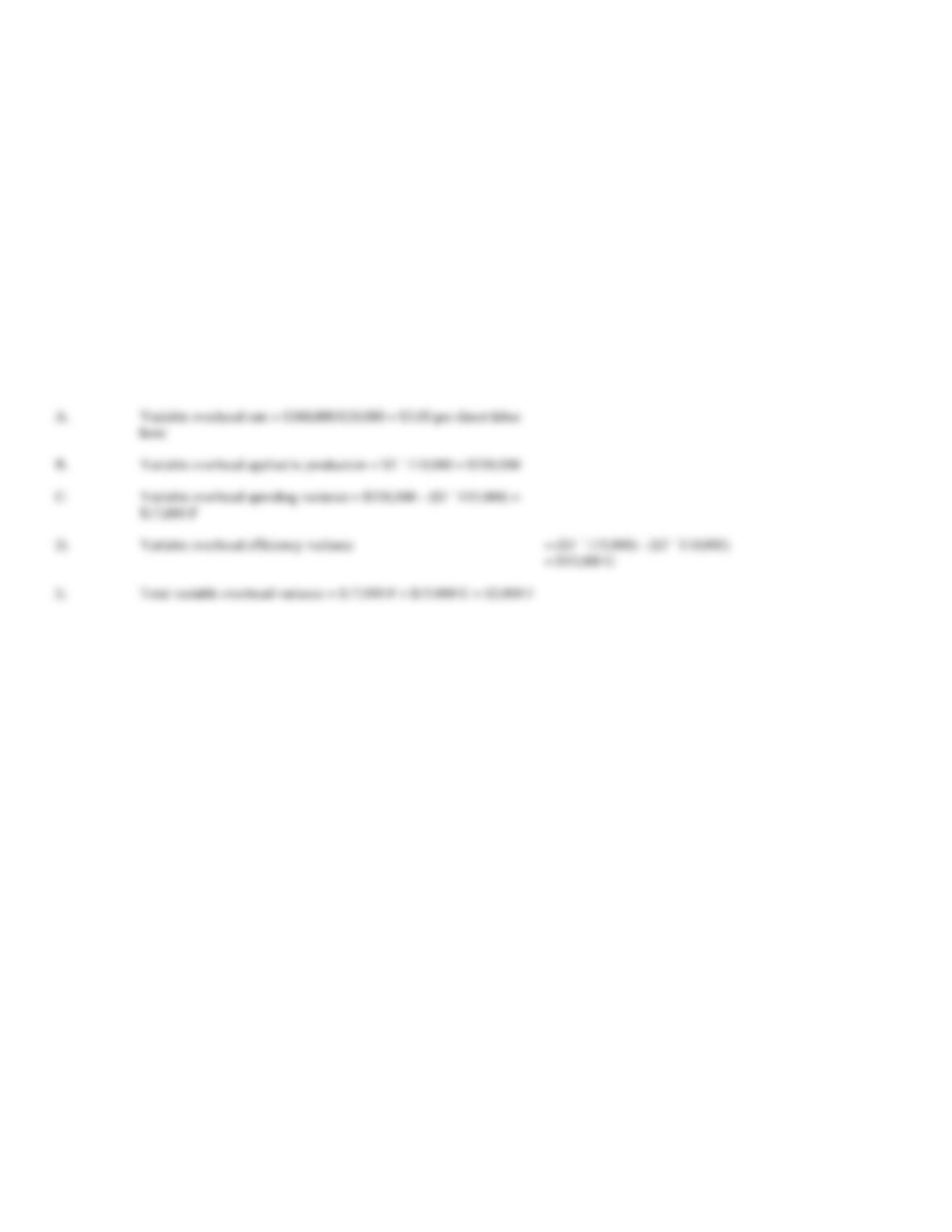
A.
Calculate the variable overhead rate.
B.
Calculate the total variable overhead applied to production.
C.
Calculate the variable overhead spending variance.
D.
Calculate the variable overhead efficiency variance.
E.
Calculate the total variable overhead variance.
B.
Variable overhead applied to production = $3 ´ 110,000 = $330,000
D.
Variable overhead efficiency variance
= ($3 ´ 115,000) – ($3 ´ 110,000)
= $15,000 U
Total variable overhead variance = $17,000 F + $15,000 U = $2,000 F
146. A company provided the following data:
Standard fixed overhead rate (SFOR)
$13 per direct labor hour
Actual fixed overhead costs
$385,800
Standard hours allowed per unit
2
Actual production
15,000 units
Required:
A. Calculate the standard hours allowed for actual production.
B. Calculate the applied fixed overhead
C. Calculate the total fixed overhead variance
Standard hours for actual units = SH per unit x actual units produced
2 x 15,000 = 30,000
B.
Applied fixed overhead = Standard hours for actual units x SFOR
30,000 x $13 = $390,000
C.
Actual fixed overhead
$385,800
Applied fixed overhead
$390,000
Total fixed overhead variance
($4,200)
F

147. Littleton Company uses a standard costing system. The following monthly cost functions apply to its
manufacturing overhead items:
Overhead Item
Cost Function
Indirect materials
$0.80 per DLH
Indirect labor
$1.00 per DLH
Utilities
$0.40 per DLH
Insurance
$8,000
Depreciation
$32,000
Information for the month of October is as follows:
Actual overhead costs incurred:
Indirect materials
$20,800
Indirect labor
24,000
Utilities
9,600
Insurance
8,800
Depreciation
32,000
Total
$95,200
Actual direct labor hours worked
24,000
Standard direct labor hours allowed for production achieved
27,000
Littleton uses expected capacity to calculate standard overhead rates. The monthly expected capacity is 25,000 hours.
A.
Calculate the following standard overhead rates
based upon expected capacity:
Variable overhead rate
Fixed overhead rate
Total overhead rate
B.
Calculate the following variances:
Variable overhead spending variance
Variable overhead efficiency variance
Fixed overhead spending variance
Fixed overhead volume variance
148. The following standard overhead costs were developed for one of the products of Mildey Company:
Variable overhead:
5 hours ´ $4 per hour
20.00
Fixed overhead:
5 hours ´ $15 per hour
75.00
Total standard overhead cost per
unit
$95.00
The following information is available regarding the company’s operations for the period:
Units produced
20,000
Direct labor
115,000 hours
Overhead incurred:
Variable
$437,500
Fixed
$1,320,000
Budgeted fixed overhead for the period is $1,350,000, and the standard fixed overhead rate is based on expected capacity of 90,000 direct labor
hours.
Required:
A.
Calculate the variable overhead spending variance and indicate whether it is favorable or unfavorable.
B.
Calculate the variable overhead efficiency variance and indicate whether it is favorable or unfavorable.
C.
Calculate the fixed overhead spending variance and indicate whether it is favorable or unfavorable.
D.
Calculate the fixed overhead volume variance and indicate whether it is favorable or unfavorable.
A.
$ 22,500 F
$437,500 – (115,000 ´ $4)
B.
$ 60,000 U
[(115,000) – (20,000 units ´ 5 hours )] ´ $4
C.
$ 30,000 F
$1,320,000 – $1,350,000
D.
$150,000 F
$1,350,000 – (20,000 units ´ 5 hours ´ $15)
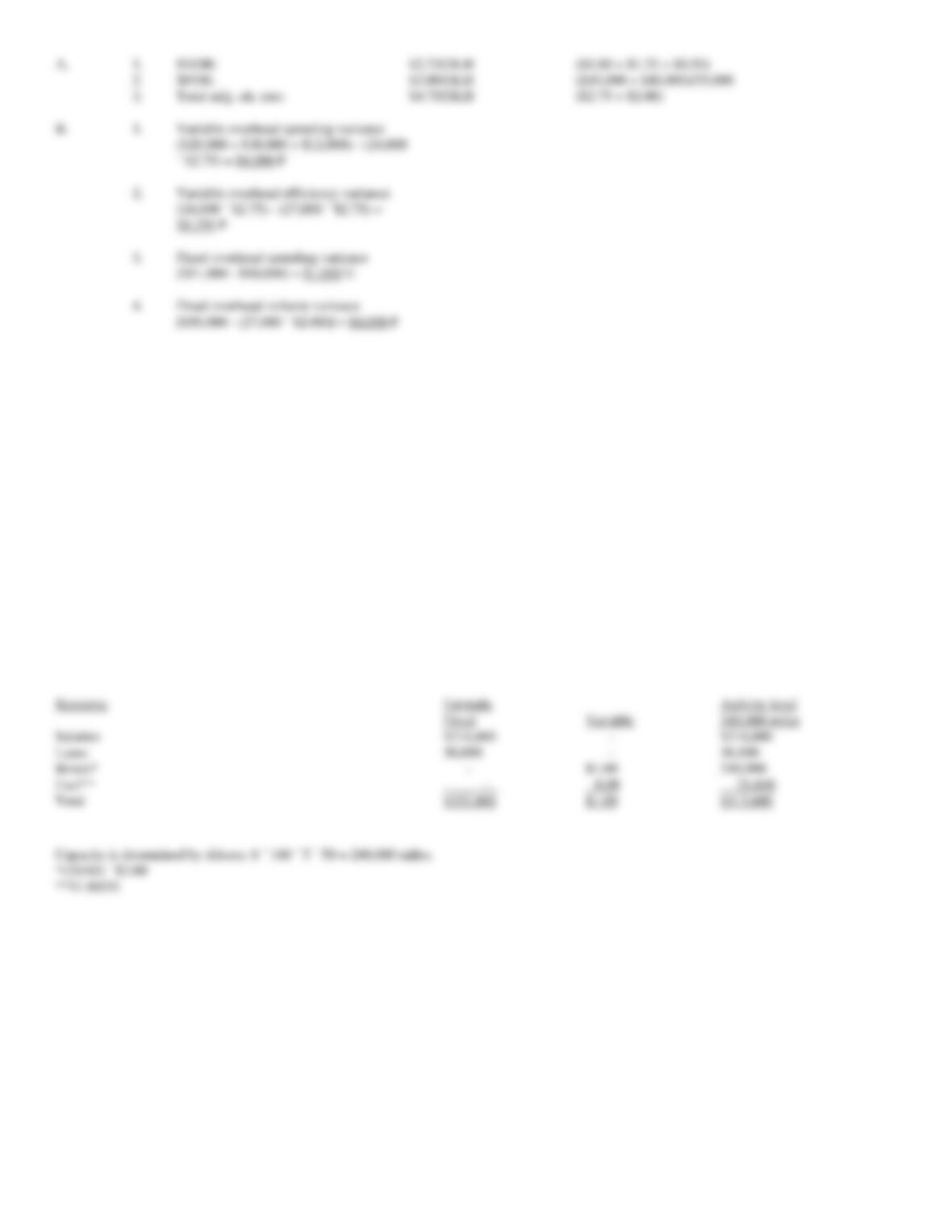
Fixed overhead rate = ($8,000 +
B.
Variable overhead spending variance:
= ($20,800 + $24,000 + $9,600) –
(24,000 hours ´ $2.20)
= $54,400 – $52,800
= $1,600 U
Variable overhead efficiency variance:
(AH – SH)SVOR
= (24,000 – 27,000)$2.20
= $6,600 F
Fixed overhead spending variance:
AFOH – BFOH
= ($40,800 – $40,000)
= $800 U
Fixed overhead volume variance:
BFOH – SH ´ SFOR
= [$40,000 – (27,000 hours ´ $1.60)]
= $3,200 F
149. At the beginning of the year, Folsom Company had the following standard cost sheet for one of its food
products:
Direct materials (10 lb @ 3.20)
$32.00
Direct labor (4 hr @ $9.00)
36.00
Fixed overhead (4 hr @ $4.00)
16.00
Variable overhead (4 hr @ $0.75)
3.00
Standard cost per unit
$87.00
Folsom computes its overhead rates using practical capacity, which is 72,000 units. The actual results for the year are:
Units produced
70,000
Direct labor hours
290,000
Actual wage per hour
$9.05
Fixed overhead
$1,160,000
Variable overhead
$ 218,000
A.
Compute the fixed overhead spending and volume variances.
B.
Compute the variable overhead spending and efficiency variances.
Actual FOH
Budgeted FOH
Applied FOH
$1,160,000
$4 ´ 288,000
$8,000 U
$32,000 U
FOH Spending
FOH Volume
B.
VOH Spending variance
= AVOH – SVOR ´ AH
= $218,000 – ($0.75 ´ 290,000)
= $500 U
VOH efficiency variance
= (AH – SH)SVOR
= (290,000 – 280,000)$0.75
= $7,500 U
150. Bushman Company is planning to produce 3,200,000 carburetors for the coming year. Each carburetor
requires 0.375 standard hours of labor for completion. The company uses direct labor hours to assign overhead
to products. The total fixed overhead budgeted for the coming year is $1,980,000. Total budgeted overhead is
$4,050,000. Predetermined overhead rates are calculated using expected production, measured in direct labor
hours. Actual results for the year follow:
Actual production (units)
3,540,000
Actual direct labor hours
1,190,000
Actual fixed overhead
$1,920,000
Actual variable overhead
2,150,000
Required:
A.
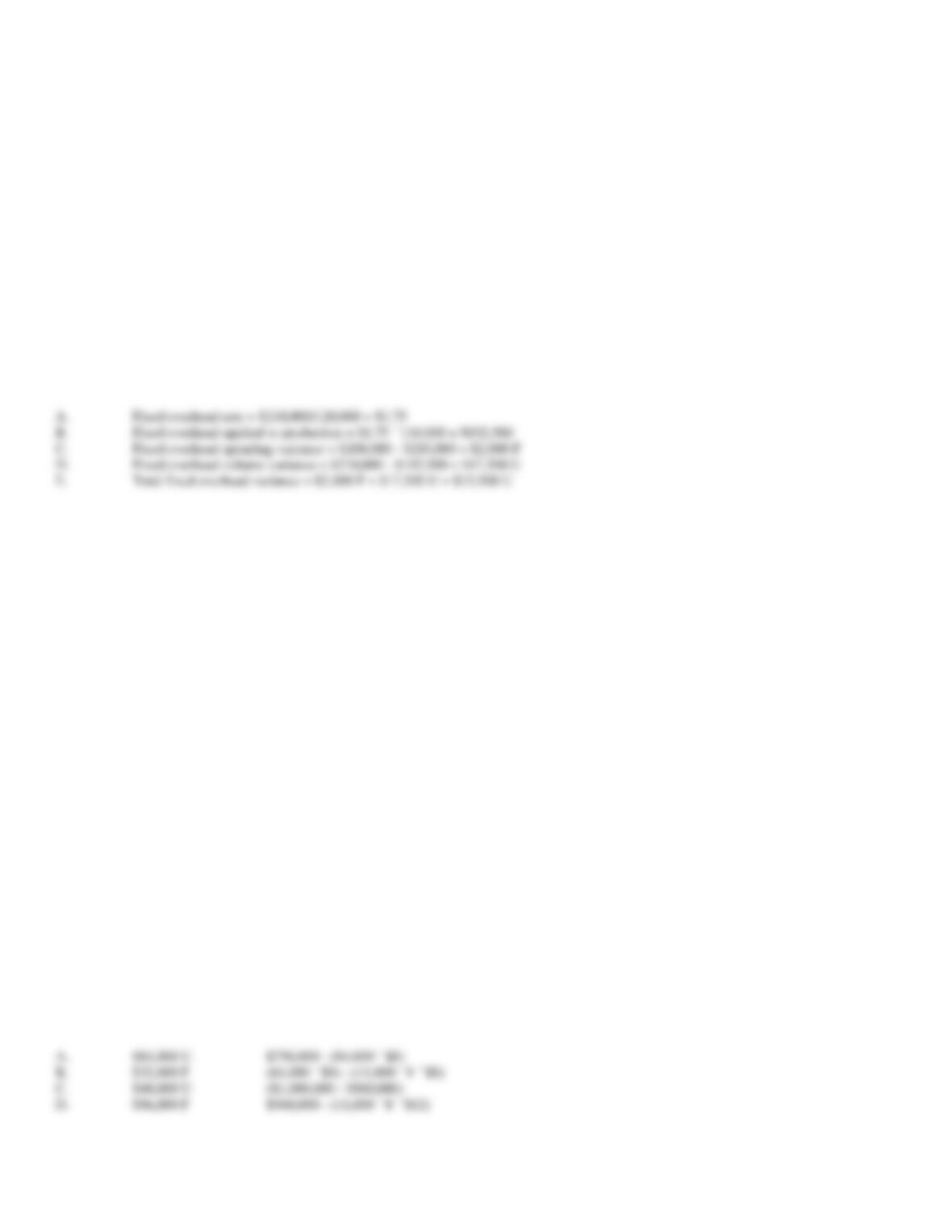
Compute the applied fixed overhead.
B.
Compute the fixed overhead spending and volume variances.
C.
Compute the applied variable overhead.
D.
Compute the variable overhead spending and efficiency variances. Carry per hour computations out to 3 decimals.
SH = 0.375 ´ 3,540,000 = 1,327,500
151. Gallant Company uses standard costing. Overhead is applied to products on the basis of standard direct
labor hours for actual production. Data for Gallant follows:
Standard direct labor hours allowed for actual output
110,000
Actual direct labor hours
115,000
Direct labor hours budgeted in the master budget
120,000
Budgeted total fixed overhead cost
$210,000
Actual fixed overhead cost
$208,000
A.
Calculate the fixed overhead rate.
B.
Calculate the total fixed overhead applied to production.
C.
Calculate the fixed overhead spending variance.
D.
Calculate the fixed overhead volume variance.
E.
Calculate the total fixed overhead variance.
152. The following costs were developed for one of the products of Larry Corporation:
Variable overhead: 8 hours ´ $8 per hour
64.00
Fixed overhead: 8 hours ´ $12 per hour
96.00
The following information is available regarding the company’s operations for the period:
Units produced:
11,000
Direct labor:
84,000 hours costing $840,000
Overhead incurred:
Variable
$756,000
Fixed
$1,000,000
Budgeted fixed overhead for the period is $960,000, and the standard fixed overhead rate is based on expected capacity of 80,000 direct labor hours.
Required:
A.
Calculate the variable overhead spending variance.
B.
Calculate the variable overhead efficiency variance.
C.
Calculate the fixed overhead spending variance.
D.
Calculate the fixed overhead volume variance.
A.
$84,000 U
$756,000 – (84,000 ´ $8)
C.
$40,000 U
($1,000,000 – $960,000)
A.
Fixed overhead rate = $210,000/120,000 = $1.75
B.
Fixed overhead applied to production = $1.75 ´ 110,000 = $192,500
C.
Fixed overhead spending variance = $208,000 – $210,000 = $2,000 F
D.
Fixed overhead volume variance = $210,000 – $192,500 = $17,500 U
E.
Total fixed overhead variance = $2,000 F + $17,500 U = $15,500 U

153. Mills Company uses standard costing for direct materials and direct labor. Management would like to use
standard costing for variable and fixed overhead.
The following monthly cost functions were developed for overhead items:
Overhead Item
Cost Function
Indirect materials
$1.00 per DLH
Indirect labor
$1.25 per DLH
Utilities
$0.50 per DLH
Insurance
$10,000
Depreciation
$40,000
The cost functions are considered reliable within a relevant range of 20,000 to 40,000 direct labor hours. The company expects to operate at 25,000
direct labor hours per month.
Information for the month of June is as follows:
Actual overhead costs incurred:
Indirect materials
$ 20,000
Indirect labor
30,000
Utilities
12,000
Insurance
11,000
Depreciation
40,000
Total
$113,000
Actual direct labor hours worked:
24,000
Standard direct labor hours allowed for production achieved:
27,000
Required:
A.
Calculate the following overhead rates
based upon expected capacity:
1.
Variable overhead
2.
Fixed overhead rate
3.
Total overhead rate
B.
Calculate the following variances:
1.
Variable overhead spending variance
2.
Variable overhead efficiency variance
3.
Fixed overhead spending variance
4.
Fixed overhead volume variance
154. Figure 11-8.
Booth Inc. uses three delivery trucks to transport finished parts from its plant to the plants of its customers. The
delivery trucks are obtained through a five-year operating lease that costs $12,000 per year per truck. Booth
employs 6 drivers who receive an average salary of $36,000 per year, including benefits. Parts are placed in
boxes and placed in the trucks. Each truck holds 20 boxes. The average round-trip distance for a delivery is 40
miles. The boxes are retained by the customers. Each box costs $2.00. Fuel for the trucks costs $1.80 per gallon.
A gallon of gas is used every 20 miles. A driver can travel 160 miles in an eight-hour shift. Each driver works
40 hours per week and 50 weeks per year.
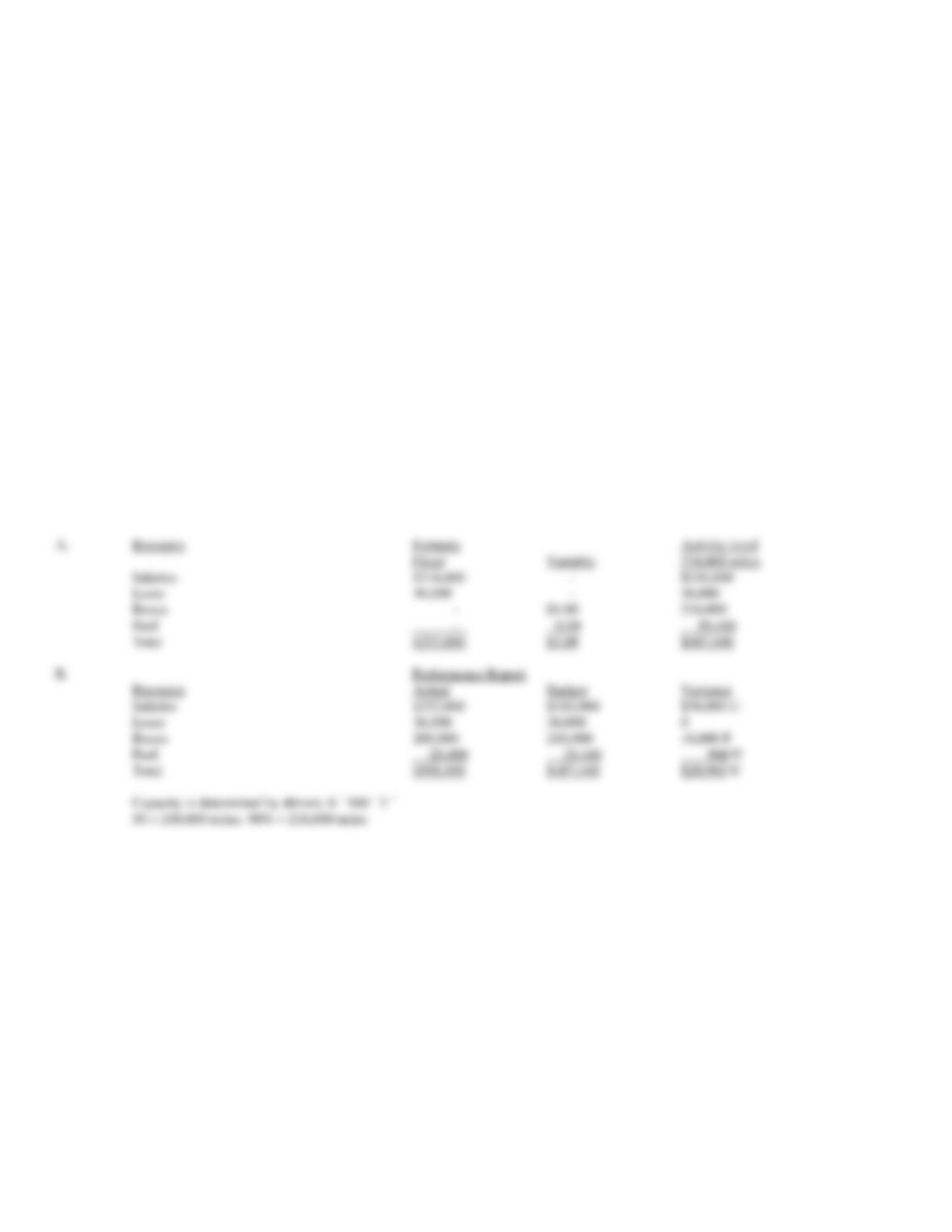
Refer to Figure 11-8. Prepare an annual budget for the activity, assuming that all of the capacity of the activity
is used (use miles as the activity driver). Identify which resources you would treat as fixed costs and which
would be viewed as variable costs.
155. Figure 11-8.
Booth Inc. uses three delivery trucks to transport finished parts from its plant to the plants of its customers. The
delivery trucks are obtained through a five-year operating lease that costs $12,000 per year per truck. Booth
employs 6 drivers who receive an average salary of $36,000 per year, including benefits. Parts are placed in
boxes and placed in the trucks. Each truck holds 20 boxes. The average round-trip distance for a delivery is 40
miles. The boxes are retained by the customers. Each box costs $2.00. Fuel for the trucks costs $1.80 per gallon.
A gallon of gas is used every 20 miles. A driver can travel 160 miles in an eight-hour shift. Each driver works
40 hours per week and 50 weeks per year.
Refer to Figure 11-8. Assume that the company uses only 90 percent of the activity capacity. The actual costs
incurred at this level were:
Salaries
$252,000
Lease
36,000
Boxes
200,000
Fuel
20,400
A.
What is the budget for this level of activity?
B.
Prepare a performance report.
Resource
Formula
Activity level
Fixed
Variable
216,000 miles
Salaries
$216,000
–
$216,000
Lease
36,000
–
36,000
Boxes
$1.00
216,000
Fuel
0.09
19,440
Total
$252,000
$1.09
$487,440
Performance Report
Resource
Actual
Budget
Variance
Salaries
$252,000
$216,000
$36,000 U
Lease
36,000
36,000
0
Boxes
200,000
216,000
16,000 F
Fuel
20,400
19,440
960 U
Total
$508,400
$487,440
$20,960 U
156. McCordy Company provided information on the following three overhead activities:
Activity
Driver
Fixed Cost
Variable Rate
Maintenance
Machine hours
$75,000
$1.50
Power
Machine hours
20,000
$2.05
Setting up
Setups
–
$1,500
McCordy has found that the following driver levels are associated with two different levels of production:
Driver
30,000 units
70,000 units
Machine hours
50,000
95,000
Setups
25
65
Required:
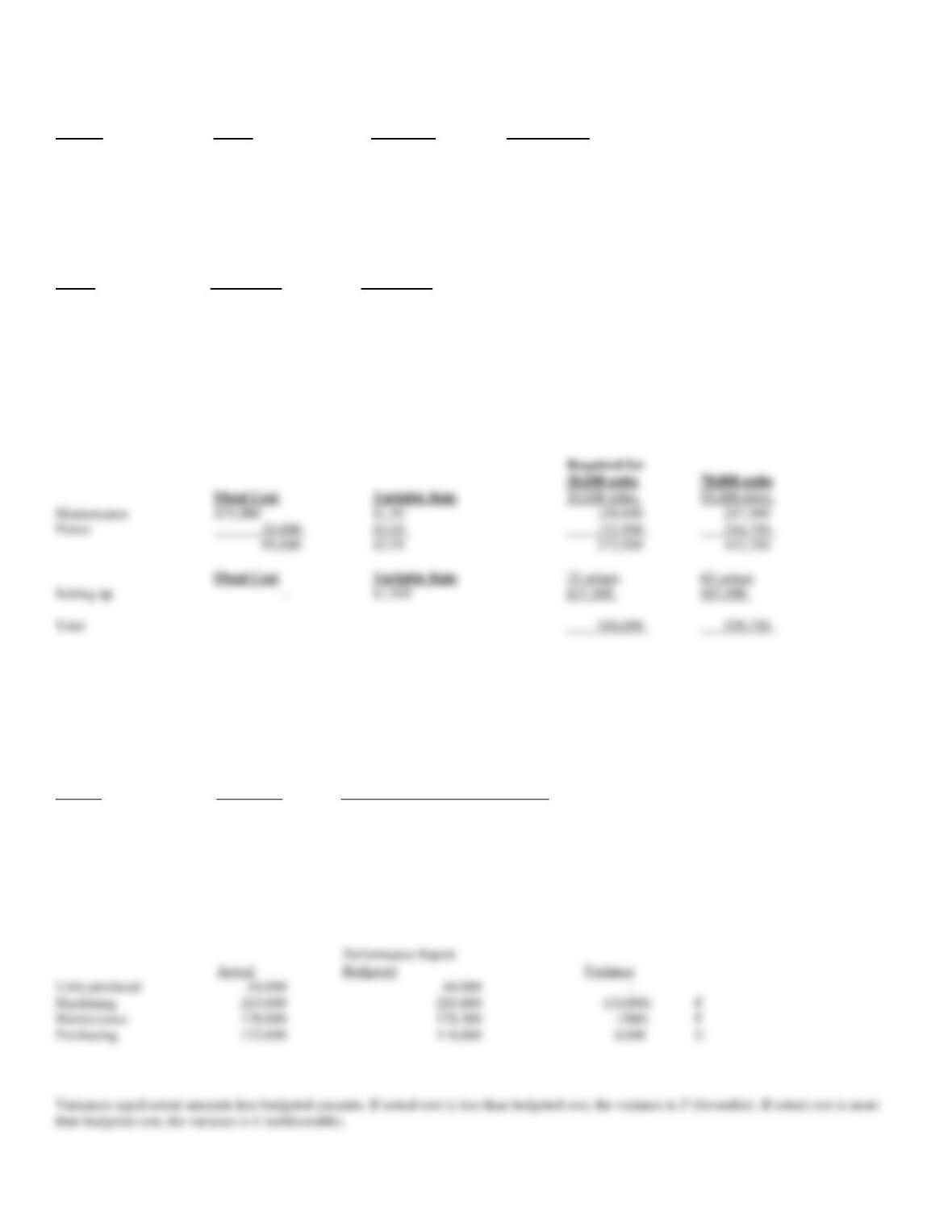
Prepare an activity-based flexible budget.
157. Allen Company produced 44,000 units last year. The information on the actual costs and budgeted costs
at actual production of three activities is provided below.
Activity
Actual Cost
Budgeted Cost for Actual Production
Machining
215,000
225,000
Maintenance
178,000
178,300
Purchasing
122,000
118,000
Required:
Prepare an activity-based performance report for the three activities for the past year.
Performance Report
Actual
Budgeted
Variance
Units produced
44,000
–
Machining
215,000
(10,000)
F
Maintenance
178,000
178,300
(300)
F
Purchasing
122,000
4,000
U
Required for
Fixed Cost
Variable Rate
50,000 mhrs.
95,000 mhrs.
Maintenance
$75,000
$1.50
150,000
217,500
Power
20,000
$2.05
122,500
214,750
95,000
$3.55
272,500
432,250
Fixed Cost
Variable Rate
25 setups
65 setups
Setting up
–
$1,500
$37,500
$97,500
Total
310,000
529,750
158. Define static budget and flexible budget. What is each type used for?
A static budget is a budget for a particular level of activity. The master budget is an example of a static budget.
It is developed in advance and is based on a single level of activity, embodied in the sales budget. The master
budget is useful in planning so that the firm can determine its sales, production needs, costs, and potential
financial statements. The static budget is less useful for control because the level of activity set in the master
budget rarely matches the actual level achieved.
159. You decide
Describe flexible budgeting, including the two types of flexible budgets.
A flexible budget enables a firm to compute expected costs for a range of activity levels. The key to flexible
budgeting is knowledge of fixed and variable costs. There are two types of flexible budgets: before-the-fact
and after-the-fact.
160. Discuss the following statement: “As long as the total variable overhead variance is small, the managers
can be assured that actual activity is proceeding as planned. No further action is necessary.”
161. Discuss the following statement: “Since fixed overhead is, by definition, not related to changes in activity
level, then the fixed overhead spending variance is zero.”
162. What is the fixed overhead volume variance? Suppose that the fixed overhead volume variance is
unfavorable; what does that mean?
163. How does activity flexible budgeting differ from traditional-based flexible budgeting?
164. Discuss why activity flexible budgeting provides a more accurate prediction of costs than a traditional
flexible budget.