Chapter 21: The Statement of Cash Flows
89. Your friend is in business and wants your advice on preparing and interpreting the statement of cash flows for 2016.
Information regarding the business is as follows:
Cash received from customers
$ 175,000
Cash paid to vendors
75,000
Cash paid to employees
140,000
Cash paid for interest
35,000
Depreciation expense
40,000
Cash paid in acquiring equipment
375,000
Cash received from issuing bonds
250,000
Cash received from issued common stock
400,000
Beginning cash balance
9,000
Required:
a.
Based upon the above information, prepare the statement of cash flows
using the direct method.
b.
Explain what has happened during the year.
$ 175,000
400,000
Chapter 21: The Statement of Cash Flows
90. Melissa, Inc. reported the following income statement, prepared on the accrual basis:
Sales
$ 6,000
Cost of goods sold
(4,700)
Gross profit
$ 1,300
Operating expenses:
Depreciation expense
$190
Other operating expenses
650
(840)
Income before taxes
$ 460
Income tax expense
(210)
Net income
$ 250
Changes during the year in selected accounts:
Accounts receivable
$100 decrease
Inventories
200 decrease
Accounts payable (on purchases)
150 increase
Salaries payable
60 decrease
Prepaid expenses
30 increase
Required:
For Melissa, Inc., compute the cash flow pertaining to:
a.
Cash collections from customers.
b.
Cash paid for operating expenses.
c.
a.
b.
c.
Cash paid for suppliers.
Chapter 21: The Statement of Cash Flows
91. Monty Corporation reported the following income statement in condensed for 2016:
Sales
$ 500,000
Cost of Goods Sold
(280,000)
Gross Profit
220,000
Operating Expenses:
Depreciation expense
$ 15,000
Salaries Expense
13,000
Rent Expense
10,000
Insurance Expense
5,000
(43,000)
Income before taxes
$ 177,000
Income tax expense
(61,950)
Net Income
$ 115,050
During 2016, the following changes occurred in the company’s current assets and current liabilities:
Increase
(Decrease)
Cash
$ 19,850
Account Receivable
(6,750)
Inventories
5,600
Accounts Payable
(2,800)
Salaries Payable
1,750
Operating Activities:
Net Income
Adjustments for noncash items:
Add: Depreciation expense
$ 15,000
Adjustments for cash flow effects from working capital items:
Decrease in accounts receivable
Increase in inventory
Decrease in accounts payable
Increase in salaries payable
Net cash provided by operating activities
Required:
By visual the inspection method prepare the net cash flows from the operating activities using the following methods
(note: headings are not necessary):
1) Indirect method
2) Direct method
Chapter 21: The Statement of Cash Flows
Chapter 21: The Statement of Cash Flows
92. The Percy’s Landing Co. reported the following condensed income statement for 2016:
Percy’s Landing CO.
Condensed Income Statement
For the Year Ended December 31, 2016
Sales
$305,000
Cost of goods sold
150,000
Gross profit
$155,000
Operating expenses:
Depreciation.
$42,000
Insurance expense
5,000
Salaries expense
80,000
127,000
Income before taxes
$ 28,000
Income taxes
6,000
Net income
$ 22,000
Also during 2016, the company’s current assets and current liabilities changed as follows:
Increase
(Decrease)
Cash
$49,500
Accounts receivable
11,000
Inventory
17,500
Prepaid insurance
(3,500)
Accounts payable (purchases)
35,000
Salaries payable
2,500
Income taxes payable
(1,500)
Required:
Prepare the Net Cash Flow from Operating Activities section of the statement of cash flows for 2016, using the
direct method.
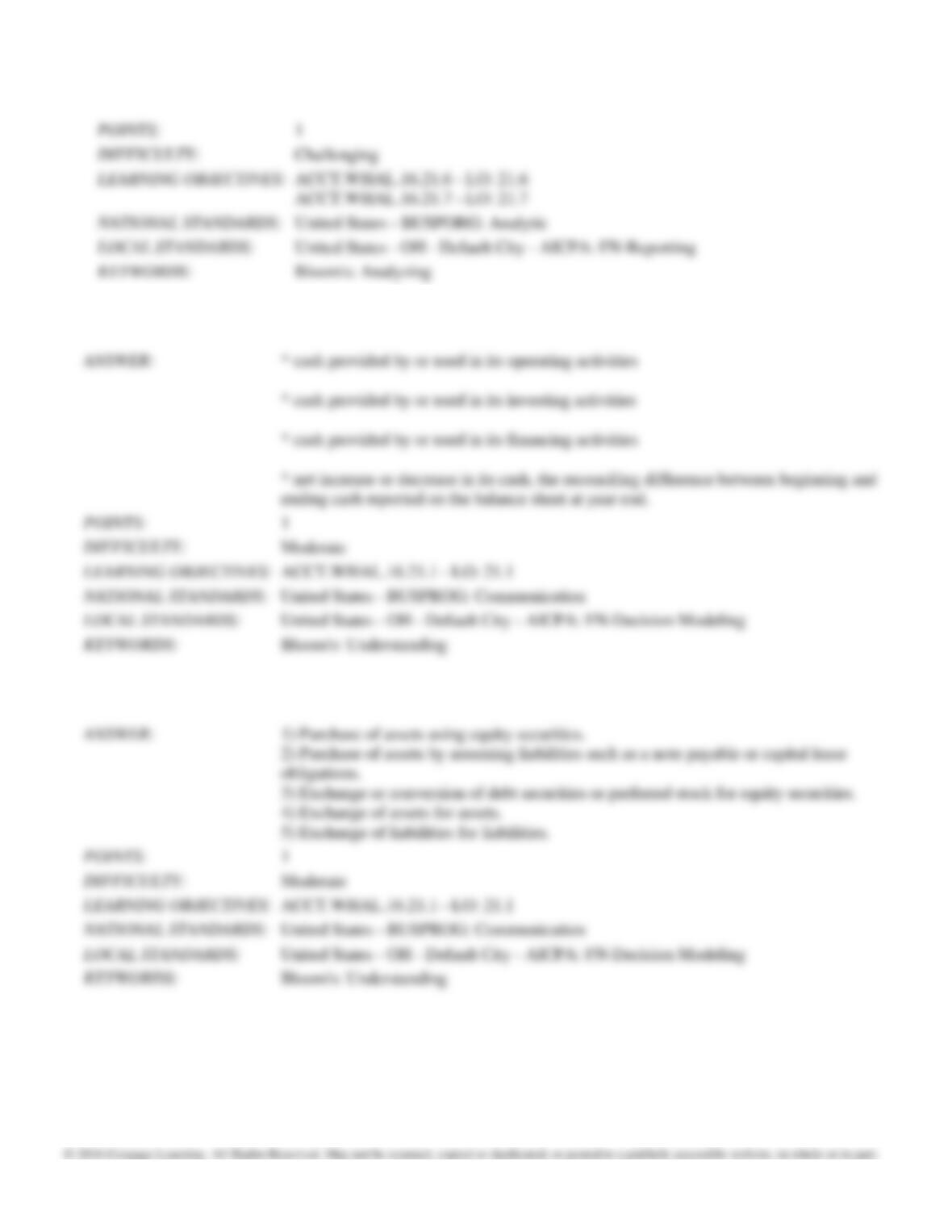
Percy’s Landing CO.
Cash Flows from Operating Activities:
Cash Inflows:
$11,000)
Cash Outflows:
Payments to suppliers
($150,000 + $17,500 – $35,000)
Payments for insurance ($5,000 -$3,500)
(77,500)
$1,500)
Chapter 21: The Statement of Cash Flows
93. According to GAAP, what must a company’s statement of cash flows show?
94. Provide three examples of noncash investing and financing activities.
Chapter 21: The Statement of Cash Flows
95. What are the five categories of operating cash outflows under the direct method of reporting cash flows?
96. What are the four steps necessary to prepare the spreadsheet and its statement of cash flows?
97. How should the sale of a depreciable asset be presented on the statement of cash flows?
Chapter 21: The Statement of Cash Flows
98. What are the three categories of cash inflows from operating activities under the direct method?
99. What working paper information does a company need for its statement of cash flows under the direct method?
100. Why do companies use the spreadsheet method to prepare the statements of cash flows?
Chapter 21: The Statement of Cash Flows
101. What are the four steps necessary to complete the statement of cash flows using the visual inspection method?
102. What is the primary purpose of the statement of cash flows? If the information provided in the statement of cash
flows is used together with the information in the other financial statements, what assistance does that information
provide to external users?
Chapter 21: The Statement of Cash Flows
103. The statement of cash flows, along with other financial and operating information, enables investors, creditors, and
other users to assess a company’s liquidity, financial flexibility, and operating capability. Distinguish between
liquidity, financial flexibility, and operating capability.
104. Current GAAP permits two methods of calculating and reporting a company’s net cash flow from operating activities
on its statement of cash flows.
Required:
Identify the two methods. Which method does the FASB prefer? Which method do most companies use and why?
Chapter 21: The Statement of Cash Flows
105. The statement of cash flows classifies cash inflows and outflows into three different activities: operating, investing,
and financing.
Required:
Describe the types of transactions that would be included under each of those three activities.
106. Because the statement of cash flows only reflects the cash flows from operating, investing, and financing activities,
certain noncash transactions are omitted from the body of the statement.
Required:
Identify the types of activities that are not included in the body of the statement of cash flows, describe the types of
transactions involved, and indicate where these items are disclosed on the statement.