Corporate Finance, 3e (Berk/DeMarzo)
Chapter 21 Option Valuation
21.1 The Binomial Option Pricing Model
1) Which of the following statements is FALSE?
A) A replicating portfolio is a portfolio of other securities that has exactly the same value in one
period as the option.
B) By using the Law of One Price, we are able to solve for the price of the option as long as we
know the probabilities of the states in the binomial tree.
C) The binomial tree contains all the information we currently know: the value of the stock,
bond, and call options in each state in one period, as well as the price of the stock and bond
today.
D) The idea that you can replicate the option payoff by dynamically trading in a portfolio of the
underlying stock and a risk-free bond was one of the most important contributions of the original
Black-Scholes paper. Today, this kind of replication strategy is called a dynamic trading strategy.
2) Which of the following statements is FALSE?
A) The techniques of the binomial option pricing model are specific to European call and put
options.
B) We can summarize the payoffs for the Binomial Option Pricing Model in a binomial tree—a
timeline with two branches at every date that represent the possible events that could happen at
those times.
C) We define the state in which the stock price goes up as the up state and the state in which the
stock price goes down as the down state.
D) When using the Binomial Option Pricing Model, by the Law of One Price, the price of the
option today must equal the current market value of the replicating portfolio.
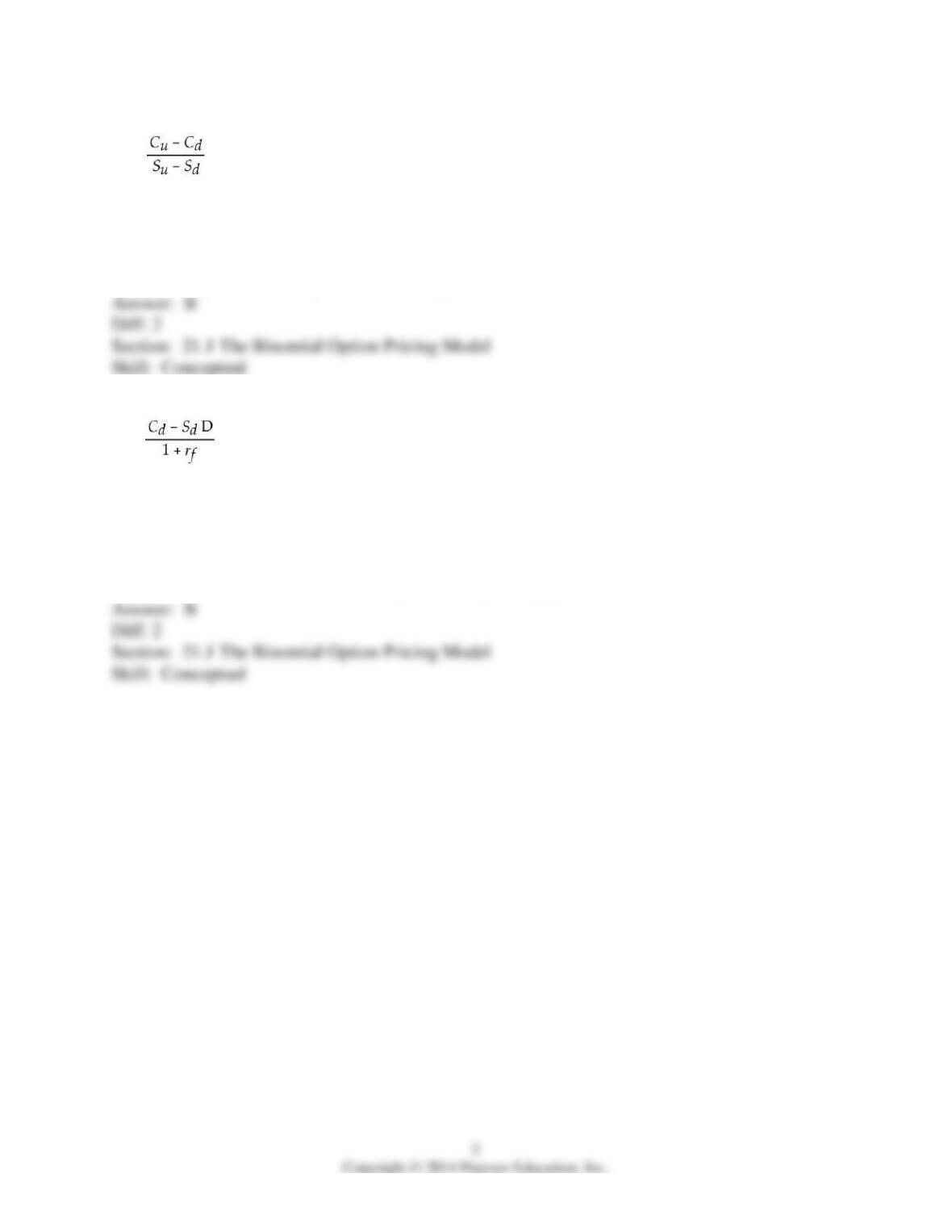
3) Consider the following equation:
D =
In this equation, the term D, represents:
A) the change in the stock price from the low state to the high state.
B) the sensitivity of the option’s value to changes in the stock price.
C) the position in bonds for the replicating portfolio.
D) the change in the stock price from the high state to the low state.
4) Consider the following equation:
B =
In this equation, the term B, represents:
A) the bid price for the option.
B) the position in bonds for the replicating portfolio.
C) the highest price at which it is advantageous to buy the option.
D) the number of shares of stock to buy for the replicating portfolio.
Use the information for the question(s) below.
The current price of KD Industries stock is $20. In the next year the stock price will either go up
by 20% or go down by 20%. KD pays no dividends. The one year risk-free rate is 5% and will
remain constant.
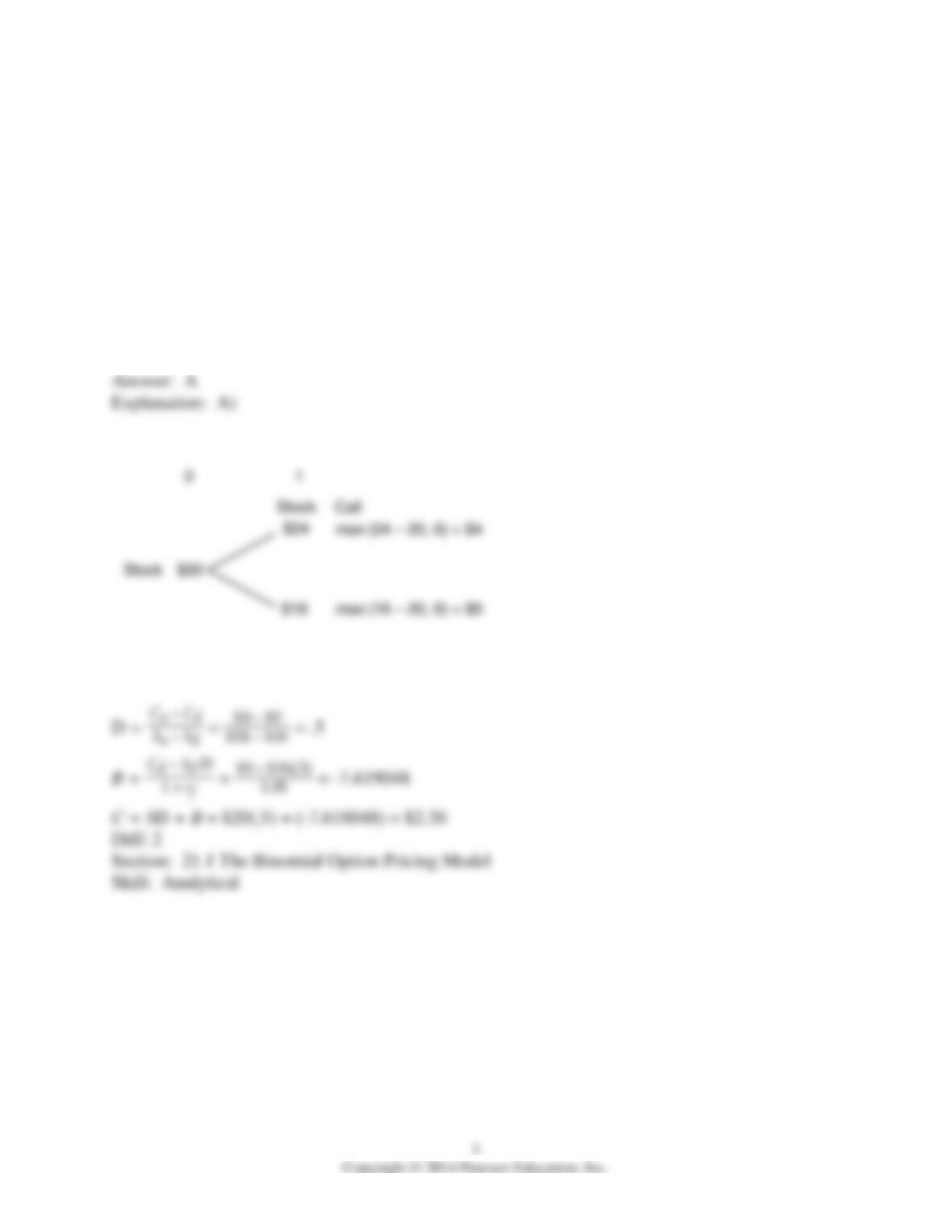
5) Using the binomial pricing model, the calculated price of a one-year call option on KD stock
with a strike price of $20 is closest to:
A) $2.40
B) $2.00
C) $2.15
D) $1.45
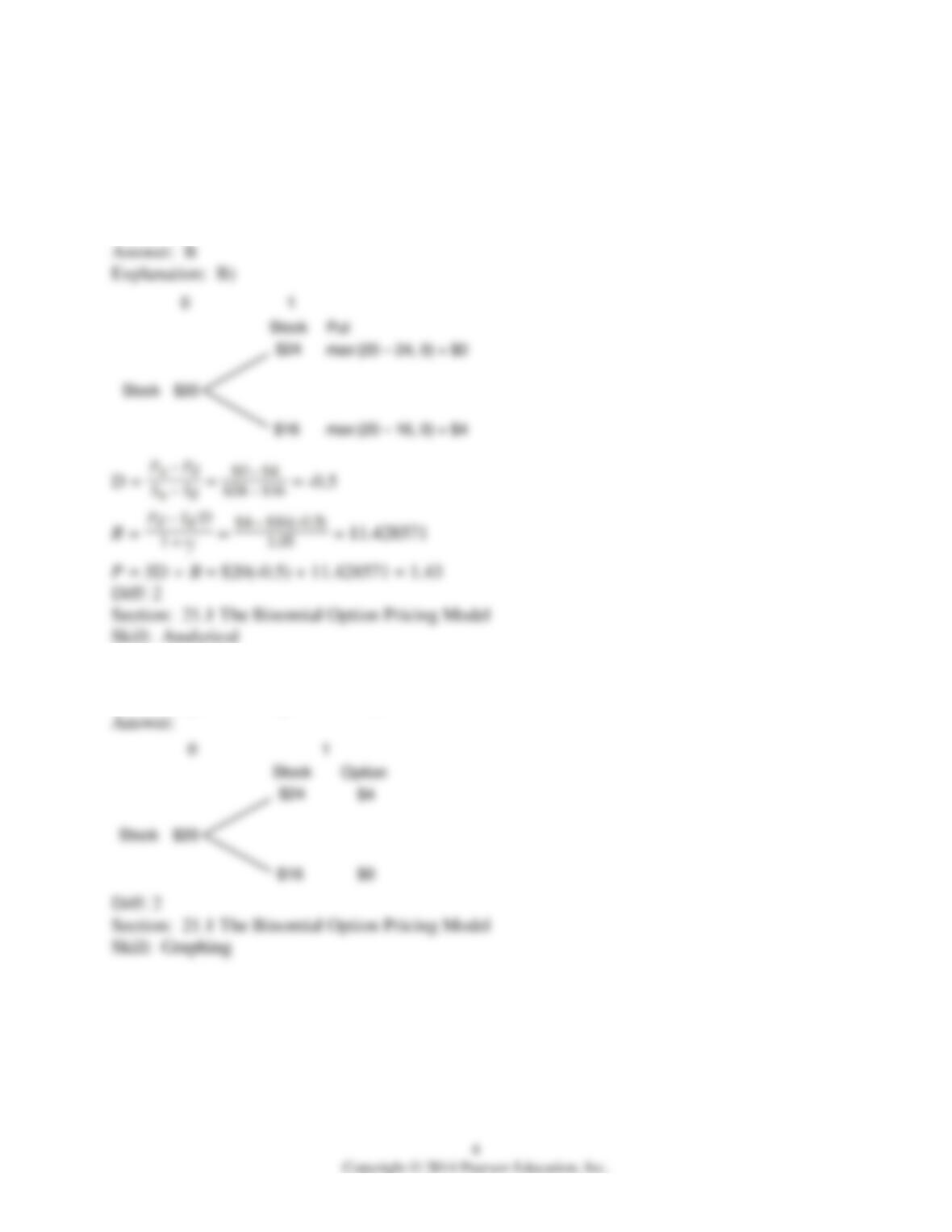
6) Using the binomial pricing model, the calculated price of a one-year put option on KD stock
with a strike price of $20 is closest to:
A) $2.00
B) $1.45
C) $2.40
D) $2..15
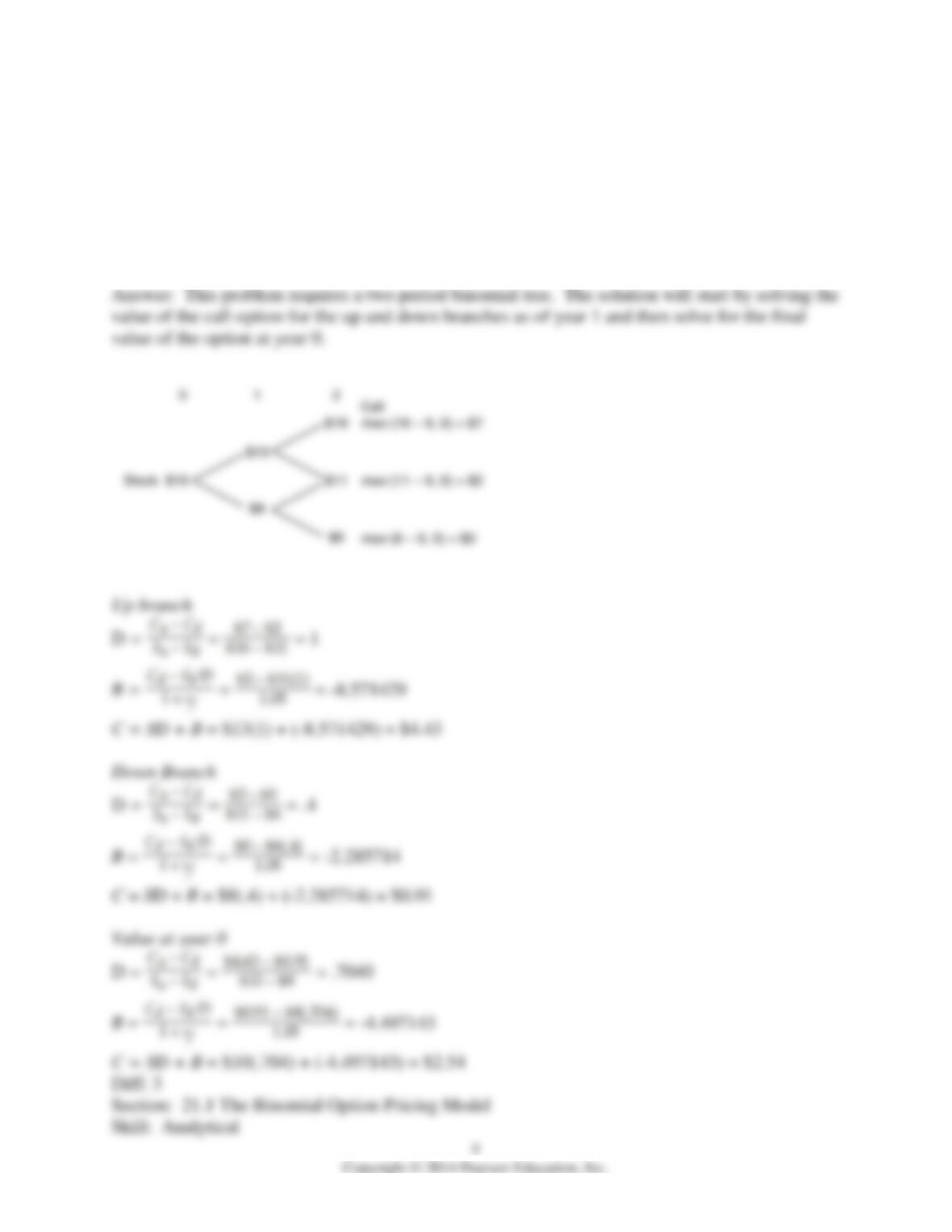
7) Construct a binomial tree detailing the option information and payoffs for a call option with a
$20 strike price that expires in one year.
Use the information for the question(s) below.
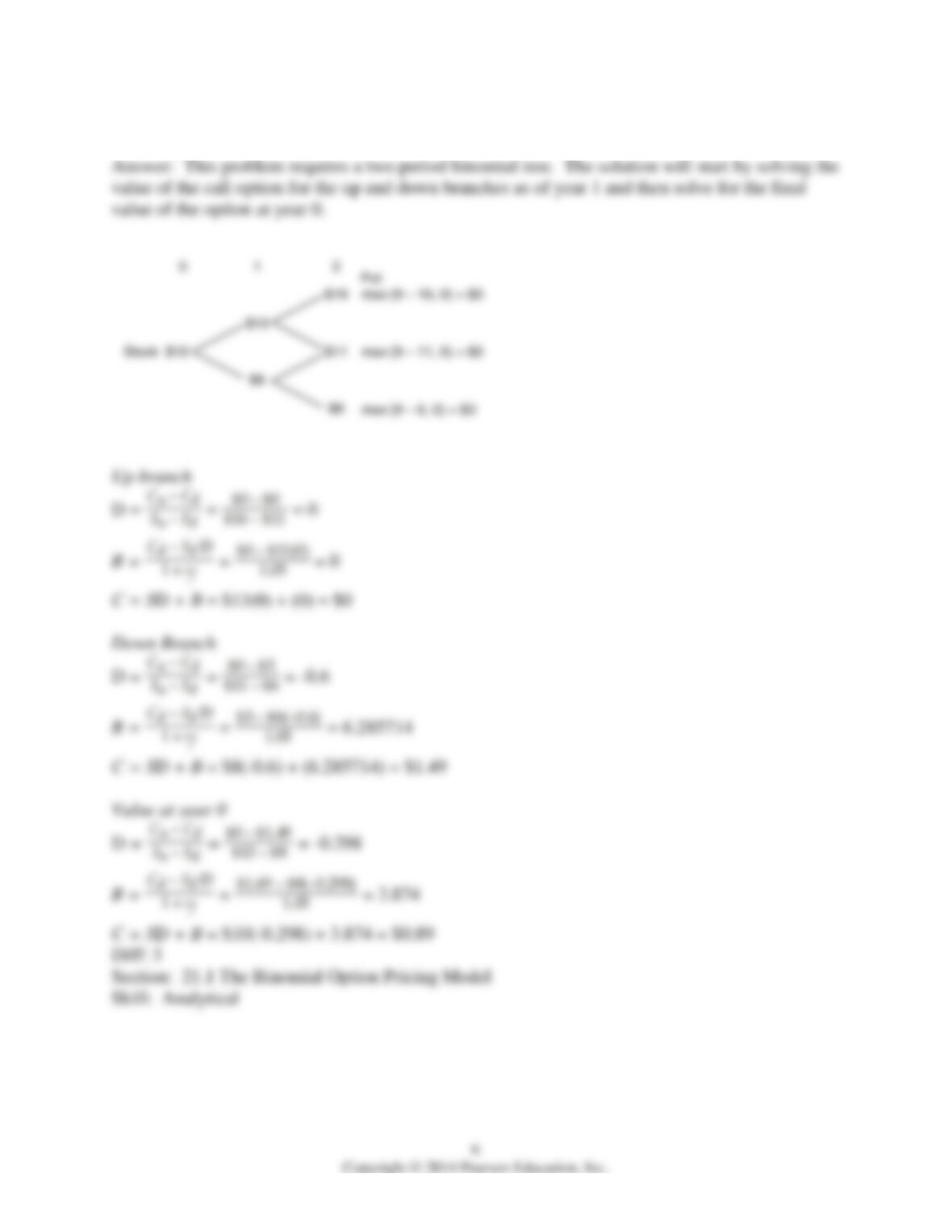
The current price of Kinston Corporation stock is $10. In each of the next two years, this stock
price can wither go up by $3.00 or go down by $2.00. Kinston stock pays no dividends. The one
year risk-free interest rate is 5% and will remain constant.
8) Using the binomial pricing model, calculate the price of a two-year call option on Kinston
stock with a strike price of $9.
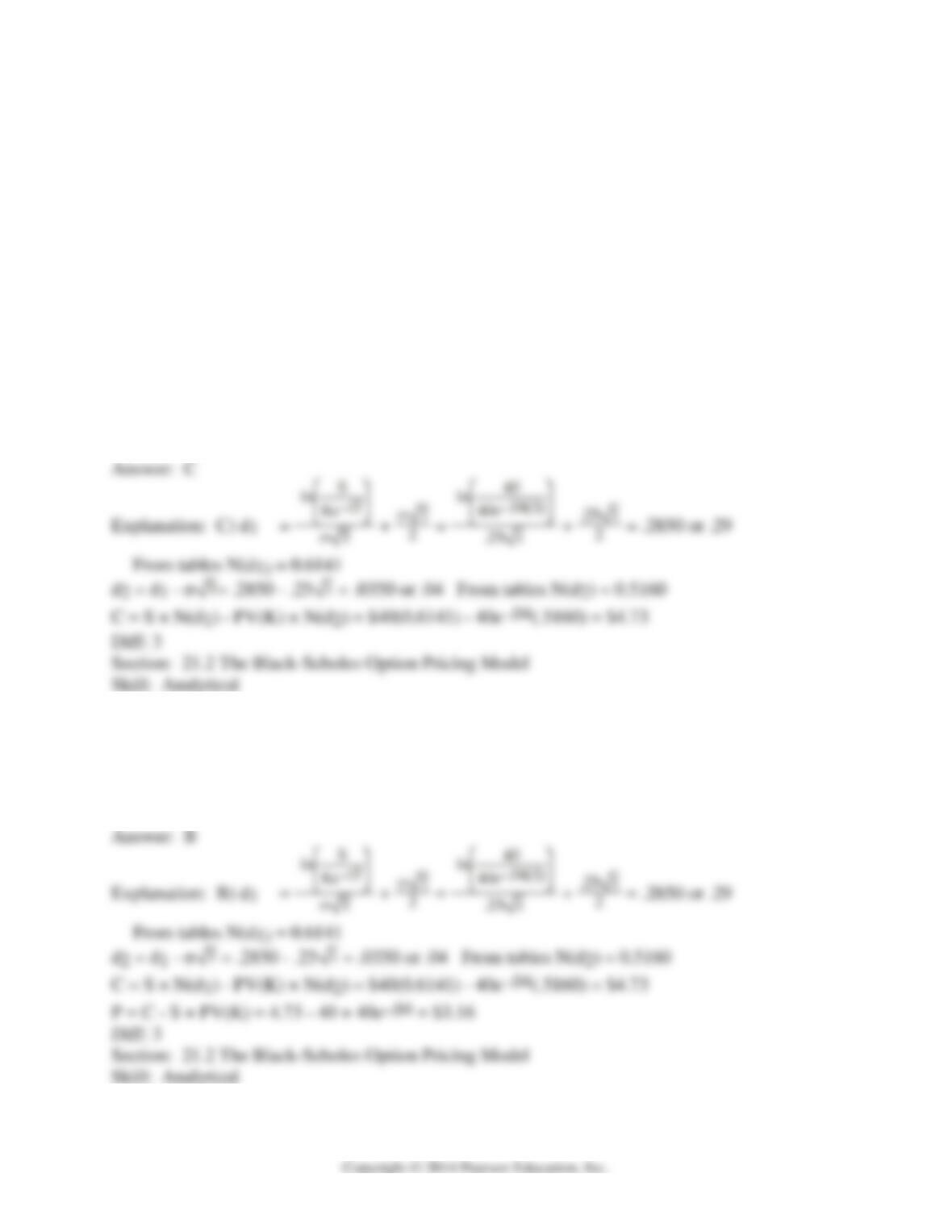
9) Using the binomial pricing model, calculate the price of a two-year put option on Kinston
stock with a strike price of $9.
7
21.2 The Black-Scholes Option Pricing Model
Use the following information to answer the question(s) below.
(Please use a copy of the Cumulative Probabilities for the standard normal distribution for these
problems.)
Taggart Transcontinental’s stock has a volatility of 25% and a current stock price of $40 per
share. Taggart pays no dividends. The risk-free interest rate is 4%.
1) The Black-Scholes value of a one-year, at-the-money call option on Taggart stock is closest
to:
A) $1.45
B) $3.15
C) $4.75
D) $9.50
2) The Black-Scholes value of a one-year, at-the-money put option on Taggart stock is closest to:
A) $1.45
B) $3.15
C) $4.75
D) $9.50
3) The Black-Scholes value of a one-year call option on Taggart stock with a strike price of $50
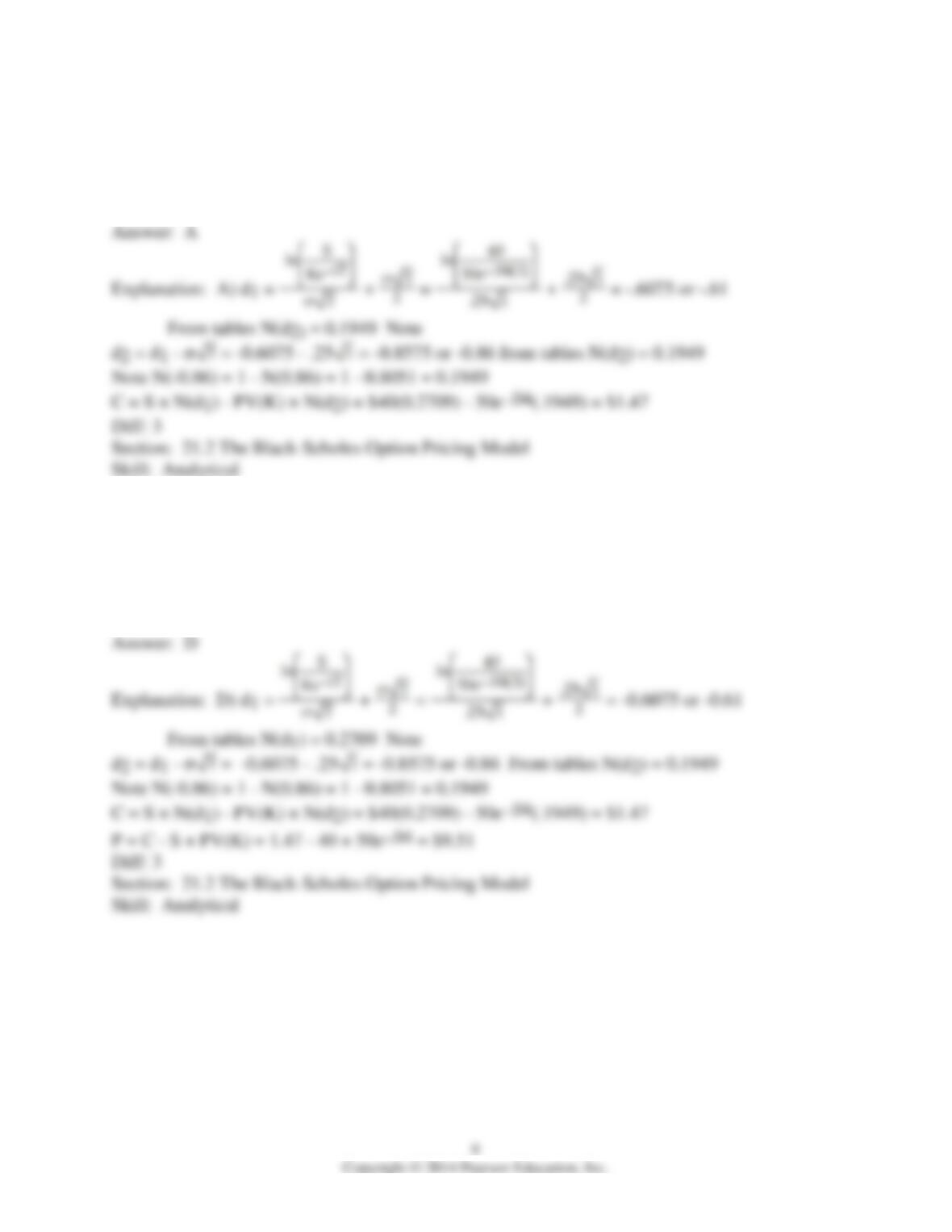
is closest to:
A) $1.45
B) $3.15
C) $4.75
D) $9.50
4) The Black-Scholes value of a one-year European put option on Taggart stock with a strike
price of $50 is closest to:
A) $1.45
B) $3.15
C) $4.75
D) $9.50
5) Consider a one-year, at-the-money call option on Taggart stock. The effect on the price of this
call option of an increase in the risk-free rate from 4% to 6% is closest to:
A) $0.50 decrease
B) $0.50 increase
C) $0.70 decrease
D) $0.80 increase
6) Consider a one-year, at-the-money call option on Taggart stock. The effect on the price of this
call option of an increase in the volatility from 25% to 40% is closest to:
A) $0.70 increase
B) $1.70 decrease
C) $2.30 increase
D) $2.80 increase
7) Which of the following is NOT an input required by the Black-Scholes option pricing model?
A) The expected volatility of the stock
B) The expected return on the stock
C) The risk-free interest rate
D) The current stock price
8) Which of the following statements is FALSE?
A) N(d) is the cumulative normal distribution–that is, the probability that a normally distributed
variable is greater than d.
B) Of the five required inputs in the Black-Scholes formula, four are directly observable.
C) The Black-Scholes formula is derived assuming that the call is a European option.
D) The Black-Scholes Option Pricing Model can be derived from the Binomial Option Pricing
Model by making the length of each period, and the movement of the stock price per period,
shrink to zero and letting the number of periods grow infinitely large.
9) Which of the following statements is FALSE?
A) If you take the option price quoted in the market as an input and solve for the volatility you
will have an estimate of a stock’s volatility known as the implied volatility.
B) The Black-Scholes formula can be used to price American or European call options on non–
dividend-paying stocks.
C) We need to know the expected return on the stock to calculate the option price in the Black-
Scholes Option Pricing Model.
D) We can use the Black-Scholes formula to compute the price of a European put option on a
non-dividend-paying stock by using the put-call parity formula.
10) Which of the following statements is FALSE?
A) The option delta, Δ, has a natural interpretation: It is the change in the price of the stock given
a $1 change in the price of the option.
B) Because a leveraged position in a stock is riskier than the stock itself, this implies that call
options on a positive beta stock are more risky than the underlying stock and therefore have
higher returns and higher betas.
C) Only one parameter input for the Black-Scholes formula, the volatility of the stock price, is
not observable directly.
D) Because a stock’s volatility is much easier to measure (and forecast) than its expected return,
the Black-Scholes formula can be very precise.
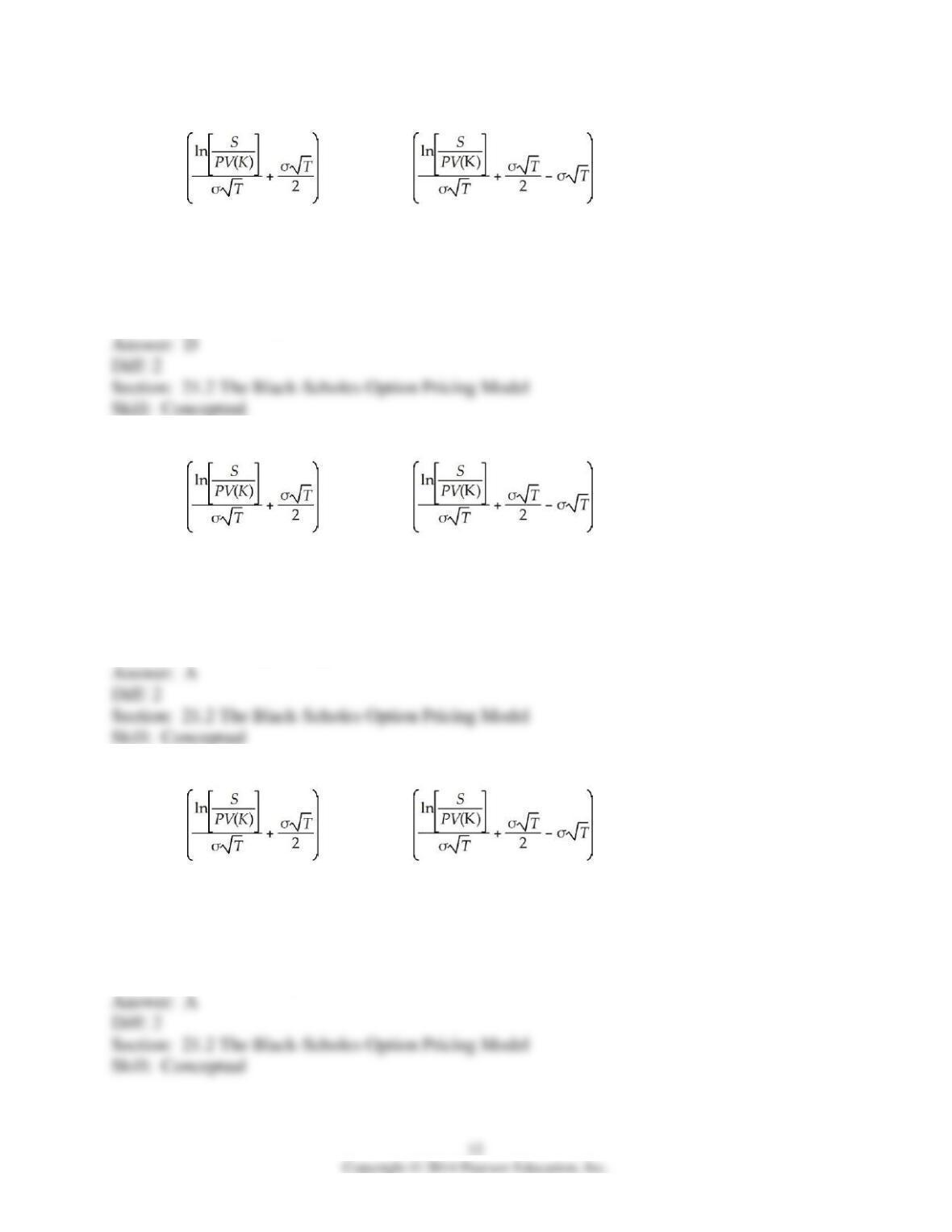
11) Consider the following equation:
C = S × N – PV(K) × N
In this equation, the term σ represents:
A) the number of days to expiration.
B) the number of years to expiration.
C) the expected return on the stock.
D) the annual volatility of the stock.
12) Consider the following equation:
C = S × N – PV(K) × N
In this equation, the term T represents:
A) the number of years to expiration.
B) the annual volatility of the stock.
C) the expected return on the stock.
D) the number of days to expiration.
13) Consider the following equation:
C = S × N – PV(K) × N
In this equation, the term S represents:
A) the current price of the stock.
B) the stock price at expiration.
C) the annual volatility of the stock.
D) strike price for the option.
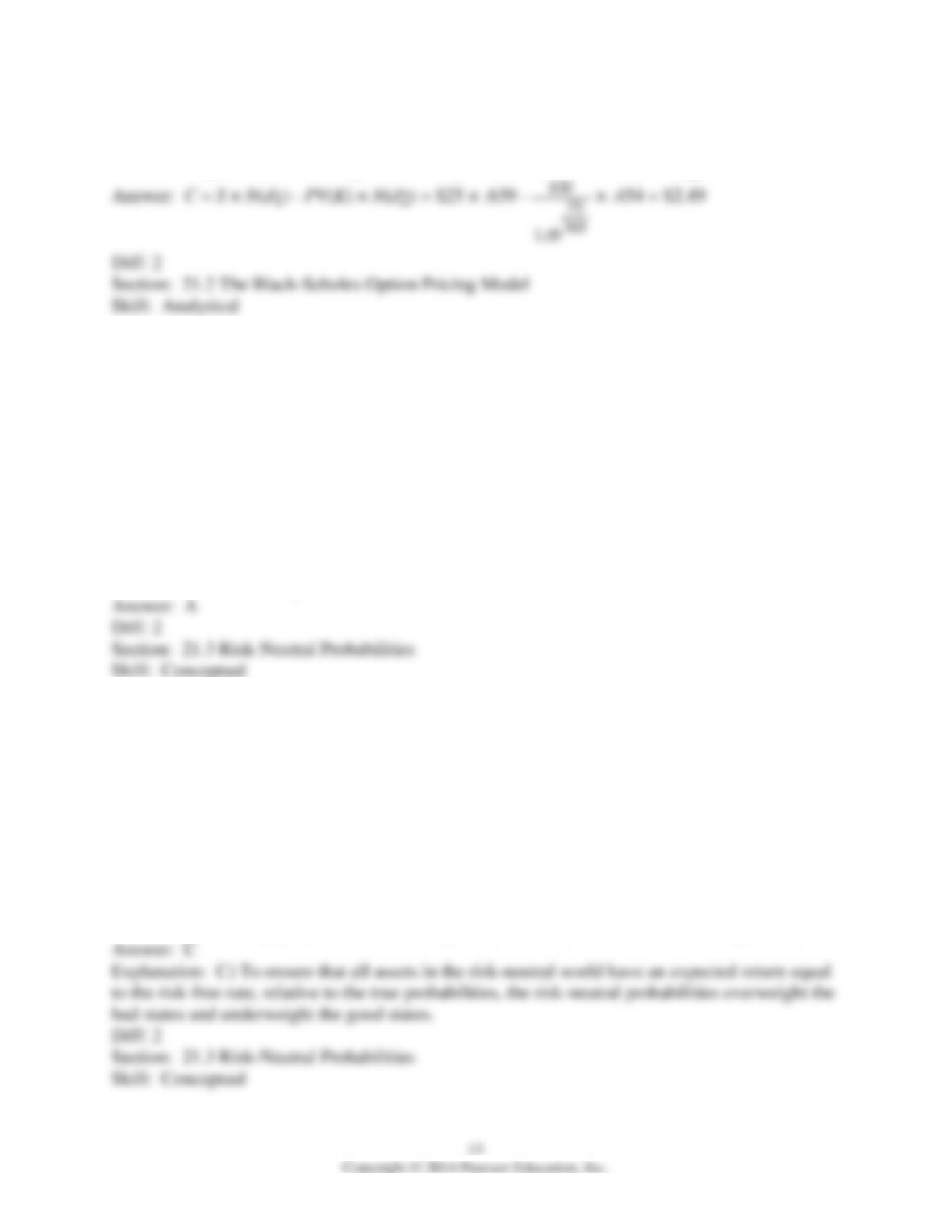
14) Luther Industries does not pay dividend and is currently trading at $25 per share. The
current risk-free rate of interest is 5%. Calculate the price of a call option on Luther Industries
with a strike price of $30 that expires in 75 days when N(d1) = .639 and N(d2) = .454.
21.3 Risk-Neutral Probabilities
1) Which of the following statements is FALSE?
A) In both the Binomial and Black-Scholes Pricing Models, we need to know the risk neutral
probability of each possible future stock price to calculate the option price.
B) In the real world, investors are risk averse. Thus, the expected return of a typical stock
includes a positive risk premium to compensate investors for risk.
C) Because no assumption on the risk preferences of investors is necessary to calculate the
option price using either the Binomial Model or the Black-Scholes formula, the models must
work for any set of preferences, including risk-neutral investors.
D) If all market participants were risk neutral, then all financial assets (including options) would
have the same cost of capital–the risk free rate of interest.
2) Which of the following statements is FALSE?
A) After we have constructed the tree and calculated the probabilities in the risk-neutral world,
we can use them to price the derivative by simply discounting its expected payoff (using the risk
neutral probabilities) at the risk-free rate.
B) By using the probabilities in the risk-neutral world we can price any derivative security–that
is, any security whose payoff depends solely on the prices of other marketed assets.
C) To ensure that all assets in the risk-neutral world have an expected return equal to the risk-
free rate, relative to the true probabilities, the risk-neutral probabilities underweight the bad
states and overweight the good states.
D) In Monte Carlo simulation, the expected payoff of the derivative security is estimated by
calculating its average payoff after simulating many random paths for the underlying stock price.
3) Risk neutral probabilities are also known as all of the following EXCEPT:
A) contingent probabilities.
B) state-contingent prices.
C) martingale prices.
D) state prices.
Use the information for the question(s) below.
The current price of KD Industries stock is $20. In the next year the stock price will either go up
by 20% or go down by 20%. KD pays no dividends. The one year risk-free rate is 5% and will
remain constant.
4) The risk neutral probability of an up state for KD Industries is closest to:
A) 37.5%
B) 60.0%
C) 40.0%
D) 62.5%
5) The risk neutral probability of a down state for KD Industries is closest to:
A) 37.5%
B) 62.5%
C) 40.0%
D) 60.0%
15
6) Using risk neutral probabilities, the calculated price of a one-year call option on KD stock
with a strike price of $20 is closest to:
A) $1.45
B) $2.40
C) $2.00
D) $2.15
7) Using risk neutral probabilities, the calculated price of a one-year put option on KD stock with
a strike price of $20 is closest to:
A) $2.00
B) $2.15
C) $1.45
D) $2.40
8) Using risk neutral probabilities, calculate the price of a two-year call option on Kinston stock
with a strike price of $9.
9) Using risk neutral probabilities, calculate the price of a two-year put option on Kinston stock
with a strike price of $9.
21.4 Risk and Return of an Option
Use the following information to answer the question(s) below.
(Please use a copy of the Cumulative Probabilities for the standard normal distribution for these
problems.)
Taggart Transcontinental’s stock has a volatility of 25% and a current stock price of $40 per
share. Taggart pays no dividends. The risk-free interest rate is 4%.
1) The Black-Scholes Δ of a one-year, at-the-money call option on Taggart stock is closest to:
A) 0.2850
B) 0.4840
C) 0.5160
D) 0.6141
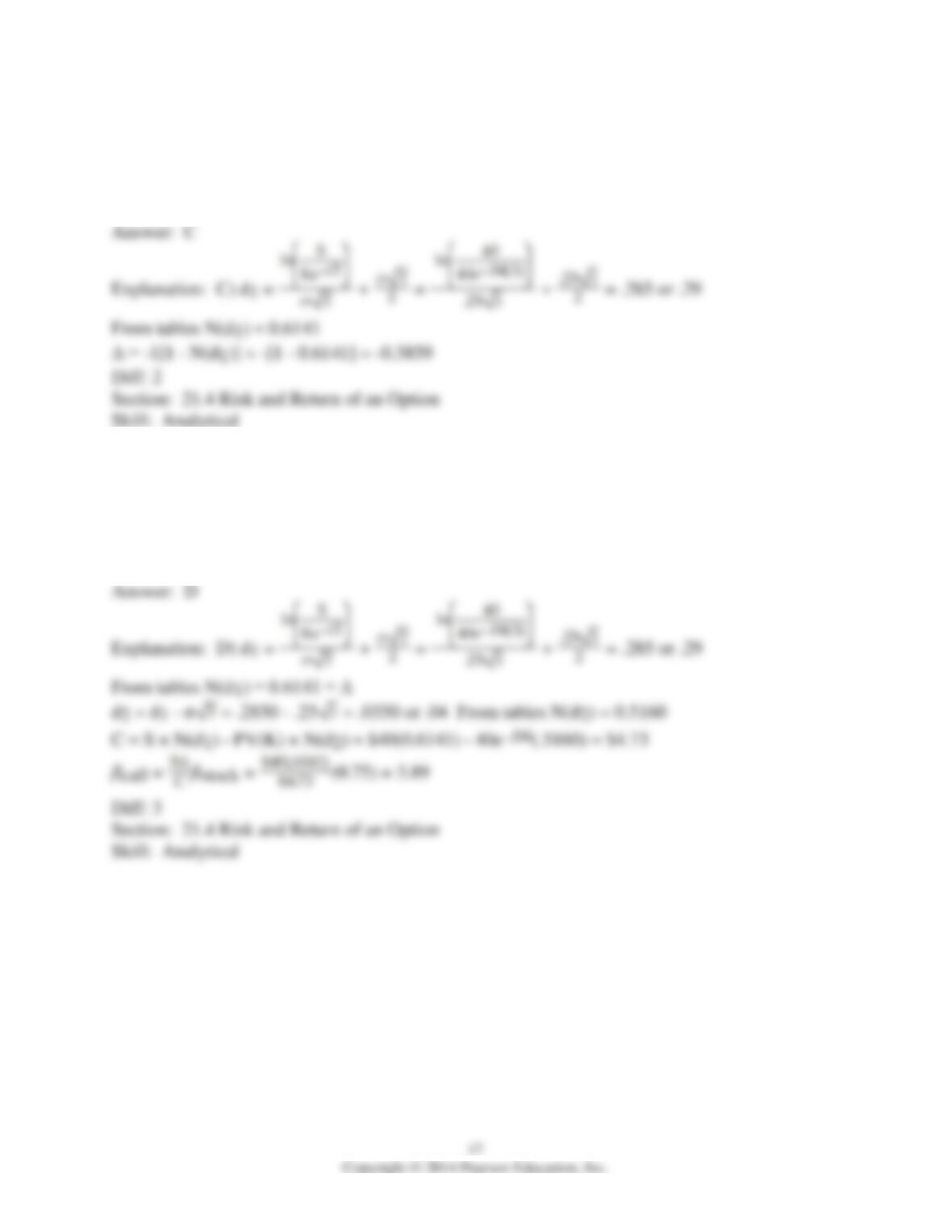
2) The Black-Scholes Δ of a one-year, at-the-money put option on Taggart stock is closest to:
A) -0.2850
B) 0.2850
C) -0.3859
D) -0.6141
3) Assuming the beta on Taggart stock is 0.75, then the beta for a one-year, at-the-money call
option on Taggart stock is closest to:
A) 0.60
B) 0.75
C) 2.84
D) 3.89
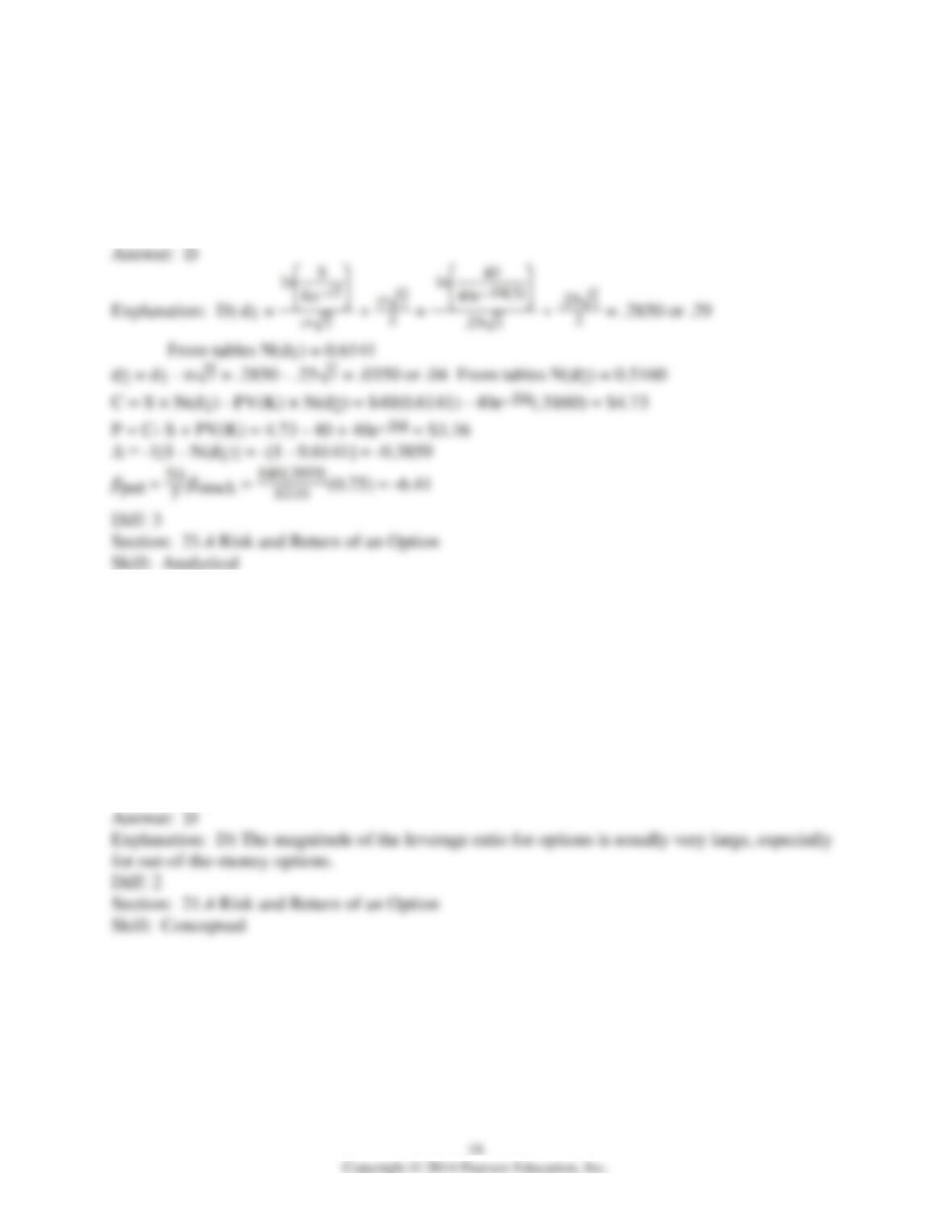
4) Assuming the beta on Taggart stock is 0.75, then the beta for a one-year, at-the-money put
option on Taggart stock is closest to:
A) -0.75
B) -2.84
C) -3.89
D) -6.41
5) Which of the following statements is FALSE?
A) Out-of-the-money calls have the highest expected returns and out-of–the-money puts have the
lowest expected returns.
B) The expression SΔ/(SΔ + B) is the ratio of the amount of money in the stock position in the
replicating portfolio to the value of the replicating portfolio (or the option price); it is known as
the leverage ratio.
C) The beta of a portfolio is just the weighted average beta of the constituent securities that make
up the portfolio.
D) The magnitude of the leverage ratio for options is usually very small, especially for out-of–
the-money options.
6) Which of the following statements is FALSE?
A) For a call written on a stock with positive beta, the beta of the call always exceeds the beta of
the stock.
B) The beta of a put option written on a negative beta stock is always negative.
C) As the stock price changes, the beta of an option will change, with its magnitude falling as the
option goes in-the-money.
D) A put option is a hedge, so its price goes up when the stock price goes down.
7) Consider the following equation:
boption = bS + bB
The term bB is:
A) always equal to zero since bB = 0.
B) always positive since B is always positive.
C) could be positive or negative depending on whether the option in question is a put or a call.
D) always negative since B is always negative.
Use the information for the question(s) below.
The current price of KD Industries stock is $20. In the next year the stock price will either go up
by 20% or go down by 20%. KD pays no dividends. The one year risk-free rate is 5% and will
remain constant.
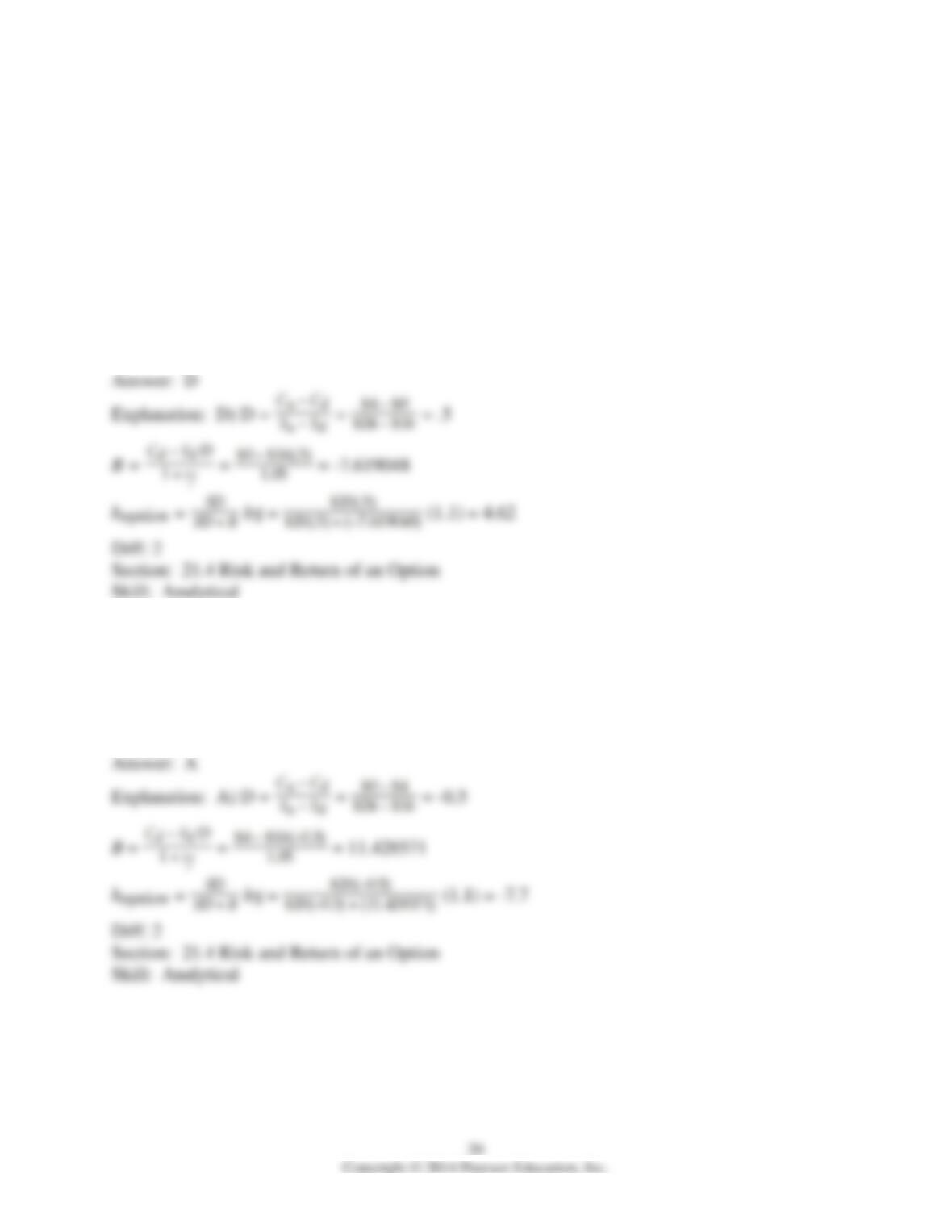
8) Assuming the Beta on KD stock is 1.1, the calculated beta for a one-year call option on KD
stock with a strike price of $20 is closest to:
A) -1.8
B) 2.4
C) -7.7
D) 4.6
9) Using the binomial pricing model, the calculated price of a one-year put option on KD stock
with a strike price of $20 is closest to:
A) -7.7
B) 2.4
C) 4.6
D) -1.8