
Campbell’s Biology, 9e (Reece et al.)
Chapter 21 Genomes and Their Evolution
Although the major overhaul of this chapter occurred during the 8th edition, questions have been added
for every concept in this new edition. The new questions test on a variety of levels, from basic
knowledge and understanding to synthesis, and some present images from the textbook that require
interpretation.
Multiple-Choice Questions
1) For mapping studies of genomes, most of which were far along before 2000, the three-stage method
was often used. Which of the following is the usual order in which the stages were performed, assuming
some overlap of the three?
A) genetic map, sequencing of fragments, physical map
B) linkage map, physical map, sequencing of fragments
C) sequencing of entire genome, physical map, genetic map
D) cytogenetic linkage, sequencing, physical map
E) physical map, linkage map, sequencing
2) What is the difference between a linkage map and a physical map?
A) For a linkage map, markers are spaced by recombination frequency, whereas for a physical map they
are spaced by numbers of base pairs (bp).
B) For a physical map, the ATCG order and sequence must be achieved; however, it does not for the
linkage map.
C) For a linkage map, it is shown how each gene is linked to every other gene.
D) For a physical map, the distances must be calculable in units such as nanometers.
E) There is no difference between the two except in the type of pictorial representation.
3) How is a physical map of the genome of an organism achieved?
A) using recombination frequency
B) using very high-powered microscopy
C) using restriction enzyme cutting sites
D) using sequencing of nucleotides
E) using DNA fingerprinting via electrophoresis

4) Which of the following most correctly describes a shotgun technique for sequencing a genome?
A) genetic mapping followed immediately by sequencing
B) physical mapping followed immediately by sequencing
C) cloning large genome fragments into very large vectors such as YACs, followed by sequencing
D) cloning several sizes of fragments into various size vectors, ordering the clones, and then sequencing
them
E) cloning the whole genome directly, from one end to the other
5) The biggest problem with the shotgun technique is its tendency to underestimate the size of the
genome. Which of the following might best account for this?
A) skipping some of the clones to be sequenced
B) missing some of the overlapping regions of the clones
C) counting some of the overlapping regions of the clones twice
D) having some of the clones die during the experiment and therefore not be represented
E) missing some duplicated sequences
6) What is metagenomics?
A) genomics as applied to a species that most typifies the average phenotype of its genus
B) the sequence of one or two representative genes from several species
C) the sequencing of only the most highly conserved genes in a lineage
D) sequencing DNA from a group of species from the same ecosystem
E) genomics as applied to an entire phylum
7) Which procedure is not required when the shotgun approach to sequencing is modified as sequencing
by synthesis, in which many small fragments are sequenced simultaneously?
A) use of restriction enzymes
B) sequencing each fragment
C) cloning each fragment into a plasmid
D) ordering the sequences
E) PCR amplification

8) What is bioinformatics?
A) a technique using 3-D images of genes in order to predict how and when they will be expressed
B) a method that uses very large national and international databases to access and work with sequence
information
C) a software program available from NIH to design genes
D) a series of search programs that allow a student to identify who in the world is trying to sequence a
given species
E) a procedure that uses software to order DNA sequences in a variety of comparable ways
9) What is proteomics?
A) the linkage of each gene to a particular protein
B) the study of the full protein set encoded by a genome
C) the totality of the functional possibilities of a single protein
D) the study of how amino acids are ordered in a protein
E) the study of how a single gene activates many proteins
10) Bioinformatics can be used to scan sequences for probable genes looking for start and stop sites for
transcription and for translation, for probable splice sites, and for sequences known to be found in other
known genes. Such sequences containing these elements are called
A) expressed sequence tags.
B) cDNA.
C) multigene families.
D) proteomes.
E) short tandem repeats.
11) A microarray known as a GeneChip, with most now-known human protein coding sequences, has
been developed to aid in the study of human cancer by first comparing two to three subsets of cancer
subtypes. What kind of information might be gleaned from this GeneChip to aid in cancer prevention?
A) information about whether or not a patient has this type of cancer prior to treatment
B) evidence that might suggest how best to treat a person’s cancer with chemotherapy
C) data that could alert patients to what kind of cancer they were likely to acquire
D) information about which parent might have provided a patient with cancer-causing genes
E) information on cancer epidemiology in the United States or elsewhere

12) What is gene annotation in bioinformatics?
A) finding transcriptional start and stop sites, RNA splice sites, and ESTs
B) describing the functions of protein-coding genes
C) describing the functions of noncoding regions of the genome
D) matching the corresponding phenotypes of different species
E) comparing the protein sequences within a single phylum
13) Why is it unwise to try to relate an organism’s complexity with its size or number of cells?
A) A very large organism may be composed of very few cells or very few cell types.
B) A single-celled organism, such as a bacterium or a protist, still has to conduct all the complex life
functions of a large multicellular organism.
C) A single-celled organism that is also eukaryotic, such as a yeast, still reproduces mitotically.
D) A simple organism can have a much larger genome.
E) A complex organism can have a very small and simple genome.
14) Fragments of DNA have been extracted from the remnants of extinct woolly mammoths, amplified,
and sequenced. These can now be used to
A) introduce into relatives, such as elephants, certain mammoth traits.
B) clone live woolly mammoths.
C) study the relationships among woolly mammoths and other wool-producers.
D) understand the evolutionary relationships among members of related taxa.
E) appreciate the reasons why mammoths went extinct.
15) If humans have 2,900 Mb, a specific member of the lily family has 120,000 Mb, and a yeast has ~13
Mb, why can’t this data allow us to order their evolutionary significance?
A) Size matters less than gene density.
B) Size does not compare to gene density.
C) Size does not vary with gene complexity.
D) Size is mostly due to “junk” DNA.
E) Size is comparable only within phyla.

16) Which of the following is a representation of gene density?
A) Humans have 2,900 Mb per genome.
B) C. elegans has ~20,000 genes.
C) Humans have ~20,000 genes in 2,900 Mb.
D) Humans have 27,000 bp in introns.
E) Fritillaria has a genome 40 times the size of a human.
17) Why might the cricket genome have 11 times as many base pairs as that of Drosophila
melanogaster?
A) The two insect species evolved at very different geologic eras.
B) Crickets have higher gene density.
C) Drosophila are more complex organisms.
D) Crickets must have more noncoding DNA.
E) Crickets must make many more proteins.
18) The comparison between the number of human genes and those of other animal species has led to
many conclusions, including
A) the density of the human genome is far higher than in most other animals.
B) the number of proteins expressed by the human genome is far more than the number of its genes.
C) most human DNA consists of genes for protein, tRNA, rRNA, and miRNA.
D) the genomes of other organisms are most significantly smaller than the human genome.
19) Barbara McClintock, who achieved fame for discovering that genes could move within genomes,
had her meticulous work ignored for nearly four decades, but eventually won the Nobel Prize. Why was
her work so distrusted?
A) The work of women scientists was still not allowed to be published.
B) Geneticists did not want to lose their cherished notions of DNA stability.
C) There were too many alternative explanations for transposition.
D) She allowed no one else to duplicate her work.
E) She worked only with maize, which was considered “merely” a plant.

20) What is the most probable explanation for the continued presence of pseudogenes in a genome such
as our own?
A) They are genes that had a function at one time, but that have lost their function because they have
been translocated to a new location.
B) They are genes that have accumulated mutations to such a degree that they would code for different
functional products if activated.
C) They are duplicates or near duplicates of functional genes but cannot function because they would
provide inappropriate dosage of protein products.
D) They are genes with significant inverted sequences.
E) They are genes that are not expressed, even though they have nearly identical sequences to expressed
genes.
21) What characteristic of short tandem repeat DNA makes it useful for DNA fingerprinting?
A) The number of repeats varies widely from person to person or animal to animal.
B) The sequence of DNA that is repeated varies significantly from individual to individual.
C) The sequence variation is acted upon differently by natural selection in different environments.
D) Every racial and ethnic group has inherited different short tandem repeats.
22) Alu elements account for about 10% of the human genome. What does this mean?
A) Alu elements cannot be transcribed into RNA.
B) Alu elements evolved in very ancient times, before mammalian radiation.
C) Alu elements represent the result of transposition.
D) No Alu elements are found within individual genes.
E) Alu elements are cDNA and therefore related to retrotransposons.
23) A multigene family is composed of
A) multiple genes whose products must be coordinately expressed.
B) genes whose sequences are very similar and that probably arose by duplication.
C) the many tandem repeats such as those found in centromeres and telomeres.
D) a gene whose exons can be spliced in a number of different ways.
E) a highly conserved gene found in a number of different species.

24) Which of the following can be duplicated in a genome?
A) DNA sequences above a minimum size only
B) DNA sequences below a minimum size only
C) entire chromosomes only
D) entire sets of chromosomes only
E) sequences, chromosomes, or sets of chromosomes
25) In comparing the genomes of humans and those of other higher primates, it is seen that humans have
a large metacentric pair we call chromosome 2 among our 46 chromosomes, whereas the other primates
of this group have 48 chromosomes and any pair like the human chromosome 2 pair is not present;
instead, the primate groups each have two pairs of midsize acrocentric chromosomes. What is the most
likely explanation?
A) The ancestral organism had 48 chromosomes and at some point a centric fusion event occurred and
provided some selective advantage.
B) The ancestral organism had 46 chromosomes, but primates evolved when one of the pairs broke in
half.
C) At some point in evolution, human ancestors and primate ancestors were able to mate and produce
fertile offspring, making a new species.
D) Chromosome breakage results in additional centromeres being made in order for meiosis to proceed
successfully.
E) Transposable elements transferred significantly large segments of the chromosomes to new locations.
26) Unequal crossing over during prophase I can result in one sister chromosome with a deletion and
another with a duplication. A mutated form of hemoglobin, known as hemoglobin Lepore, is known in
the human population. Hemoglobin Lepore has a deleted set of amino acids. If it was caused by unequal
crossing over, what would be an expected consequence?
A) If it is still maintained in the human population, hemoglobin Lepore must be selected for in
evolution.
B) There should also be persons born with, if not living long lives with, an anti-Lepore mutation or
duplication.
C) Each of the genes in the hemoglobin gene family must show the same deletion.
D) The deleted gene must have undergone exon shuffling.
E) The deleted region must be located in a different area of the individual’s genome.

27) When does exon shuffling occur?
A) during splicing of DNA
B) during mitotic recombination
C) as an alternative splicing pattern in post-transcriptional processing
D) as an alternative cleavage or modification post-translationally
E) as the result of faulty DNA repair
28) What are genomic “hot spots”?
A) the locations that correspond to most genetic diseases
B) the areas of a genome that most often mutate due to environmental effects
C) the locations that most often correspond with chromosomal breakpoints
D) the locations that correspond to most genetic diseases and the locations that most often correspond
with chromosomal breakpoints
E) the locations that correspond to most genetic diseases, the areas of a genome that most often mutate
due to environmental effects, and the locations that most often correspond with chromosomal
breakpoints
29) In order to determine the probable function of a particular sequence of DNA in humans, what might
be the most reasonable approach?
A) Prepare a knockout mouse without a copy of this sequence and examine the mouse phenotype.
B) Genetically engineer a mouse with a copy of this sequence and examine its phenotype.
C) Look for a reasonably identical sequence in another species, prepare a knockout of this sequence in
that species, and look for the consequences.
D) Prepare a genetically engineered bacterial culture with the sequence inserted and assess which new
protein is synthesized.
E) Mate two individuals heterozygous for the normal and mutated sequences.
30) Homeotic genes contain a homeobox sequence that is highly conserved among very diverse species.
The homeobox is the code for that domain of a protein that binds to DNA in a regulatory developmental
process. Which of the following would you then expect?
A) that homeotic genes are selectively expressed over developmental time
B) that a homeobox-containing gene has to be a developmental regulator
C) that homeoboxes cannot be expressed in nonhomeotic genes
D) that all organisms must have homeotic genes
E) that all organisms must have homeobox-containing genes

31) Which of the following studies would not likely be characterized as eco-devo?
A) the study of a particular species to see whether or not it has developmental regulation
B) a study of the assortment of homeotic genes in the zebra
C) a comparison of the functions of a particular homeotic gene among four species of reptiles
D) studying the environmental pressures on developmental stages such as the tadpole
E) a fossil comparison of organisms from the Devonian era
32) A recent report has indicated several conclusions about comparisons of our genome with that of
Neanderthals. This report concludes, in part, that, at some period in evolutionary history, there was an
admixture of the two genomes. This is evidenced by
A) some Neanderthal sequences not found in humans.
B) a small number of modern H. sapiens with Neanderthal sequences.
C) Neanderthal Y chromosomes preserved in the modern population of males.
D) mitochondrial sequences common to both groups.
Art Questions
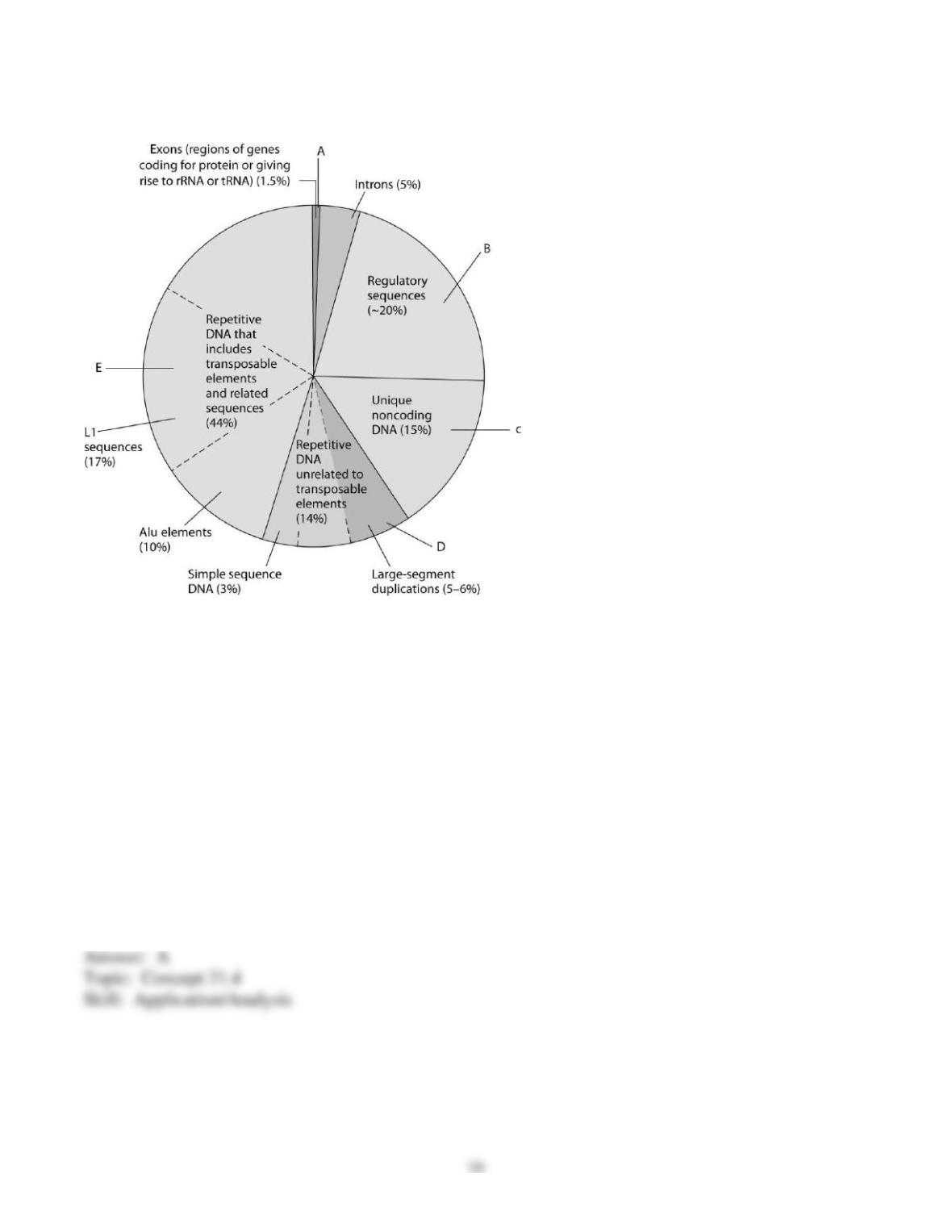
Use the following figure to answer the next few questions.
Figure 21.1 Types of DNA sequences in the human genome.
The pie chart in Figure 21.1 represents the relative frequencies of the following in the human genome:
I. repetitive DNA unrelated to transposons
II. repetitive DNA that includes transposons
III. unique noncoding DNA
IV. introns and regulatory sequences
V. exons
33) Which region is occupied by exons only (V)?
A) A
B) B
C) C
D) D
E) E
34) Which region includes Alu elements and LI sequences?
A) A
B) B
C) C
D) D
E) E
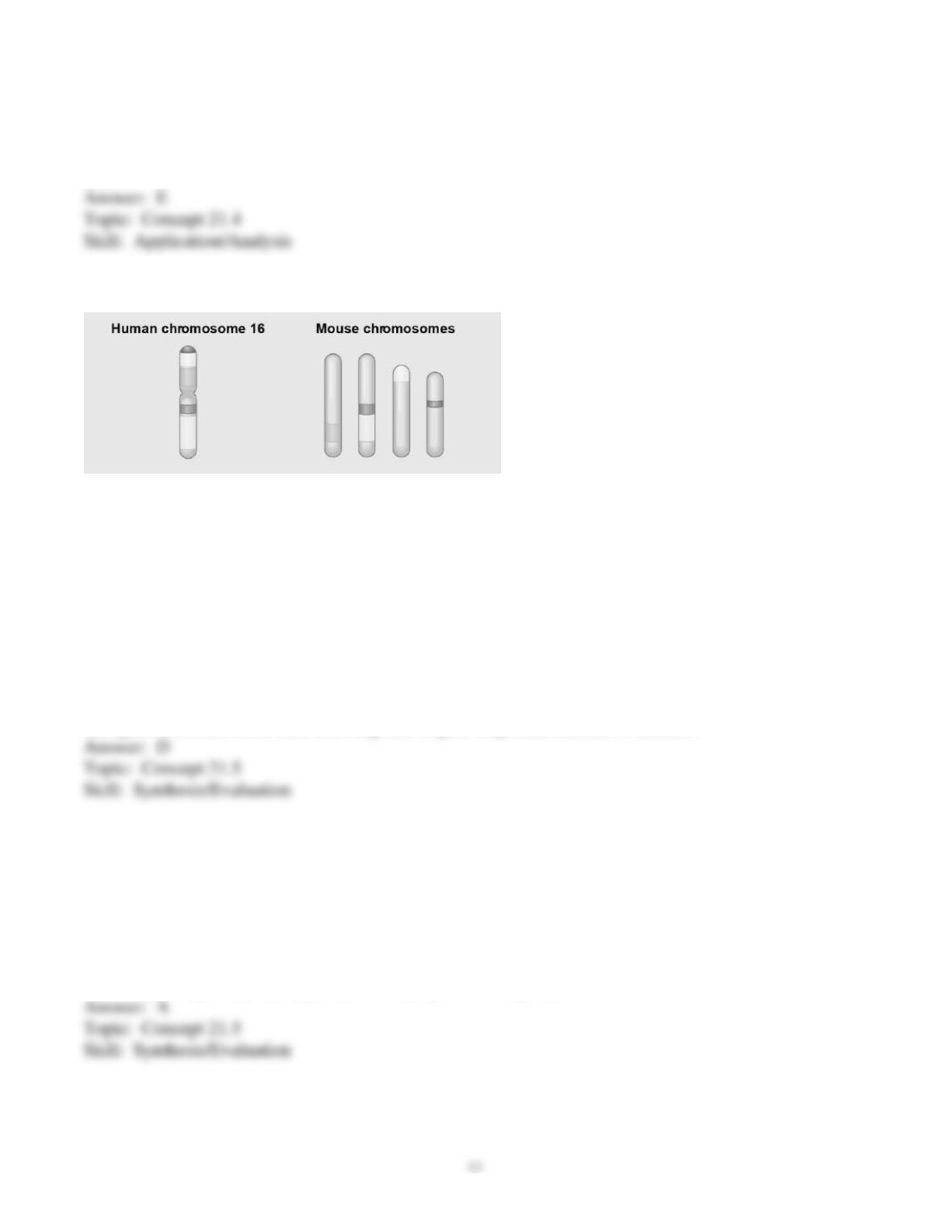
Use the following figure to answer the next few questions.
Figure 21.2
Figure 21.2 shows a diagram of blocks of genes on human chromosome 16 and the locations of blocks
of similar genes on four chromosomes of the mouse.
35) The movement of these blocks suggests that
A) during evolutionary time, these sequences have separated and have returned to their original
positions.
B) DNA sequences within these blocks have become increasingly divergent.
C) sequences represented have duplicated at least three times.
D) chromosomal translocations have moved blocks of sequences to other chromosomes.
E) higher mammals have more convergence of gene sequences related in function.
36) Which of the following represents another example of the same phenomenon as that shown in Figure
21.2?
A) the apparent centric fusion between two chromosome pairs of primates such as chimps to form the
ancestor of human chromosome 2
B) the difference in the numbers of chromosomes in five species of one genus of birds
C) the formation of several pseudogenes in the globin gene family subsequent to human divergence
from other primates
D) the high frequency of polyploidy in many species of angiosperms

Scenario Questions
Use the following information to help you answer the next few questions.
Multigene families include two or more nearly identical genes or genes sharing nearly identical
sequences. A classical example is the set of genes for globin molecules, including genes on human
chromosomes 11 and 16.
37) How might identical and obviously duplicated gene sequences have gotten from one chromosome to
another?
A) by normal meiotic recombination
B) by normal mitotic recombination between sister chromatids
C) by transcription followed by recombination
D) by chromosomal translocation
E) by deletion followed by insertion
38) Several of the different globin genes are expressed in humans, but at different times in development.
What mechanism could allow for this?
A) exon shuffling
B) intron activation
C) pseudogene activation
D) differential translation of mRNAs
E) differential gene regulation over time
End-of-Chapter Questions
The following questions are from the end-of–chapter “Test Your Understanding” section in Chapter 21
of the textbook.
39) Bioinformatics includes all of the following except
A) using computer programs to align DNA sequences.
B) analyzing protein interactions in a species.
C) using molecular biology to combine DNA from two different sources in a test tube.
D) developing computer-based tools for genome analysis.
E) using mathematical tools to make sense of biological systems.

40) One of the characteristics of retrotransposons is that
A) they code for an enzyme that synthesizes DNA using an RNA template.
B) they are found only in animal cells.
C) they generally move by a cut-and-paste mechanism.
D) they contribute a significant portion of the genetic variability seen within a population of gametes.
E) their amplification is dependent on a retrovirus.
41) Homeotic genes
A) encode transcription factors that control the expression of genes responsible for specific anatomical
structures.
B) are found only in Drosophila and other arthropods.
C) are the only genes that contain the homeobox domain.
D) encode proteins that form anatomical structures in the fly.
E) are responsible for patterning during plant development.
42) Two eukaryotic proteins have one domain in common but are otherwise very different. Which of the
following processes is most likely to have contributed to this similarity?
A) gene duplication
B) RNA splicing
C) exon shuffling
D) histone modification
E) random point mutations