Cost Accounting: A Managerial Emphasis, 6e
Chapter 21 – Capital Budgeting: Methods of Investment Analysis
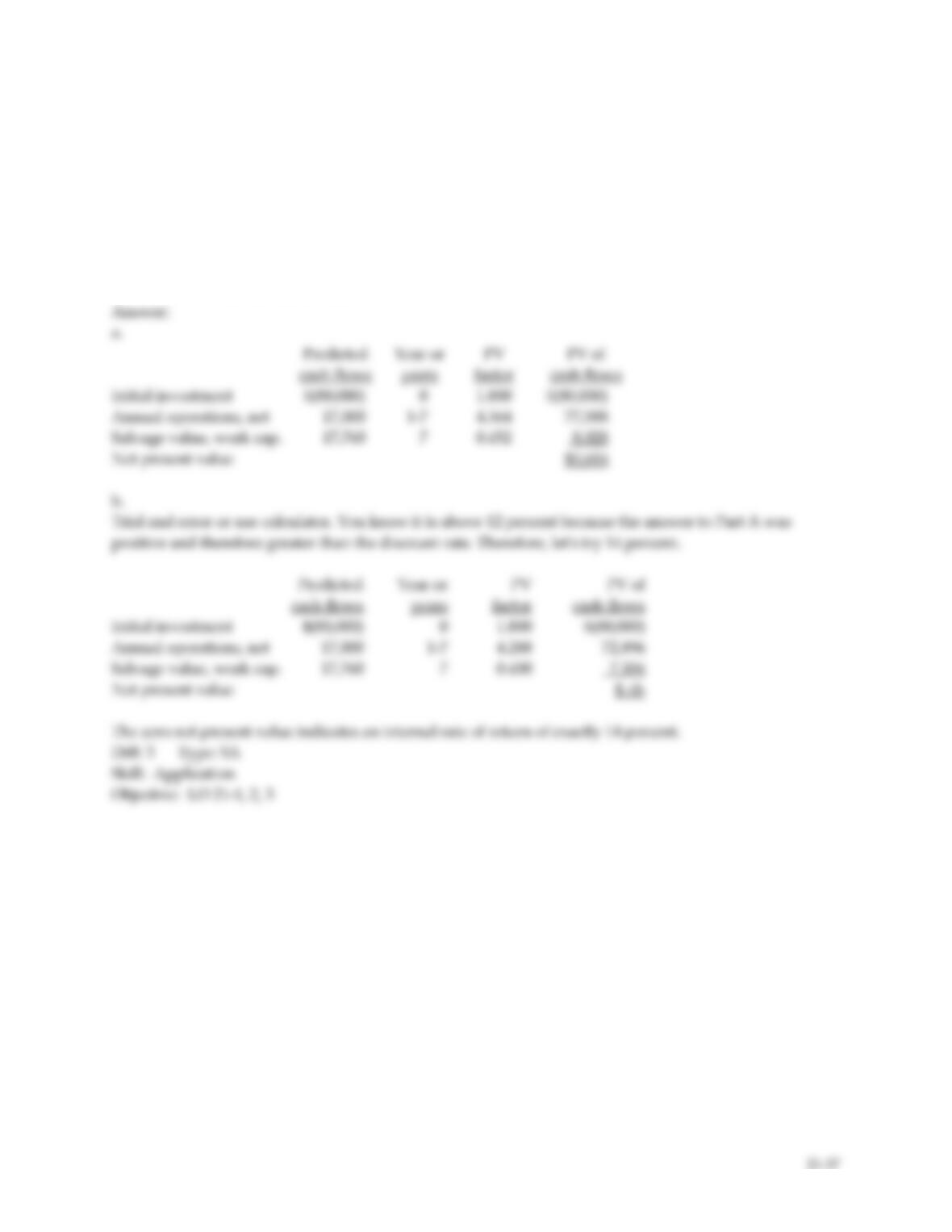
15) Mercury Ltd. is considering purchasing laser equipment for $72,000. The machine will require
additional working capital of $8,000. Its anticipated seven-year life will generate additional revenue of
$31,000 annually with operating costs, excluding depreciation, of $14,000. At the end of seven years it will
have a salvage value of $17,760 and return $8,000 in working capital.
Required:
a. If the company has a required rate of return of 12 percent, what is the net present value of the
proposed investment?
b. What is the internal rate of return?
Cost Accounting: A Managerial Emphasis, 6e
Chapter 21 – Capital Budgeting: Methods of Investment Analysis
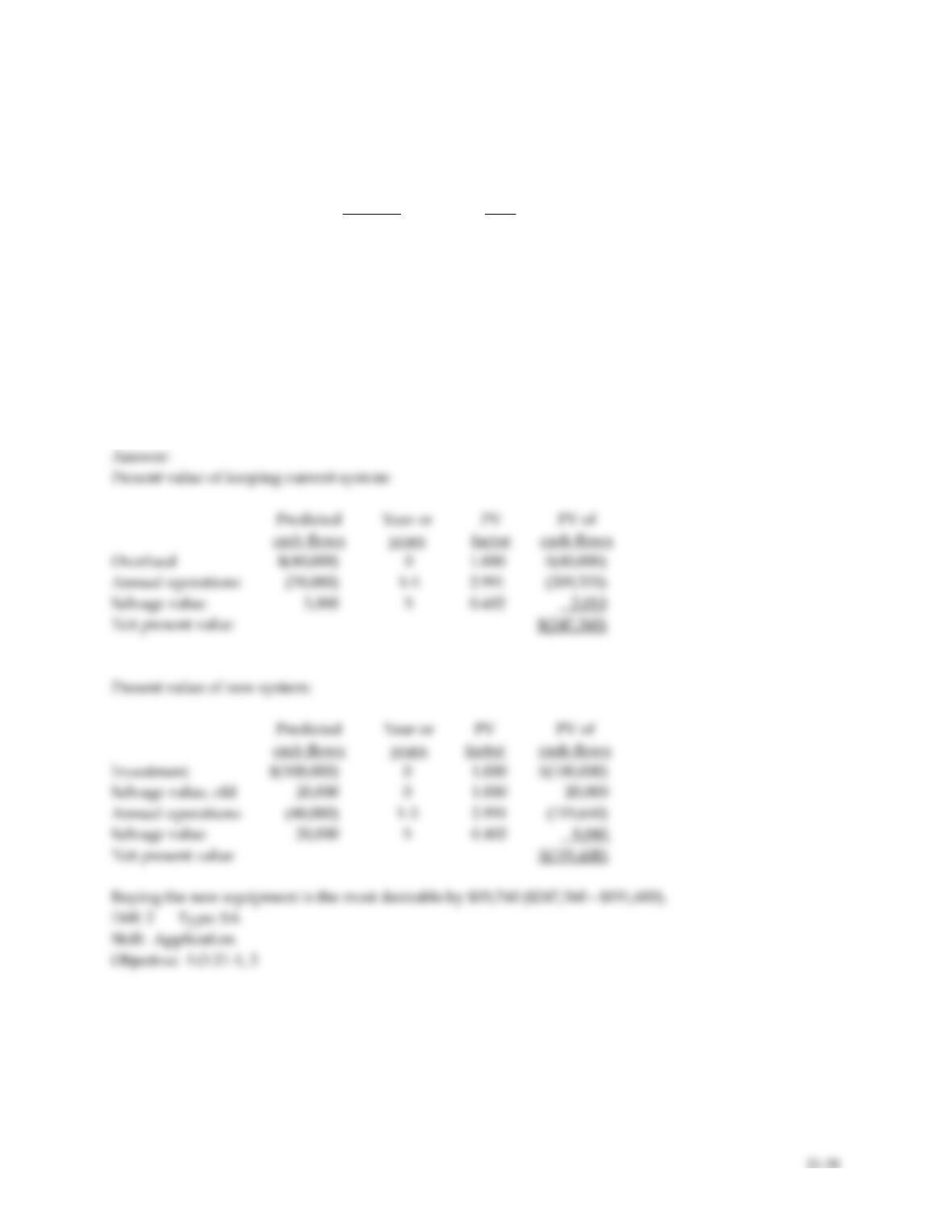
16) EIF Manufacturing company needs to overhaul its drill press or buy a new one. The facts have been
gathered, and are as follows:
Current New
machine
Purchase price, new $80,000 $100,000
Current book value 30,000
Overhaul needed now 40,000
Annual cash operating costs 70,000 40,000
Current salvage value 20,000
Salvage value in five years 5,000 20,000
Required:
Based on present value analysis, which alternative is the most desirable with a current required rate of
return of 20 percent? Show computations.
Cost Accounting: A Managerial Emphasis, 6e
Chapter 21 – Capital Budgeting: Methods of Investment Analysis
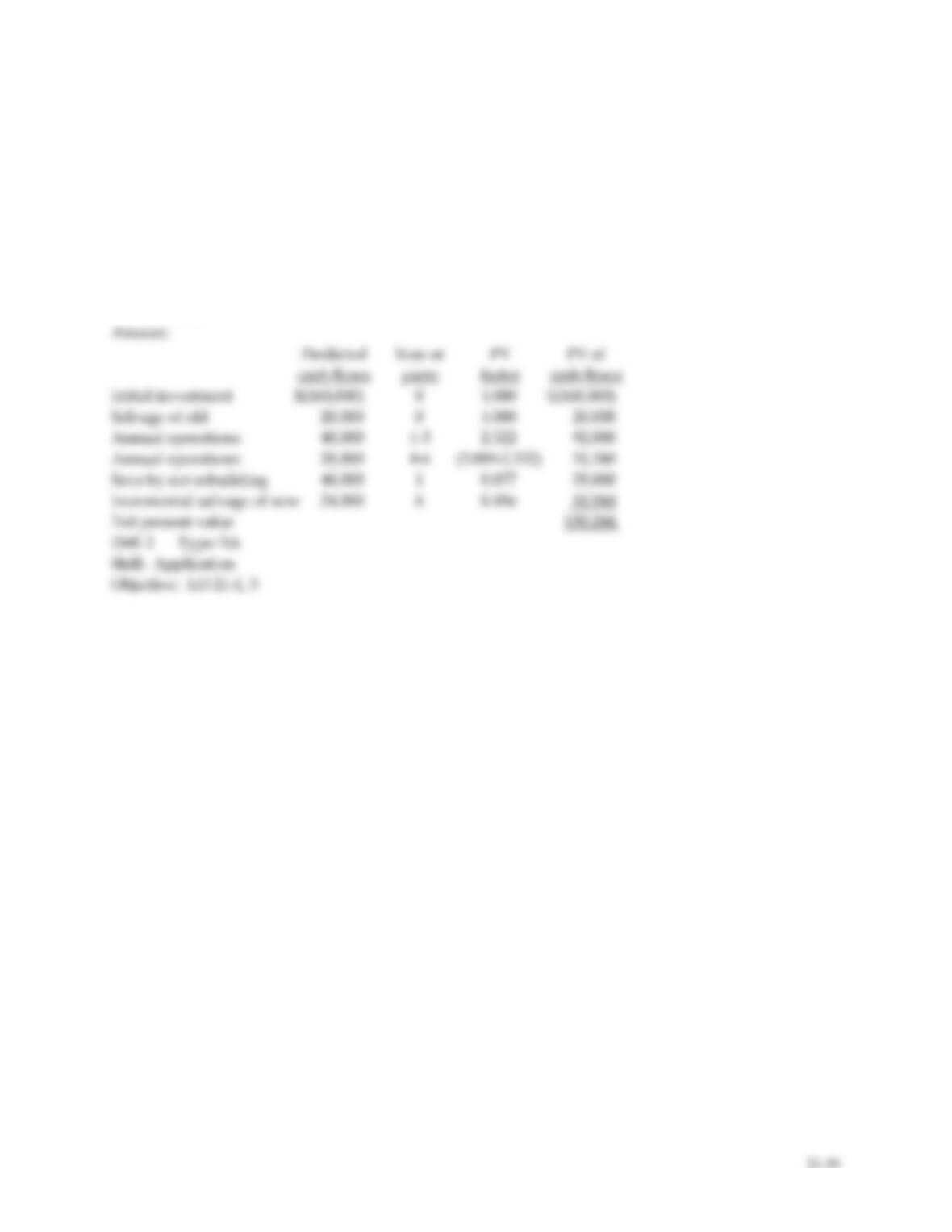
17) ABC Boat Company is interested in replacing a moulding machine with a new improved model. The
old machine has a salvage value of $20,000 now and a predicted salvage value of $4,000 in six years, if
rebuilt. If the old machine is kept, it must be rebuilt in one year at a predicted cost of $40,000. The new
machine costs $160,000 and has a predicted salvage value of $28,000 at the end of six years. The new
machine will generate cash savings of $40,000 for each of the first three years and $20,000 for each year of
its remaining six-year life. Ignore income taxes.
Required:
What is the net present value of purchasing the new machine if the company has a required rate of return
of 14 percent?
Cost Accounting: A Managerial Emphasis, 6e
Chapter 21 – Capital Budgeting: Methods of Investment Analysis
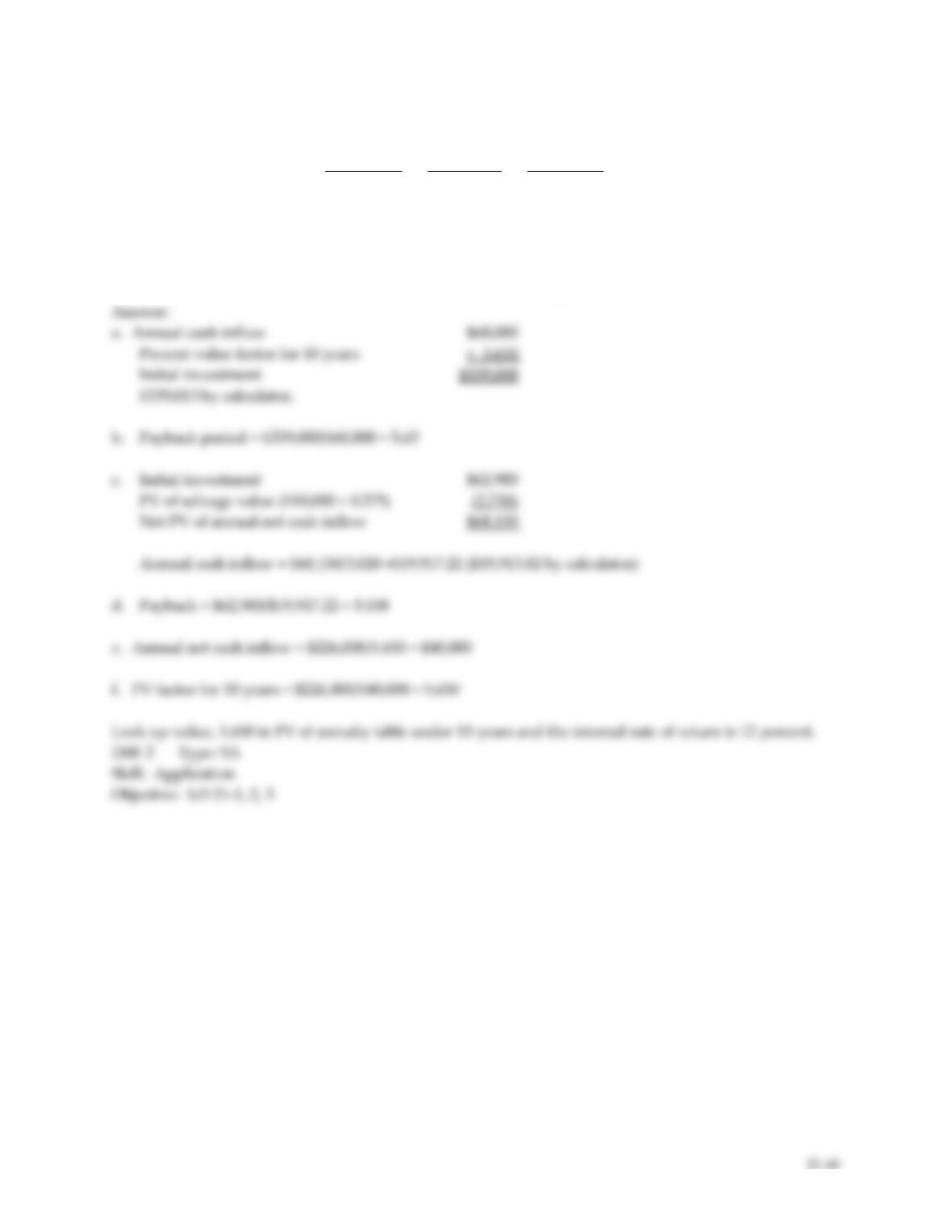
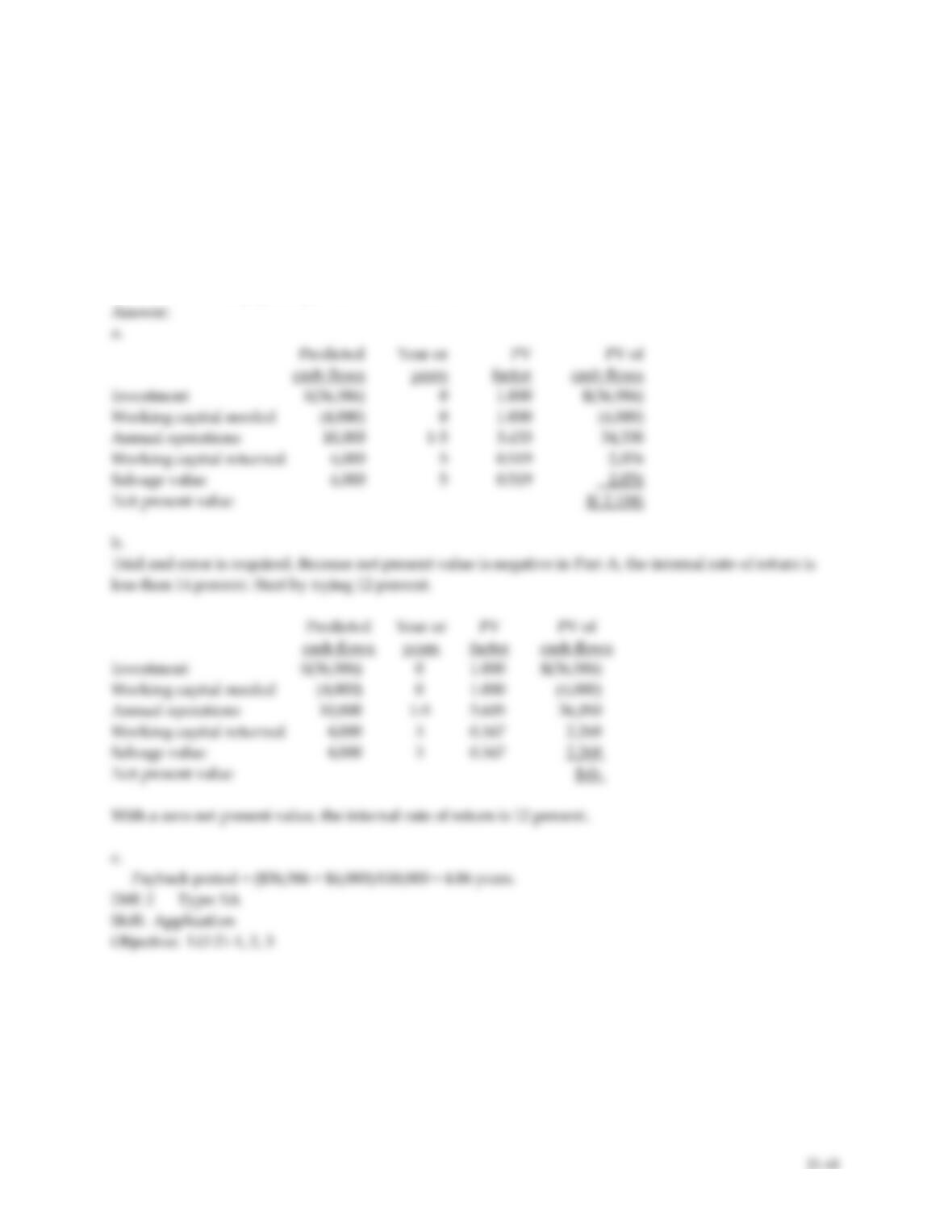
18) Supply the missing data for each of the following proposals.
Proposal A Proposal B Proposal C
Initial investment (a) $62,900 $226,000
Annual net cash inflow $60,000 (c) (e)
Life in years 10 6 10
Salvage value $0 $10,000 $0
Payback period in year (b) (d) 5.65
Internal rate of return 12% 24% (f)
Cost Accounting: A Managerial Emphasis, 6e
Chapter 21 – Capital Budgeting: Methods of Investment Analysis
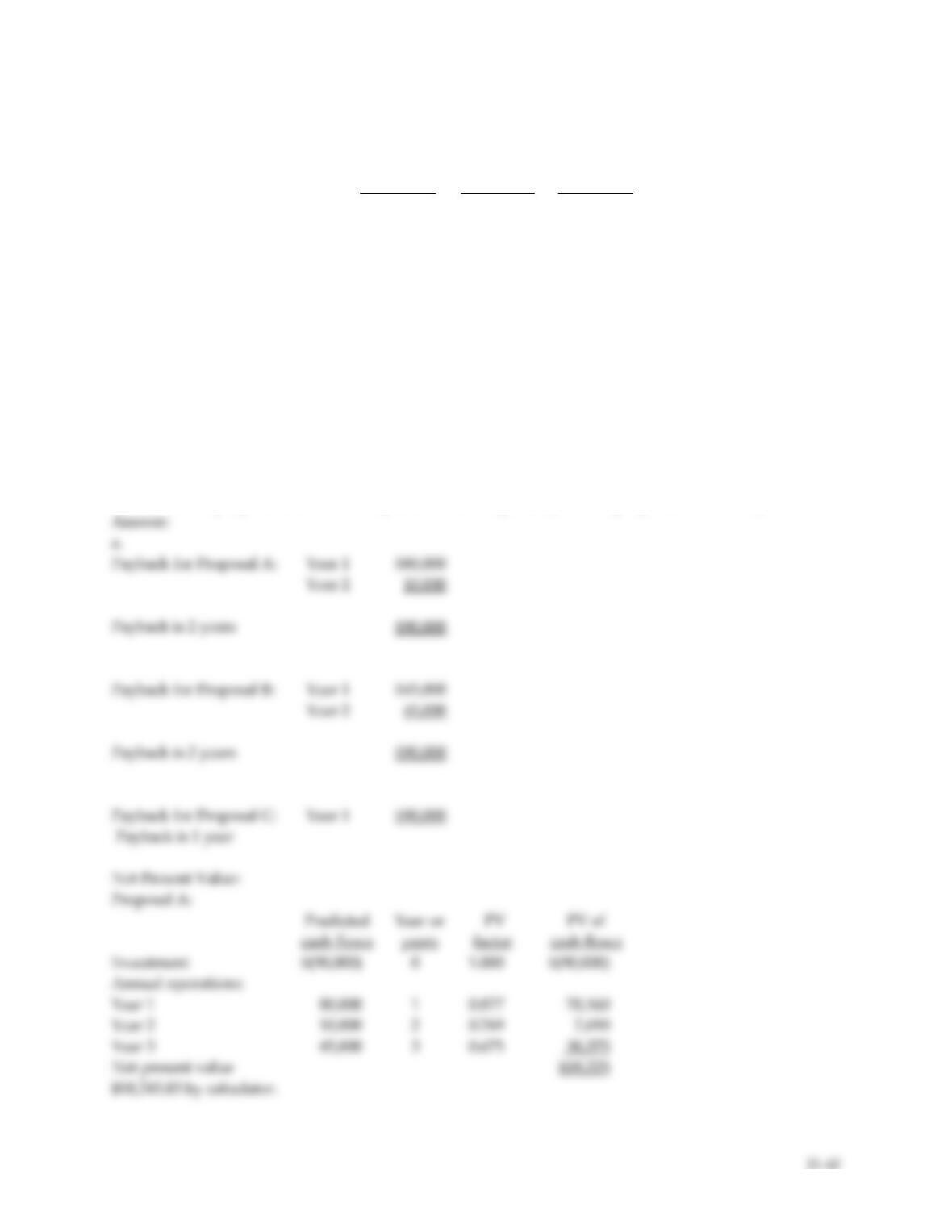
19) Book & Bible Bookstore desires to buy a new coding machine to help control book inventories. The
machine sells for $36,586 and requires working capital of $4,000. Its estimated useful life is five years and
will have a salvage value of $4,000. Recovery of working capital will be $4,000 at the end of its useful life.
Annual cash savings from the purchase of the machine will be $10,000. Ignore income taxes.
Required:
a. Compute the net present value at a 14 percent required rate of return.
b. Compute the internal rate of return.
c. Determine the payback period of the investment.
Cost Accounting: A Managerial Emphasis, 6e
Chapter 21 – Capital Budgeting: Methods of Investment Analysis
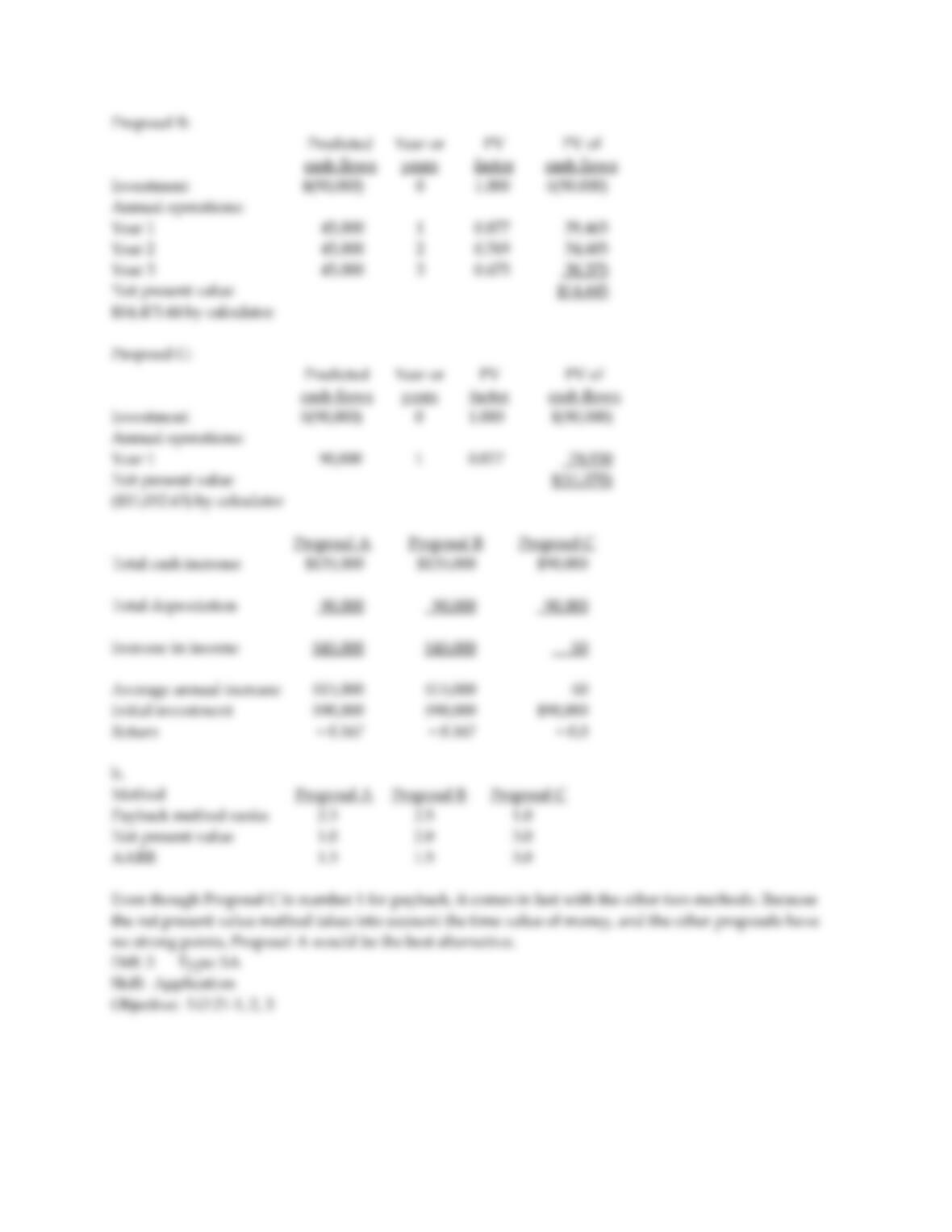
20) Hentgen and Ferraro, baseball consultants, are in need of a microcomputer network for their staff.
They have received three proposals, with related facts as follows:
Proposal A Proposal B Proposal C
Initial investment in equipment $90,000 $90,000 $90,000
Annual cash increase in operations:
Year 1 80,000 45,000 90,000
Year 2 10,000 45,000 0
Year 3 45,000 45,000 0
Salvage value 0 0 0
Estimated life 3 yrs. 3 yrs. 1 yr.
The company uses straight-line depreciation for all capital assets. Ignore income taxes.
Required:
a. Compute the payback period, net present value, and accrual accounting rate of return with initial
investment, for each proposal. Use a discount rate of 14 percent.
b. Rank each proposal 1, 2, and 3 using each method separately. Which proposal is best? Why?
Cost Accounting: A Managerial Emphasis, 6e
Chapter 21 – Capital Budgeting: Methods of Investment Analysis
21–43
Cost Accounting: A Managerial Emphasis, 6e
Chapter 21 – Capital Budgeting: Methods of Investment Analysis
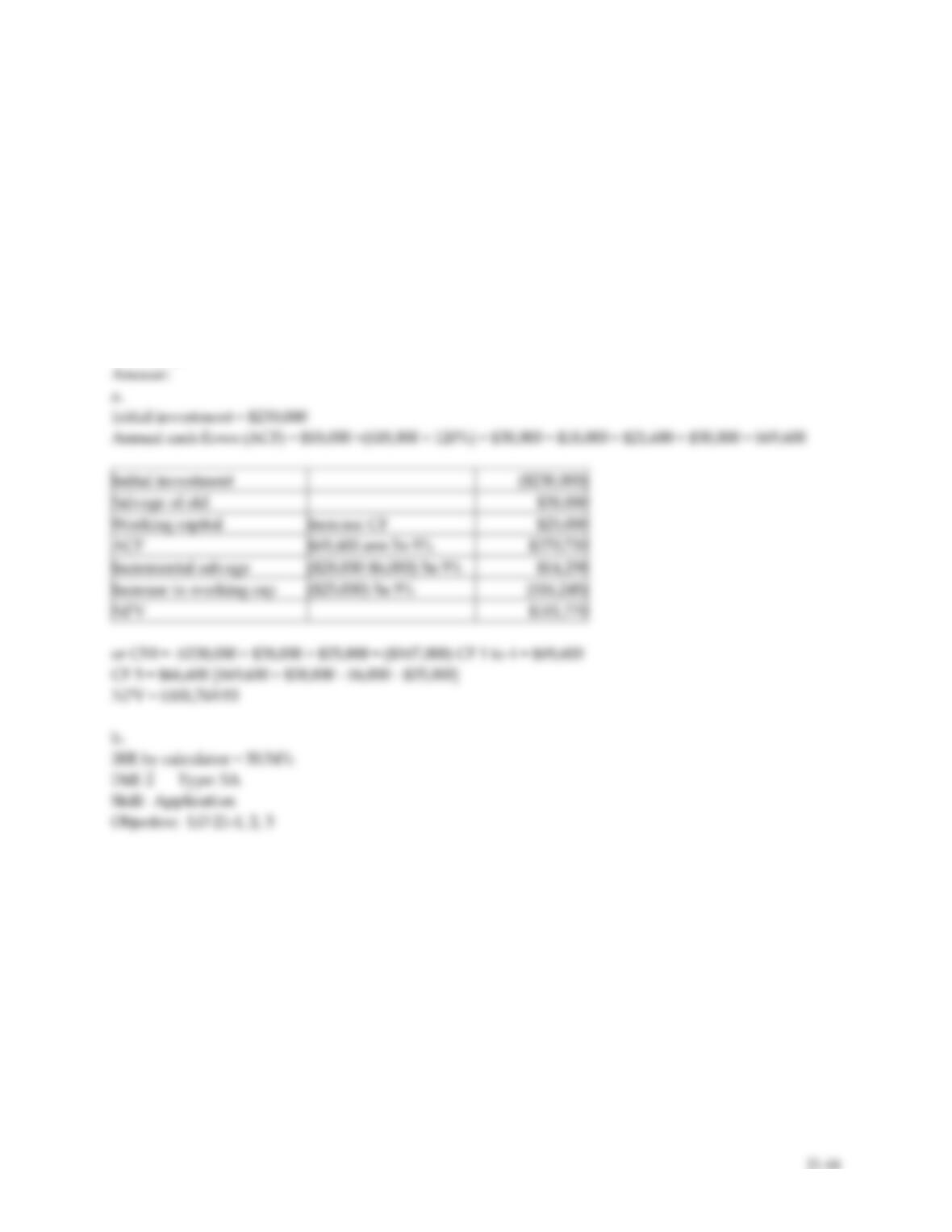
21) Crofton Inc. is evaluating new machinery in its foundry. The machinery would replace existing
equipment. The new machinery would cost $230,000, would last 5 years, and would have a salvage value
of $28,000. The existing machinery currently has a net book value of $52,000 and could be sold for
$38,000. If kept, the old machine would have a salvage value of $6,000 in 5 years’ time. The new
machinery is expected to lower direct labour costs by $18,000 per year. The current variable overhead rate
is 120% of direct labour. Annual fixed cost savings are projected to be $30,000. Due to the reduction in the
production cycle time, working capital requirements will decrease by $25,000 during the life of the new
machine. Ignore income taxes.
Required:
a. Compute the net present value at a 9 percent required rate of return.
b. Compute the internal rate of return.
Cost Accounting: A Managerial Emphasis, 6e
Chapter 21 – Capital Budgeting: Methods of Investment Analysis
21–45
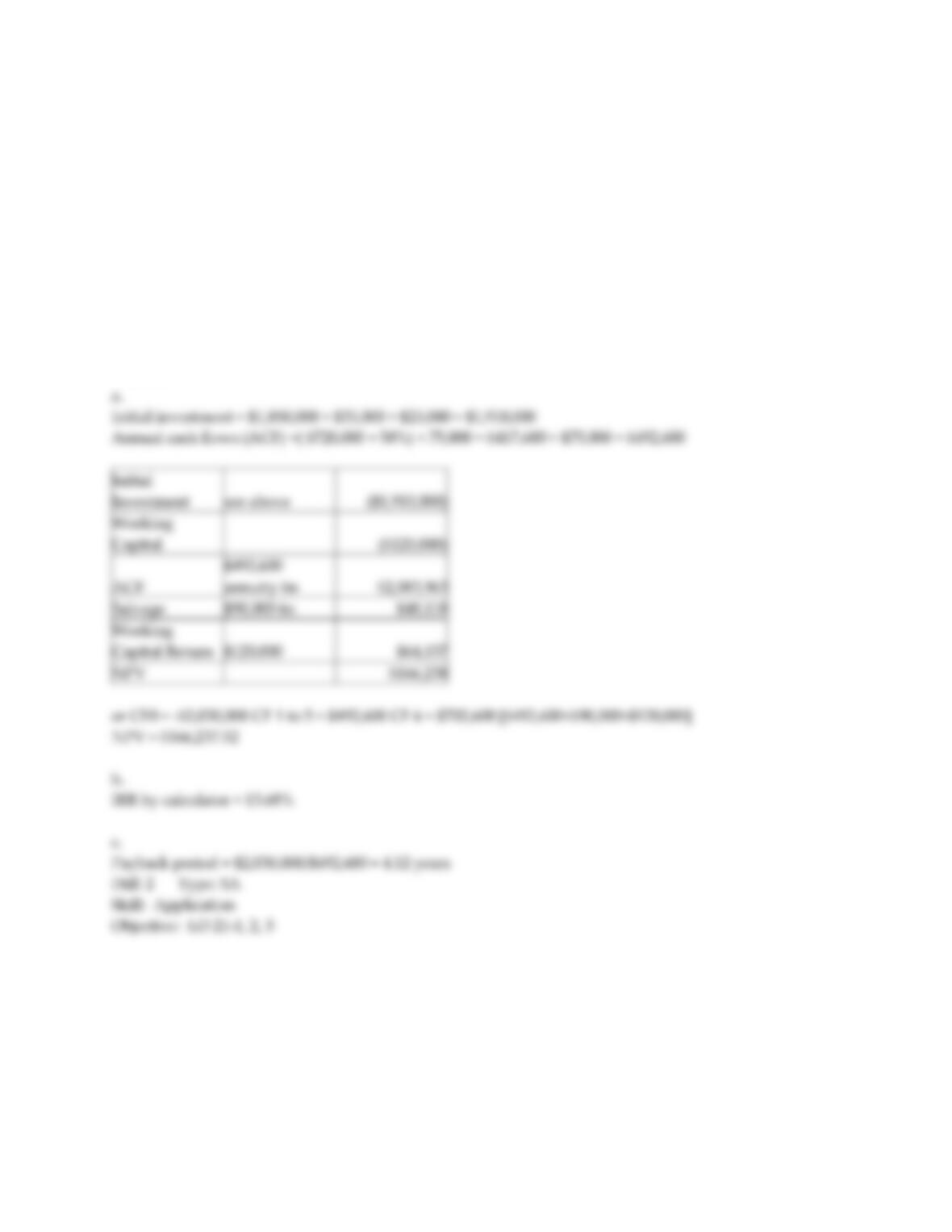
22) Jefferson Ltd. is considering the acquisition of new production equipment. If purchased, the new
equipment would cost $1,850,000. Installation and testing costs would be $35,000 and $25,000
respectively. Once operational, the equipment will cause and increase in working capital of $120,000. The
new equipment is expected to generate increased annual sales of $720,000. Variable costs to operate the
machine are estimated at 42% of sales and annual fixed costs would be lowered by $75,000. The
equipment has an estimate 6 year life and a salvage value of $90,000. The company requires an 11%
return on its investments. Ignore income taxes.
Required:
a. Compute the net present value.
b. Compute the internal rate of return.
c. Determine the payback period of the investment.
Answer:
Cost Accounting: A Managerial Emphasis, 6e
Chapter 21 – Capital Budgeting: Methods of Investment Analysis
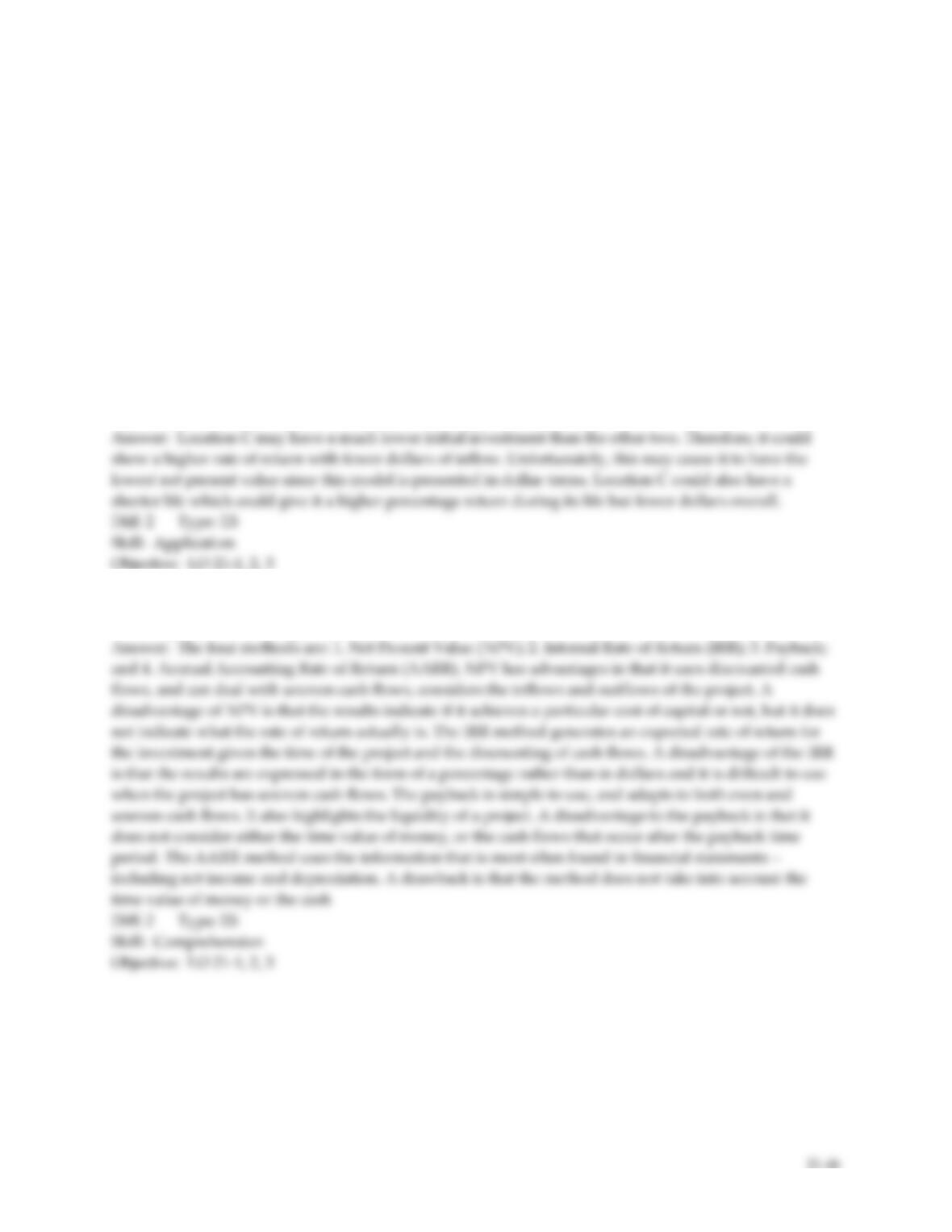
23) Retail Outlet is looking for a new location near a shopping mall. It is considering purchasing a
building rather than leasing, as it has done in the past. Three retail buildings near a new mall are
available but each has its own advantages and disadvantages. The owner of the company has completed
an analysis of each location which includes considerations for the time value of money. The information
is as follows:
Location A Location B Location C
Internal rate of return 13% 17% 20%
Net present value $25,000 $40,000 $20,000
The owner does not understand how the location with the highest percentage return has the lowest net
present value.
Required:
Explain to the owner the probable cause(s) of the comparable differences.
24) What are the four alternative methods for evaluating capital budgeting projects? What is an
advantage and disadvantage of each method?

Cost Accounting: A Managerial Emphasis, 6e
Chapter 21 – Capital Budgeting: Methods of Investment Analysis
21.4 Assess the complexities in capital budgeting within an interdependent set of
value-chain business functions.
1) Companies should make decisions concerning investing in computer-integrated technology, based
solely on the relevant costs.
2) “Faster response to market changes” is a benefit of computer-integrated technology.
3) The accrual accounting rate of return for evaluating performance is often a stumbling block when
implementing capital-budgeting decisions.
4) Computer integrated technology may increase workers’ knowledge of automation and facilitate future
installations.
5) Comparison of the actual results for a project to the costs and benefits expected at the time the project
was selected is referred to as
A) the audit trail.
B) management control.
C) a post-investment audit.
D) a cost-benefit analysis.
E) capital budgeting.
Cost Accounting: A Managerial Emphasis, 6e
Chapter 21 – Capital Budgeting: Methods of Investment Analysis
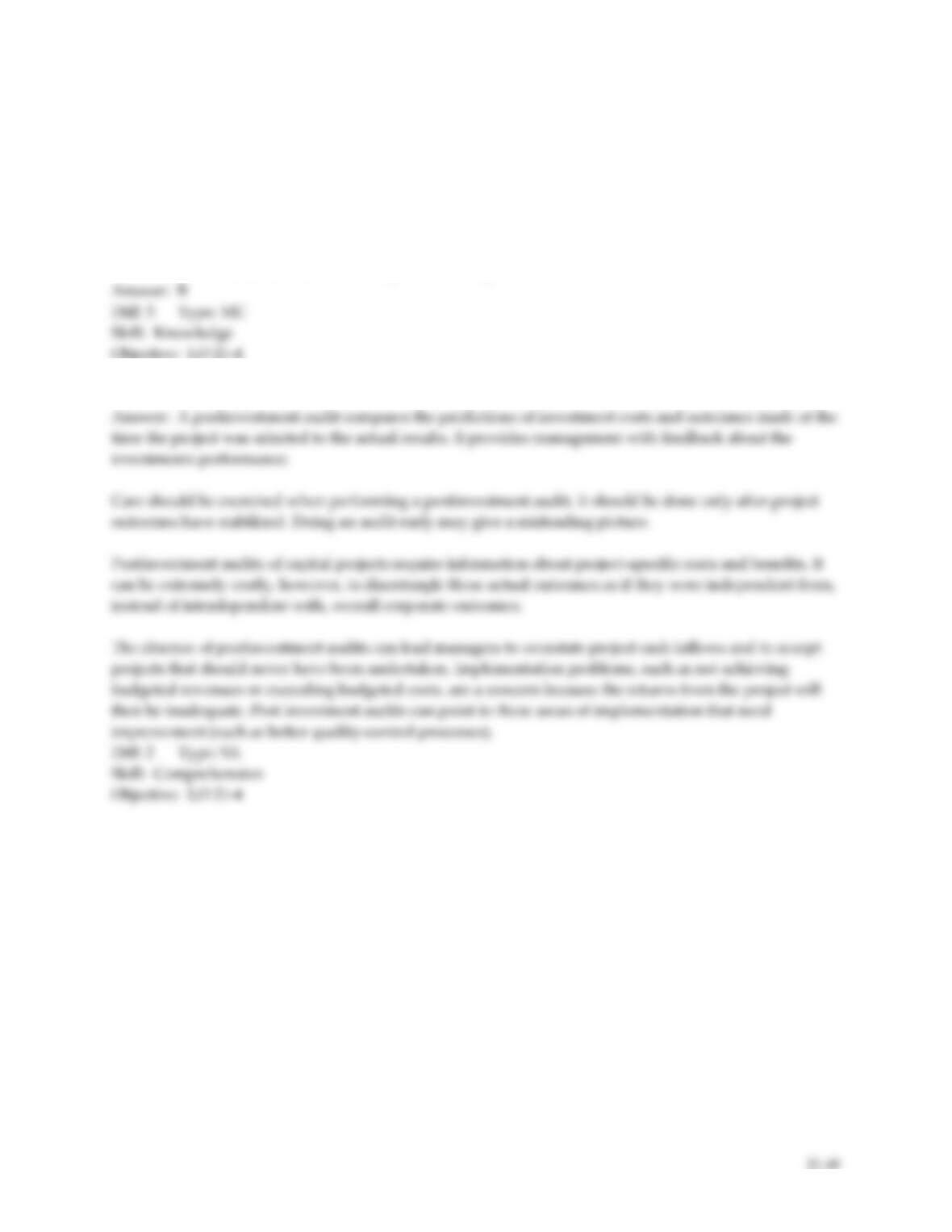
6) Post-investment audits
A) should be done as soon as possible after the investment is made.
B) provide management with feedback about the performance of a project.
C) include obtaining appropriation requests so that the funding will be authorized to purchase the
equipment.
D) are usually not feasible in a large project because the cost accounting system does not collect actual
costs at the same level of detail as the initial plans had.
E) should not be undertaken because they are too costly.
7) Describe the purpose, features and benefits of a postinvestment audit for a capital budgeting project.
Cost Accounting: A Managerial Emphasis, 6e
Chapter 21 – Capital Budgeting: Methods of Investment Analysis
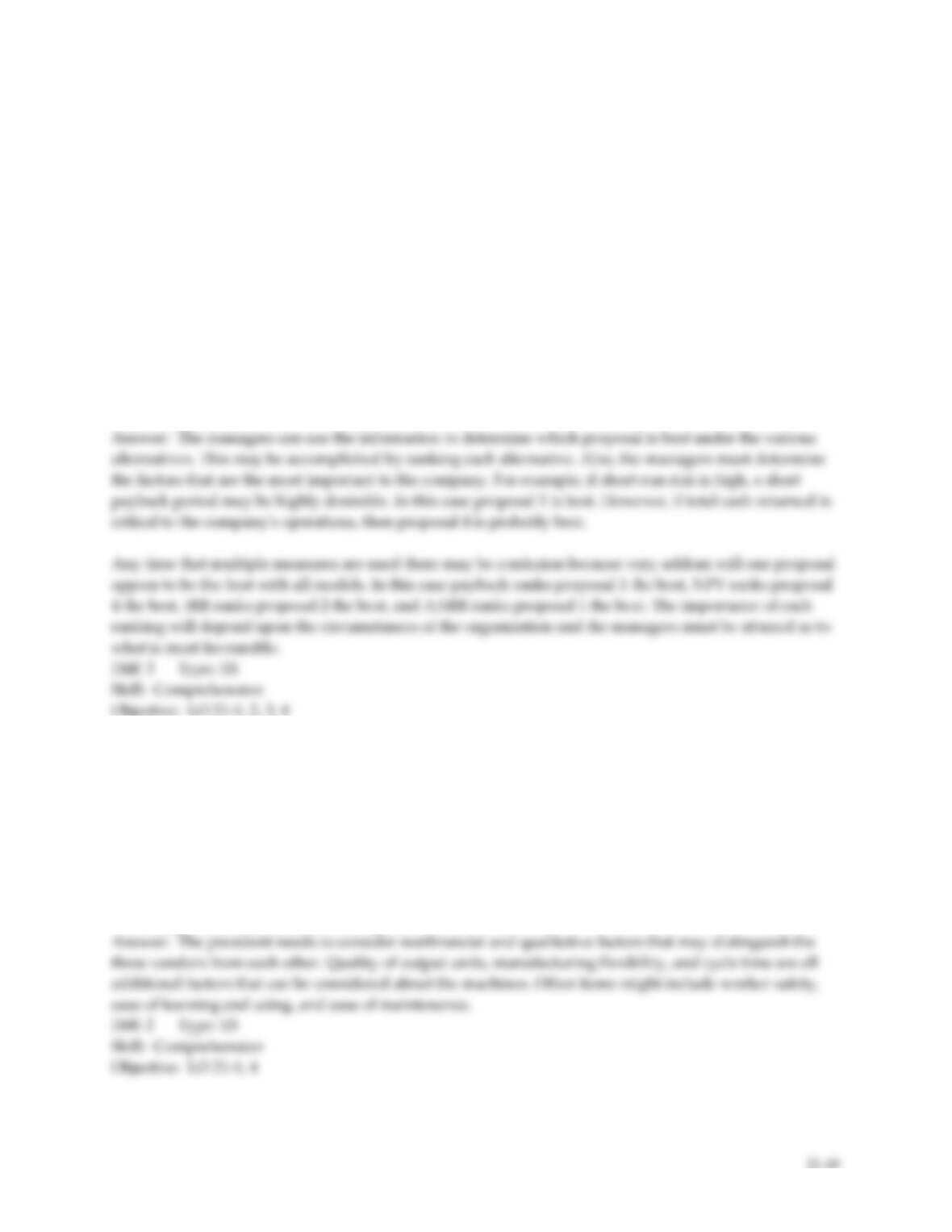
8) Bock Construction Company is considering four proposals for the construction of new loading facilities
that will include the latest in ship loading/unloading equipment. After careful analysis, the company’s
accountant has developed the following information about the four proposals:
Proposal 1 Proposal 2 Proposal 3 Proposal 4
Payback period 4 years 4.5 years 6 years 7 years
Net present value $80,000 $178,000 $166,000 $308,000
Internal rate
of return 12% 14% 11% 13%
Accrual accounting
rate of return 8% 6% 4% 7%
Required:
How can this information be used in the decision making process for the new loading facilities? Does it
cause any confusion?
9) A Company wants to buy a moulding machine that can be integrated into its computerized
manufacturing process. It has received three bids for the machine and related manufacturer’s
specifications. The bids range from $3,500,000 to $3,550,000. The estimated annual savings of the
machines range from $260,000 to $270,000. The payback periods are almost identical and the net present
values are all within $8,000 of each other. The president just doesn’t know what to do about which vendor
to choose; all the selection criteria are so close together.
Required:
What suggestions do you have for the president?
Cost Accounting: A Managerial Emphasis, 6e
Chapter 21 – Capital Budgeting: Methods of Investment Analysis
10) Many new capital projects are investments in new technologies. Both benefits and costs of these new
technologies are hard to estimate.
Required:
Discuss some of the difficulties in quantifying the expected benefits and costs of new technologies.
21.5 Apply the concept of defensive strategic investment to the capital budgeting
process.
1) Net present value can be used to examine the effects of alternative ways of increasing customer loyalty.
2) Defensive strategies can be difficult to quantify because opportunity costs are difficult to predict.
3) A comparison of year-to-year changes in customer net present value estimates
A) is one way to add certainty to the customer evaluation process.
B) highlights whether managers have been successful in maintaining long–run profitable relationships
with their customers.
C) can be used to motivate customers.
D) is difficult to calculate because of the need to know the customers’ cost of capital.
E) can be used in place of the payback method.
Cost Accounting: A Managerial Emphasis, 6e
Chapter 21 – Capital Budgeting: Methods of Investment Analysis
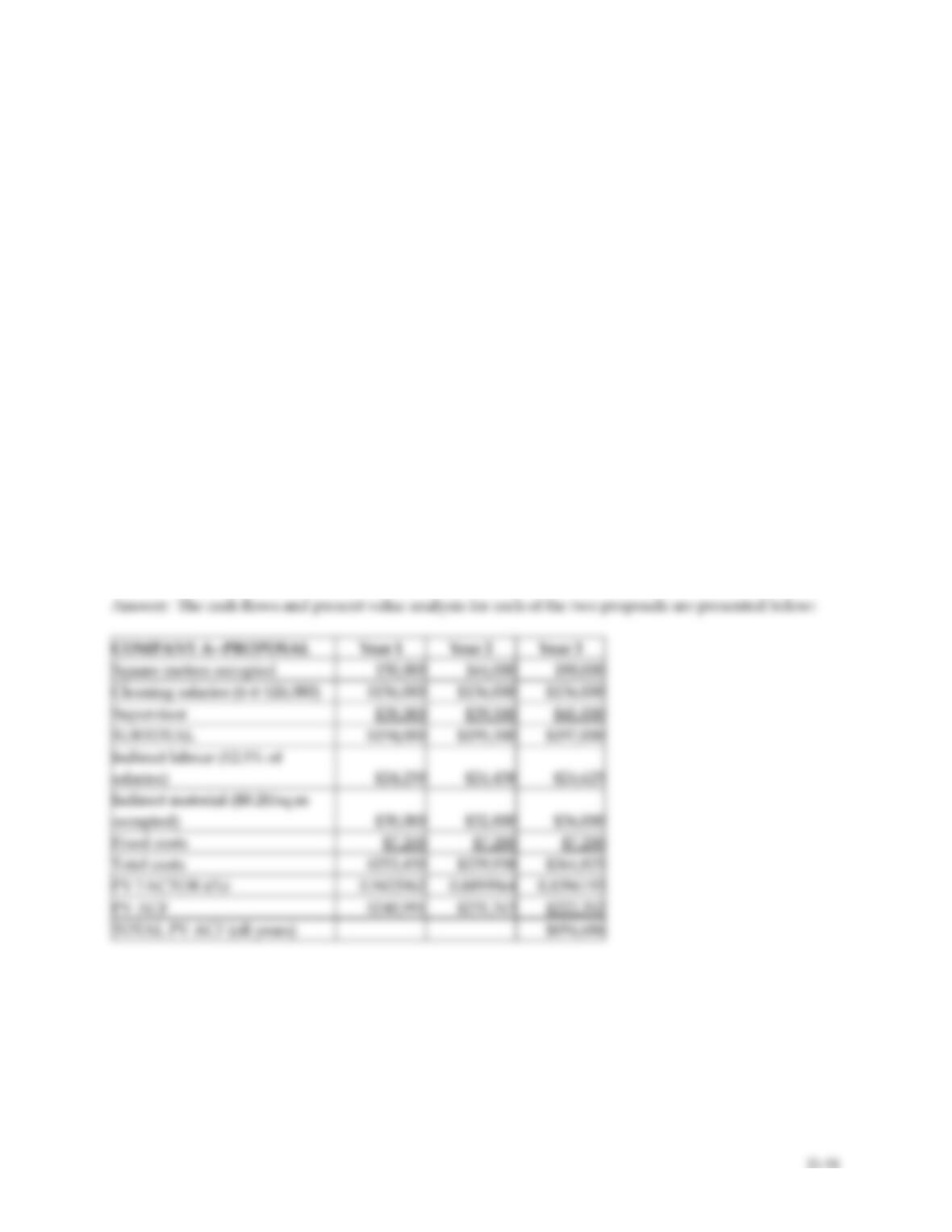
4) Pender Ltd. is analyzing two proposals for cleaning contracts for the next 3 year period. The company
has 200,000 square metres of floor space which is currently 75% occupied. It expects that occupancy will
increase to 82% in year 2 and 90% in year 3.
The proposal from Company A is as follows:
Six janitors will be used at a budgeted annual salary of $26,000/each. These salaries are expected to
remain static over the 3 year period. One supervisor will be used at an annual salary of $38,000. Salary
increases for the supervisor will be $1,500 per year. Indirect labour costs are at 12.5% of salaries. Indirect
material costs will be at a rate of $0.20 per square metre occupied. Fixed costs of $7,200 per year will also
be charged to Pender by the contractor.
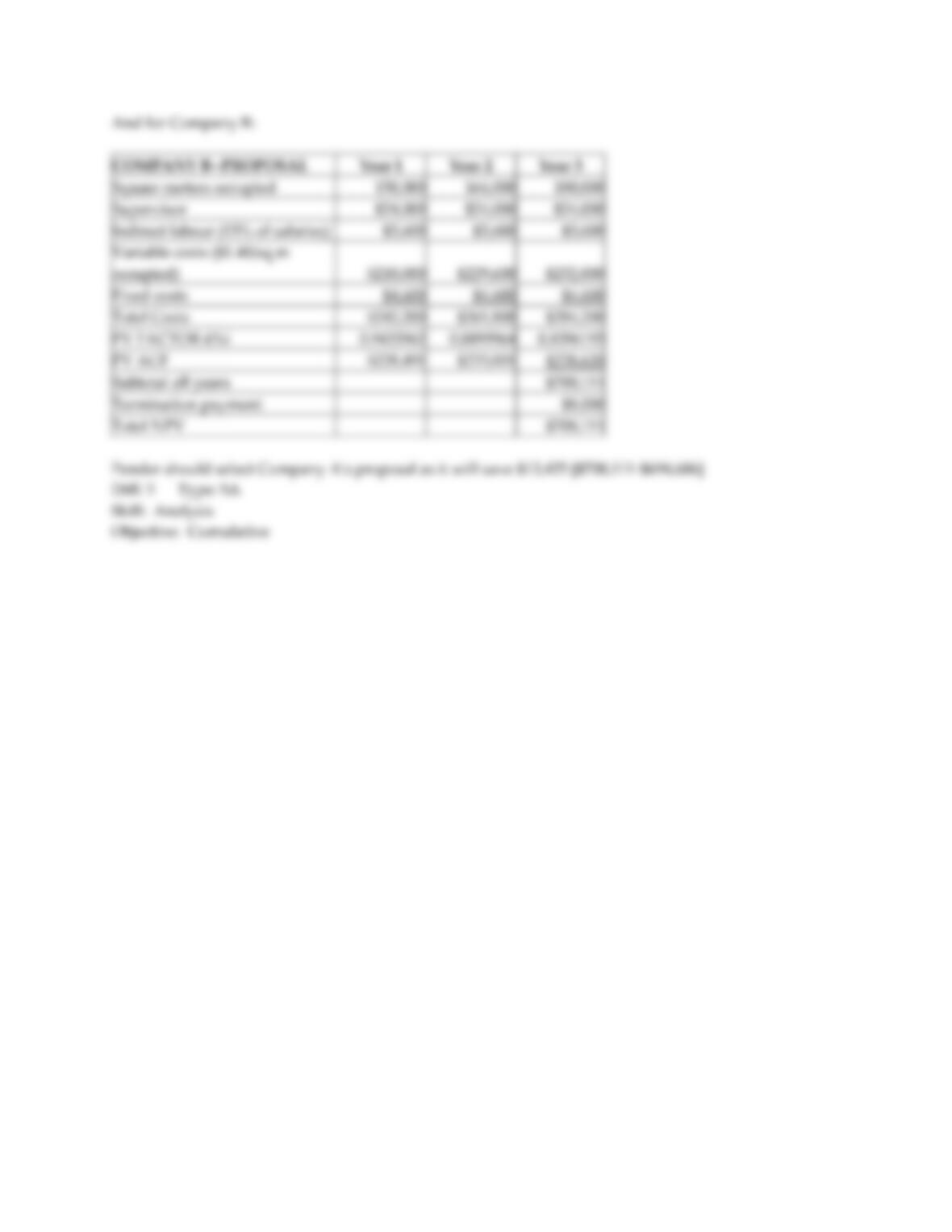
The proposal from Company B is as follows:
A rate of $1.40 per square metre occupied will be charged. In addition a part time supervisor will be
required at an annual cost of $24,000 plus benefits at 15%. Fixed costs of $4,600 per year will be charged to
Pender by Company B. No increases are forecast through the three year period.
Additional information:
Company A is the existing contractor. If the agency does not choose Company A, it must pay Company A
a flat $8,000 on termination of its services. This payment would be made immediately.
Assume cash flows occur at the end of the year unless otherwise stated. The discount rate to be used is
6% and is not expected to change in the next 3 years.
Cost Accounting: A Managerial Emphasis, 6e
Chapter 21 – Capital Budgeting: Methods of Investment Analysis
21–52