
Chapter 21—Strategic and Operational Financial Planning
MULTIPLE CHOICE
1. Last year, Grow Now reported sales of $s million, net income of $ni, total assets of $a million, and
total equity of $e million. If the firm wants to increase sales next year by g percent and has a dividend
payout ratio of d percent of earnings, Grow Now’s contribution to retained earnings next year will be
__________ according to the sustainable growth model.
a.
$ans
b.
$w1
c.
$w2
d.
$w3
e.
cannot be determined with given information
2. According to the sustainable growth model, if a firm finances its assets with r1 percent debt and r2
percent equity, and retains $b million in earnings in a given year, the firm can afford to borrow an
additional __________ to maintain the desired mix of debt and equity.
a.
$c million
b.
$w1 million
c.
$w2 million
d.
$w3 million
e.
none of the above
3. Consider Higgins’ sustainable growth model. Which of the following would produce a decrease in
value for g*?
a.
a decrease in total assets to sales
b.
a decrease in dividend payouts
c.
a decrease in the level of financial leverage
d.
b and c
e.
all of the above
4. The bottom-up method for forecasting sales:
a.
relies on the ability of complex statistical models to predict individual unit or regional
sales figures, which are added together and reported to senior managers.
b.
relies on the ability of senior managers to determine sales objectives for their company‘s

product and inform personnel about targets for each business unit.
c.
relies on the ability of sales personnel to correctly apply statistical models in order to
obtain firm wide objectives for increased sales.
d.
relies on the ability of sales personnel to assess future demand, usually without the aid of
statistical models.
e.
relies on the ability of sales personnel and senior managers to predict reasonable sales
objectives based on macroeconomic factors.
5. __________ are often used as the plug figure in pro forma projections.
a.
Gross fixed assets
b.
Cash balances
c.
Retained earnings
d.
a and b
e.
b and c
6. Employing the EFR model, how much external funding will a firm require if it plans to increase sales
from $s0 million to $s1 million, has total assets of $a, accounts payable of $ap, net income of $ni, and
a dividend payout of d percent?
a.
$w1
b.
$efr
c.
$w2
d.
none; it will have a surplus of $w3
e.
none; it will have a surplus of $w4
7. Following __________ financing strategy takes advantage of short-term interest rates but also
increases refinancing risk. Following __________ financing strategy minimizes the risk of a liquidity
crisis, but generally increases borrowing costs. Following __________ financing strategy results in the
use of long-term funding for permanent assets and short-term debt financing for temporary or seasonal
requirements.
a.
a matching; an aggressive; a conservative
b.
a conservative; an aggressive; a matching
c.
an aggressive; a matching; a conservative
d.
a conservative; a matching; an aggressive
e.
none of the above
8. “Required total financing” figures in a cash budget:
a.
show the monthly financing activities for a firm
b.
show the monthly change in borrowing for a firm
c.
show the additional amount a firm must borrow at the end of each month
d.
show the amount of excess cash a firm has to invest at the end of each month

e.
show the difference between the beginning and ending cash balances each month
9. According to the cash budget, Middleman, Inc. must borrow $a in May. If Middleman is required to
pay its suppliers at the beginning of the month and subsequently collects payment from its customers:
a.
net cash flow will be positive in May
b.
net cash flow will be negative in May
c.
intramonth borrowing needs for May will be less than $a
d.
intramonth borrowing needs for May will exceed $a
e.
the minimum cash balance will need to be reduced in May
10. A speedup in __________ should __________ a firm’s financing needs; whereas, a slowdown in
__________ should __________ financing needs for a firm.
a.
collections; decrease; payments; increase
b.
payments; increase; collections; decrease
c.
collections; increase; payments; increase
d.
payments; increase; collections; increase
e.
collections; increase; collections; decrease
11. A long-term financial plan begins with __________.
a.
strategy
b.
pro forma financial statements
c.
matching principals
d.
the cash budget
e.
the sustainable growth model
12. The trade-offs a firm must weigh when it expands depend on which of these factors?
a.
how rapidly the firm plans to grow
b.
how profitable its existing business is
c.
how efficiently it manages its assets
d.
how much financial leverage it is willing to bear
e.
all of the above
13. The sustainable growth model gives managers a kind of shorthand projection that ties together
__________ and __________.
a.
external funds required; strategic plan
b.
growth objectives; strategic plan
c.
growth objectives; cash receipts
d.
growth objectives; financial needs
e.
The cash budget; strategic plan
14. The key input required to build a cash budget is __________.

a.
the cash disbursements
b.
the strategic plan
c.
the firm’s sales forecast
d.
the sustainable growth model
e.
the external funds required
15. Which of the following are common cash disbursements?
a.
rent and lease payments
b.
interest payments and taxes
c.
payments of accounts payable and wages
d.
fixed asset outlays and cash purchases
e.
all of the above
16. Most pro forma statements begin with a sales forecast. One approach to deriving a sales forecast is the
top-down approach. Top-down sales forecasts rely heavily on:
a.
macroeconomic and industry forecasts
b.
customer input
c.
forecasts from the sales force
d.
Board of Directors input
e.
the sales figure from the previous year coming from the top of the income statement
17. A firm that employs an aggressive strategy to finance assets:
a.
will have enough long-term financing to cover both its permanent investment in fixed and
current assets and the additional seasonal investments in current assets
b.
will employ riskier borrowing techniques to finance its short-term assets
c.
will finance a portion of long-term (permanent) growth in assets with short-term financing
d.
will finance long-term assets with long-term financing and short-term assets with
short-term financing
e.
will necessarily have a lower rate of return
18. Bahia Industries had sales of $s last month in March. The firm has projected sales of $psa in April,
$psm in May and $psj in June. Bahia, on average, makes r1% of its sales on credit and r2% of its
credit customers pay in the following month. Another r3% of credit sales is collected within 60 days,
and r4% is never collected. What are Bahia’s cash collections in May?
a.
$w1
b.
$w2
c.
$w3
d.
$ans

19. A firm has a balance of $a in its cash account and a balance of $b million in its marketable securities
account on its 2005 year-end balance sheet. If you were told that this firm is an individual retail store
that sold Christmas products and that its year end is in June, this would lead you to believe that the
firm:
a.
Is following a flexible working capital policy
b.
Is following a conservative working capital policy
c.
Not given enough information to answer
d.
Is not following a working capital policy
20. What is the level of cash collections from sales for the firm this month if:
– Sales last month and the month before last were $s1 and $s2, respectively
– Sales this month were $s3
– Credit sales account for r1% of all sales
– The firm gives 30-day terms to r2% of its customers, while the other r3% have 60 days
a.
$w1
b.
$ans
c.
$w2
d.
$w3
21. Most firms when planning for growth focus on
a.
Maintaining ROI over the firm’s cost of capital
b.
Maximizing Economic Value Added (EVA©)
c.
Meeting asset target growth rates
d.
Meeting sales target growth rates
22. When generating pro-forma statements, most firms rely on a ___________ approaches to sales
forecasts
a.
Top-down
b.
Bottom-up
c.
Regression
d.
Blended
23. Using short-term financing to meet short-term needs takes advantage of short-term rates generally
_______ cost than long-term financing, exposes the firm to ________ interest-rate volatility.
a.
Lower; higher
b.
Lower; lower
c.
Higher; higher
d.
Higher; lower

24. The greatest risk with using short-term financing to finance short-term needs is
a.
Credit becomes unavailable
b.
Credit becomes more expensive
c.
Credit becomes more volatile
d.
Duration exposure
25. The cash budget is most critical for
a.
Large firms
b.
Medium firms
c.
Small firms
d.
All firms equally
MATCHING
Match the term with the correct description:
a.
Strategic plan
b.
Operating plan
c.
Pro forma statements
d.
Cash Budget
1. forecast of the short-term inflows and outflows of a firm
2. long-term guide driven by competitive forces
3. projected financial statements typically based on the historical financial relationships within the firm
4. short-term financial plans
Match the following symbols with their best description:
a.
dollar change in sales
b.
growth rate
c.
asset to equity ratio
d.
profit margin
e.
dividend payout ratio
f.
asset turnover
5. S / A
6. d
7. m
8. A / E
9. g
SHORT ANSWER
1. What is a company’s strategic plan?
2. What does the sustainable growth model do?
3. What are pro forma financial statements?
4. What is the percent-of-sales method?
5. What is the cash budget?
6. How do a firm’s collection and payment patterns affect the cash budget?
7. Jackson Corporation has developed a monthly cash budget for next year. What must the Jackson
Corporation assume for the cash budget to work?
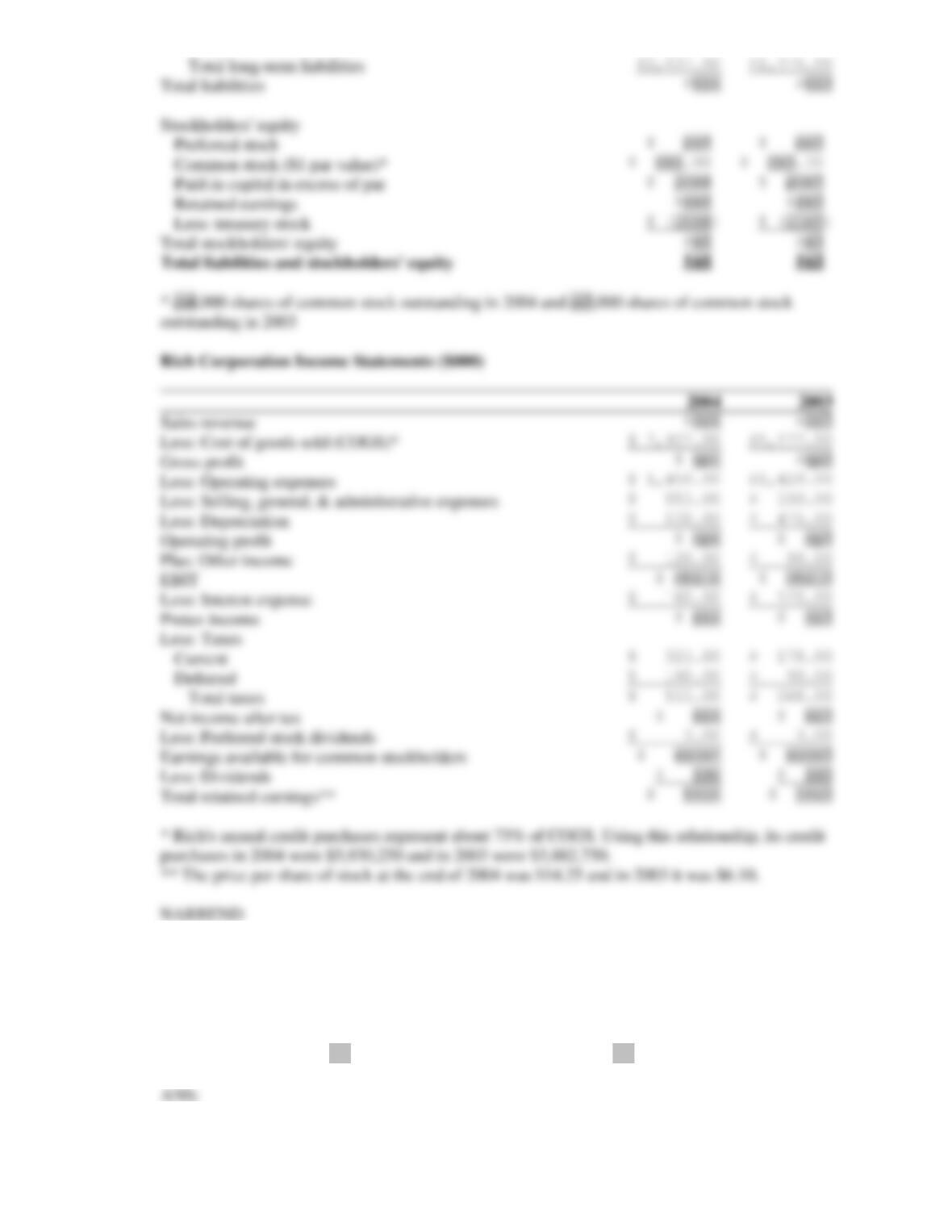
8. Refer to Rich Corporation’s Financial Statements.
a.
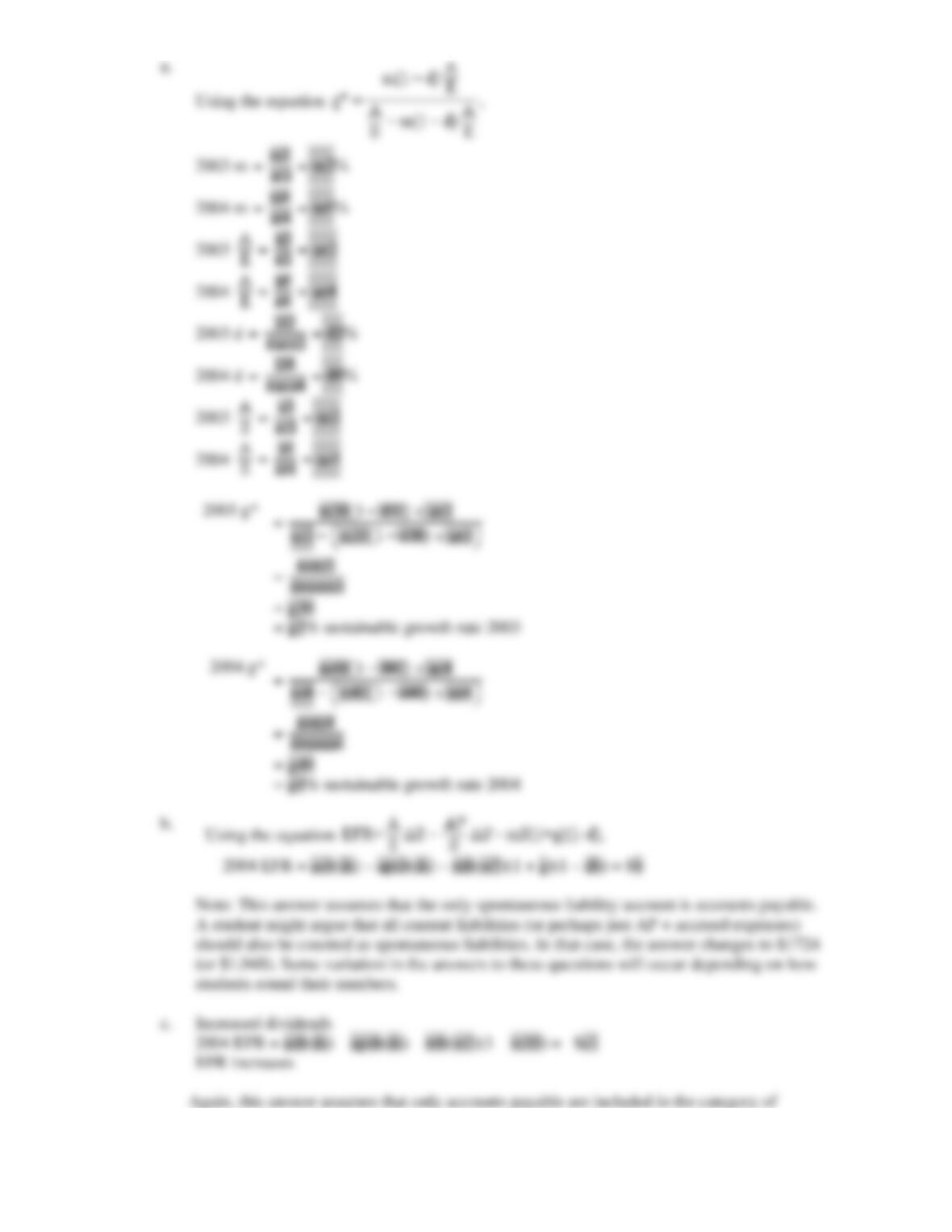
What is Rich’s sustainable growth rate in 2003 and 2004?
b.
Based on the changes occurring in Rich Corporation from 2003-2004 what is Rich’s external
fund requirements in 2004 (use 2003 figures for all input except the change in sales)?
c.
How will your answer to the previous question change if Rich Corporation increased its
dividend payout to rc1% or decreased its dividend payout to rc2%?
Total liabilities
Stockholders’ equity
Total stockholders’ equity
* cs4,000 shares of common stock outstanding in 2004 and cs3,000 shares of common stock
outstanding in 2003
Sales revenue
Less: Cost of goods sold (COGS)*
Gross profit
Less: Operating expenses
Less: Selling, general, & administrative expenses
Less: Depreciation
Operating profit
Plus: Other income
EBIT
Less: Interest expense
Pretax income
Less: Taxes
Net income after tax
Less: Preferred stock dividends
Earnings available for common stockholders
Less: Dividends
Total retained earnings**
* Rich’s annual credit purchases represent about 75% of COGS. Using this relationship, its credit
purchases in 2004 were $5,930,250 and in 2003 were $3,882,750.
** The price per share of stock at the end of 2004 was $14.25 and in 2003 it was $6.10.
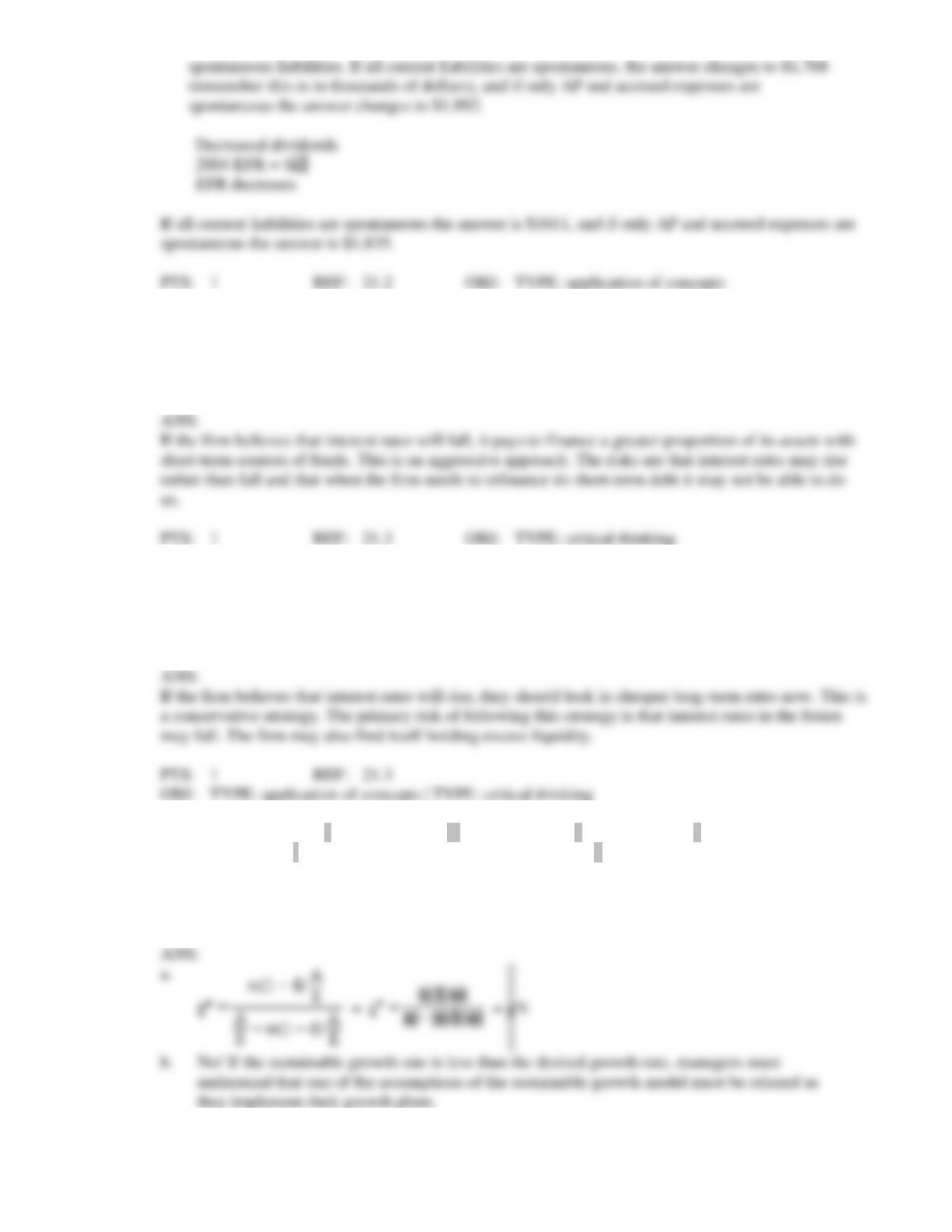
9. A particular firm usually follows the matching strategy. However, managers currently believe that
interest rates will fall in the future. If the firm deviates from the matching strategy, will it pursue an
aggressive or a conservative financing strategy? Describe the risks that the firm takes if it deviates in
the manner you predict.
10. A particular firm usually follows the matching principle. However, managers currently believe that
interest rates will rise in the future. If the firm deviates from the matching principle, will it pursue an
aggressive or a conservative financing strategy? Describe the risks that the firm takes if it deviates in
the manner you predict.
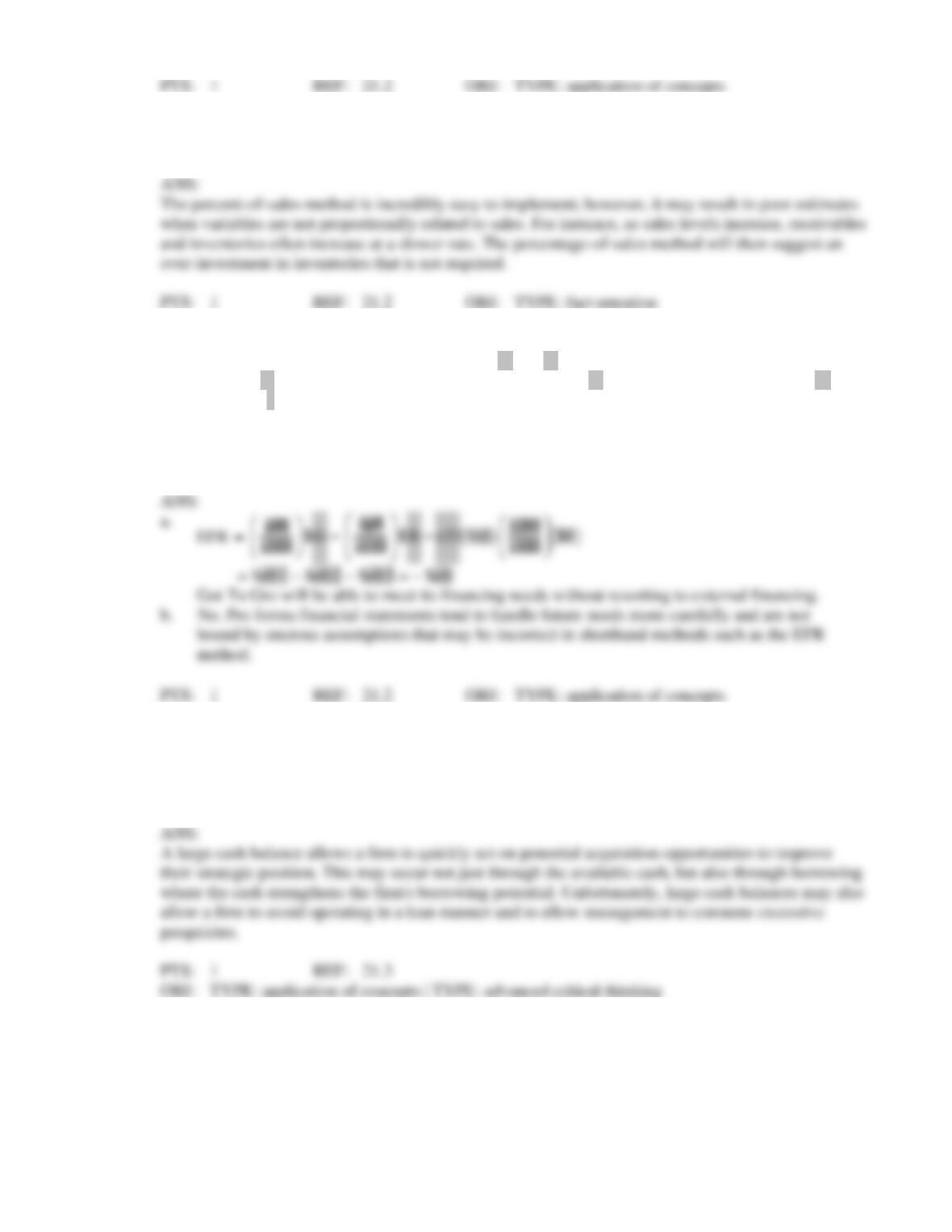
11. Your firm has sales of $s, net income of $ni, total assets of $a, and equity of $e. Your firm projects an
increase in sales of i percent and has a dividend payout ratio of d percent?
a.
What is the sustainable growth rate?
b.
In general, if we find that the sustainable growth rate is less than what managers and
shareholders believe is achievable and value maximizing, should we limit growth?
spontaneous the answer changes to $1,992.
Decreased dividends
2004 EFR = $c2
12. Describe some of the pros and cons of using the percent-of-sales method to construct pro forma
financial statements or to do any other kind of financial forecasting.
13. The external funds required (EFR) formula can be used to determine the need for financing. Your firm,
Got To Gro, is expecting to increase sales from $s1 to $s2 without changing its current dividend
payout rate of r1 percent. Your firm has a net profit margin of r2 percent, accounts payable of $ap, and
total assets of $a.
a.
What is Got To Gro’s EFR for the next year?
b.
Would you expect the EFR computed above to exactly match those from a pro forma set of
financial statements?
= $efr1 – $efr2 – $efr3 = – $efr
Got To Gro will be able to meet its financing needs without resorting to external financing.
method.
14. You are considering an investment in a firm that has a large cash balance. Management claims, they
are “poised to take advantage of some excellent acquisition opportunities.” Elaborate on what the
management team is suggesting and discuss at least one concern that you might have when investing
in a firm with a large cash balance.
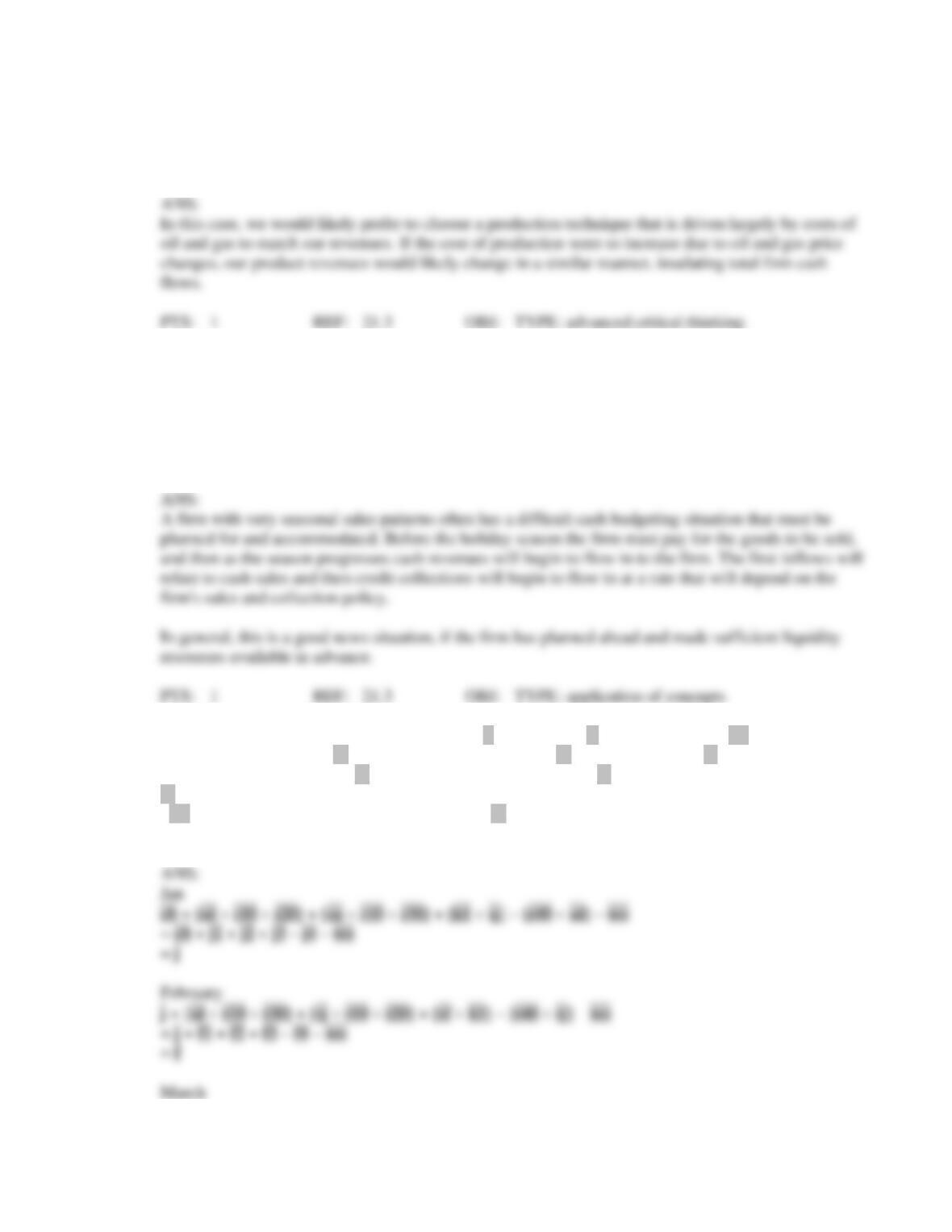
15. Your firm produces a petroleum-based product whose production costs are heavily dependent on the
price of petroleum in the market. Your firm is considering two methods of production. The first
method uses a gas furnace and will result in costs that are heavily dependent on the costs of oil and
gas. The second production technique uses electricity as the primary energy source in production. In
recent history, the costs of electricity have been only partially related to the costs of oil and gas. If you
were to adhere to the principal of matching, which production technique would you favor and why?
16. Holiday Fun is a wholesaler whose primary customers are retail establishments that have heavy sales
in December. The firm is struggling with a cash flow problem and has asked you to explain why they
are having cash flow problems. They have just finished their most successful sales season of all time
and cannot understand why they are heavily in debt. Explain how this problem often arises for a
retailer based on the timing of costs and revenues. Does this problem represent good or bad news for
the firm?
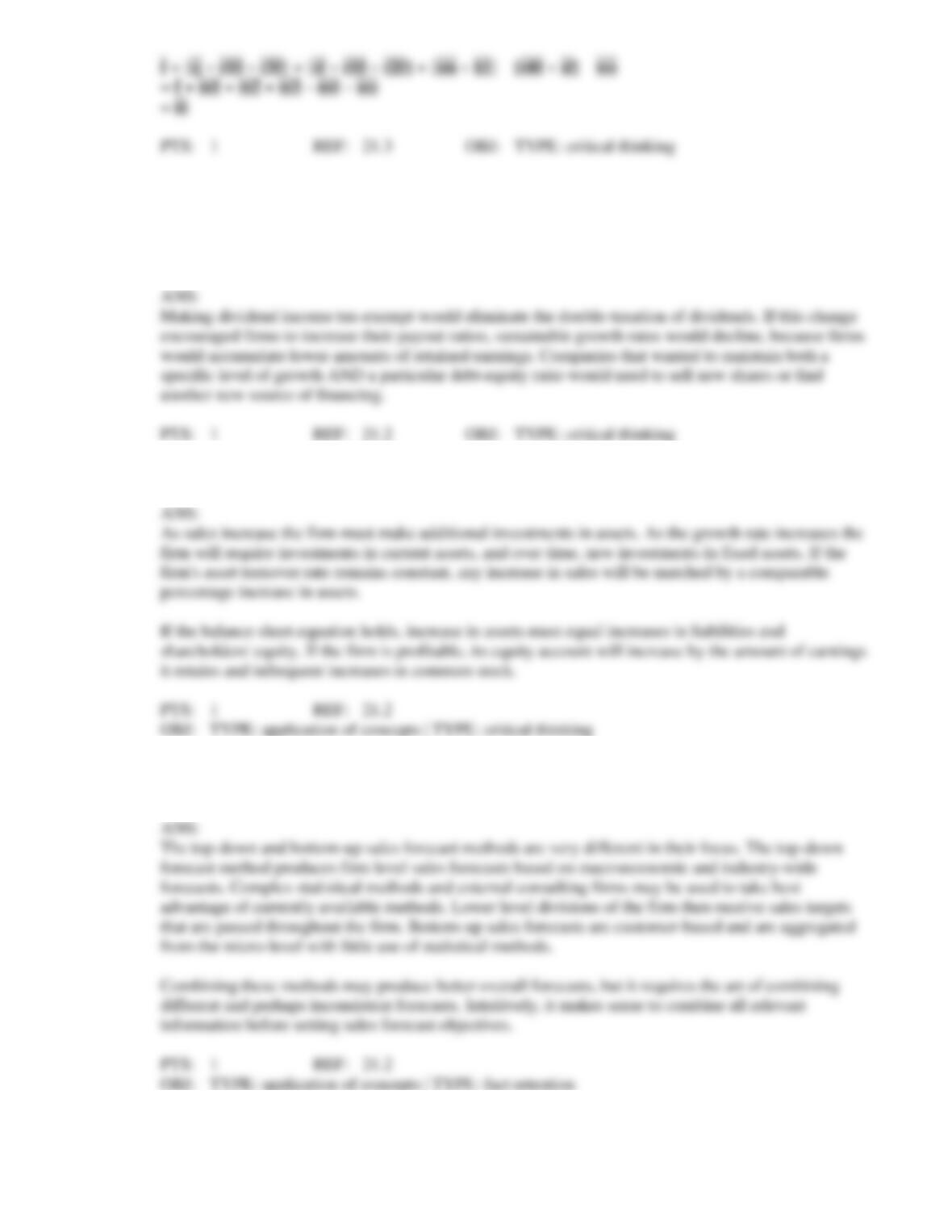
17. Treefold’s Corporation has projected sales of $sj in January, $sf in February, and $sm in March.
November’s sales were $sn, and December’s sales were $sd. Treefold’s makes r1% of their sales on
credit. Of these credit sales, r2% is collected in one month, and r3% in two months. Purchases average
r4% of sales. Purchases are made on credit and paid in the following month. Wages and overhead are
$wo a month. If the firm has a cash balance of $cb at the beginning of January, what will its cash
balance be in March?
ESSAY
1. Assume that a change in the tax code makes dividend income tax-exempt. Explain how this change
could affect the sustainable growth rate of corporations.
2. What is the impact of planned sales growth on a firm’s balance sheet?
3. Compare and contrast the top-down and bottom-up sales forecast methods. Explain the costs and
benefits of attempting to integrate these two methods on a company-wide basis.
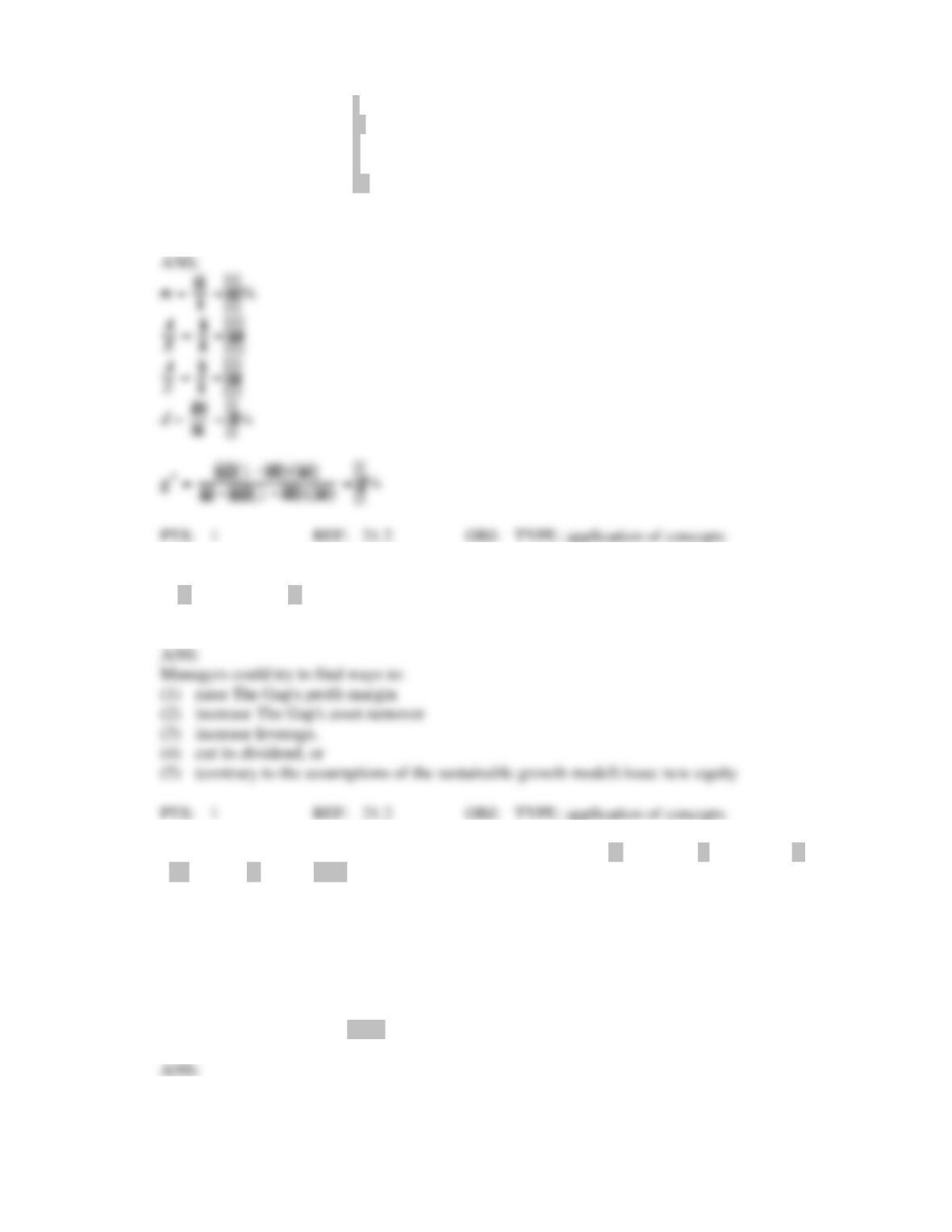
4. In November 2002, Gap Inc. reported the following financial data:
Sales
$s million
Net Income
$ni million
Total assets
$a million
Total equity
$e million
Dividends
$dv million
(1)
raise The Gap’s profit margin
(2)
increase The Gap’s asset turnover
(3)
increase leverage,
(4)
cut its dividend, or
(5)
(contrary to the assumptions of the sustainable growth model) issue new equity
Given this information, what is the firm’s sustainable growth rate?
5. Assume managers at The Gap, Inc. decide shareholders would derive greater benefits if the firm grew
at r2% rather than r1%. What types of actions might financial managers have to undertake to make
sure the company can grow at a higher rate?
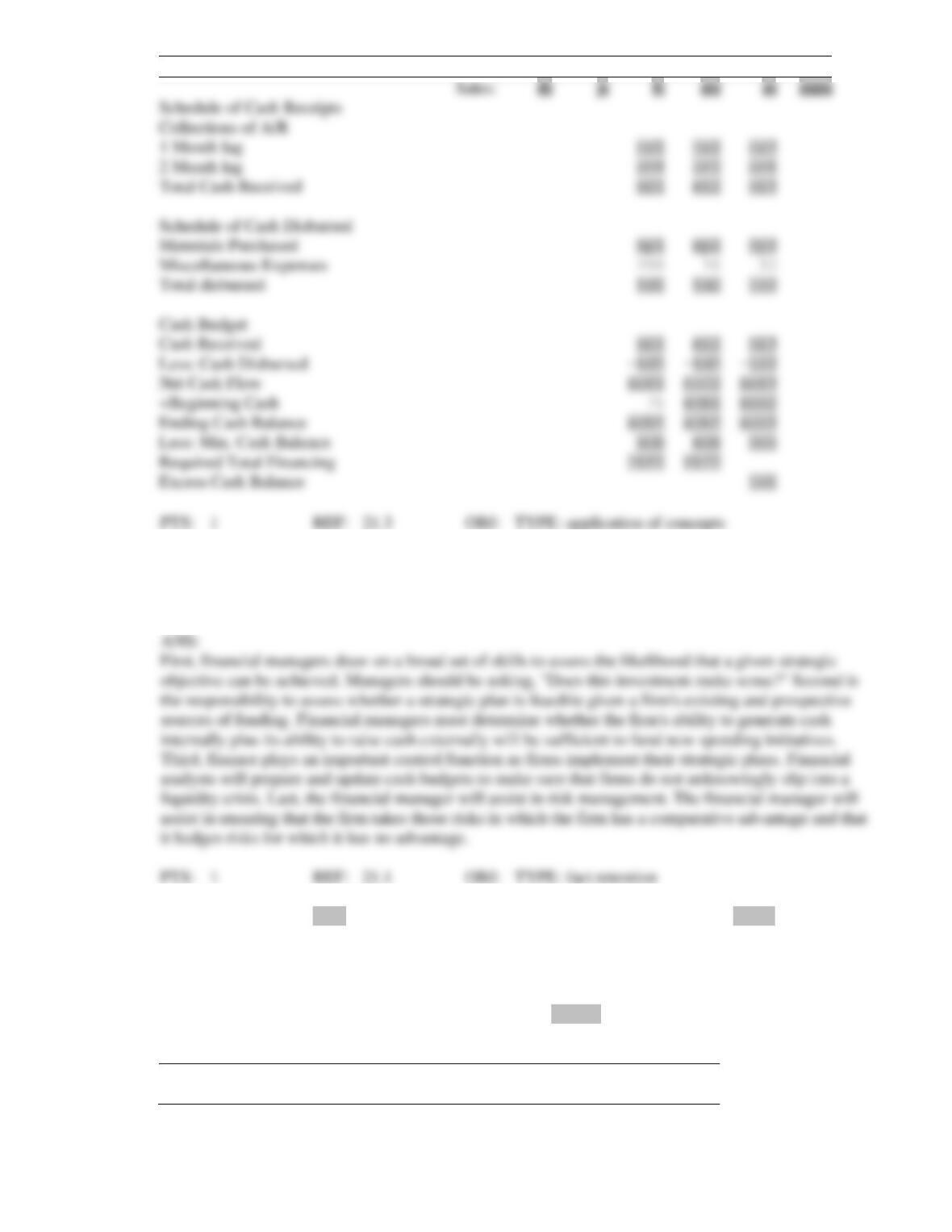
6. A firm’s sales manager forecasts the following sales: December $ds, January $js, February $fs, March
$ms, April $as, May $mms.
All sales are on credit. Collection of sales typically follows the following schedule; 80% are collected
one month later and 20% are collected two months later.
Purchases of goods amounts to 50% of sales and goods are purchased one month in advance. Payment
is made one month after the purchase. Other expected miscellaneous expenses are $200 in February,
$10 in March, and $30 in April. The beginning cash balance on February 1 is expected to be $75. The
minimum cash balance is $mcb1. Prepare the cash budget for February – April.
Dec
Jan
Feb
Mar
Apr
May
7. Senior managers of a firm construct a multiyear strategic plan for major investments and competitive
initiatives they believe will drive the future success of the enterprise. What major roles do financial
managers play in the construction of a strategic plan for a firm?
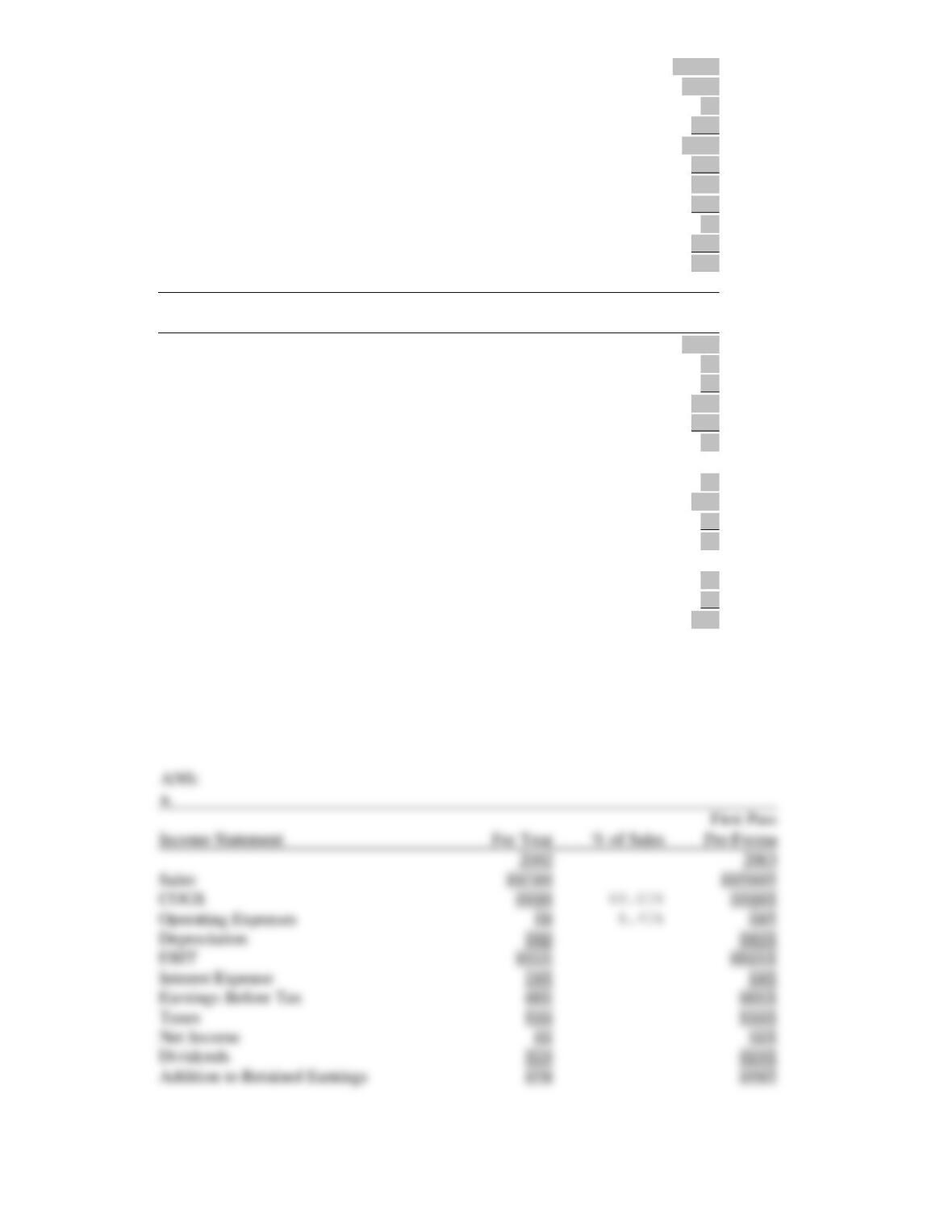
8. A firm currently has $sales in sales (in millions). It projects next year’s sales to be $sales1. The firm
has a dividend payout ratio of 40% of net income that management, along with the board, has decided
to continue no matter how many shares are issued. The firm is in the 50% tax bracket. The firm uses a
target capital structure of 50% debt and 50% equity. The firm is currently operating its plant and
equipment at almost full capacity, so an increase in sales is expected to require an increase in fixed
assets of $20. This in turn will increase depreciation by $adddep next year. The current financial
statements are given below.
Income Statement
For Year
2002
Schedule of Cash Receipts
Collections of A/R
1 Month lag
2 Month lag
Total Cash Received
Schedule of Cash Disbursed
Materials Purchased
Miscellaneous Expenses
Total disbursed
Cash Budget
Cash Received
Less: Cash Disbursed
+Beginning Cash
Ending Cash Balance
Less: Min. Cash Balance
Required Total Financing
Excess Cash Balance
Sales
sales
COGS
cogs
Operating Expenses
oe
Depreciation
dep
EBIT
ebit
Interest Expense
ie1
Earnings Before Tax
ebt
Taxes
tax
Net Income
ni
Dividends
div
Addition to Retained Earnings
are
As of
Balance Sheet
12/31/2002
Cash
cash
Accounts Receivable
ar
Inventory
in
Total Current Assets
tca
Net Plant and Equipment
npe
Total Assets
ta
Accounts Payable
ap
Accruals
acc
Mortgage Bonds (10%)
mb
Total Liabilities
tl
Common Stock
cs
Retained Earnings
re
Total Liabilities and Equity
tle
a.
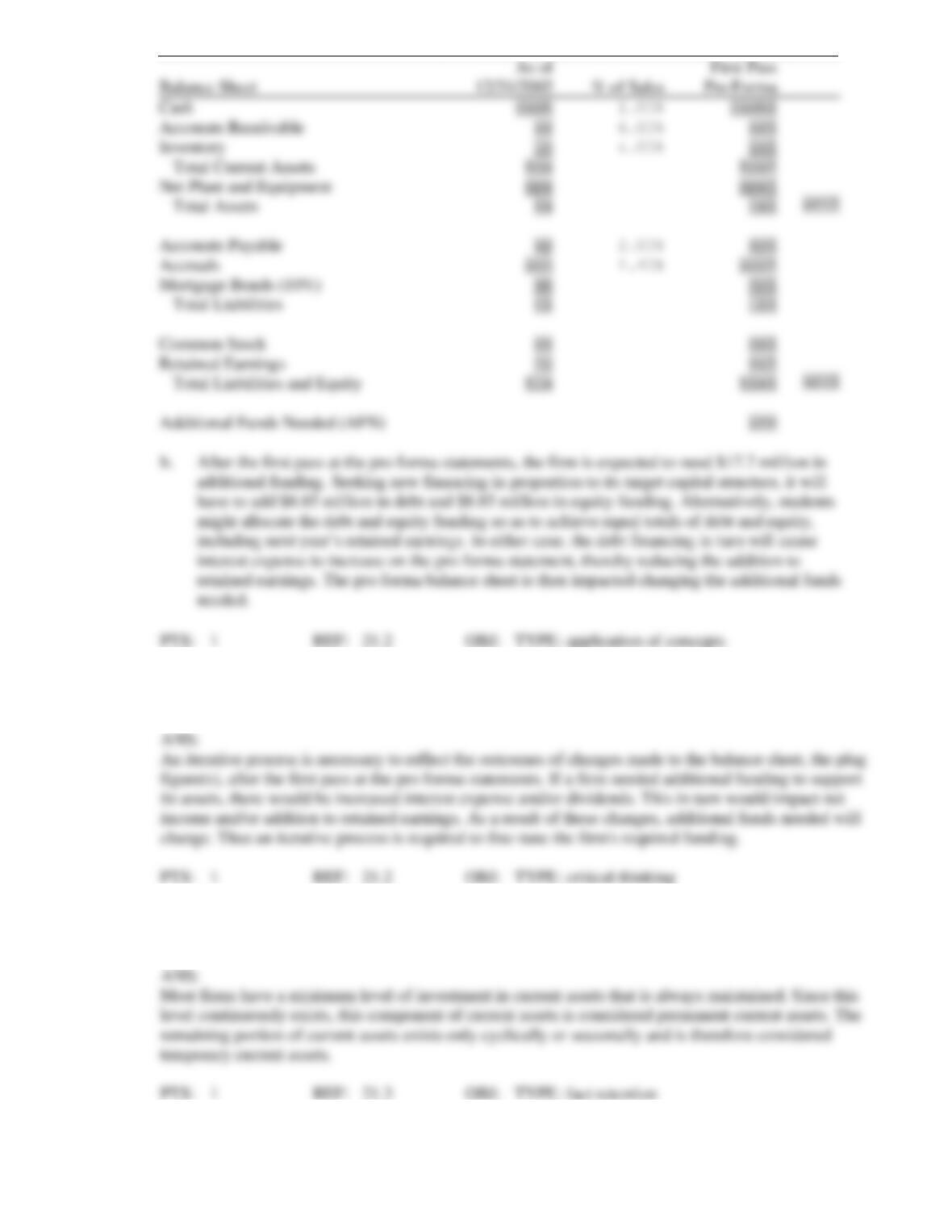
Use the percent of sales technique and prepare the first pass pro forma statement.
b.
Discuss what feedback will have to go into a second pass at the pro forma statements given
that the firm will issue new debt and equity if additional financing is needed to keep the
current capital structure in place. If extra funds are available, the firm will pay down its
accounts payable.
Income Statement
Sales
sales
COGS
cogs
Operating Expenses
oe
8.40%
oe1
Depreciation
dep
dep1
EBIT
ebit
Interest Expense
ie1
ie1
Earnings Before Tax
ebt
ebt1
Taxes
tax
tax1
Net Income
ni
ni1
Dividends
div
div1
Addition to Retained Earnings
are
are1
9. Explain why an iterative process is needed for pro forma statements and what numbers would be
necessary to change after a first pass at the pro forma statements if the firm needed additional funding.
10. Despite the fact that current assets are short-term and frequently turned over, the current asset balance
is considered to have a portion of both temporary and permanent current assets. Discuss this concept.