Chapter 21: The Statement of Cash Flows
51. The Red Blast Company uses the visual inspection method for completing the statement of cash flows. The following
information relates to the Red Blast Company:
Increase in accounts receivable
$ 80
Increase in bonds payable
1,000
Decrease in inventory
75
Net income
10,000
Amortization of premium on bonds payable
260
Increase in income taxes payable
60
Depreciation expense
2,000
Decrease in accounts payable
380
What is the net cash provided by operating activities?
a.
$ 9,065
b.
$11,415
c.
$11,935
d.
$12,415
b
1
Moderate
ACCT.WHAL.16.21.3 – LO: 21.3
United States – BUSPORG: Analytic
United States – OH – Default City – AICPA: FN-Measurement
Bloom’s: Analyzing
Exhibit 21-2
In preparation for completing the statement of cash flows using the spreadsheet method, Williams Company provided
the following information relating to patents for 2016:
Balance, 1/1/2016
$4,800
Purchase of 10-year life patent for cash
2,000
Sale of patent at book value
(1,400)
Amortization of patents
(290)
Balance, 12/31/2016
$5,110
52. Refer to Exhibit 21-2. The Cash Flows from Operating Activities section prepared using the indirect method would
include which of the following deductions or add-back amounts related to patents?
a.
$(310)
b.
$(290)
c.
$ 290
d.
$ 600
c
1
Challenging
ACCT.WHAL.16.21.4 – LO: 21.4
United States – BUSPORG: Analytic
United States – OH – Default City – AICPA: FN-Measurement
Bloom’s: Analyzing
53. Refer to Exhibit 21-2. The Cash Flows from Investing Activities section would include a net change related to patents
of
a.
$(600).
b.
$(310).
c.
$ 310.
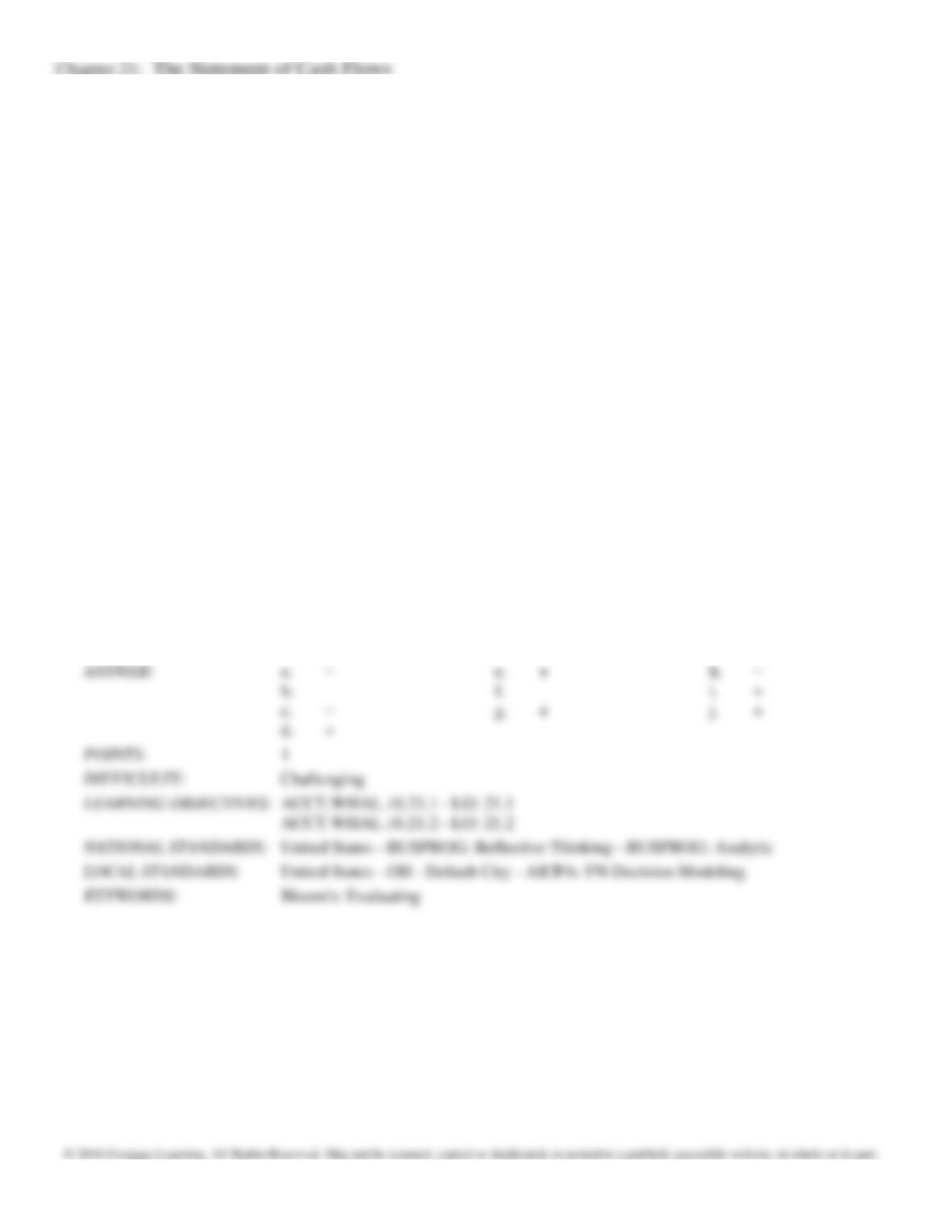
d.
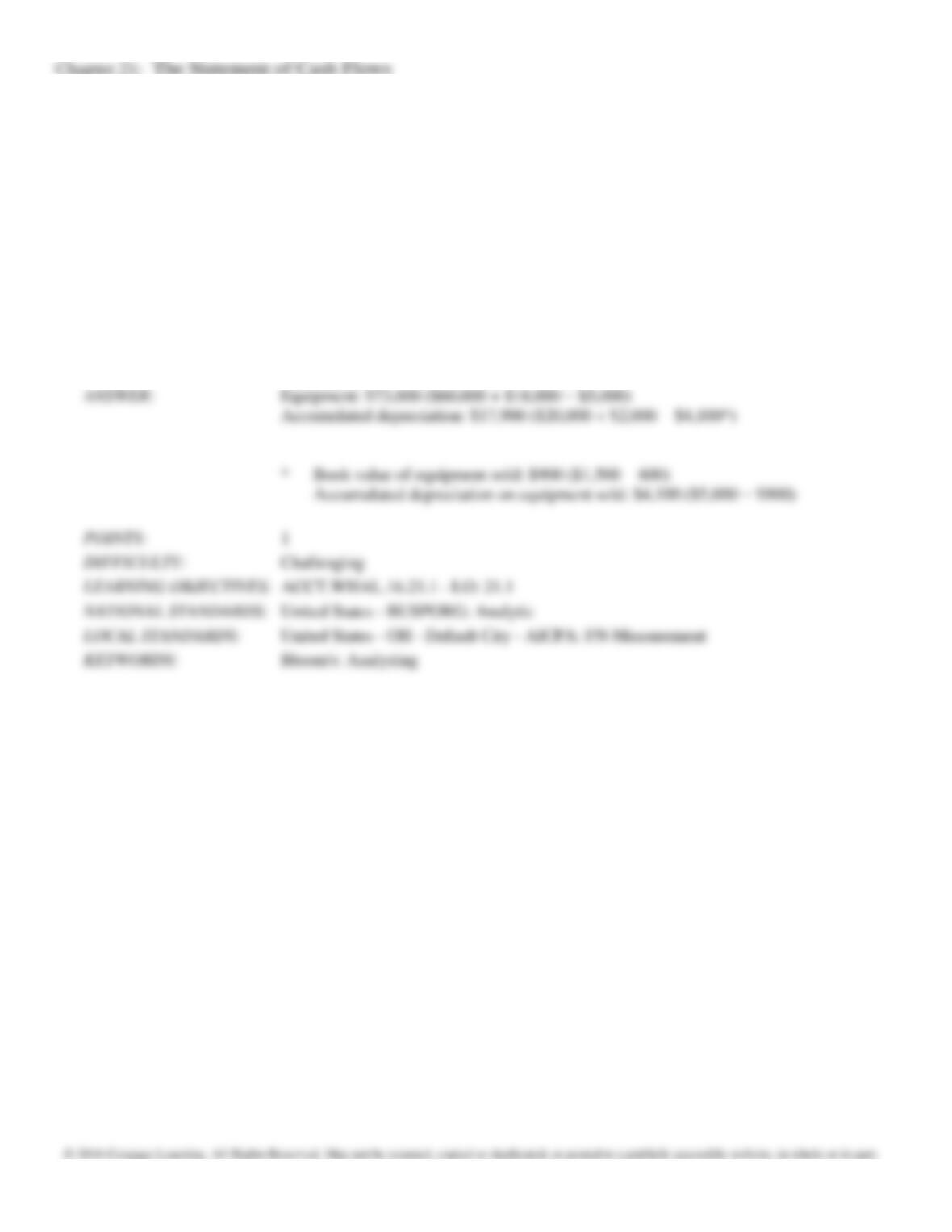
$ 600.
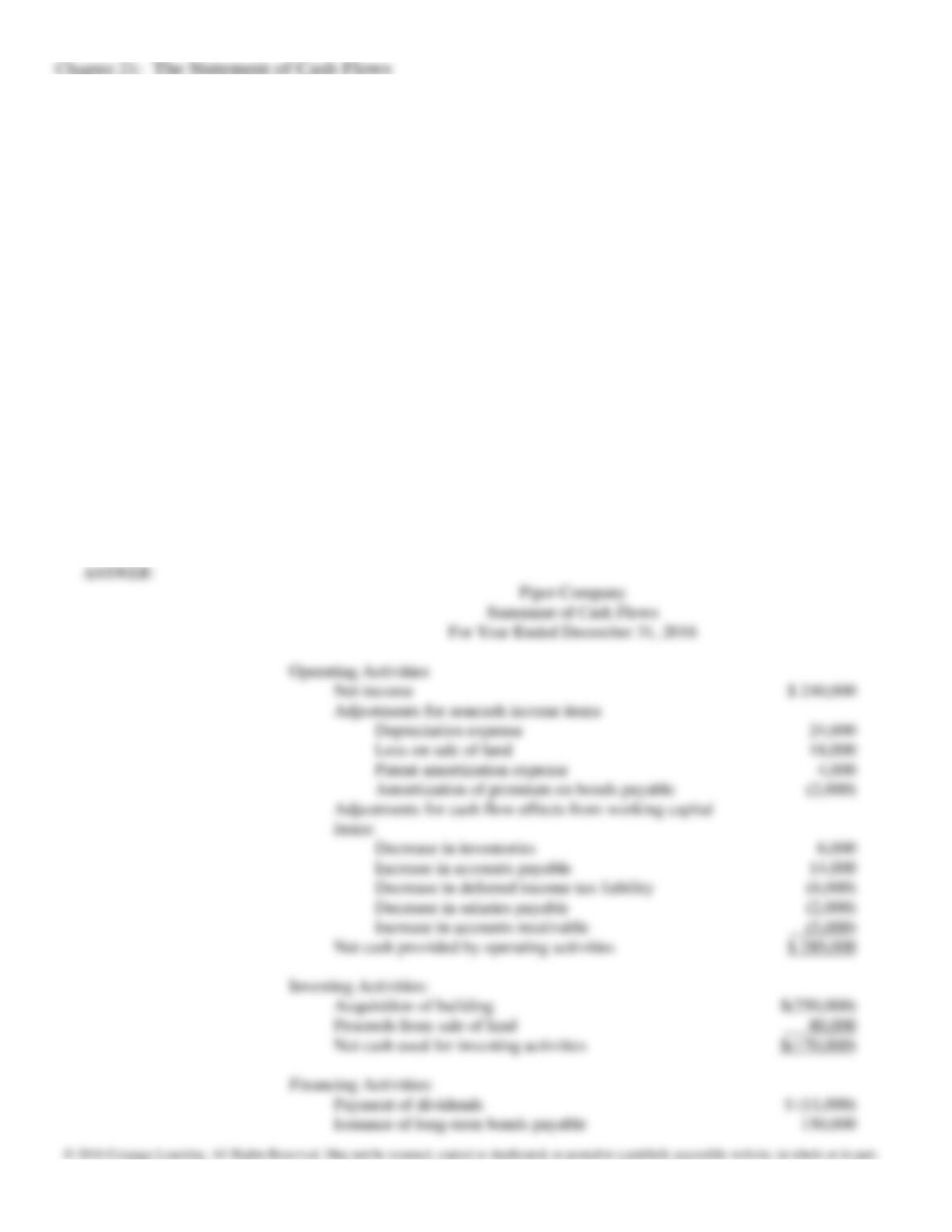
a
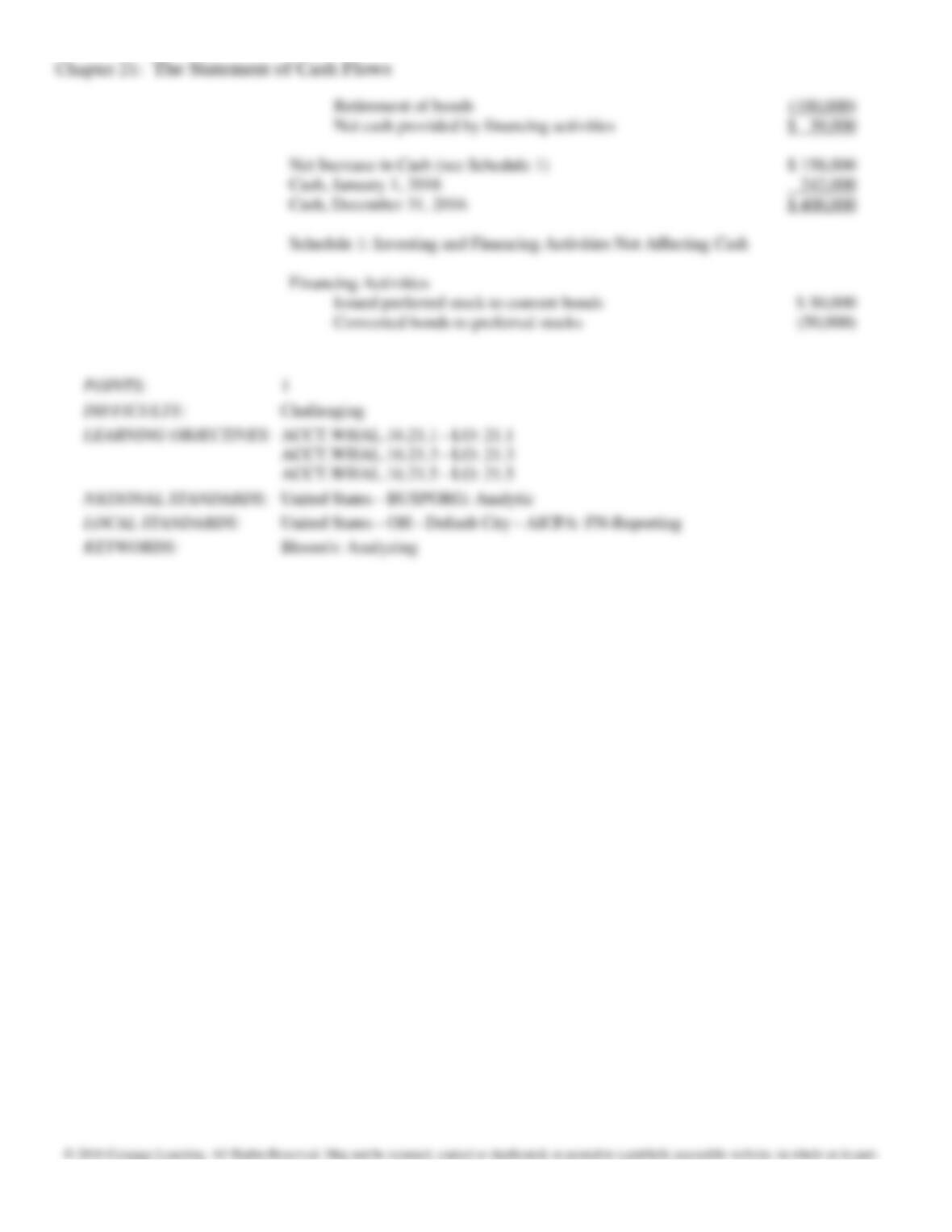
1
Challenging
ACCT.WHAL.16.21.4 – LO: 21.4
United States – BUSPORG: Analytic
United States – OH – Default City – AICPA: FN-Measurement
Bloom’s: Analyzing
Chapter 21: The Statement of Cash Flows
Exhibit 21-3
The Travis Company uses the spreadsheet method for completing the statement of cash flows. The balance sheet
accounts and other information related to those accounts are presented below for Travis Company:
December 31
Assets
2017
2016
Cash
$ 140,000
$ 100,000
Accounts Receivable, net
200,000
240,000
Inventory
160,000
140,000
Long-Term Investments
60,000
150,000
Plant Assets
500,000
450,000
Accumulated Depreciation
(300,000)
(290,000)
Patents
8,000
10,000
Total Assets
$ 768,000
$ 800,000
Equities
Accounts Payable
$ 100,000
$ 80,000
Bonds Payable, due 2017
180,000
240,000
Common Stock, $10 par
200,000
160,000
Additional Paid-in Capital
160,000
140,000
Retained Earnings
128,000
180,000
Total Equities
$ 768,000
$ 800,000
Additional information related to 2017 activities:
1.
Net loss for 2017 was $40,000.
2.
Cash dividends of $12,000 were declared and paid in 2017.
3.
4,000 shares of common stock were issued to bondholders converting bonds payable into
common stock.
4.
A long-term investment was sold for $100,000 cash.
5.
Equipment costing $100,000 and having accumulated depreciation of $30,000 was sold for
$50,000 cash.
54. Refer to Exhibit 21-3. Net cash provided (used) in the financing activities section of Travis’s 2017 statement of cash
flows was
a.
$ 0.
b.
$(12,000).
c.
$(52,000).
d.
$(32,000).
b
1
Challenging
ACCT.WHAL.16.21.4 – LO: 21.4
United States – BUSPORG: Analytic
Bloom’s: Analyzing
55. Refer to Exhibit 21-3. Net cash provided (used) in the investing activities section of Travis’s 2017 statement of cash
flows was
a.
$ 0.
b.
$(150,000).
c.
$ (50,000).
d.
$ 150,000.
a
1
Challenging
ACCT.WHAL.16.21.4 – LO: 21.4
United States – BUSPORG: Analytic
United States – OH – Default City – AICPA: FN-Measurement
Bloom’s: Analyzing
56. Refer to Exhibit 21-3. Net cash provided (used) in the operating activities section of Travis’s 2017 statement of cash
flows was
a.
$(40,000).
b.
$ 50,000.
c.
$ 52,000.
d.
$ 56,000.
c
1
Challenging
ACCT.WHAL.16.21.4 – LO: 21.4
United States – BUSPORG: Analytic
United States – OH – Default City – AICPA: FN-Measurement
Bloom’s: Analyzing
57. When preparing a statement of cash flows using a spreadsheet, it is best to begin the spreadsheet with
a.
a trial balance.
b.
an adjusted trial balance.
c.
a balance sheet.
d.
a balance sheet and an income statement.
c
1
Easy
ACCT.WHAL.16.21.4 – LO: 21.4
United States – BUSPROG: Reflective Thinking – BUSPROG: Analytic
United States – OH – Default City – AICPA: FN-Decision Modeling
Bloom’s: Remembering
58. The following information relates to the Davensmith Company:
Interest payable, beginning of period
$ 60
Bond discount amortization, end of period
40
Interest payable, end of period
10
Total interest expense reported on the income statement
850
Bond discount amortization, beginning of period
70
What was the amount of interest paid?
a.
$820
b.
$830
c.
$850
d.
$870
d
1
Moderate
ACCT.WHAL.16.21.5 – LO: 21.5
United States – BUSPORG: Analytic
United States – OH – Default City – AICPA: FN-Measurement
Bloom’s: Analyzing
59. Which of the following should be presented in a statement of cash flows?
Stock Dividends
Stock Splits
I.
Yes
Yes
II.
Yes
No
III.
No
Yes
IV.
No
No
a.
I
b.
II
c.
III
d.
IV
d
1
Moderate
ACCT.WHAL.16.21.5 – LO: 21.5
United States – BUSPROG: Reflective Thinking – BUSPROG: Analytic
United States – OH – Default City – AICPA: FN-Reporting
Bloom’s: Understanding
60. The statement of cash flows would not report which one of the following items?
a.
stock dividends
b.
purchase of capital stock
c.
redemption of long-term debt
d.
issuance of long-term debt
a
1
Easy
ACCT.WHAL.16.21.5 – LO: 21.5
United States – BUSPROG: Reflective Thinking – BUSPROG: Analytic
United States – OH – Default City – AICPA: FN-Decision Modeling
Bloom’s: Remembering
61. A company had an increase in interest payable during the year and also amortized discount on bonds payable. Under
the direct method, the amount of interest paid during the year to be reflected in the statement of cash flows is
a.
interest expense plus the increase in interest payable minus the discount amortization.
b.
interest expense plus the increase in interest payable plus the discount amortization.
c.
interest expense minus the increase in interest payable minus the discount amortization.
d.
interest expense minus the increase in interest payable plus the discount amortization.
c
1
Moderate
ACCT.WHAL.16.21.6 – LO: 21.6
United States – BUSPORG: Analytic
United States – OH – Default City – AICPA: FN-Measurement
Bloom’s: Analyzing
62. A company’s unearned rental revenue account increases from the beginning to the end of the year. In the statement of
cash flows using the direct method, the cash collected from tenants would be
a.
rent revenue plus unearned rent revenue at the beginning of the year.
b.
rent revenue plus the increase in unearned rent revenue during the year.
c.
rent revenue minus the increase in unearned rent revenue during the year.
d.
equal to rental revenue on the income statement.
b
1
Moderate
ACCT.WHAL.16.21.6 – LO: 21.6
United States – BUSPROG: Reflective Thinking – BUSPROG: Analytic
United States – OH – Default City – AICPA: FN-Decision Modeling
Bloom’s: Understanding
63. The following information relates to the Fowler Company for 2016:
Sales discounts
$ 700
Beginning accounts receivable
5,000
Collections on accounts receivable
20,000
Total sales reported on income statement
82,500
Ending accounts receivable
7,000
What was the amount of cash sales?
a.
$61,200
b.
$59,800
c.
$63,800
d.
$65,200
b
1
Moderate
ACCT.WHAL.16.21.6 – LO: 21.6
United States – BUSPORG: Analytic
United States – OH – Default City – AICPA: FN-Measurement
Bloom’s: Analyzing
64. When reading the Cash Outflows from Operating Activities portion of the statement of cash flows, you would expect
to find which of the following?
I.
Payments to suppliers
II.
Payments to customers
III.
Payments to employees
IV.
Payments of interest
V.
Payments for income taxes
VI.
Other operating payments
a.
I, II, III, and V
b.
I, III, IV, and VI
c.
I, II, III, IV, V, and VI
d.
I, III, IV, VI, and V
d
1
Moderate
ACCT.WHAL.16.21.6 – LO: 21.6
United States – BUSPORG: Analytic
United States – OH – Default City – AICPA: FN-Reporting
Bloom’s: Understanding
65. When reading the Cash Inflows from Operating Activities portion of the statement of cash flows using the direct
method, you would expect to find which of the following?
I.
Collections from customers
II.
Interest and dividends collected
III.
Other operating receipts
IV.
Receipts from shareholders
a.
I
b.
I and IV
c.
I, II, and III
d.
I, II, III, and IV
c
1
Moderate
ACCT.WHAL.16.21.7 – LO: 21.7
United States – BUSPROG: Reflective Thinking – BUSPROG: Analytic
United States – OH – Default City – AICPA: FN-Reporting
Bloom’s: Understanding
66. Which statement is false?
a.
Salaries expense + Decrease in salaries payable = Cash payments to employees.
b.
Other revenues + Increase in unearned revenues − Gains on disposal of assets − Equity investment income =
Other operating cash receipts.
c.
Sales revenue − Increase in accounts receivable = Cash collections from customers.
d.
Other expenses + Decrease in prepaid expenses − Depreciation expense + Losses on disposal of assets −
Equity investment loss = Other operating cash payments.
d
1
Moderate
ACCT.WHAL.16.21.7 – LO: 21.7
United States – BUSPORG: Analytic
United States – OH – Default City – AICPA: FN-Measurement
Bloom’s: Analyzing
67. Which of the following items would be deducted from net income to determine net cash provided by operating
activities using the direct method?
a.
loss on sale of plant assets and amortization of bond payable discount
b.
amortization of bond payable premium and gain on sale of equipment
c.
amortization expense and gain on sale of equipment
d.
None of these choices would be deducted from net income
d
1
Moderate
ACCT.WHAL.16.21.7 – LO: 21.7
United States – BUSPROG: Reflective Thinking – BUSPROG: Analytic
United States – OH – Default City – AICPA: FN-Decision Modeling
Bloom’s: Understanding
68. Which of the following is true concerning the direct method of calculating operating cash flows?
a.
does not tie the net income reported on a company’s income statement to the net cash provided from operating
activities
b.
does not show how the changes in the elements of a company’s operating cycle affected its operating cash
flows
c.
reports a company’s operating cash inflows separately from its operating cash outflows
d.
All of these choices are true concerning the direct method.
d
1
Easy
ACCT.WHAL.16.21.7 – LO: 21.7
United States – BUSPROG: Reflective Thinking – BUSPROG: Analytic
United States – OH – Default City – AICPA: FN-Decision Modeling
Bloom’s: Remembering
69. On the statement of cash flows prepared using the direct method, cash from customers would be computed as sales
plus
a.
an increase in accounts receivable.
b.
an increase in accounts payable.
c.
a decrease in accounts receivable.
d.
a decrease in accounts payable.
c
1
Easy
ACCT.WHAL.16.21.7 – LO: 21.7
United States – BUSPROG: Reflective Thinking – BUSPROG: Analytic
United States – OH – Default City – AICPA: FN-Decision Modeling
70. On the statement of cash flows prepared using the direct method, cash paid for income taxes would be income tax
expense minus
a.
an increase in income taxes payable.
b.
a decrease in income taxes payable.
c.
beginning income taxes payable.
d.
ending income taxes payable.
a
1
Easy
ACCT.WHAL.16.21.7 – LO: 21.7
United States – BUSPROG: Reflective Thinking – BUSPROG: Analytic
United States – OH – Default City – AICPA: FN-Decision Modeling
Bloom’s: Remembering
71. Under the direct method, which one of the following would represent cash paid?
a.
gains on sales of plant assets
b.
losses on sales of plant assets
c.
depreciation expense, adjusted for changes in depreciation methods
d.
interest expense, adjusted for changes in interest payable and amortization of bond premium or discount
d
1
Easy
ACCT.WHAL.16.21.7 – LO: 21.7
United States – BUSPROG: Reflective Thinking – BUSPROG: Analytic
United States – OH – Default City – AICPA: FN-Decision Modeling
Bloom’s: Remembering
72. The following are totals from selected financial statements of Macy May Company for the years ended December 31,
2015, 2016 and 2017:
12/31/2015
12/31/2016
12/31/2017
Cash flows provided by operating activities
$ 204,000
$ 184,000
Cash flows provided by investing activities
(15,500)
(19,750)
Cash flows used by financing activities
(45,000)
20,000
Net increase in cash
$ 143,500
$ 184,250
Net income
$ 55,000
$ 74,000
Current assets
$ 155,000
175,000
201,250
Total assets
245,000
300,000
345,000
Current liabilities
85,000
100,000
115,000
Total liabilities
212,500
250,000
287,500
Required:
1)Compute the operating cash flow ratios for the years ended December 31, 2016 and 2017.
2) Compute the operating cash flow to total liabilities ratios for the years ended December 31, 2016, and 2017.
73. A statement of cash flows contains the following sections:
a.
net cash flow from operating activities
b.
cash flows from investing activities
c.
cash flows from financing activities
d.
investing and financing activities not affecting cash
A list of items that appear on the statement is provided below:
____
1.
Depreciation expense
____
2.
Proceeds from sale of land at a gain
____
3.
Decrease in accounts payable
____
4.
Conversion of bonds to common stock
____
5.
Payment of dividends, declared last fiscal year
____
6.
Proceeds from issuance of short-term note payable,
not relating to operating activities
____
7.
Loss on cash sale of equipment
____
8.
Payment for purchase of a building
____
9.
Bond premium amortization using the effective interest method
____
10.
Issuance of common stock to convert bonds payable
1.
a +
5.
c −
8.
2.
b +, a −
6.
c +
9.
3.
a −
7.
a +, b +
10.
4.
d
Bloom’s: Evaluating
Required:
In the space provided, using the letters (a-d), indicate in which section(s) of the statement of cash flows (or
accompanying schedule) the preceding items would most likely be classified. After each item affecting cash, indicate
with a plus sign (+) or a minus sign (−) whether the item would be reported as an increase (inflow) or a decrease
(outflow).
74. Several items to be considered in converting net income to the net cash flow from operating activities under the
indirect method are listed below:
____
a.
Increase in inventory
____
b.
Amortization of discount on investment in bonds
____
c.
Decrease in accounts payable
____
d.
Amortization of discount on bonds payable
____
e.
Increase in salaries payable
____
f.
Increase in prepaid expenses
____
g.
Subsidiary loss under the equity method
____
h.
Gain on disposal of equipment
____
i.
Decrease in accounts receivable
____
j.
Increase in deferred tax liability
Required:
Fill in the blanks by using a plus sign (+) or a minus sign (−) to indicate whether each item should be added to or
subtracted from net income to arrive at the net cash flow from operating activities.
a.
e.
+
h.
b.
f.
i.
c.
g.
+
j.
d.
+
75. On its January 1, 2016, balance sheet, Calvin Company reported equipment of $60,000 and accumulated depreciation
of $20,000. During 2016, Calvin sold equipment with an original cost of $5,000. Selected information from Calvin’s
2016 statement of cash flows follows:
Net income
$20,000
Depreciation expense on equipment
2,000
Gain on sale of equipment
600
Proceeds from sale of equipment
1,500
Purchase of equipment
18,000
Required:
Compute the amount of equipment and accumulated depreciation that should appear on Calvin’s December 31, 2016,
balance sheet.
*
76. The information below was taken from the records of the Piper Company for the year ended December 31, 2016:
Acquisition of building
$250,000
Amortization of premium on bonds payable
2,000
Decrease in deferred income tax liability
8,000
Decrease in inventories
6,000
Decrease in salaries payable
2,000
Depreciation expense
24,000
Dividends paid
11,000
Loss on sale of land
18,000
Increase in accounts payable
14,000
Increase in accounts receivable
5,000
Issuance of long-term bonds payable
150,000
Net income
240,000
Patent amortization expense
4,000
Preferred stock issued to convert bonds
50,000
Retirement of bonds
100,000
Proceeds from sale of land
80,000
Ending cash balance
400,000
Required:
Prepare Piper’s statement of cash flows for 2016, using the indirect method.

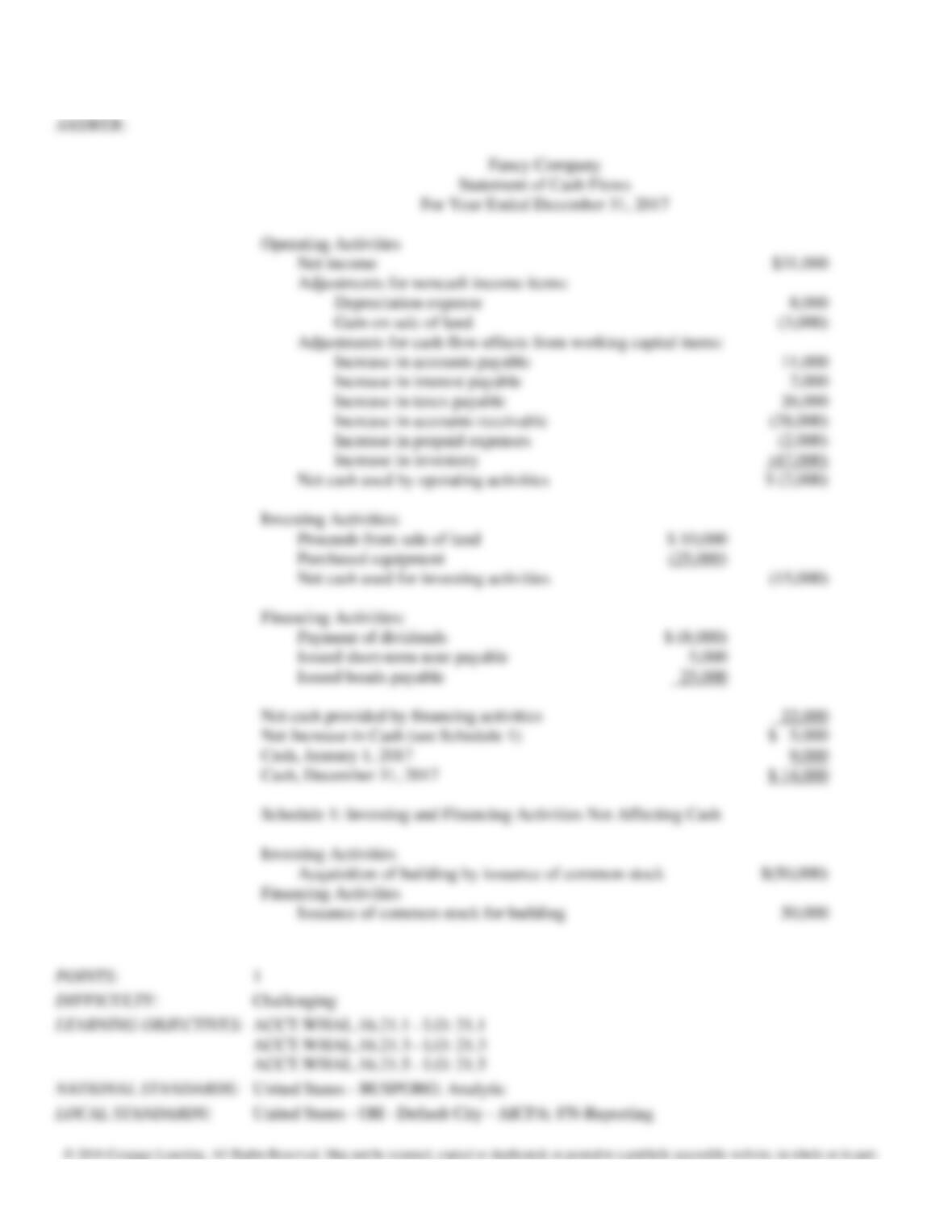
77. The Fancy Company’s comparative balance sheets for 2016 and 2017, and additional information, are presented
below.
Fancy Company
Comparative Balance Sheets
December
31,
December
31,
ASSETS
2017
2016
Cash
$ 14,000
$ 9,000
Accounts receivable
52,000
24,000
Inventory
87,000
40,000
Equipment
125,000
100,000
Accumulated depreciation
(42,000)
(34,000)
Prepaid expenses
4,000
2,000
Land
-0-
7,000
Building
50,000
-0-
Total Assets
$290,000
$148,000
LIABILITIES AND SHAREHOLDERS’ EQUITY
Accounts payable
$ 25,000
$ 14,000
Interest payable
8,000
6,000
Taxes payable
37,000
11,000
Short-term note payable
37,000
32,000
Bonds payable
75,000
50,000
Common stock, $10 par
75,000
25,000
Retained earnings
33,000
10,000
Total Liabilities and Shareholders’ Equity
$290,000
$148,000
Additional 2017 information:
Net income, $31,000
Sold land for gain of $3,000
Paid dividends of $8,000
Issued $50,000 common stock to purchase
building
Required:
Prepare Fancy Company’s 2017 statement of cash flows using the indirect method.
Chapter 21: The Statement of Cash Flows
78. An abbreviated set of financial statements for Caraba’s Company for 2017 and 2016 is shown below:
Caraba’s Company
Income Statement
For the Year Ended December 31, 2017
Sales
$553,000
Investment income
26,000
Gain on sale of investments
3,500
$582,500
Less:
Selling & administrative expenses
$221,600
Depreciation expense
15,000
Interest expense
3,900
Income taxes expense
6,500
247,000
Net Income
$335,500
Comparative Balance Sheets
December 31
2017
2016
Cash
$209,000
$ 49,900
Accounts receivable
160,300
63,700
Investments
117,000
126,100
Equipment (net)
146,200
80,400
Land
312,000
276,300
Total Assets
$944,500
$596,400
Accounts payable
$130,000
$ 87,500
Mortgage payable
65,000
97,400
Common stock
266,500
238,000
Retained earnings
483,000
173,500
Total Liabilities & Shareholders’ Equity
$944,500
$596,400
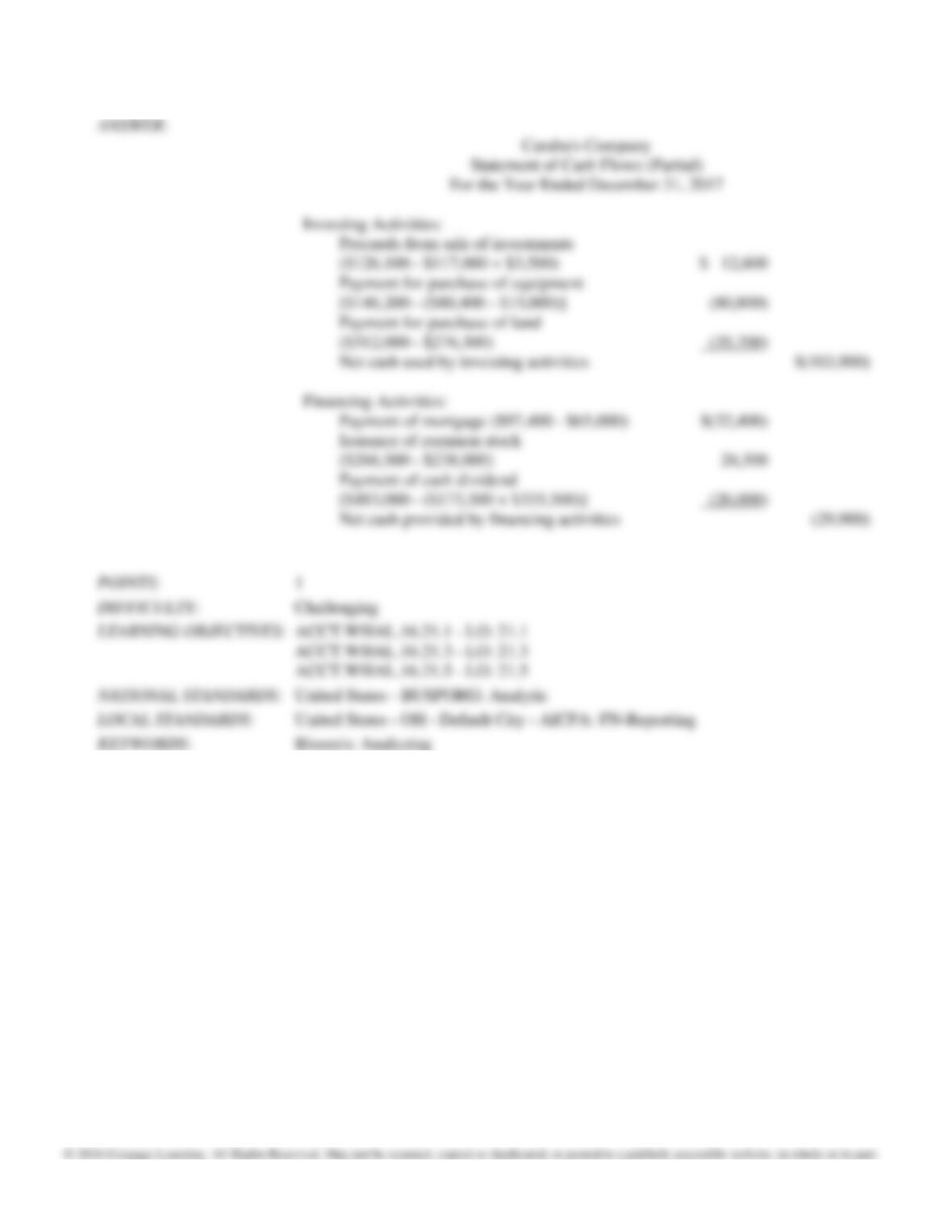
Required:
Prepare the cash flows from investing and financing activities sections of the 2017 statement of cash flows.
Chapter 21: The Statement of Cash Flows