d.
quality of incoming raw materials.
34. Service businesses are typically more concerned with _____ costs than with the cost of materials for
operations.
a.
equipment
b.
fixed asset
c.
labor
d.
leasing
35. A reason to buy component parts is
a.
closer coordination between scheduling and production.
b.
equipment obsolescence.
c.
improved plant utilization.
d.
the parts are a specialty of the supplier.
36. The buying of products or services from a third party to manage a firm’s functions is known as
a.
asset efficiency.
b.
diversification of supplies.
c.
importing.
d.
outsourcing.
37. A suggestion for increasing outsourcing success is
a.
have a back-up plan in case of supplier failure.
b.
outsource the unique product of the business.
c.
periodically monitor the company’s progress.
d.
negotiate for priority in the production schedule.
38. Sam’s company can either make the components or buy them. He should decide to buy components
from a supplier (as opposed to making them):
a.
when his plant has excess plant capacity.
b.
when buying the components will require greater flexibility on the firm’s part to
accommodate the supplier.
c.
if product quality would be the same (regardless of the firm’s decision).
d.
if the risk of equipment obsolescence can be transferred to the supplier.
39. Cooperative purchasing organizations for small businesses are more successful now because of the:
a.
acceptance of coops as a business model by suppliers.
b.
diversification of numerous global suppliers.
c.
increased use of the Internet to locate more suppliers.
d.
use of crowdsourcing to locate new suppliers.
40. Terrell is trying to decide whether to concentrate his purchases with one supplier or diversify with two
or three. One factor in favor of a single supplier is:
a.
insurance against interruptions caused by strikes.
b.
a particular supplier’s superiority in product quality.
c.
knowing the customer’s loyalty, the supplier may provide better prices and service.
d.
locating the best source in terms of price, quality and service with each purchase.
41. The most important reason why a small business should build good relationships with large
suppliers is
a.
forecasting can be made easier with the suppliers input.
b.
it will make the small business stand out from other firms buying from the supplier.
c.
the need for the small business to have prices as low as possible on purchases.
d.
the relationship can make the small business more competitive.
42. Aaron operates a lemonade stand in the New York City’s Central Park. His business is seasonal but
within those seasons several other factor influence the demand for lemonade. Aaron is most likely to
use _______________ to help him predict demand on a daily basis.
a.
associative forecasting
b.
linear regression
c.
historical sales data
d.
the weather report
43. An approach that emphasizes efficiency through elimination of waste independent of other aspects of
the process is called
a.
capacity management.
b.
lean production.
c.
synchronous management.
d.
waste-less production.
44. The approach that recognizes the assets and activities of the company are interdependent and should be
managed so as to maximize the company’s performance is
a.
capacity management.
b.
lean production.
c.
synchronous management.
d.
waste-less production.
45. Myra operates a punch press on a production line. Because she is slower than the operators both
before and after her in the process, work stacks up at her press. Myra is a:
a.
bottleneck.
b.
constraint.
c.
defect.
d.
hazard
46. Of the following, which is of greatest concern to a production manager?
a.
a bottleneck
b.
capacity waste
c.
a constraint
d.
overproduction
47. Which solution to a constraint would be more long term?
a.
Move maintenance times.
b.
Rearrange schedules.
c.
Subdivide work.
d.
Expand capacity.
48. Shoichiro Toyoda, former president of Toyota Motors, built on Ford’s concepts and focused on the
need to eliminate waste from the production system. He followed a(n) _______ approach.
a.
assembly line
b.
distribution
c.
lean production
d.
synchronous production
MATCHING
Match the term with its definition. Some terms may not be used.
a.
ABC method
g.
Just-in-time inventory system
b.
Associative forecasting
h.
Perpetual inventory system
c.
Cooperative purchasing organization
i.
Physical inventory system
d.
Cycle counting
j.
Poka-yoke
e.
Demand management strategies
k.
Statistical inventory control
f.
Economic order quantity
l.
Two-bin inventory system
1. Operational strategies used to stimulate customer demand when it is normally low
2. A system of classifying items in inventory by relative value
3. A method of reducing inventory carrying costs by making or buying what is needed just as it is needed
4. A method of controlling inventory that uses a targeted service level, allowing statistical determination
of the appropriate amount of inventory to carry
5. An index that determines the quantity to purchase in order to minimize total inventory costs
6. A method for counting different segments of the physical inventory at different times during the year
7. A method of inventory control based on the use of two containers for each item in inventory, one to
meet current demand and the other to meet future demand
8. A method that provides for periodic counting of items in inventory
9. Forecasting that considers a variety of variables to determine expected sales
10. A method for keeping a running record of inventory
11. An organization in which small businesses combine their demand for products or services in order to
negotiate as a group with suppliers
Match the term with its definition. Some terms may not be used.
a.
Acceptance sampling
g.
Operations
b.
Attributes
h.
Operations management
c.
Bottleneck
i.
Poka-Yoke
d.
Constraint
j.
Quality
e.
Inspection
k.
Total quality management
f.
ISO 9000
l.
Variables
12. The features of a product or service that enable it to satisfy customers’ stated and implied needs
13. Any point in the operations process where limited capacity reduces the production capability of an
entire chain of activities
14. The examination of a part or a product to determine whether it meets quality standards
15. The planning and control of a conversion process that includes turning inputs into outputs that
customers desire
16. A proactive approach to quality management that seeks to mistake-proof a firm’s operations
17. The most restrictive limit on capacity, determining the capacity of the entire system
18. The standards governing international certification of a firm’s quality management procedures
19. Product or service parameters that can be counted as being present or absent
20. Measured parameters that fall on a continuum, such as weight or length
21. The use of a random, representative portion of products to determine the acceptability of an entire lot
22. An all-encompassing management approach to providing high-quality products or services
Match the term with its definition. Some terms may not be used.
a.
Continuous manufacturing
b.
Flexible manufacturing systems
c.
Job shops
d.
Lean production
e.
Make-or-buy decisions
f.
Operations
g.
Outsourcing
h.
Poka-yoke
i.
Project manufacturing
j.
Repetitive manufacturing
k.
Supply Chain Operations Reference model
l.
Synchronous manufacturing
23. An approach that recognizes the interdependence of assets and activities and manages them to
optimize the entire firm’s performance
24. A form of manufacturing with output that more closely resembles a product stream than individual
products
25. An approach that emphasizes efficiency through elimination of waste
26. Manufacturing operations that usually involve computer-controlled equipment that can turn out
products in smaller or more flexible quantities
27. Manufacturing operations used to create unique but similar products
28. Manufacturing operations designed for short production runs of small quantities of items
29. Manufacturing operations designed for long production runs of high-volume, standardized products
30. Contracting with a third party to take on and manage one or more of a firm’s functions
31. A choice that companies must make when they have the option of making or buying component parts
for products they produce
32. The processes used to create and deliver a product or service
33. A list of critical factors that provides a helpful starting place when assessing a supplier’s performance
ESSAY
1. After defining operations management, discuss operational factors that will impact a firm’s
performance.
2. Christie and Kevin are starting a produce farm raising organic vegetables. Kevin plans to sell the
produce wholesale to a local restaurant and Christie is going to start a cooking school spotlighting the
produce. Complete the following table detailing the inputs and outputs between the product business
versus the service business. What are the similarities?
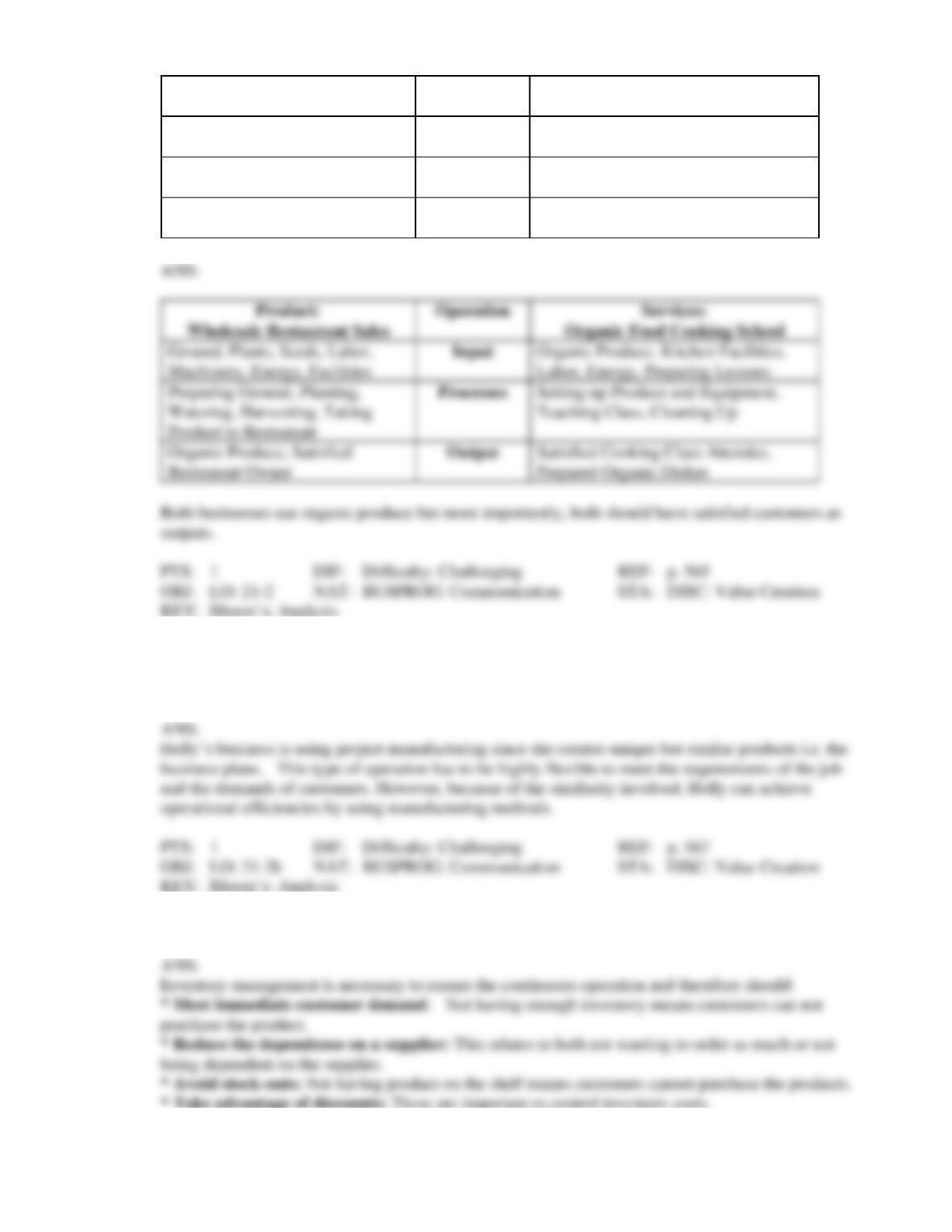
Product:
Wholesale Restaurant Sales
Operation
Services:
Organic Food Cooking School
Input
Processes
Output
3. Holly is a business consultant who assists new companies in writing business plans. What type of
manufacturing operation would Holly’s business be considered and what are important characteristics
for operational success?
4. Discuss the objectives of inventory management.
Ground, Plants, Seeds, Labor,
Input
Organic Produce, Kitchen Facilities,
Watering, Harvesting, Taking
Organic Produce, Satisfied
Output
Satisfied Cooking Class Attendee,
Prepared Organic Dishes
5. After describing the ABC Inventory Classification System, give examples of each category for a food
item common to a restaurant.
6. After describing common inventory record-keeping systems, what are guidelines for their use?
7. According to The American Society for Quality, what features are necessary for TQM?
8. Wallie’s Western Wear is a retailer of western style clothing that produces all of its own products.
Wallie and Wanda, the owners, want to incorporate a system to solve quality problems and understand
they need to start with their customers. What suggestions would be helpful for this process?
9. Discuss quality tools and techniques that can be used to improve quality. Specifically describe the
difference between inspection vs. poka-yoke as a quality assurance method. How do these methods
relate to Ishikawa’s “The Basic Seven” and statistical methods of quality control?
10. Hillary is the operations manager at a small company which imports English leather-goods for resale.
In a recent meeting with the CEO, the decision was made that the small company would concentrate
purchases with one supplier. What are reasons that this decision could have been made?
11. How can supplier performance be measured when selecting a new supplier? Discuss the SCOR
model followed by other suggestions for good relations.
12. Discuss principles of lean production, specifically the ways that the Toyota Production System uses
to eliminate waste.
13. Tonya owns TT’s T-shirts, a sports clothing production company that produces embroidered shirts that
are monogrammed. She has identified a constraint with her monogramming machine in that the work
flow slows considerably due to the shirts not being fed into the machine properly and the machine
taking a certain amount of time. How could this problem be addressed?