
173)
All of the following are advantages of a corporation EXCEPT
173)
A)
unlimited life.
B)
limited liability.
C)
ability to raise large sums of financial capital.
D)
double taxation.
174)
In a partnership of two people
174)
A)
the law releases each partner from legal liabilities.
B)
it is more difficult to specialize with two persons than with one.
C)
each person has unlimited liability.
D)
each person has 50 percent liability.
175)
The three primary sources of corporate funds are
175)
A)
investment banks, brokerages, and insurance companies.
B)
stocks, bonds, and reinvestment of profits.
C)
banks, friends, and family.
D)
government, other corporations, and the central bank.
176)
A business owned by two or more joint owners, or partners, who share the responsibilities and the
profits of the firm and are individually liable for all the debts is a(n)
176)
A)
partnership.
B)
entrepreneur.
C)
proprietorship.
D)
corporation.
177)
If a corporation fails, the first recipients of funds that may remain are
177)
A)
bond holders.
B)
common stockholders.
C)
preferred stockholders.
D)
no one.

178)
The theory that there is no predictable trends in securities prices is the
178)
A)
random walk theory.
B)
capital reinvestment.
C)
opportunity cost of capital.
D)
present value.
179)
Suppose your donut shop earns $24,000 in total revenues per month with explicit costs of $12,000
and opportunity costs of $8,000. Your accounting profit is
179)
A)
zero.
B)
$4,000.
C)
$12,000.
D)
$16,000.
C
180)
Suppose the supply of ocean front property in California is perfectly inelastic. Any increases in
demand for this property increases the
180)
A)
opportunity cost of land owners.
B)
present discounted value.
C)
real interest rate.
D)
economic rent.
D
181)
A person starts his own business after quitting his job in which he made $75,000. Expenses include
$100,000 for wages and salaries, which includes a wage for the owner of $75,000, utilities of $5000,
equipment of $50,000, and materials of $40,000. If revenues are $200,000, his accounting and
economic profits are respectively
181)
A)
$5000 and $5000.
B)
–$70,000 and –$70,000.
C)
$80,000 and $5000.
D)
–$70,000 and $5000.
A
182)
According to the random walk theory
182)
A)
the probability that a stock’s price will increase tomorrow is greater if it increased today.
B)
the best forecast of tomorrow’s price is found by determining the trend for the last five
trading days.
C)
the probability that a stock’s price will increase tomorrow is greater if it decreased today.
D)
the best forecast of tomorrow’s price is today’s price.
D
A

183)
The nominal rate of interest is
183)
A)
the rate observed in the market that includes an inflation premium.
B)
not the rate observed in the market.
C)
expressed in dollars from the chosen base year.
D)
not adjusted for inflation.
184)
A star basketball player signs a contract that newspaper reports indicate is worth $10 million. The
player receives $2 million upon signing, and $2 million every year for four years. The contract is
worth
184)
A)
more than $10 million since the present value of $2 million received one or more years from
now is more than $2 million.
B)
less than $10 million since the present value of $2 million received one or more years from
now is less than $2 million.
C)
$10 million as reported in the press.
D)
some amount around $10 million. To determine whether it is more or less than $10 million we
need to know whether the interest the player can earn is more or less than the market rate of
interest.
B
185)
All of the following are characteristics of a proprietorship EXCEPT
185)
A)
one person gets all of the profits.
B)
the firm can form a corporation to protect itself against the debts.
C)
one person is responsible for all the debts of the firm.
D)
the business is owned by one individual.
B
186)
What is the real (adjusted for inflation) present value of $104.25 that you could receive one year
from now, given that the rate of interest is 4.25 percent and the anticipated rate of inflation is 1
percent?
186)
A)
$100.97
B)
$99.05
C)
$107.64
D)
$100.00
A
A

187)
Which legal claim has a fixed annual coupon payment?
187)
A)
common stock
B)
preferred stock
C)
bond
D)
reinvestment
188)
Which of the following statements about stock market brokers and dealers is TRUE?
188)
A)
Both brokers and dealers earn commissions from trading stocks.
B)
Brokers earn commissions from trading stocks but dealers try to profit from trading stocks.
C)
Both brokers and dealers try to profit from trading stocks.
D)
Brokers try to profit from trading stocks but dealers earn commissions from trading stocks.
189)
In which of the following ways can a corporation raise new funds for investment?
I. Issuing new shares of stock
II. Having existing stock resold between two owners
189)
A)
I only
B)
II only
C)
Both I and II
D)
Neither I nor II
190)
The person least likely to receive a payment from a corporation in a year of losses is the
190)
A)
common stockholder.
B)
bank that loaned money to the corporation.
C)
bondholder.
D)
preferred stockholder.
191)
Suppose your donut shop earns $20,000 in total revenues per month with explicit costs of $15,000
and opportunity costs of $5,000. Your economic profit is
191)
A)
zero.
B)
$12,000.
C)
$16,000.
D)
$5,000.

192)
A famous opera star made $2 million per year. He said he would rather sell insurance if he couldn’t
make more than $100,000 per year. If he is telling the truth, how much is he being paid in economic
rent?
192)
A)
$2.1 million
B)
$2.0 million
C)
$1.9 million
D)
$100,000
193)
What is the present value of $104.25 that you could receive one year from now, given that the rate
of interest is 4.25 percent?
193)
A)
$100.00
B)
$0.00
C)
$108.50
D)
$4.25
194)
Economic rent is broadly defined as
194)
A)
a payment received by a landowner.
B)
the return to owners of farmland.
C)
a payment for the use of any resource that has a fixed supply.
D)
the dividend return on a share of stock.
195)
One advantage of a partnership is
195)
A)
they are double taxed.
B)
lower costs.
C)
they are easy to form.
D)
all the profits go to the older partner.
196)
The rate of interest that you pay on a home loan depends upon all of the following EXCEPT
196)
A)
your credit rating.
B)
the supply of houses in the real estate market.
C)
handling charges or loan fees.
D)
the length of the loan.

197)
Interest rates are higher the
197)
A)
lower the inflation rate.
B)
shorter the duration of the loan.
C)
greater the risk.
D)
larger the amount of the loan, holding other things constant.
198)
Which of the following statements is FALSE?
198)
A)
The accounting profit of a firm is its total revenue minus total explicit costs.
B)
The accounting profit earned by a firm will always be less than its economic profit.
C)
The major difference between accounting and economic profit is that accounting profit does
not reflect the opportunity cost of using resources.
D)
A correct measure of a firm’s economic cost includes both accounting and opportunity cost.
B
199)
The funds used to purchase capital goods are called
199)
A)
dividends and interest.
B)
financial capital.
C)
investment.
D)
savings.
B
200)
The goal of the firm, according to economists, is to
200)
A)
sell as many units of the good it produces as possible.
B)
make as much economic profit as is possible.
C)
stay in business for as long as possible.
D)
grow as large as possible.
B
201)
If a major league baseball player would be willing to work for $500,000 per year and is currently
being paid $1,200,000 per year, that player is earning an annual economic rent of
201)
A)
$1,700,000.
B)
$700,000.
C)
$1,200,000.
D)
$500,000.
B
C

202)
Suppose that you open your own business and earn an accounting profit of $30,000 per year. When
you started your business, you left a job that paid you a $25,000 salary annually. Also, suppose that
you invested $70,000 of your own funds to start up your business. If the normal rate of return on
capital is 5 percent, your economic profit is
202)
A)
$1,500.
B)
$5,000.
C)
–$5,000.
D)
–$1,500.
203)
A difference between a share of stock in a corporation and a corporate bond is that
203)
A)
the share of stock is a legal claim while the bond is not.
B)
stocks are issued in return for funds that are lent to the corporation.
C)
the bond owner is entitled to receive a fixed annual coupon payment plus a lump–sum
payment at the bond’s maturity date, whereas the stockholder is entitled to a share of future
profits.
D)
the bond owner has voting rights within the corporation whereas the stockholder does not.
204)
Stock markets for securities are important because
204)
A)
they are where proprietorships and partnerships raise financial capital.
B)
they make the stocks and bonds more valuable.
C)
they are where corporations raise financial capital.
D)
they permit individuals to transfer their savings directly into investment spending.
205)
The stock market showed a PE for Alibaba equal to 32. What does PE mean?
205)
A)
price–equity ratio
B)
perfect–earnings ratio
C)
profit–earnings ratio
D)
price–earnings ratio

206)
Under which one of the following situations would you be better off?
206)
A)
You borrowed $2,500 at 7 percent to pay for this year’s college expenses and unanticipated
inflation is 12 percent during the year.
B)
You have paid $500 for a $1,000 U.S. savings bond that matures in 10 years and unanticipated
inflation is 10 percent per year.
C)
You have $10,000 in your savings account paying 5 percent per year and unanticipated
inflation is 8 percent per year.
D)
You lend a friend $1,000 at 6 percent to be repaid in one year and unanticipated inflation is 7
percent during the year.
207)
Accounting profit will always be
207)
A)
less than economic profit.
B)
equal to implicit costs.
C)
equal to sunk costs.
D)
more than economic profit.
D
208)
The real rate of interest is 5% and the anticipated rate of inflation is 2%. What is the nominal rate of
interest?
208)
A)
5%
B)
2%
C)
3%
D)
7%
D
209)
A basic tenet of the theory of the firm is that the firm’s primary objective is to
209)
A)
stay out of debt.
B)
produce a given level of output at a specified cost.
C)
operate for the benefit of society.
D)
maximize economic profits.
D
A

210)
The difference between explicit costs and implicit costs
210)
A)
is that implicit costs are opportunity costs while explicit costs are not.
B)
is that explicit costs are opportunity costs while implicit costs are not.
C)
is that explicit costs involve resources that are purchased and implicit costs involve resources
the firm already owns.
D)
is that explicit costs are short–run costs and implicit costs are long–run costs.
211)
Expenses that a firm does not have to pay out of pocket are
211)
A)
wages of employees.
B)
explicit costs.
C)
taxes.
D)
implicit costs.
212)
“Stocks and bonds” are collectively known as
212)
A)
real property.
B)
equities.
C)
securities.
D)
shares.
213)
Suppose that during a given time period the implicit cost for a business was $1,500 and that the
explicit cost was $6,000. Also suppose that the firm sold 1,000 units of its products at $7 per item.
We can conclude that the firm’s
213)
A)
accounting profit was $1,000, and its economic profit was –$500.
B)
accounting profit was –$500, and economic profit was $1,000.
C)
accounting and economic profits were both $1000.
D)
accounting profit was $1000, and economic profit was –$1,500.

214)
Interest rates perform the function of
214)
A)
rewarding those who save but has no direct allocative role.
B)
signaling information about the inflation rate.
C)
allocating funds, but only in the consumer sector.
D)
allocating funds, which determines the allocation of physical capital.
215)
According to efficient market theory, which of the following can best predict the stock price of a
particular company tomorrow?
215)
A)
a finance professor who knows a lot of investment theory
B)
that company’s employee who has inside information about the company
C)
a stock trader who has traded stocks for more than 10 years
D)
none of the above: Everyone has an equal chance of predicting future stock prices
216)
A firm is considering an investment that will cost $2 million today and $2 million a year from now.
It will generate revenues of $1 million a year for five years, beginning two years from now. If the
interest rate is 10 percent, the firm should
216)
A)
not make the investment because the present value of the net revenues is less than $4 million.
B)
make the investment because the present value of the net revenues is greater than the present
value of the investment.
C)
not make the investment because the present value of the net revenues is less than the present
value of the investment spending.
D)
make the investment because the project will generate a net profit of $1 million.
217)
An important problem with corporations is
217)
A)
the difficulties with raising financial capital.
B)
the inability of the government to control and tax the firms.
C)
the possibility of large liabilities for the owners.
D)
the separation of ownership and control.

218)
Which of the following is the most common form of business organization in the United States?
218)
A)
corporation
B)
partnership
C)
S–corporation
D)
proprietorship
219)
The owner(s) of a corporation
219)
A)
is the CEO.
B)
is the entrepreneur.
C)
are the shareholders.
D)
are the bondholders.
220)
If the present value of $110 to be received one year from now is $100, what will $100 be worth two
years from now?
220)
A)
$121
B)
$110
C)
$100
D)
can’t say since we don’t know what the interest rate is
221)
World–class models receive significant economic rents because
221)
A)
there is no equilibrium quantity of world–class models.
B)
there is a surplus of world–class models.
C)
their talents and abilities are in fixed supply.
D)
there is a shortage of world–class models.
222)
The economy’s current rate of interest is 10 percent and a firm has $10,000 of owner–invested
capital. Its total revenue is $5000 and the firm’s explicit costs are $3500. From this we know that this
firm’s
222)
A)
accounting profit is $11,500.
B)
accounting profit is $500.
C)
economic profit is $500.
D)
economic profit is $1,500.

223)
When interest rates allocate capital
223)
A)
investment projects of firms tend to get funded while valuable social investments funded by
the government tend not to get funded.
B)
only investment projects are funded for which the expected benefits of the projects equal or
exceed the opportunity cost of the projects.
C)
there is an under investment in capital and overspending on durable consumer goods.
D)
many worthwhile projects fail to get funded and society is worse off.
224)
The real rate of interest is
224)
A)
equal to the nominal rate of interest less the anticipated rate of inflation.
B)
equal to the nominal rate of interest plus the anticipated rate of inflation.
C)
found by taking the nominal rate of interest and adding the actual rate of inflation.
D)
found by taking the nominal rate of interest and dividing it by the actual rate of inflation.
A
225)
A legal entity that may conduct business in its own name just as an individual does is a(n)
225)
A)
proprietorship.
B)
partnership.
C)
entrepreneur.
D)
corporation.
D
226)
Which of the following is not an explicit cost?
226)
A)
wages
B)
opportunity cost of using an owner’s savings
C)
taxes
D)
rent
B
B

227)
Economic profit is always
227)
A)
greater than accounting profit.
B)
less than accounting profit.
C)
equally likely to be either greater or less than accounting profit.
D)
equal to accounting profit.
228)
The implicit cost incurred by a firm to use its resources to produce its output is the firm’s
228)
A)
accounting cost.
B)
explicit cost.
C)
opportunity cost.
D)
total cost.
229)
An example of an implicit cost is
229)
A)
a business using a building owned by the business owner.
B)
a payment to a resource owner.
C)
the payment of interest on a bond.
D)
payment of a salary to a CEO of a company.
230)
When economic profits are negative, accounting profits
230)
A)
must be positive.
B)
will be negative.
C)
will equal zero.
D)
could be positive, negative or zero.
231)
Joanne left her last job, in which she was earning $50,000, in order to form her own consulting
business. Her revenues for the first year of consulting were $200,000. During that year, she hired
two assistants for $25,000 each and spent $25,000 on office equipment. In addition, she incurred
$75,000 in miscellaneous expenses. Her economic profit that first year was
231)
A)
$50,000.
B)
$200,000.
C)
$75,000.
D)
$0.

232)
The supply curve for land in New York City is most likely
232)
A)
an upward sloping straight line.
B)
a downward sloping straight line.
C)
vertical or perfectly inelastic.
D)
horizontal or perfectly elastic.
233)
The most common form of business organization, as far as the number of such firms in business, is
the
233)
A)
proprietorship.
B)
corporation.
C)
S corporation.
D)
partnership.
234)
If the death of an owner causes the firm to dissolve, the firm must have been
234)
A)
either a proprietorship or a partnership.
B)
a proprietorship only.
C)
a corporation only.
D)
a partnership only.
235)
If the interest rate is 10 percent and a business pays $100,000 for a lease on a factory, the explicit
costs are
235)
A)
$90,000.
B)
$100,000.
C)
$110,000.
D)
$10,000.
236)
Suppose the supply of land is perfectly inelastic and landowners are receiving payments equal to
$25,000 an acre. If the government taxed the landowners’ income with a tax rate of 80 percent, how
much tax would the government collect?
236)
A)
zero, because the owner would do something else with the tax rather than pay such a high tax
B)
$20,000 because the use of the land doesn’t depend on the price the landowners receive for the
land
C)
less than $20,000 because the owners would change their behavior so as to pay less tax
D)
more than $20,000 because the combined effects of all the owners trying to change their
behavior actually would generate higher returns

237)
Corporations account for
237)
A)
the smallest amount of revenues in the United States.
B)
the largest proportion of business revenues generated in the United States.
C)
the largest amount of taxes paid to the U.S. government.
D)
the largest number of firms in the United States.
238)
How much money would you have to put into a savings account today to be worth $500 three
years from now at a market rate of interest equal to 8 percent?
238)
A)
$397
B)
$351
C)
$459
D)
$420
239)
In an inflationary atmosphere that everyone anticipates will persist, lenders will
239)
A)
tend to see the real rate of interest increase, particularly if the inflation is unforeseen.
B)
desire a higher nominal interest rate to protect against the inflation.
C)
desire a lower nominal interest rate to increase the real rate.
D)
have the real rate of interest guaranteed by the Federal Reserve Board.
240)
A shareholder in a corporation
240)
A)
may not sell his or her share of ownership in the business without the business dissolving.
B)
is personally liable for the debts of the corporation.
C)
can earn interest, but not dividends, from the profits of the business.
D)
is a part owner of the business.
241)
If, as an entrepreneur, I am earning accounting profits of $60,000 per year and the opportunity cost
of my time is $50,000
241)
A)
I am earning economic profits of $60,000.
B)
I am earning economic losses of $10,000.
C)
I am earning economic profits of $10,000.
D)
I should close my business.

242)
Suppose someone offered to give you $1,000,000 five years in the future and the anticipated interest
rate is 5 percent. The present value of this offer would be worth approximately
242)
A)
$784,000.
B)
$1,050,000.
C)
$286,000.
D)
$500,000.
243)
A legal organization of a firm where the business is owned by one individual who makes the
business decisions, receives all the profits, and is legally responsible for the debts of the firm is a(n)
243)
A)
partnership.
B)
corporation.
C)
entrepreneur.
D)
proprietorship.
244)
Numerically, the dominant type of business enterprise in the United States is
244)
A)
the corporation.
B)
the proprietorship.
C)
the partnership.
D)
the multinational corporation.
245)
Businesses go to credit markets in order to
245)
A)
obtain capital.
B)
channel their savings into investments.
C)
obtain capital so they can earn rents.
D)
obtain financial assets that can be used to buy capital.
246)
Suppose that you borrow $10,000 for two years, and at the end of the second year, you must repay
$11,664. The interest rate is
246)
A)
8.0 percent.
B)
9.0 percent.
C)
7.0 percent.
D)
16.7 percent.
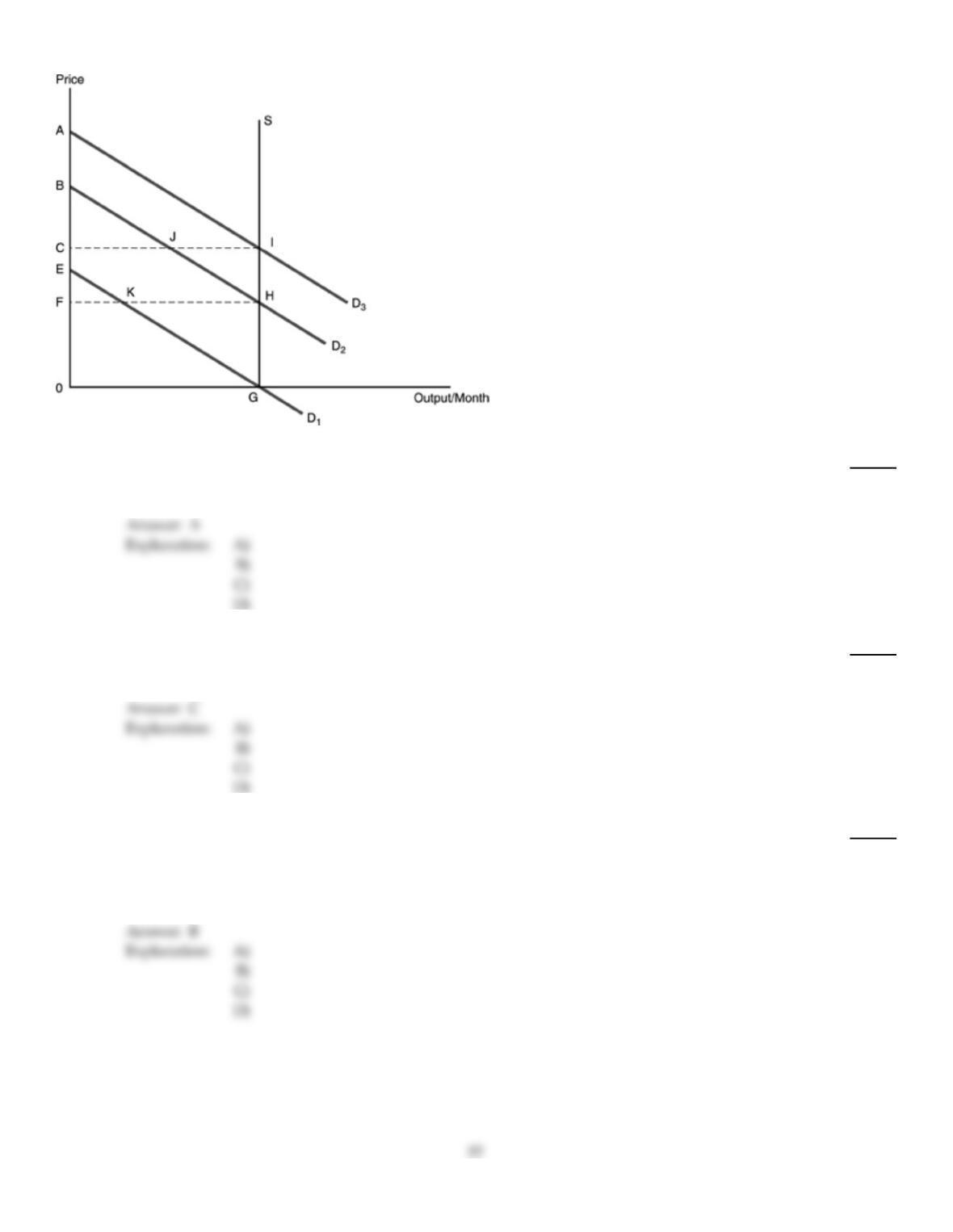
247)
Refer to the above figure. Suppose demand is D2 and then increases to D3. The change in economic
rent is
247)
A)
area CIHF.
B)
area BJC.
C)
area CIGO.
D)
zero.
248)
Interest is paid to
248)
A)
individuals who own gold.
B)
borrowers of funds.
C)
owners of capital.
D)
all holders of stock.
249)
The idea that any public information you will be able to find will prove of little value to you when
buying and selling stocks, because that information is so quickly incorporated into the trading
prices of stocks, is known as the
249)
A)
theory of fundamental analysis.
B)
theory of efficient markets.
C)
principle of context.
D)
over–the–counter hypothesis.

250)
The most important source of financial capital for firms today is
250)
A)
sale of bonds.
B)
reinvestment of profits.
C)
trade of previously issued stock.
D)
sale of new issues of stock.
251)
Which of the following would be most likely to receive high economic rent payments?
251)
A)
factory worker
B)
professional baseball player
C)
doctor
D)
farmer
252)
When the rate of interest is 10 percent, the present value of $100 payable in two years is
approximately
252)
A)
$100.
B)
$110.
C)
$80.
D)
$83.
253)
Unlimited liability is found in
253)
A)
proprietorships and corporations.
B)
proprietorships and partnerships.
C)
partnerships and corporations.
D)
proprietorships, partnerships, and corporations.
254)
In a partnership, legal responsibility for all debts is
254)
A)
paid by the principle owner.
B)
shared by the partners.
C)
handled by the bondholders.
D)
passed to the shareholders.

255)
If the bank advertises 6 percent annual interest rate on a one–year certificate of deposit and you
anticipate the rate of inflation to rise to 3 percent during the year, then the real rate of interest on
the certificate of deposit is
255)
A)
9 percent.
B)
2 percent.
C)
6 percent.
D)
3 percent.
256)
A proprietorship is a business
256)
A)
which produces a service rather than goods.
B)
owned by one individual who is responsible legally for the debts of the firm.
C)
with annual sales below $100,000.
D)
in which the stock of the company is closely held by members of one family.
B
257)
When a business is considered by law to be a legal entity, it is known as a
257)
A)
conglomerate.
B)
partnership.
C)
proprietorship.
D)
corporation.
D
258)
If the entrepreneur is also the manager of the firm, we would expect
258)
A)
the manager to work hard because he or she is also the residual claimant.
B)
the firm to operate poorly because the entrepreneur is not as good at managing workers as a
professional manager would be.
C)
the manager to not work hard since there is no possibility of further advancement.
D)
the firm to operate poorly because the specialization of labor is not adequate.
A
259)
Which of the following is considered an advantage of a sole proprietorship?
259)
A)
permits effective specialization
B)
profit taxed only once
C)
easy to raise large sums of capital
D)
limited liability for owner
B
D

260)
In a partnership, debts accumulated by one partner
260)
A)
are the responsibility of that partner only.
B)
are the responsibility of the other partners only up to the amount each partner initially
invested in the partnership.
C)
are the responsibility of all the employees of the partnership, regardless of whether those
employees are partners.
D)
are the responsibility of the other partners as well.
261)
In considering economic profit in a market economy, it is correct to say that
261)
A)
economic profit performs an important function in allocating resources to their most highly
valued uses.
B)
there should never be any economic profit.
C)
economic profit tends to reduce the production efficiency of the economy, leading to wasted
resources.
D)
economic profit will only occur, even in the short run, as a result of imperfect competition.
262)
When the Dutch East India Company was founded in 1602, it raised financial capital by issuing
notes of indebtedness called
262)
A)
notes.
B)
funds.
C)
stocks.
D)
bonds.
263)
On a bar graph comparing a firm’s economic profit with its accounting profit, it will always be
TRUE that
263)
A)
total revenue will be greater in the column depicting accounting profit.
B)
opportunity costs will be missing from the column depicting accounting profit.
C)
explicit costs will be greater in the column representing accounting profit.
D)
explicit costs will be greater in the column representing economic profit.