A) TiCl4 + 4 HOCH2CH3 + 4 NH3 → Ti(OCH2CH3)4 + 4 NH4Cl (in benzene)
B) Ti(OCH2CH3)4 + 4 H2O → Ti(OH)4 + 4 HOCH2CH3
C) (HO)3–Ti-OH + HO-Ti-(OH)3 → (HO)3–Ti-O-Ti(OH)3 + H2O
D) 4 Ti(OH)4 + heat → 2 Ti2O3 + 8 H2O + O2
81) Silica (SiO2) can be prepared from silicon ethoxide by the sol-gel process. Write a balanced
equation for the hydrolysis of silicon ethoxide.
A) SiCl4 + 4 HOCH2CH3 + 4 NH3 → Si(OCH2CH3)4 + 4 NH4Cl (in benzene)
B) Si(OCH2CH3)4 + 4 H2O → Si(OH)4 + 4 HOCH2CH3
C) Si(OCH2CH3)4 + 4 HOCH3 → Si(OCH3)4 + 4 HOCH2CH3
D) Si(OCH3)4 + 4 H2O → Si(OH)4 + 4 HOCH3
82) What is a cermet?
A) boron nitride/epoxy
B) ceramic-metal composite
C) ceramic-polymer composite
D) silicon carbide/graphite
83) Silicon nitride/zirconia is a example of a
A) ceramic-ceramic composite
B) ceramic-metal composite
C) ceramic-polymer composite
D) superconductor
84) Relative to a bulk sample of gold, nanoparticles of gold have
A) greater reactivity and higher melting point.
B) greater reactivity and lower melting point.
C) lower reactivity and higher melting point.
D) lower reactivity and lower melting point.
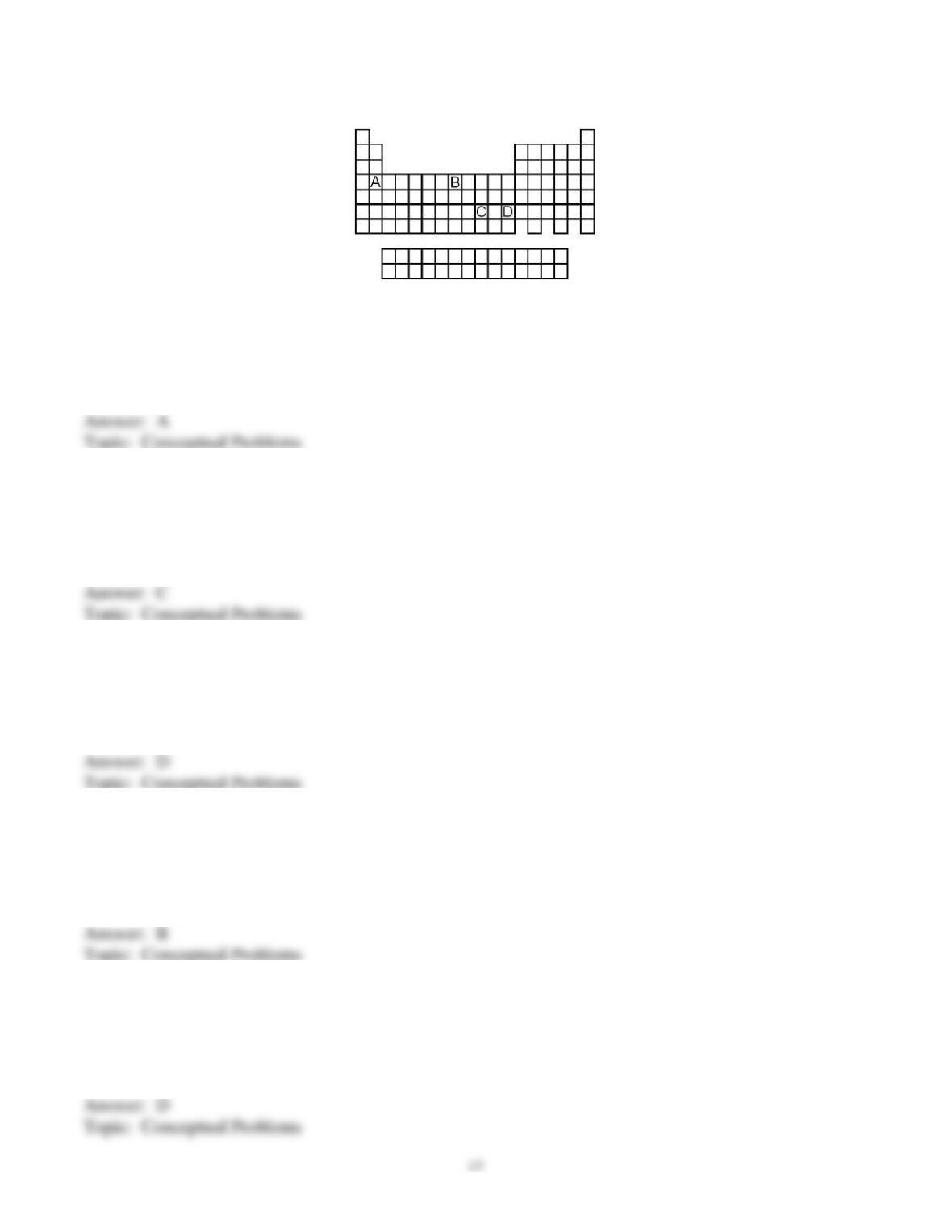
Look at the location of elements A, B, C, and D in the following periodic table.
85) Which of these elements is likely to be found in nature as a carbonate?
A) element A
B) element B
C) element C
D) element D
86) Which of these elements is likely to be found in nature as a free metal?
A) element A
B) element B
C) element C
D) element D
87) Which of these elements is likely to be found in nature as a sulfide?
A) element A
B) element B
C) element C
D) element D
88) Which of these elements is likely to be found in nature as an oxide?
A) element A
B) element B
C) element C
D) element D
89) Which of these elements is likely to be extracted from its ore by roasting of a metal sulfide?
A) element A
B) element B
C) element C
D) element D
90) Which of these elements is likely to be extracted from its ore by chemical reduction of a metal
oxide?
A) element A
B) element B
C) element C
D) element D
91) Which of these elements is likely to be extracted from its ore by electrolysis?
A) element A
B) element B
C) element C
D) element D
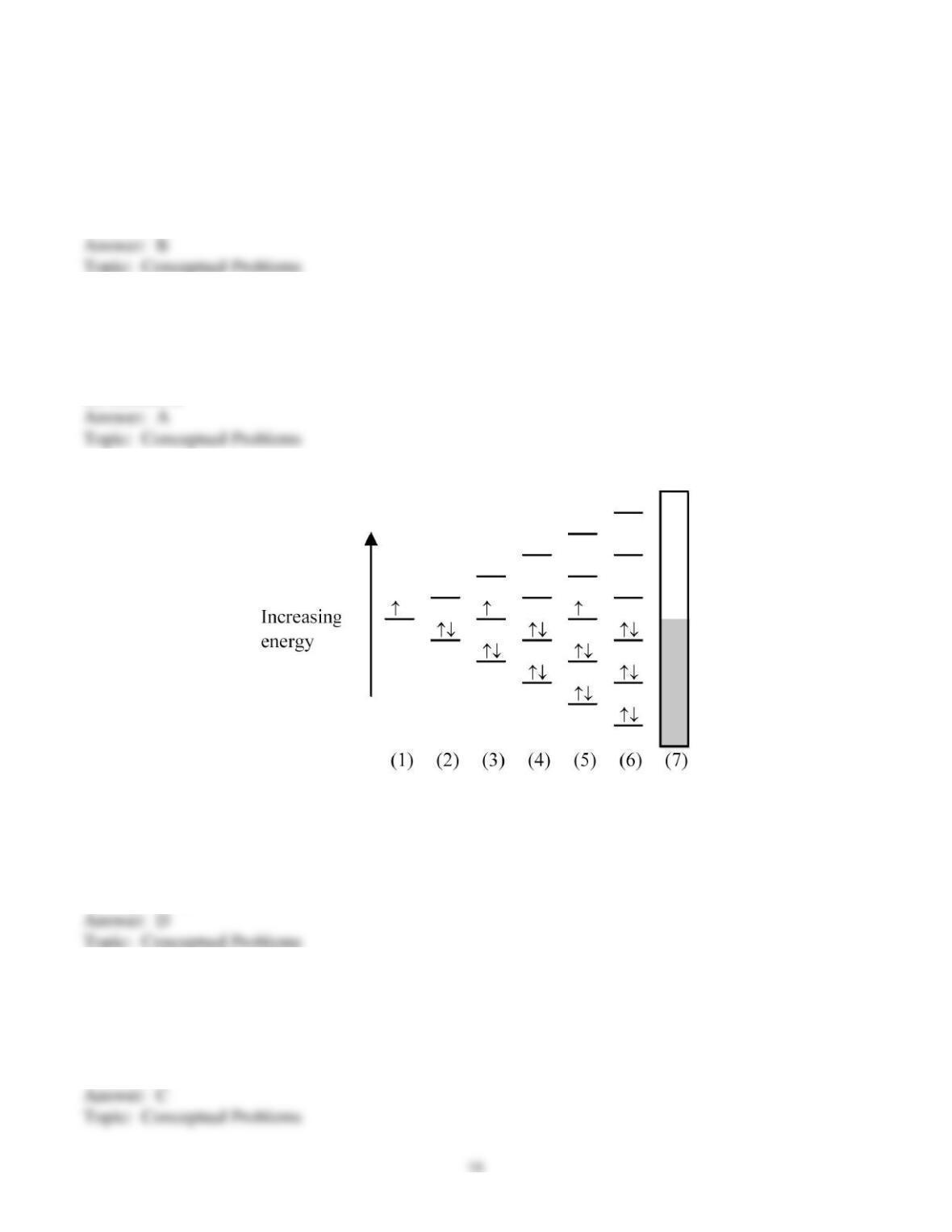
Use the picture below to answer the following questions.
92) What diagram would describe the molecular orbital picture for the species Na4?
A) diagram (1)
B) diagram (2)
C) diagram (3)
D) diagram (4)
93) Which diagram describes the molecular orbital picture for the species Na6?
A) diagram (4)
B) diagram (5)
C) diagram (6)
D) diagram (7)
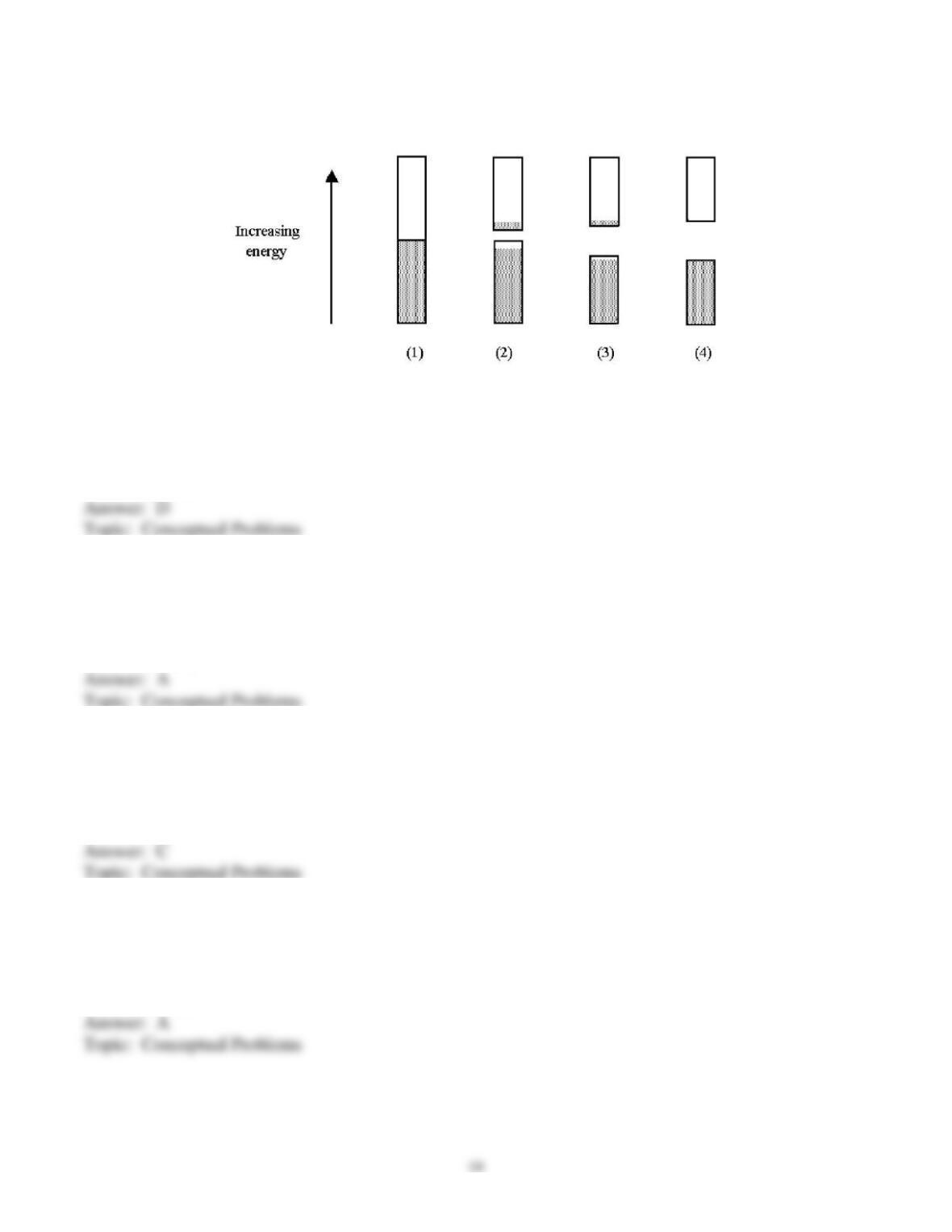
The following pictures show the electron population of the bands of MO energy levels for four different
materials.
94) Which of these materials is an insulator?
A) material (1)
B) material (2)
C) material (3)
D) material (4)
95) Which of these materials is a metal?
A) material (1)
B) material (2)
C) material (3)
D) material (4)
96) Which of these materials is a semiconductor?
A) materials (1) and (2)
B) materials (1) and (4)
C) materials (2) and (3)
D) materials (3) and (4)
97) Which of these materials has the highest electrical conductivity?
A) material (1)
B) material (2)
C) material (3)
D) material (4)
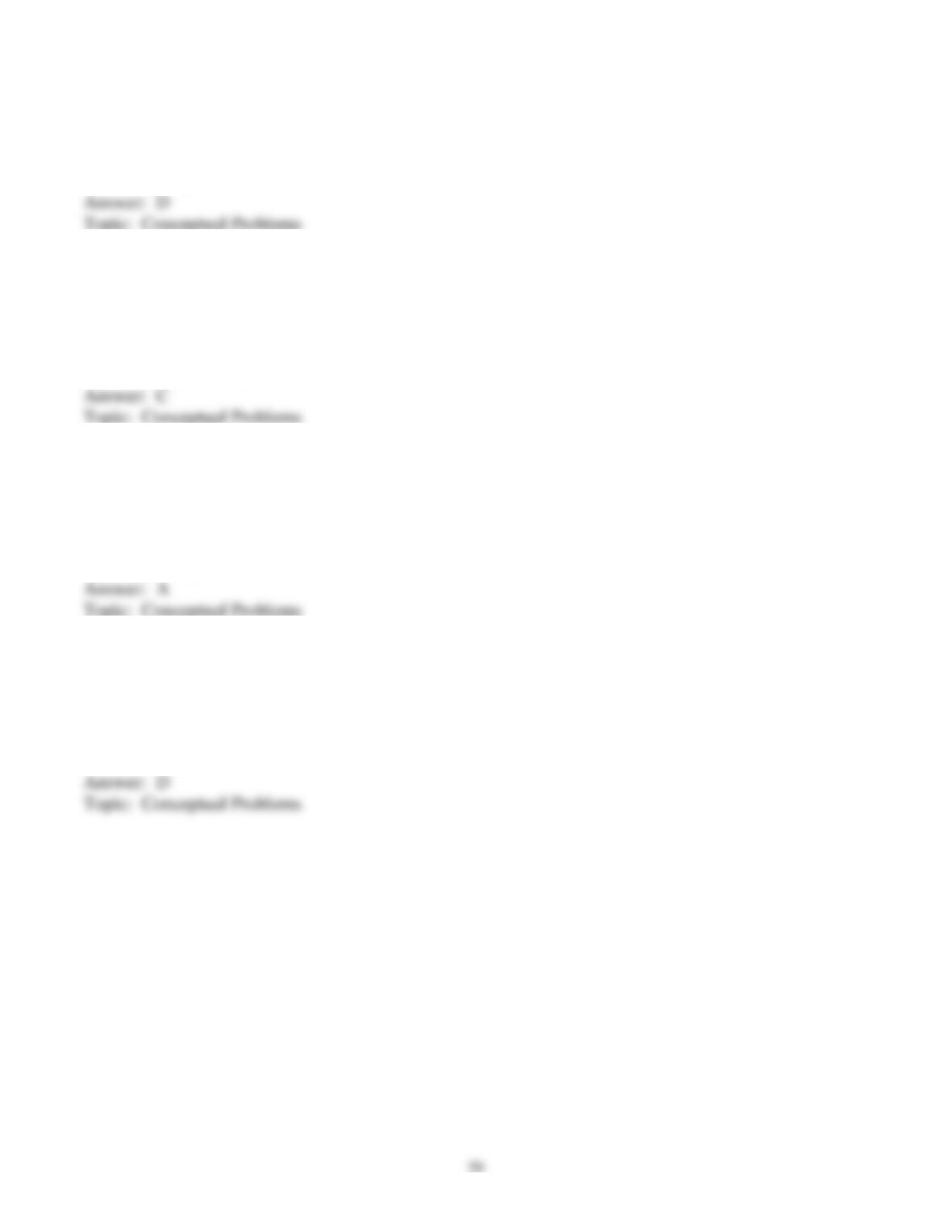
98) Which of these materials has the lowest electrical conductivity?
A) material (1)
B) material (2)
C) material (3)
D) material (4)
99) Which of these materials has an electrical conductivity that increases with an increase in
temperature?
A) materials (1) and (2)
B) materials (1) and (4)
C) materials (2) and (3)
D) materials (3) and (4)
100) Which of these materials has an electrical conductivity that decreases with an increase in
temperature?
A) material (1)
B) material (2)
C) material (3)
D) material (4)
101) Which of these materials has an electrical conductivity that remains constant with an increase in
temperature?
A) material (1)
B) material (2)
C) material (3)
D) material (4)
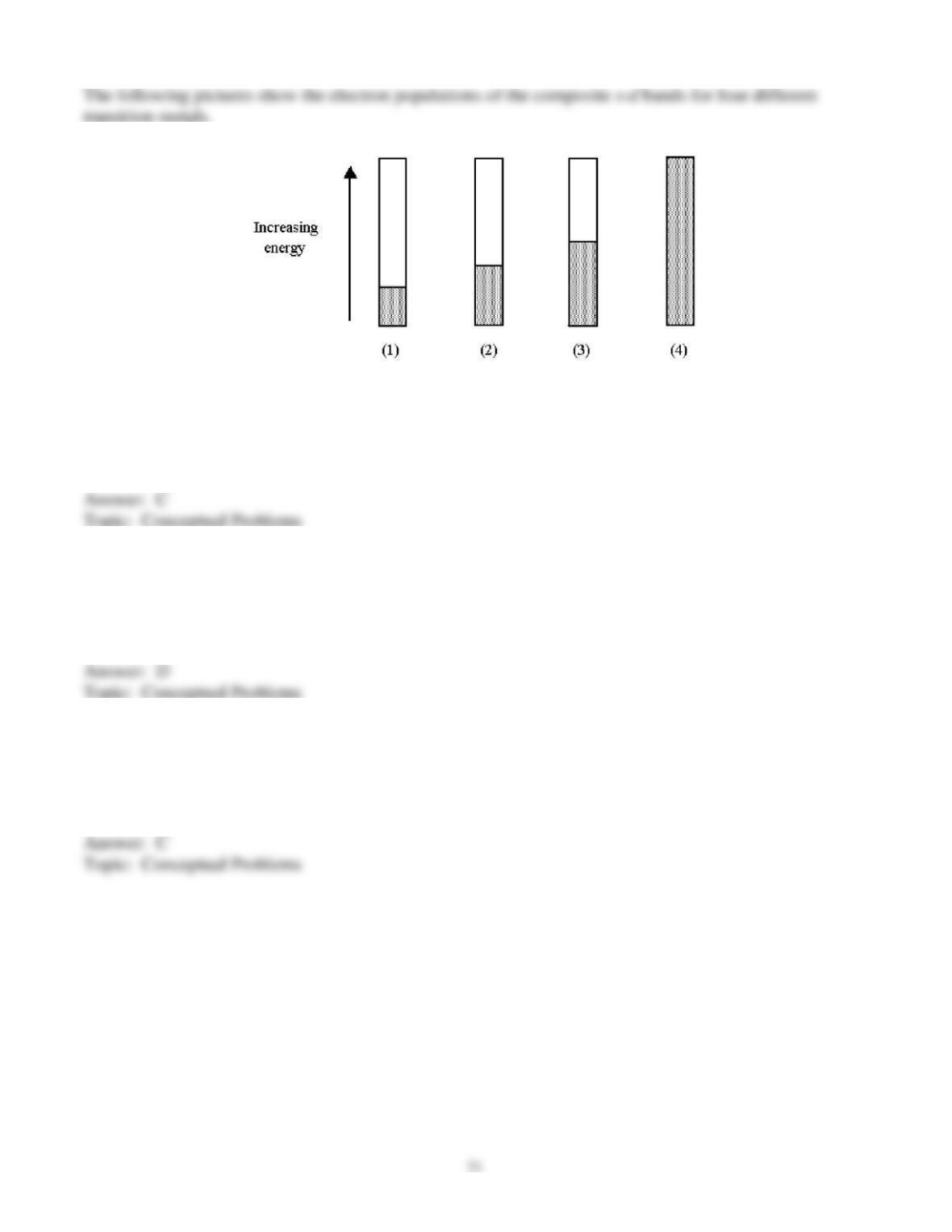
102) Which metal has the highest melting point?
A) metal (1)
B) metal (2)
C) metal (3)
D) metal (4)
103) Which metal has the lowest melting point?
A) metal (1)
B) metal (2)
C) metal (3)
D) metal (4)
104) Which is the hardest metal?
A) metal (1)
B) metal (2)
C) metal (3)
D) metal (4)
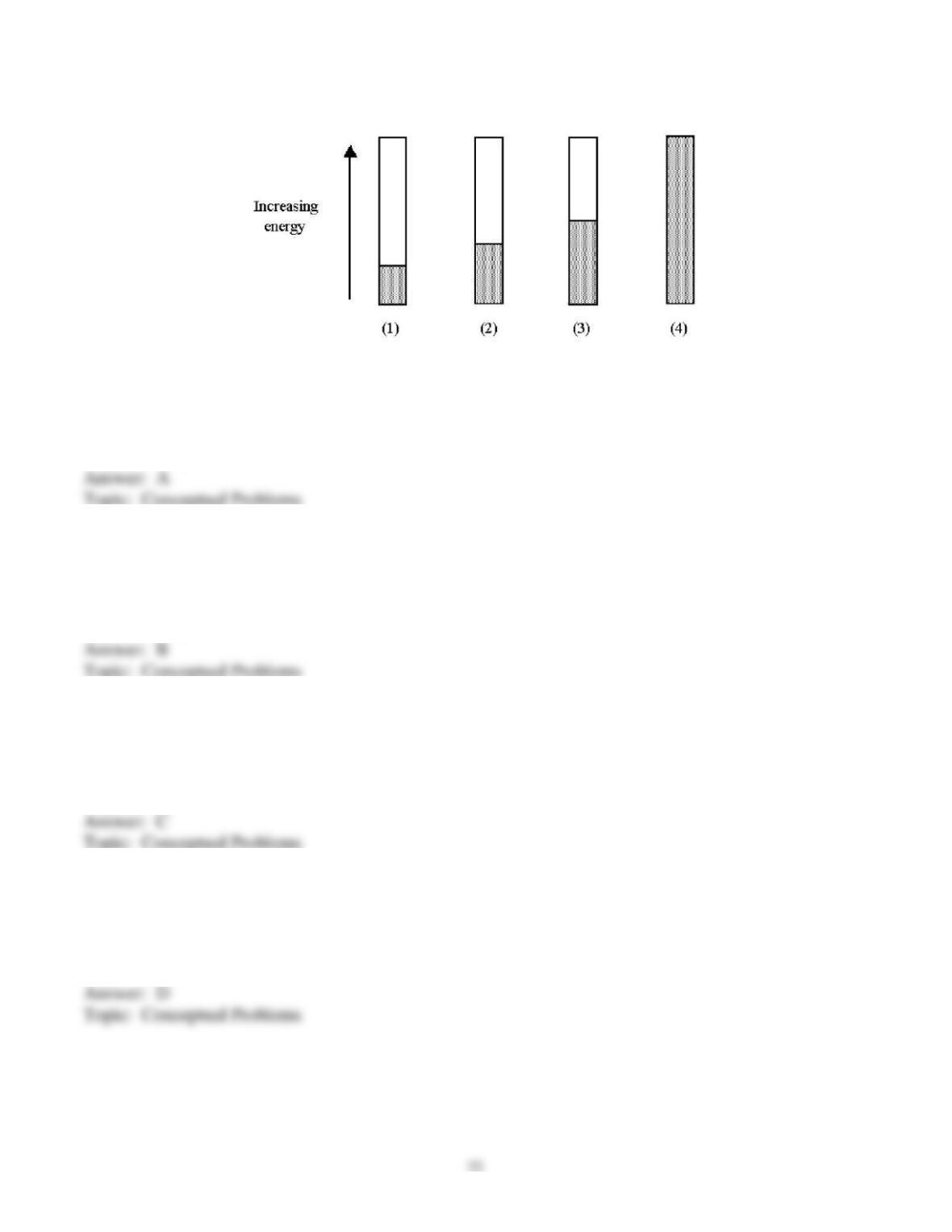
The following pictures show the electron populations of the composite s-d bands for Sc, Ti, V, and Zn.
105) Which picture corresponds to Sc?
A) picture (1)
B) picture (2)
C) picture (3)
D) picture (4)
106) Which picture corresponds to Ti?
A) picture (1)
B) picture (2)
C) picture (3)
D) picture (4)
107) Which picture corresponds to V?
A) picture (1)
B) picture (2)
C) picture (3)
D) picture (4)
108) Which picture corresponds to Zn?
A) picture (1)
B) picture (2)
C) picture (3)
D) picture (4)
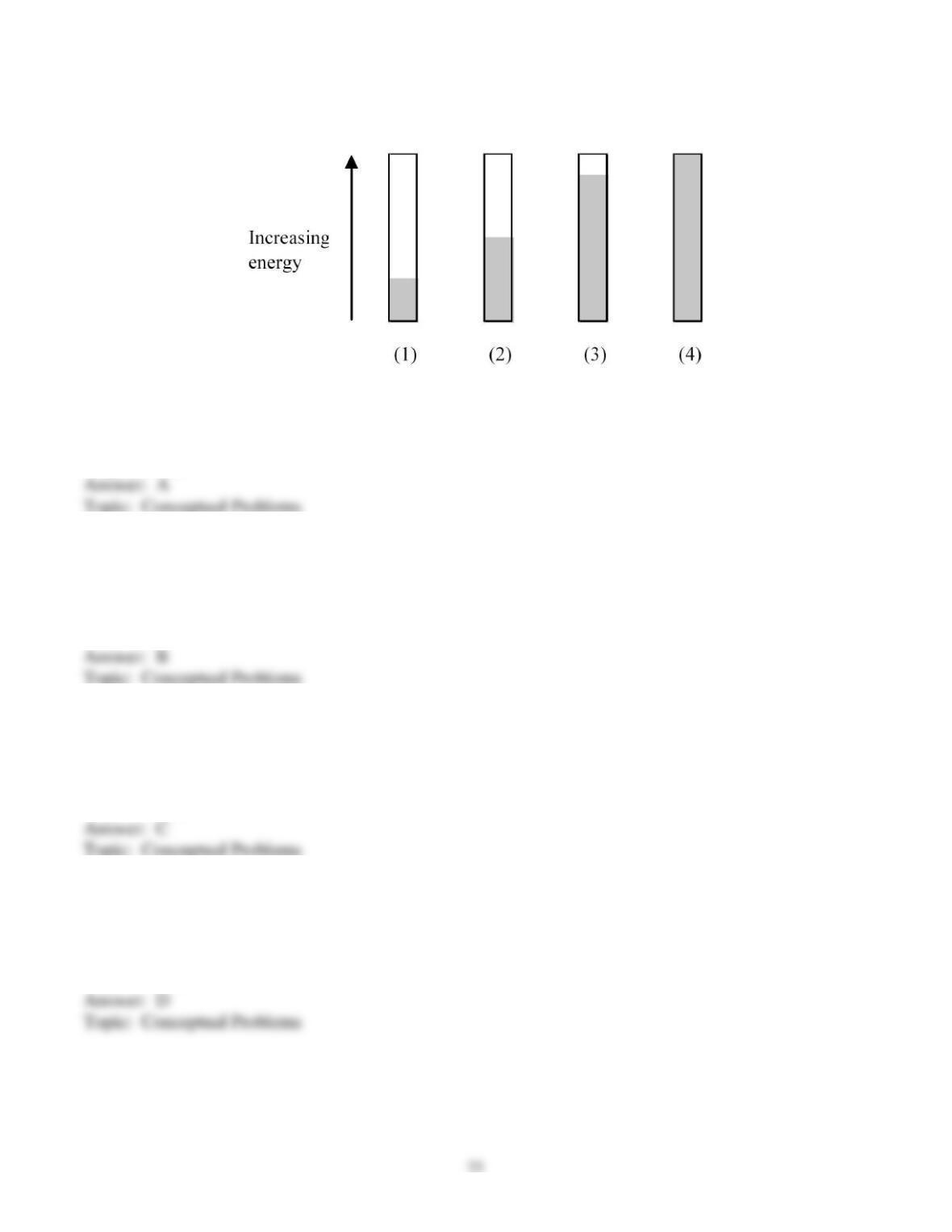
The following pictures show the electron populations of the composite s – d bands for Y, Mo, Ag, and
Cd.
109) Which picture corresponds to Y?
A) picture (1)
B) picture (2)
C) picture (3)
D) picture (4)
110) Which picture corresponds to Mo?
A) picture (1)
B) picture (2)
C) picture (3)
D) picture (4)
111) Which picture corresponds to Ag?
A) picture (1)
B) picture (2)
C) picture (3)
D) picture (4)
112) Which picture corresponds to Cd?
A) picture (1)
B) picture (2)
C) picture (3)
D) picture (4)
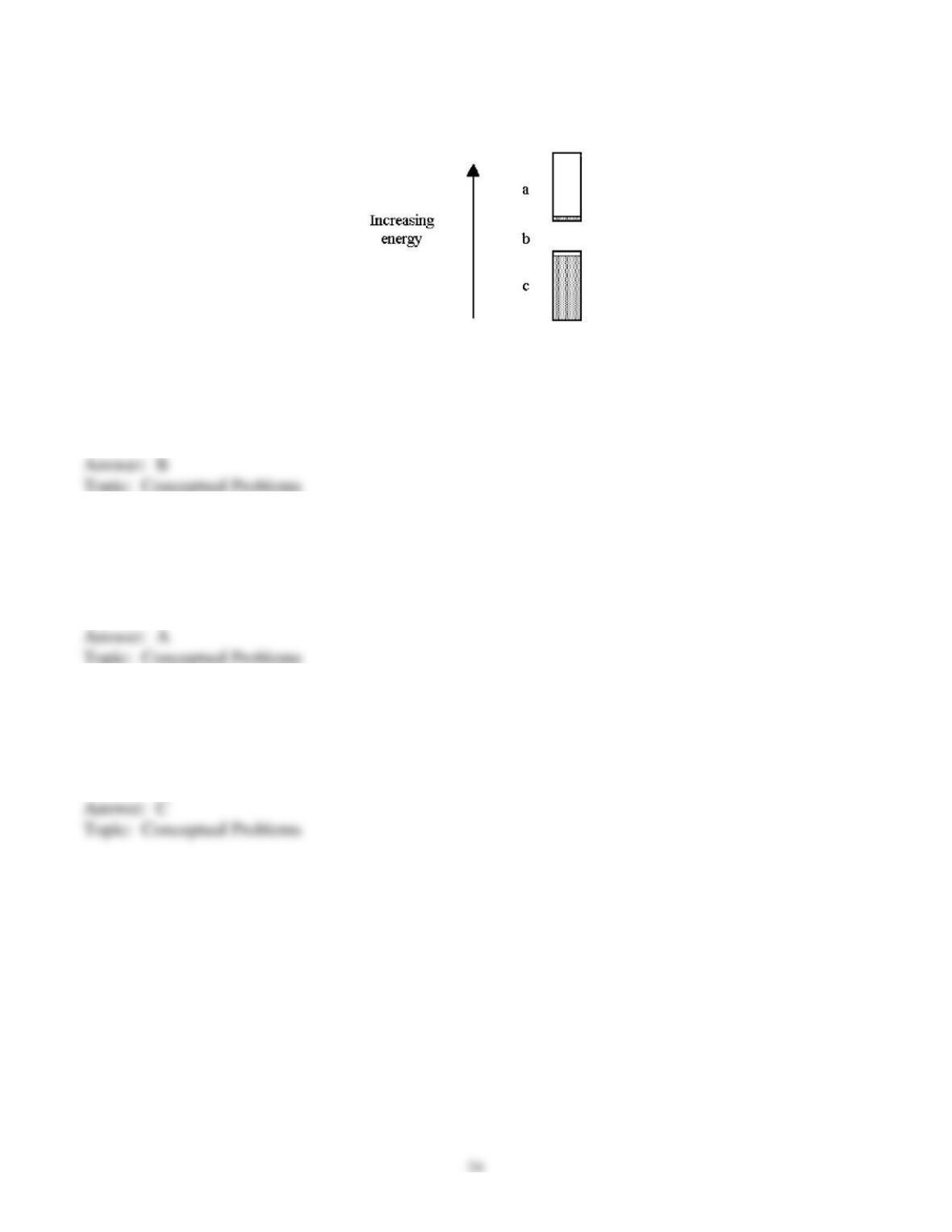
The following picture shows the electron populations of the bands of MO energy levels for elementary
silicon.
113) In this picture the band gap is given by letter(s)
A) a.
B) b.
C) c.
D) a and b.
114) In this picture the conduction band is given by letter(s)
A) a.
B) b.
C) c.
D) a and b.
115) In this picture the valence band is given by letter(s)
A) a.
B) b.
C) c.
D) a and b.
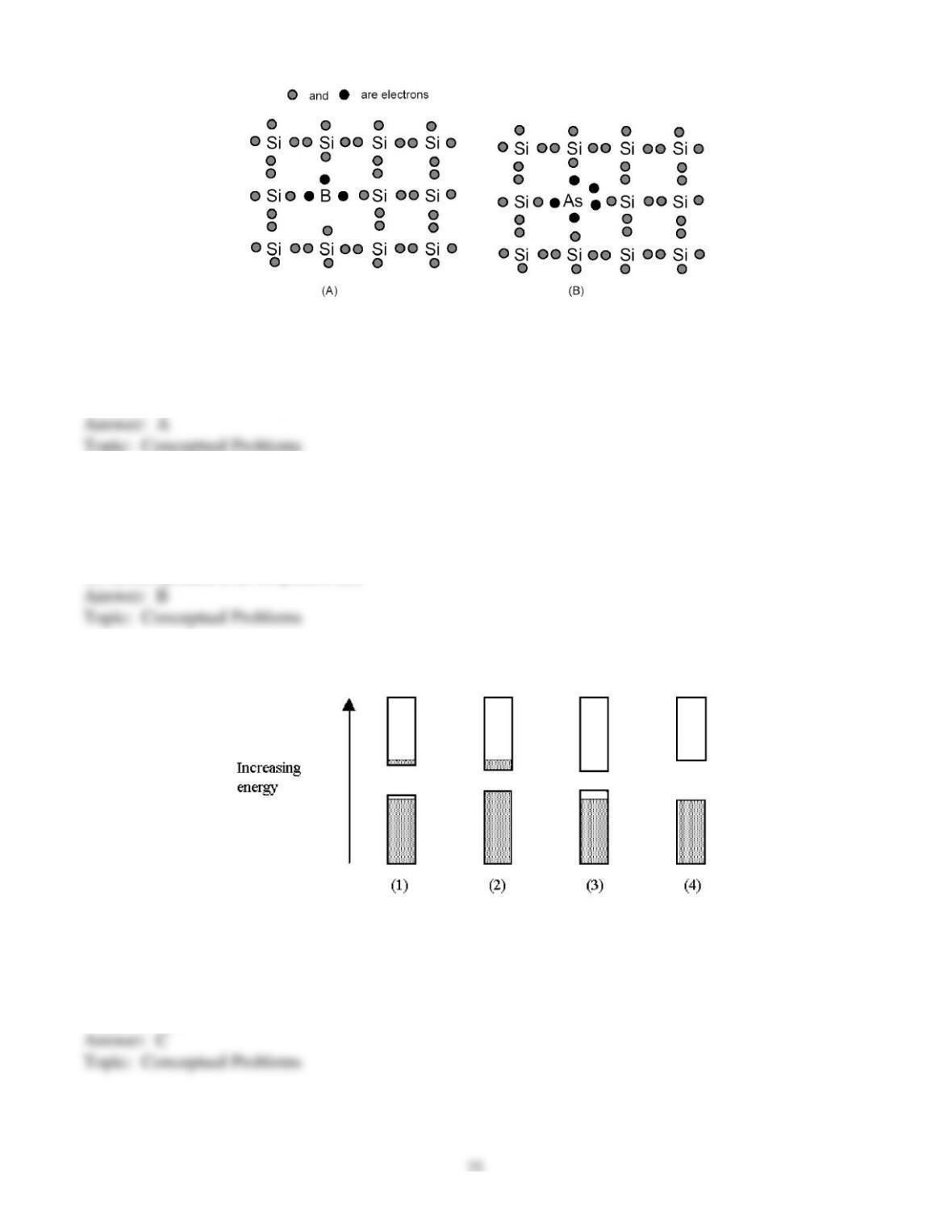
116) Which picture represents a p-type Si semiconductor?
A) picture (A)
B) picture (B)
C) both picture (A) and picture (B)
D) neither picture (A) nor picture (B)
117) Which picture represents an n-type Si semiconductor?
A) picture (A)
B) picture (B)
C) both picture (A) and picture (B)
D) neither picture (A) nor picture (B)
Picture (1) shows the electron populations of the bands of MO energy levels for elementary silicon.
118) Which picture (1)-(4) shows the electron populations when the silicon is doped with gallium?
A) picture (1)
B) picture (2)
C) picture (3)
D) picture (4)
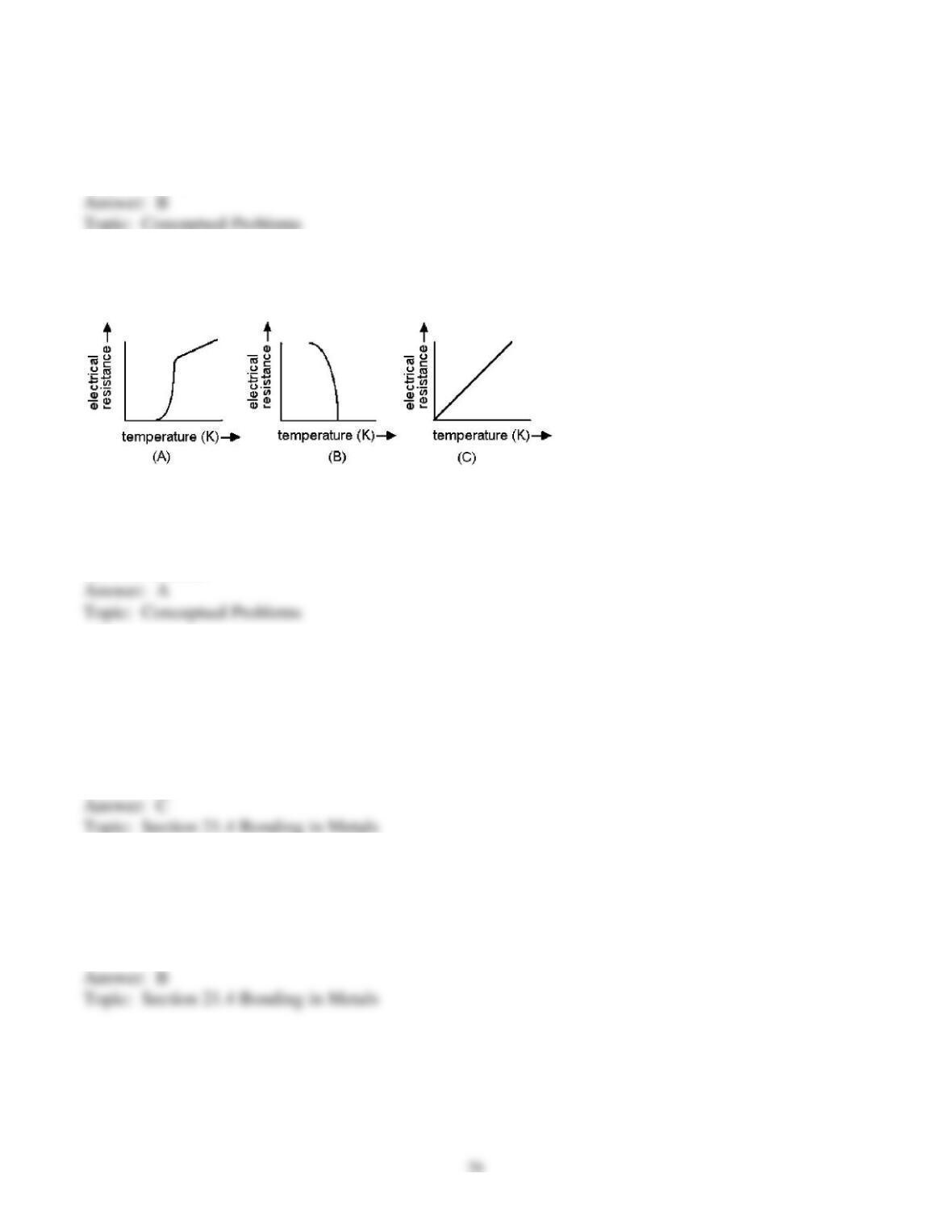
119) Which picture (1)-(4) shows the electron populations when the silicon is doped with arsenic?
A) picture (1)
B) picture (2)
C) picture (3)
D) picture (4)
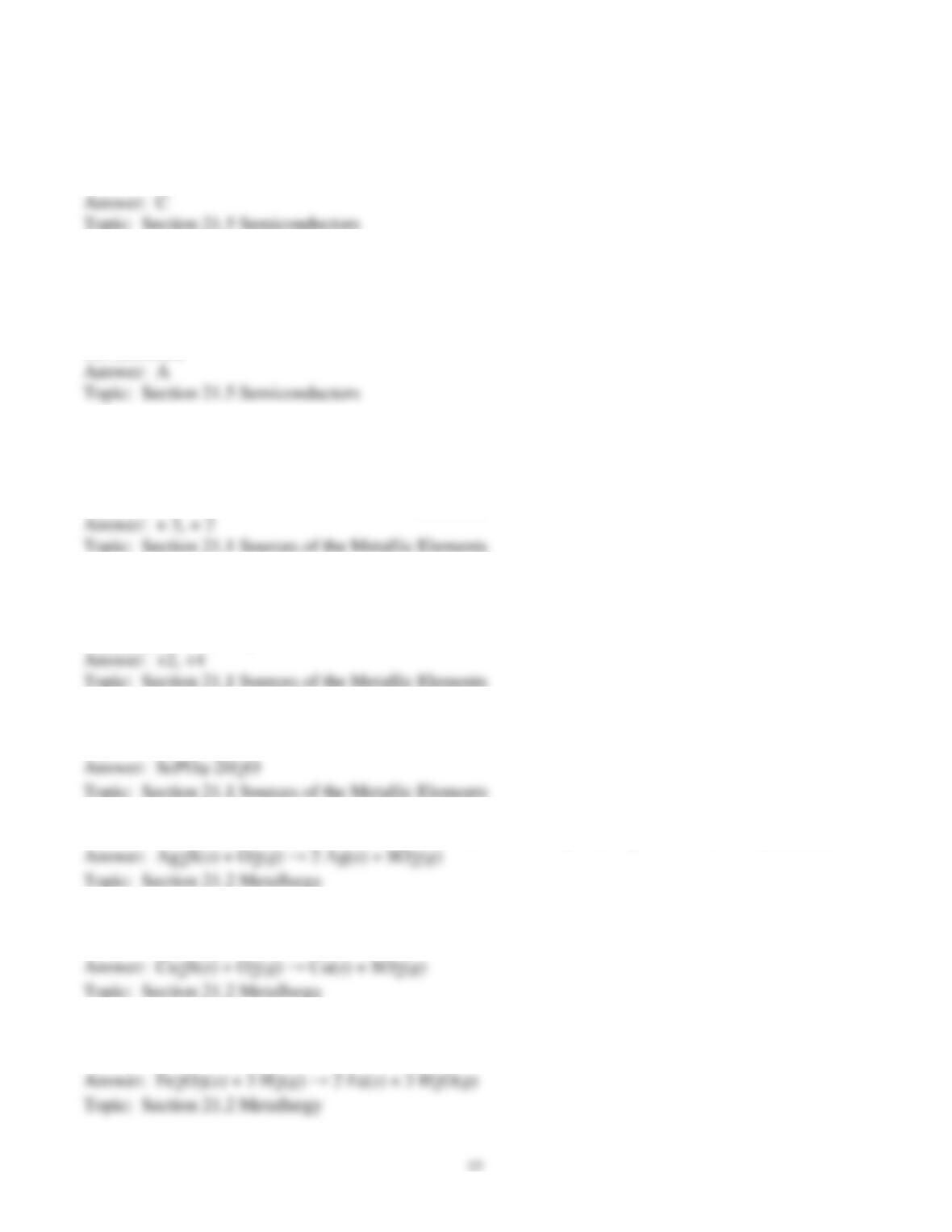
120) Which schematic best represents the electrical resistance versus temperature curve for a
superconductor?
A) A
B) B
C) C
D) none of these
21.2 Algorithmic Questions
1) Which substance is the best conductor of electricity?
A) arsenic
B) boron
C) silver
D) tellurium
2) Which one of the following metals is expected to have the highest melting point?
A) La
B) Nb
C) Hg
D) Pd
3) Which element has the smallest energy band gap?
A) B
B) I
C) K
D) S
4) Which one of the following is an electrical insulator?
A) phosphorus
B) platinum
C) potassium
D) ruthenium
21.3 Short Answer Questions
1) The principal source of chromium is chromite, FeCr2O4 in which chromium has an oxidation state of
________ and iron has an oxidation state of ________.
2) One source of titanium is illmenite, FeTiO3. Other ores containing titanium are geikielite, MgTiO3,
and pyrophanite, MnTiO3. The oxidation states of iron and titanium in illmentite are ________ and
________, respectively.
3) One source of scandium is kolbeckite, which is a dihydrated phosphate of scandium. What is the
formula of kolbeckite?
4) The balanced chemical equation for the production of silver by roasting of its sulfide is ________.
5) Copper can be obtained from its copper(I) sulfide ore by roasting. What is the balanced equation for
the roasting of copper(I) sulfide?
6) Write a balanced chemical equation for obtaining iron metal by the reduction of hematite, Fe2O3, by
hydrogen gas.
28
7) Al2O3 can be separated from iron oxide impurities in bauxite by dissolving the Al2O3 in hot aqueous
NaOH. Give the formula of the aluminum complex ion that forms, and write a balanced net ionic
equation for its formation by the reaction between Al2O3 and NaOH.
8) During the production of iron, the formation of CaSiO3 (slag) from the reaction of CaO (lime) and
SiO2 (sand), shown below, facilitates the separation of the iron from the gangue.
CaO(s) + SiO2(s) → CaSiO3(l)
In this reaction the acidic oxide is ________ and the basic oxide is ________.
9) The number of electrons that half fill a composite s–d band is ________.
10) According to band theory, the element having all of its bonding molecular orbitals filled and all of
its antibonding orbitals empty in the 4s-3d composite band is ________.
11) Tin exists in two forms: gray tin and white tin. The electrical conductivity of gray tin increases with
an increase in temperature, whereas the electrical conductivity of white tin decreases with an increase in
temperature. The form of tin that is a semiconductor is ________ tin.
12) Addition of a small amount of As impurity in silicon results in a(n) ________-type semiconductor
that has a conductivity that is ________ (greater, less) than silicon.
13) Addition of a small amount of Ga impurity in silicon results in a(n) ________-type semiconductor
that has a conductivity that is ________ (greater, less) than silicon.
14) A diode has a positive bias when the p-type semiconductor is attached to the ________ (negative,
positive) battery terminal, which ________ (inhibits, permits) electron flow.
15) A diode has a negative bias when the p-type semiconductor is attached to the ________ (negative,
positive) battery terminal, which ________ (inhibits, permits) electron flow.
16) Light emitting diodes (LEDs) used in automobile brake lights illuminate 200 milliseconds faster
29
than conventional incandescent brake lights. The faster illumination gives the driver of a trailing car an
additional stopping distance of ________ feet at 55 mph.
17) The wavelength of light emitted by the GaP0.40As0.60 LED, which has a band gap of 181 kJ/mol, is
________ nm.
18) An AlGaAs diode laser pointer emits 532 nm light and appears ________ (blue, green, red) in color.
19) In order for a photovoltaic cell to convert light to electricity, the band gap must be less than or equal
to the energy of the light absorbed. If light of 955 nm is to be absorbed, the band gap of the photovoltaic
cell must be less than or equal to ________ kJ/mol.
20) The superconductor Tl2Ba2Ca2Cu3O10 has a critical temperature Tc = 125 K. In order for each of
the atoms to have a whole-number oxidation number, the oxidation numbers of Tl, Ba, Ca, Cu, and O
must be ________, ________, ________, ________, and ________, respectively.
21) Nonoxide ceramics include silicon nitride, the formula of which is ________.
22) A silicon carbide ceramic has a unit cell with carbon atoms in a cubic closest packed arrangement
with carbon atoms occupying one-half of the tetrahedral holes. The empirical formula of this ceramic is
________.
23) Composite materials can be classified as ceramic-ceramic, ceramic-metal, or ceramic-polymer.
Boron nitride/epoxy is classified as ________.
24) Alumina-titanium is a composite material used in hip replacements. Composite materials can be
classified as ceramic-ceramic, ceramic-metal, or ceramic-polymer. Alumina-titanium is classified as
________.
25) Because nanoparticles have a larger percentage of atoms on the surface of the nanoparticle than on
the surface of bulk material, nanoparticles have ________ melting points and ________ chemical

30
reactivity than the bulk material.