21
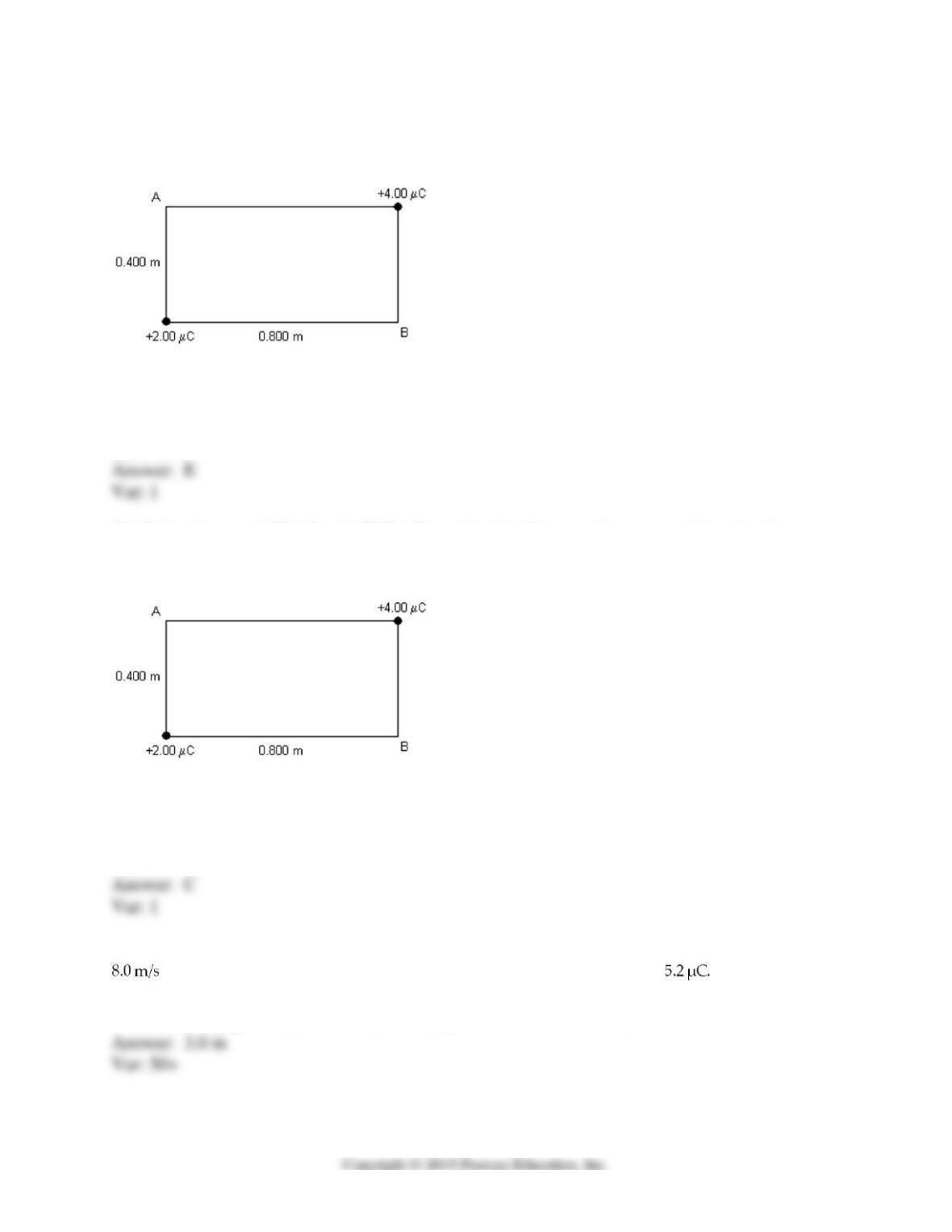
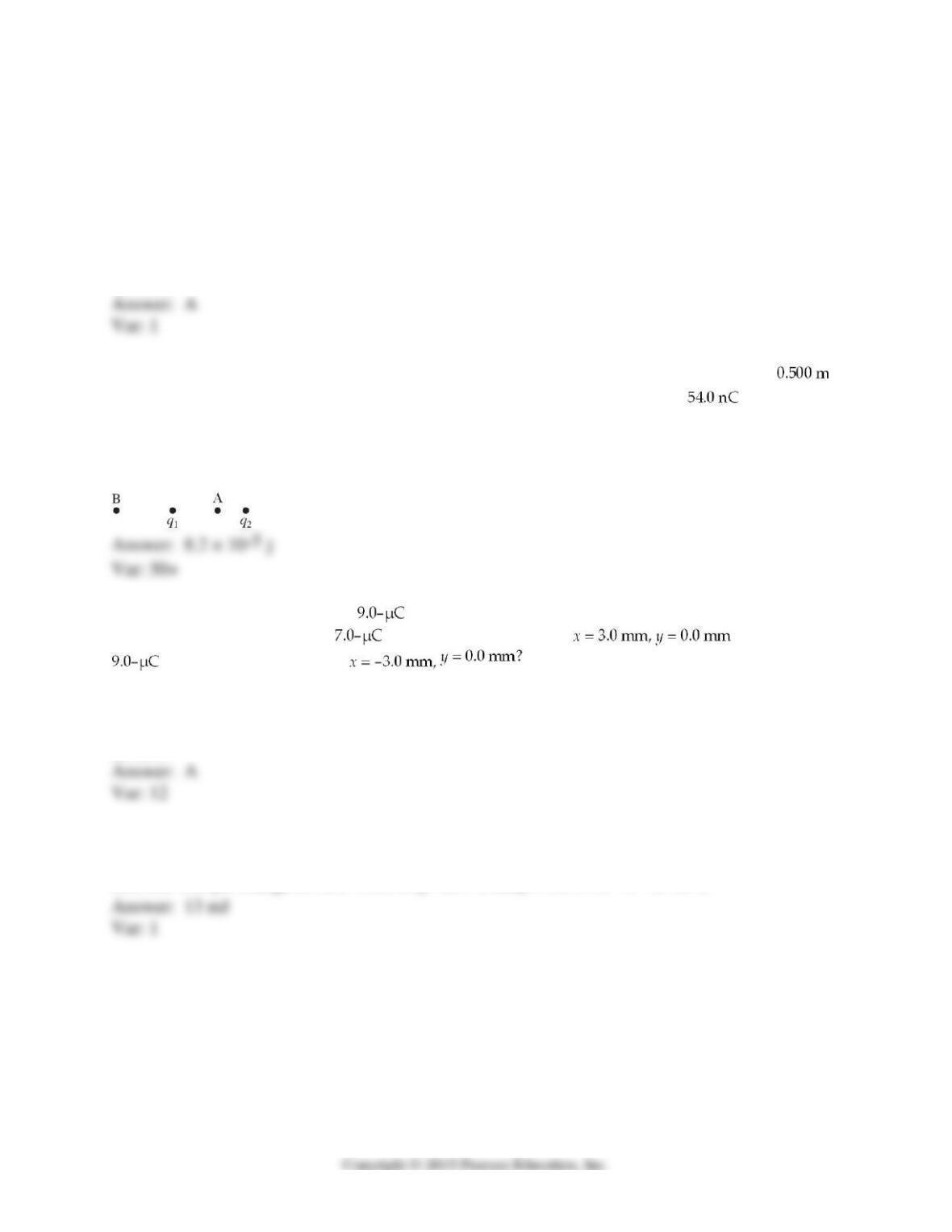
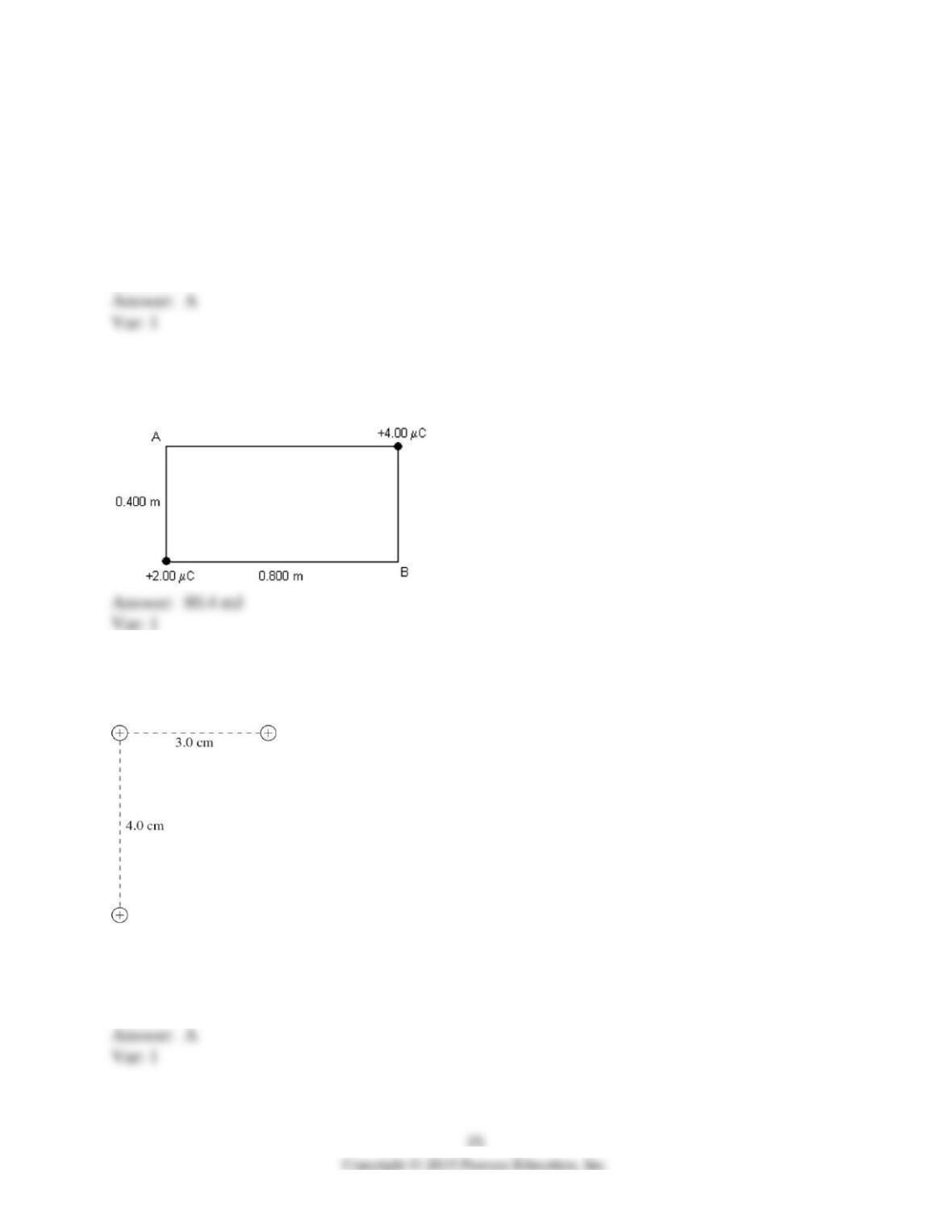
30) Point charges +4.00 μC and +2.00 μC are placed at the opposite corners of a rectangle as
shown in the figure. What is the potential at point B due to these charges? (k = 1/4πε0 = 8.99 ×
109 N ∙ m2/C2)
A) 8.99 kV
B) 11.2 kV
C) 89.9 kV
D) 899 kV
E) 112 kV
31) Point charges +4.00 μC and +2.00 μC are placed at the opposite corners of a rectangle as
shown in the figure. What is the potential difference VA – VB? (k = 1/4πε0 = 8.99 × 10⁹ N ∙
m2/C2)
A) +203 kV
B) -203 kV
C) -22.5 kV
D) +22.5 kV
E) 0.00 kV
32) A very small 4.8-g particle carrying a charge of +9.9 μC is fired with an initial speed of
directly toward a second small 7.8-g particle carrying a charge of + The second
particle is held fixed throughout this process. If these particles are initially very far apart, what is
the closest they get to each other? (k = 1/4πε0 = 9.0 × 10⁹ N ∙ m2/C2)
22
33) Two tiny grains of sand having charges of 4.0 μC and –4.0 μC are situated along the x-axis at
x1 = 2.0 m and x2 = -2.0 m. What is electric potential energy of these grains relative to infinity?
(k = 1/4πε0 = 9.0 × 10⁹ N ∙ m2/C2)
A) -36 mJ
B) 36 mJ
C) 0 J
D) -72 mJ
E) 72 mJ
34) Two tiny particles having charges q1 = +56.0 nC and q2 = -46.0 nC are separated by
and held in place, as shown in the figure. A third particle, having a charge of is placed at
the point A, which is 0.18 m to the left of q2. How much work is needed to move the third
particle from point A to point B, which is 0.40 m to the left of q1. All the points in the figure lie
on the same line. (k = 1/4πε0 = 9.0 × 10⁹ N ∙ m2/C2)
35) A 7.0-μC point charge and a point charge are initially extremely far apart. How much
work does it take to bring the point charge to the point , and the
point charge to the point (k = 1/4πε0 = 9.0 × 10⁹ N ∙ m2/C2)
A) 95 J
B) 190 J
C) 63 J
D) 16 J
36) A +7.5-nC point charge is 5.0 cm from a -9.4-µC point charge in your laboratory in
California. How much work would you have to do if you left the +7.5-nC charge in the lab but
took the -9.4-µC charge to New York City? (k = 1/4πε0 = 9.0 × 10⁹ N ∙ m2/C2)
23
37) An alpha particle (a helium nucleus, having charge +2e and mass 6.64 × 10⁻²⁷ kg) moves
head-on at a fixed gold nucleus (having charge +79e). If the distance of closest approach is 2.0 ×
10-10 m, what was the speed of the alpha particle when it was very far away from the gold? (k =
1/4πε0 = 9.0 × 10⁹ N ∙ m2/C2, e = 1.60 × 10⁻¹⁹ C)
A) 2.3 × 10⁵ m/s
B) 4.6 × 10⁵ m/s
C) 2.3 × 10⁶ m/s
D) 4.6 × 10⁶ m/s
38) How much energy is necessary to place three +2.0-µC point charges at the vertices of an
equilateral triangle of side 2.0 cm if they started out extremely far away? (k = 1/4πε0 = 9.0 × 10⁹
N ∙ m2/C2)
A) 4.5 J
B) 5.4 J
C) 6.7 J
D) 7.6 J
39) An electric dipole with ±5.0 μC point charges is positioned so that the positive charge is
to the right of the origin and the negative charge is at the origin. How much work does it
take to bring a point charge from very far away to the point x = 3.0 mm, y = 0.0 mm? (k =
1/4πε0 = 9.0 × 10⁹ N ∙ m2/C2)
A) 23 J
B) 110 J
C) 19 J
D) 49 J
40) A +3.0-µC point charge is initially extremely far from a positive point charge Q. You find
that it takes 41 J of work to bring the +3.0-µC charge to the point x = 3.0 mm, y = 0.0 mm and
the point charge Q to the point x = -3.0 mm, y = 0.00 mm. What is Q? (k = …)
A) 55 nC
B) 9.1 µC
C) 4.6 µC
D) 27 pC
24
41) A point charge of +3.00 μC and a second charge Q are initially very far apart. If it takes
of work to bring them to a final configuration in which the charge is at the point x =
1.00 mm, y = 1.00 mm, and the second charge Q is at the point x = 1.00 mm, y = 3.00 mm, find
the magnitude of the charge Q. (k = 1/4πε0 = 8.99 × 10⁹ N ∙ m2/C2)
A) 2.15 μC
B) 4.30 μC
C) 10.74 μC
D) 4.30 nC
42) A +5.0-nC charge is at the point (0.00 m, 0.00 m) and a -2.0-nC charge is at (3.0 m, 0.00 m).
What work is required to bring a 1.0-nC charge from very far away to point (0.00 m, 4.0 m)? (k =
1/4πε0 = 9.0 × 10⁹ N ∙ m2/C2)
A) 15 nJ
B) 3.6 nJ
C) 11 nJ
D) 7.7 nJ
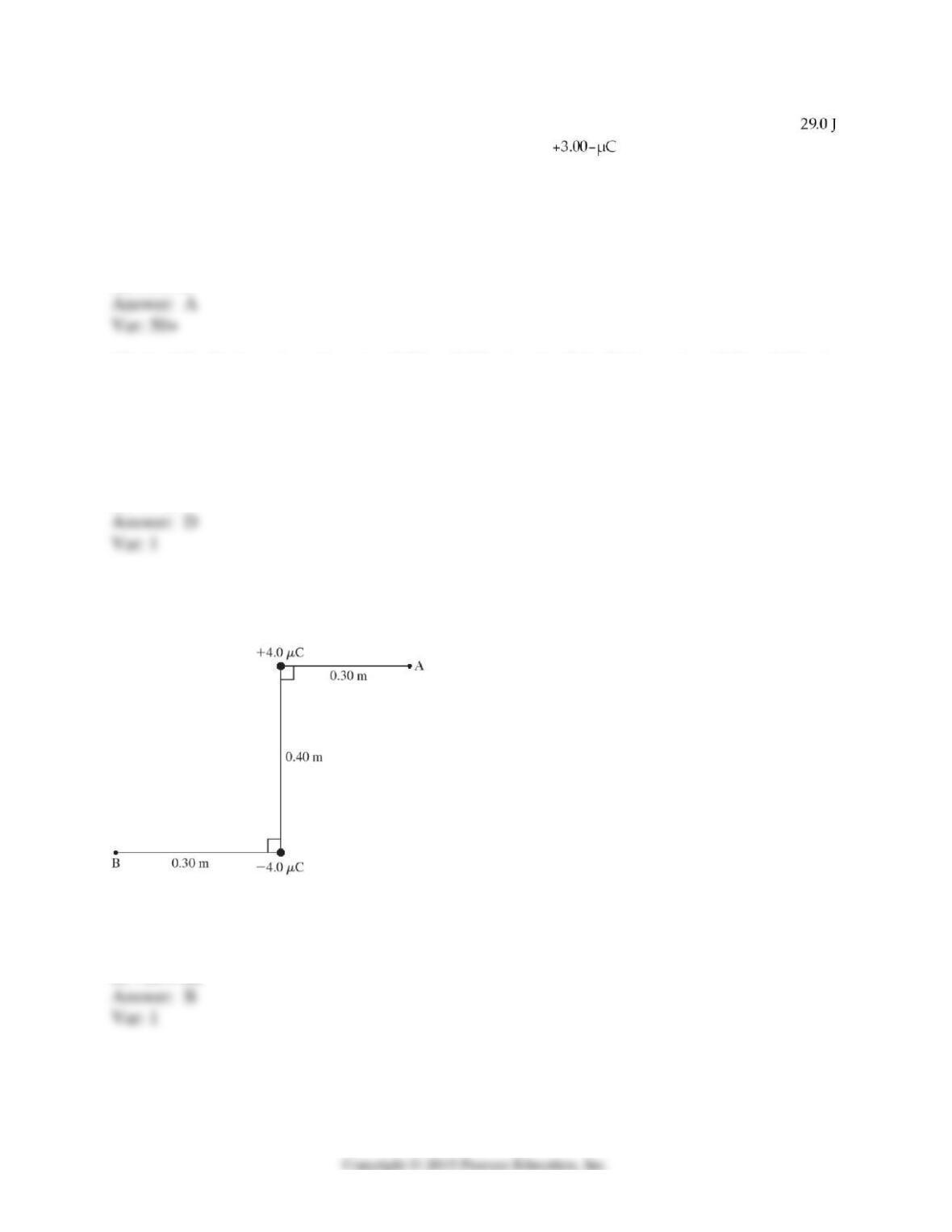
43) In the figure, +4.0-μC and -4.0-μC point charges are located as shown. Now an additional
+2.00-µC point charge is placed at point A. What is the electric potential energy of this system of
three charges, relative to infinity? (k = 1/4πε0 = 8.99 × 10⁹ N ∙ m2/C2)
A) +264 mJ
B) -264 mJ
C) 0.00 J
D) -26.4 mJ
E) +26.4 mJ
44) A small 4.0-µC charge and a small 1.5-µC charge are initially very far apart. How much
work does it take to bring them to a final configuration in which the 4.0-µC charge is at the point
x = 1.0 mm, y = 1.0 mm, and the 1.5-µC charge is at the point x = 1.0 mm, y = 3.0 mm? (k =
1/4πε0 = 8.99 × 10⁹ N ∙ m2/C2)
A) 27 J
B) 13.5 kJ
C) 54 J
D) 13.5 J
45) Point charges +4.00 μC and +2.00 μC are placed at the opposite corners of a rectangle as
shown in the figure. If these charges are released and are free to move with no friction, what is
the maximum amount of kinetic energy they will gain? (k = 1/4πε0 = 8.99 × 10⁹ N ∙ m2/C2)
46) The figure shows a group of three particles, all of which have charge Q = 8.8 nC. How much
work did it take to assemble this group of charges if they all started out extremely far from each
other? (k = 1/4πε0 = 9.0 × 10⁹ N ∙ m2/C2)
A) 5.5 × 10⁻⁵ J
B) 6.2 × 10⁻⁵ J
C) 5.7 × 10⁻⁵ J
D) 5.9 × 10⁻⁵ J
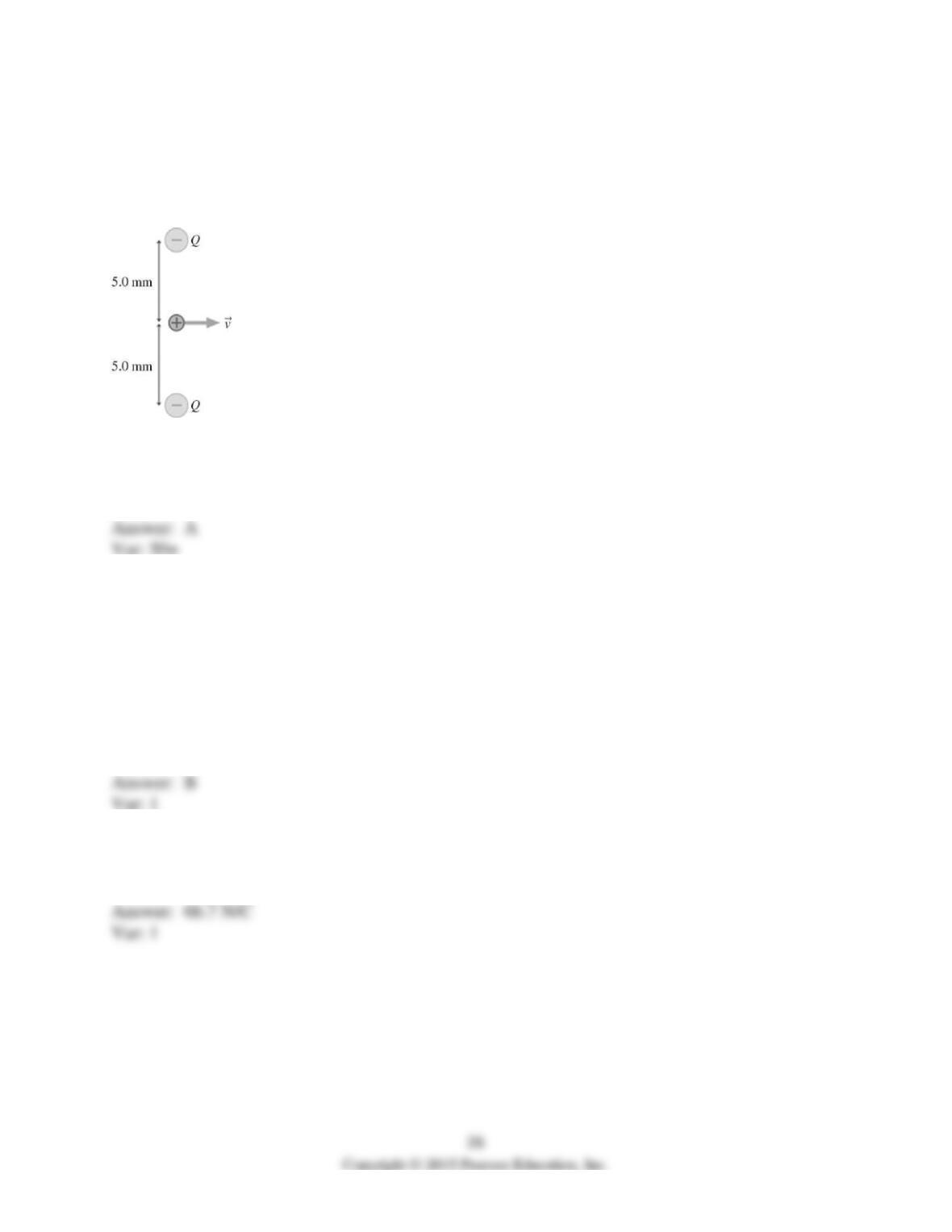
47) The figure shows an arrangement of two particles each having charge Q = -6.8 nC and each
separated by 5.0 mm from a proton.If the two particles are held fixed at their locations and the
proton is set into motion as shown, what is the minimum speed the proton needs to totally escape
from these particles? (mproton = 1.67 × 10⁻²⁷ kg, e = 1.60 × 10⁻¹⁹ C, k = 1/4πε0 = 9.0 × 10⁹ N ∙
m2/C2)
A) 2.2 × 10⁶ m/s
B) 4.3 × 10⁶ m/s
C) 8.3 × 10⁶ m/s
D) 1.7 × 10⁷ m/s
48) An electron is released from rest at a distance of 9.00 cm from a fixed proton. How fast will
the electron be moving when it is 3.00 cm from the proton? (k = 1/4πε0 = 8.99 × 10⁹ N ∙ m2/C2,
e = 1.60 × 10⁻¹⁹ C, melectron = 9.11 × 10⁻³¹ kg, mproton = 1.67 × 10⁻²⁷ kg)
A) 75.0 m/s
B) 106 m/s
C) 130 m/s
D) 1.06 × 10³ m/s
E) 4.64 × 10⁵ m/s
49) The potential difference between two square parallel plates is 4.00 V. If the plate separation
is 6.00 cm and they each measure 1.5 m by 1.5 m, what is the magnitude of the electric field
between the plates?

50) In a region where the electric field is uniform and points in the +x direction, the electric
potential is -2000 V at x = 8 m and is +400 V at x = 2 m. What is the magnitude of the electric
field?
A) 200 V/m
B) 300 V/m
C) 400 V/m
D) 500 V/m
E) 600 V/m
51) Two isolated copper plates, each of area 0.40 m2, carry opposite charges of magnitude 7.08
× 10-10 C. They are placed opposite each other in parallel alignment, with a spacing of 4.0 cm
between them. What is the potential difference between the plates? (ε0 = 8.85 × 10⁻¹² C2/N ∙
m2)
A) 0.40 V
B) 3.0 V
C) 3.2 V
D) 7.6 V
E) 8.0 V
52) A space probe approaches a planet, taking measurements as it goes. If it detects a potential
difference of 6000 MV between the altitudes of 253,000 km and 276,000 km above the planet’s
surface, what is the approximate electric field strength produced by the planet at 264,500 km
above the surface? Assume the electric field strength is approximately constant at these altitudes.
A) 261 N/C
B) 0.261 N/C
C) 561 N/C
D) 493 μN/C
53) A spherical oil droplet with nine excess electrons is held stationary in an electric field
between two large horizontal plates that are 2.25 cm apart. The field is produced by maintaining
a potential difference of 0.3375 kV across the plates, and the density of the oil is 824 kg/m3.
What is the radius of the oil drop? (e = 1.60 × 10⁻¹⁹ C)

54) A battery maintains the electrical potential difference of 6.0-V between two large parallel
metal plates separated by 1.0 mm. What is the strength of the electric field between the plates?
A) 6.0 V/m
B) 600 V/m
C) 6000 V/m
D) zero
55) A uniform electric field, with a magnitude of 500 V/m, is points in the +x direction. If the
potential at x = 5.0 m is 2500 V, what is the potential at x = 2.0 m?
A) 0.50 kV
B) 1.0 kV
C) 2.0 kV
D) 4.0 kV
E) 5.0 kV
56) Consider a uniform horizontal electric field of 50 N/C directed toward the east. If the
electric potential measured at a given point is 80 V, what is the potential at a point 1.0 m directly
west of that point?
A) 30 V
B) 50 V
C) 80 V
D) 130 V
57) Consider a uniform horizontal electric field of 50 N/C directed toward the east. If the
electric potential at a given point in the field is 80 V, what is the potential at a point 1.0 m
directly east of the point?
A) 15 V
B) 30 V
C) 90 V
D) 130 V

58) Consider a uniform horizontal electric field of 50 N/C directed toward the east. If the
electric potential at a given point in the field is 80 V, what is the potential at a point 1.0 m
directly south of that point?
A) 0 V
B) 30 V
C) 50 V
D) 80 V
59) A proton moves 0.10 m along the direction of an electric field of magnitude 3.0 V/m. What
is the change in kinetic energy of the proton? (e = 1.60 × 10⁻¹⁹ C)
A) 4.8 × 10⁻²⁰ J
B) 3.2 × 10⁻²⁰ J
C) 1.6 × 10⁻²⁰ J
D) 8.0 × 10⁻²¹ J
60) Two very large parallel metal plates, separated by 0.20 m, are connected across a 12-V
source of potential. An electron is released from rest at a location 0.10 m from the negative
plate. When the electron arrives at a distance 0.050 m from the positive plate, how much kinetic
energy has the electron gained? (e = 1.60 × 10⁻¹⁹ C)
A) 2.4 × 10⁻¹⁹ J
B) 4.8 × 10⁻¹⁹ J
C) 7.2 × 10⁻¹⁹ J
D) 9.6 × 10⁻¹⁹ J
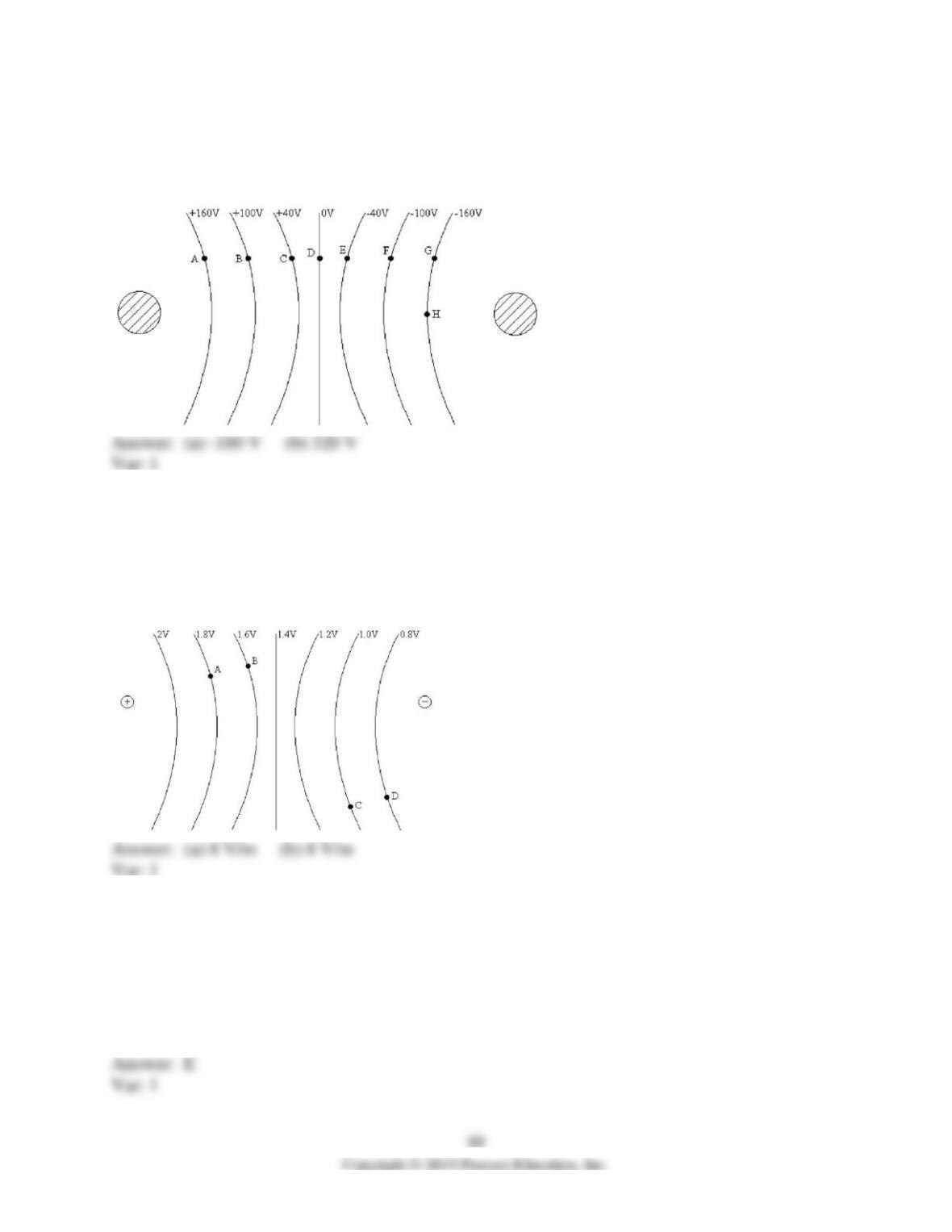
61) The equipotential surfaces for two point charges are shown in the figure, with the value of
potential marked on the line for each surface.
(a) What is the potential difference, VG – VD, between points G and D?
(b) What is the potential difference, VA – VG, between points A and G?
62) The equipotential surfaces for two spherical conductors are shown in the figure, with the
value of potential marked on the line for each surface.
(a) If the distance between points A and B is 2.5 cm what is the approximate intensity of the
electric field between these two points?
(b) If the distance between points C and D is 2.5 cm what is the approximate intensity of the
electric field between these two points?
63) When the magnitude of the charge on each plate of an air-filled capacitor is 4 μC, the
potential difference between the plates is 80 V. What is the capacitance of this capacitor?
A) 0.1 µF
B) 50 µF
C) 100 µF
D) 20 µF
E) 50 nF

64) What charge accumulates on the plates of a 2.0-μF air-filled capacitor when it is charged
until the potential difference across its plates is 100 V?
A) 50 μC
B) 100 μC
C) 150 μC
D) 200 μC
65) The potential difference between the plates of an ideal air-filled parallel-plate capacitor with
a plate separation of 6.0 cm is 60 V. What is the strength of the electric field between the plates
of this capacitor?
A) 60 V/m
B) 500 V/m
C) 1000 V/m
D) 2000 V/m
E) 3600 V/m
66) An ideal air-filled parallel plate capacitor with plate a separation of 4.0 cm has a plate area of
0.040 m2. What is the capacitance of this capacitor with air between these plates? (ε0 = 8.85 ×
10-12 C2/N ∙ m2)
A) 89 pF
B) 8.9 pF
C) 0.89 pF
D) 8.9 µF
E) 8.9 nF
67) An ideal air-filled parallel-plate capacitor with horizontal plates has a plate separation of 5.0
cm. If the potential difference between the plates is 2000 V, with the top plate at the higher
potential, what are the magnitude and direction of the electric field between the plates?
A) 100 N/C upward
B) 100 N/C downward
C) 40000 N/C upward
D) 40000 N/C downward

68) Each plate of an ideal air-filled parallel-plate capacitor has an area of 0.0020 , and the
separation of the plates is An electric field of is present between the plates.
What is the surface charge density on the plates? (ε0 = 8.85 × 10⁻¹² C2/N ∙ m2)
A) 19 µC/m2
B) 39 µC/m2
C) 9.3 µC/m2
D) 28 µC/m2
E) 47 µC/m2
69) Each plate of an ideal air-filled parallel-plate capacitor has an area of 0.0010 , and the
separation of the plates is An electric field of is present between the plates.
What is the capacitance of this capacitor? (ε0 = 8.85 × 10⁻¹² C2/N ∙ m2)
A) 180 pF
B) 120 pF
C) 300 pF
D) 240 pF
E) 360 pF
70) Two large parallel plates are separated by 1.0 mm of air. If the potential difference between
them is 3.0 V, what is the magnitude of their surface charge densities? (ε0 = 8.85 × 10⁻¹² C2/N ∙
m2)
A) 2.7 × 10⁻⁸ C/m2
B) 1.6 × 10⁻⁴ C/m2
C) 5.3 × 10⁻⁸ C/m2
D) 3.3 × 10⁻⁴ C/m2
71) A 3.0-pFcapacitor consists of two large closely-spaced parallel plates that have surface
charge densities of If the potential across the plates is with only air between
them, find the surface area of each of the plates. (ε0 = 8.85 × 10⁻¹² C2/N ∙ m2)
A) 69 mm2
B) 0.014 mm2
C) 35 mm2
D) 0.0072 mm2
72) An ideal air-filled parallel-plate capacitor consists of two circular plates, each of radius
How far apart should the plates be for the capacitance to be 300.0-pF? (ε0 = 8.85 × 10–
12 C2/N ∙ m2)
A) 0.0083 μm
B) 0.0042 μm
C) 0.00094 μm
D) 0.00047 μm
73) When the potential difference between the plates of an ideal air-filled parallel plate capacitor
is 35 V, the electric field between the plates has a strength of 750 V/m. If the plate area is 4.0 ×
10-2 m2, what is the capacitance of this capacitor? (ε0 = 8.85 × 10⁻¹² C2/N ∙ m2)
A) 7.6 × F
B) 7.6 × F
C) 7.6 × F
D) 7.6 × F
E) None of the other choices is correct.
74) An ideal air-filled parallel-plate capacitor consists of plates that are 1.0 mm apart and have
an area of 1.5 × 10⁻⁴ m2. The capacitor is connected to a 12-V potential source (battery). (ε0 =
8.85 × 10⁻¹² C2/N ∙ m2)
(a) What is the capacitance of this capacitor?
(b) How much charge is on each of its plates?
(c) What is the strength of the electric field between the plates?
75) An air-filled parallel-plate capacitor is constructed with a plate area of 0.40 m2 and a plate
separation of 0.10 mm. It is then charged to a potential difference of 12 V? (ε0 = 8.85 × 10⁻¹²
C2/N ∙ m2)
(a) How much charge is stored on each of its plates?
(b) How much energy is stored in it?
76) A 12.0-V battery (potential source) is connected across a 6.00-µF air-filled capacitor.
(a) How much energy can be stored this way?
(b) How much excess charge is on each plate of the capacitor?

77) Measurements show that it takes 0.30 mJ of work to move 5.0-μC of charge from one plate
to another of a certain air-filled capacitor while the potential difference between these plates is
kept constant. What is the potential difference between the plates of this capacitor?
A) 60 V
B) 81 V
C) 55 V
D) 23 V
E) 0 V
78) An air-filled 20-μF capacitor has a charge of 60 μC on its plates. How much energy is stored
in this capacitor?
A) 70 μJ
B) 80 μJ
C) 90 μJ
D) 100 μJ
E) 110 μJ
79) An air-filled capacitor has a potential difference between the plates of 80 V. If the charge on
each of the plates of the capacitor has magnitude 8.0 μC, what is the electrical energy stored by
this capacitor?
A) 640 µJ
B) 320 µJ
C) 50 nJ
D) 60 nJ
E) 30 pJ
80) When a 4-μF capacitor has a potential drop of 20 V across its plates, how much electric
potential energy is stored in this capacitor?
A) 0.8 μJ
B) 8 μJ
C) 80 μJ
D) 800 μJ
E) 8000 μJ

81) When a 6.00-μF air–filled capacitor has a charge of ±40.0 μC on its plates, how much
potential energy is stored in this capacitor?
A) 103 μJ
B) 113 μJ
C) 123 μJ
D) 133 μJ
E) 143 μJ
82) An ideal, isolated, air-filled parallel-plate capacitor is not connected to a battery but has
equal and opposite charges of 3.9 nC on its plates. The separation between the plates initially is
1.2 mm, and for this separation the capacitance is 3.1 × 10⁻¹¹ F. How much work must be done
to pull the plates apart until their separation becomes 7.7 mm? (ε0 = 8.85 × 10⁻¹² C2/N ∙ m2)
83) Two parallel circular plates, each with a radius of and carrying equal-magnitude
surface charge densities of are separated by a distance of with only air between
them. How much energy is stored in these plates? (ε0 = 8.85 × 10⁻¹² C2/N ∙ m2)
A) 78 nJ
B) 25 nJ
C) 7.9 nJ
D) 250 nJ
84) Two parallel plates that are initially uncharged are separated by 1.7 mm, have only air
between them, and each have surface areas of 16 cm2. How much charge must be transferred
from one plate to the other if 1.9 J of energy are to be stored in the plates? (ε0 = 8.85 × 10⁻¹²
C2/N ∙ m2)
A) 5.6 μC
B) 4.0 μC
C) 8.0 μC
D) 0.60 mC
85) When a 12.0-V battery causes 2.00 μC of charge to flow onto the plates of an air–filled
capacitor, how much work did the battery do?
A) 24.0 μJ
B) 12.0 μJ
C) 144 μJ
D) 576 J

86) If you want to store 2.0 mJ of energy in a 10-μF capacitor, how much potential do you need
to put across it?
A) 5.0 V
B) 10 V
C) 15 V
D) 20 V
87) A 5.0 μF capacitor has a potential difference of applied across its plates. If the potential
difference across its plates is increased to how much additional energy does the capacitor
store?
A) 98 μJ
B) 200 μJ
C) 23 μJ
D) 45 μJ
88) A 15-μF capacitor is connected to a 50-V battery and becomes fully charged. The battery is
removed and a slab of dielectric, having a dielectric constant of 5.0, is inserted between the
plates and completely fills the space between them.
(a) What is the capacitance of the capacitor after the slab is inserted?
(b) What is the potential difference across the capacitor with the dielectric inserted.
89) A 12.6-µF isolated capacitor is constructed with Teflon, having a dielectric constant of 2.1,
between the plates. The capacitor is initially charged to 1.5 volts, and then the Teflon is removed.
(a) How much excess charge was originally stored on the plates of the capacitor?
(b) After removing the Teflon, what is the potential difference across the capacitor plates?
90) A parallel-plate capacitor consists of two parallel, square plates having dimensions 1.0 cm by
1.0 cm. The plates are separated by and the space between them is filled with Teflon,
which has a dielectric constant of 2.1. What is the capacitance of this capacitor? (ε0 = 8.85 × 10–
12 C2/N ∙ m2)
A) 1.9 pF
B) 0.44 pF
C) 2.1 pF
D) 0.89 pF

91) A parallel-plate capacitor with plate separation of 4.0 cm has a plate area of 6.0 ×
.What is the capacitance of this capacitor if a dielectric material with a dielectric constant of
2.4 is placed between the plates, completely filling the space? (ε0 = 8.85 × 10⁻¹² C2/N ∙ m2)
A) 3.7 × F
B) 3.7 × F
C) 16 × F
D) 32 × F
E) 32 × F
92) The square plates of a 5000-pF parallel-plate capacitor measure 50 mm by 50 mm and are
separated by a dielectric that is thickand totally fills the region between the plates. The
voltage rating (the maximum safe voltage) of the capacitor is What is the maximum energy
that can be stored in this capacitor without damaging it? (ε0 = 8.85 × 10⁻¹² C2/N ∙ m2)
A) 0.40 mJ
B) 0.50 mJ
C) 0.60 mJ
D) 0.70 mJ
E) 0.80 mJ
93) The square plates of a 3000-pF parallel-plate capacitor measure 40 mm by 40 mm and are
separated by a dielectric that is 0.29 mm thick and completely fills the region between the plates.
What is the dielectric constant of the dielectric? (ε0 = 8.85 × 10⁻¹² C2/N ∙ m2)
A) 61
B) 56
C) 50
D) 45
E) 67
94) An air-filled capacitor carries enough charge to store of potential energy. It is then
accidentally filled with water in such a way as not to discharge its plates. How much energy does
it continue to store after it is filled? The dielectric constant for water is 78 and for air it is 1.0006.
A) 0.077 mJ
B) 468 mJ
C) 0.04 mJ
D) 6.00 mJ

95) A capacitor has a voltage of applied across its plates, and then the voltage source is
removed. What is the potential difference across its plates if the space between them is then
filled with mica, having a dielectric constant of 5.4?
A) 72 V
B) 2110 V
C) 641 V
D) 18,675 V
96) A 6.0-μF air-filled capacitor is connected across a 100-V potential source (a battery). After
the battery fully charges the capacitor, it is left connected and the capacitor is immersed in
transformer oil, which has a dielectric constant of 4.5. How much additional charge flows from
the battery onto the capacitor during this process?
A) 1.2 mC
B) 1.7 mC
C) 2.1 mC
D) 2.5 mC
97) A parallel-plate air-filled capacitor is made from two plates that are 0.070 m on each side and
spaced 9.2 mm apart. What must the potential difference between the plates be to produce an
energy density of in the region between them? (ε0 = 8.85 × 10⁻¹² C2/N ∙ m2)
98) A uniform electric field has the strength of What is the electric energy density of this
field? (ε0 = 8.85 × 10⁻¹² C2/N ∙ m2)
A) 2.2 × 10⁻¹⁰ J/m3
B) 3.1 × 10⁻¹¹ J/m3
C) 2.8 × 10¹² J/m3
D) 5.5 × 10¹² J/m3
99) Each plate of a parallel-plate air-filled capacitor has an area of 0.0040 , and the separation
of the plates is An electric field of is present between the plates. What is
the energy density in the region between the plates? (ε0 = 8.85 × 10⁻¹² C2/N ∙ m2)
A) 300 J/
B) 200 J/
C) 400 J/
D) 500 J/
E) 610 J/
100) What the electric energy density at a point 1.0 cm from a proton? (e = 1.6 × 10⁻¹⁹ C, ε0 =
8.85 × 10⁻¹² C2/N ∙ m2, k = 1/4πε0 = 9.0 × 10⁹ N ∙ m2/C2)
101) A tiny particle carries a charge of What is the energy density in the electric field at a
distance of from this charge? (ε0 = 8.85 × 10⁻¹² C2/N ∙ m2, k = 1/4πε0 = 9.0 × 10⁹ N ∙
m2/C2)
A) 0.050 mJ/m3
B) 0.20 mJ/m3
C) 0.81 mJ/m3
D) 3.2 mJ/m3
102) A -6.5-µC point charge is 8.0 cm from a -17-µC charge. What is the electric energy density
at the point midway between them? (ε0 = 8.85 × 10⁻¹² C2/N ∙ m2, k = 1/4πε0 = 9.0 × 10⁹ N ∙
m2/C2)
103) A 25.0-V potential source (a battery) is connected across the plates of a 6.66-µF air-filled
parallel-plate capacitor having plates that are 1.22 mm apart. What energy density does it
produce between the plates? (ε0 = 8.85 × 10⁻¹² C2/N ∙ m2)