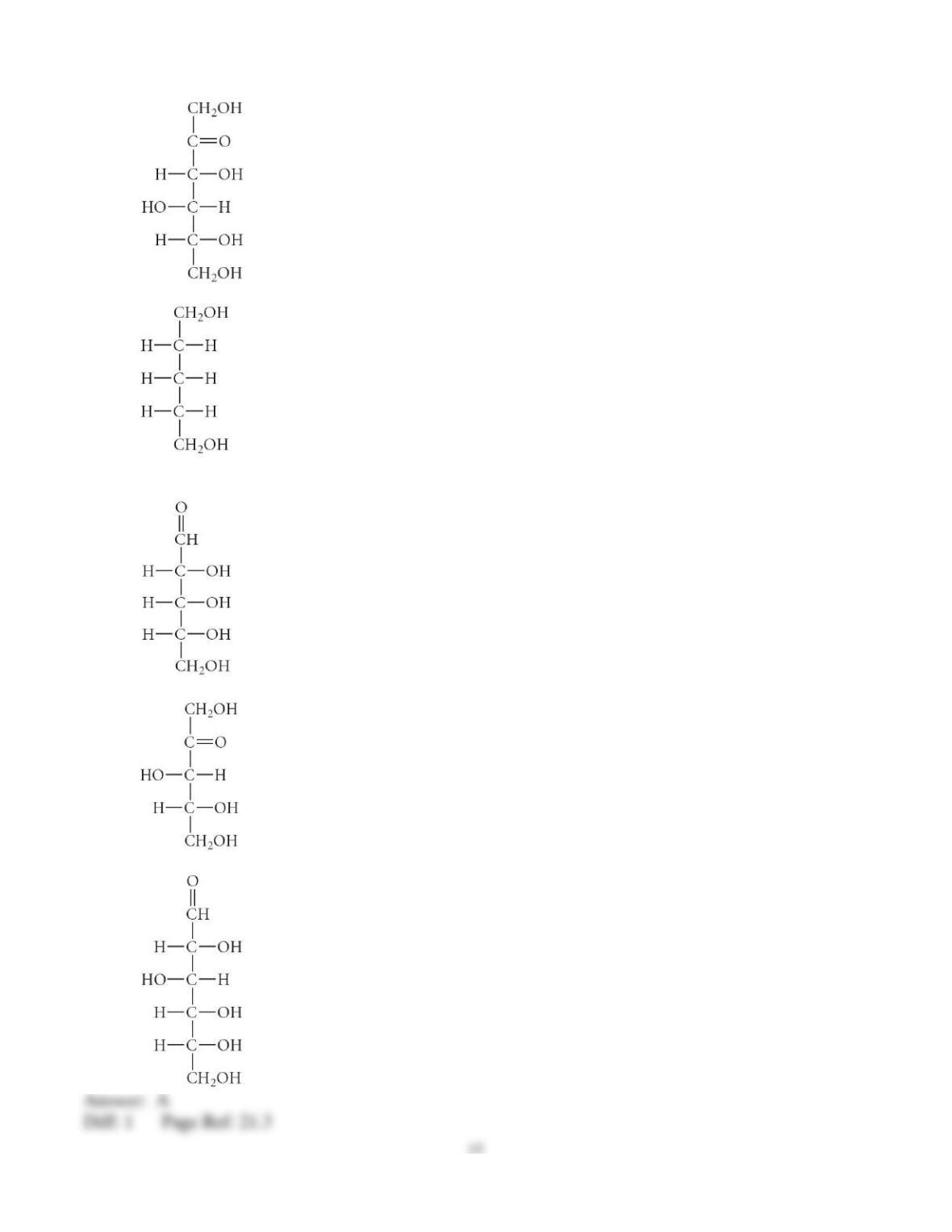
18) Identify fructose.
A)
B)
C)
D)
E)
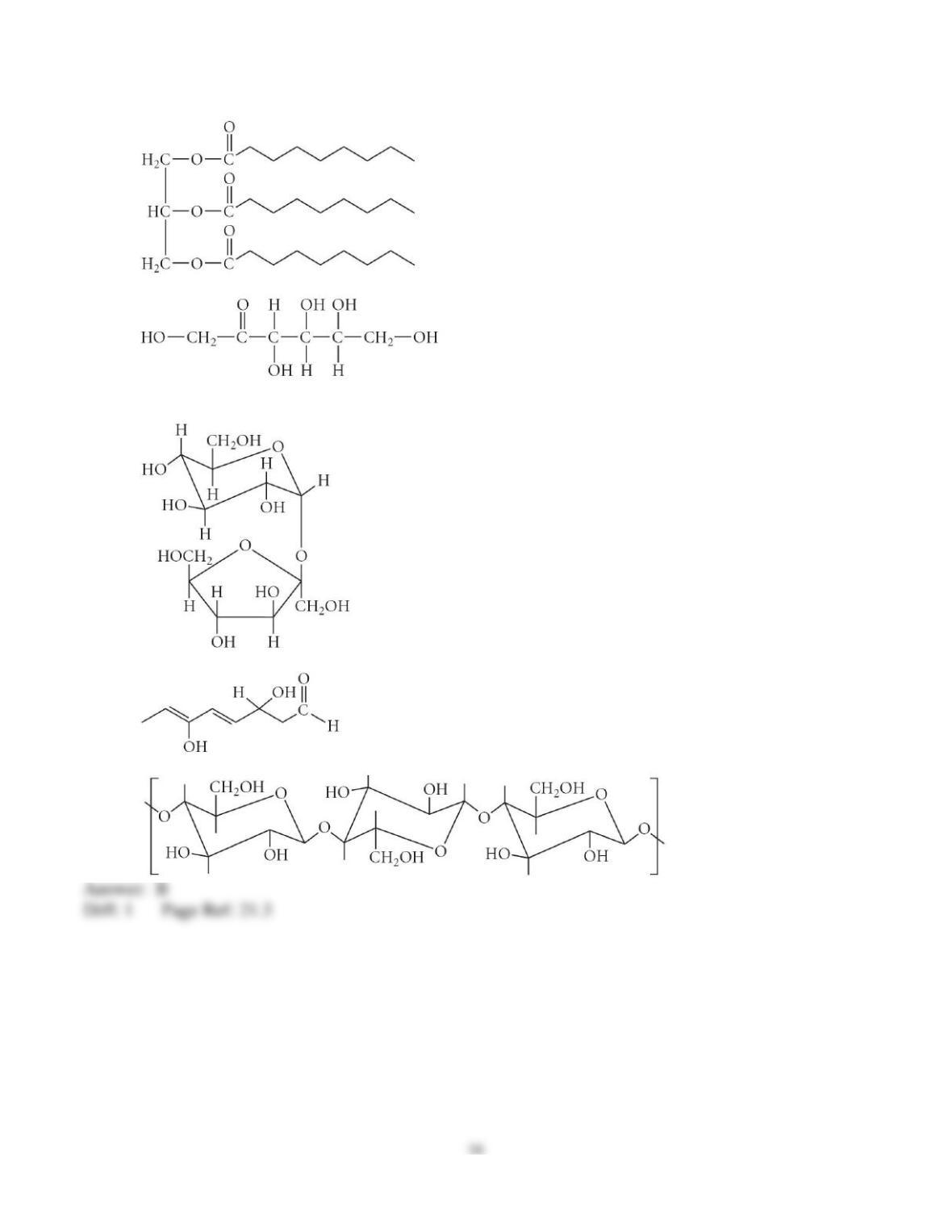
19) Choose the monosaccharide from the compounds below.
A)
B)
C)
D)
E)
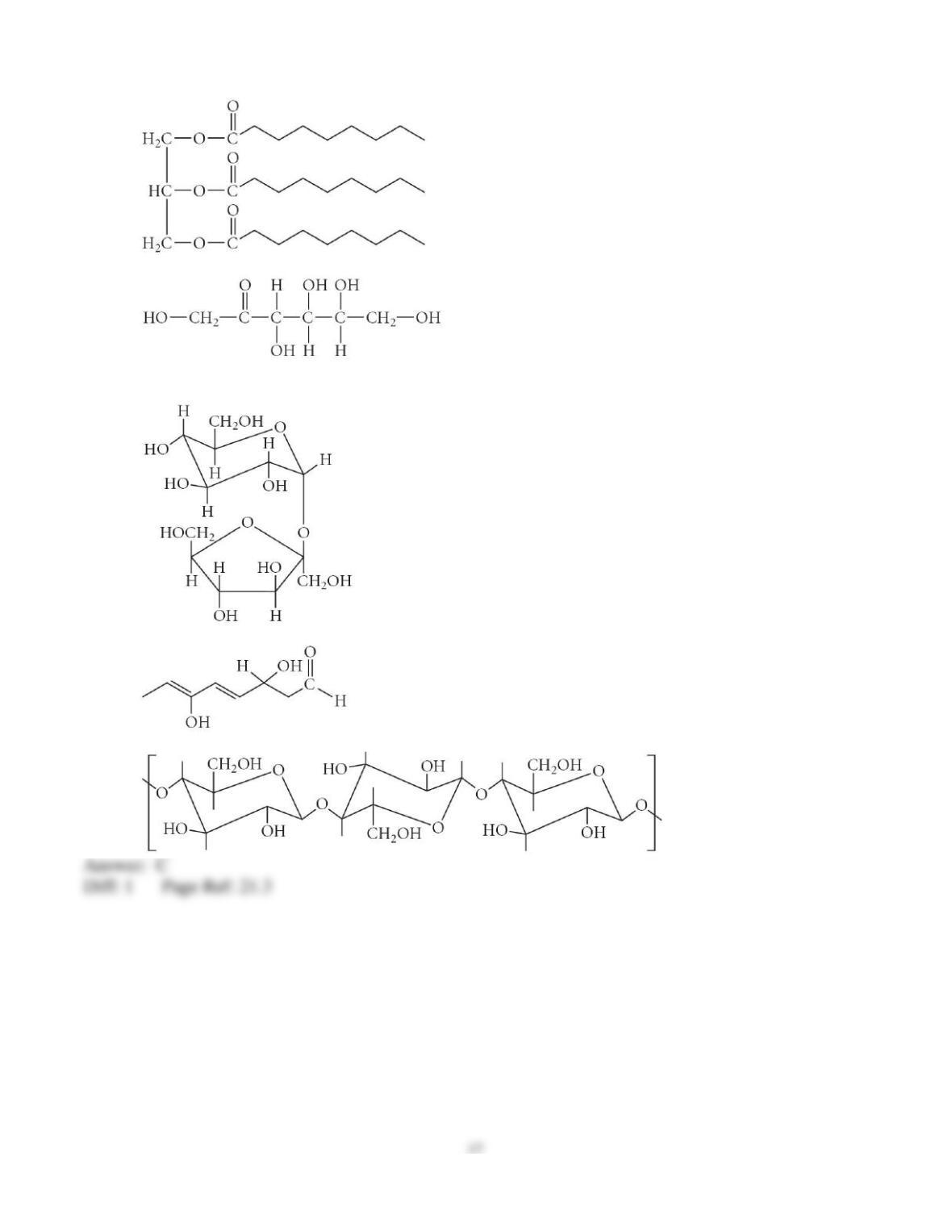
20) Choose the disaccharide from the compounds below.
A)
B)
C)
D)
E)
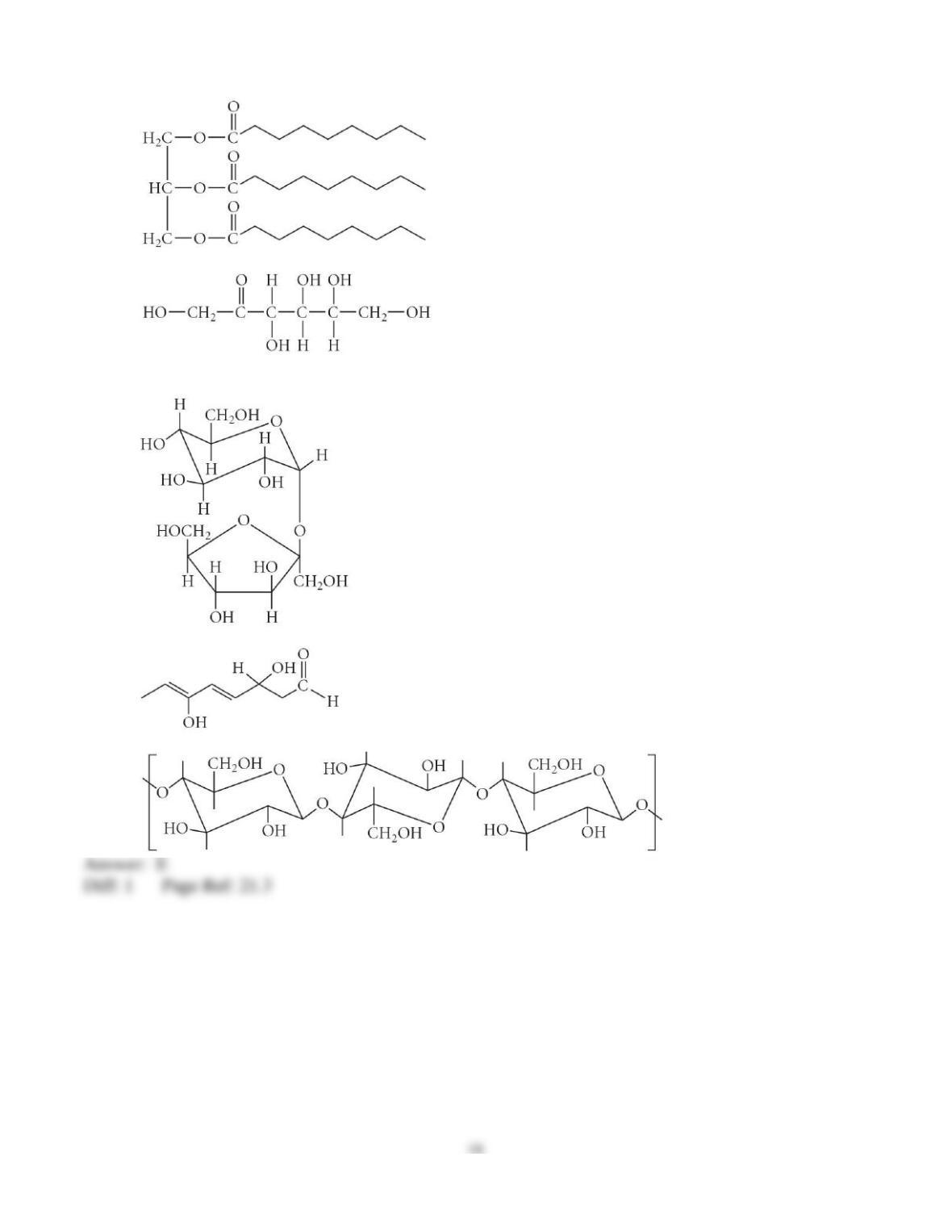
21) Choose the polysaccharide from the compounds below.
A)
B)
C)
D)
E)
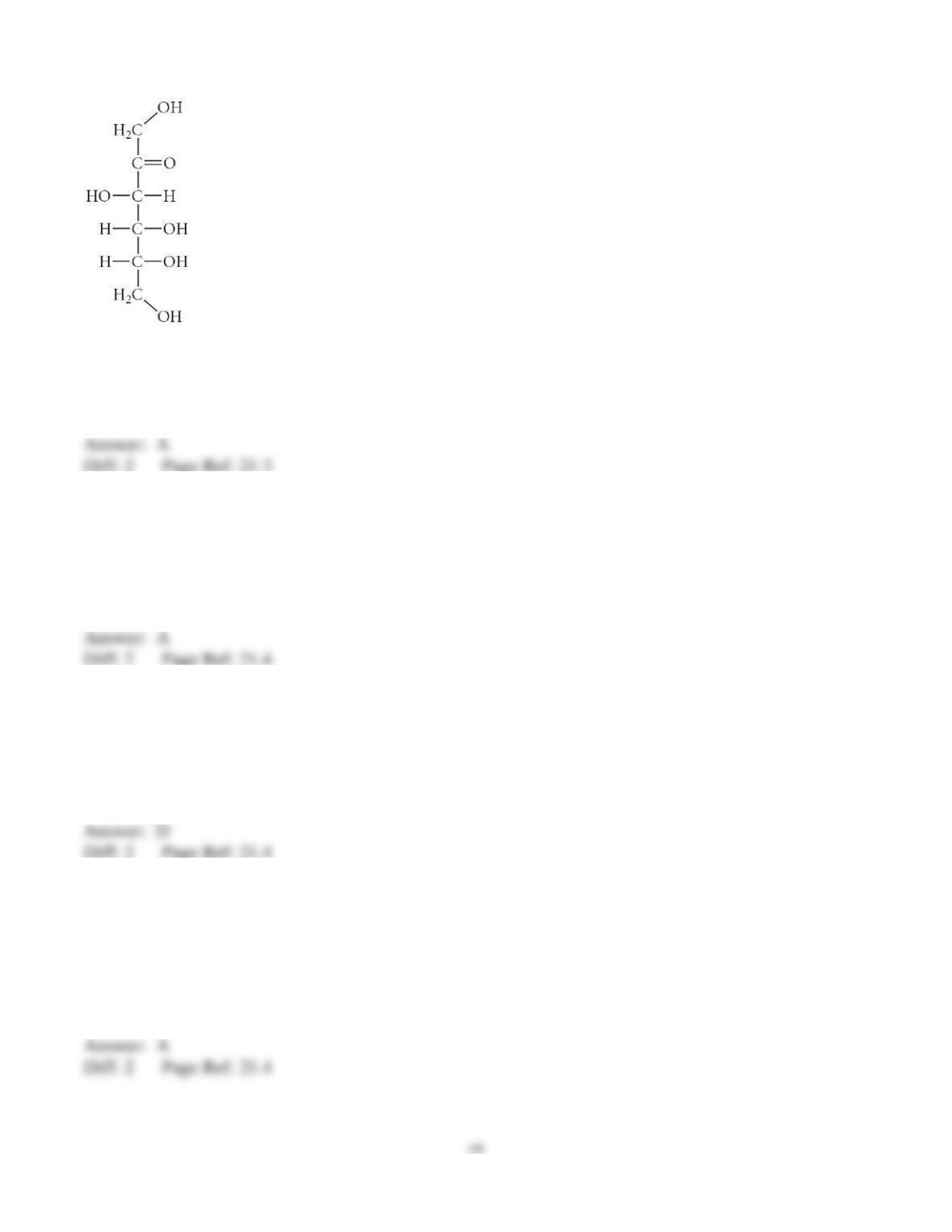
22) How many of the carbons in the following structure are chiral?
A) 3
B) 0
C) 2
D) 1
E) 4 or more
23) Identify the smallest amino acid.
A) glycine
B) cysteine
C) phenylalanine
D) tyrosine
E) aspartic acid
24) Identify the compound that is not an amino acid.
A) cysteine
B) threonine
C) serine
D) guanine
E) tryptophan
25) Which of the following shows all of the tripeptides that can be formed from one molecule each of
glycine (Gly), valine (Val), and leucine (Leu)?
A) GlyValLeu, GlyLeuVal, ValLeuGly, ValGlyLeu, LeuGlyVal, LeuValGly
B) GlyValLeu, GlyLeuVal, LeuGlyVal
C) ValGlyLeu, GlyValLeu, GlyLeuVal, LeuGlyVal
D) ValGlyLeu and GlyLeuVal
E) GlyValLeu
26) Which of the following shows all of the tripeptides that can be formed from one molecule each of
lysine (Lys), threonine (Thr), and hisitidine (His)?
A) LysThrHis
B) LysThrHis, LysHisThr, HisThrLys, HisLysThr, ThrLysHis, ThrHisLys
C) LysThrHis, LysHisThr, HisLysThr, ThrHisLys
D) LysThrHis, LysHisThr, HisLysThr
E) LysThrHis and LysHisThr
27) Which of the following shows all of the tripeptides that can be formed from one molecule each of
alanine (Ala), methionine (Met), and proline (Pro)?
A) AlaMetPro
B) AlaMetPro and AlaProMet
C) AlaMetPro, AlaProMet, ProMetAla, ProAlaMet, MetProAla, MetAlaPro
D) AlaMetPro, AlaProMet, ProAlaMet
E) AlaMetPro, AlaProMet, ProAlaMet, MetProAla
28) Which of the following describes a primary protein structure?
A) protein structure maintained by disulfide linkages
B) amino acid sequence maintained by peptide bonds
C) protein chains maintained by interactions of peptide backbones
D) arrangement of multiple protein subunits
E) protein structure maintained through multiple hydrogen bonds
29) Identify the sugar in RNA.
A) ribose
B) deoxyribose
C) fructose
D) glucose
E) galactose
30) Identify the sugar in DNA.
A) ribose
B) deoxyribose
C) fructose
D) glucose
E) galactose
31) Which of the following statements is TRUE?
A) A nucleotide is composed of a sugar, a base and a phosphate group.
B) A codon is a sequence of 3 bases that codes for a single amino acid.
C) A gene is a portion of DNA that codes for a single protein
D) A chromosome is a structure within a cell nucleus that houses DNA.
E) All of the above are true.
32) The following is part of a DNA sequence. What is its complementary sequence?
AGTTCGAGCCT
A) AGTTCGAGCCT
B) TCCGAGCTTGA
C) CAGTCCA
D) AGGCTCGAACT
E) TCAAGCTCGGA
33) The following is part of a DNA sequence. What is its complementary sequence?
TCGTAAGCTTGCG
A) AGCATTCGAACGC
B) CGCAAGCTTACGA
C) TCATTCAC
D) GCGTTCGAATGCT
E) TCGTAAGCTTGCG
34) The ability for DNA to replicate itself was discovered by ________.
A) Curie
B) Einstein
C) Watson and Crick
D) Galileo
E) Edison
35) What is between the two strands of DNA, holding them together?
A) hydrogen bonds
B) London dispersion forces
C) dipole-dipole bonds
D) ionic bonds
E) covalent bonds
Algorithmic Questions
1) Which of the following form between glycerol and fatty acids to form triglycerides?
A) alcohol bonds
B) disulfide linkages
C) amide bonds
D) glycosidic linkages
E) ester linkages
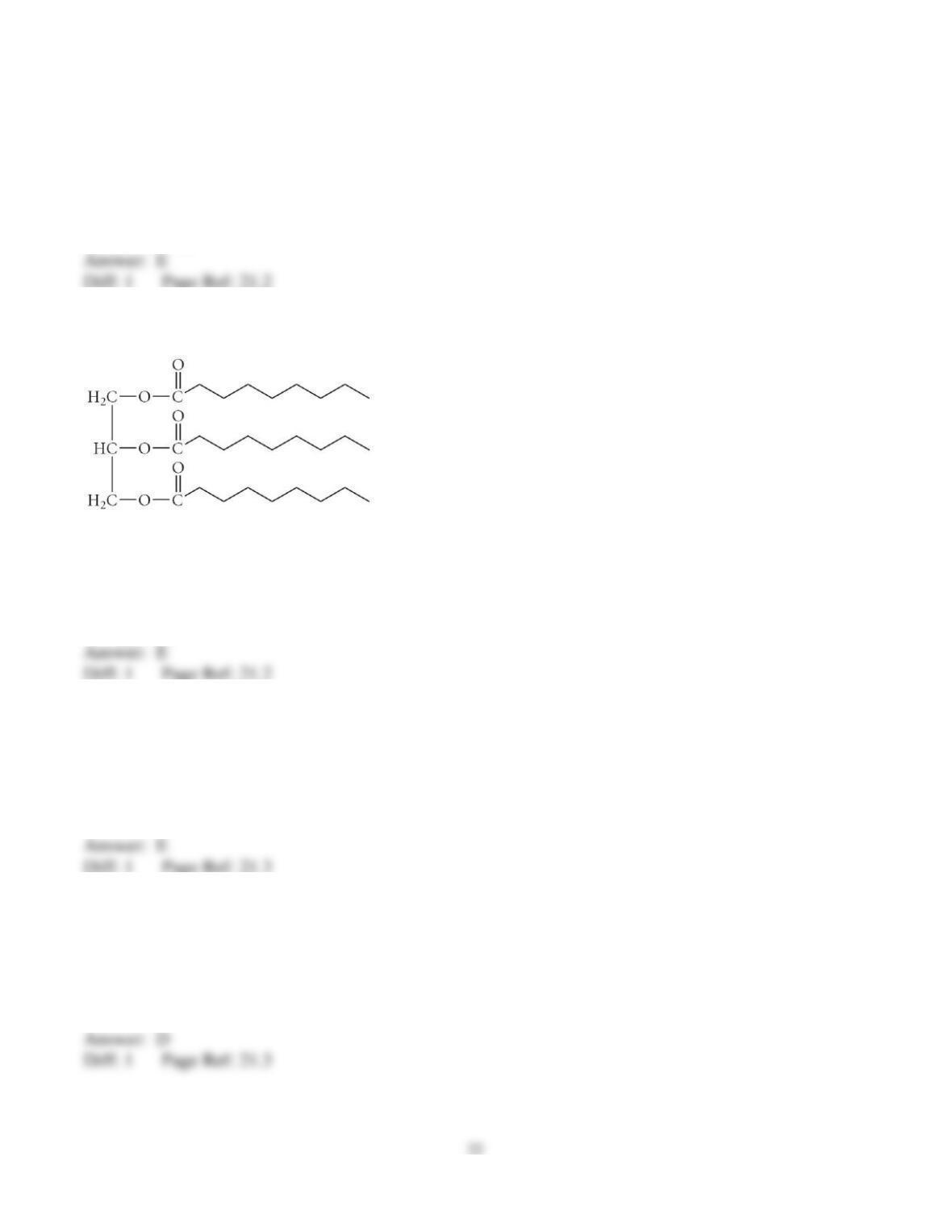
2) What type of lipid is the following compound?
A) steroid
B) phospholipid
C) glycolipid
D) fatty acid
E) triglyceride
3) Identify the disaccharide.
A) glucose
B) cholesterol
C) fructose
D) cellulose
E) sucrose
4) Identify the polysaccharide.
A) maltose
B) cholesterol
C) galactose
D) cellulose
E) sucrose
5) Which of the following bond monosaccharide units together into polysaccharides?
A) hydrogen bonds
B) glycosidic linkages
C) disulfide linkages
D) hydrogen bonds
E) ester linkages
6) Which of the following statements is TRUE?
A) Monosaccharides are the building blocks of peptides.
B) Nucleotides are the building blocks of saccharides.
C) Fatty acids are responsible for DNA replication.
D) Peptides are the building blocks of amino acids.
E) Carbohydrates are water soluble and responsible for short term energy storage.
7) Which one of the following amino acids does not contain a basic side chain?
A) arginine
B) histidine
C) lysine
D) threonine
8) Which one of the following amino acids contains a polar side chain?
A) alanine
B) glycine
C) threonine
D) valine
9) Which one of the following amino acids contains a hydrophobic side chain?
A) valine
B) histidine
C) glutamine
D) glutamic acid
10) In the protein, His-Tyr-Val-Pro, which amino acid contains the N-terminal group?
A) valine
B) tyrosine
C) proline
D) histidine
11) In the protein, Arg-Pro-Leu-Gln, which amino acid contains the C-terminal group?
A) proline
B) leucine
C) glutamine
D) arginine
12) Which of the following link together amino acid units?
A) glycosidic linkages
B) sulfide linkages
C) peptide bonds
D) hydrogen bonds
E) ester linkages
13) Which of the following hold two strands of DNA in an a-helix?
A) ester linkages
B) sulfide linkages
C) peptide bonds
D) hydrogen bonds
E) glycosidic linkages
14) Which of the following is an example of a secondary protein structure?
A) tripeptide
B) glyceride
C) a-helix
D) amino acid
E) fatty acid
15) Which of the following is an example of a secondary protein structure?
A) fatty acid
B) triglyceride
C) lipid
D) b-pleated sheet
E) dipeptide
16) Which of the following has a tertiary protein structure?
A) amino acid
B) ester
C) nucleotide
D) fatty acid
E) fibrous protein
17) Which of the following is a type of nucleic acid?
A) DNA
B) amino acid
C) dipeptide
D) carbohydrate
E) lipid
18) Which of the following statements is TRUE?
A) Cytosine and Thymine are a complementary base pair that forms 3 hydrogen bonds.
B) Adenine and Guanine are a complementary base pair that forms 3 hydrogen bonds.
C) Cytosine and Guanine are a complementary base pair that forms 2 hydrogen bonds.
D) Thymine and Adenine are a complementary base pair that forms 2 hydrogen bonds.
E) Thymine and Guanine are a complementary base pair that forms 2 hydrogen bonds.
19) How many chromosomes are in the nuclei of human cells?
A) 41
B) 44
C) 46
D) 48
E) 52
26
Matching Questions
Match the following.
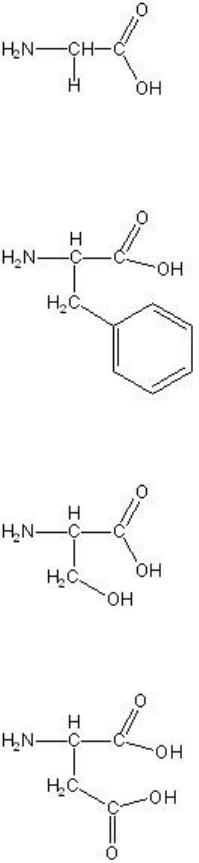
A) glycine
B) alanine
C) aspartic acid
D) phenylalanine
E) serine
F) lysine
1)
Diff: 1 Page Ref: 21.4
2)
Diff: 1 Page Ref: 21.4
3)
Diff: 1 Page Ref: 21.4
4)
Diff: 1 Page Ref: 21.4
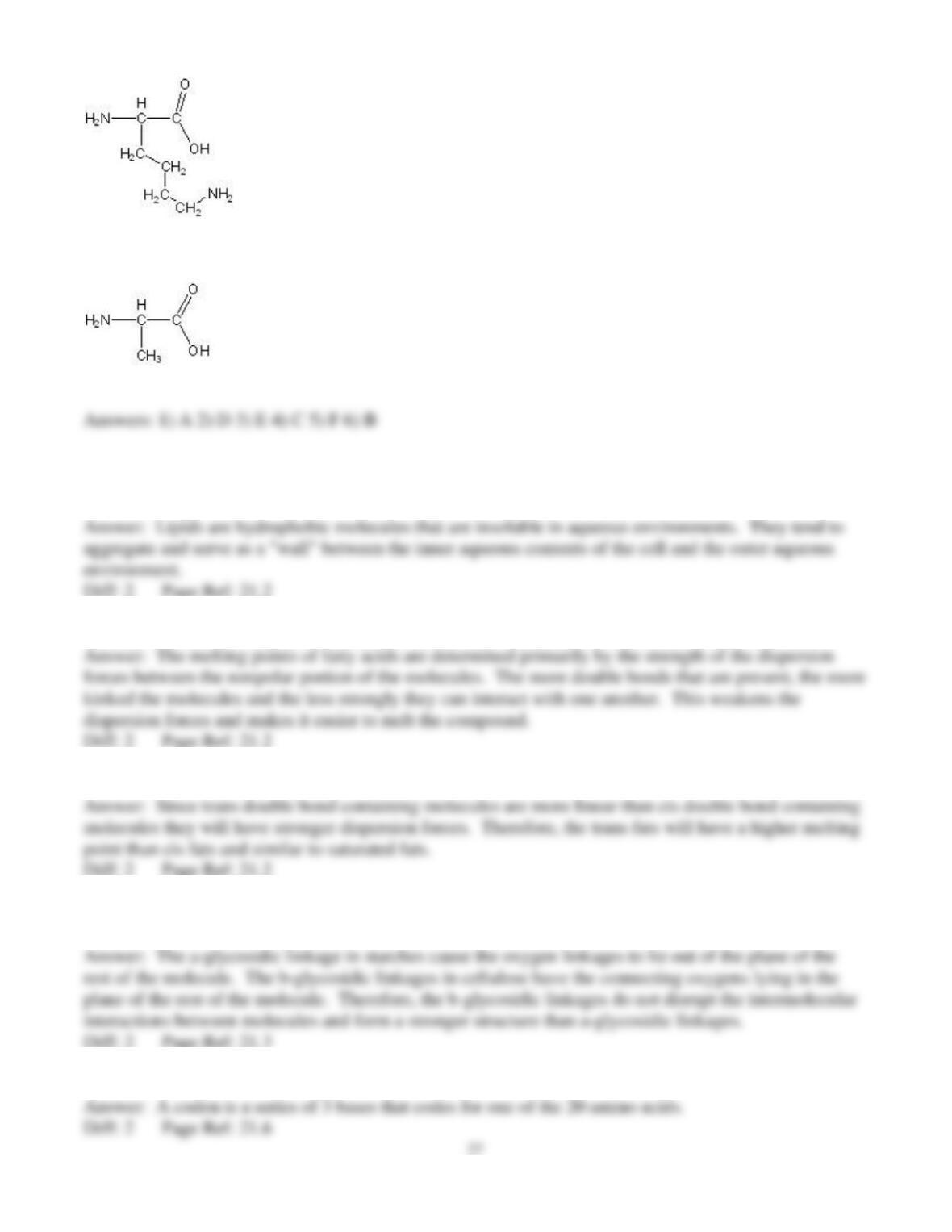
5)
Diff: 1 Page Ref: 21.4
6)
Diff: 1 Page Ref: 21.4
Short Answer Questions
1) Why are lipids well-suited as structural components of cell membranes?
2) Why does the melting point of fatty acids decrease with the number of double bonds present?
3) How do cis- and trans-fats differ?
4) What is the difference between an a-glycosidic linkage and a b-glycosidic linkage? What implication
does this have for the strength of the intermolecular forces between molecules?
5) What is a codon?