
81)
A popular entertainer gives a concert in a 50,000 seat stadium. To give her fans a break, she charges
only $50 a seat instead of the customary $75 a seat. At $75 a ticket, there would have been 50,000
tickets sold, and at $50, there are 80,000 people who want tickets. As a consequence of the
generosity of the entertainer,
81)
A)
a more fair system of pricing the tickets has been found.
B)
another type of system will have to be found to allocate the tickets, making some of her fans
better off and others worse off.
C)
her fans are made better off.
D)
her fans are made worse off since there is an excess demand of 30,000 tickets.
82)
The opportunity cost of capital is
82)
A)
usually unknown and must be estimated by looking at the price of capital goods.
B)
an explicit cost.
C)
the normal rate of return.
D)
a part of economic profits.
C
83)
Suppose that during a given time period the implicit cost for a business was $1,000 and that the
explicit cost was $5,000. Also suppose that the firm sold 1,000 units of its products at $5 per item.
We can conclude that the firm‘s
83)
A)
accounting profit was $0, and economic profit was –$1,000.
B)
accounting profit was $5,000, and its economic profit was $0.
C)
accounting profit was $0, and economic profit was $1,000.
D)
accounting and economic profits were both $0.
A
84)
“Inside information” is the use of information
84)
A)
by those who read the companies’ annual reports.
B)
that is not available to the public.
C)
by stockbrokers at the largest brokerage firms.
D)
by those who write the companies’ annual reports.
B
B

85)
The most prestigious stock market in the world is the
85)
A)
Chicago Mercantile Exchange.
B)
New York Stock Exchange.
C)
Tokyo Stock Exchange.
D)
London Stock Exchange.
86)
The interest rate used to bring future sums back to present value is
86)
A)
always negative.
B)
the rate of discount.
C)
the prime rate.
D)
zero when there is no inflation.
87)
The owners of a corporation are
87)
A)
taxed only once.
B)
the shareholders.
C)
the employees of the firm.
D)
completely in control of the firm.
88)
Each of the following is a source of financial capital for a corporation EXCEPT
88)
A)
issuing new stock.
B)
dividends.
C)
issuing bonds or borrowing funds from a bank.
D)
reinvestment of profit or retained earnings.
89)
Rents
89)
A)
have an allocative function since they help decide to which use a resource will be put.
B)
have a distributional function since they affect incomes, but have no allocative function since
the resource is in fixed supply.
C)
have an economic purpose only if they are taxed and provide revenue to the government.
D)
have no useful economic purpose.

90)
Unlimited liability exists when
90)
A)
a firm dissolves when the owner dies.
B)
the profits of the firm are taxed once.
C)
a corporation exists.
D)
the personal assets of the owner of a firm can be seized to pay off the firm’s debts.
91)
Economic rent serves
91)
A)
an allocative function by guiding available supplies to the most efficient use.
B)
a descriptive function by making some wealthier than others, but serves no allocative
function.
C)
only to make the rich richer and the poor poorer.
D)
no useful function in a modern economy.
92)
Limited liability is a characteristic of
92)
A)
partnerships and proprietorships only.
B)
proprietorships only.
C)
partnerships only.
D)
corporations only.
93)
Most businesses in the United States are ________, and the type of business organization that
accounts for the LEAST amount of total revenues is ________.
93)
A)
proprietorships; partnerships
B)
proprietorships; proprietorships
C)
corporations; proprietorships
D)
corporations; partnerships
94)
The most common form of business organization, as far as the number of such firms in business, is
the
94)
A)
partnership.
B)
S corporation.
C)
corporation.
D)
proprietorship.

95)
In which of the following ways can a corporation raise new funds for investment?
I. Issuing new shares of stock
II. Having existing stock resold between two owners
95)
A)
I only
B)
II only
C)
Both I and II
D)
Neither I nor II
96)
A portion of a worker’s earnings is economic rent if the worker
96)
A)
would accept a small reduction in pay without quitting.
B)
has been on the job for at least a year.
C)
was the last person hired at the going wage rate.
D)
has skills that make him more productive than an unskilled worker.
97)
Implicit costs are
97)
A)
costs that are variable in the short run and fixed in the long run.
B)
costs that are taken into consideration by accountants.
C)
the opportunity costs of using factors that a producer does not buy or hire but already owns.
D)
the costs of using factors that a producer hires or rents.
98)
According to Ricardo’s explanation of land rent, what happens when the demand for land
increases?
98)
A)
Both revenues to owners of land and economic rent increase.
B)
The supply curve shifts to the right just enough to keep the price per acre constant.
C)
The amount of economic rent stays constant, constrained by a perfectly inelastic supply curve.
D)
Revenues to owners of land increase but economic rent declines.

99)
When economic profits are zero, accounting profits
99)
A)
must be positive.
B)
could be positive, negative or zero.
C)
will equal zero.
D)
will be negative.
100)
A proprietorship is
100)
A)
a business owned by one individual who makes all of the decisions.
B)
a corporation that is taxed like an individual.
C)
a government–owned franchise.
D)
two or more individuals in business together.
101)
When a corporation uses profits to pay for the purchase of new capital equipment, this is know as
101)
A)
dividend.
B)
collusion.
C)
reinvestment.
D)
a coupon payment.
102)
Which form of business organization accounts for the largest proportion of sales in the United
States?
102)
A)
the proprietorship
B)
the subchapter S partner–based proprietorship.
C)
the corporation
D)
the partnership
103)
The concept of economic rent is associated with the economist
103)
A)
Karl Marx.
B)
David Ricardo.
C)
Adam Smith.
D)
Henry George.

104)
The higher the expected rate of inflation,
104)
A)
the higher is the real rate of interest.
B)
the higher the real and nominal rates of interest.
C)
the higher is the nominal rate of interest.
D)
the lower is the nominal rate of interest.
105)
An advantage of a corporation is
105)
A)
the fact that the corporation is dissolved when one of its owners dies.
B)
unlimited liability on the part of shareholders.
C)
the fact that ownership and control are never separated.
D)
the ability to raise large sums of financial capital.
D
106)
If a rock star insists that tickets to her concert be sold for $150 each rather than the $450 each that
could be charged as reflected by demand for those tickets, then the result will be
106)
A)
that the demand for tickets will decrease.
B)
to eliminate $150 worth of economic rent per ticket.
C)
to create an excess supply of tickets.
D)
that part of the economic rent will be dissipated by scalpers, radio station owners, etc..
D
107)
Accounting profits are typically
107)
A)
greater than economic profits because accounting profits do not include explicit costs.
B)
greater than economic profits because accounting profits do not include implicit costs.
C)
equal to economic profits in the long run.
D)
smaller than economic profits because accounting profits do not include explicit costs.
B
C

108)
Normal rate of return is
108)
A)
an explicit cost.
B)
accounting profit.
C)
the amount that must be paid to obtain investment in a business.
D)
economic profit.
109)
If the death of an owner causes the firm to dissolve, the firm must have been
109)
A)
a proprietorship only.
B)
a corporation only.
C)
either a proprietorship or a partnership.
D)
a partnership only.
C
110)
Which of the following is a disadvantage of the corporate form of business organization?
110)
A)
Limited financing
B)
Double taxation
C)
Limited liability
D)
Unlimited liability
B
111)
Under which one of the following situations would you be better off?
111)
A)
You have $10,000 in your savings account paying 5 percent per year and unanticipated
inflation is 8 percent per year.
B)
You borrowed $2,500 at 7 percent to pay for this year’s college expenses and unanticipated
inflation is 12 percent during the year.
C)
You have paid $500 for a $1,000 U.S. savings bond that matures in 10 years and unanticipated
inflation is 10 percent per year.
D)
You lend a friend $1,000 at 6 percent to be repaid in one year and unanticipated inflation is 7
percent during the year.
B
C

112)
Suppose Jon Stewart of the “Daily Show” makes an annual income of $1,000,000. If he quit his
television job and went into producing he could make $400,000 per year. Jon Stewart’s annual
economic rent to labor is
112)
A)
$400,000.
B)
$1,400,000.
C)
$600,000.
D)
1,000,000.
113)
A famous opera star made $2 million per year. He said he would rather sell insurance if he couldn’t
make more than $100,000 per year. If he is telling the truth, how much is he being paid in economic
rent?
113)
A)
$2.1 million
B)
$2.0 million
C)
$1.9 million
D)
$100,000
114)
Which of the following is the most common form of business organization in the United States?
114)
A)
S–corporation
B)
Corporation
C)
Proprietorship
D)
Partnership
115)
The form of business organization responsible for generating the greatest portion of business
revenues in the United States is the
115)
A)
partnership.
B)
corporation.
C)
proprietorship.
D)
dual proprietorship.
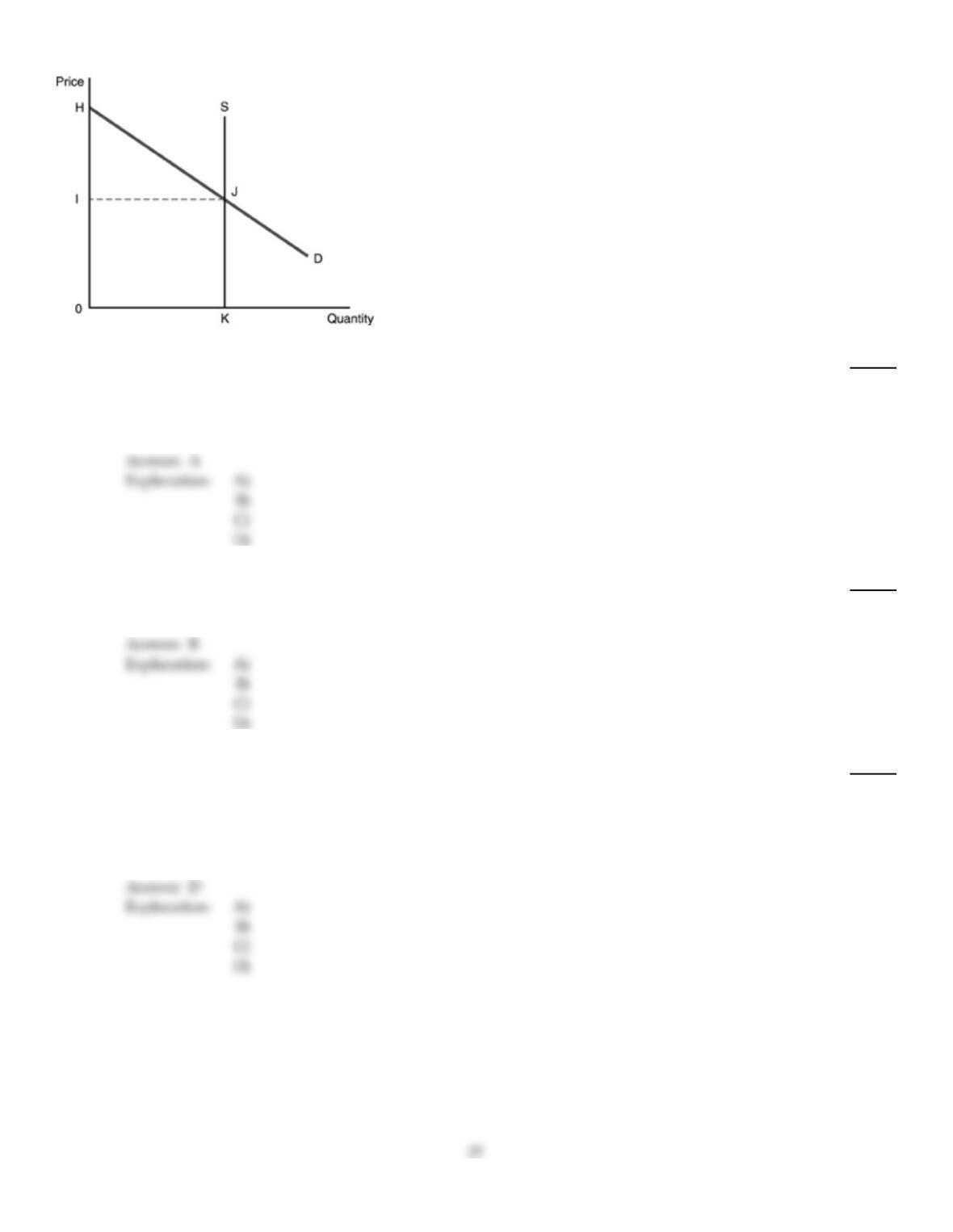
116)
Refer to the above figure. What can we say about economic rent?
116)
A)
Economic rent equals the area IJK0.
B)
Economic rent equals the area HJI.
C)
Economic rent equals the area HJK0.
D)
There is no economic rent represented in the figure.
117)
You own $10,000 in personal property, $2,000 in Company X stocks, $1,000 in U.S. Savings Bonds
and have $500 in your checking account. If Company X goes bankrupt, the most you could lose is
117)
A)
$13,500.
B)
$2,000.
C)
$11,500.
D)
$500.
118)
Suppose that the implicit cost for a business was $1,000 and the explicit cost was $5,000 and that the
firm sold 1,000 units of its products at $6 per item. We can conclude that the firm‘s
118)
A)
accounting and economic profits were both $0.
B)
accounting profit was $6,000, and its economic profit was $0.
C)
accounting profit was $1,000, and economic profit cannot be determined.
D)
accounting profit was $1,000, and economic profit was $0.
119)
A difference between a share of stock in a corporation and a corporate bond is that
119)
A)
stocks are issued in return for funds that are lent to the corporation.
B)
the share of stock is a legal claim while the bond is not.
C)
the bond owner is entitled to receive a fixed annual coupon payment plus a lump–sum
payment at the bond’s maturity date, whereas the stockholder is entitled to a share of future
profits.
D)
the bond owner has voting rights within the corporation whereas the stockholder does not.
120)
The main advantage of a corporate form of organization is that
120)
A)
all corporate profits must be distributed as dividends.
B)
shareholders are not subject to double taxation.
C)
shareholders have unlimited liability.
D)
shareholders have limited liability.
SHORT ANSWER. Write the word or phrase that best completes each statement or answers the question.
121)
Consider an NBA superstar Kobe Bryant and one of your economics professors. Who is
likely to receive more economic rent in his/her job? Explain your answer.
121)
122)
Why is limited liability so important when firms try to raise large amounts of financial
capital? How is this advantage of a corporation tied to a disadvantage of a corporation?
122)
123)
Do people make decisions on the basis of the nominal interest rate or the real interest rate?
What is the relationship between the two interest rates?
123)
124)
What is the main purpose of an interest payment? What major factors affect interest rates?
124)
125)
What is the random walk theory?
125)
126)
What are the two meanings of interest in economics?
126)
127)
Suppose that you decide to purchase either stocks or bonds of a particular corporation and
you also prefer to receive some returns from the securities every year. Which should you
buy – stocks or bonds? Why?
127)
128)
“Economic profits are less than or at most equal to accounting profits.” Do you agree or
disagree? Explain.
128)
129)
You have won the lottery. There are two payment options for you. The first option is a
lump sum payment of $10 million that you will receive immediately. The second option is
an annual payment of $1 million for each of the next 12 years. Assume there is no inflation.
How would you make a decision between the two options?
129)
130)
Which method of corporate finance is used the most? Why?
130)
131)
Discuss the advantages and disadvantages of proprietorships.
131)
132)
What is a normal rate of return?
132)
133)
For which type of organization is unlimited liability likely to be the greater
problem–proprietorships or partnerships? Why?
133)
134)
How can one “beat the market?”
134)
135)
What would happen if a corporation goes out of business?
135)
136)
“Economic rent reflects a waste of resources.” Do you agree or disagree? Explain.
136)
137)
How is inflation related to interest rates?
137)
138)
What is the difference between accounting profits and economic profits? Which of the two
concepts is more appropriate for explaining decisions made by entrepreneurs? Explain.
138)
139)
Describe and explain the three principle methods of financing used by corporations.
139)
140)
Why are there so many more proprietorships than corporations, yet corporations account
for so much more of the sales of business firms in the country?
140)
141)
If the random walk theory is correct, then is there any way to “beat the market”?
141)
142)
Amber has opened a coffee shop for many years on a piece of land that she has also owned.
She has also made accounting profits from the coffee shop. This year, rents in the area rose
considerably, and Amber responded by deciding to sell the land and the coffee shop to an
apartment builder. How can you explain Amber’s decision to sell her business?
142)

Answer Key
Testname: C21

Answer Key
Testname: C21
Answer Key
Testname: C21
34
Answer Key
Testname: C21
35