
88)
Bonnie is debating whether to take a job as a professional therapist or a florist. She will earn $40,000
a year as a therapist or $22,000 a year as a florist. If she chooses to be a therapist, the economic rent
is
88)
A)
$40,000.
B)
$18,000.
C)
$22,000.
D)
unable to determine.
89)
Dividends are
89)
A)
the portion of a corporation‘s revenues that are distributed to bondholders.
B)
taxes on the profits of corporations.
C)
the portion of a corporation’s profits that are distributed to stockholders.
D)
bonuses given to managers of corporations, to ensure that the managers perform in the way
that stockholders want.
90)
Economic rent is defined as
90)
A)
a payment to an owner of a factor greater than the opportunity cost of utilizing the factor.
B)
any payment that has a contract period.
C)
a payment to an owner of a factor that is in perfectly elastic supply.
D)
the opportunity cost or return to a productive factor such as capital.
91)
A dedicated professor loves being in the classroom and would teach for $50,000 per year, but he is
actually paid $60,000 per year. This individual
91)
A)
receives economic rent of $1100,000.
B)
has an opportunity cost of $110,000.
C)
receives economic rent of $10,000.
D)
has an opportunity cost of $50,000.

92)
Monitoring the performance of the people managing the firm is easiest in the case of
92)
A)
partnerships.
B)
S corporations.
C)
corporations.
D)
proprietorships.
93)
The greater the risk of nonrepayment of a loan, other things being equal
93)
A)
the lower is the charged loan fees.
B)
the smaller is the amount of collateral that is used.
C)
the longer is the repayment term.
D)
the higher is the rate of interest.
94)
When economic profits are positive, accounting profits
94)
A)
must be positive.
B)
will be negative.
C)
will equal zero.
D)
could be positive, negative or zero.
95)
When economic rent exists,
95)
A)
price is the same as the discount rate.
B)
the price is equal to the opportunity cost of the resources.
C)
resources are allocated efficiently.
D)
resources are allocated inefficiently.

96)
You have received your advanced degree in biochemistry with a specialty in recombinant DNA
technology. Your colleagues wish to form a partnership to research adenovirus vectors. Your legal
counsel advises you on the following aspects of a partnership, yet you tell her, based on your
knowledge of economics, that you think one of the following points is INCORRECT.
96)
A)
An advantage of the partnership would be that it is relatively easy to form, almost as easy as
forming a proprietorship.
B)
Partnerships often help reduce the costs of monitoring job performance in situations in which
it is difficult to measure objectively.
C)
The personal assets of each partner should be safe and would not necessarily be at risk due to
claims by financial institutions.
D)
The income of the partnership is treated as personal income and is subject only to personal
taxation rates.
97)
Proprietorships are
97)
A)
the most common form of business organization in the country.
B)
generally large relative to other business organizations.
C)
easy to form but difficult to dissolve.
D)
responsible for most of the profits in the country.
A
98)
Economic rent is
98)
A)
a payment for the use of any resource above its opportunity cost.
B)
the return to owners of farmland.
C)
a payment for land, an apartment, or a house that one does not own.
D)
the return to landlords.
A
99)
Accounting profits are total revenues minus
99)
A)
all relevant opportunity costs.
B)
explicit costs.
C)
explicit and implicit costs.
D)
explicit costs and all other relevant opportunity costs.
B
C

100)
A payment for the use of an input that exceeds the opportunity cost of the input is known as
100)
A)
economic cost.
B)
economic rent.
C)
economic profit.
D)
real interest.
101)
The economy’s current rate of interest is 10 percent and a firm has $10,000 of owner–invested
capital. Its total revenue is $5000 and the firm’s explicit costs are $3500. From this we know that this
firm’s
101)
A)
accounting profit is $1,500.
B)
economic profit is $5,000.
C)
accounting profit is $500.
D)
economic profit is $1,500.
102)
Larger loans, other things constant, have lower interest rates because
102)
A)
only large, financially sound corporations obtain such loans.
B)
large loans are always for short time periods.
C)
large loans always have collateral.
D)
the fixed costs associated with the handling charges as a percent of the total loan are less.
103)
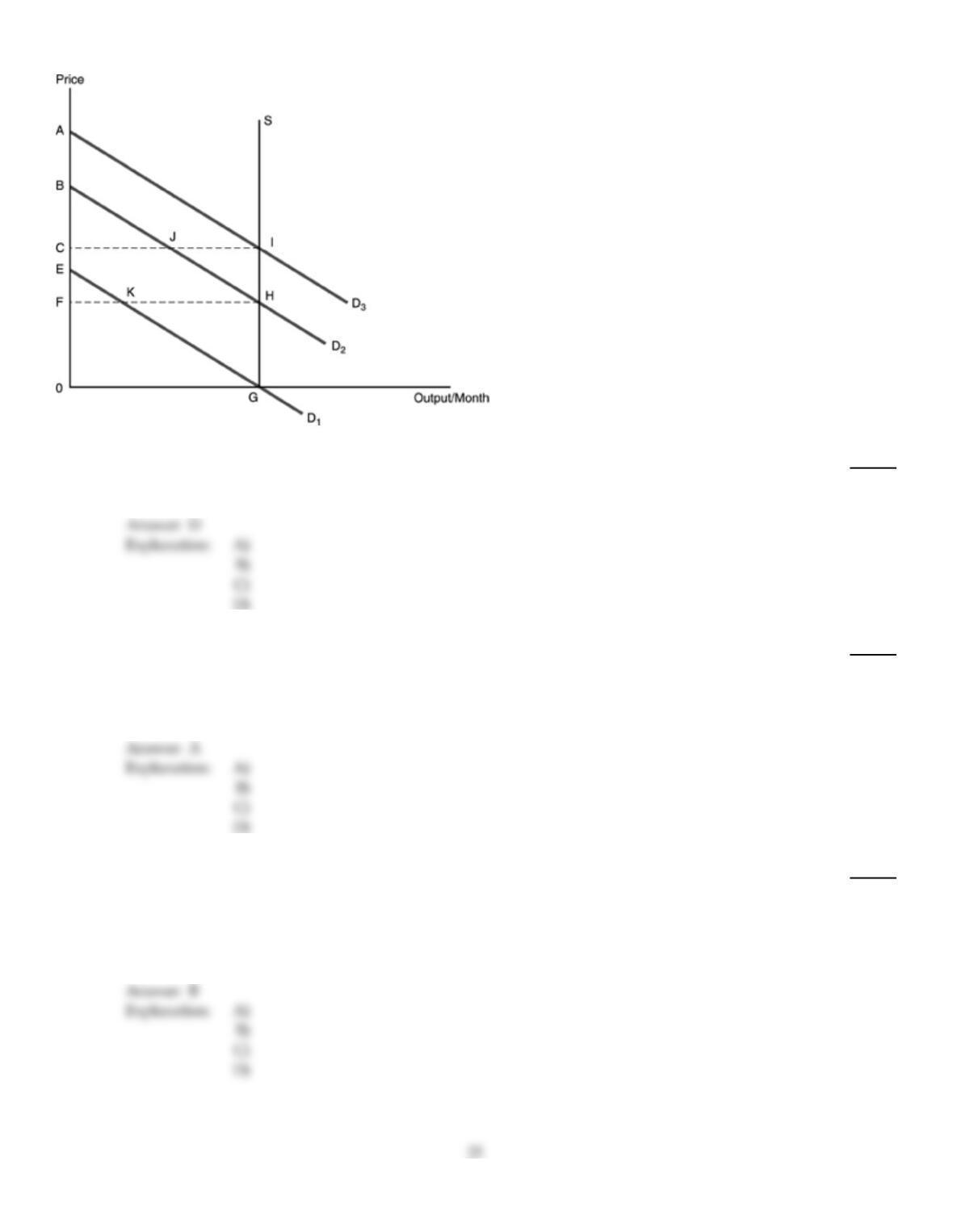
Refer to the above figure. Suppose demand is D2 and then increases to D3. Economic rent after the
change is
103)
A)
area CIHF.
B)
area BJC.
C)
zero.
D)
area CIGO.
104)
The higher the expected rate of inflation,
104)
A)
the higher is the nominal rate of interest.
B)
the higher the real and nominal rates of interest.
C)
the higher is the real rate of interest.
D)
the lower is the nominal rate of interest.
105)
For an individual such as a movie star or a pop singer whose natural talents are almost impossible
to duplicate
105)
A)
all of their earnings consist of economic rents.
B)
part of their earnings consists of economic rents.
C)
all of their earnings consist of interest payments.
D)
none of their earnings consist of economic rents since rent applies only to land.

106)
Corporations have a separation and control problem because
106)
A)
most of the profits are reinvested.
B)
taxes are paid only by the board of directors.
C)
the shareholders control the firm.
D)
owners and managers frequently have different incentives.
107)
Suppose a firm wanted to go out of business. The firm sells all its assets and pays off everything it
owes to creditors. The stockholders would receive
107)
A)
nothing.
B)
the rest of the funds, after everyone who has a claim against the firm is paid.
C)
one half of the funds; the other half of the funds goes to bondholders.
D)
their annual dividend payment.
B
108)
When a resource has a perfectly elastic supply curve
108)
A)
the entire payment received by this resource is economic rent.
B)
the amount of economic rent for this resource is determined by demand for the resource.
C)
there is no economic rent being earned by this resource.
D)
the amount of economic rent for the resource is determined by its supply.
C
109)
Suppose that you borrow $5,000 from the bank to purchase some land and you agree to pay 9
percent interest on the loan. If the loan must be repaid in 12 months and the inflation rate is 13
percent during the year, then
109)
A)
the bank will receive fewer dollars, because of inflation, than it had initially expected to
receive.
B)
you will repay the bank with dollars with more purchasing power than you initially
borrowed.
C)
you will repay the bank with dollars with less purchasing power than it initially loaned you.
D)
you will repay the bank with fewer dollars than the bank initially loaned you.
C
D

110)
What is the present value of $100 one–year from now at an interest rate of 6%?
110)
A)
$6
B)
$94.34
C)
$106
D)
$160
111)
The greater is the risk of non–repayment of a loan, the
111)
A)
lower is the handling charges for the loan.
B)
lower is the expected rate of interest.
C)
higher is the expected rate of interest.
D)
longer is the expected time to repay the loan.
112)
The most that someone would pay today to receive a certain sum at some point in the future is
known as
112)
A)
future value.
B)
present value.
C)
economic profit.
D)
the interest rate.
113)
Unlimited liability exists when
113)
A)
a firm dissolves when the owner dies.
B)
a corporation exists.
C)
the profits of the firm are taxed once.
D)
the personal assets of the owner of a firm can be seized to pay off the firm’s debts.
114)
Ricardo’s assumption for economic rents for land was based on
114)
A)
total government control of land.
B)
the supply of land being a fixed quantity.
C)
a surplus of land.
D)
a shortage of land.

115)
A long–term loan that is given to a firm is known as a
115)
A)
bond.
B)
dividend.
C)
random walk.
D)
share of stock.
116)
Which of the following is not a legal organization of a firm?
116)
A)
entrepreneurship
B)
proprietorship
C)
corporation
D)
partnership
A
117)
Implicit costs are measured by
117)
A)
the lowest value of all alternative uses of inputs.
B)
total revenues minus total costs.
C)
the value of the next–best alternative uses of inputs.
D)
actual expenses paid by a firm.
C
118)
If a corporation fails, the last recipients of funds that may remain are
118)
A)
preferred stockholders.
B)
bond holders.
C)
government tax collectors.
D)
common stockholders.
D
119)
Because handling charges are relatively fixed, the interest rate on a loan generally
119)
A)
is constant regardless of the size of the loan.
B)
is unrelated to the size of the loan.
C)
increases with the size of the loan.
D)
decreases with the size of the loan.
D
A

120)
The difference between the nominal rate of interest and the real rate of interest is
120)
A)
the anticipated rate of inflation.
B)
government regulatory charges.
C)
handling charges.
D)
administrative overhead charges.
121)
A share of stock in a corporation is
121)
A)
a legal claim to a share of the company’s future profits.
B)
a legal claim to a dividend, regardless of the corporation‘s ability to pay its interest payments.
C)
a legal claim to a lump–sum payment at a specified point of time in the future.
D)
a guarantee to a fixed amount of income from the corporation.
122)
Suppose the auto industry has several investment projects with an expected rate of return of 15
percent, the aluminum industry has projects with an expected return of over 20 percent, the
publishing industry projects with an expected return of 10 percent, the steel industry has projects
with an expected return of 7 percent and the rubber industry projects with an expected return of 5
percent. The current market rate of interest is 7 percent. A reduction in the supply of funds causes
interest rates to rise to 11 percent. The effect is to
122)
A)
force the firms in the automobile industry and the publishing industry to rely on funding
their projects through other means.
B)
cause the firms in the steel and the rubber industries to go ahead with their projects.
C)
make the projects of the aluminum industry and the steel industry unprofitable; the firms in
these industries will not borrow the funds or make the investments.
D)
cause the firms in the steel and publishing industries to cancel their projects, which would
have been funded at the old interest rate.
123)
What is the present value of $100 two years from now at an interest rate of 5%?
123)
A)
$90.70
B)
$105
C)
$95.24
D)
$5
124)
A legal claim entitling the owner of the claim to fixed annual payments and a lump–sum payment
is called a(n)
124)
A)
stock.
B)
equity share.
C)
bond.
D)
debit.
125)
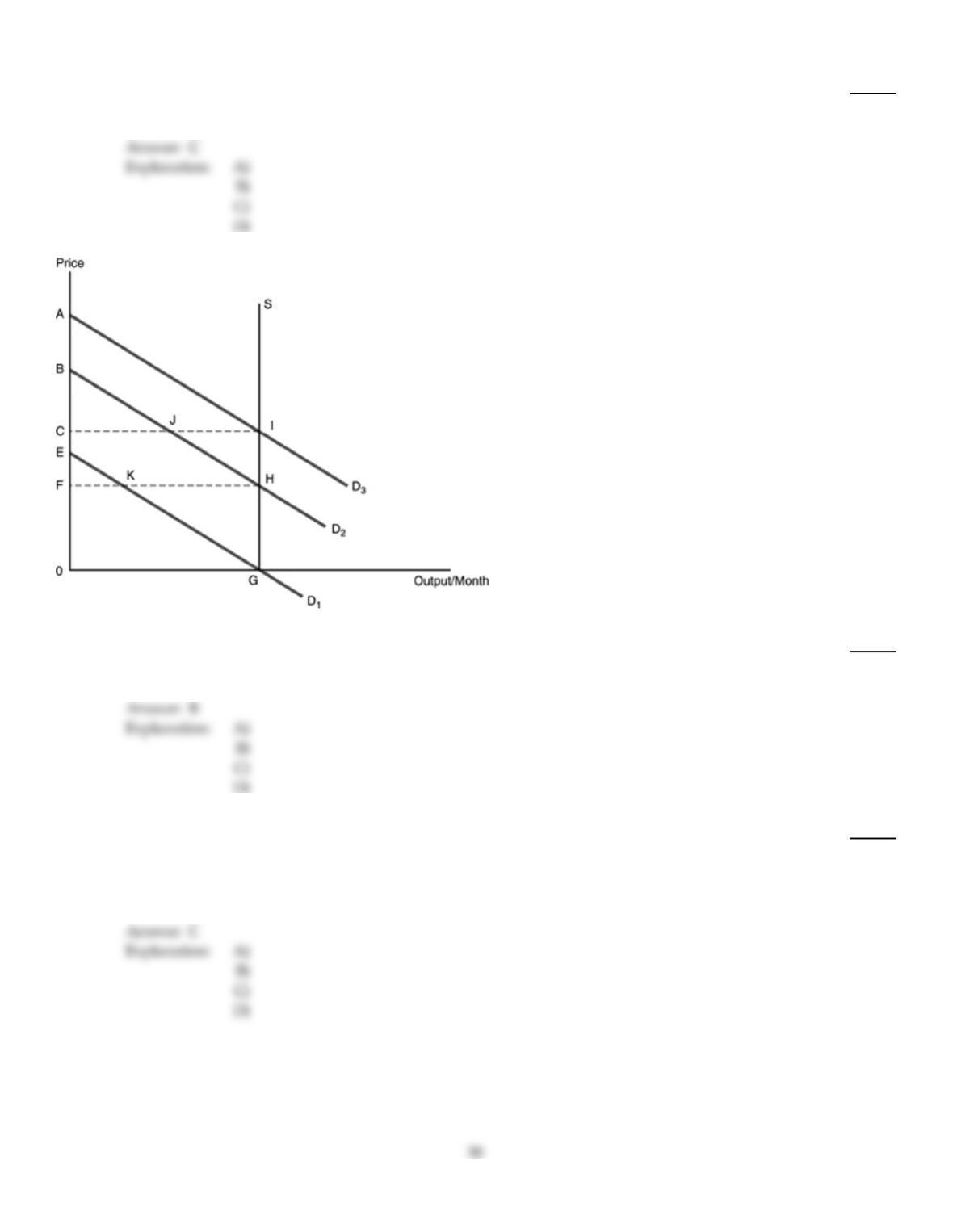
Refer to the above figure. At demand curve D2, price equals ________ and economic rent equals
________.
125)
A)
OF; KHG
B)
OF; FHGO
C)
OE; KHG
D)
OE; EKGO
126)
Corporations are able to raise large amounts of financial capital because
126)
A)
of the elimination of the problem of separation of ownership and control.
B)
of the tax breaks corporations are given relative to partnerships or proprietorships.
C)
of limited liability and the treatment of a corporation as an individual entity.
D)
of their greater ability to monitor the performance of decision makers.

127)
What is the present value of $100 three years from now at an interest rate of 6%?
127)
A)
$82
B)
$119.10
C)
$83.96
D)
$94.34
128)
Which of the following is not an implicit cost?
128)
A)
owner–provided labor
B)
wages
C)
owner–provided capital
D)
opportunity cost of using an owner’s savings
B
129)
“Inside information” is the use of information
129)
A)
by stockbrokers at the largest brokerage firms.
B)
by those who write the companies’ annual reports.
C)
that is not available to the public.
D)
by those who read the companies’ annual reports.
C
130)
Economic rents are useful because
130)
A)
they increase the income of the owner.
B)
they increase tax revenue.
C)
resources will go to their most efficient use.
D)
they make it easy to calculate opportunity cost.
C
131)
Information that is not available to the general public about what is happening in a corporation is
131)
A)
economic rent.
B)
inside information.
C)
opportunity benefit.
D)
limited liability.
B
C

132)
A difference between a proprietorship and a partnership is that
132)
A)
a partnership allows for specialization while a proprietorship does not.
B)
a proprietorship has only one owner while a partnership has only two owners.
C)
a proprietorship is easy to form while a partnership is hard to form.
D)
the profits in a proprietorship are taxed only once while in a partnership they are taxed twice.
133)
The most numerous or plentiful firms in the United States are found in this form of business
133)
A)
corporation.
B)
proprietorship.
C)
monopoly.
D)
partnership.
134)
A firm that is not maximizing profits
134)
A)
is likely to face legal prosecution from the Department of Commerce.
B)
must not be owned by stockholders.
C)
would never be able to operate in the United States.
D)
may find it difficult to raise financial capital from external capital markets.
135)
Businesses demand funds because
135)
A)
they make investments that they believe will increase productivity and profitability.
B)
they prefer earlier consumption to later consumption.
C)
they have deficits to cover.
D)
they prefer to purchase capital goods in the current year.
136)
Accounting profits are found by total revenues minus
136)
A)
explicit and implicit costs.
B)
implicit costs.
C)
all opportunity costs.
D)
explicit costs.

137)
Suppose that the implicit cost for a business was $1,000 and the explicit cost was $5,000 and that the
firm sold 1,000 units of its products at $6 per item. We can conclude that the firm‘s
137)
A)
accounting profit was $1,000, and economic profit cannot be determined.
B)
accounting profit was $6,000, and its economic profit was $0.
C)
accounting and economic profits were both $0.
D)
accounting profit was $1,000, and economic profit was $0.
138)
Which of the following is the most common form of a business organization?
138)
A)
partnership
B)
subchapter S corporation
C)
corporation
D)
sole proprietorship
139)
The rate of discount is best described as the rate of
139)
A)
return on financial capital that has not been adjusted for inflation.
B)
interest used to derive the present values of future sums.
C)
return on financial assets after an inflation adjustment has been made.
D)
return on physical capital after the cost of capital has been removed.
140)
Let us suppose that if Oprah Winfrey was not a superstar she would have been a judge making
$100,000 per year. If she makes $63 million dollars this year, her opportunity cost is
140)
A)
$100,000.
B)
$62.9 million.
C)
$63.0 million.
D)
$63.1 million.
141)
A legal claim to a percentage of a company’s future profits and assets is known as a
141)
A)
bond.
B)
dividend.
C)
random walk.
D)
share of stock.

142)
The characteristic of limited liability enables corporations to
142)
A)
start up and dissolve easily.
B)
exist even when owners die.
C)
raise large amounts of financial capital.
D)
avoid taxes on some of their profits.
143)
In economics we assume that the goal of a firm is to
143)
A)
maximize economic profits.
B)
maximize revenue.
C)
maximize total sales.
D)
minimize costs.
144)
Explicit costs are
144)
A)
the costs associated with the resources that the firm owns.
B)
actual expenditures that a firm must make.
C)
all costs associated with the short run.
D)
the opportunity costs of all resources used by the firm.
145)
For an individual who has special talent as an entertainer, a large proportion of his salary can be
considered
145)
A)
a fixed cost.
B)
economic rent.
C)
non–taxable income.
D)
a payment below opportunity cost.
146)
Which of the following modern methods of financing a corporation was not available to
corporations four hundred years ago?
146)
A)
selling stock
B)
reinvestment.
C)
selling bonds
D)
All of these methods were used then as well as now.

147)
Accounting profits are typically
147)
A)
smaller than economic profits because accounting profits do not include explicit costs.
B)
greater than economic profits because accounting profits do not include explicit costs.
C)
equal to economic profits in the long run.
D)
greater than economic profits because accounting profits do not include implicit costs.
148)
Let us suppose that if Oprah Winfrey was not a superstar she would have been a judge making
$100,000 per year. If she makes $63 million dollars this year, her economic rent is
148)
A)
$63.1 million.
B)
$63.0 million.
C)
$100,000.
D)
$62.9 million.
D
149)
The theory that there is no way to “get rich quick” in securities due to a lack of predictable trends is
149)
A)
trading.
B)
no–win theory.
C)
random walk theory.
D)
market trend analysis.
C
150)
Economic rent directs resources to
150)
A)
the people who can use them most efficiently.
B)
people only.
C)
labor–intensive industries only.
D)
large corporations.
A
D
151)
A proprietorship is
151)
A)
a form of business in which the stock of the company is closely held by members of one
family.
B)
a business owned by one individual who receives the profits and is legally responsible for the
debts of the firm.
C)
a business owned by one individual that employs 10 or fewer workers, and has been in
business less than 15 years.
D)
a business with annual sales of less than $50,000 a year.
152)
The most common form of business organization in the United States is the
152)
A)
corporation.
B)
proprietorship.
C)
partnership.
D)
cooperative.
153)
Which of the following is not a disadvantage of a proprietorship?
153)
A)
how profits are taxed
B)
ability to raise capital
C)
the disposition of the firm when the owner dies
D)
unlimited liability
154)
If all the return to a resource is economic rent, we know that
154)
A)
the price of the resource is above its opportunity cost.
B)
the price of the resource is below its opportunity cost.
C)
the price of the resource equals its opportunity cost.
D)
the resource has no opportunity cost.

155)
When an entrepreneur invests his own financial capital in order to start a business
155)
A)
the firm’s economic profits will exceed its accounting profits.
B)
the opportunity cost of capital should be included in the economic cost of doing business.
C)
the investment is treated as a fixed cost, so it should not be considered as a cost of doing
business.
D)
the accounting costs increase because the funds would otherwise have to be borrowed.
156)
Another term for the opportunity cost of capital is
156)
A)
the normal interest rate.
B)
a normal wage rate.
C)
a normal profit.
D)
the normal rate of return.
D
157)
The price of the stock divided by the profits per share of stock is known as the
157)
A)
dividend.
B)
price–earnings ratio.
C)
number of shares traded during the day.
D)
yield in percent per year.
B
158)
The random walk theory says that
158)
A)
stock prices follow a trend for varying periods of time.
B)
successive stock prices are dependent on the weighted average of the previous week’s prices.
C)
successive stock prices increase more than they decrease.
D)
successive stock prices are independent of each other.
D
B

159)
If Lady Gaga insists that tickets to her concert be sold for $100 each rather than the $500 each that
could be charged as reflected by demand for those tickets, then the result will be
159)
A)
that the demand for tickets will decrease.
B)
that part of the economic rent will be dissipated by scalpers, radio station owners, etc.
C)
to create an excess supply of tickets.
D)
to eliminate $150 worth of economic rent per ticket.
160)
The disadvantages of proprietorships include
160)
A)
the fact that the proprietorship can continue even after the owner dies.
B)
limited liability for the owner.
C)
the fact that the proprietor is solely responsible for all the firm’s debts.
D)
double taxation of business profits.
C
161)
Creditors require collateral in many cases, because
161)
A)
the loan is small.
B)
it helps offset the risks of lending the funds.
C)
the borrower is a low risk.
D)
none of the above.
B
162)
Which of the following participants in the working of a firm are referred to as residual claimants?
162)
A)
workers
B)
entrepreneurs
C)
managers
D)
all of the above
B
B

163)
The term “economic rent” refers to payments
163)
A)
to owners of real estate.
B)
equal to the opportunity cost of the use of land.
C)
for the use of housing in company owned properties.
D)
for the use of any resource above its opportunity cost.
164)
A person who is willing to bear more risk will buy
164)
A)
preferred stock.
B)
common stock.
C)
bonds.
D)
government bonds.
B
165)
Assuming a market rate of interest equal to 7 percent and anticipated inflation is 2 percent, what is
the real (adjusted for inflation) present value of $200 to be received one year from today?
165)
A)
$214
B)
$187
C)
$210
D)
$190
D
166)
When a firm uses profits to purchase new capital equipment, it is engaging in
166)
A)
balance sheet accounting.
B)
the most risky way the firm can obtain investment funds.
C)
reinvestment.
D)
tax evasion.
C
167)
When a corporation uses profits to pay for the purchase of new capital equipment, this is known as
167)
A)
reinvestment.
B)
dividend.
C)
collusion.
D)
a coupon payment.
A
D
168)
In general, which form of business organization has the greatest capacity to raise large sums of
financial capital?
168)
A)
corporations
B)
sole proprietorships
C)
limited partnerships
D)
partnerships
169)
If a major league baseball player would be willing to work for $500,000 per year and is currently
being paid $1,200,000 per year, the opportunity cost of his decision to play baseball is
169)
A)
$1,700,000.
B)
$700,000.
C)
$1,200,000.
D)
$500,000.
170)
When accounting profits are negative, economic profits
170)
A)
must be positive.
B)
will be negative.
C)
will equal zero.
D)
could be positive, negative or zero.
171)
In which field would economic rents likely be greatest for the best in their field?
171)
A)
teaching
B)
farming
C)
hockey
D)
car repairing
172)
The nominal rate of interest is 5% and the anticipated rate of inflation is 5%. What is the real rate of
interest?
172)
A)
5%
B)
–10%
C)
0%
D)
10%