Chemistry, 6e (McMurry/Fay)
Chapter 21 Metals and Solid-State Materials
21.1 Multiple-Choice Questions
1) What are the most abundant minerals in the earth’s crust?
A) aluminosilicates and silicates
B) chlorides and iodides
C) nitrates and phosphates
D) oxides and sulfides
2) What minerals are important commercial sources of metals?
A) aluminosilicates and silicates
B) chlorides and iodides
C) nitrates and phosphates
D) oxides and sulfides
3) What is a principal commercial ore for the element aluminum?
A) bauxite
B) chalcopyrite
C) chromite
D) hematite
4) What is a principal commercial ore for the element iron?
A) cassiterite
B) cinnabar
C) galena
D) hematite
5) What is the most important copper containing ore?
A) cassitrite
B) chalcopyrite
C) chromite
D) cinnabar
6) What metal is isolated from the ore galena?
A) lead
B) manganese
C) tin
D) zinc
7) What metal is isolated from the ore sphalerite?
A) copper
B) manganese
C) titanium
D) zinc
8) What metal is isolated from the ore rutile and what is the chemical formula of rutile?
A) aluminum, Al2O3 ∙ xH2O
B) manganese, MnO2
C) tin, SnO2
D) titanium, TiO2
9) What statement is inconsistent concerning the correlation of the chemical compositions of the most
common ores with the locations of their metals in the periodic table?
A) Gold and the platinum-group metals (Ru, Os, Rh, Ir, Pd, and Pt) are sufficiently unreactive to occur
commonly as the free metals.
B) The early transition metals on the left side of the d block generally occur as oxides while the more
electronegative, late transition metals on the right side of the d block occur as sulfides.
C) The more electronegative p-block metals are commonly found as oxides and nitrates except for Al
and Sn which are found as sulfides.
D) The s-block metals are found in nature as carbonates, silicates and in the case of Na and K as
chlorides.
10) Which of the following metals occurs in nature principally as oxide ores?
A) Ca
B) Co
C) Cr
D) Cu
11) Which substance is commonly found in nature in an uncombined form?
A) aluminum
B) iron
C) platinum
D) tin
12) Which metal is not found in nature in uncombined form?
A) Ag
B) Au
C) Pd
D) Pt
13) Which of the following elements is most likely to occur as a metal sulfide ore?
A) Hf
B) Hg
C) K
D) W
14) Which of the following elements is most likely to naturally occur as a carbonate?
A) Ca
B) Co
C) Cr
D) Cu
15) Which oxide ore will yield the greatest number of grams of pure metal per kilogram of ore?
A) cassiterite, SnO2
B) hematite, Fe2O3
C) pyrolusite, MnO2
D) rutile, TiO2
16) Limnite is an ore having a formula that is sometimes written as an iron(III) oxide hydrate,
Fe2O3·xH2O. If 1.00 kg of limnite produces 0.747 kg of anhydrous Fe2O3 upon heating, what is the
number of waters of hydration x in the Fe2O3·xH2O?
A) 1
B) 2
C) 3
D) 4
17) Vanadium ore contains two isotopes of vanadium, 50V and 51V. The least abundant isotope is
radioactive and undergoes beta capture. What is the product of the beta decay?
A) 50Cr
B) 51Cr
C) 50Ti
D) 51Ti
18) What is not a metallurgy process?
A) environmental reconstruction of the landscape
B) extraction of metals from their ores
C) making of alloys and metallic composites
D) reduction of the mineral to the free metal
19) Which of the following steps is not always necessary in the extraction of a metal from its ore?
A) chemical treatment prior to reduction
B) concentration of the ore
C) reduction of the mineral to the free metal
D) refining or purification of the metal
20) What is the concentration process used to separate chalcopyrite (CuFeS2) from its gangue?
A) chemical treatment
B) density differences
C) floatation process
D) magnetic differences
21) How is slag separated from molten ore in a blast furnace?
A) chemical treatment
B) density differences
C) distillation
D) magnetic differences
22) What is the name of the process commonly associated with the isolation and concentration of Al2O3
from the ore bauxite (Al2O3 ∙ xH2O)?
A) basic oxygen process
B) bayer process
C) contact process
D) mond process
23) The chemical process of roasting is commonly used to facilitate the reduction of which metal ores?
A) Ag, Cu, and Hg
B) Al, Mg, and Na
C) Au and Pt
D) Fe, Mn, and V
24) When zinc sulfide undergoes roasting, the products are
A) Zn and S
B) Zn and H2S
C) ZnO and S
D) ZnO and SO2
25) What is not an appropriate method of isolating the metals shown?
A) HgS(s) + O2(g) + heat → Hg(g) + SO2(g)
B) ZnO(s) + C(s) + heat → Zn(g) + CO(g)
C) WO3(s) + 3 H2(g) + heat → W(s) + 3 H2O(g)
D) Al2O3(s) + 2 Cr(s) + heat → Cr2O3(s) + 2 Al(l)
26) How does one commercially reduce the metal oxides or chlorides of sodium and magnesium?
A) electrolysis of the molten salts
B) high temperature reduction with aluminum
C) high temperature reduction with carbon
D) roasting
27) Which of the following metals is not commonly obtained by electrolysis?
A) Al
B) Li
C) Na
D) Zn
28) Which element is likely to be a principal impurity in zinc ore?
A) cadmium
B) copper
C) gallium
D) nickel
29) What is the chemical process most likely to be used to purify nickel metal?
A) distillation
B) electrorefining
C) reaction with carbon monoxide (a Mond process)
D) reaction with iodine
30) What is the chemical process most likely to be used to purify zirconium metal?
A) distillation
B) electrorefining
C) reaction with carbon monoxide (a Mond process)
D) reaction with iodine
31) What conditions favor the decomposition of Ni(CO)4 into Ni and CO after equilibrium is
established in the reaction Ni(s) + 4 CO(g) ⇌ Ni(CO)4(g) that has both ΔH and ΔS being negative?
A) decrease volume
B) increase pressure
C) increase temperature
D) simultaneously increase the pressure and decrease volume
32) Zinc occurs in sulfide ores. How many liters of SO2(g) are produced at STP for each kilogram of
roasted ore that is 70% zinc sulfide?
A) 160 L
B) 230 L
C) 460 L
D) 660 L
33) Steel is a mixture composed primarily of ________.
A) iron and carbon
B) iron and copper
C) iron and silicon
D) iron and sulfur
34) Why is CaCO3 added to a blast furnace in the steel making process?
A) to give a source of CO2
B) to remove basic oxides from the iron ore
C) to remove silicates and phosphates from the iron ore
D) to remove unreactive carbon from the iron ore
35) Why is silicon dioxide added to molten iron in the basic oxygen process?
A) to remove acidic oxides from the molten iron
B) to remove manganese oxide from the molten iron
C) to remove phosphates and carbonates from the molten iron
D) to remove trace amounts of carbon from the molten iron
36) What is not a primary ingredient used in the production of iron by the blast furnace process?
A) coke
B) iron ore
C) limestone
D) phosphates and silicates
37) What is not a major component of slag?
A) CaSiO3
B) Ca3(PO4)2
C) Fe2O3
D) MnSiO3
38) In the reaction shown below calcium phosphate slag is formed from a reaction of calcium oxide with
phosphoric anhydride.
6 CaO(s) + P4O10(l) → 2 Ca3(PO4)2(l)
CaO is a(n) ________ oxide, and P4O10 is a(n) ________ oxide.
A) acidic, acidic
B) acidic, basic
C) basic, acidic
D) basic, basic
39) To three significant figures, how many metric tons of iron ore are needed to produce 10,000 metric
tons of iron per day in the blast furnace process? Assume that the iron ore is iron(III) oxide and that the
ore is 70.0% pure. The reaction of interest is Fe2O3(s) + 3 CO(g) → 2 Fe(l) + 3 CO2(g).
A) 14,300 metric tons
B) 20,000 metric tons
C) 20,400 metric tons
D) 30,000 metric tons
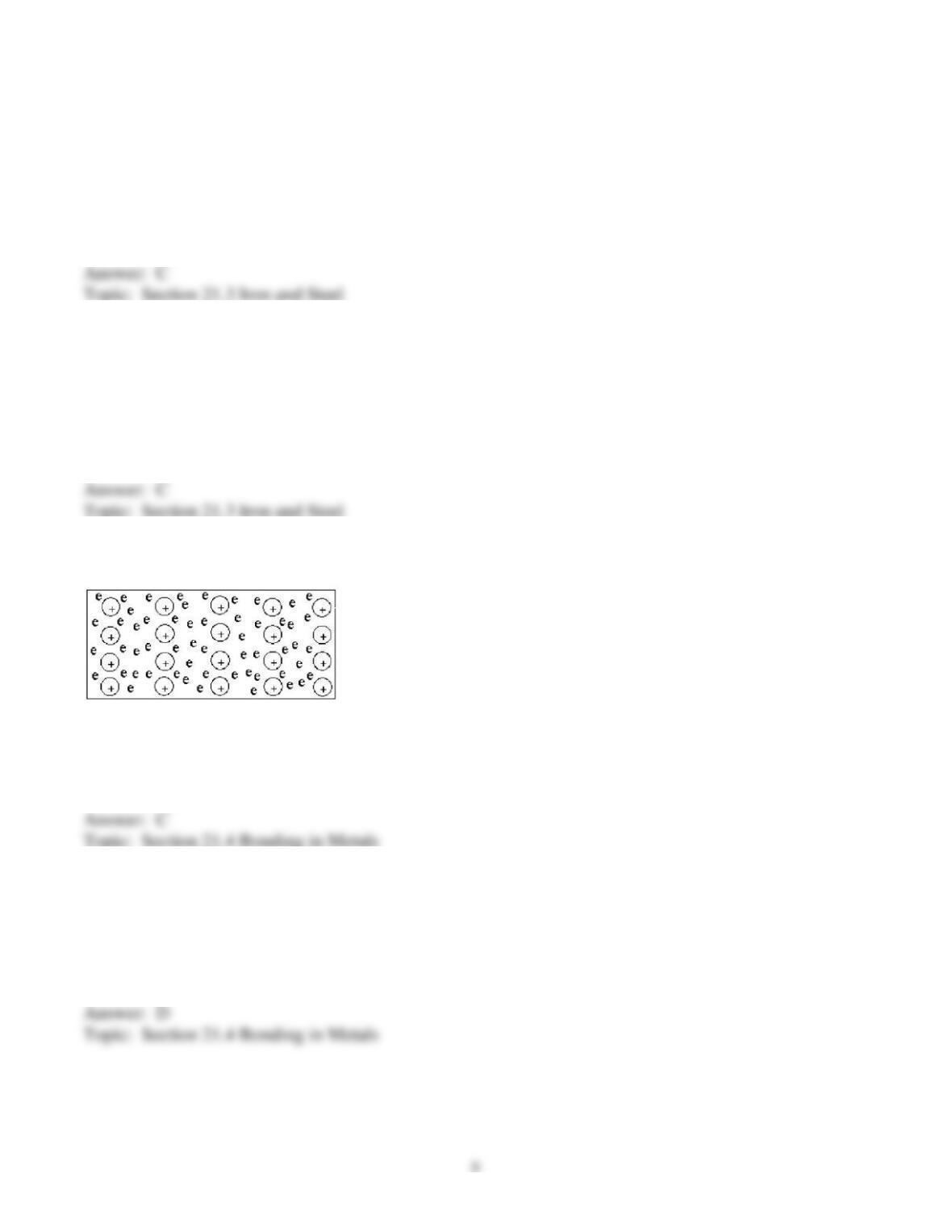
40) What terminology best describes the bonding in the following schematic of a metal?
A) ionic bonding
B) covalent bonding
C) electron-sea model
D) crystal model
41) Which metal has maximum filling of bonding molecular orbitals and minimal filling of antibonding
molecular orbitals in its composite s-d band?
A) Au
B) Cs
C) Re
D) W
42) Which substance is the best conductor of electricity?
A) diamond
B) germanium
C) gold
D) phosphorus
43) According to band theory, which one of the following metals is expected to have the highest melting
point?
A) Cd
B) Cr
C) Hg
D) Zn
44) According to band theory, which of the following metals is expected to have the strongest bonding
and highest melting point?
A) Cs
B) Cu
C) Rb
D) Ru
45) Electrical resistance of a metal ________ with increasing temperature.
A) can decrease or increase
B) decreases
C) does not change
D) increases
46) What type of substances exhibit an increase in conductivity with an increase in temperature?
A) both metals and semiconductors
B) only insulators
C) only metals
D) only semiconductors
47) White tin has an electrical conductivity that decreases with increasing temperature, and gray tin has
an electrical conductivity that increases with increasing temperature. Therefore, white tin is classified as
a(n) ________, and gray tin is classified as a(n) ________.
A) insulator, metal
B) metal, insulator
C) metal, semiconductor
D) semiconductor, metal
48) Which of the following is a semiconductor?
A) Al
B) B
C) Ga
D) Pb
49) Which one of the following is an electrical insulator?
A) alumina
B) germanium doped with antimony
C) gold
D) tellurium
50) Which substance is a good semiconductor?
A) diamond
B) germanium
C) gold
D) phosphorus
51) Which substance has a larger band gap than silicon?
A) diamond
B) copper
C) germanium
D) silver
52) Which element has the largest energy band gap?
A) C (diamond)
B) Si
C) Ge
D) Sn (white)
53) Which element has the smallest energy band gap?
A) C (diamond)
B) Ge
C) Pb
D) Si
54) How would one classify a germanium crystal doped with arsenic?
A) conductor
B) n-type semiconductor
C) p-type semiconductor
D) insulator
55) How would one classify copper mixed with tin?
A) conductor
B) n-type semiconductor
C) p-type semiconductor
D) insulator
56) How would one classify a silicon crystal doped with indium?
A) conductor
B) n-type semiconductor
C) p-type semiconductor
D) insulator
57) Which one of the following is an n-type of semiconductor?
A) alumina
B) germanium doped with antimony
C) germanium doped with boron
D) tellurium
58) Which one of the following is a p-type of semiconductor?
A) germanium doped with antimony
B) germanium doped with boron
C) tellurium
D) YBa2Cu3O7
12
59) Which combination of semiconductors can be employed to make a diode?
A) GaAs doped with Ge and GaP doped with Si
B) GaAs doped with Se and GaP doped with Zn
C) Si doped with B and Ge doped with Ga
D) Si doped with P and Ge doped with As
60) A light emitting diode with a band gap of 181 kJ/mol emits light in what region of the
electromagnetic radiation spectrum?
A) infrared
B) ultraviolet
C) visible – blue
D) visible – red
61) Which one of the following is a metallic conductor at room temperature but a superconductor at 18
K?
A) diamond
B) graphite
C) fullerene
D) potassium fulleride
62) A particular superconductor has eight copper atoms on corners and eight copper atoms on edges of
its unit cell. How many copper atoms are attributed to a single unit cell of this superconductor?
A) 1
B) 3
C) 5
D) 16
63) What is the average oxidation state of Cu in HgCa2Ba2Cu3O8-x if Hg is in the +2 oxidation state?
A) +1
B) +2
C) +2 – 2x/3
D) +2 + 2x/3
64) What is the average oxidation number of Cu in the 1-2-3 superconductor YBa2Cu3O7 if Y is in the
+3 oxidation state?
A) +2
B) +2.33
C) +3
D) +3.33
65) Who discovered the phenomenon of superconductivity in 1911?
A) J. G. Bednorz
B) R. B. Fuller
C) K. A. M ller
D) H. K. Onnes
66) What element was found to be the first superconductor of electricity at 4.2 K in 1911?
A) copper
B) iron
C) gallium
D) mercury
67) Below the superconducting transition temperature Tc, superconductors ________.
A) become perfect conductors
B) become perfect magnets
C) become perfect resistors
D) fail to work
68) What is the Meissner effect associated with superconductors? It is ________.
A) when the temperature above which the superconductor fails to work
B) when the temperature at which the superconductors become perfect insulators
C) when the net magnetic field within the bulk of the superconductor is zero
D) when the net magnetic field within the bulk of the superconductor becomes nearly infinite
69) What structural features appear necessary for superconductivity in the 1-2-3 YBa2Cu3O7
superconductor?
A) high metallic character
B) infinite extended layers of Cu and O atoms and a fractional oxidation state for Cu
C) presence of an inner transition element
D) All of these are necessary.
70) Which has been found to be a three dimensional superconductor that conducts equally in all
directions?
A) C (diamond)
B) C (graphite)
C) K3C60
D) YBa2Cu3O7
71) Why are ceramics superior to metals as structural materials?
A) Ceramics are easier to fabricate into shapes than metals.
B) Ceramics are more malleable than metals.
C) Ceramics are more resistant to wear and corrosion than metals.
D) Ceramics have greater impact resistance than metals.
72) Which process is used in the fabrication of ceramics?
A) electrolysis
B) reduction
C) roasting
D) sintering
73) Sintering is
A) a filtration process through a molecular sieve.
B) the process of heating particles of a powder below the melting point so that they fuse together.
C) the process of rapid cooling of a material to yield a superconducting mixture.
D) the process of removing metals from ore by passing material through a magnetic field.
74) Why are ceramics so much more brittle than metals?
A) The bonding in ceramics has a very high degree of ionic bonding character.
B) The bonding in ceramics has a very high degree of pi bonding character.
C) The bonding in ceramics is highly nondirectional.
D) The localized bonding in ceramics is highly directional.
75) What substance has a rating of 10 on the Mohs hardness scale?
A) alumina
B) aluminum
C) diamond
D) talc
76) What is the name of the oxide ceramic BeO?
A) beryllia
B) beryllic
C) beryllium ceramic
D) beryllium oxide
77) What is not generally considered to be a ceramic?
A) indium, In
B) silica, SiO2
C) silicon nitride, Si3N4
D) zirconia, ZiO2
78) What is the coordination number of Si in SiC that has a diamond-like structure?
A) 1
B) 2
C) 4
D) 6
79) What is the sol-gel process?
A) a series of chemical steps that involves the isolation of CuS and then roasting with oxygen
B) a series of chemical steps that involves the isolation of SO3 and then treatment with H2SO4
C) a series of chemical steps that involves the synthesis of a metal oxide powder from a metal alkoxide
D) a series of chemical steps that involves the thermal decomposition of fibers of polyacrylonitrile
80) What is not part of the sol-gel process for the production of titania?