Exam
Name___________________________________
MULTIPLE CHOICE. Choose the one alternative that best completes the statement or answers the question.
1)
The Hawaiian island of Lana’i is privately owned by Castle & Cooke and for generations most of its
land was used to grow pineapples. Now, many of the pineapple fields have been replaced by
tourist accommodations, including a pair of world–class hotels and a top rated golf course. What
would an economist say about this change in land–use patterns?
1)
A)
To find the land’s economic rent, add the price per acre that land on Lana’i would be worth if
used to grow pineapples to the value per acre when used for a golf course.
B)
Economic rent has allocated the island’s resources to their highest valued use: tourism.
C)
Agriculture is still the land’s highest–valued and most efficient use, but tourism earns more
profits for Castle & Cooke.
D)
While growing pineapples used the island’s land more efficiently, tourism provides utility to
the largest number of people.
2)
One advantage of a proprietorship is that
2)
A)
there are limits to the possible liabilities of the owner.
B)
it is relatively easy to raise financial capital for a proprietorship.
C)
depreciation rates on capital are higher.
D)
a proprietorship is relatively easy to form and to dissolve.
3)
An entrepreneur is
3)
A)
the rate of discount.
B)
a legal form of business.
C)
one who takes risks and makes innovations in organizing a firm.
D)
the rate of return on capital.

4)
The most prestigious stock market in the world is the
4)
A)
New York Stock Exchange.
B)
London Stock Exchange.
C)
Chicago Mercantile Exchange.
D)
Tokyo Stock Exchange.
5)
Economic profits are
5)
A)
total revenue minus accounting costs.
B)
total revenue minus explicit and implicit costs.
C)
total revenue minus explicit costs.
D)
total revenue minus implicit costs.
B
6)
In a partnership
6)
A)
upon the death of a partner it may be necessary to sell the business.
B)
each partner’s liability is limited to their investment in the company.
C)
profits are taxed at both the corporate rate and the personal income tax rate.
D)
there is a separation of ownership and management like in a corporation.
A
7)
Accounting costs represent
7)
A)
opportunity costs.
B)
explicit costs paid by the firm.
C)
both sunk and future costs.
D)
long run costs only.
B
8)
If you want a say in the management of a corporation, you should buy
8)
A)
bonds.
B)
either bonds or preferred stock.
C)
common stock.
D)
preferred stock.
C
A

9)
David Ricardo used the example of land to demonstrate the concept of rent, as the supply of land is
9)
A)
negatively sloped.
B)
perfectly elastic.
C)
perfectly inelastic.
D)
relatively elastic.
10)
The three basic legal forms of business enterprise in the United States are
10)
A)
monopolies, enterprises, and competitors.
B)
proprietorships, partnerships, and corporations.
C)
national, global, and multinational corporations.
D)
vertical, horizontal, and conglomerate corporations.
11)
If your business earns $10,000 in revenues, has explicit costs of $7,000, and implicit costs of $5,000,
your accounting profit is
11)
A)
–$2,000.
B)
$5,000.
C)
$3,000.
D)
$2,000.
12)
Economic profits are found by total revenues minus
12)
A)
explicit and implicit costs.
B)
explicit costs.
C)
implicit costs.
D)
all opportunity costs.
13)
Economic rent is a concept that can be applied
13)
A)
to any resource or factor of production that has a supply curve with a positive (upward)
slope.
B)
only to land and natural talent.
C)
only to land, as that is the only resource that is in limited supply.
D)
to any factor of production that is fixed in supply.

14)
The greatest advantage of a corporation is
14)
A)
the double taxation of dividends.
B)
limited liability.
C)
ease of setting up the business.
D)
separation of ownership and control of the business.
15)
The amount that must be paid to an individual to get them to invest in the industry is
15)
A)
the explicit costs.
B)
a normal rate of return.
C)
financial capital.
D)
reinvestment.
16)
An organization that brings together the factors of production is called
16)
A)
a plant.
B)
a firm.
C)
a conglomerate.
D)
an industry.
17)
A disadvantage of the proprietorship form of business organization is
17)
A)
its limited liability.
B)
that the owner must fight a lot of red tape to form the firm.
C)
its limited access to capital.
D)
that it can issue only one class of stock.
18)
The more profits are reinvested into the firm, the
18)
A)
less there is available to distribute to stockholders.
B)
less there is available to distribute to bondholders.
C)
more the firm will be able to raise in sales of new issues to stock.
D)
more bonds the firm will sell in order to pay their required dividends to preferred
stockholders.

19)
An advantage of the partnership form of business organization is
19)
A)
its limited access to capital, thus reducing the possible size of debt.
B)
the ability of its owners to specialize.
C)
that it is difficult to start up, because a lot of thought has to go into the establishment of the
firm.
D)
its limited liability.
20)
A stock that has a price of $20 per share, earnings per share of $2.00, and a dividend of $1.50 will
have
20)
A)
a PE ratio of 20/1.50.
B)
a yield of 12 percent.
C)
a yield of 7.5 percent.
D)
a PE ratio of 1.333.
C
21)
When the anticipated rate of inflation declines, the real rate of interest
21)
A)
decreases.
B)
is not affected.
C)
increases.
D)
increases exponentially.
C
22)
Which legal claim comes with the most preferential treatment in the payment of dividends?
22)
A)
common stock
B)
preferred stock
C)
bond
D)
reinvestment
B
23)
An accountant shows an invoice for a resource to the manager of the firm. They are discussing
23)
A)
economic profits.
B)
implicit costs.
C)
explicit costs.
D)
either explicit costs or implicit costs, but we can’t tell without more information.
C
B

24)
Suppose you own $15,000 of personal property, $5,000 of stock in ABC Corporation, a $1,000
certificate of deposit, and $10,000 of government bonds. If ABC goes bankrupt, the most you could
lose is
24)
A)
$26,000.
B)
$15,000.
C)
$31,000.
D)
$5,000.
25)
To find economic profit from accounting profit, it is necessary to
25)
A)
subtract the opportunity cost of capital.
B)
add depreciation expense.
C)
subtract dividends.
D)
add retained earnings.
26)
Which of the following is a TRUE statement about stock markets?
26)
A)
It is always better to buy growth stocks than the older and more stable blue–chip stocks.
B)
It is illegal for a friend of a corporate executive to make large profits in the stock market by
using his inside information.
C)
The stock market on average over time is random and totally unrelated to the performance of
the economy.
D)
Economists can make above–average profits in the stock market because of their specialized
knowledge of economics.
27)
The form of business organization responsible for generating the greatest portion of business
revenues in the United States is the
27)
A)
partnership.
B)
corporation.
C)
dual proprietorship.
D)
proprietorship.

28)
The present value of $100 to be received one year from now
28)
A)
is $90.
B)
is $110.
C)
is $100.
D)
cannot be determined without knowing the interest rate.
29)
Economic profits are equal to
29)
A)
total revenues minus total fixed costs.
B)
total revenues minus the implicit and explicit costs of all inputs used.
C)
total revenues minus the opportunity cost of labor.
D)
total revenues, after tax, minus cost of goods sold.
30)
When Patricia sells her General Motors common stock at the same time that Brian purchases the
same amount of General Motors stock from another party, General Motors receives
30)
A)
only the par value of the common stock.
B)
the dollar amount of the transaction, less brokerage fees.
C)
the dollar value of the transaction.
D)
nothing.
31)
Implicit costs are
31)
A)
costs that are taken into consideration by accountants.
B)
the costs of using factors that a producer hires or rents.
C)
costs that are variable in the short run and fixed in the long run.
D)
the opportunity costs of using factors that a producer does not buy or hire but already owns.

32)
The normal rate of return is the
32)
A)
return on capital associated with zero accounting profits.
B)
average rate of return earned in an industry at a given point in time.
C)
the amount paid to an investor when the firm is an on–going concern.
D)
opportunity cost of capital.
33)
Pure economic rent involves situations where
33)
A)
the supply curve is perfectly elastic.
B)
the supply curve is perfectly inelastic.
C)
the uses to which a resource can be used can be varied but the quality of the resource cannot
be varied.
D)
the quality of a resource can be varied but the price cannot be varied.
34)
If a factor of production with a fixed supply is earning $100 in its current use and its next best use
would yield earnings of $80, the factor is earning a pure economic rent equal to
34)
A)
$0.
B)
$80.
C)
$20.
D)
$180.
35)
If the supply curve for land was a vertical line, then any payment made for land would be
considered
35)
A)
as an opportunity lease payment.
B)
as economic interest.
C)
as economic lease.
D)
as economic rent.

36)
Compared to a proprietorship, a disadvantage of a partnership is
36)
A)
that it is harder to keep the firm going after the death of an owner.
B)
unlimited liability.
C)
that potential liability to each partner is greater.
D)
that profits are taxed twice.
37)
People basically borrow in order to
37)
A)
have current consumption rather than waiting to consume in the future.
B)
go into debt.
C)
have interest payments.
D)
have more funds.
A
38)
A proprietorship is
38)
A)
two or more individuals in business together.
B)
a government–owned franchise.
C)
a corporation that is taxed like an individual.
D)
a business owned by one individual who makes all of the decisions.
D
39)
In the market for land, if the supply of land is perfectly inelastic, an increase in the demand for land
will result in a(n)
39)
A)
increase in economic rent.
B)
decrease in the equilibrium price.
C)
increase in the real interest rate.
D)
increase in the quantity supplied of land.
A
40)
The British economist most often associated with the issue of economic rent for land was
40)
A)
Jeremy Bentham.
B)
John Maynard Keynes.
C)
David Ricardo.
D)
A. W. Phillips.
C
C

41)
Suppose that you borrow $10,000 for one year, and at the end of the year, you must repay $10,450.
Also, during that year inflation was 2.5%. The real interest rate is
41)
A)
4.5 percent.
B)
2.0 percent.
C)
7.0 percent.
D)
12.0 percent.
42)
In economic terms, interest is the payment for
42)
A)
producers’ goods.
B)
stocks.
C)
both consumer and capital goods.
D)
current command over resources.
43)
The main advantage of a corporate form of organization is that
43)
A)
shareholders are not subject to double taxation.
B)
shareholders have limited liability.
C)
all corporate profits must be distributed as dividends.
D)
shareholders have unlimited liability.
44)
If the annual interest rate remains unchanged over the next two years, and the present value of
$120 to be received one year from now is $100, what will $100 be worth two years from now?
44)
A)
$120
B)
$140
C)
$144
D)
Uncertain. We need to know the interest rate.
45)
When accounting profits are positive, economic profits
45)
A)
must be positive.
B)
will be negative.
C)
will equal zero.
D)
could be positive, negative or zero.

46)
Which of the following is NOT a correct description of opportunity cost of capital?
46)
A)
It is normally included in accounting costs.
B)
It is an implicit cost.
C)
It is the income sacrificed by not investing in another firm.
D)
It is the normal rate of return on investment.
47)
In comparing accounting profit with economic profit, we generally find that
47)
A)
economic profit and accounting profit are the same in the short run.
B)
economic profit exceeds accounting profit by the amount of opportunity costs.
C)
accounting profit is less than economic profit.
D)
accounting profit is greater than or equal to economic profit.
D
48)
Often single–owner proprietorships seem more profitable than they really are. The reason for this
is that
48)
A)
they are not allowed to deduct depreciation expense.
B)
they often fail to consider the opportunity cost of the labor provided by the owner.
C)
they use different accounting procedures.
D)
they receive special tax benefits compared to corporations.
B
49)
A famous opera star made $2 million per year. He said he would rather sell insurance if he couldn’t
make more than $100,000 per year. If he is telling the truth, what’s his opportunity cost as an opera
star?
49)
A)
$2.1 million
B)
$100,000
C)
$2.0 million
D)
$1.9 million
B
A

50)
For superstar athletes
50)
A)
none of their earnings are economic rent since they will do some other work once they are too
old to be an athlete.
B)
part of their earnings are economic rent.
C)
none of their earnings are economic rent since rent doesn’t apply to labor.
D)
their entire earnings are economic rent.
51)
Which legal claim comes with voting rights?
51)
A)
common stock
B)
preferred stock
C)
bond
D)
reinvestment
52)
The person most likely to receive a payment from a corporation in a year of losses is the
52)
A)
preferred stockholder.
B)
bondholder.
C)
common stockholder.
D)
investment banker.
53)
If, as an entrepreneur, I am earning accounting profits of $50,000 per year and the opportunity cost
of my time is $60,000
53)
A)
I should close my business.
B)
I am earning economic profits of $10,000.
C)
I am in a long–run equilibrium position.
D)
I am earning economic profits of $50,000.
54)
Suppose that the nominal rate of interest is holding steady at 8 percent even as the anticipated rate
of inflation rises. What is happening to the real rate of interest?
54)
A)
It equals the nominal interest rate.
B)
It is decreasing.
C)
It is unchanged.
D)
It is increasing.

55)
You own $10,000 in personal property, $2,000 in Company X stocks, $1,000 in U.S. Savings Bonds
and have $500 in your checking account. If Company X goes bankrupt, the most you could lose is
55)
A)
$13,500.
B)
$2,000.
C)
$500.
D)
$11,500.
56)
It is likely that the owners have little to do with the day–to–day management of a firm in the case
of
56)
A)
partnerships only.
B)
corporations only.
C)
partnerships and corporations.
D)
proprietorships only.
57)
When the anticipated rate of inflation is 5 percent and the real rate of interest is 4 percent, the
nominal rate of interest is
57)
A)
1 percent.
B)
4 percent.
C)
5 percent.
D)
9 percent.
58)
Bonds are
58)
A)
promises to repay loans.
B)
promissory notes issued by proprietorships.
C)
promissory notes issued by partnerships.
D)
shares of ownership in a corporation.
59)
The concept of economic rent can be applied to
59)
A)
land, natural resources, and paintings by dead masters only.
B)
land only.
C)
any resource that cannot be replicated exactly.
D)
land and natural resources only.

60)
The theory that there are no predictable trends in securities prices that can be used to “get rich
quick” is the
60)
A)
inefficient market hypothesis.
B)
random walk theory.
C)
dartboard theory.
D)
Wall Street theory.
61)
Out–of–pocket expenses such as wages and raw materials are
61)
A)
an owner–provided capital cost.
B)
explicit costs.
C)
implicit costs.
D)
direct costs.
62)
In a firm, an entrepreneur is one who
62)
A)
takes the risks associated with a business firm.
B)
decides to hire or fire.
C)
works for the owner by running the firm.
D)
represents the firm in legal proceedings.
63)
Which of the following is not a principal method of financing today?
63)
A)
common stock
B)
bond
C)
the entrepreneur‘s wealth
D)
reinvestment
64)
The problem with the separation of ownership from control is that
64)
A)
the owners of firms may not always know the best way to run a firm, yet they are the ones
who elect the managers of the firm.
B)
the owner in a proprietorship may not always act in the profit–maximizing fashion because
he or she may not have the experience or expertise that professional managers have.
C)
the managers of the firm can make decisions that reduce the wealth of the owners while not
reducing their own wealth.
D)
the managing partner of a firm may not always behave in the way that other managers would
if they were the managing partners.
65)
In analyzing the operation of a firm, an economist assumes the firm wants to
65)
A)
maximize total production.
B)
maximize total profits.
C)
maximize total sales.
D)
maximize total revenue.
66)
Which of the following statements regarding accounting and economic profits is FALSE?
66)
A)
Accounting profits = total revenue – explicit costs
B)
Economic profits can be zero even if accounting profits are positive.
C)
Accounting profits can be negative if economic profits are positive.
D)
Economic profits = total revenue – (explicit + implicit costs)
67)
An advantage of a corporation is
67)
A)
the ability to raise large sums of financial capital.
B)
the fact that ownership and control are never separated.
C)
unlimited liability on the part of shareholders.
D)
the fact that the corporation is dissolved when one of its owners dies.
68)
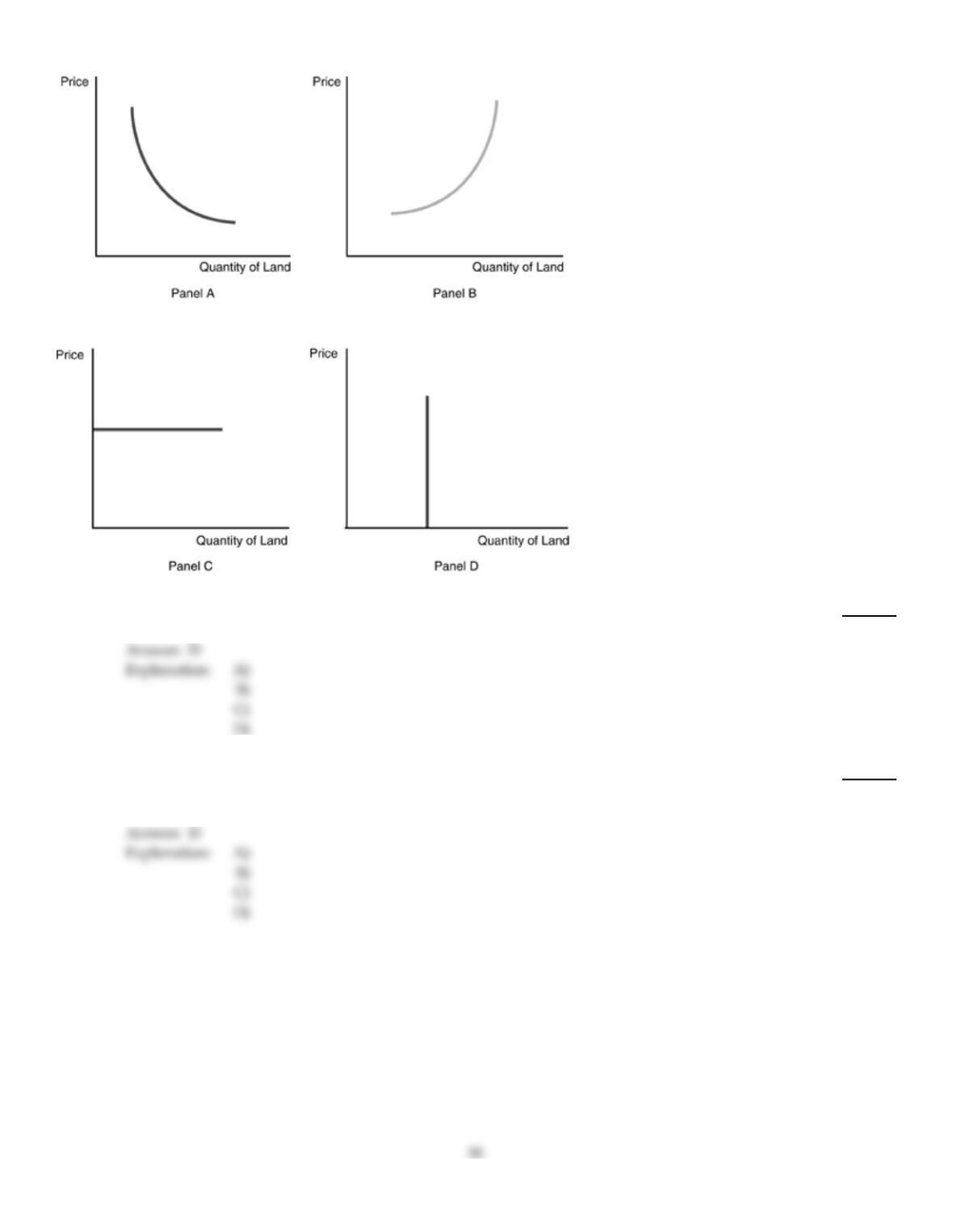
Refer to the above figure. Which panel is consistent with Ricardo’s view on the supply of land?
68)
A)
Panel A
B)
Panel B
C)
Panel C
D)
Panel D
69)
All of the following are advantages of organizing a business as a sole proprietorship EXCEPT
69)
A)
single taxation.
B)
ease of formation.
C)
ease of decision–making.
D)
limited liability.

70)
In economics, interest refers to all of the following EXCEPT
70)
A)
the return paid to the owners of capital.
B)
the return paid to owners of financial institutions.
C)
the payment for current rather than future command over resources.
D)
the cost of obtaining credit.
71)
A disadvantage of corporations over a proprietorship or partnership is in the
71)
A)
legal liability.
B)
future of the firm when an owner dies.
C)
ability to raise funds.
D)
taxation system.
72)
A business organization that employs resources to produce goods and services for profit is
72)
A)
inside information.
B)
a firm.
C)
economic rent.
D)
the opportunity cost of capital.
73)
When a person buys stock in a company, that person is buying ________, but when a person buys a
bond in a company, that person is ________ the company.
73)
A)
ownership; lending funds to
B)
debt; borrowing funds from
C)
debt; lending funds to
D)
ownership; borrowing funds from
74)
The double taxation of corporate profit in the United States refers to the fact that
74)
A)
depreciation is not a deductible expense.
B)
proprietorships are not subject to any tax on earnings.
C)
tax rates on partnerships are very high.
D)
corporate profit is first taxed and then any dividends paid are subject to personal income tax.

75)
Limited liability exists when
75)
A)
the liability of owners is limited to the value of the shares in the firm they own.
B)
bondholders must receive their payments before stockholders can earn any money.
C)
the liability of owners is limited to the share of the debt they personally took on.
D)
partners specialize and each partner is responsible for the debts of his or her specialized area.
76)
A proprietorship is
76)
A)
risky for its owner, who is personally responsible for the firm’s debts.
B)
not often found in developed economies, in which corporations have become the most
common form of business organization.
C)
difficult to form.
D)
taxed twiceonce when it pays business taxes and again when its owner pays personal
income taxes.
77)
Economic rent serves
77)
A)
only to make the rich richer and the poor poorer.
B)
no useful function in a modern economy.
C)
an allocative function by guiding available supplies to the most efficient use.
D)
a descriptive function by making some wealthier than others, but serves no allocative
function.
78)
Which of the following options is NOT a characteristic of a proprietorship?
78)
A)
unlimited liability
B)
easy to form and dissolve
C)
double taxation
D)
single ownership

79)
A popular entertainer gives a concert in a 50,000 seat stadium. To give her fans a break, she charges
only $50 a seat instead of the customary $75 a seat. At $75 a ticket, there would have been 50,000
tickets sold, and at $50, there are 80,000 people who want tickets. As a consequence of the
generosity of the entertainer
79)
A)
another type of system will have to be found to allocate the tickets, making some of her fans
better off and others worse off.
B)
her fans are made worse off since there is an excess demand of 30,000 tickets.
C)
a more fair system of pricing the tickets has been found.
D)
her fans are made better off.
80)
If you own 500 shares of preferred stock, how many regular votes would you get to cast at the next
stockholders meeting?
80)
A)
250
B)
500
C)
1
D)
0
81)
Last year, the nominal interest rate was less than the anticipated rate of inflation.
81)
A)
This means that the real interest rate was very high.
B)
This scenario is not possible.
C)
This means that not enough loans were made by banks.
D)
This means that the real interest rate was negative.
82)
The nominal rate of interest is 4% and the anticipated rate of inflation is 5%. What is the real rate of
interest?
82)
A)
9%
B)
4%
C)
1%
D)
–1%

83)
Efficient markets theory suggests that purchasing the published reports of financial analysts
83)
A)
is likely to increase one’s returns by an average of about 3 to 5 percent.
B)
is likely to increase one’s returns by an average of 5 percent.
C)
is not likely to increase financial returns.
D)
will increase financial returns in the first year but not in following years.
84)
Accounting profit is equal to
84)
A)
dividends paid.
B)
total revenue minus dividends and interest.
C)
total revenue minus implicit costs.
D)
total revenue minus explicit costs.
85)
A payment to an owner of a resource in excess of its opportunity cost is know as
85)
A)
economic rent.
B)
real wages.
C)
financial interest.
D)
accounting profits.
86)
What is the present value of $100 two years from now at an interest rate of 6%?
86)
A)
$106
B)
$6
C)
$89
D)
$94.34
87)
Tim has a toenail clipping business that is a sole proprietorship. If he is sued for a botched pedicure
87)
A)
he has separation of ownership and control.
B)
all of his personal assets are at risk.
C)
he will be taxed doubly.
D)
he has limited liability.