Chemistry for Changing Times, 14e (Hill/McCreary)
Chapter 21 Household Chemicals
21.1 Multiple Choice Questions
1) One of the major problems with the use of household chemicals is
A) they are toxic.
B) consumers often fail to read directions and warnings.
C) they do not perform well.
D) all of the above
2) The majority of household chemicals are
A) cleaning agents.
B) laundry products.
C) cosmetics.
D) paints.
3) Sodium carbonate (Na2CO3) and potassium carbonate (K2CO3) react with water to form an alkaline
solution that has detergent properties. These compounds are present in
A) detergents.
B) lye based soaps.
C) saponins.
D) plant ashes.
4) American pioneers combined potash solution and animal fat in a huge iron kettle and cooked it over
several hours. The result was
A) detergent.
B) soap.
C) cooking oil.
D) food for animals.
5) The substance with the formula shown below is a(n)
CH3CH2CH2CH2CH2CH2CH2CH2CH2CH2CH2COOH
A) alcohol.
B) detergent.
C) saponin.
D) fatty acid.
6) Soap is
A) a glycerol ester.
B) a salt of a fatty acid.
C) lithium sulfate.
D) glycerol.
7) Animal fats and vegetable oil can be converted to soaps by reaction with
A) sodium hydroxide.
B) sodium carbonate.
C) sodium hyperchlorite.
D) sodium phosphate.
8) Floating soaps are
A) composed of short chain fatty acids.
B) composed of branched chain fatty acids.
C) blown with air during processing.
D) detergents.
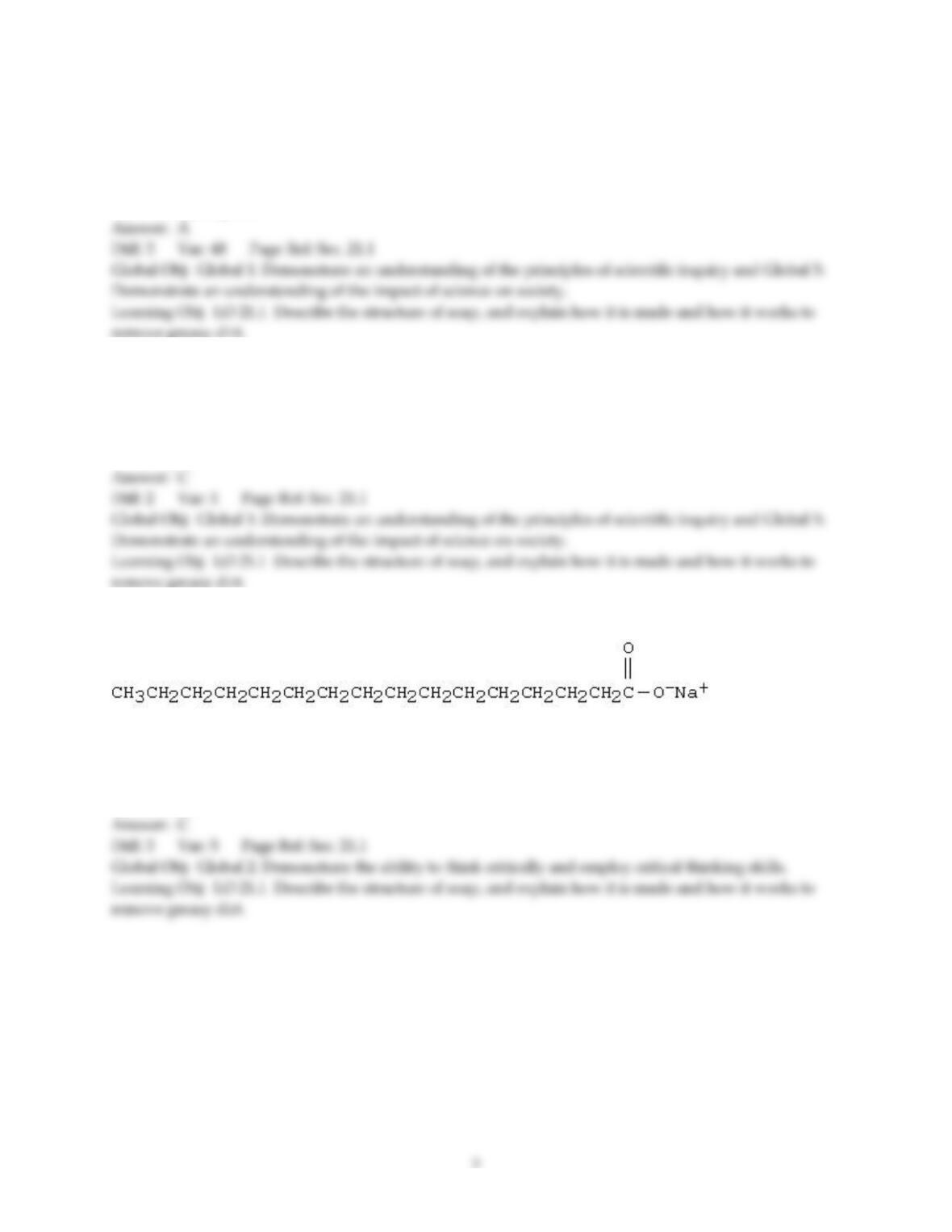
9) The molecule shown below is a(n)
A) detergent.
B) saponin.
C) soap.
D) esterester.
10) In cleaning, soap acts as a(n) ________ between “dirt” and water.
A) catalyst
B) chemical reactant
C) emulsifier
D) insulator
11) In acidic solutions, soaps are converted to
A) salts.
B) fatty acids.
C) detergents.
D) fats.
12) In hard water, soaps are converted to
A) insoluble salts.
B) bases.
C) lye.
D) anhydrides.
13) An advantage of potassium soaps is that they are ________ than sodium soaps.
A) softer
B) harder
C) more neutral
D) stronger
14) Bathtub ring is caused by
A) the action of ammonia with water.
B) precipitation of soap by “hard” metal ions.
C) rust formation from sulfur in the water.
D) soap and water cause a ringing sound in the ears.
15) Washing soda is
A) sodium peroxide.
B) sodium carbonate.
C) sodium borate.
D) sodium chloride.
16) Water softeners
A) remove “hard” ions.
B) destroy “hard” ions.
C) modify “hard” ions.
D) Water softeners do all of the above.
17) Water softeners remove all of the following ions EXCEPT
A) Ca2+.
B) Fe2+.
C) Mg2+.
D) Na+.
18) Which of the following statements about soaps and detergents is NOT true?
A) The hydrophilic end has the hydrocarbon chain.
B) The hydrophilic end is ionic.
C) The hydrophobic end has the hydrocarbon chain.
D) Soaps form micelles in solution.
19) Which of the following is NOT an advantage of soap? Soap is
A) biodegradable.
B) derived from renewable resources.
C) an excellent cleaner in hard water.
D) relatively nontoxic.
20) Soap can be made by boiling animal fat with lye or potash for several hours. What is the major
disadvantage to the lye soap made this way?
A) It did not clean well.
B) It often contained unreacted alkali, which was very harsh on the skin.
C) Glycerol separated out from the soap and remained on the bottom of the kettle.
D) It did not kill bacteria.
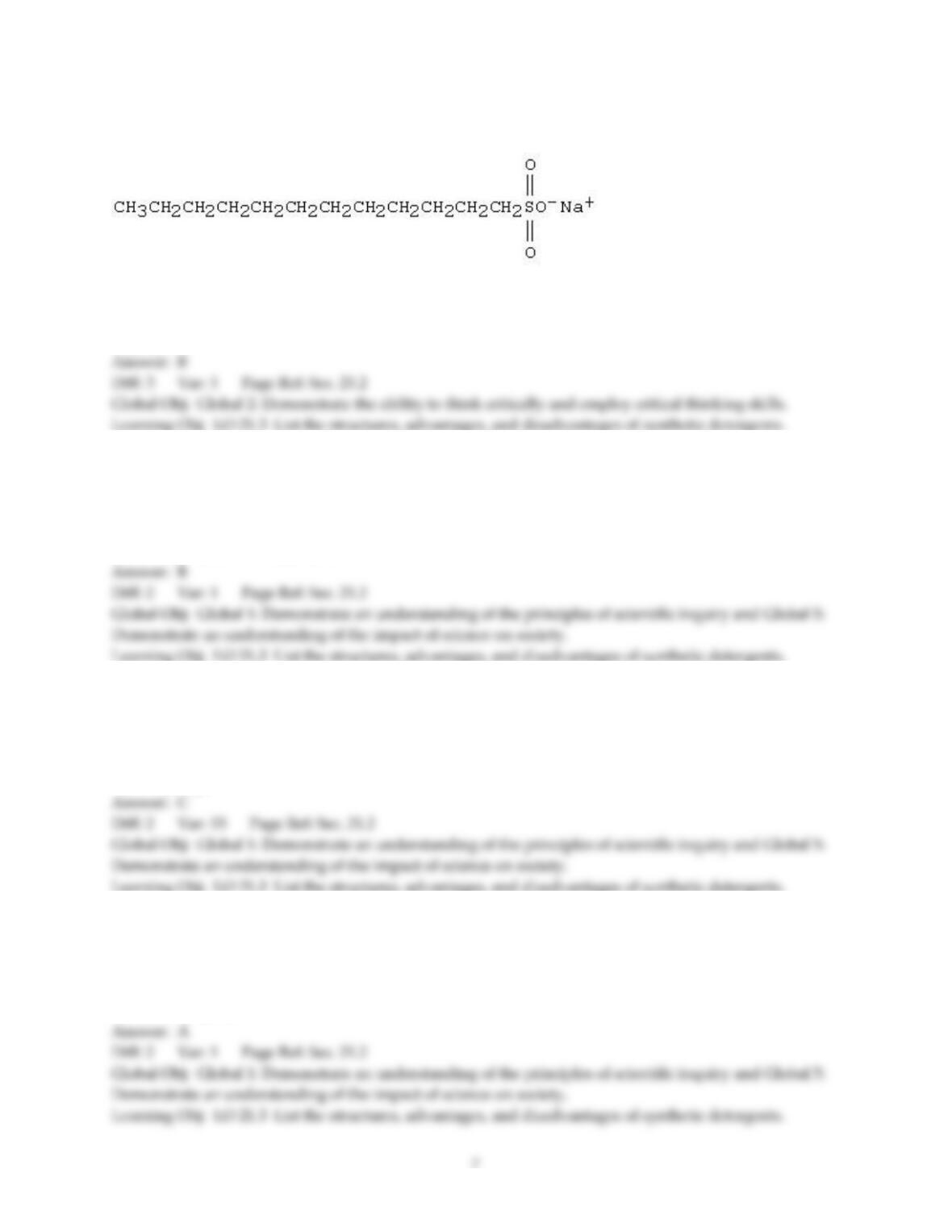
21) The molecule shown below is a
A) soap.
B) detergent.
C) fatty acid.
D) polymer.
22) A problem with ABS detergents is that they
A) are toxic.
B) do not degrade readily.
C) contain phosphates.
D) are less effective in hard water.
23) The major advantage of LAS detergents over ABS detergents is that they
A) are effective in hard water.
B) are soil based.
C) are biodegradable.
D) lack phosphates.
24) Detergents are better cleaners than soaps in
A) hard water.
B) soft water.
C) alkaline water.
D) all of the above
8
25) Which water softener “ties up” calcium ions and keeps them in solution?
A) sodium carbonate
B) sodium phosphate
C) fatty acids
D) zeolites
26) Substances added to surfactants to increase their detergency are
A) brighteners.
B) builders.
C) emulsifiers.
D) enzymes.
27) Optical brighteners are often added to
A) detergents.
B) soaps.
C) cosmetics.
D) They are added to all of the above.
28) Optical brighteners work by
A) absorbing blue rays and ultraviolet rays.
B) absorbing ultraviolet rays and emitting blue rays.
C) spontaneously emitting blue rays when they attach to clothing fibers.
D) spontaneously emitting ultraviolet rays when they attach to clothing fibers.
29) Cationic surfactants are not good detergents but are used mainly for their ________ action.
A) cleaning
B) menthol
C) germicidal
D) darkening
30) Sequestration is
A) precipitating magnesium and calcium ions.
B) when sodium and lithium ions are tied up in soluble complexes.
C) when calcium and magnesium ions are tied up in soluble complexes.
D) a nonionic surfactant.
31) Which of the following categories of surfactants gives the least amount of sudsing?
A) amphoteric surfactants
B) anionic surfactants
C) cationic surfactants
D) nonionic surfactants
32) Soaps are
A) anionic surfactants.
B) nonionic surfactants.
C) neutral surfactants.
D) positive surfactants.
33) Automatic dishwashing detergents are
A) similar to detergents for hand washing.
B) relatively strong bases.
C) relatively strong acids.
D) safe for hand washing of dishes.
34) Which of the following forms a strongly caustic solution when mixed with water?
A) automatic dishwashing detergent
B) liquid dishwashing detergent
C) liquid clothing detergent
D) bath soap
35) Which of the following is NOT a component of detergents for washing dishes by hand?
A) enzymes
B) fragrances
C) strong alkalis
D) surfactants
36) Quaternary salts with two long carbon chains and two smaller chains on the nitrogen are used as
A) bleaches.
B) analgesics.
C) fabric softeners.
D) weed killers.
37) Which of the following statements is NOT true for fabric softeners?
A) They are anionic surfactants.
B) They are quaternary salts.
C) They form a film which lubricates the fibers in the fabric.
D) They have two long hydrocarbon chains.
38) The active ingredient in chlorine laundry bleaches is
A) chlorine, Cl2.
B) sodium hypochlorite, NaOCl.
C) sodium chloride, NaCl.
D) a mixture of CFCs.
39) The active ingredient in oxygen bleaches is
A) NaOCl.
B) NaBO2 ∙ H2O2.
C) O2.
D) Na3PO4.
40) Why are perborate bleaches better for white, resin-treated, polyester-cotton fabrics than chlorine
bleaches?
A) Chlorine bleaches release a toxic gas when in contact with this type of fabric.
B) Chlorine bleaches ruin the fabric.
C) Oxygen bleaches are cheaper.
D) The fabric lasts longer.
41) Bleaches are
A) oxidizing agents.
B) reducing agents.
C) brighteners.
D) detergents.
42) Bleaches work by
A) changing the structure of color-producing groups called chromophores to make them colorless.
B) acting directly on the soiled spot to remove the soil.
C) changing the stains so that they absorb UV light and then release blue light.
D) covering the stains with quaternary ammonium ions so that they are no longer visible.
43) Fabric softeners are
A) potassium salts of long chain fatty acids.
B) oxidizing agents.
C) quaternary salts with two long carbon chains and two smaller chains on the nitrogen.
D) nonionic surfactants.
44) Household ammonia solutions are
A) acidic.
B) basic.
C) neutral.
D) oxidizing agents.
45) Baking soda can be used as
A) an automatic dishwashing detergent.
B) a germicide.
C) a substance to absorb odor.
D) an acid.
46) The abrasive in commercial powdered cleansers is often
A) sodium carbonate.
B) baking powder.
C) charcoal.
D) gold metal.
47) The main ingredient in oven cleaners is
A) acetic acid (vinegar).
B) bleach.
C) citric acid.
D) sodium hydroxide.
48) What type of chemical is most effective in removing the build-up of “lime” that is often found in toilet
bowls?
A) an abrasive
B) an acid
C) a base
D) a bleach
49) A cleaning product that may contain either ammonia or vinegar in a dilute solution of isopropyl
(rubbing) alcohol would be used as a(n)
A) toilet bowl cleaner.
B) oven cleaner.
C) glass cleaner.
D) drain cleaner.
50) Which of the following ingredients is NOT found in drain cleaners?
A) aluminum filings
B) bleach
C) HCl
D) NaOH
51) A green product would most likely NOT contain which of the following?
A) a natural scent
B) materials derived from plant sources
C) degradable ingredients
D) volatile hydrocarbons
52) When we buy products for household use, we should avoid products whose packaging is
A) reusable.
B) recyclable.
C) degradable.
D) longest lasting.
53) A molecule that contains only C, H and O atoms will degrade most quickly if its structure
A) is a straight chain.
B) contains many branches.
C) contains rings.
D) also has halogen atoms.
54) Which of the following is a hazard of using organic solvents in the home? Organic solvents are
A) flammable.
B) toxic.
C) volatile.
D) All of the above are hazards.
55) Which of the following is no longer used as a component of paint?
A) polymers
B) 2PbCO3 ∙ Pb(OH)2
C) tung oil
D) ester
56) Which of the following ingredients will NOT be found in paint?
A) white lead
B) titanium dioxide
C) a solvent
D) a binder
57) Lanolin comes from
A) beeswax.
B) palm tree leaves.
C) sheep’s wool.
D) sea urchins.
58) A wax is a(n)
A) ether made from two long-chain alcohols.
B) ester made from a long-chain fatty acid and a long-chain alcohol.
C) long-chain compound that contains both an alcohol group and an amino group.
D) amide made from a long-chain fatty acid and a long-chain amine.
59) All of the following are used as binders for paint EXCEPT
A) acrylic resins.
B) linseed oil.
C) polyvinyl acetate.
D) All of the above are binders.
60) Which one of the following is NOT considered a cosmetic?
A) soap
B) lipstick
C) toothpaste
D) facial cream
61) Which generally does NOT need to be proven safe and effective before marketing?
A) cosmetic
B) drug
C) food additive
D) a cooking oil
62) Which is NOT a cosmetic?
A) antidandruff shampoo
B) lipstick
C) blush
D) perfume
63) The oil secreted by glands in the skin is called
A) sweat.
B) sebum.
C) melanin.
D) musk.
64) A cosmetic that is a suspension of oil in water is called a
A) wax.
B) lotion.
C) lanolin.
D) cream.
65) A cosmetic that is a suspension of water in oil is called a
A) cream.
B) sunscreen.
C) moisturizer.
D) wax.
66) The ideal moisture content of skin is approximately
A) 3%.
B) 10%.
C) 16%.
D) 75%.
67) The outer layer of skin is called the
A) exoskin.
B) episkin.
C) epidermis.
D) exodermis.
68) A typical ingredient in skin lotions and creams is
A) palm oil.
B) pork fat.
C) corn oil.
D) walnut oil.
69) Emollients are
A) artificial skin.
B) skin plasticizers.
C) skin coatings.
D) skin catalysts.
70) Skin moisturizers
A) add moisture to skin.
B) prevent loss of moisture from skin.
C) cause skin to produce more water.
D) do all of the above.
71) Sunscreens contain chemicals that
A) absorb both UV-A and UV-B rays.
B) absorb neither UV-A nor UV-B rays.
C) inhibit melanin production in the skin.
D) promote melanin production in skin.
72) Exposure of skin to UV radiation does NOT cause
A) melanin production.
B) increased risk of skin cancer.
C) premature aging of skin.
D) a reverse in the aging process.
73) Skin cream and lipsticks have approximately the same basic composition. What is added to lipsticks
to make them more firm?
A) wax
B) cellulose
C) petroleum jelly
D) abrasive
74) A major problem with eye makeups is
A) bacterial contamination after extended use.
B) color fading.
C) allergic reactions.
D) all of the above
75) White eye shadow is “colored” with titanium dioxide or
A) lampblack.
B) chromic oxide.
C) lead sulfide.
D) zinc oxide.
76) Deodorants act by
A) breaking down odorous chemicals as they are produced.
B) destroying odor-causing bacteria.
C) producing enzymes.
D) reacting with sweat glands to stop perspiration.
77) The active ingredient in almost all antiperspirants is