Chapter 21—Cost Behavior and Cost-Volume-Profit Analysis Key
1. Cost behavior refers to the methods used to estimate costs for use in managerial decision making.
2. Cost behavior refers to the manner in which a cost changes as the related activity changes.
3. The fixed cost per unit varies with changes in the level of activity.
4. A production supervisor’s salary that does not vary with the number of units produced is an example of a
fixed cost.
5. Direct materials cost that varies with the number of units produced is an example of a fixed cost of
production.
6. In order to choose the proper activity base for a cost, managerial accountants must be familiar with the
operations of the entity.
7. The relevant range is useful for analyzing cost behavior for management decision-making purposes.
8. The relevant activity base for a cost depends upon which base is most closely associated with the cost and the
decision-making needs of management.
9. The range of activity over which changes in cost are of interest to management is called the relevant range.
10. Total fixed costs change as the level of activity changes.
11. Because variable costs are assumed to change in direct proportion to changes in the activity level, the graph
of the variable costs when plotted against the activity level appears as a circle.
12. Variable costs are costs that remain constant in total dollar amount as the level of activity changes.
13. Variable costs are costs that remain constant on a per-unit basis as the level of activity changes.
14. Variable costs are costs that vary in total in direct proportion to changes in the activity level.
15. Variable costs are costs that vary on a per-unit basis with changes in the activity level.
16. Direct materials and direct labor costs are examples of variable costs of production.
17. Total variable costs change as the level of activity changes.
18. Unit variable cost does not change as the number of units of activity changes.
19. A mixed cost has characteristics of both a variable and a fixed cost.
20. Rental charges of $40,000 per year plus $3 for each machine hour over 18,000 hours is an example of a
fixed cost.
21. A rental cost of $20,000 plus $.70 per machine hour of use is an example of a mixed cost.
22. For purposes of analysis, mixed costs can generally be separated into their variable and fixed components.
23. The contribution margin ratio is the same as the profit-volume ratio.
24. Variable costs as a percentage of sales are equal to 100% minus the contribution margin ratio.
25. The dollars available from each unit of sales to cover fixed cost and profit is the unit variable cost.
26. The ratio that indicates the percentage of each sales dollar available to cover the fixed costs and to provide
operating income is termed the contribution margin ratio.
27. If sales total $2,000,000, fixed costs total $800,000, and variable costs are 60% of sales, the contribution
margin ratio is 60%.
28. If sales total $2,000,000, fixed costs total $800,000, and variable costs are 60% of sales, the contribution
margin ratio is 40%.
29. The data required for determining the break-even point for a business are the total estimated fixed costs for a
period, stated as a percentage of net sales.
30. If fixed costs are $500,000 and variable costs are 60% of break-even sales, profit is zero when sales revenue
is $930,000.
31. If fixed costs are $850,000 and the unit contribution margin is $50, profit is zero when 15,000 units are
sold.
32. The point in operations at which revenues and expired costs are exactly equal is called the break-even
point.
33. Break-even analysis is one type of cost-volume-profit analysis.
34. If the property tax rates are increased, this change in fixed costs will result in a decrease in the break-even
point.
35. If yearly insurance premiums are increased, this change in fixed costs will result in an increase in the
break-even point.
36. If employees accept a wage contract that increases the unit contribution margin, the break-even point will
decrease.
37. If employees accept a wage contract that decreases the unit contribution margin, the break-even point will
decrease.
38. If direct materials cost per unit increases, the break-even point will decrease.
39. If direct materials cost per unit increases, the break-even point will increase.
40. If direct materials cost per unit decreases, the amount of sales necessary to earn a desired amount of profit
will decrease.
41. If fixed costs are $450,000 and the unit contribution margin is $50, the sales necessary to earn an operating
income of $50,000 are 10,000 units.
42. If fixed costs are $650,000 and the unit contribution margin is $30, the sales necessary to earn an operating
income of $30,000 are 14,000 units.
43. Only a single line, which represents the difference between total sales revenues and total costs, is plotted on
44. Only a single line, which represents the difference between total sales revenues and total costs, is plotted on
the cost-volume-profit chart.
45. Cost-volume-profit analysis can be presented in both equation form and graphic form.
46. If a business sells two products, it is not possible to estimate the break-even point.
47. If a business sells four products, it is not possible to estimate the break-even point.
48. Even if a business sells six products, it is possible to estimate the break-even point.
49. If the unit selling price is $40, the volume of sales is $3,000,000, sales at the break-even point amount to
$2,500,000, and the maximum possible sales are $3,300,000, the margin of safety is 11,500 units.
50. If the unit selling price is $40, the volume of sales is $3,000,000, sales at the break-even point amount to
$2,500,000, and the maximum possible sales are $3,300,000, the margin of safety is 14,500 units.
51. If the volume of sales is $6,000,000 and sales at the break-even point amount to $4,800,000, the margin of
safety is 25%.
52. If the volume of sales is $7,000,000 and sales at the break-even point amount to $4,800,000, the margin of
safety is 45.8%.
53. Companies with large amounts of fixed costs will generally have a high operating leverage.
54. A low operating leverage is normal for highly automated industries.
55. Garmo Co. has an operating leverage of 5. Next year’s sales are expected to increase by 10%. The
company’s operating income will increase by 50%.
56. The reliability of cost-volume-profit analysis does NOT depend on the assumption that costs can be
accurately divided into fixed and variable components.
57. Absorption costing is required for financial reporting under generally accepted accounting principles.
58. The adoption of variable costing for managerial decision making is based on the premise that fixed factory
overhead costs are related to productive capacity of the manufacturing plant and are normally not affected by
the number of units produced.
59. In an absorption costing income statement, the manufacturing margin is the excess of sales over the variable
cost of goods sold.
60. Assuming no other changes, operating income will be the same under both the variable and absorption
costing methods when the number of units manufactured equals the number of units sold.
61. Cost behavior refers to the manner in which:
62. The three most common cost behavior classifications are:
63. Costs that remain constant in total dollar amount as the level of activity changes are called:
64.
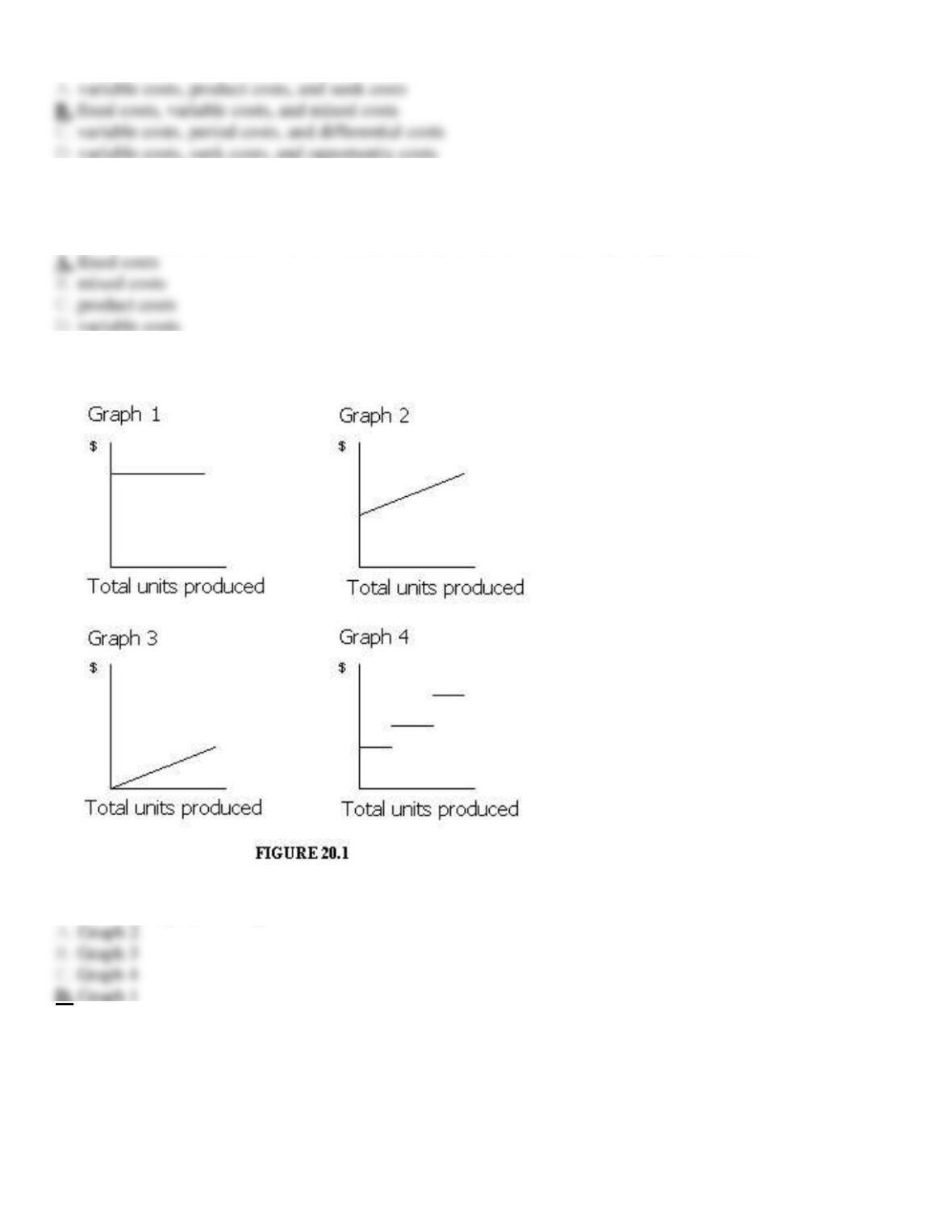
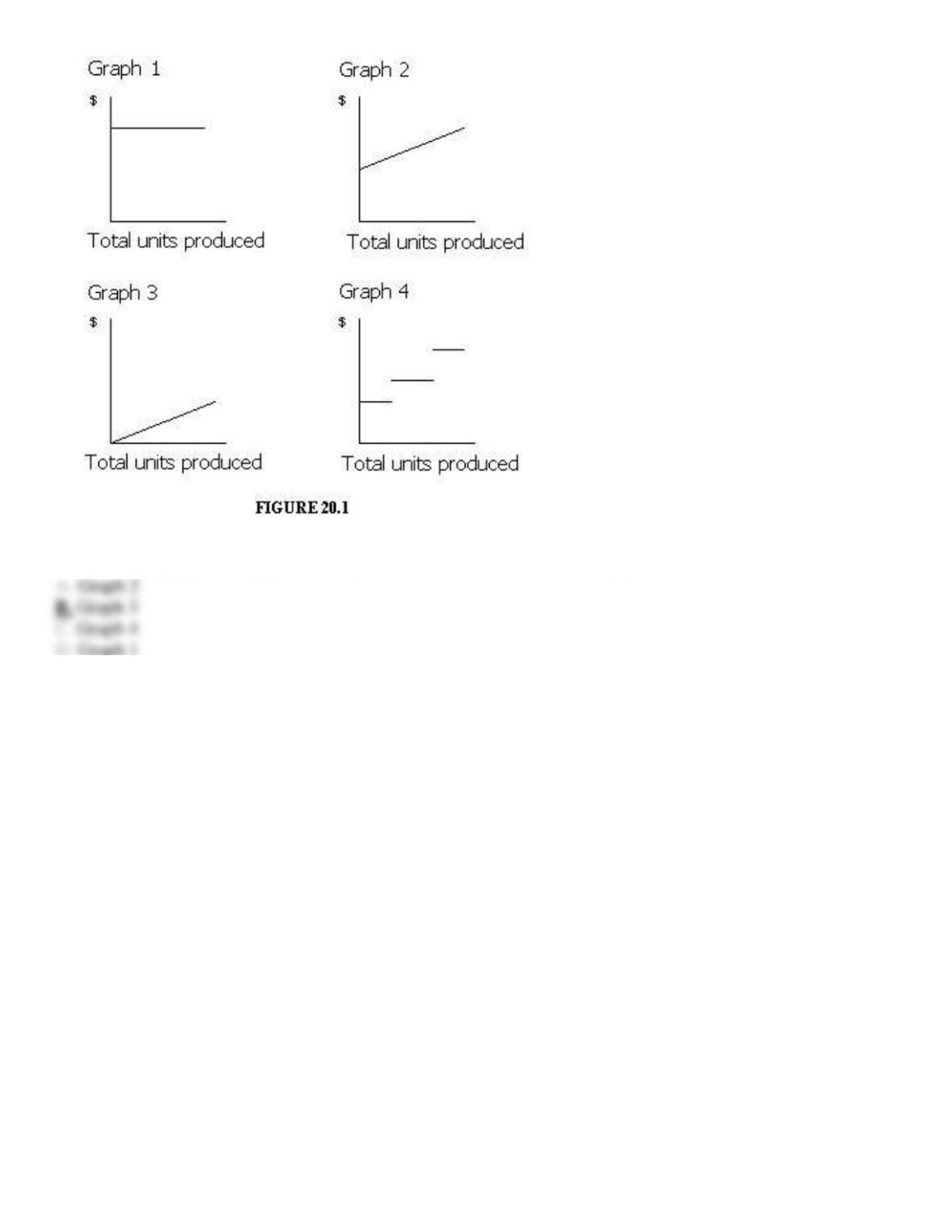
Which of the graphs in Figure 20-1 illustrates the behavior of a total fixed cost?
65.
Which of the graphs in Figure 20-1 illustrates the behavior of a total variable cost?
66.
Which of the graphs in Figure 20-1 illustrates the nature of a mixed cost?
67. Which of the following costs is an example of a cost that remains the same in total as the number of units
produced changes?
68. Which of the following describes the behavior of the fixed cost per unit?
69. Which of the following activity bases would be the most appropriate for food costs of a hospital?
70. Which of the following activity bases would be the most appropriate for gasoline costs of a delivery service,
such as United Postal Service?
71. Most operating decisions of management focus on a narrow range of activity called the:
72. Costs that vary in total in direct proportion to changes in an activity level are called:
73. Which of the following is an example of a cost that varies in total as the number of units produced changes?
74. Which of the following is NOT an example of a cost that varies in total as the number of units produced
changes?
75. Which of the following is NOT an example of a cost that varies in total as the number of units produced
changes?
76. Which of the following describes the behavior of the variable cost per unit?
77. The graph of a variable cost when plotted against its related activity base appears as a:
78. A cost that has characteristics of both a variable cost and a fixed cost is called a:
79. Which of the following costs is a mixed cost?
80. For purposes of analysis, mixed costs are generally:
81. Marcye Co. manufactures office furniture. During the most productive month of the year, 3,500 desks were
manufactured at a total cost of $84,400. In its slowest month, the company made 1,100 desks at a cost of
$46,000. Using the high-low method of cost estimation, total fixed costs are:
82. Given the following cost and activity observations for Bounty Company’s utilities, use the high-low method
to calculate Bounty’ variable utilities costs per machine hour.
Cost
Machine Hours
March
$3,100
15,000
April
2,700
10,000
May
2,900
12,000
June
3,600
18,000
83. Given the following cost and activity observations for Smithson Company’s utilities, use the high-low
method to calculate Smithson’s fixed costs per month. Do not round your intermediate calculations.
Cost
Machine Hours
January
$52,200
20,000
February
75,000
29,000
March
57,000
22,000
April
64,000
24,500
84. Given the following cost and activity observations for Taco Company’s utilities, use the high-low method to
calculate Taco’s variable utilities costs per machine hour.
Cost
Machine Hours
May
$8,300
15,000
June
10,400
20,000
July
7,200
12,000
August
9,500
18,000
85. Manley Co. manufactures office furniture. During the most productive month of the year, 4,500 desks were
manufactured at a total cost of $86,625. In its slowest month, the company made 1,800 desks at a cost of
$49,500. Using the high-low method of cost estimation, total fixed costs are:
86. Which of the following statements is true regarding fixed and variable costs?
87. As production increases, what would you expect to happen to fixed cost per unit?
88. Knowing how costs behave is useful to management for all the following reasons except for
89. The manufacturing cost of Prancer Industries for three months of the year are provided below:
Total Cost
Production
April
$ 60,700
1,200 Units
May
80,920
1,800
June
100,300
2,400
Using the high-low method, the variable cost per unit, and the total fixed costs are:
90. As production increases, what should happen to the variable costs per unit?
91. Cool-It Company manufactures and sells commercial air conditioners. Because of current trends, it expects
to increase sales by 10 percent next year. If this expected level of production and sales occurs and plant
expansion is not needed, how should this increase affect next year’s total amounts for the following costs.
Variable Costs Fixed Costs Mixed Costs
92. Given the following costs and activities for Downing Company electrical costs, use the high-low method to
calculate Downing’s variable electrical costs per machine hour.
Costs
Machine Hours
April
$11,700
15,000
May
$13,200
17,500
June
$11,400
14,500
93. The systematic examination of the relationships among selling prices, volume of sales and production, costs,
and profits is termed:
94. In cost-volume-profit analysis, all costs are classified into the following two categories:
95. Contribution margin is:
96. The contribution margin ratio is:
97. If sales are $820,000, variable costs are 45% of sales, and operating income is $260,000, what is the
contribution margin ratio?
98. What ratio indicates the percentage of each sales dollar that is available to cover fixed costs and to provide a
profit?
99. A firm operated at 80% of capacity for the past year, during which fixed costs were $210,000, variable costs
were 70% of sales, and sales were $1,000,000. Operating profit was:
100. If sales are $425,000, variable costs are 62% of sales, and operating income is $50,000, what is the
contribution margin ratio?
101. Variable costs as a percentage of sales for Lemon Inc. are 80%, current sales are $600,000, and fixed costs
are $130,000. How much will operating income change if sales increase by $40,000?
102. Spice Inc.’s unit selling price is $60, the unit variable costs are $35, fixed costs are $125,000, and current
sales are 10,000 units. How much will operating income change if sales increase by 8,000 units?
103. If sales are $914,000, variable costs are $498,130, and operating income is $260,000, what is the
contribution margin ratio?
104. A firm operated at 80% of capacity for the past year, during which fixed costs were $330,000, variable
costs were 70% of sales, and sales were $1,000,000. Operating profit was:
105. If sales are $525,000, variable costs are 53% of sales, and operating income is $50,000, what is the
contribution margin ratio?
106. Zipee Inc.’s unit selling price is $90, the unit variable costs are $40.50, fixed costs are $170,000, and
current sales are 12,000 units. How much will operating income change if sales increase by 5,000 units?
107. Zeke Company sells 25,000 units at $21 per unit. Variable costs are $10 per unit, and fixed costs are
$75,000. The contribution margin ratio and the unit contribution margin are:
108. If the contribution margin ratio for France Company is 45%, sales were $425,000. and fixed costs were
$100,000, what was the income from operations?
109. If fixed costs are $250,000, the unit selling price is $125, and the unit variable costs are $73, what is the
break-even sales (units)?
110. If fixed costs are $750,000 and variable costs are 60% of sales, what is the break-even point in sales
dollars?
111. If fixed costs are $1,200,000, the unit selling price is $240, and the unit variable costs are $110, what is the
amount of sales required to realize an operating income of $200,000?
112. If fixed costs are $300,000, the unit selling price is $31, and the unit variable costs are $22, what is the
break-even sales (units) if fixed costs are reduced by $30,000?
113. If fixed costs are $500,000, the unit selling price is $55, and the unit variable costs are $30, what is the
break-even sales (units) if fixed costs are increased by $80,000?
114. If fixed costs are $350,000, the unit selling price is $29, and the unit variable costs are $20, what is the
break-even sales (units) if the variable costs are decreased by $4?
115. If fixed costs are $450,000, the unit selling price is $75, and the unit variable costs are $50, what are the
old and new break-even sales (units) if the unit selling price increases by $10?
116. If fixed costs are $400,000 and the unit contribution margin is $20, what amount of units must be sold in
order to have a zero profit?
117. If fixed costs are $700,000 and the unit contribution margin is $17, what amount of units must be sold in
order to realize an operating income of $100,000?
118. If fixed costs are $500,000 and the unit contribution margin is $20, what is the break-even point in units if
fixed costs are reduced by $80,000?