Environment: Science Behind the Stories, 2e Cdn. Ed. (Withgott)
Chapter 21 Environmental Ethics and Economics: Values and Choices
21.1 Graph and Figure Interpretation Questions
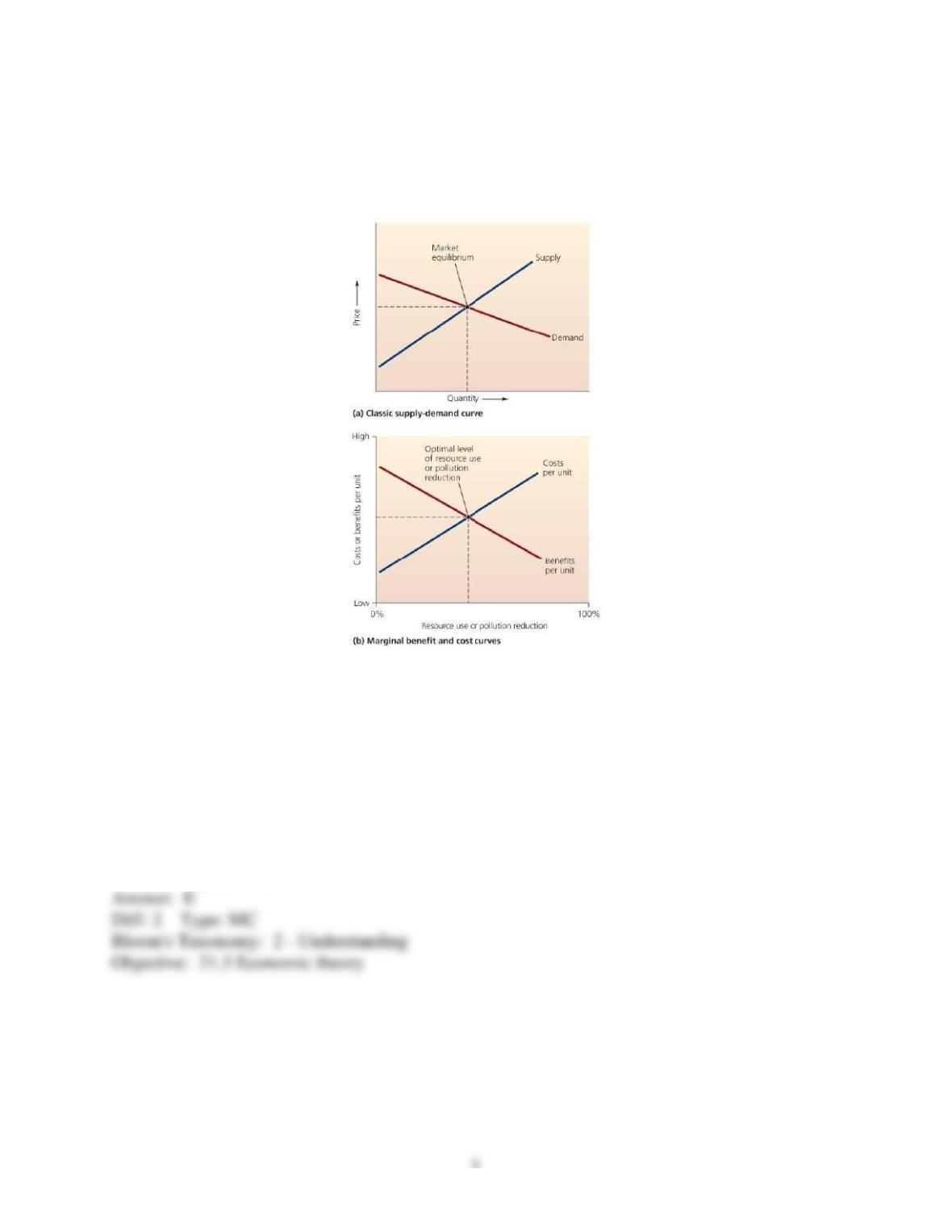
Figure 21.1
Use Figure 21.1 to answer the following questions.
1) Refer to Figure 21.1 (a). The intersection of the two lines (the middle of the “X”) represents
________.
A) the maximum price buyers will pay for goods and services
B) market correction
C) the maximum quantity of goods and services that a company can produce
D) where the market begins to decline
E) market equilibrium
2) Refer to Figure 21.1 (a). The graph successfully illustrates ________.
A) marginal benefit and cost curves
B) the costs of resource use and pollution reduction
C) internal and external costs associated with market economies
D) how price is determined by supply and demand
E) how prices stabilize when demand is high
3) Refer to Figure 21.1. If no more new reserves of oil can be found, then ________.
A) the prices of oil will go up and the demand will decline
B) the prices of oil will go down and the demand will decline
C) the prices will go up and the demand will increase
D) the prices will go down and the demand will increase
E) the prices and the demand will remain unchanged
21.2 Matching Questions
Match the following.
A) Robert Wilson
B) John Muir
C) transcendentalist
D) fundamentalist
E) Immanuel Kant
F) Gifford Pinchot
G) James Bernard Harkin
H) ecocentrist
I) utilitarian
J) deep ecologist
K) preservationist
1) Ecocentrist and anthropocentrist who argued that we should protect America’s natural
environment in its pristine, unaltered state
2) Conservationist who advocated protection of nature for its beauty and usefulness; founder of
Parks Canada
3) Views nature as a direct manifestation of the divine
4) Proposed the categorical imperative, which advocates treating others as you would wish to be
treated
5) Advocates for the conservation of forest biodiversity on the grounds that the possibility exists
that a cure for cancer might be found there among the naturally occurring biological compounds
6) Would say, “A thing is right when it tends to preserve the integrity, stability, and beauty of the
biotic community. It is wrong when it tends otherwise”
Diff: 3 Type: MA
Bloom’s Taxonomy: 3 – Applying
Objective: 21.2 Evolution of environmental ethics
21.3 Short Answer Questions
1) Since 1961, Alberta’s GDP increased more than five-fold, but its GPI Well-Being Index
decreased. What does it mean?
2) Briefly explain how Earth’s ecological systems support world economies. Is this support
recognized by the traditional neoclassical economics? How or why not?
3) Briefly explain how over human history the scope of who and what humans are ethically
concerned about has changed. How are these changes linked with the historical trends in our
economy and culture?
4) Briefly explain how governments can intervene to counter market failure.
5) Briefly explain deep ecology.
6) What do the world views of indigenous people, such as the Mirrar, American
Transcendentalists, and Deep Ecologists have in common?
7) ________ can occur when markets do not take into account the environment’s positive effects
on economies or when they do not reflect the bad effects of economic activity on the
environment and people.
8) ________ is a method used by manufacturers that tells consumers which brands use
manufacturing processes that are environmentally beneficial.
9) How may environmental injustice lead to environmental degradation?
21.4 Multiple-Choice Questions
1) “If domestic fuel prices rise to $3 per litre, conservation will increase, alternative fuels will be
developed, and energy efficiency and our quality of life will improve.” This philosophy is
consistent with ________ economics.
A) environmental
B) neoclassical
C) subsistence
D) social
E) cooperative
2) “If domestic fuel prices rise to $3 per litre, growth will slow significantly and our quality of
life will decline.” This philosophy is consistent with ________ economics.
A) environmental
B) neoclassical
C) subsistence
D) social
E) cooperative
3) The philosophy of classical economics developed by Adam Smith ________.
A) assures equality between rich and poor
B) proposes maintenance of economies through government restraint and regulation
C) argues that individuals acting in their own self-interest harm society
D) was adopted by the Aborigines in the Kakadu region of Australia
E) advocates laissez-faire policies that some credit for the tremendous gains in material
prosperity of industrial nations
4) Contingent valuation ________.
A) measures how much time, effort, and money people spend to travel for natural recreation
B) measures how much people would pay to restore a resource after it is damaged
C) says all individuals deserve just and equal treatment
D) says we should treat others as we wish to be treated
E) involves buying and selling “rights to pollute”
5) Which of the following is an assumption of neoclassical economics?
A) Growth is good.
B) Resources are finite.
C) Long-term effects are important.
D) External costs and benefits should be valued
E) All citizens deserve just and equal treatment.
6) In general, environmentalists believe that governments should ________.
A) lower corporate taxes
B) nationalize all Earth’s natural resources
C) discourage ecolabelling
D) deregulate corporations
E) promote social justice
7) Which of the following values includes volunteer work and pollution in a country’s goods and
services?
A) GDP
B) GNP
C) NDP
D) GPI
E) GPD
8) Jack may approve a mine if it brings net economic benefits to the local population and its
negative impacts on nature are limited. Jack’s view can be described as ________.
A) biocentrist
B) ecocentrist
C) anthropocentrist
D) ethnocentrist
E) market economist
9) When considering an action, Jill considers its impacts on the abiotic environment, because she
believes that the preservation of larger systems generally protects their components. This belief
makes her a(n) ________,
A) biocentrist
B) ecocentrist
C) anthropocentrist
D) ethnocentrist
E) ecofeminist
10) ________ believe that we should model economies on Earth’s natural systems, which
generally operate in self-renewing cycles.
A) Ecological economists
B) Cornucopians
C) Capitalists
D) Socialists
E) Malthusians
10
11) ________ is best defined as the study of how we decide to use scarce resources in the face of
demand.
A) Ecology
B) Environmental science
C) Economics
D) Ethics
E) Ethnobiology
12) Modern market economies generally do not address ________.
A) cost-benefit analysis
B) market value of goods
C) GDP
D) aesthetic and cultural value
E) cost of production
13) External costs include ________.
A) raw materials
B) utilities
C) wages
D) workers’ compensation and insurance
E) environmental damage
14) ________ believe that we will not be able to sustain economic growth over a long time and
point to the fact that natural sustainable systems operate in self-renewing cycles, not in
exponential growth, which has been the pattern of our economy for the last few centuries.
A) Ecological economists
B) Environmental economists
C) Capitalists
D) Socialists
E) Malthusians
15) List the economists in order of decreasing faith in the viability of the current market
economy (with the most skeptical being the last).
A) neoclassical, ecological, environmental
B) neoclassical, environmental, ecological
C) ecological, environmental, neoclassical
D) environmental, neoclassical, ecological
E) ecological, neoclassical, environmental
16) Aldo Leopold’s “The Land Ethic” essay describes ________.
A) how American Navajos suffered from the adverse effects of uranium mining
B) how most toxic landfills are located in poorer communities
C) pesticide misuse
D) the history of the EPA
E) individuals as members of a community of interdependent parts
17) ________ is best defined as the knowledge, beliefs, values, and learned ways of life shared
by a group of people.
A) Niche
B) Economics
C) Worldview
D) Habitat
E) Culture
18) Who is best known as the founder of the Sierra Club?
A) Ralph Waldo Emerson
B) Aldo Leopold
C) John Ruskin
D) Walter Sierra
E) John Muir
19) As the Industrial Revolution spread in the ________ century from ________ throughout
Europe and to North America and elsewhere, it amplified human impacts on the environment.
A) nineteenth; Russia
B) seventeenth; Rome
C) seventeenth; Greece
D) nineteenth; Great Britain
E) eighteenth; Australia
20) “Ecosystem services” include ________.
A) erosion
B) global warming
C) genetically modifying food
D) pollination of crop plants
E) creating pollution
21) Developed countries have built their wealth on the unrestricted use of fossil fuels.
Unrestricted use of fossil fuels causes climate change. Climate change disproportionally affects
people in developing countries. This type of issue is the dominant concern of ________.
A) environmental justice movements
B) deep ecologists
C) land ethicists
D) socialists
E) environmental virtue groups
22) Which American president is famous for instituting the protection of the California
wilderness in the early 1900s?
A) John Quincy Adams
B) Woodrow Wilson
C) Thomas Jefferson
D) William McKinley
E) Theodore Roosevelt