
College Physics: A Strategic Approach, 3e (Knight)
Chapter 21 Electric Potential
21.1 Conceptual Questions
1) If the result of your calculation of a quantity has SI units kg ∙ m2/(s2 ∙ C), that quantity could
be
A) an electric field strength.
B) a dielectric constant.
C) an electric potential difference.
D) a capacitance
E) an electric potential energy.
2) If the result of your calculation of a quantity has SI units of kg ∙ m/(s2 ∙ C), that quantity could
be
A) an electric field strength.
B) a dielectric constant.
C) an electric potential difference.
D) a capacitance
E) an electric potential energy.
3) As a proton moves in the direction the electric field lines
A) it is moving from low potential to high potential and gaining electric potential energy.
B) it is moving from low potential to high potential and losing electric potential energy.
C) it is moving from high potential to low potential and gaining electric potential energy.
D) it is moving from high potential to low potential and losing electric potential energy.
E) both its electric potential and electric potential energy remain constant.
4) As an electron moves in the direction the electric field lines
A) it is moving from low potential to high potential and gaining electric potential energy.
B) it is moving from low potential to high potential and losing electric potential energy.
C) it is moving from high potential to low potential and gaining electric potential energy.
D) it is moving from high potential to low potential and losing electric potential energy.
E) both its electric potential and electric potential energy remain constant.
5) As a proton moves in a direction perpendicular to the electric field lines
A) it is moving from low potential to high potential and gaining electric potential energy.
B) it is moving from low potential to high potential and losing electric potential energy.
C) it is moving from high potential to low potential and gaining electric potential energy.
D) it is moving from high potential to low potential and losing electric potential energy.
E) both its electric potential and electric potential energy remain constant.
6) A proton is accelerated from rest through a potential difference V0 and gains a speed v0. If it
were accelerated instead through a potential difference of 2V0, what speed would it gain?
A) 8v0
B) 4v0
C) 2v0
D) v0
7) If the electric potential at a point in space is zero, then the electric field at that point must be
A) negative.
B) zero.
C) uniform.
D) positive.
E) impossible to determine based on the information given.
8) The electron-volt is a unit of
A) charge.
B) electric potential.
C) electric field.
D) electric force.
E) energy.
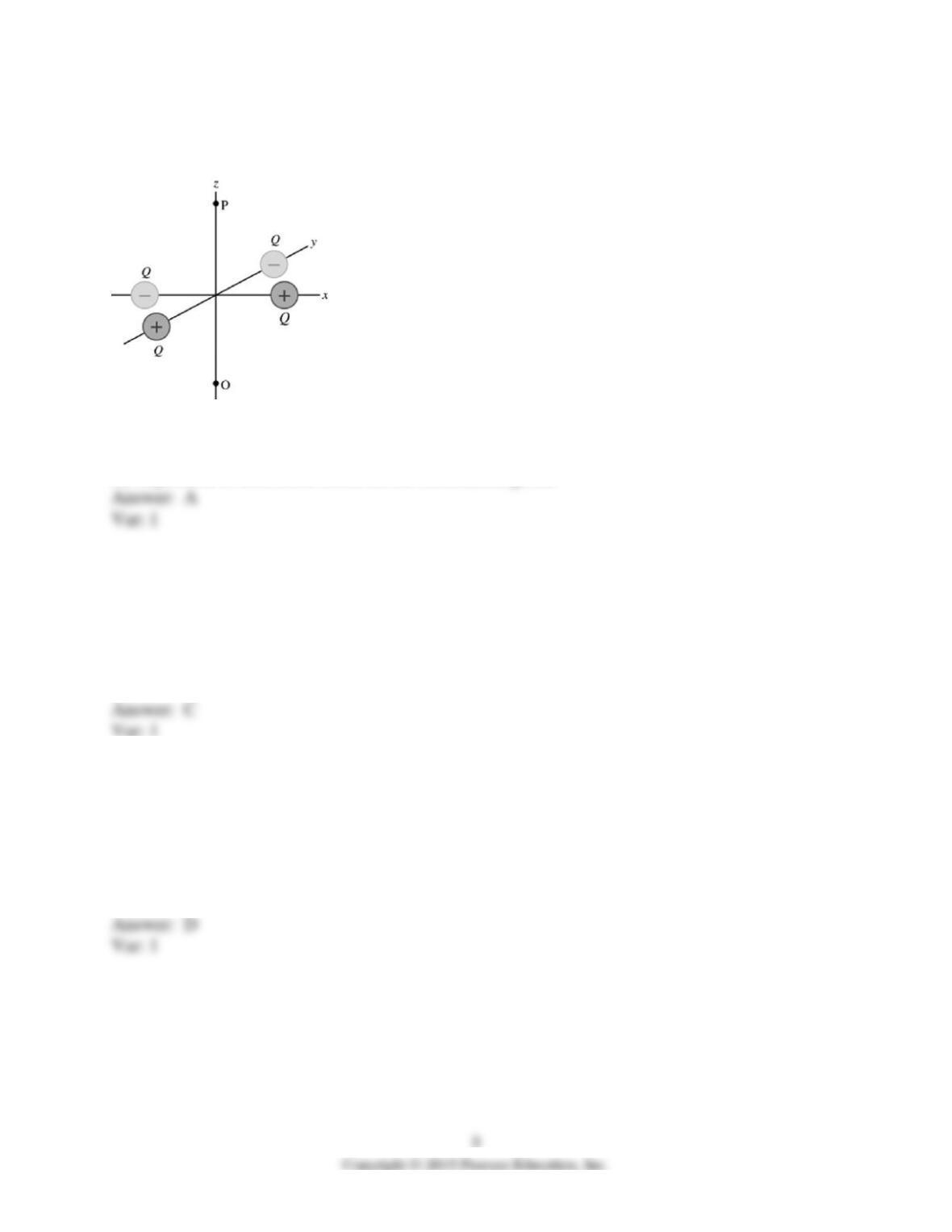
9) Four charged particles (two having a charge +Q and two having a charge –Q) are arranged in
the xy-plane, as shown in the figure. These particles are all equidistant from the origin. The
electric potential (relative to infinity) at point P on the z-axis due to these particles, is
A) zero.
B) positive.
C) negative.
D) impossible to determine based on the information given.
10) The electric potential at a distance of 4 m from a certain point charge is 200 V relative to
infinity. What is the potential (relative to infinity) at a distance of 2 m from the same charge?
A) 200 V
B) 50 V
C) 400 V
D) 100 V
E) 600 V
11) The potential (relative to infinity) at the midpoint of a square is 3.0 V when a point charge of
+Q is located at one of the corners of the square. What is the potential (relative to infinity) at the
center when each of the other corners is also contains a point charge of +Q?
A) 0 V
B) 3.0 V
C) 9.0 V
D) 12 V

12) Two protons are released from rest, with only the electrostatic force acting. Which of the
following statements must be true about them as they move apart? (There could be more than
one correct choice.)
A) Their electric potential energy keeps increasing.
B) Their kinetic energy keeps increasing.
C) Their electric potential energy keeps decreasing.
D) Their kinetic energy keeps decreasing.
E) Their acceleration keeps decreasing.
13) A proton and an electron are released from rest, with only the electrostatic force acting.
Which of the following statements must be true about them as they move toward each other?
(There could be more than one correct choice.)
A) Their electric potential energy keeps increasing.
B) Their kinetic energy keeps increasing.
C) Their electric potential energy keeps decreasing.
D) Their kinetic energy keeps decreasing.
E) Their acceleration keeps decreasing.
14) Two protons are fired toward each other in a particle accelerator, with only the electrostatic
force acting. Which of the following statements must be true about them as they move closer
together? (There could be more than one correct choice.)
A) Their electric potential energy keeps increasing.
B) Their kinetic energy keeps increasing.
C) Their electric potential energy keeps decreasing.
D) Their kinetic energy keeps decreasing.
E) Their acceleration keeps decreasing.
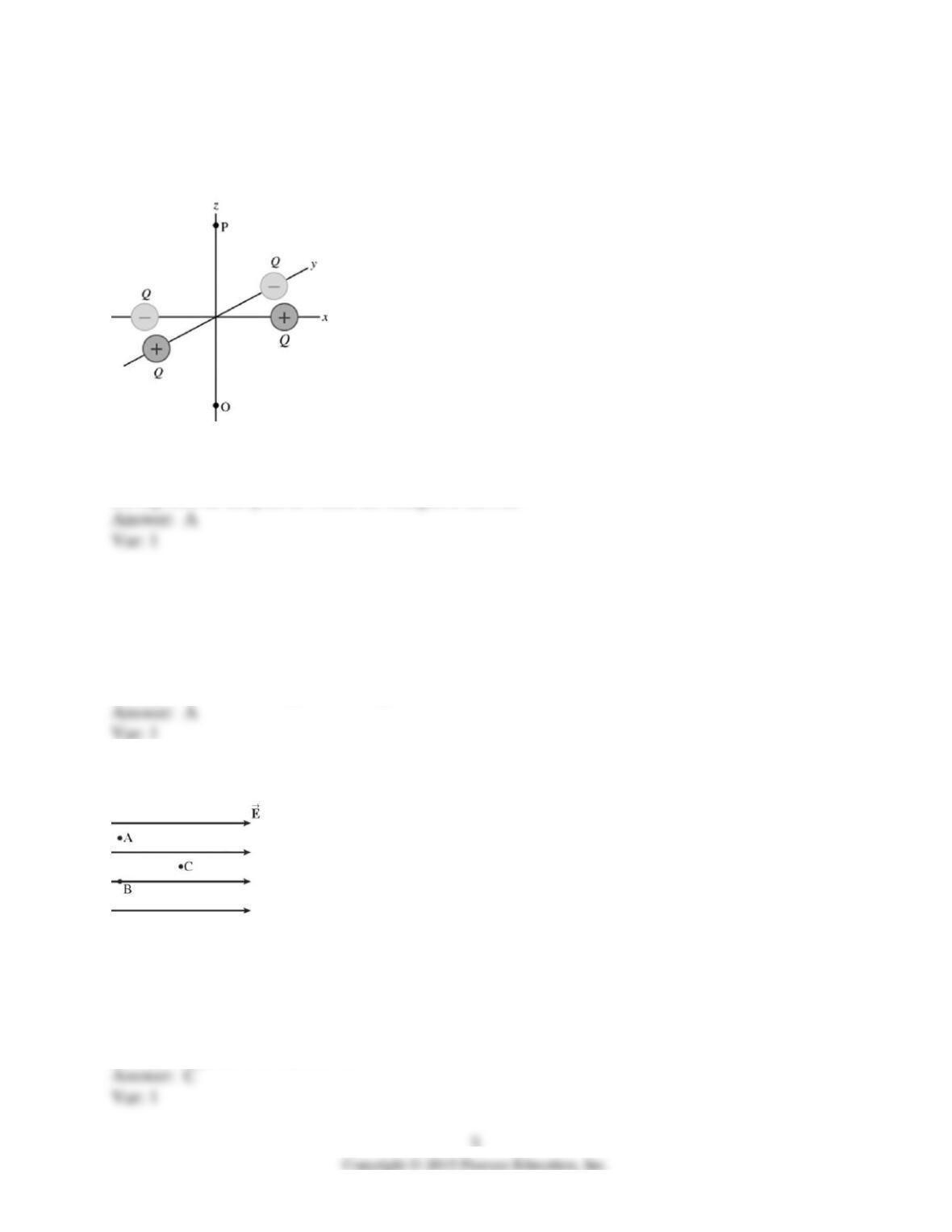
15) Four charged particles (two having a charge +Q and two having a charge –Q) are arranged in
the xy-plane as shown in the figure. The charges are all equidistant from the origin. The amount
of work required to move a positively charged particle from point P to point O (both of which are
on the z-axis) is
A) zero.
B) positive.
C) negative.
D) depends on the path in which the charged is moved.
16) A hydrogen atom consists of a proton and an electron. If the orbital radius of the electron
increases, the electric potential energy of the electron due to the proton
A) increases.
B) decreases.
C) remains the same.
D) depends on the zero point of the potential.
17) A region of space contains a uniform electric field, directed toward the right, as shown in the
figure. Which statement about this situation is correct?
A) The potential at all three locations is the same.
B) The potentials at points A and B are equal, and the potential at point C is higher than the
potential at point A.
C) The potential at points A and B are equal, and the potential at point C is lower than the
potential at point A.
D) The potential at point A is the highest, the potential at point B is the second highest, and the
potential at point C is the lowest.

18) Which statements must be true about the surface of a charged conductor in which no charge
is moving? (There could be more than one correct choice.)
A) The electric field is zero at the surface.
B) The electric potential of the surface is zero.
C) The electric field is constant at the surface.
D) The electric potential is constant over the surface.
E) The electric field is perpendicular to the surface.
19) If the result of your calculations for a quantity has SI units of C2 ∙ s2/(kg ∙ m2), that quantity
could be
A) an electric potential difference.
B) a dielectric constant.
C) an electric field strength.
D) a capacitance.
E) an electric potential energy.
20) If the electric field between the plates of a given air-filled capacitor is weakened by
removing charge from the plates, the capacitance of that capacitor
A) increases.
B) decreases.
C) does not change.
D) It cannot be determined from the information given.
21) Two ideal parallel-plate capacitors are identical in every respect except that one has twice the
plate area of the other. If the smaller capacitor has capacitance C, the larger one has capacitance
A) C/2.
B) C.
C) 2C.
D) 4C.
22) An ideal parallel-plate capacitor has a capacitance of C. If the area of the plates is doubled
and the distance between the plates is halved, what is the new capacitance?
A) C/4
B) C/2
C) 2C
D) 4C
23) A battery charges a parallel-plate capacitor fully and then is removed. The plates are then
slowly pulled apart. What happens to the potential difference between the plates as they are
being separated?
A) It increases.
B) It decreases.
C) It remains constant.
D) It cannot be determined from the information given.
24) The plates of a parallel-plate capacitor are maintained with constant potential by a battery as
they are pulled apart. During this process, the amount of charge on the plates
A) must increase.
B) must decrease.
C) must remain constant.
D) could either increase or decrease. There is no way to tell from the information given.
25) When a certain capacitor carries charges of ±10 µC on its plates, the potential difference
cross the plates is 25 V. Which of the following statements about this capacitor are true? (There
could be more than one correct choice.)
A) If we double the charges on the plates to ±20 µC, the capacitance of the capacitor will also
double.
B) If we double the charges on the plates to ±20 µC, the potential difference across the plates
will also double.
C) If we double the charges on the plates to ±20 µC, the capacitance of the capacitor will not
change.
D) If we double the charges on the plates to ±20 µC, the potential difference across the plates
will decrease by a factor of two.
26) An ideal parallel-plate capacitor having circular plates of diameter D that are a distance d
apart stores energy U when it is connected across a fixed potential difference. If you want to
triple the amount of energy stored in this capacitor by changing only the size of its plates, the
diameter should be changed to
A) 9D.
B) 3D.
C) D
D)
E)

27) Which of the following will increase the capacitance of a parallel-plate capacitor? (There
could be more than one correct choice.)
A) a decrease in the plate area and an increase in the plate separation
B) a decrease in the potential difference between the plates
C) an increase in the potential difference between the plates
D) an increase in the plate area and a decrease in the plate separation
E) an increase in the charge on the plates
28) An ideal parallel-plate capacitor consists of two parallel plates of area A separated by a
distance d. This capacitor is connected across a battery that maintains a constant potential
difference between the plates. If the separation between the plates is now doubled, the magnitude
of the charge on the plates will
A) double.
B) quadruple.
C) be cut in half.
D) be cut in fourth.
E) not change.
29) An capacitor consists of two large parallel plates of area A separated by a very small distance
d. This capacitor is connected to a battery and charged until its plates carry charges +Q and –Q,
and then disconnected from the battery. If the separation between the plates is now doubled, the
potential difference between the plates will
A) double.
B) quadruple.
C) be cut in half.
D) be cut in fourth.
E) not change.
30) The plates of a parallel-plate capacitor are maintained with constant voltage by a battery as
they are pulled apart. What happens to the strength of the electric field between the plates during
this process?
A) It increases.
B) It decreases.
C) It remains constant.
D) It cannot be determined from the information given.

31) A parallel-plate capacitor is connected to a battery and becomes fully charged. The capacitor
is then disconnected, and the separation between the plates is increased in such a way that no
charge leaks off. As the plates are being separated, the energy stored in this capacitor
A) increases.
B) decreases.
C) does not change.
D) become zero.
32) Doubling the capacitance of a capacitor that is holding a constant charge causes the energy
stored in that capacitor to
A) quadruple.
B) double.
C) decrease to one-half.
D) decrease to one-fourth.
33) Doubling the potential across a given capacitor causes the energy stored in that capacitor to
A) quadruple.
B) double.
C) reduce to one-half.
D) reduce to one-fourth.
34) An ideal parallel-plate capacitor consists of two parallel plates of area A separated by a
distance d. This capacitor is connected to a battery that maintains a constant potential difference
across the plates. If the separation between the plates is now doubled, the amount of electrical
energy stored on the capacitor will
A) double.
B) quadruple.
C) be cut in half.
D) be cut in fourth.
E) not change.

35) An ideal parallel-plate capacitor consists of two parallel plates of area A separated by a
distance d. This capacitor is connected to a battery and charged until its plates carry charges +Q
and –Q, and the battery is then disconnected. If the separation between the plates is now doubled,
the electrical energy stored in the capacitor will
A) double.
B) quadruple.
C) be cut in half.
D) be cut in fourth.
E) not change.
36) When a dielectric material is introduced between the plates of a parallel-plate capacitor and
completely fills the space, the capacitance increases by a factor of 4. What is the dielectric
constant of the material that was introduced?
A) 0.4
B) 1/4
C) 2
D) 4
E) None of the other choices is correct.
37) A parallel-plate capacitor consists of a set of two parallel plates of area A separated by a
distance d. This capacitor is connected to a battery that maintains a constant potential difference
across the plates. A slab of a dielectric material is inserted in the region between the plates and
completely fills it. What changes would you observe as the dielectric is inserted? (There could be
more than one correct choice.)
A) Only the charge on the plates of the capacitor would change.
B) Only the capacitance would change.
C) Both the charge on the plates of the capacitor and its capacitance would change.
D) The potential difference across the plates would increase.
E) Nothing would change.
38) Which of the following changes will increase the capacitance of a parallel-plate capacitor?
(There could be more than one correct choice.)
A) increase the charge on the plates
B) decrease the potential between the plates
C) increase the potential between the plates
D) introduce a dielectric material between the plates
E) decrease the separation between the plates
39) A dielectric material such as paper is inserted between the plates of a capacitor as the
capacitor holds a fixed charge on its plates. What happens to the electric field between the plates
as the dielectric is inserted?
A) There is no change in the field.
B) The field becomes stronger.
C) The field becomes weaker.
D) The field reduces to zero.
40) At a distance d from a point charge Q, the energy density in its electric field is u. If we
double the charge, what is the energy density at the same point?
A) 16u
B) 8u
C) 4u
D) 2u
E) u
41) At a distance d from a point charge Q, the energy density in its electric field is u. If we now
go to a distance d/2 from the charge, what is the energy density at the new location?
A) 16u
B) 8u
C) 4u
D) 2u
E) u
21.2 Problems
1) How much kinetic energy does a proton gain if it is accelerated, with no friction, through a
potential difference of 1.00 V? The proton is 1836 times heavier than an electron, and e = 1.60 ×
10-19 C.
A) 1836 eV
B) 1.00 eV
C) 1.60 × 10⁻¹⁹ eV
D) 1.00 J
E) 1836 J
2) A tiny particle with charge + 5.0 μC is initially moving at 55 m/s. It is then accelerated
through a potential difference of 500 V. How much kinetic energy does this particle gain during
the period of acceleration?
A) 1.0 × 10⁴ J
B) 2.5 × 10⁻³ J
C) 100 J
D) 2500 J
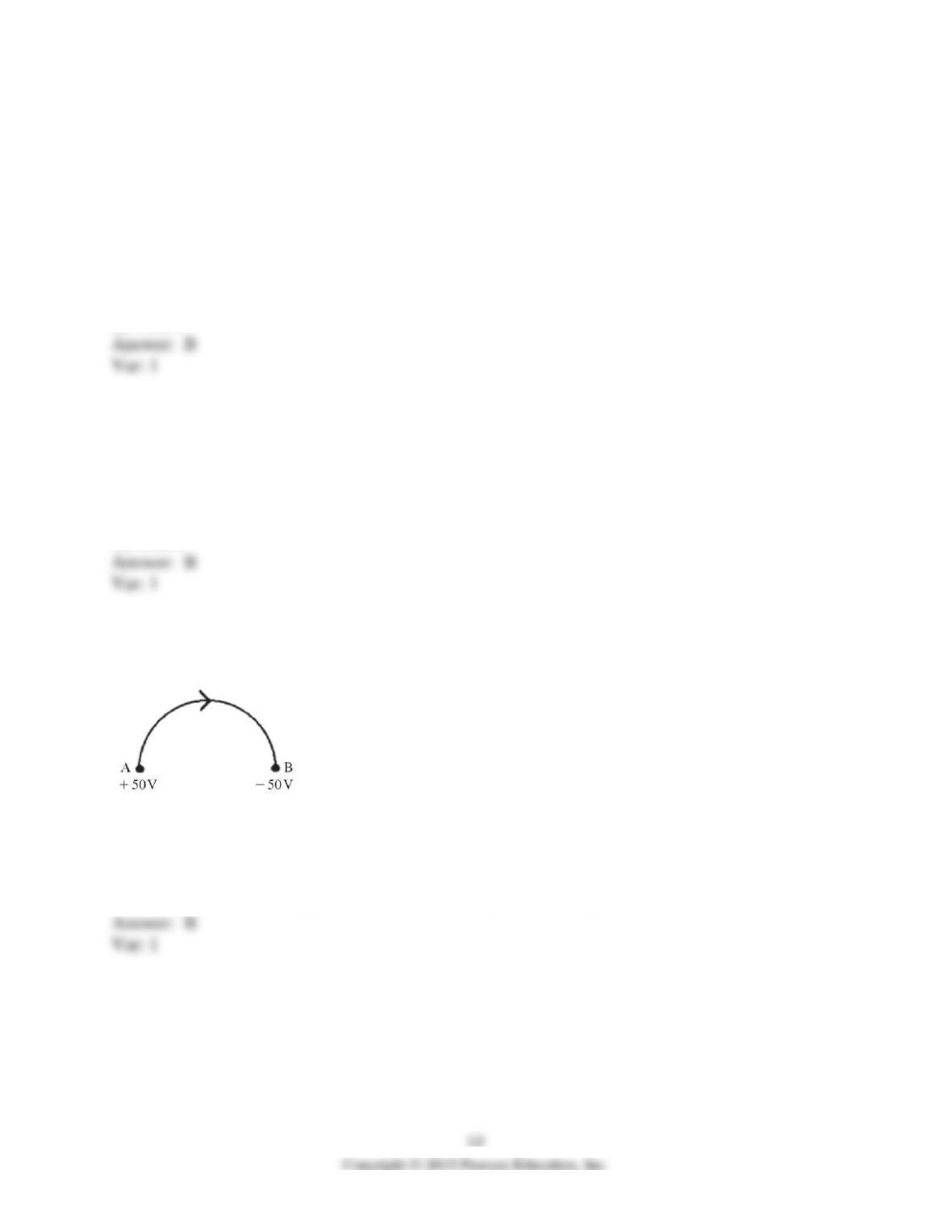
3) How much work must we do on an electron to move it from point A, which is at a potential of
+50V, to point B, which is at a potential of -50 V, along the semicircular path shown in the
figure? Assume the system is isolated from outside forces. (e = 1.60 × 10⁻¹⁹ C)
A) 1.6 J
B) 1.60 × 10⁻¹⁷ J
C) -1.60 × 10⁻¹⁷ J
D) -1.6 J
E) This cannot be determined because we do not know the distance traveled.

4) If an electron is accelerated from rest through a potential difference of 1500 V, what speed
does it reach? (e = 1.60 × 10⁻¹⁹ C , melectron = 9.11 × 10⁻³¹ kg)
A) 2.3 × 10⁷ m/s
B) 1.9 × 10⁷ m/s
C) 1.5 × 10⁷ m/s
D) 1.1 × 10⁷ m/s
5) A proton that is initially at rest is accelerated through an electric potential difference of
magnitude 500 V. How much kinetic energy does it gain? (e = 1.60 × 10⁻¹⁹ C)
A) 500 J
B) 8.0 × 10⁻¹⁷ J
C) 1.6 × 10⁻¹⁹ J
D) 800 J
6) A proton that is initially at rest is accelerated through an electric potential difference of
magnitude 500 V. What speed does the proton gain? (e = 1.60 × 10⁻¹⁹ C , mproton = 1.67 × 10–
27 kg)
A) 2.2 × 10⁵ m/s
B) 3.1 × 10⁵ m/s
C) 9.6 × 10⁵ m/s
D) 1.1 × 10⁵ m/s
7) A proton with a speed of 2.0 x m/s accelerates through a potential difference and thereby
increases its speed to 4.0 x m/s. Through what magnitude potential difference did the proton
accelerate? (e = 1.60 × 10⁻¹⁹ C , mproton = 1.67 × 10⁻²⁷ kg)
A) 630 V
B) 210 V
C) 840 V
D) 1000 V
E) 100 V

8) After a proton with an initial speed of 1.50 × 10⁵ m/s has increased its speed by accelerating
through a potential difference of 0.100 kV, what is its final speed? (e = 1.60 × 10⁻¹⁹ C , mproton
= 1.67 × 10⁻²⁷ kg)
A) 4.56 × 10⁵ m/s
B) 2.04 × 10⁵ m/s
C) 3.55 × 10⁵ m/s
D) 8.80 × 10⁵ m/s
E) 1.55 × 10⁶ m/s
9) How much work is needed to carry an electron from the positive terminal to the negative
terminal of a 9.0-V battery. (e = 1.60 × 10⁻¹⁹ C , melectron = 9.11 × 10⁻³¹ kg)
A) 1.6 × 10⁻¹⁹ J
B) 17 × 10-19 J
C) 9.0 J
D) 14.4 × 10⁻¹⁹ J
E) 14.4 × 10⁻¹⁹ J/C
10) If it takes 50 J of energy to move 10 C of charge from point A to point B, what is the
magnitude of the potential difference between points A and B?
A) 500 V
B) 50 V
C) 5.0 V
D) 0.50 V
11) A 4.0-g bead carries a charge of 20 μC. The bead is accelerated from rest through a potential
difference V, and afterward the bead is moving at 2.0 m/s. What is the magnitude of the
potential difference V?
A) 800 kV
B) 400 kV
C) 800 V
D) 400 V
E) 200 V

12) If a Cu2+ ion that is initially at rest accelerates through a potential difference of 12 V without
friction, how much kinetic energy will it gain? (e = 1.60 × 10⁻¹⁹ C)
A) 3.0 eV.
B) 6.0 eV.
C) 12 eV.
D) 24 eV.
13) A sphere with radius 2.0 mm carries a charge. What is the potential difference,
between point B, which is from the center of the sphere, and point A, which is
from the center of the sphere? (k = 1/4πε0 = 9.0 × 10⁹ N ∙ m2/C2)
A) 1500 V
B) -1500 V
C) 170 V
D) -0.63 V
14) Two 3.0 μC charges lie on the x-axis, one at the origin and the other at What is the
potential (relative to infinity) due to these charges at a point at on the x-axis? (k = 1/4πε0 =
9.0 × 10⁹ N ∙ m2/C2)
A) 11,000 V
B) 9000 V
C) 14,000 V
D) 3400 V
15) A 6.9 μC negative point charge has a positively charged particle in an elliptical orbit about it.
If the mass of the positively charged particle is and its distance from the point charge
varies from to , what is the maximum potential difference through which the
positive object moves? (k = 1/4πε0 = 9.0 × 10⁹ N ∙ m2/C2)
A) 12 MV
B) 3.9 MV
C) -5.2 MV
D) 19 MV
16
16) Two very small +3.00-μC charges are at the ends of a meter stick. Find the electric potential
(relative to infinity) at the center of the meter stick. (k = 1/4πε0 = 8.99 × 10⁹ N ∙ m2/C2)
A) 0.00 V
B) 2.70 × 10⁴ V
C) 5.40 × 10⁴ V
D) 1.08 × 10⁵ V
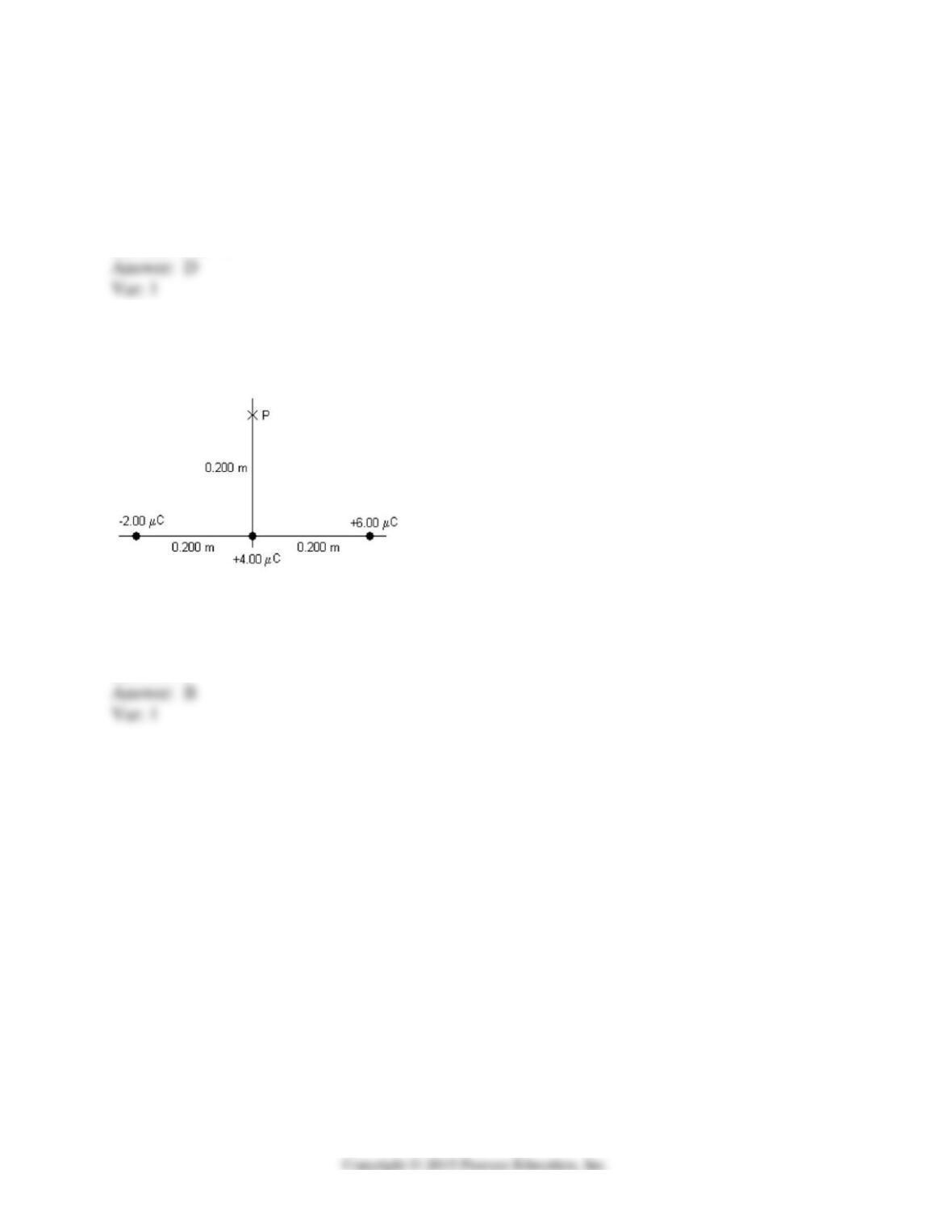
17) Three point charges, –2.00 μC, +4.00 μC, and +6.00 μC, are located along the x-axis as
shown in the figure. What is the electric potential (relative to infinity) at point P due to these
charges? (k = 1/4πε0 = 8.99 × 10⁹ N ∙ m2/C2)
A) -307 kV
B) +307 k V
C) -154 kV
D) +154 kV
E) 0.00 kV
17
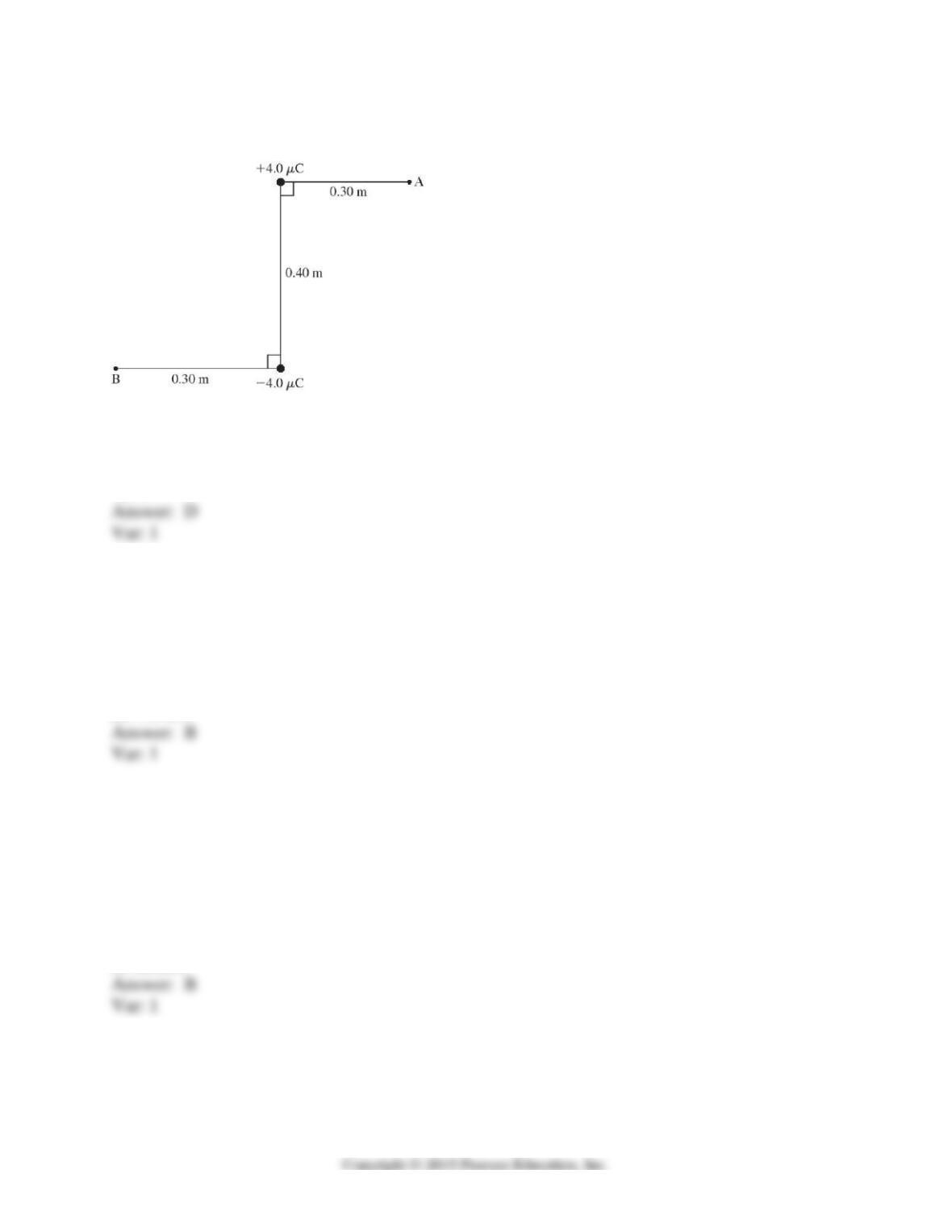
18) A +4.0-μC and a -4.0-μC point charge are placed as shown in the figure. What is the
potential difference between points A and B? (k = 1/4πε0 = 9.0 × 10⁹ N ∙ m2/C2)
A) 48 V
B) 96 V
C) 0 V
D) 96 kV
E) 48 kV
19) Four 2.0-µC point are at the corners of a rectangle with sides of length 3.0 cm and 4.0 cm.
What is the electric potential (relative to infinity) at the midpoint of the rectangle? (k = 1/4πε0 =
9.0 × 10⁹ N ∙ m2/C2)
A) 1.3 MV
B) 2.9 MV
C) 3.5 MV
D) 7.8 MV
20) A square is 1.0 m on a side. Point charges of +4.0 μC are placed in two diagonally opposite
corners. In the other two corners are placed charges of +3.0 μC and –3.0 μC. What is the
potential (relative to infinity) at the midpoint of the square? (k = 1/4πε0 = 9.0 × 10⁹ N ∙ m2/C2)
A) 1.0 × 10⁴ V
B) 1.0 × 10⁵ V
C) 1.0 × 10⁶ V
D) 0 V
E) infinite
21) Two 5.0-µC point charges are 12 cm apart. What is the electric potential (relative to infinity)
of this combination at the point where the electric field due to these charges is zero? (k = 1/4πε0
= 9.0 × 10⁹ N ∙ m2/C2)
A) 0.75 MV
B) 1.5 MV
C) 0.0 MV
D) 25 MV
E) 12.5 MV
22) A +5.0-µC point charge is 12 cm from a -5.0-µC point charge. What is the magnitude of the
electric field they produce at the point on the line connecting them where their electric potential
(relative to infinity) is zero? (k = 1/4πε0 = 9.0 × 10⁹ N ∙ m2/C2)
A) 0 N/C
B) 12.5 MN/C
C) 0.75 MN/C
D) 25 MN/C
E) 1.5 MN/C
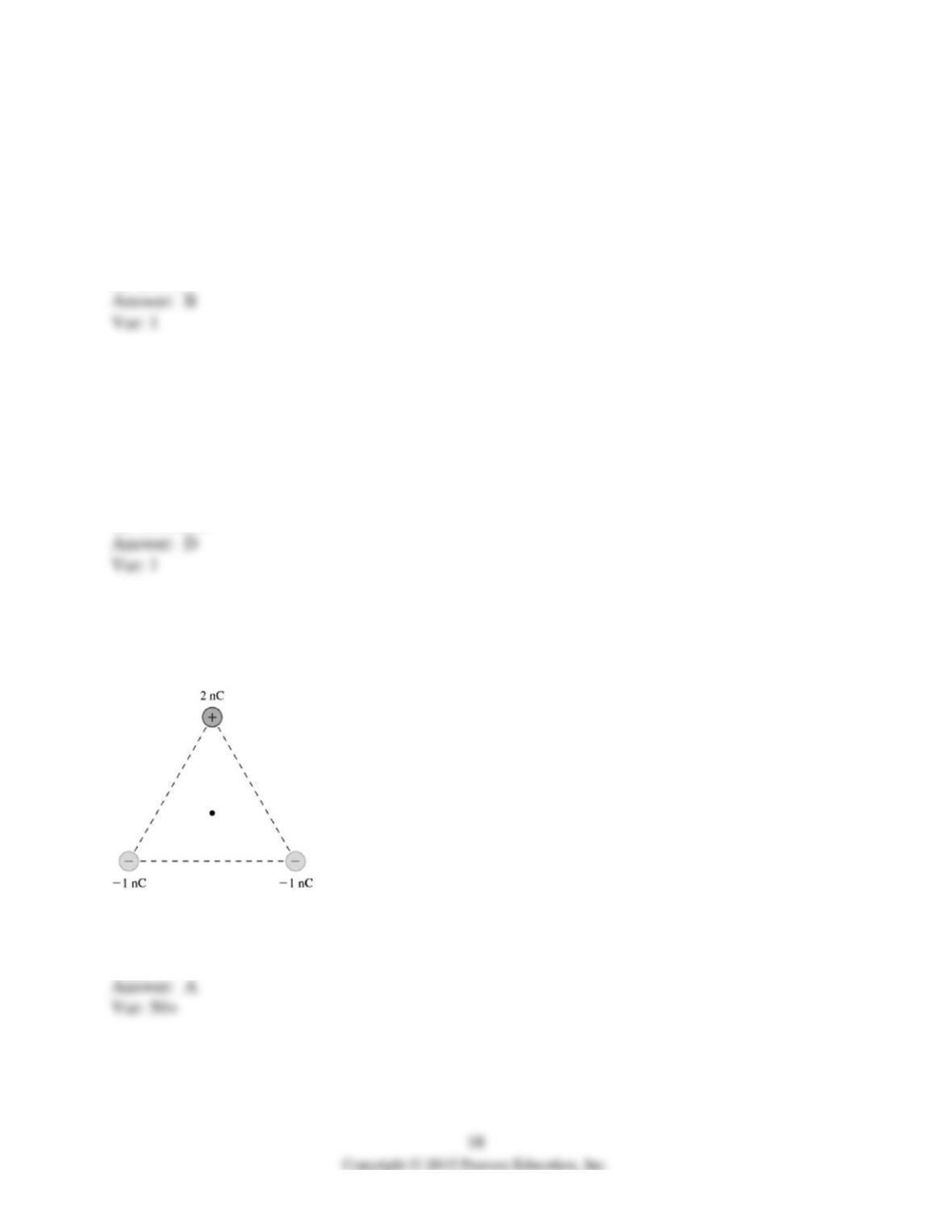
23) The three point charges shown in the figure form an equilateral triangle with sides 4.9 cm
long. What is the electric potential (relative to infinity) at the point indicated with the dot, which
is equidistant from all three charges? Assume that the numbers in the figure are all accurate to
two significant figures. (k = 1/4πε0 = 9.0 × 10⁹ N ∙ m2/C2)
A) 0.00 V
B) 1300 V
C) 640 V
D) 1900 V

19
24) Four +6.00-µC point charges are at the corners of a square 2.00 m on each side. What is the
electric potential of these charges, relative to infinity, at the center of this square? (k = 1/4πε0 =
8.99 × 10⁹ N ∙ m2/C2)
A) 76.4 kV
B) 38.2 kV
C) 306 kV
D) 153 kV
E) 61.0 kV
25) Four point charges of magnitude 6.00 μC and are at the corners of a square 2.00 m on each
side. Two of the charges are positive, and two are negative. What is the electric potential at the
center of this square, relative to infinity, due to these charges? (k = 1/4πε0 = 8.99 × 10⁹ N ∙
m2/C2)
A) 76.4 kV
B) 0 V
C) 153 kV
D) 61.0 kV
E) 306 kV
26) Two +6.0-µC charges are placed at two of the vertices of an equilateral triangle having sides
2.0 m long. What is the electric potential at the third vertex, relative to infinity, due to these
charges? (k = 1/4πε0 = 9.0 × 10⁹ N ∙ m2/C2)
A) 54 kV
B) 108 V
C) 0 V
D) 90 kV
E) 27 kV
20
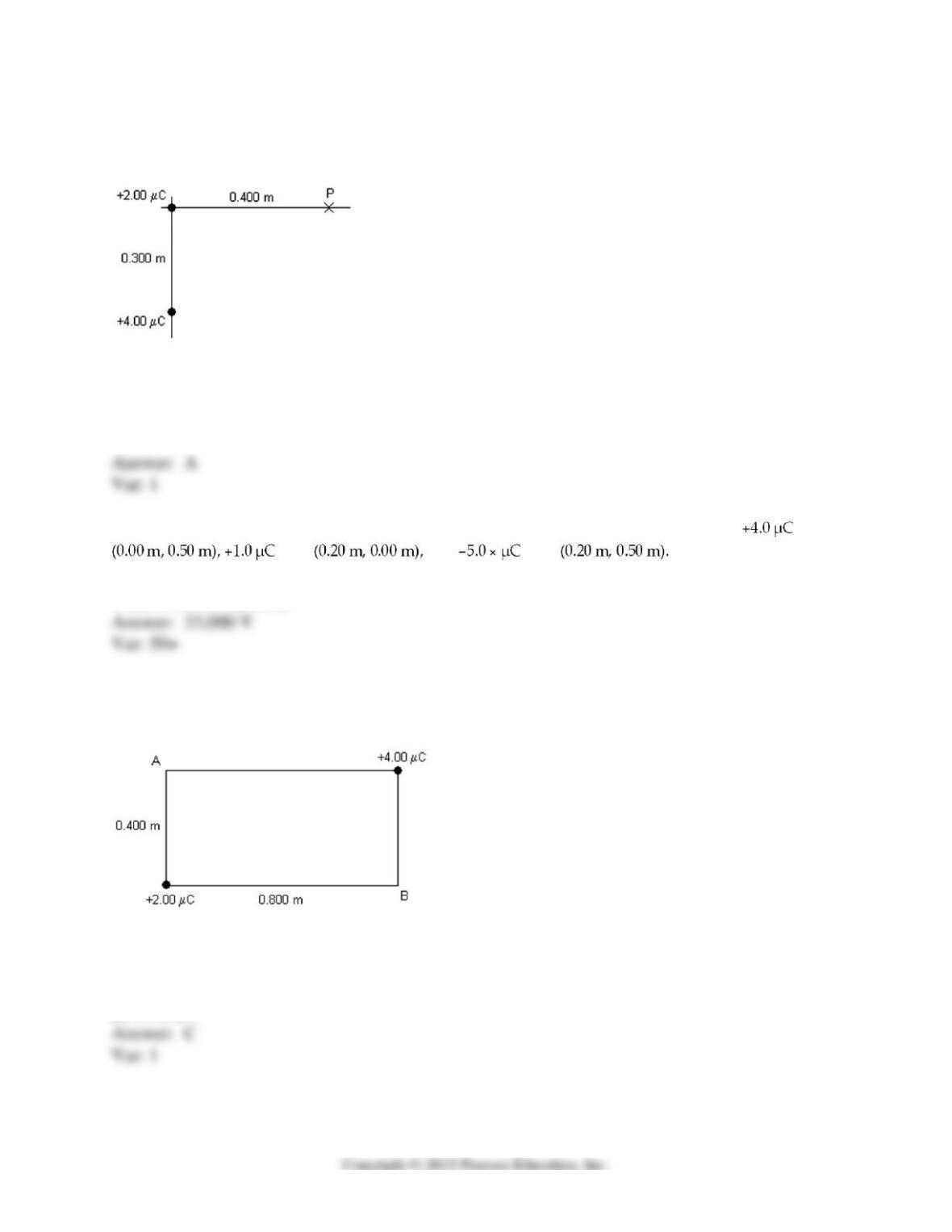
27) Two point charges of +2.00 μC and +4.00 μC are at the origin and at the point x = 0.000 m, y
= -0.300 m, as shown in the figure. What is the electric potential due to these charges, relative to
infinity, at the point P at x = 0.400 m on the x-axis? (k = 1/4πε0 = 8.99 × 10⁹ N ∙ m2/C2)
A) 117 kV
B) 15.7 kV
C) 11.7 kV
D) 56.0 kV
E) 36.0 kV
28) Three point charges are placed at the following points in a horizontal x-y plane: is at
is at and is at Calculate the
electrical potential (relative to infinity) at the origin due to these three point charges. (k = 1/4πε0
= 9.0 × 10⁹ N ∙ m2/C2)
29) Point charges +4.00 μC and +2.00 μC are placed at the opposite corners of a rectangle as
shown in the figure. What is the potential at point A, relative to infinity, due to these charges?
(k = 1/4πε0 = 8.99 × 10⁹ N ∙ m2/C2)
A) 0.899 kV
B) 8.99 kV
C) 89.9 kV
D) 899 kV
E) 8990 kV