Chapter 20 – Genes Within Populations
Clarify Question
•
What is the key concept addressed by the question?
population in Hardy-Weinberg equilibrium?
•
What type of thinking is required?
•
What key words does the question contain and what do they mean?
Gather Content
•
What do you already know about the Hardy-Weinberg principle? How does it relate to
the question?
Consider Possibilities
•
What other information is related to the question? Which information is most useful?
Choose Answer
•
Given what you now know, what information and/or problem solving approach is most
likely to produce the correct answer?
Chapter 20 – Genes Within Populations
Reflect on Process
•
Did your problem-solving process lead you to the correct answer? If not, where did the
process break down or lead you astray? How can you revise your approach to produce a
more desirable result?
50. You are studying a population of geese in which there are two color phases, brown and
gray. Color in this species is controlled by a single gene, with brown dominant to gray. A
random sample of 250 geese shows that 210 are brown. What percentage of the brown geese
are heterozygous? (Assume that the population is in Hardy-Weinberg equilibrium.)
Chapter 20 – Genes Within Populations
Clarify Question
•
What is the key concept addressed by the question?
•
What type of thinking is required?
•
What key words does the question contain and what do they mean?
Gather Content
Chapter 20 – Genes Within Populations
•
What do you already know about the Hardy-Weinberg principle? How does it relate to
the question?
Consider Possibilities
•
What other information is related to the question? Which information is most useful?
Choose Answer
•
Given what you now know, what information and/or problem solving approach is most
likely to produce the correct answer?
Reflect on Process
•
Did your problem-solving process lead you to the correct answer? If not, where did the
process break down or lead you astray? How can you revise your approach to produce a
more desirable result?
Chapter 20 – Genes Within Populations
51. Coloration in the peppered moth (Biston betularia) is determined by a single gene with
two alleles showing complete dominance. Dark moths are homozygous dominant or
heterozygous for the gene, light moths are homozygous recessive. In a sample of 100 moths,
you determine that 64 of the moths are dark. According to the Hardy-Weinberg rule, the
expected frequency of the dominant allele is ___.
Chapter 20 – Genes Within Populations
Clarify Question
•
What type of thinking is required?
•
What key words does the question contain and what do they mean?
Gather Content
•
What do you already know about the Hardy-Weinberg principle? How does it relate to
the question?
Consider Possibilities
•
What other information is related to the question? Which information is most useful?
Choose Answer
•
Given what you now know, what information and/or problem solving approach is most
Chapter 20 – Genes Within Populations
likely to produce the correct answer?
Reflect on Process
•
Did your problem-solving process lead you to the correct answer? If not, where did the
process break down or lead you astray? How can you revise your approach to produce a
more desirable result?
52. Antigens on red blood cells are hereditary traits that allow blood to be typed in different
ways. One system is based on a gene with two alleles, M and N. If the frequency of the M
allele in a population is 0.4, then according to the Hardy-Weinberg rule, the expected
frequency of the heterozygous MN genotype is ___.
Chapter 20 – Genes Within Populations
Clarify Question
•
What is the key concept addressed by the question?
•
What type of thinking is required?
•
What key words does the question contain and what do they mean?
Gather Content
•
What do you already know about the Hardy-Weinberg principle? How does it relate to
the question?
Consider Possibilities
•
What other information is related to the question? Which information is most useful?
Choose Answer
•
Given what you now know, what information and/or problem solving approach is most
likely to produce the correct answer?
Chapter 20 – Genes Within Populations
Reflect on Process
•
Did your problem-solving process lead you to the correct answer? If not, where did the
process break down or lead you astray? How can you revise your approach to produce a
53. The disease, sickle-cell anemia is common in malaria-infested areas because individuals
that are heterozygous for the gene (AS) have enhanced resistance to malaria over normal
individuals (AA). Individuals with severe sickle-cell anemia (SS) usually die before
reproduction. If this population moves to an area without malaria, what will happen to the
allele frequency of the A allele over time?
Chapter 20 – Genes Within Populations
54. A fur color gene in rabbits has a white dominant (W) and brown recessive allele (w). The
environment changes suddenly and none of the white rabbits survive. In a population of
10,000 rabbits the initial frequency of W in the pool was 0.7. How many generations would
be required to eliminate all W alleles from the population? Assume that there is no mutation
and the population meets all other Hardy-Weinberg conditions.
55. ____ would produce the smallest evolutionary change in a given period of time in a
population of birds.
Chapter 20 – Genes Within Populations
56. ______ could not be involved in gene flow.
57. Assortative and disassortative mating are similar in that both ____
58. The California populations of the Northern elephant seal are descendants from a very
small population of seals that was over-hunted in the 1890s. Heterozygosity in this population
would be expected to be ________ due to _______________.
Chapter 20 – Genes Within Populations
59. The several hundred species of picture-winged fruit flies of the Hawaiian Islands are
genetically very similar, yet they all differ markedly from their ancestral population in Asia.
This is probably an example of _____
60. An insect population that becomes resistant to a commonly used insecticide is an example
of _____.
61. The organism with the highest fitness is:
Chapter 20 – Genes Within Populations
62. A population of lizards lives in a rocky area next to a desert. Some lizards are light
colored and blend into the sand. Others are dark and blend into the rocks. What may happen
to this population of lizards over time?
Chapter 20 – Genes Within Populations
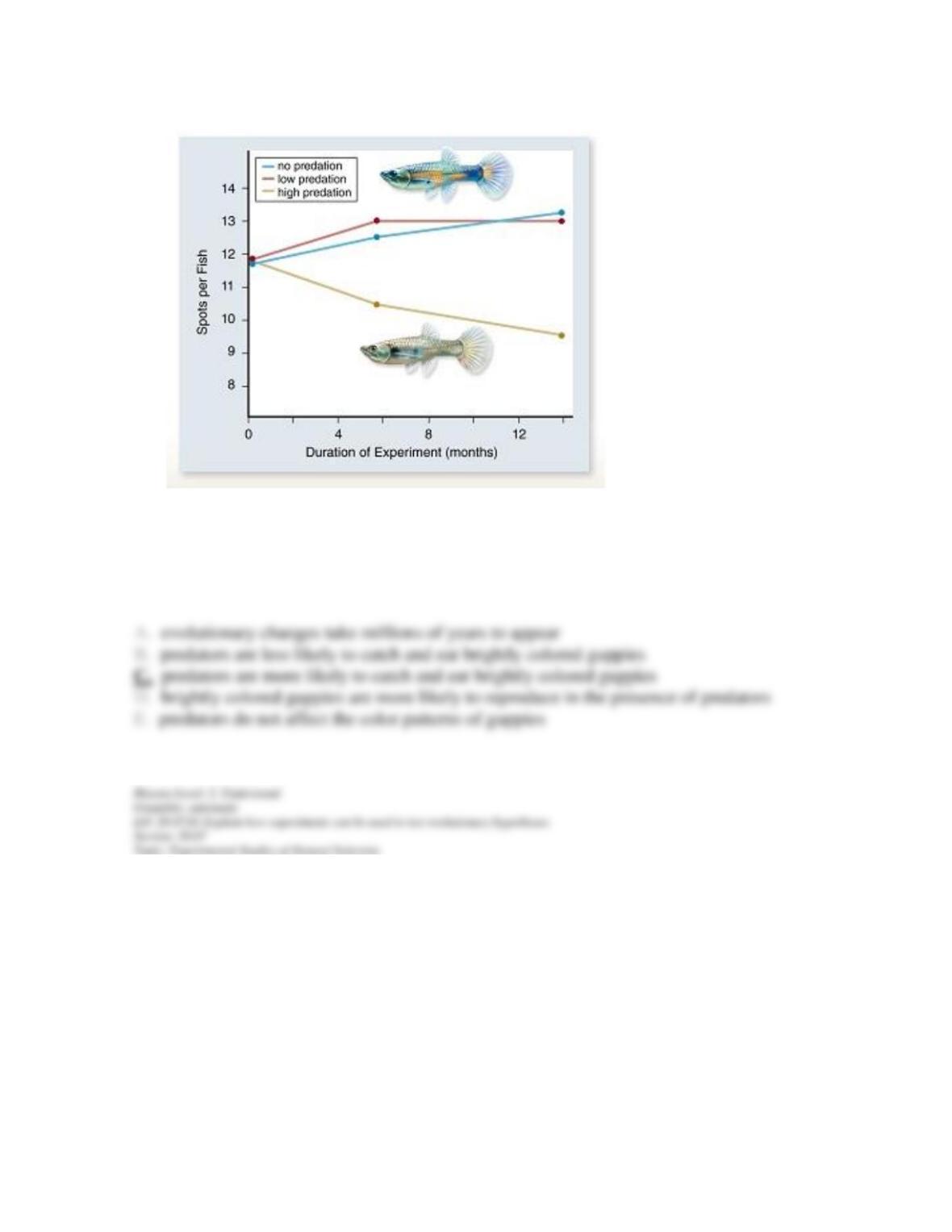
63.
In the experiment above, guppy color patterns (spots) were measured in populations exposed
to increasing amounts of predation. From this you could conclude that ____ .
Chapter 20 – Genes Within Populations
64. Both extremes of an array of phenotypes are favored in _____ .
65. In early ancestors of the modern giraffe, longer necks allowed animals to reach higher
tree branches as food. This would lead to ____ in the ancestral giraffe population.
66. The midrange of an array of phenotypes is favored in ____.
Chapter 20 – Genes Within Populations
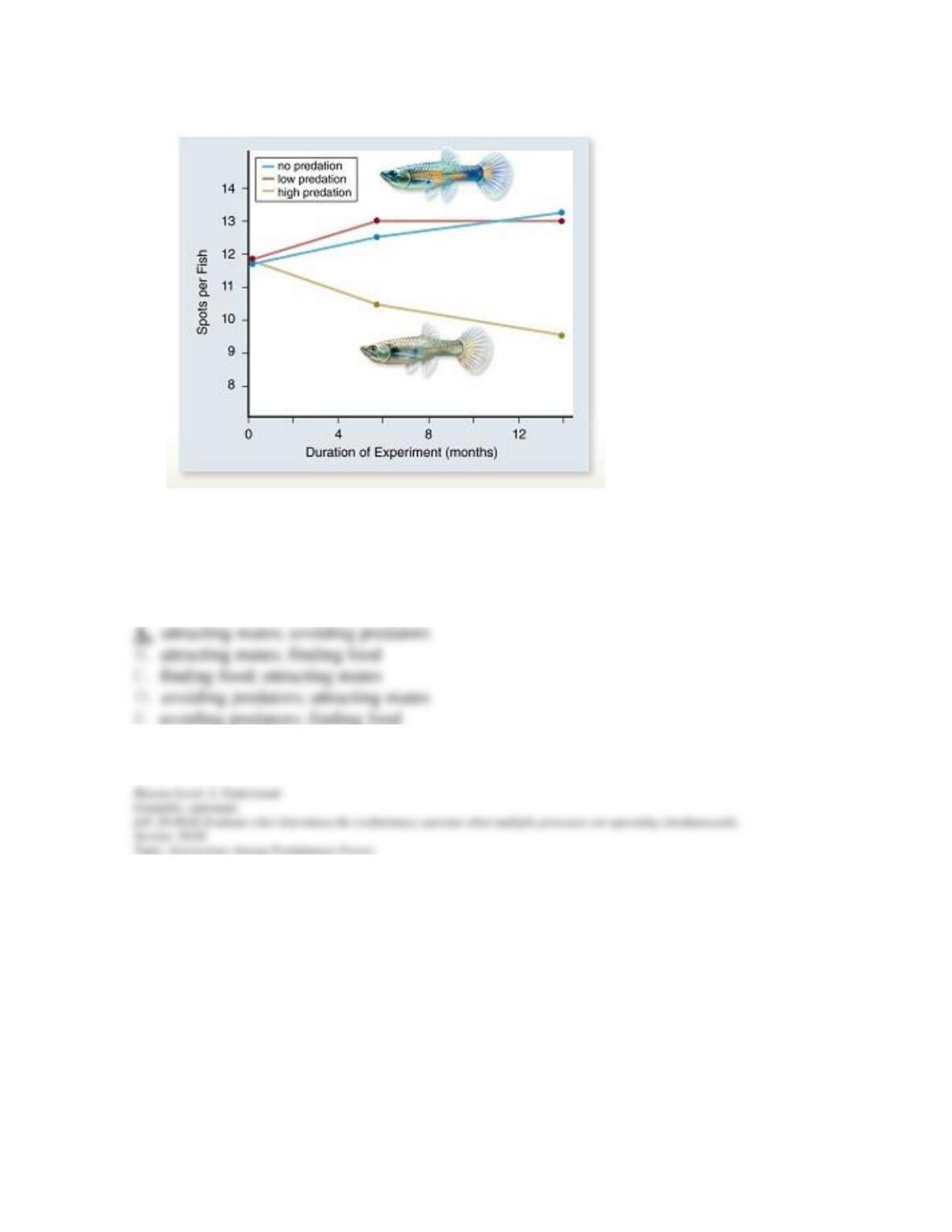
67.
Based on the graph above, the color of male guppies can be seen as a balance between
positive and negative selections. Bright colors are an advantage in _____, but a disadvantage
in _____.
Chapter 20 – Genes Within Populations
68. Many male songbirds are brightly colored. However, the color of the birds is determined
by a balance of
69. Average human males are most likely to be attracted to women with a waist to hip ratio
of 0.72. Women with this waist to hip ratio are also the most fertile. By being attracted to
women with a waist to hip ratio, a male is increasing his chances of having children and thus
improve his ____ .