4) Luther Industries is currently trading for $27 per share. The stock pays no dividends. A one-
year European put option on Luther with a strike price of $30 is currently trading for $2.60. If
the risk-free interest rate is 6% per year, then the price of a one-year European call option on
Luther with a strike price of $30 will be closest to:
A) $1.30
B) $7.10
C) $2.60
D) $1.95
5) Rose Industries is currently trading for $47 per share. The stock pays no dividends. A one–
year European call option on Luther with a strike price of $45 is currently trading for $7.45. If
the risk-free interest rate is 6% per year, then calculate the price of a one-year European put
option on Luther with a strike price of $45.
20.4 Factors Affecting Option Prices
1) Suppose that Nielson Motors stock is trading for $50 per share and that Nielson pays no
dividends. What is the maximum possible price for a call option on Nielson Motors?
A) $0
B) $20
C) $50
D) infinite
2) Suppose that Nielson Motors stock is trading for $50 per share and that Nielson pays no
dividends. What is the minimum possible price for an American put option on Nielson Motors
with a strike price of $70?
A) $0
B) $20
C) $50
D) infinite
3) Which of the following will NOT increase the value of a put option?
A) An increase in the time to maturity
B) A decrease in the stock price
C) A decrease in the stock’s volatility
D) An increase in the exercise price
4) Which of the following statements is FALSE?
A) Put-call parity gives the price of a European call option in terms of the price of a European
put, the underlying stock, and a zero-coupon bond.
B) For a given strike price, the value of a call option is higher if the current price of the stock is
higher, as there is a greater likelihood the option will end up in-the-money.
C) The value of an otherwise identical call option is higher if the strike price the holder must pay
to buy the stock is higher.
D) Because a put is the right to sell the stock, puts with a lower strike price are less valuable.
5) Which of the following statements is FALSE?
A) The intrinsic value of an option is the value it would have if it expired immediately.
B) A European option cannot be worth less than its American counterpart.
C) Put options increase in value as the stock price falls.
D) A put option cannot be worth more than its strike price.
6) Which of the following statements is FALSE?
A) Because an American option cannot be worth less than its intrinsic value, it cannot have a
negative time value.
B) An American option with a later exercise date cannot be worth less than an otherwise
identical American option with an earlier exercise date.
C) The value of an option generally decreases with the volatility of the stock.
D) The intrinsic value is the amount by which the option is currently in-the money or 0 if the
option is out-of-the-money.
7) KD Industries stock is currently trading at $32 per share. Consider a put option on KD stock
with a strike price of $30. The intrinsic value of this put option is:
A) $0
B) -$2
C) $2
D) $30
8) KD Industries stock is currently trading at $32 per share. Consider a put option on KD stock
with a strike price of $30. The maximum value of this put option is:
A) $0
B) $32
C) $30
D) $2
20.5 Exercising Options Early
Use the following information to answer the question(s) below.
Consider an American put option on Rearden Metal stock with a strike price of $60 and one year
to expiration. Assume that Rearden pays no dividends, is stock is currently trading at $15 per
share, and the one year interest rate is 5%. Also assume that it is optimal to exercise this put
option early.
1) The price of a one-year American put option on Rearden Metal with a strike price of $70 per
share is closest to:
A) $45
B) $50
C) $55
D) $60
2) The maximum value of a one-year American call option on Rearden Metal with a strike price
of $60 per share is closest to:
A) $0
B) $1.84
C) $2.48
D) $2.86
3) Consider the following equation:
C = S – K + dis(K) + P
In this equation, S – K tells us:
A) the market value of the option.
B) the time value of the option.
C) the option spread.
D) the intrinsic value of the option.
4) Consider the following equation:
C = S – K + dis(K) + P – PV(Div)
In this equation, dis(K) + P – PV(Div) tells us:
A) the market value of the option.
B) the difference in the price of an American option over a European option because of dividend
capture.
C) the intrinsic value of the option.
D) the time value of the option.
5) Which of the following statements is FALSE?
A) An American call on a non-dividend-paying stock has the same price as its European
counterpart.
B) The price of any call option on a non-dividend-paying stock always exceeds its intrinsic
value.
C) It is never optimal to exercise a call option on a dividend-paying stock early—you are always
better off just selling the option.
D) If present value of the dividend payment is large enough, the time value of a European call
option can be negative, implying that its price could be less than its intrinsic value.
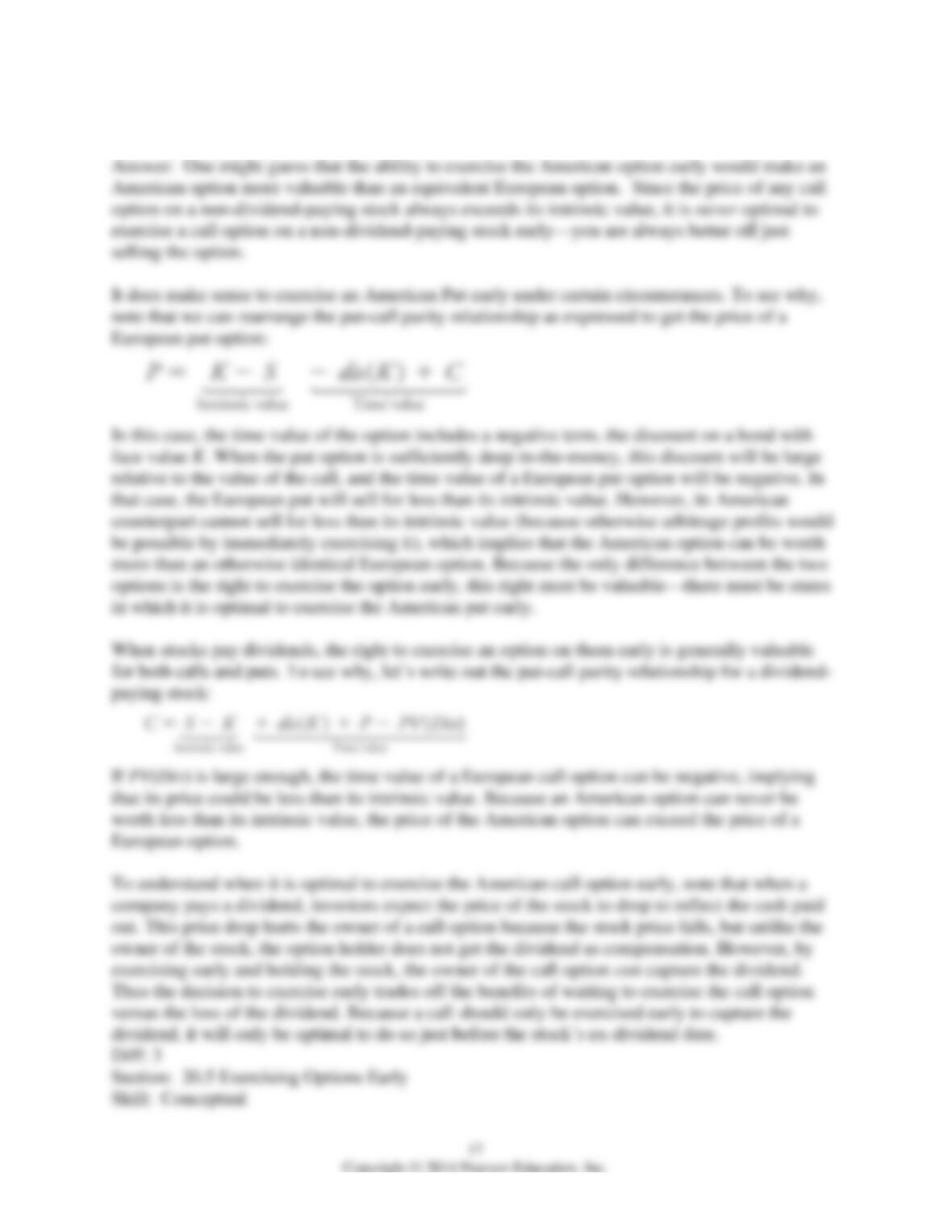
6) Describe the conditions when it would be optimal to exercise an American Call and an
American Put option prior to their expiration.
20.6 Options and Corporate Finance
Use the following information to answer the question(s) below.
Galt Industries is trading for $20 per share and has 25 million shares outstanding. Galt Industries
has a debt-equity ratio of 0.4 and its debt is zero coupon debt with a ten year maturity and a yield
to maturity of 8%.
1) In describing Galt’s equity as a call option, the maturity of this option is:
A) 5 years
B) 10 years
C) 20 years
D) infinite
2) In describing Galt’s equity as a call option, the market value of the assets underlying the call
option is:
A) $200 million
B) $300 million
C) $500 million
D) $700 million
3) In describing Galt’s equity as a call option, the strike price of the call option is:
A) $200 million
B) $300 million
C) $500 million
D) $700 million
4) In describing Galt’s debt as a put option, the strike price of the put option is:
A) $200 million
B) $300 million
C) $500 million
D) $700 million
5) Which of the following best describes Galt’s debt using a put option?
A) Long $200 million in risk free debt and Short a put option on the firm’s assets with a $200
strike price
B) Short $200 million in risk free debt and Long a put option on the firm’s assets with a $200
strike price
C) Long $200 million in risk free debt and Short a put option on the firm’s assets with a $700
strike price
D) Short $200 million in risk free debt and Long a put option on the firm’s assets with a $700
strike price
6) Which of the following best describes Galt’s debt using a call option?
A) Long $700 million in the firm’s assets and Short a call option with a $700 strike price
B) Short $700 million in the firm’s assets and Long a call option with a $700 strike price
C) Long $700 million in the firm’s assets and Short a call option with a $200 strike price
D) Short $700 million in the firm’s assets and Long a call option with a $200 strike price
7) Which of the following statements is FALSE?
A) The option price is more sensitive to changes in volatility for at-the-money options than it is
for in-the-money options.
B) A share of stock can be thought of as a put option on the assets of the firm with a strike price
equal to the value of debt outstanding.
C) In the context of corporate finance, equity is at-the-money when a firm is close to bankruptcy.
D) Because the price of equity is increasing with the volatility of the firm’s assets, equity holders
benefit from a zero-NPV project that increases the volatility of the firm’s assets.
8) Which of the following statements is FALSE?
A) If the value of the firm’s assets exceeds the required debt payment, debt holders are fully
repaid.
B) Another way to view corporate debt: as a portfolio of riskless debt and a short position in a
call option on the firm’s assets with a strike price equal to the required debt payment.
C) Viewing debt as an option portfolio is useful as it provides insight into how credit spreads for
risky debt are determined.
D) You can think of the debt holders as owning the firm and having sold a call option with a
strike price equal to the required debt payment.
9) A credit default swap is essentially a:
A) put option on the firm’s assets.
B) call option on the firm’s assets.
C) put option on the firm’s debt.
D) call option on the firm’s debt.
10) With a(n) ________, the buyer pays a premium to the seller and receives a payment from the
seller to make up for the loss if the underlying bond defaults.
A) equity option swap
B) credit default swap
C) risk-free swap
D) interest rate swap