
Exam
Name___________________________________
MULTIPLE CHOICE. Choose the one alternative that best completes the statement or answers the question.
1)
The main goal of paleoclimatology is to understand the climate of the past in order to ________.
1)
A)
positively identify why some species died out and others remain on Earth
B)
assess the current and potential future climate in the context of natural climate variability
C)
discover the changes in climate through geologic time and correlate it with gas composition
changes in the atmosphere
D)
all of the above
2)
Modern climate change is dominated by ________.
2)
A)
human influences that exceed the bounds of natural variability
B)
orbital fluctuations of Earth
C)
glacier melting
3)
The 2013 IPCC report states that if there is a doubling of preindustrial level of carbon dioxide there
will be a “likely temperature increase” in the range of ________.
3)
A)
2 to 4.5°C
B)
greater than 4.5°C
C)
less than 1.5°C
D)
1.5 to 2.5°C
4)
Types of climate–feedback mechanisms consist of ________.
4)
A)
negative–feedback mechanisms
B)
positive–feedback mechanisms
C)
neutral–feedback mechanisms
D)
both A and B

5)
What are the solid and liquid particles suspended within the atmosphere called?
5)
A)
aerosols
B)
water vapor
C)
trace gases
D)
ozone
6)
Ozone is a major component in a noxious mixture of gases and particles called ________.
6)
A)
photochemical smog
B)
water vapor
C)
aerosols
D)
chlorofluorocarbons
E)
trace gases
7)
The natural cause(s) of climate change is(are) ________.
7)
A)
movement of lithospheric plates farther/closer to the equator
B)
variability in Earth’s orbit
C)
variability in Earth’s orbit and volcanic activity
D)
volcanic activity
E)
all of the above
8)
Global warming since the mid–1970s has been about ________.
8)
A)
0.6°C
B)
0.8°C
C)
1.0°C
D)
0.4°C
9)
Variations in the angle that Earth‘s axis makes with the plane of it’s orbit is called ________.
9)
A)
eccentricity
B)
obliquity
C)
precession
D)
axis precession

10)
Solar radiation is reflected back to space from ________.
10)
A)
land–sea surface
B)
clouds
C)
snow and ice
D)
atmosphere
E)
all of the above
11)
The hotter the radiating body, ________.
11)
A)
the shorter the wavelength of maximum radiation
B)
the wavelength of maximum radiation does not change
C)
the longer the wavelength of maximum radiation
A
Explanation:
12)
Proxy data for detecting climate change comes from ________.
12)
A)
seafloor sediments
B)
sunspots
C)
tropical deforestation
D)
all of the above
A
Explanation:
13)
What percent of the solar energy reaching the top of the atmosphere passes through the
atmosphere and is absorbed at Earth’s surface?
13)
A)
30 percent
B)
50 percent
C)
20 percent
D)
40 percent
B
Explanation:
E
Explanation:

14)
How do aerosols affect climate?
14)
A)
reflecting sunlight back to space
B)
making clouds “brighter” reflectors
C)
absorbing sunlight, not reflecting it back to space
D)
both A and B
E)
both B and C
15)
Ozone, another important component of the atmosphere is concentrated in the ________.
15)
A)
troposphere
B)
thermosphere
C)
mesosphere
D)
stratosphere
16)
Earth’s atmosphere is divided vertically into four layers on the basis of temperature. The layers, in
order from bottom to top, are ________.
16)
A)
troposphere, stratosphere, mesosphere, thermosphere
B)
stratosphere, troposphere, mesosphere, thermosphere
C)
mesosphere, thermosphere, stratosphere, troposphere
D)
thermosphere, mesosphere, stratosphere, troposphere
17)
The climate system consists of the ________.
17)
A)
geosphere and cryosphere
B)
biosphere
C)
hydrosphere and atmosphere
D)
all of the above
18)
One half of the atmosphere lies below an altitude of ________.
18)
A)
100 kilometers
B)
3.7 kilometers
C)
16 kilometers
D)
5.6 kilometers

19)
Clean, dry air is composed almost entirely of ________.
19)
A)
oxygen
B)
nitrogen
C)
oxygen and carbon dioxide
D)
nitrogen and oxygen
E)
carbon dioxide
20)
Seafloor sediments are very important in discovering paleoclimate because they ________.
20)
A)
contain the remains of organisms whose numbers and types vary with changing climate
B)
show a record of temperature in the oceans, which can then be correlated to the temperature
of the atmosphere
C)
contain meteorites that show when the climate had a drastic fluctuation
D)
all of the above
A
21)
Climate is a description of the ________.
21)
A)
state of the atmosphere at a given time and place
B)
central component of the complex, connected global environmental system on which all life
depends
C)
exchange of energy and moisture
D)
aggregate weather conditions, “average weather”
D
22)
The trace gas(es) that are most important are ________.
22)
A)
methane and nitrous oxide
B)
methane
C)
chlorofluorocarbons
D)
nitrous oxide
E)
all of the above
E
D

23)
Oxygen isotope analysis is the measurement of two isotopes of oxygen (18O and 16O). The lighter
isotope, 16O, ________.
23)
A)
is more prevalent in glaciers
B)
is more prevalent in precipitation
C)
evaporates more readily from the oceans
D)
all of the above
SHORT ANSWER. Write the word or phrase that best completes each statement or answers the question.
24)
Light, heat, and ultraviolet rays are part of a large array of energy from the Sun called
________.
24)
25)
Feedback mechanisms that produce results that are just the opposite of the initial change
are called ________.
25)
Word Analysis. Examine the words and/or phrases for each question below and determine the relationship among the
majority of words/phrases. Choose the option that does not fit the pattern.
26)
a. paleoclimatology b. sea–level rise c. increasing ocean acidity d. arctic
changes
26)
27)
The best–known features on the surface of the Sun are dark blemishes called ________.
27)
28)
The________ isotopes in the hard skeletons of corals are an important paleothermometer.
28)
29)
Gases are selective absorbers and ________ of radiation.
29)
Word Analysis. Examine the words and/or phrases for each question below and determine the relationship among the
majority of words/phrases. Choose the option that does not fit the pattern.
30)
a. fire b. overgrazing of lands c. ground cover alteration d.
drought
30)

31)
a. solar variability b. volcanic activity c. movement of lithospheric plates d.
deforestation
31)
32)
a. nitrogen b. oxygen c. carbonic acid d. argon
32)
33)
________ is 20 times more effective than carbon dioxide at absorbing infrared radiation
emitted by Earth.
33)
34)
Scientists who analyze proxy data and reconstruct past climates are studying ________.
34)
35)
The role of carbon dioxide and methane in the atmosphere plays in heating Earth’s surface
has been named the ________.
35)
Word Analysis. Examine the words and/or phrases for each question below and determine the relationship among the
majority of words/phrases. Choose the option that does not fit the pattern.
36)
a. methane b. chlorofluorocarbons c. nitrous oxide d. oxygen
36)
37)
a. eccentricity b. precession c. ubiquity d. obliquity
37)
38)
a. geosphere b. troposphere c. biosphere d. hydrosphere
38)
39)
Gases are called ________ gases because their concentrations are so much smaller than that
of carbon dioxide.
39)
40)
In 1883, ________ erupted and emitted great quantities of sulfur dioxide gas that cooled the
global mean temperature.
40)

Word Analysis. Examine the words and/or phrases for each question below and determine the relationship among the
majority of words/phrases. Choose the option that does not fit the pattern.
41)
a. nuclear power b. coal c. natural gas d. petroleum
41)
42)
The reflectivity of surfaces is called ________.
42)
43)
Oxygen isotopes (18O and 16O) are used to determine ________.
43)
Word Analysis. Examine the words and/or phrases for each question below and determine the relationship among the
majority of words/phrases. Choose the option that does not fit the pattern.
44)
a. thermosphere b. mesosphere c. troposphere d.
meteorsphere
44)
45)
The temperature decrease in the troposphere is called the ________.
45)
46)
Carbon dioxide is transparent to incoming ________ solar radiation.
46)
TRUE/FALSE. Write ‘T’ if the statement is true and ‘F’ if the statement is false.
47)
The 2013 IPCC report states if there is a doubling of the preindustrial level of carbon dioxide, the
“likely temperature increase” will be higher than 5°C.
47)
48)
Hotter objects radiate more total energy per unit area than do colder objects.
48)
49)
Methane is produced by anaerobic bacteria.
49)
50)
Past temperatures are determined by oxygen isotope analysis.
50)

51)
Most of the long–wavelength radiation from the Sun passes through the atmosphere and is
absorbed by Earth’s land–sea surface.
51)
52)
Oxygen isotope analysis is the precise measurement of the ratio between two isotopes of oxygen.
52)
53)
One half of the atmosphere lies below an altitude of 5.6 kilometers.
53)
54)
Research indicates that sea level has risen between 10 and 23 centimeters (4 and 8 inches) in the
past century.
54)
55)
Studies indicate that prolonged periods when sunspots were absent (or nearly so) on the sun
corresponded closely with warm periods in Europe and North America.
55)
56)
Volcanic clouds that remain in the stratosphere for a year or more are composed largely of
carbonic–acid droplets.
56)
57)
The use of coal and other fuels is the most prominent means by which humans add carbon dioxide
to the atmosphere.
57)
ESSAY. Write your answer in the space provided or on a separate sheet of paper.
Critical thinking and discussion questions. Use complete sentences, correct spelling, and the information presented in
chapter 20 to answer the questions below.
58)
What are some of the human impacts on global climate change? What are the possible consequences of global
warming? Discuss the projected changes and estimated probability of certain global warming effects occurring.
59)
Earth’s atmosphere is divided vertically into four layers on the basis of temperature. What are the layers in
order from closest to Earth to farthest, and how do they differ?
60)
What are the significant differences between global warming by greenhouse gases and aerosol cooling?
61)
Explain why the atmosphere is heated mostly by radiation from the Earth’s surface rather than by direct solar
radiation.
62)
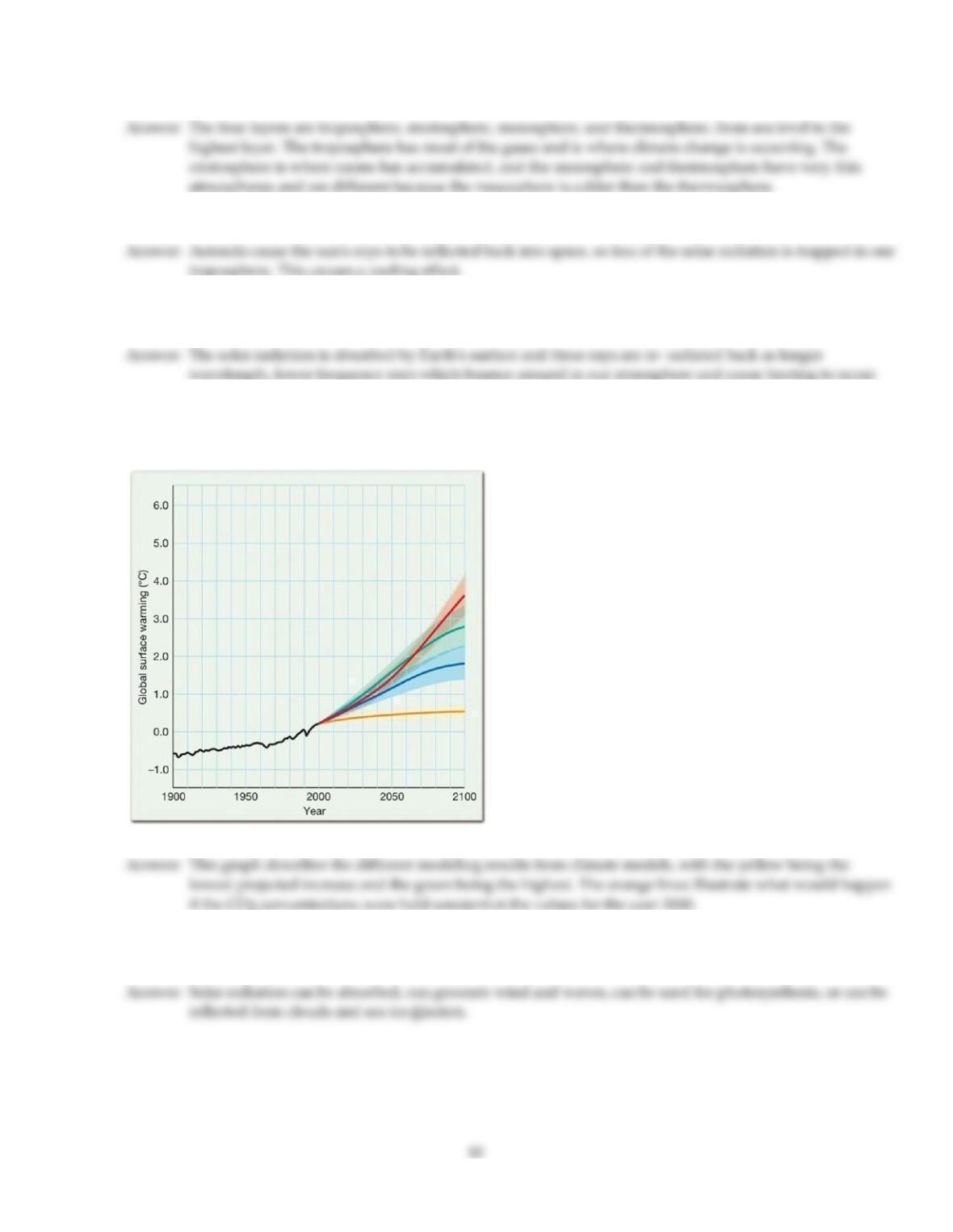
What scenarios is this graph describing? How does the orange line compare to the other colored lines on the
graph?
63)
Discuss the various fates of incoming solar energy when penetrating Earth’s atmosphere. Is it absorbed or
reflected, or both?

64)
Discuss the three major volcanic events covered in the chapter and how the affected climate change. Also,
analyze the Cretaceous Period climate and how it was related to volcanic activity.

Answer Key
Testname: C20
Answer Key
Testname: C20
13