104. Figure 10-3.
Bortello Corporation produces high-quality leather boots. The company has a standard cost system and has set
the following standards for materials and labor:
Leather (12 strips @ $20)
$240
Direct labor (10 hours @ $12)
$120
Total prime cost
$360
During the year Bortello produced 125 boots. Actual leather purchased was 1,700 strips, at $16 per strip. There were no beginning or ending
inventories of leather. Actual direct labor was 1,500 hours at $15 per hour.
Refer to Figure 10-3. Compute the costs of leather and direct labor that should have been incurred for the production of 125 boots.
105. Figure 10-5.
Seaside Company produces picture frames. During the year 190,000 picture frames were produced.
Materials and labor standards for producing the picture frames are as follows:
Direct materials (2 pieces of wood @ $2.25)
$4.50
Direct labor (2 hours @ $10)
$20.00
Seaside purchased and used 400,000 pieces of wood at $2.00 each and its actual labor hours were
360,000 hours at a wage rate of $10.50.
Refer to Figure 10-5. What is the materials price variance?
106. Figure 10-5.
Seaside Company produces picture frames. During the year 190,000 picture frames were produced.
Materials and labor standards for producing the picture frames are as follows:
Direct materials (2 pieces of wood @ $2.25)
$4.50
Direct labor (2 hours @ $10)
$20.00
Seaside purchased and used 400,000 pieces of wood at $2.00 each and its actual labor hours were
360,000 hours at a wage rate of $10.50.
Refer to Figure 10-5. What is the materials usage variance?
107. Figure 10-5.
Seaside Company produces picture frames. During the year 190,000 picture frames were produced.
Materials and labor standards for producing the picture frames are as follows:
Direct materials (2 pieces of wood @ $2.25)
$4.50
Direct labor (2 hours @ $10)
$20.00
Seaside purchased and used 400,000 pieces of wood at $2.00 each and its actual labor hours were
360,000 hours at a wage rate of $10.50.
Refer to Figure 10-5. What is Seaside’s labor rate variance?
108. Figure 10-5.
Seaside Company produces picture frames. During the year 190,000 picture frames were produced.
Materials and labor standards for producing the picture frames are as follows:
Direct materials (2 pieces of wood @ $2.25)
$4.50
Direct labor (2 hours @ $10)
$20.00
Seaside purchased and used 400,000 pieces of wood at $2.00 each and its actual labor hours were
360,000 hours at a wage rate of $10.50.
Refer to Figure 10-5. What is Seaside’s total labor variance?
109. Which of the following is true regarding direct labor variances?
110. The labor rate variance is computed by
111. The labor efficiency variance is calculated by the equation
112. Which of the following is not true regarding the use of labor variance information?
113. Kaizen costing involves:
114. Which of the following is not true about Kaizen Standards?
115. Claire Company uses a standard costing system. The following information pertains to direct labor costs
for February:
Standard direct labor rate per hour
$15.00
Actual direct labor rate per hour
$13.50
Labor rate variance
$18,000 F
Actual output
1,000 units
Standard hours allowed for actual production
10,000 hours
What is the total labor budget variance for Claire Company?
116. Claire Company uses a standard costing system. The following information pertains to direct labor costs
for February:
Standard direct labor rate per hour
$15.00
Actual direct labor rate per hour
$13.50
Labor rate variance
$18,000 F
Actual output
1,000 units
Standard hours allowed for actual production
10,000 hours
How many actual labor hours were worked during February for Claire Company?
117. If the actual labor rate exceeds the standard labor rate and the actual labor hours exceed the number of
hours allowed, the labor rate variance and labor efficiency variance will be
Labor Rate Labor Efficiency
Variance Variance

118. During January, 7,000 direct labor hours were worked at a standard cost of $20 per hour. If the direct labor
rate variance for January was $17,500 favorable, the actual cost per direct labor hour must be
119. During October, 10,000 direct labor hours were worked at a standard cost of $10 per hour. If the direct
labor rate variance for October was $4,000 unfavorable, the actual cost per direct labor hour must be
120. Bender Corporation produced 100 units of Product AA. The total standard and actual costs for materials
and direct labor for the 100 units of Product AA are as follows:
Material
s:
Standard
Actual
Standard:
200 pounds at $3.00 per pound
$600
Actual:
220 pounds at $2.85 per pound
$627
Direct
labor:
Standard:
400 hours at $15.00 per hour
6,000
Actual:
368 hours at $16.50 per hour
6,072
What is the labor efficiency variance for Bender Corporation?
121. Figure 10-4.
High Fliers Company produces model airplanes. During the month of November, it produced 2,000 planes. The
actual labor hours were 7 hours per plane. Its standard labor hours are 10 hours per plane. The standard labor
rate is $11 per hour. At the end of November, High Fliers found that it had a favorable labor rate variance of
$10,500.
Refer to Figure 10-4. What was High Fliers’ actual cost per labor hour?
122. Figure 10-4.
High Fliers Company produces model airplanes. During the month of November, it produced 2,000 planes. The
actual labor hours were 7 hours per plane. Its standard labor hours are 10 hours per plane. The standard labor
rate is $11 per hour. At the end of November, High Fliers found that it had a favorable labor rate variance of
$10,500.
Refer to Figure 10-4. What was High Fliers’ total labor variance?
123. Figure 10-6.
Extreme Builders constructs houses. The standard labor rate is $25 per hour and the standard number of hours is
15,000 hours per home. During the year, it constructed 12 homes using 18,000 labor hours per home and a rate
of $28 per hour.
Refer to Figure 10-6. Calculate the Extreme Builders’ labor rate variance.
124. Figure 10-6.
Extreme Builders constructs houses. The standard labor rate is $25 per hour and the standard number of hours is
15,000 hours per home. During the year, it constructed 12 homes using 18,000 labor hours per home and a rate
of $28 per hour.
Refer to Figure 10-6. Calculate the labor efficiency variance.
125. Assume that SQ = Standard Quantity, SP = Standard Price, AQ = Actual Quantity, and AP = Actual Price.
The correct entry along with the equation to record the issuance and usage of materials, assuming a favorable
materials usage variance, is as follows
126. Which of the following is true regarding the disposition of materials and labor variances?
127. During September, a small roofing company purchased 500 bundles of a certain type of shingle at a price
of $35 per bundle, $5 less than the standard price. Its standard quantity of this type of shingle is 550 bundles.
What is the journal entry to record the purchase of materials?
128. During June, Cisco Company produced 15,000 chainsaw blades. The standard quantity of material allowed
per unit was 1.5 pounds of steel per blade at a standard cost of $5 per pound. The actual purchase price was
$6.25 per pound. Cisco determined that it had a favorable materials usage variance of $2,500 for June. What is
the journal entry to record the issuance and usage of materials?
129. Figure 10-7.
During April, a small roofing company purchased 700 bundles of a certain type of shingle at a price of $35 per
bundle, $8 more than the standard price. Its standard quantity of this type of shingle is 725 bundles.
Refer to Figure 10-7. What is the journal entry to record the issuance and usage of materials assuming that the
roofing company purchased and used 700 bundles?
130. Figure 10-7.
During April, a small roofing company purchased 700 bundles of a certain type of shingle at a price of $35 per
bundle, $8 more than the standard price. Its standard quantity of this type of shingle is 725 bundles.
Refer to Figure 10-7. What is the journal entry to record the purchase of materials?
131. Figure 10-8.
The Perfect Tool Company (South America Division) produced 80,000 saw blades during the year. It took 1.5
hours of labor per blade at a rate of $8.50 per hour. However, its standard labor rate is $8.00. Its labor efficiency
variance was an unfavorable $40,000.
Refer to Figure 10-8. What is Perfect’s standard hours allowed for a volume of 80,000 blades?
132. Figure 10-8.
The Perfect Tool Company (South America Division) produced 80,000 saw blades during the year. It took 1.5
hours of labor per blade at a rate of $8.50 per hour. However, its standard labor rate is $8.00. Its labor efficiency
variance was an unfavorable $40,000.
Refer to Figure 10-8. What is Perfect’s labor rate variance?
133. Figure 10-8.
The Perfect Tool Company (South America Division) produced 80,000 saw blades during the year. It took 1.5
hours of labor per blade at a rate of $8.50 per hour. However, its standard labor rate is $8.00. Its labor efficiency
variance was an unfavorable $40,000.
Refer to Figure 10-8. What is the journal entry to record both labor variances?
134. Figure 10-9.
James Company manufactures t-shirts. During the year, it manufactured 250,000 t-shirts, using 2 hours of direct
labor at a rate of $8.50 per hour. The materials and labor standards for manufacturing the t-shirts are:
Direct materials (6 yards of fabric @ $3 per yard)
$18
Direct labor (2.4 hours @ $8.00 per hour)
17
It took James 1,400,000 yards at $2.50 per yard to make the 250,000 t-shirts.
Refer to Figure 10-9. What is James’ materials price variance assuming that materials purchased equals materials used?
135. Figure 10-9.
James Company manufactures t-shirts. During the year, it manufactured 250,000 t-shirts, using 2 hours of direct
labor at a rate of $8.50 per hour. The materials and labor standards for manufacturing the t-shirts are:
Direct materials (6 yards of fabric @ $3 per yard)
$18
Direct labor (2.4 hours @ $8.00 per hour)
17
It took James 1,400,000 yards at $2.50 per yard to make the 250,000 t-shirts.
Refer to Figure 10-9. What is James’ materials usage variance?
136. Figure 10-9.
James Company manufactures t-shirts. During the year, it manufactured 250,000 t-shirts, using 2 hours of direct
labor at a rate of $8.50 per hour. The materials and labor standards for manufacturing the t-shirts are:
Direct materials (6 yards of fabric @ $3 per yard)
$18
Direct labor (2.4 hours @ $8.00 per hour)
17
It took James 1,400,000 yards at $2.50 per yard to make the 250,000 t-shirts.
Refer to Figure 10-9. What is James’ labor rate variance?
137. Figure 10-9.
James Company manufactures t-shirts. During the year, it manufactured 250,000 t-shirts, using 2 hours of direct
labor at a rate of $8.50 per hour. The materials and labor standards for manufacturing the t-shirts are:
Direct materials (6 yards of fabric @ $3 per yard)
$18
Direct labor (2.4 hours @ $8.00 per hour)
17
It took James 1,400,000 yards at $2.50 per yard to make the 250,000 t-shirts.
Refer to Figure 10-9. What is James’ labor efficiency variance?
138. Figure 10-9.
James Company manufactures t-shirts. During the year, it manufactured 250,000 t-shirts, using 2 hours of direct
labor at a rate of $8.50 per hour. The materials and labor standards for manufacturing the t-shirts are:
Direct materials (6 yards of fabric @ $3 per yard)
$18
Direct labor (2.4 hours @ $8.00 per hour)
17
It took James 1,400,000 yards at $2.50 per yard to make the 250,000 t-shirts.
Refer to Figure 10-9. What is the entry to record the purchase of materials?
139. Figure 10-9.
James Company manufactures t-shirts. During the year, it manufactured 250,000 t-shirts, using 2 hours of direct
labor at a rate of $8.50 per hour. The materials and labor standards for manufacturing the t-shirts are:
Direct materials (6 yards of fabric @ $3 per yard)
$18
Direct labor (2.4 hours @ $8.00 per hour)
17
It took James 1,400,000 yards at $2.50 per yard to make the 250,000 t-shirts.
Refer to Figure 10-9. What is the entry to record the issuance and usage of materials?
140. Figure 10-9.
James Company manufactures t-shirts. During the year, it manufactured 250,000 t-shirts, using 2 hours of direct
labor at a rate of $8.50 per hour. The materials and labor standards for manufacturing the t-shirts are:
Direct materials (6 yards of fabric @ $3 per yard)
$18
Direct labor (2.4 hours @ $8.00 per hour)
17
It took James 1,400,000 yards at $2.50 per yard to make the 250,000 t-shirts.
Refer to Figure 10-9. What is the entry to close the variances of labor and materials?
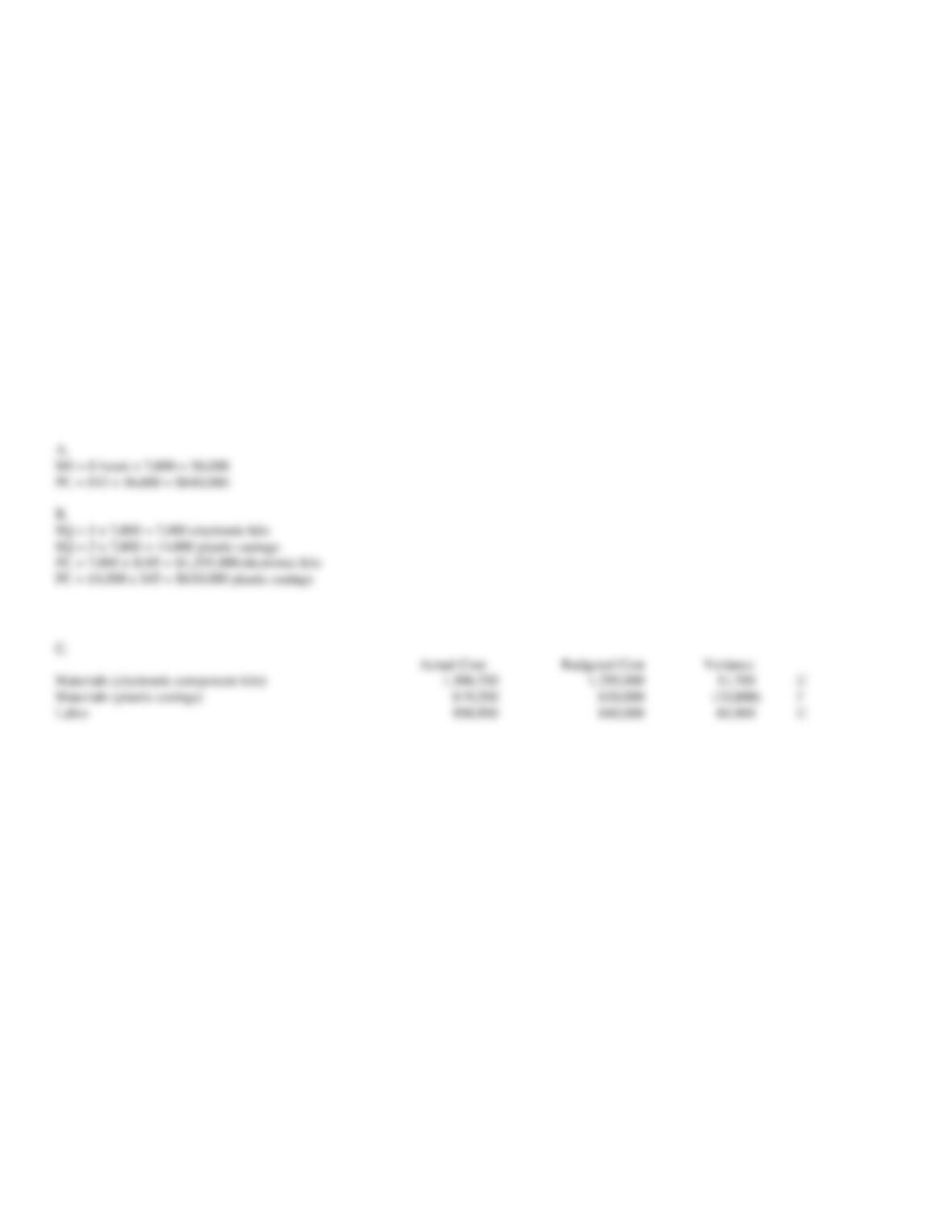
141. Top Notch Music Inc. produces car stereos. During the year Top Notch Music produced 7,000
stereos. Materials and labor standards for producing these units are as follows:
Direct materials (1 electronic component kit @ $185)
185
Direct materials (2 plastic casing @ $45)
90
Direct labor (8 hours @ $15)
120
Required:
A. Compute the standards hours allowed for a volume of 7,000 stereos and the planned cost.
B. Compute the standard number of kits and casings allowed for a value of 7,000 units and the planned cost for each direct material.
C. Compute the total budget variances for materials and labor assuming that actual number of electronic kits purchased and used were
7,300 at a price of $179 and actual plastic casings purchased were 14,400 at a price of $43. Actual labor was 57,200 hours at $15.75
per hour.
SH = 8 hours x 7,000 = 56,000
PC = $15 x 56,000 = $840,000
SQ = 1 x 7,000 = 7,000 electronic kits
SQ = 2 x 7,000 = 14,000 plastic casings
PC = 7,000 x $185 = $1,295,000 electronic kits
PC = 14,000 x $45 = $630,000 plastic casings
Actual Cost
Budgeted Cost
Variance
Materials (electronic component kits)
1,306,700
1,295,000
11,700
U
Materials (plastic casings)
619,200
630,000
(10,800)
F
Labor
900,900
840,000
60,900
U
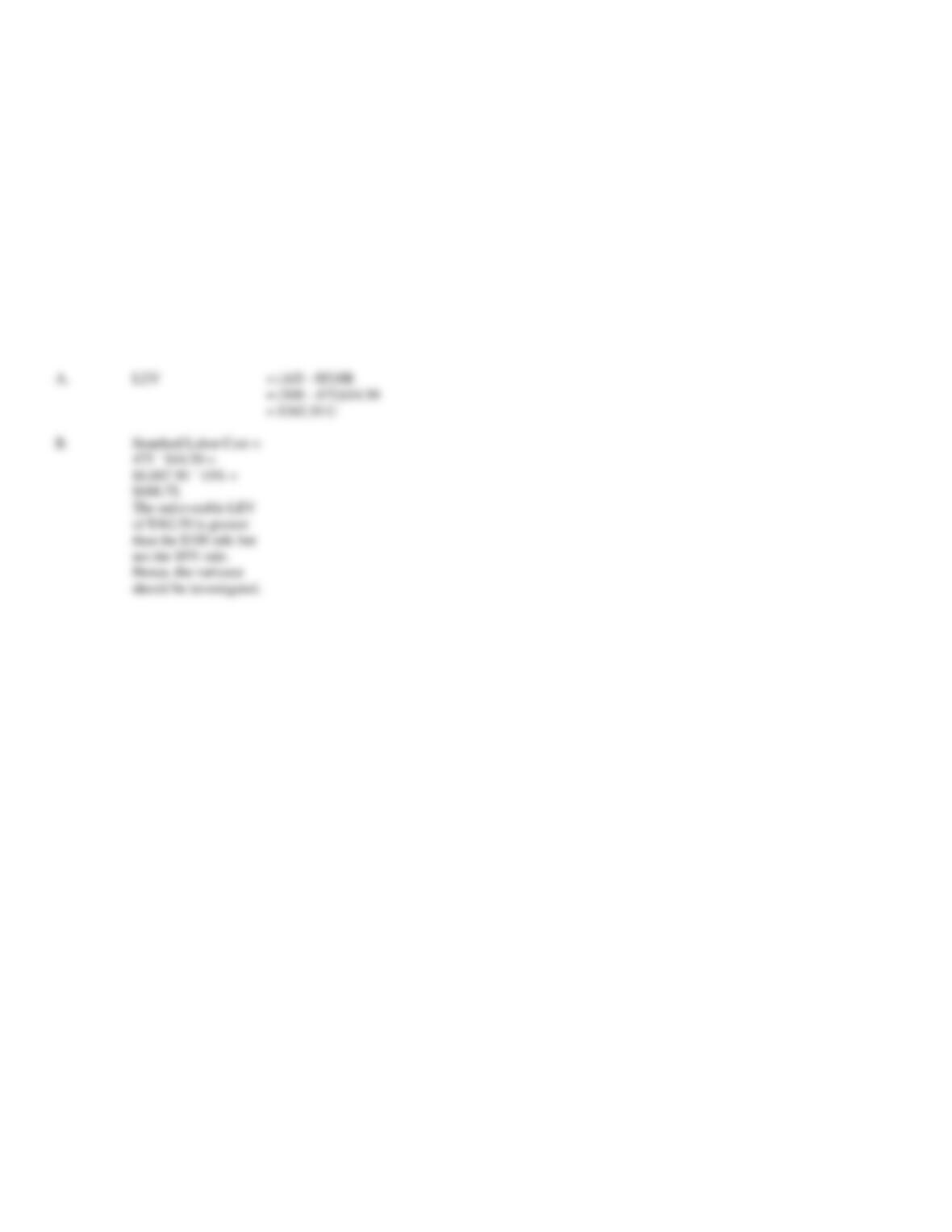
142. Leeds Company uses the following rule to determine whether labor efficiency variances should be
investigated:
A labor efficiency variance will be investigated when the variance is greater than either $100 or 10 percent of
the standard labor cost.
During September, the company used 500 direct labor hours at a rate of $15 per hour. Its standard rate is 475
direct labor hours at a rate of $14.50 per hour.
A.
Determine the company’s labor efficiency variance and whether it is favorable or unfavorable.
B.
Should the variance be investigated?
= (500 – 475)$14.50
= $362.50 U
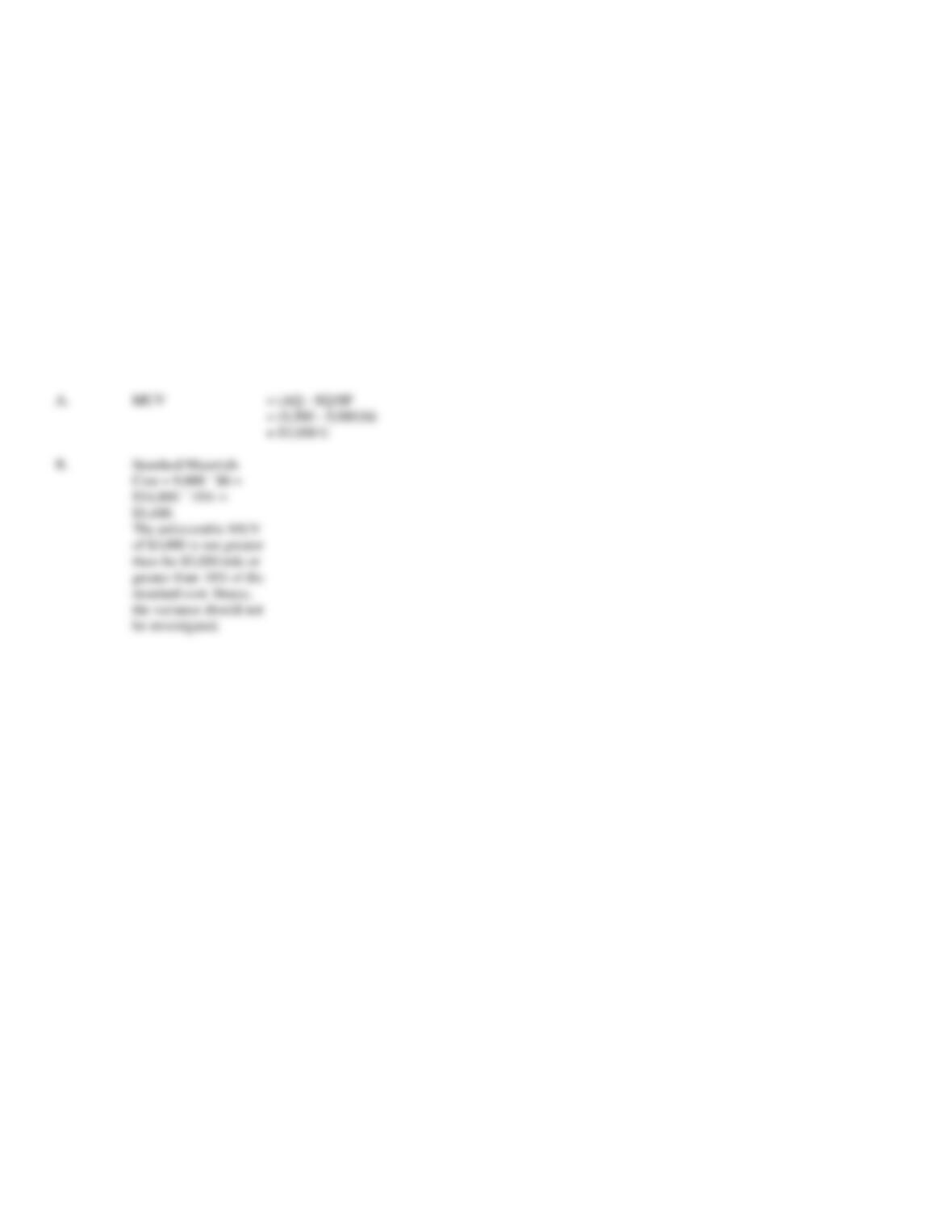
143. Acme Brick Company uses the following rule to determine whether materials usage variances should be
investigated:
A materials usage variance will be investigated when the variance is greater than either $5,000 or 10 percent of
the standard cost.
During June, the company purchased and used 9,500 pounds of concrete for $5 per pound. It was able to make
20,000 bricks. Its standard quantity of materials allowed is 0.45 pound of concrete per brick at a standard price
of $6 per pound.
A.
Determine Acme’s material usage variance and whether it is favorable or unfavorable.
B.
Should the variance be investigated?
= (9,500 – 9,000)$6
= $3,000 U
$5,400.
be investigated.
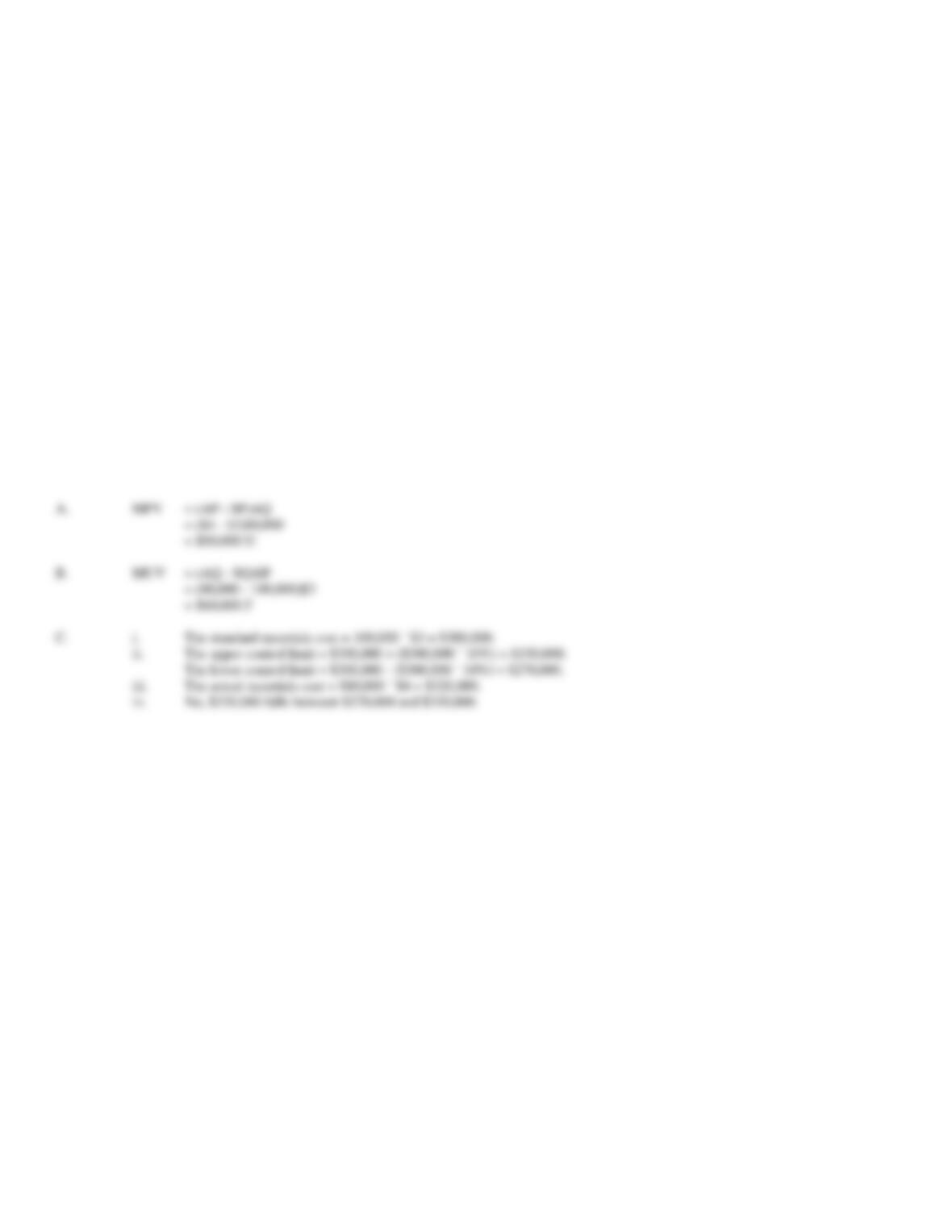
144. Westminster Company has the following information concerning its direct materials:
Direct Materials:
Standard Quantity
100,000
Actual Quantity
80,000
Standard Price
$3
Actual Price
$4
A.
Determine the materials price variance and
whether it is favorable or unfavorable.
B.
Determine the materials usage variance and
whether it is favorable or unfavorable.
C.
Westminster has set control limits stating that
actual costs should be investigated if they fall
outside the acceptable range of the standard
materials cost 10%.
i.
What is the standard materials cost?
ii.
What are the upper and lower control limits?
iii.
What is the actual materials cost?
iv.
Should the actual materials cost be investigated?
= (AP – SP)AQ
= $80,000 U
MUV
= (AQ – SQ)SP
= (80,000 – 100,000)$3
= $60,000 F
i.
The standard materials cost = 100,000 ´ $3 = $300,000.
ii.
The upper control limit = $300,000 + ($300,000 ´ 10%) = $330,000.
The lower control limit = $300,000 – ($300,000 ´ 10%) = $270,000.
iii.
The actual materials cost = $80,000 ´ $4 = $320,000.
iv.
No, $320,000 falls between $270,000 and $330,000.
145. PURE Inc. produces flavored waters, sold in gallons. Recently the company adopted the following
materials standard for one gallon of its raspberry flavored water:
Direct materials (90 oz. @ $0.08)
$ 7.20
During the first month of operations the company experienced the following results:
A. Gallon units produced: 80,000
B. Ounces of materials purchased and used: 7,320,000 ounces at $0.07
C. No beginning or ending inventories of raw materials
Required:
A. Compute the materials price variance indicating if it is favorable or unfavorable.
B. Compute the materials usage variance indicating if it is favorable or unfavorable.
MPV = (AP – SP) x AQ
($0.07 – $0.08) x 7,320,000 = $73,200 F
MUV = (AQ – SQ) x SP
(7,320,000 – 7,200,000) x $0.08 = $9,600 U
146. McDaniel Company manufactures 100-pound bags of fertilizer that have the following unit standard costs
for direct materials and direct labor:
Direct materials (100 lbs. @ $1.00 per lb.)
$100.00
Direct labor (0.5 hours at $24 per hour)
12.00
Total standard prime cost per 100 lb. bag
$112.00
The following activities were recorded for October:
•
1,000 bags were manufactured.
•
95,000 lbs. of materials costing $76,000 were purchased.
•
102,500 lbs. of materials were used.
•
$12,000 was paid for 475 hours of direct labor.
There were no beginning or ending work-in-process inventories.
Required:
A.
Compute the direct materials variances.
B.
Compute the direct labor variances.
C.
Give possible reasons for the occurrence of each of the preceding variances.
A.
Material price variance:
[$76,000 – (95,000 ´ 1.00)] = $19,000 F
Material usage variance
[102,500 – 1,000(100)] ´ 1.00 = $2,500 U
B.
Labor rate variance
[$12,000 – (475 hrs. ´ $24)] = $600 U
Labor efficiency variance
[(475 – 500)]$24 = 600 F
Material usage variance:
Low-quality materials; lower skilled workers; less efficient machines; low employee morale.
Labor rate variance:
Higher skilled workers; longer tenured workers with higher wages.
Labor efficiency variance:
147. DuRoss Company produces coats. The company uses a standard costing system and has set the following
standards for materials and labor:
Fabric (8 yards @ $6)
$48
Direct labor (2 hours @ $18)
$36
Total prime cost
$84
During the year DuRoss produced 55,000 coats. Actual fabric purchased was 460,000 yards at $5.75 per yard. There were no beginning or ending
inventories of fabric. Actual direct labor was 120,000 hours at $19.25 per hour.
Required:
A. Compute the cost of leather and direct labor that should be incurred for the production of 55,000 coats.
B. Compute the total budget variances for materials and labor.
C. Compute the materials price variance.
D. Compute the materials usage variance.
E. Compute the labor rate variance.
F. Compute the labor efficiency variance.
Materials = $48 x 55,000 = $2,640,000
Labor = $36 x 55,000 = $1,980,000
Actual Cost
Budgeted Cost
Variance
Materials
2,645,000
2,640,000
5,000
U
Labor
2,310,000
1,980,000
330,000
U
MPV = (AP – SP) x AQ
($5.75 – $6) x 460,000 = $115,000 F
MUV = (AQ – SQ) x SP
(460,000 – 440,000) x $6 = 120,000 U
LRV = (AR -SR) x AH
(19.25 – 18.00) x 120,000 = $150,000 U
LEV = (AH – SH) x SR
(120,000 – 110,000) x $18 = $180,000 U