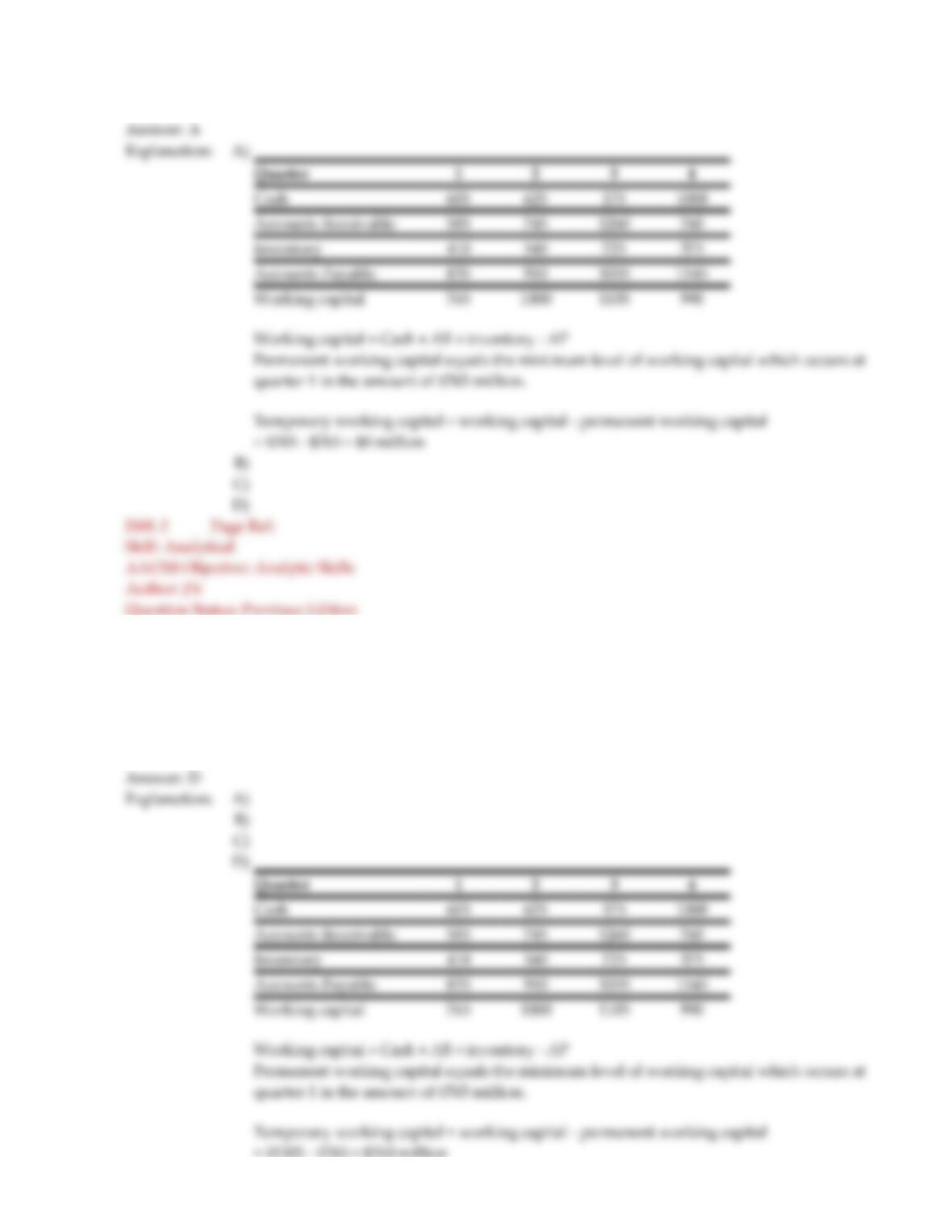
B) $340 million
C) $770 million
D) $845 million
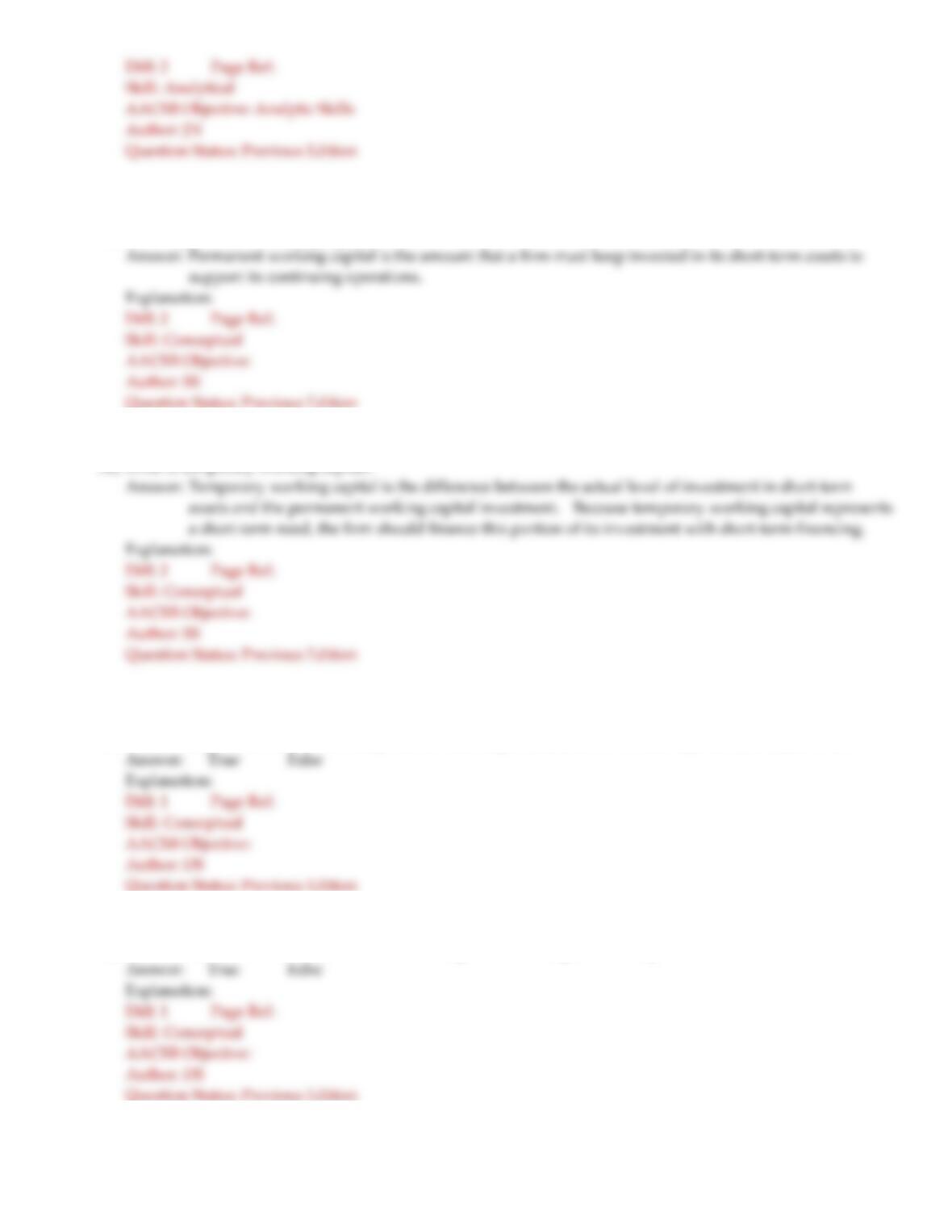
48) The temporary working capital needs for Hasbeen Toys in quarter 3 is closest to:
A) $845 million
B) $0 million
C) $770 million
D) $ 340 million
SHORT ANSWER. Write the word or phrase that best completes each statement or answers the question.
49) What is permanent working capital?
50) What is temporary working capital?
TRUE/FALSE. Write ‘T’ if the statement is true and ‘F’ if the statement is false.
51) The prime rate is the rate banks charge all but their largest customers, who can negotiate a sub–prime rate.
52) An uncommitted line of credit is obtained through a nonbinding, informal agreement.
MULTIPLE CHOICE. Choose the one alternative that best completes the statement or answers the question.
53) Which of the following best describes a loan where the firm must pay interest on the loan and pay back the
principal in one lump sum at the end of the loan?
A) single, end–of–period payment loan
B) promissory note
C) bridge loan
D) committed line of credit
54) Which of the following best describes a bank loan arrangement where a bank agrees to lend a firm any
amount up to a stated maximum in an informal agreement which does not legally bind the bank to provide
the funds?
A) single, end–of–period payment loan
B) bridge loan
C) committed line of credit
D) uncommitted line of credit
55) Which of the following bank loan arrangements is typically accompanied by a requirement that the firm
maintain a minimum level of deposits with the lending bank and restricts the level of the borrowing firm’s
working capital?
A) single, end–of–period payment loan
B) bridge loan
C) committed line of credit
D) uncommitted line of credit
56) Which of the following is a committed line of credit with no fixed maturity?
A) a bridge loan
B) evergreen credit
C) a promissory note
D) a blanket lien
57) A petroleum exploration company takes a short–term bank loan in order to finance the purchase of several
truck–mounted, vibroseis shakers, which have unexpectedly come onto the market at a good price. Once the
purchase is made, the company will obtain long–term financing. Which of the following best describes the
short–term loan the company has taken?
A) a single, end–of–period payment loan
B) a promissory note
C) a bridge loan
D) an uncommitted line of credit
58) A firm has a committed line of credit with a maximum of $2.5 million and an interest rate of 9% (EAR) with a
certain bank. The commitment fee is 0.65% (EAR). The firm borrows $2 million at the start of the year, and
then repays it at the end of the year. What is the total cost of the loan?
A) $180,000
B) $183,250
C) $193,000
D) $212,500
59) A firm has a committed line of credit with a maximum of $10 million and an interest rate of 8.5% (EAR) with
a certain bank. The commitment fee is 0.5% (EAR). The firm borrows $2 million at the start of the year and
then repays it at the end of the year. What is the total cost of the loan?
A) $520,000
B) $680,000
C) $210,000
D) $720,000
60) A firm has a committed line of credit with a maximum of $1.2 million and an interest rate of 12% (EAR) with
a certain bank. The commitment fee is 0.6% (EAR). The firm borrows $500,000 at the start of the year and
then repays it at the end of the year. What is the total cost of the loan?
A) $60,000
B) $64,200
C) $76,300
D) $95,000
61) Crimini Foods is offered a $400,000 line of credit for six months at an APR of 10%. This loan has a loan
origination fee of 2%. What is the actual six–month interest rate paid, expressed as an EAR?
A) 7.14%
B) 10.60%
C) 11.03%
D) 14.80%
62) Gemini Real Estate is offered a $2 million line of credit for four months at an APR of 9%. This loan has a loan
origination fee of 1.5%. What is the actual four–month interest rate paid, expressed as an EAR?
A) 4.57%
B) 9.68%
C) 12.44%
D) 14.34%
63) Conways Roofing Services is offered a $1 million line of credit for three months at an APR of 8%. The bank
requires that the firm keep an amount equal to 12% of the loan principal in a non–interest–earning account
with the bank as long as the loan remains outstanding. What is the actual three–month interest rate paid,
expressed as an EAR?
A) 9.41%
B) 24.40%
C) 60.30%
D) 80.40%
64) Jim’s Electrical is offered a $400,000 line of credit for six months at an APR of 9%. The bank requires that the
firm keep an amount equal to 5% of the loan principal in a non–interest–earning account with the bank as
long as the loan remains outstanding. What is the actual six–month interest rate paid, expressed as an EAR?
A) 3.2%
B) 5.0%
C) 9.70%%
D) 24.3%
65) Stuart Mining is offered a $4,000,000 line of credit for three months at an APR of 6%. The bank requires that
the firm keep an amount equal to 10% of the loan principal in an account with the bank as long as the loan
remains outstanding. This account pays 2% APR with quarterly compounding. What is the actual
three–month interest paid on this loan?
A) 1.6%
B) 6.6%
C) 12.6%
D) 14.6%
E) 60.9%
66) A loan agreement requires that the firm pay interest on the loan and pay back the principal in one lump sum
at the end of the loan is called
A) a short–term mortgage loan.
B) a single, end–of–period–payment loan.
C) a bridge loan.
D) a line of credit.
67) A short–term bank loan that is often used until a firm can arrange for long–term financing is called
A) a committed line of credit.
B) a short–term mortgage loan.
C) a bridge loan.
D) a single, end–of–period–payment loan.
68) A written, legally binding agreement that obligates the bank to lend a firm any amount up to a stated
maximum, regardless of the financial condition of the firm (unless the firm is bankrupt) as long as the firm
satisfies any restrictions in the agreement is called
A) a bridge loan.
B) a single, end–of–period–payment loan.
C) a short–term mortgage loan.
D) a committed line of credit.
69) Which of the following statements is FALSE?
A) Bank loans are typically initiated with a promissory note, which is a written statement that indicates the
amount of the loan, the date payment is due, and the interest rate.
B) The most straightforward type of bank loan is a single, end–of–period–payment loan.
C) With a fixed interest rate, the specific rate that the bank will charge is stipulated at the time the loan is
made.
D) One of the primary sources of short–term financing, especially for small businesses, is the investment
bank.
70) Which of the following statements is FALSE?
A) The prime rate is the rate banks charge other banks.
B) With a variable interest rate, the terms of the loan may indicate that the rate will vary with some spread
relative to a benchmark rate, such as the yield on one–year Treasury securities or the prime rate.
C) With a discount loan, the borrower is required to pay the interest at the beginning of the loan period.
D) A common benchmark rate is the London Inter–Bank Offered Rate, or LIBOR, which is the rate of
interest at which banks borrow funds from each other in the London inter bank market.
71) Which of the following statements regarding lines of credit is FALSE?
A) The line of credit agreement may also stipulate that at some point in time the outstanding balance must
be zero. This policy ensures that the firm does not use the short–term financing to finance its long–term
obligations.
B) A revolving line of credit is an uncommitted line of credit that involves an informal agreement from the
bank for a longer period of time, typically two to three years.
C) The line of credit may be uncommitted, meaning it is an informal agreement that does not legally bind
the bank to provide the funds.
D) A revolving line of credit with no fixed maturity is called evergreen credit.
72) Which of the following statements is FALSE?
A) Regardless of the loan structure, the bank may include a compensating balance requirement in the loan
agreement that reduces the usable loan proceeds.
B) Another common type of fee is a loan origination fee, which a bank charges to cover credit checks and
legal fees.
C) Firms frequently use lines of credit to finance seasonal needs.
D) The commitment fee associated with a committed line of credit is designed to decreases the effective
cost of the loan to the firm.
73) Luther Industries is offered a $1 million dollar loan for four months at an APR of 9%. If this loan has an
originati on fee of 1%, then the effective annual rate (EAR) for this loan is closest to:
A) 12.0%
B) 12.6%
C) 4.1%
D) 13.8%
74) Luther Industries is offered a $1 million loan for four months at an APR of 9%. If Luther’s bank requires
that the firm maintain a compensating balance equal to 10% of the loan amount in a non–interest–earning
account, then the effective annual rate EAR for this loan is closest to:
A) 10.3%
B) 12.6%
C) 14.4%
D) 71.5%
SHORT ANSWER. Write the word or phrase that best completes each statement or answers the question.
75) What is single, end–of–period payment loan?
76) What are commitment fees and what effect does it have on the loan?
77) What are loan origination fees and what effect does it have on the loan?
78) What are compensating balance and what effect does it have on the loan?
TRUE/FALSE. Write ‘T’ if the statement is true and ‘F‘ if the statement is false.
79) Commercial paper is usually a more expensive source of funds than a short–term bank loan.
80) The interest on commercial paper is typically paid by selling it at an initial discount.
81) Commercial paper is rated by credit rating agencies.
MULTIPLE CHOICE. Choose the one alternative that best completes the statement or answers the question.
82) What is the maximum maturity of commercial paper?
A) 60 days
B) 90 days
C) 180 days
D) 270 days
83) A firm issues three–month commercial paper with $200,000 face value and receives $192,000. What is the
EAR the firm is paying for these funds?
A) 5.24%
B) 8.00%
C) 16.00%
D) 17.74%
84) A firm issues six–month commercial paper with $500,000 face value and receives $488,000. What is the EAR
the firm is paying for these funds?
A) 2.40%
B) 2.45%
C) 4.98%
D) 6.00%
85) A firm issues two–month commercial paper with $1,000,000 face value and receives $985,000. What is the
EAR the firm is paying for these funds?
A) 1.52%
B) 7.50%
C) 9.49%
D) 15.00%
86) Ultimate Industries issues commercial paper with a face value of $500,000 and a maturity of six months.
Ultimate receives net proceeds of $486,000 when it sells the paper. If the prime rate is 8.5% APR