Biology: A Guide to the Natural World, 5e (Krogh)
Chapter 20 Arriving Late, Traveling Far: The Evolution of Human Beings
1) According to the primate family tree, the modern species most closely related to the humans is
the:
A) chimpanzee.
B) orangutan.
C) gorilla.
D) lemur.
2) The Taung baby, a member of Australopithecus africanus, is estimated to have lived about:
A) 1 million years ago.
B) 2—3 million years ago.
C) 4—5 million years ago.
D) 5—10 million years ago.
3) Based on evidence from “primate molecular clocks,” a primate common ancestor of humans
and chimpanzees existed about:
A) 3 million years ago.
B) 4—5 million years ago.
C) 6—7 million years ago.
D) 10 million years ago.
4) Which Homo species from 1—2 million years ago is connected as an ancestor of Homo
sapiens according to the hominin family tree?
A) Homo ergaster
B) Homo habilis
C) Homo erectus
D) Homo neanderthalensis
5) Of the following four species, which one lies closest to modern humans?
A) Homo habilis
B) Homo neanderthalensis
C) Homo ergaster
D) Homo erectus
6) Place the following in correct order from least to most closely related to modern humans: (1)
orangutans, (2) monkeys, (3) Homo erectus, (4) Australopithecus afarensis.
A) 1, 2, 3, 4
B) 4, 3, 2, 1
C) 2, 1, 3, 4
D) 2, 1, 4, 3
7) Modern humans have been in existence for approximately how many years?
A) 100,000
B) 200,000
C) 500,000
D) 1,000,000
8) Which statement would support a hypothesis that most (about the first 70 percent) of human
evolution took place in Africa?
A) The oldest fossils are found in Africa.
B) Homo sapiens fossils are found in Africa and Europe.
C) No Neanderthal fossils are found in Africa.
D) The earliest fossils found outside of Africa are 1,800,000 years old.
9) Which of the following species of hominin is the most recent to have become extinct?
A) Homo neanderthalensis
B) Homo habilis
C) Homo erectus
D) Homo ergaster
10) A piece of evidence in favor of including Sahelanthropus tchadensis (Toumai) with the
hominins rather than apes is that the species was likely:
A) tree dwelling.
B) bipedal.
C) related to Neanderthals.
D) carnivorous.
11) Which of the following is least important in deciding whether a fossil should be classified as
a hominin?
A) bipedalism
B) slope of the face
C) brain size
D) tooth structure
12) A paleoanthropologist is a scientist who studies:
A) rocks and their ages.
B) all fossils.
C) fossils in the human lineage.
D) ancient human culture.
13) Which of the following characteristics of a fossil suggests that the species belonged to the
hominin group?
A) large canine teeth and thinner tooth enamel
B) a protruding lower face
C) small canine teeth and thicker tooth enamel
D) prominent brow ridges
14) Which of the following characteristics of a fossil suggests that the species does not belong to
the hominin group?
A) bipedal walking
B) small canine teeth
C) protruding brow ridges
D) a flat face
15) To what does the term “mosaic pattern” refer in terms of evolution?
A) Natural selection is no longer operating on modern humans.
B) Different features developed at different times in different species.
C) Every species was subject to a different form of natural selection.
D) Fossils are found in a mosaic pattern at a paleontological site.
16) “Grasping feet” suggest an adaptation for some degree of:
A) tree-dwelling life-style.
B) limited tool use.
C) knuckle walking.
D) migratory behavior.
17) Which hominin may be a direct ancestor of our genus but had long arms, short legs, and
grasping feet?
A) Homo erectus
B) Australopithecus afarensis
C) Homo neanderthalensis
D) Kenyanthropus platyops
18) Which of the following was most ape-like?
A) Homo habilis
B) Homo ergaster
C) Homo neanderthalensis
D) Australopithecus afarensis
19) How long ago did Australopithecus afarensis live?
A) 50,000—100,000 years ago
B) 500,000 years ago
C) about 2.2 million years ago
D) about 3.2 million years ago
20) Paleontologists have determined that Australopithecines, such as Lucy, could walk upright.
On what evidence do they base this claim?
A) the tools found with the fossils
B) the structure of her hands
C) the structure of her pelvis
D) the structure of the skull

6
21) According to the fossil evidence, which hominin was the first to leave Africa?
A) Homo neanderthalensis
B) Homo sapiens
C) Homo erectus
D) Homo ergaster
22) Which natural material seems to be the first used by hominins to make tools?
A) stones
B) wood
C) feathers
D) hair
23) Most of hominin evolution occurred in Africa, but there is fossil evidence that members of
the genus Homo first migrated out of Africa at least ________ years ago.
A) 1.8 million
B) 3 million
C) 5 million
D) 10 million
24) The cranial capacity for the species Australopithecus afarensis was close to:
A) 450 cubic centimeters.
B) 900 cubic centimeters.
C) 1,400 cubic centimeters.
D) 2,000 cubic centimeters.
25) A significant difference between Neanderthals and modern humans is that Neanderthals:
A) had smaller brains.
B) were taller.
C) were foragers, not “collectors.”
D) used throwing spears.
26) Several lines of evidence, including fossils and a genetic analysis of different groups of
modern humans, suggest that our species originated and spread out from:
A) north Africa.
B) east Africa.
C) central Europe.
D) India.
27) Homo floresiensis is a relatively new find of fossils from:
A) Africa.
B) Indonesia.
C) Australia.
D) Europe.
28) Modern humans (Homo sapiens) coexisted in Europe for thousands of years with which
other hominin?
A) Homo erectus
B) Homo neanderthalensis
C) Homo ergaster
D) Homo heidelbergensis
29) Homo erectus was able to migrate great distances from Africa. A good hypothesis for why he
was able to do so is that he possessed:
A) a larger brain than Homo sapiens.
B) lower metabolic requirements than ancestors.
C) the ability to walk much like modern humans.
D) tools more advanced than those used by Neanderthals.
30) There are currently at least 2 dozen species who are candidates for membership in the
Hominini (human-like primate) group.
31) The hominid group of primates has existed on Earth for approximately 6—7 million years.
32) The genus Kenyanthropus appears to be the immediate ancestor of the genus Homo.
33) Homo sapiens and Homo neanderthalensis coexisted for thousands of years.
34) Homo floresiensis represents a branching point for modern humans in Africa.
35) Most hominin evolution took place in south Africa and Australia.
36) A paleoanthropologist studies the development of ancient human culture.
37) The closest living primate relative to humans is the gorilla.
38) A relatively early hominin with advanced tool technology was Homo ergaster.
39) The brain of Australopithecus afarensis was almost the same size as that of modern humans.
40) Australopithecus afarensis represents a hominin with both ape-like and human-like
characteristics.
41) Hominins migrated from Africa, through Asia, all the way to Australia.
42) The first wave of modern human migration reached Europe and northern Asia.
10
Match the following.
A) first hominin to leave Africa
B) the “hobbit people”
C) Lucy
D) arguably, the earliest hominin
E) “Turkana boy”
43) Sahelanthropus tchadensis
Topic: Section 20.3
Skill: Knowledge/Comprehension
44) Homo floresiensis
Topic: Section 20.6
Skill: Knowledge/Comprehension
45) Homo erectus
Topic: Section 20.4
Skill: Knowledge/Comprehension
46) Homo ergaster
Topic: Section 20.4
Skill: Knowledge/Comprehension
47) Australopithecus afarensis
Topic: Section 20.4
Skill: Knowledge/Comprehension
48) Modern humans are classified as belonging to the species ________.
49) The two hominin species that are believed to have been alive 50,000 years ago concurrently
with modern humans are ________ and ________.
50) The ability for a hominin to walk upright is referred to as ________.
Refer to the scenario below, and then answer the following question(s).
In a long forgotten corner of your museum’s warehouse, workers find two old crates, each with a
set of human fossils and a notebook. The first crate that is brought to you has fossil arm bones
longer than leg bones and a pelvic bone suggestive of upright-walking abilities. The notebook
states that rocks in the same stratum as the fossils were dated at 3.8 Mya. The second set has
limb bones more proportionate to modern humans and also has simple tools in the same box. The
notebook states that rocks in the same stratum as the fossils were dated at 1.6 Mya.
51) To which species does the fossil hominin in the first crate belong? Briefly explain your
answer.
52) To which species might the fossil hominin in the second crate belong? Briefly explain your
answer.
53) The first wave of modern human migration out of Africa began about ________.
54) The fossils of Australopithecines indicate that, even though they walked upright, their arms
were longer than their legs, and their feet still contained a partially opposable big toe. What does
this suggest to you about their habitat and lifestyle?
55) Describe the characteristics that appear to differentiate humans from apes in the hominin
group.
56) As you know from having studied the scientific method, a hypothesis must be able to make
predictions that can be proved or disproved. The “out-of-Africa” hypothesis is currently more
widely accepted than the “multiregionalism” school of thought. Summarize the out-of-Africa
hypothesis, and explain the genetic diversity evidence in its favor.
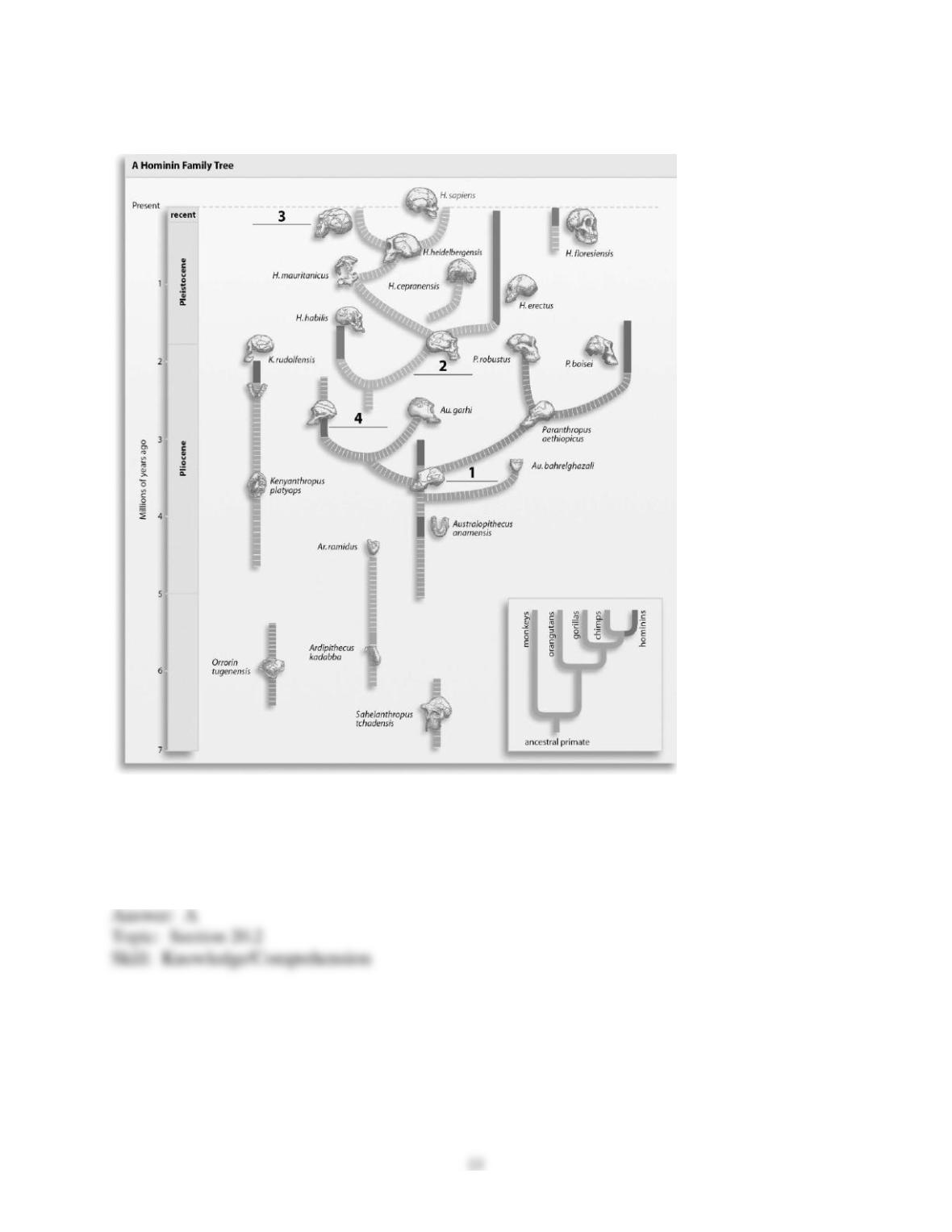
Refer to the figure below, and then answer the following question(s).
57) The missing label indicated by a “1” in the figure should be:
A) Australopithecus afarensis.
B) Australopithecus africanus.
C) Homo ergaster.
D) Homo neanderthalensis.
58) The missing label indicated by a “2” in the figure should be:
A) Australopithecus afarensis.
B) Australopithecus africanus.
C) Homo ergaster.
D) Homo neanderthalensis.
59) The missing label indicated by a “3” in the figure should be:
A) Australopithecus afarensis.
B) Australopithecus africanus.
C) Homo ergaster.
D) Homo neanderthalensis.
60) The missing label indicated by a “4” in the figure should be:
A) Australopithecus afarensis.
B) Australopithecus africanus.
C) Homo ergaster.
D) Homo neanderthalensis.