
Elements of Ecology, 9e (Smith)
Chapter 20 Ecosystem Energetics
20.1 Short Answer Questions
1) A(n) ________ chemical reaction must absorb energy in order to proceed.
2) The ________ law of thermodynamics states that when energy is transferred or transformed,
part of the energy assumes a form that cannot pass on any further.
3) ________ primary productivity is the total rate of photosynthesis or energy assimilated by
plants.
4) The amount of accumulated organic matter found in an area at a given time is the ________
crop biomass.
5) For photosynthesis and productivity to occur, a plant must open its ________ to take in carbon
dioxide.
6) In a body of water, the depth at which the availability of light is such that the rate of
photosynthesis equals the rate of respiration is called the ________ depth.
7) Organic carbon produced within an ecosystem is termed ________.

8) Relative net primary productivity is the ratio of net primary productivity to standing
________.
9) Net primary ________ is the energy available to the heterotrophic component of the
ecosystem.
10) ________ efficiency is the ratio of production to assimilation, which measures how
efficiently the consumer incorporates assimilated energy into secondary production.
11) Within any ecosystem, the two major food chains are the ________ food chain and the
grazing food chain.
20.2 Multiple-Choice Questions
1) According to the first law of thermodynamics,
A) chemical reactions are exothermic.
B) entropy tends to increase.
C) potential energy tends to degrade into an unavailable form.
D) energy is neither created nor destroyed.
2) A chemical reaction requires energy to proceed. This would be
A) exothermic.
B) endothermic.
C) entropy.
D) kinetic energy.

3) Which of the following formulas are correct regarding productivity?
A) GPP + R = NPP
B) GPP – R = NPP
C) NPP – GPP = R
D) NPP – R = GPP
4) Plants assimilate energy through the process of
A) decomposition.
B) respiration.
C) photosynthesis.
D) regeneration.
5) An ecologist studying productivity in a sample of grasses measures gross primary productivity
as 1000 kcal/m2/yr and autotrophic respiration as 100 kcal/m2/yr. Based on these calculations,
the net primary productivity would be
A) 10 kcal/m2/yr.
B) 900 kcal/m2/yr.
C) 1100 kcal/m2/yr.
D) 10,000 kcal/m2/yr.
6) Net primary productivity in an ecosystem increases as mean annual temperature
A) and mean annual rainfall decrease.
B) decreases and mean annual rainfall increases.
C) increases and mean annual rainfall decreases.
D) and mean annual rainfall increases.
7) Net primary productivity is generally greatest at
A) tropical latitudes near the equator.
B) subtropical latitudes (e.g., 25° of latitude).
C) temperate latitudes (e.g., 50° of latitude).
D) polar latitudes (e.g., 80° of latitude).
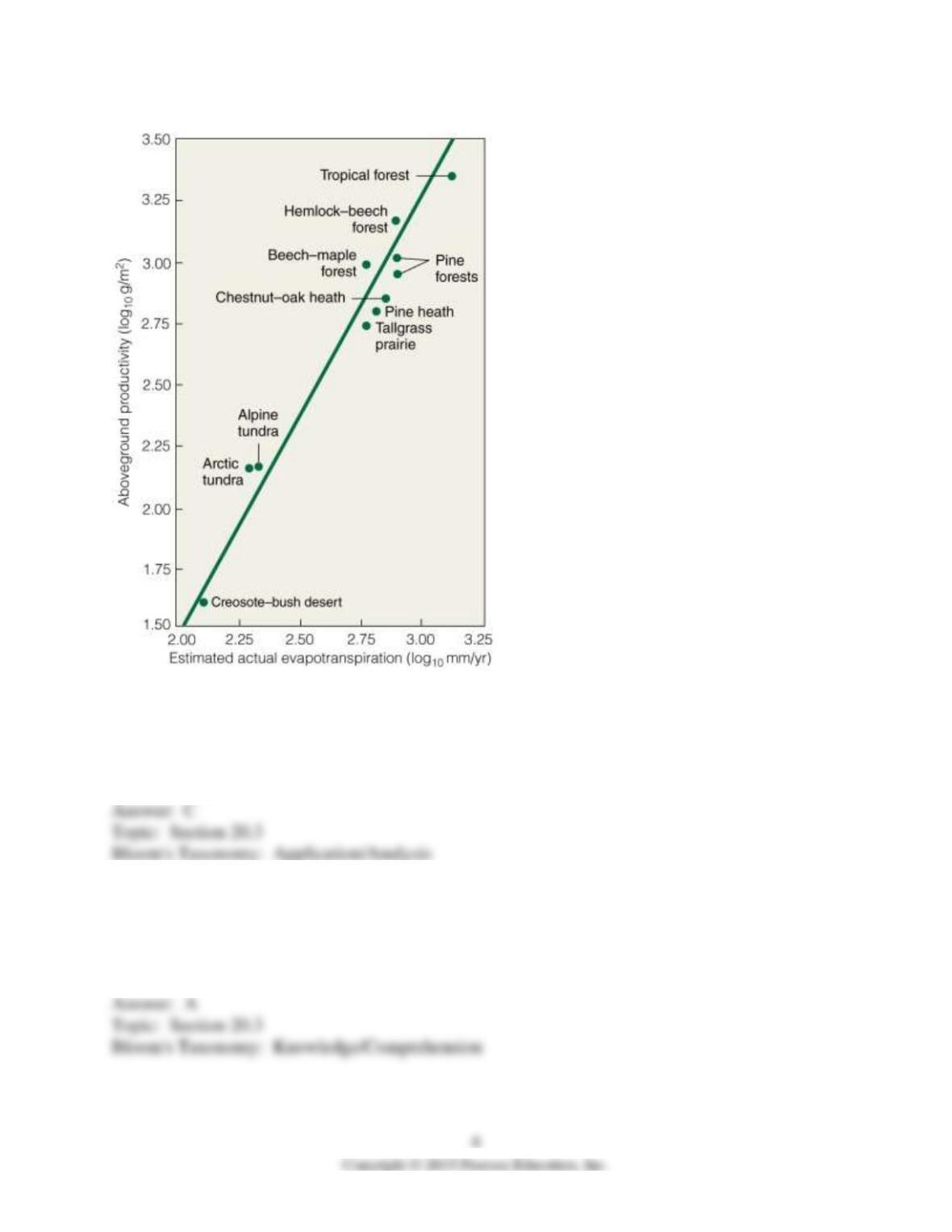
8)
Which ecosystem has the highest actual evapotranspiration?
A) creosote-bush desert
B) tallgrass prairie
C) pine forest
D) beech-maple forest
9) Where are the areas of highest NPP?
A) equator
B) arctic
C) temperate region
D) Saharan desert

10) What level of productivity would one predict with high levels of water supply but low
temperatures?
A) very low
B) low
C) high
D) very high
11) Which factor is the primary control of productivity in aquatic systems?
A) temperature
B) precipitation
C) light
D) salinity
12) In the surface waters of oceans, the two most limiting nutrients for primary productivity are
A) sulfur and phosphorus.
B) sulfur and nitrogen.
C) nitrogen and iron.
D) nitrogen and phosphorus.
13) The presence of which element is highly correlated with NPP?
A) carbon
B) phosphorus
C) sodium
D) hydrogen
14) The river continuum concept suggests that one of the following is higher in headwater
streams.
A) autochthonous carbon
B) allochthonous carbon
C) phytoplankton abundance
D) macrophyte abundance

15) How does the open ocean have the highest relative net primary productivity while having
one of the lowest mean biomass per unit area?
A) high turnover rate of plankton
B) high mean net primary productivity
C) the presence of large organisms like whales
D) having a larger third dimension of depth
16) Low-moisture conditions favor allocation by a plant to
A) leaves.
B) stems.
C) roots.
D) flowers.
17) Which of the following tree stands would you predict has the highest NPP?
A) 0-1 years old
B) 1-10 years old
C) 30-60 years old
D) over 100 years old
18) Why might secondary production be lower in grasslands than in forests?
A) because average temperatures are lower
B) because average water availability is higher
C) because primary production is lower
D) because there is a higher biomass of animals in grasslands
19) Secondary production is limited primarily by
A) water availability.
B) nutrient availability.
C) primary production.
D) light availability.

20) Which organism is most likely to have the highest assimilation efficiency?
A) endothermic carnivore, such as a lion
B) ectothermic carnivore, such as a snake
C) endothermic herbivore, such as a deer
D) ectothermic herbivore, such as a grasshopper
21) Which group has the highest production efficiency?
A) mice
B) voles
C) insects
D) fish
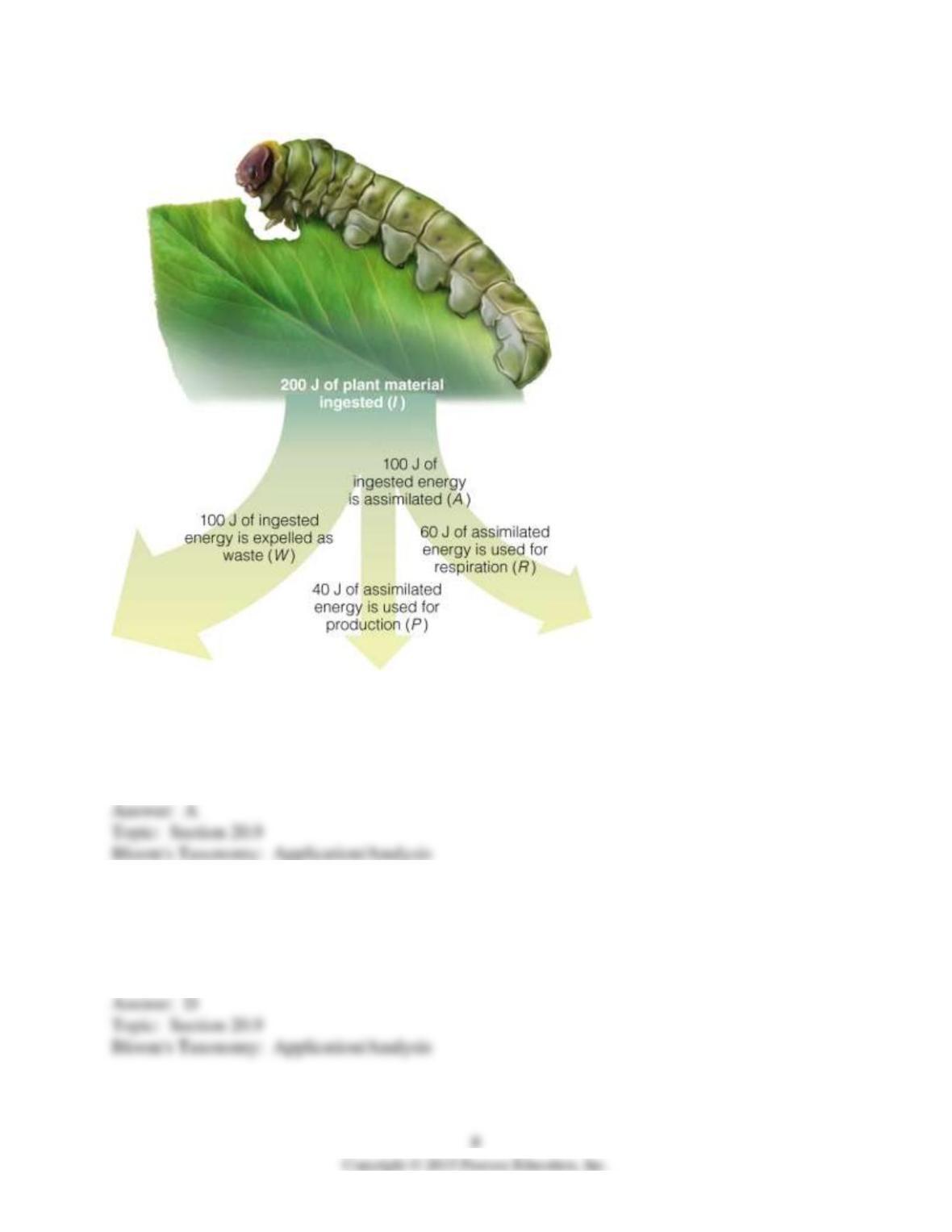
22)
Which pathway leads to the detrital food chain?
A) W
B) P
C) R
D) I
23) Which of the following has the highest assimilation efficiency?
A) lion
B) rodent
C) caterpillar
D) spider

24) Detrital food chains contain all of the following except
A) carnivores.
B) herbivores.
C) decomposer herbivores.
D) detritus.
25) The base of the detrital food chain is formed by
A) primary producers.
B) decomposers.
C) herbivores.
D) dead organic matter.
26) The ratio of energy consumed at the next trophic level over what is produced is known as
A) consumption efficiency.
B) trophic efficiency.
C) food chain efficiency.
D) detrital efficiency.
27) In most terrestrial and many aquatic ecosystems, the ________ food chain is the dominant
pathway of energy flow.
A) detrital
B) grazing
C) consumer
D) heterotroph
28) In which situation is the detrital food chain not more dominant than the grazing food chain?
A) open-water aquatic ecosystems
B) kelp forest ecosystems
C) grassland ecosystems
D) tropical forest ecosystems

29) Rates of herbivory are highest in
A) aquatic ecosystems dominated by phytoplankton.
B) aquatic ecosystems dominated by vascular plants.
C) terrestrial ecosystems dominated by herbaceous plants.
D) terrestrial ecosystems dominated by woody plants.
30) If herbivores eat 1000 kcal of plant energy, approximately how much energy will be
converted into the tissues of herbivores?
A) 1 kcal
B) 10 kcal
C) 100 kcal
D) 1000 kcal
31) The ratio of the productivity of one trophic level over what its organisms consume is known
as
A) consumption efficiency.
B) trophic efficiency.
C) food chain efficiency.
D) detrital efficiency.
32) Why are there not seven or eight levels to a trophic food chain?
A) lack of biodiversity
B) lack of global energy
C) lack of trophic efficiency
D) lack of primary productivity
33) Estimates of HANPP range around 20 percent, yet what percent of total heterotrophic
biomass do humans make up?
A) 20 percent
B) 50 percent
C) 10 percent
D) less than 1 percent
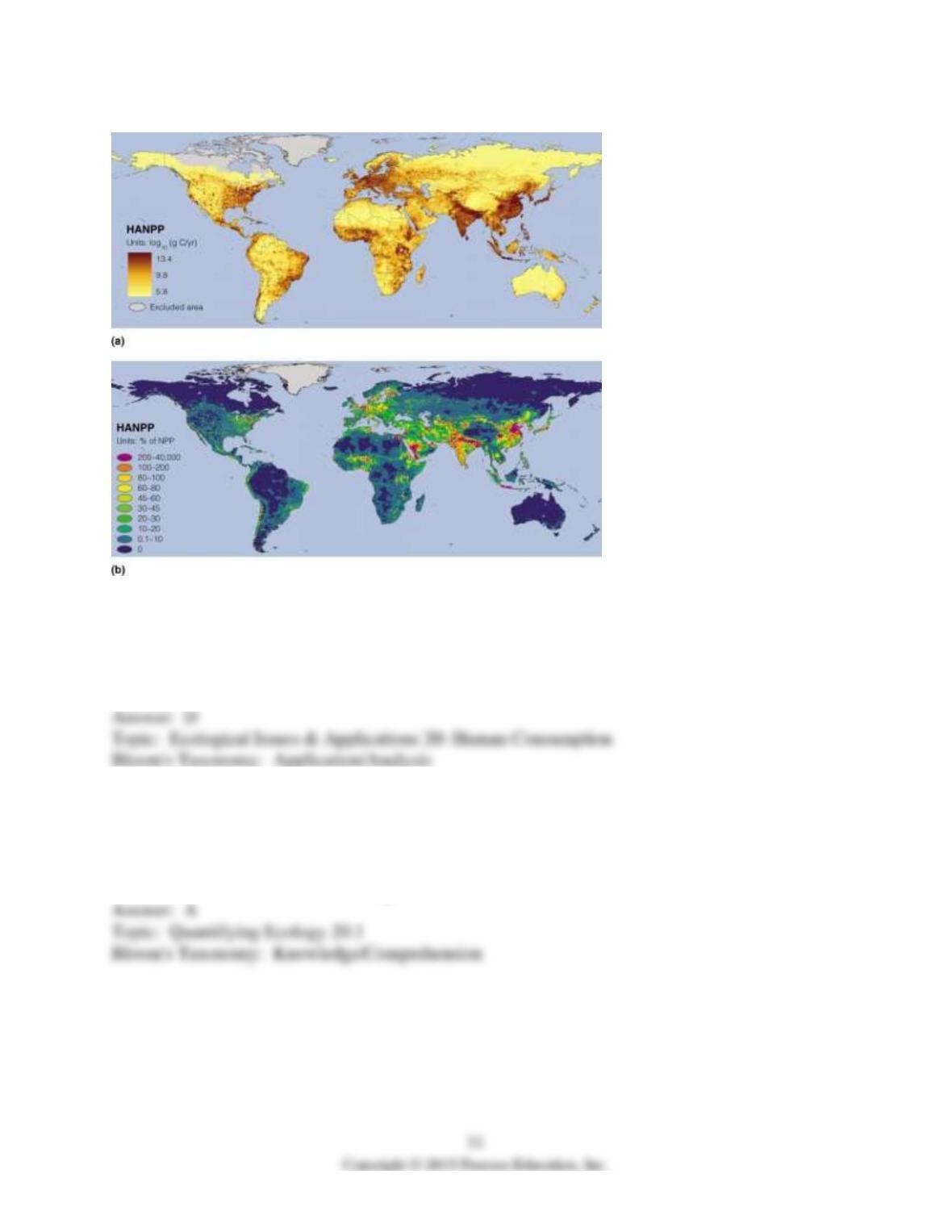
34)
Which region represents the highest HANPP as a percentage of local NPP?
A) Australia
B) Canada
C) South America
D) India
35) NPP can be measured via satellite data because vegetation has
A) high reflectance in the NIR and low reflectance in VIS.
B) low reflectance in the NIR and low reflectance in VIS.
C) high reflectance in the NIR and high reflectance in VIS.
D) low reflectance in the NIR and high reflectance in VIS.

20.3 True/False Questions
1) When a chemical reaction results in the loss of energy from the system, the reaction is
exothermic.
2) The second law of thermodynamics is valid only in a closed system, such as a living
organism.
3) Productivity may be expressed in units of energy per unit area per unit time or in units of dry
organic matter per unit area per unit time.
4) Net primary productivity cannot be measured in aquatic ecosystems.
5) Net primary productivity is greater in areas with a long photosynthetic period than in areas
with a short photosynthetic period.
6) Net primary productivity is greater in temperate grasslands than in tropical rain forest.
7) Net primary productivity is greater in the open ocean than along the coast.
8) In most marine ecosystems, autochthonous inputs of organic carbon are greater than
allochthonous inputs of carbon.

9) In plants, low water availability favors the allocation of energy to the roots.
10) In a temperate rain forest, primary productivity remains relatively constant.
11) Primary productivity in forests often increases during the early stages of stand development
and then decreases again as the forest ages and standing biomass increases.
12) Secondary production in an ecosystem is always less than primary production.
13) In endotherms, an increase in mass-specific metabolic rate lowers production efficiency.
14) Primary producers form the base of all food chains.
15) In all food chains, the flow of energy is unidirectional from the bottom to the top.
16) Consumption efficiency is the ratio of ingestion to production.
17) In terrestrial and shallow-water ecosystems, the grazing food chain is dominant over the
detrital food chain.

18) In stream and river ecosystems, the grazing food chain is of minor importance compared
with the detrital food chain.
19) In most ecosystems, the biomass of carnivores is greater than the biomass of producers.
20) In all ecosystems, the biomass of primary producers is greater than the biomass of
herbivores.
21) Wealthy nations typically have lower rates of human appropriation of net primary
productivity (HANPP) than developing nations.
20.4 Essay Questions
1) Define net primary productivity, and describe an experiment for how it can be measured.
2) Describe the effects of temperature, moisture, length of photosynthetic period, and nutrient
availability on net primary productivity in terrestrial ecosystems.
3) Describe the changes that might be expected to occur in allochthonous and autochthonous
sources of carbon in the energy balance of flowing-water ecosystems from the smaller headwater
streams to larger river systems.
4) Explain the difference between primary production and secondary production. How is
secondary production affected by primary production?

5) What are the two main food chains of ecosystems? Which is more dominant in terrestrial
ecosystems and why?
6) Explain why energy is lost as it is transferred from one trophic level to another. What are the
effects of energy loss on the biomass of different trophic levels?
7) How do humans affect net primary productivity? Does the affluence of a society affect how
humans appropriate net primary productivity?