CHAPTER 20: INVENTORY MANAGEMENT: ECONOMIC ORDER
QUANTITY, JIT, AND THE THEORY OF CONSTRAINTS
1. Effective inventory management conserves investment capital and facilitates response to customer demands.
a. True
b. False
2. Just-in–case inventory management is a traditional inventory model based on a wait–until–needed demand.
a. True
b. False
3. Ordering costs are costs of placing and receiving an order and setup costs are the costs of getting equipment and
facilities to produce products.
a. True
b. False
4. Effective inventory management does not consider inventory–related costs.
a. True
b. False
5. Competitive pressures have led many companies to favor the JIT inventory approach.
a. True
b. False
6. Firms face limited resources and limited demand for their products called constraints.
a. True
b. False
7. JIT is a manufacturing approach focused on present demand rather than anticipated demand.
a. True
b. False
Chapter 20: Inventory Management: Economic Order Quantity, JIT, and the Theory of Constraints
8. JIT inventory management offers alternative solutions that require higher inventories.
a. True
b. False
9. JIT uses long-term contracts, continuous refilling, and electronic data interchanges to reduce or eliminate ordering
costs.
a. True
b. False
10. Reducing ordering and setup costs interfere with the reduction of inventory costs.
a. True
b. False
11. The Kanban system is an information system which ensures that parts or materials are available when needed.
a. True
b. False
12. External constraints are imposed on a firm from within and internal constraints are imposed electronically.
a. True
b. False
13. When a product mix does not utilize fully its constraints, they are called loose constraints, when used completely,
they are called binding constraints.
a. True
b. False
14. When only one binding constraint exists, the product with the smallest contribution margin will be focused on.
a. True
b. False
Chapter 20: Inventory Management: Economic Order Quantity, JIT, and the Theory of Constraints
15. With multiple internal binding constraints, the optimal mix is determined by a graphical approach or the simplex
method.
a. True
b. False
16. The goal of the theory of constraints is to make money in the future by managing constraints.
a. True
b. False
17. The theory of constraints identifies a company’s constraints and exploits them.
a. True
b. False
18. Throughput is the rate at which an organization generates money through sales.
a. True
b. False
19. The theory of constraints focuses on two operational measures of system performance: inventory expenses and
operating expenses.
a. True
b. False
20. The major binding constraint in an organization is defined as the drummer, which sets the production rate for the
whole plant.
a. True
b. False
21. The costs of holding inventory are called costs.
22. The traditional inventory model based on anticipated demand is called the inventory management.
Chapter 20: Inventory Management: Economic Order Quantity, JIT, and the Theory of Constraints
23. The inventory management system which represents the continuous goal of eliminating waste is called the
inventory management.
24. The process of continuous replacement of inventory has been made easier by the use of
interchanges.
25. The manufacturing model which shares the same practices as a JIT manufacturing system is called
manufacturing.
26. The system that ensures that parts or materials are available when needed is called the system.
27. The optimal mix chosen which maximizes the total contribution margin given the constraints face by a firm is called
__________ .
28. The model which expresses a constrained optimization problem as a linear objective function is called the
__________ model.
29. The focus on the goal of making money now and in the future by managing constraints is called the .
30. The is the amount of inventory needed to keep the constrained resource busy for a specified time
interval.
31. Which of the following is NOT an example of an ordering cost?
a. receiving costs
b. salespeople’s salaries costs
c. clerical costs of preparing documents
d. insurance costs on shipment
32. Which of the following is NOT a cost readily identified with inventory management?
a. cost of selling inventory
b. cost of not having stock on hand
c. cost of holding inventory
d. cost of acquiring inventory
Chapter 20: Inventory Management: Economic Order Quantity, JIT, and the Theory of Constraints
33. The cost of acquiring inventory includes
a. setup costs for goods produced internally.
b. cost of insurance on the warehouse for inventory.
c. cost of not having a product when a customer wants one.
d. cost of obsolescence.
34. Which of the following is NOT considered a carrying cost?
a. insurance on the inventory
b. the opportunity cost of funds invested in inventory
c. storage costs
d. receiving costs
35. The cost of holding inventory is known as
a. ordering cost.
b. setup cost.
c. stock-out cost.
d. carrying cost.
36. The cost of preparing equipment and facilities so they can be used to produce a particular product or component is
known as
a. ordering costs.
b. setup costs.
c. carrying costs.
d. inventory costs.
37. Which of the following is NOT an opportunity cost associated with inventory management?
a. lost sales to customers
b. use of capital tied up in inventory investment
c. cost of expediting
d. all are opportunity costs
Chapter 20: Inventory Management: Economic Order Quantity, JIT, and the Theory of Constraints
38. Which of the following costs are considered in the EOQ model?
a. ordering costs
b. selling costs
c. carrying costs
d. both a and c
39. Inventory management identifies an economic order quantity that
a. minimizes the total costs of ordering and carrying inventory.
b. maximizes the stockout costs.
c. minimizes the costs of ordering.
d. maximizes the cost of carrying inventory.
40. The ordering of small, frequent orders
a. minimizes stockout costs.
b. minimizes ordering costs.
c. minimizes carrying costs.
d. minimizes all three.
41. Safety stock is
a. the cost of holding inventory.
b. a non-value activity and should never be considered.
c. not considered when calculating the reorder point.
d. extra inventory carried to serve as insurance against fluctuations in demand.
42. Aeroboats Frame Corporation increased the size of several inventory order quantities that had previously been
determined using the EOQ model. What is the impact on the total annual ordering costs?
a. increase
b. decrease
c. no change
d. cannot be determined
Chapter 20: Inventory Management: Economic Order Quantity, JIT, and the Theory of Constraints
43. If inventory consists of goods produced internally, the inventory-related costs are
a. ordering and carrying costs.
b. setup costs and carrying costs.
c. ordering and setup costs.
d. both a and c.
44. Which of the following equations determines the total annual ordering costs?
a. Cost of placing an order times the order quantity.
b. Cost of placing an order times the number of orders per year.
c. Cost of placing an order times one-half of the order quantity.
d. Unit carrying costs per year times the order quantity.
45. If inventory consists of goods purchased from an outside supplier, the inventory–related costs are
a. ordering and carrying costs.
b. setup costs and carrying costs.
c. ordering and setup costs.
d. both a and c.
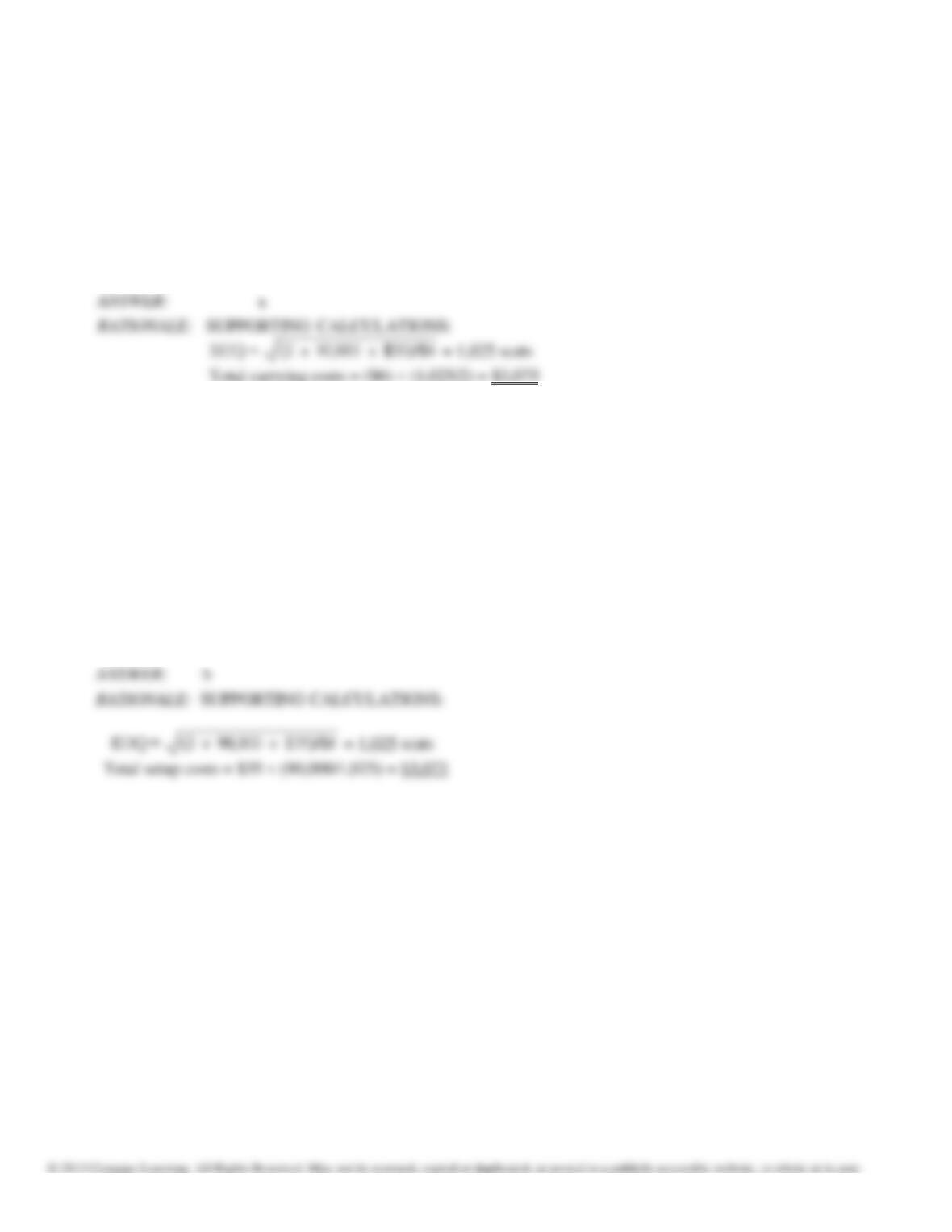
46. Comfy Wheels Bus Company produces buses. In order to produce the seats for the buses, special equipment must
be set up. The setup cost per frame is $35. The cost of carrying seats in inventory is $6 per seat per year. The
company produces 90,000 buses per year.
The number of seats that should be produced per setup in order to minimize the total setup and carrying costs is
a. 933 seats.
b. 2,050 seats.
c. 1,025 seats.
d. 513 seats.
Chapter 20: Inventory Management: Economic Order Quantity, JIT, and the Theory of Constraints
47. Comfy Wheels Bus Company produces buses. In order to produce the seats for the buses, special equipment must
be set up. The setup cost per frame is $35. The cost of carrying seats in inventory is $6 per seat per year. The
company produces 90,000 buses per year.
Total carrying costs (rounded to the nearest dollar) associated with the economic order quantity are
a. $3,075.
b. $3,750.
c. $502.
d. $328.
48. Comfy Wheels Bus Company produces buses. In order to produce the seats for the buses, special equipment must
be set up. The setup cost per frame is $35. The cost of carrying seats in inventory is $6 per seat per year. The
company produces 90,000 buses per year.
Total setup costs associated with the economic order quantity are
a. $4,610.
b. $3,073.
c. $3,750.
d. $1,537.
Chapter 20: Inventory Management: Economic Order Quantity, JIT, and the Theory of Constraints
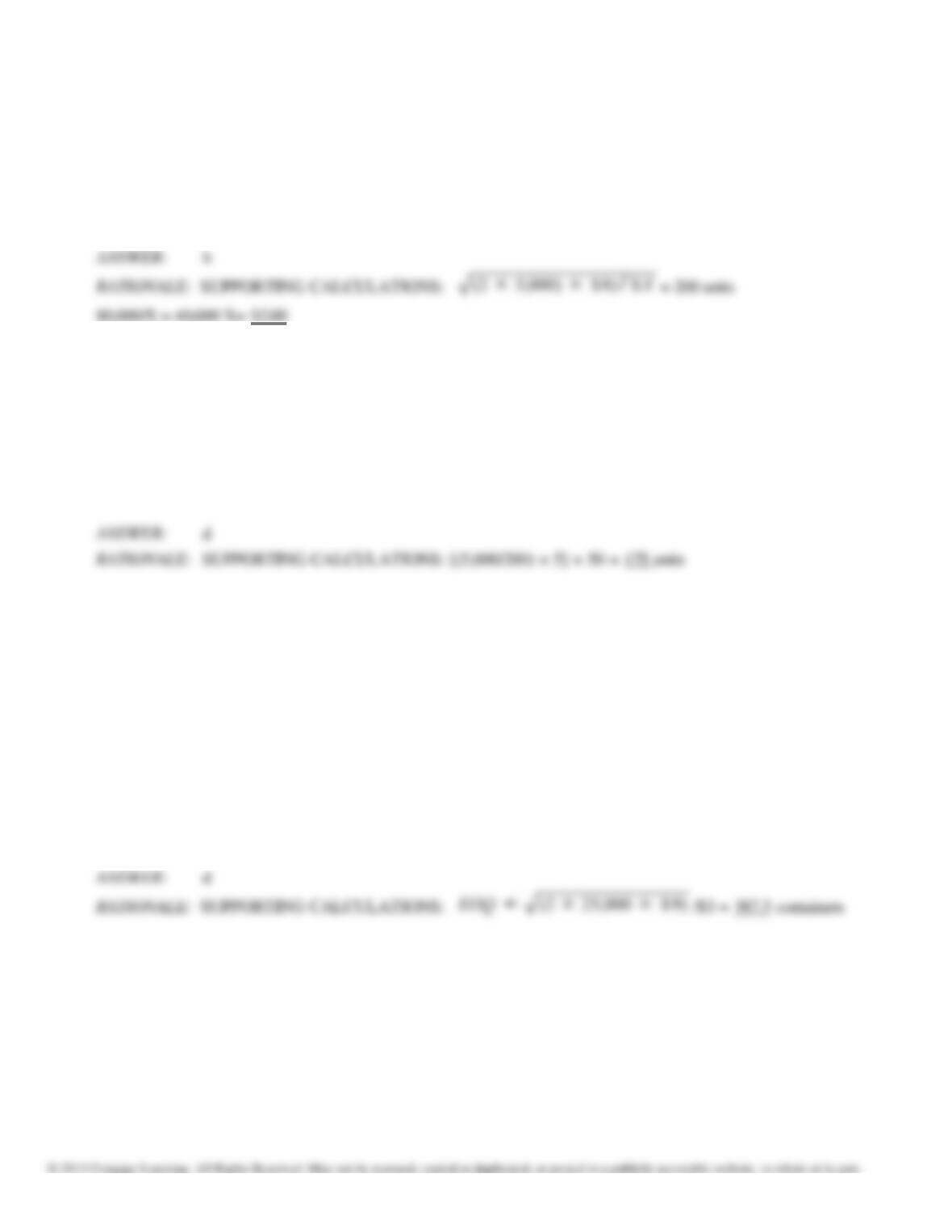
49. Southwestern Supply Company has an economic order quantity for item A of 200 units. The annual demand for the
product is 5,000 units, and the cost of placing an order is $8. The carrying cost per unit is
a. $6.00.
b. $2.00.
c. $4.00.
d.$141.00.
50. Southwestern Supply Company has an economic order quantity for item A of 200 units. The annual demand for the
product is 5,000 units, and the cost of placing an order is $8. If the company operates 200 days a year and the lead
time for the item is five days, what is the reorder point if a safety stock of 50 units is maintained?
a. 4 days
b. 50 units
c. 25 units
d. 175 units
Figure 20 – 1
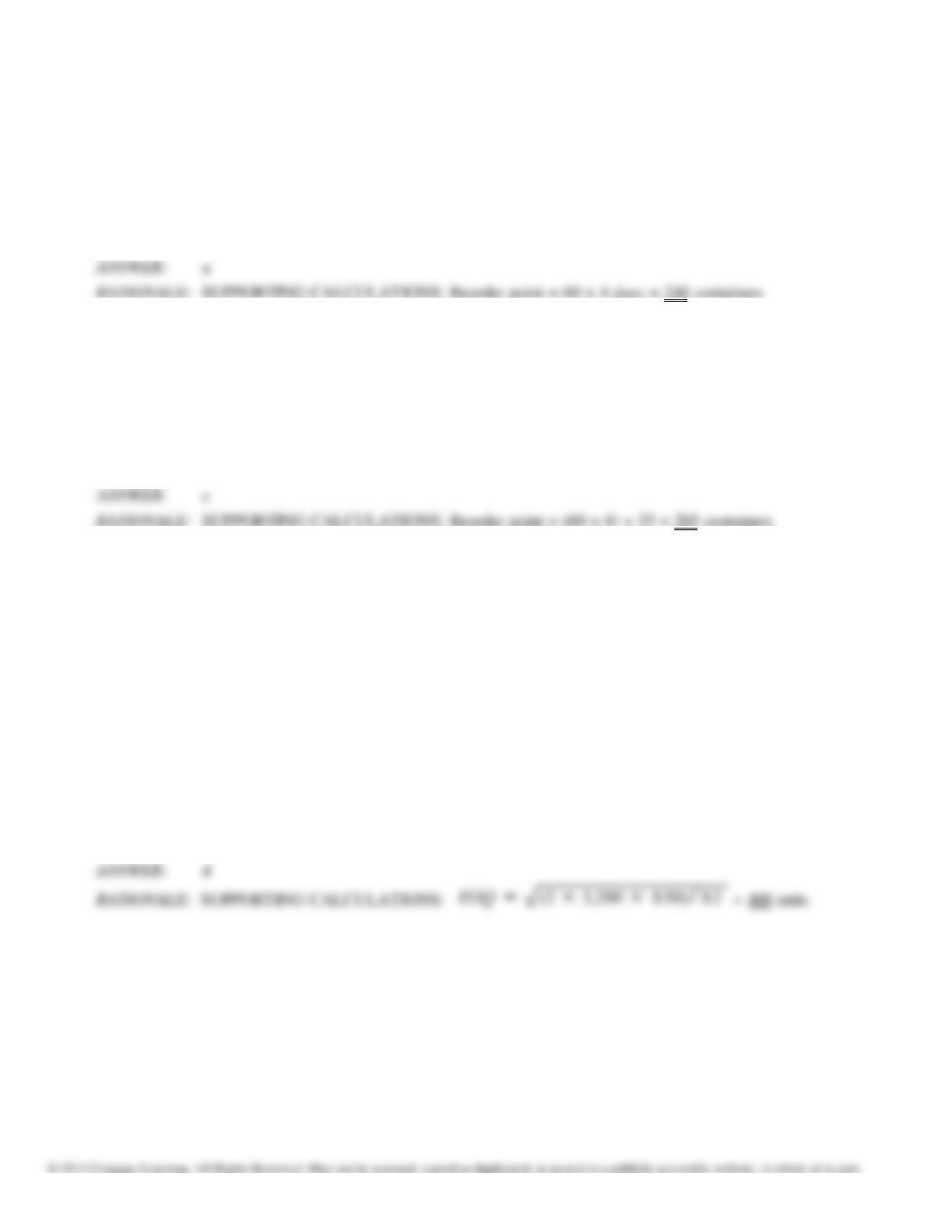
Moriah’s Candle Company manufactures candles. The company buys wax in 45-Kilogram containers that cost $17
each. The company uses 25,000 containers per year, and usage occurs evenly throughout the year. The average
cost to carry a 45-Kilogram container in inventory per year is $3, and the cost to place an order is $9. The company
works 250 days per year.
51. Refer to Figure 20–1. The economic order quantity (rounded) is
a. 1,000 containers.
b. 750 containers.
c. 45 containers.
d. 387 containers.
Chapter 20: Inventory Management: Economic Order Quantity, JIT, and the Theory of Constraints
52. Refer to Figure 20–1. The lead time is 4 working days and the average rate of usage is 60 containers per day. What
is the reorder point?
a. 240 containers
b. 260 containers
c. 220 containers
d. 200 containers
53. Refer to Figure 20–1. The lead time is 4 working days, the average rate of usage is 60 containers per day, and the
company carries a safety stock of 25 containers. What is the reorder point?
a. 285 containers
b. 245 containers
c. 265 containers
d. 225 containers
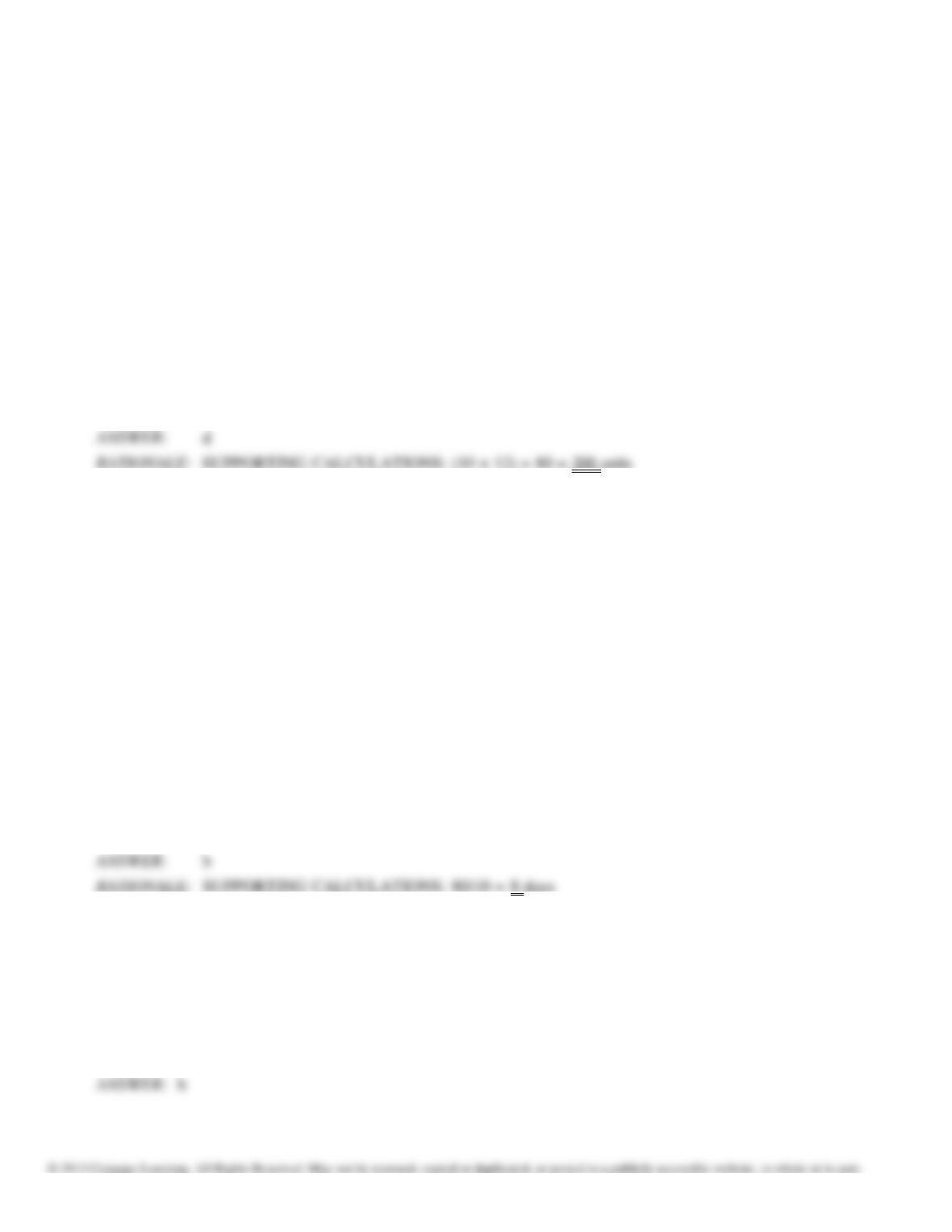
54. Albuquerque Company has the following information available concerning one of its inventory items:
Cost of placing an order
$50.00
Unit carrying cost per year
$2.00
Annual unit demand
3,200
Safety stock
80
Average daily demand
10
Normal lead time in days
12
The economic order quantity for this item is
a. 16 units.
b. 160,000 units.
c. 500 units.
d. 400 units.
Chapter 20: Inventory Management: Economic Order Quantity, JIT, and the Theory of Constraints
55. Albuquerque Company has the following information available concerning one of its inventory items:
Cost of placing an order
$50.00
Unit carrying cost per year
$2.00
Annual unit demand
3,200
Safety stock
80
Average daily demand
10
Normal lead time in days
The reorder point for the inventory item is
a. 500 units.
12
b. 970 units.
c. 320 units.
d. 200 units.
56. Albuquerque Company has the following information available concerning one of its inventory items:
Cost of placing an order
$50.00
Unit carrying cost per year
$2.00
Annual unit demand
3,200
Safety stock
80
Average daily demand
10
Normal lead time in days
12
If there is a delay in shipping the item, approximately how many days can be covered by the safety stock?
a. 0.83 days
b. 8.00 days
c. 6.67 days
d. 40.00 days
57. Dry Creek Company decreased the size of inventory order quantities that had previously been determined using the
EOQ model. If demand remains the same, what is the impact on the number of orders made during the year?
a. no change
b. increase
c. decrease
d. cannot be determined
Chapter 20: Inventory Management: Economic Order Quantity, JIT, and the Theory of Constraints
58. Dry Creek Company decreased the size of inventory order quantities that had previously been determined using the
EOQ model. What is the impact on the total amount of annual carrying and ordering costs?
a. no change
b. decrease
c. increase
d. cannot be determined
59. The economic order quantity is the order quantity that results in
a. the minimum total annual inventory costs.
b. the maximum total annual inventory costs.
c. no inventory shortages.
d. minimum ordering costs.
60. The order quantity used in the EOQ model is the quantity of inventory ordered
a. during one year.
b. for one job.
c. for one department.
d. at one time.
61. In the economic order quantity equation, the numerator under the square root includes
a. annual demand and cost of placing an order.
b. annual demand and unit carrying cost.
c. unit carrying cost and cost of placing an order.
d. order quantity and cost of placing an order.
62. Alabaster Manufacturing Company increased the size of several inventory order quantities that had previously been
determined using the EOQ model. What is the impact on the total amount of annual carrying and ordering costs?
a. no change
b. increase
c. decrease
d. cannot be determined
Chapter 20: Inventory Management: Economic Order Quantity, JIT, and the Theory of Constraints
63. Olga Company has an economic order quantity for item B of 100 units. The annual demand for the product is 1,400
units, and the unit carrying cost per year is $7. What is the cost of placing an order?
a. $25
b. $8
c. $200
d. $2
64. Olga Company has an economic order quantity for item B of 100 units. The annual demand for the product is 1,400
units, and the unit carrying cost per year is $7. The company operates 200 days a year, the lead time for the item is
ten days, and the safety stock is 100 units.
What is the reorder point?
a. 70 units
b. 100 units
c. 1000 units
d. 170 units
Chapter 20: Inventory Management: Economic Order Quantity, JIT, and the Theory of Constraints
65. Which of the following equations determines the total annual carrying costs when no safety stock is kept?
a. Cost of placing an order × Order quantity
b. Cost of placing an order × Number of orders per year
c. Cost of placing an order × One-half of the order quantity
d. Unit carrying costs per year × One-half of the order quantity
66. The reorder point in the EOQ model is
a. the day of the month for reordering.
b. when all of the inventory has been used.
c. when the inventory level is below the order quantity.
d. the inventory level at which an order for additional units is placed.
67. Which of the following elements could be determined by using the economic order quantity formula?
a. the optimum size of production run
b. reorder point
c. safety stock
d. annual demand
Figure 20 –2
Walrus Company has the following information available concerning one of its inventory items:
Cost of placing an order
$30.00
Unit carrying cost per year
$3.00
Annual unit demand
6,625
Safety stock
125
Average daily demand
25
Normal lead time in days
10
68. Refer to Figure 20–2. The economic order quantity for this item is
a. 1,500 units.
b. 364 units.
c. 140 units.
d. 725 units.
Chapter 20: Inventory Management: Economic Order Quantity, JIT, and the Theory of Constraints
69. Refer to Figure 20–2. The reorder point for the inventory item is
a. 275 units.
b. 375 units.
c. 625 units.
d. 1,525 units.
70. Refer to Figure 20–2. If there is a delay in shipping the item, approximately how many days can be covered by the
safety stock?
a. 5 days
b. 31 days
c. 26 days
d. 110 days
71. JIT reduces lead times to meet delivery dates by
a. reducing setup times.
b. expediting delivery to customers.
c. having more inventory available.
d. working overtime to fill orders.
72. Strategic objectives of JIT include
a. increasing profits.
b. improving a firm‘s competitive position.
c. increasing inventory.
d. both a and b.
73. The JIT approach to inventory management
a. allows greater flexibility as to when products can be manufactured.
b. results in higher inventory levels but reduces ordering and setup costs.
c. results in lower inventory carrying costs.
d. none of these.
Chapter 20: Inventory Management: Economic Order Quantity, JIT, and the Theory of Constraints
74. The objectives of JIT are achieved by
a. controlling costs.
b. improving delivery performance.
c. improving quality.
d. all of these.
75. One of the traditional reasons for holding inventory is to minimize total carrying costs and setup costs. The JIT
solution is to
a. reduce setup costs.
b. reduce lead time.
c. use total preventive maintenance.
d. use total quality control.
76. JIT purchasing is done using
a. short-term contracts emphasizing price.
b. long–term contracts based on quality, reliability, and price.
c. short–term contracts based on quality, reliability, and price.
d. inventory to hedge against stockouts and price increases.
77. JIT avoids shutdowns due to materials shortage in all of the following ways EXCEPT
a. using total preventive maintenance.
b. holding inventory.
c. using total quality control to reduce defective materials.
d. working with suppliers to ensure the availability of materials.
78. One of the traditional reasons for holding inventory is to avoid shutdowns due to unavailability of materials. The JIT
solution is to
a. reduce setup costs.
b. reduce lead time.
c. use long–term contracts with suppliers.
d. use total preventive maintenance.
Chapter 20: Inventory Management: Economic Order Quantity, JIT, and the Theory of Constraints
79. When comparing the traditional approach of inventory management to JIT, which of the following statements is
true?
a. The traditional approach accepts the existence of setup costs, but not carrying costs or inventories. JIT
accepts the existence of setup and carrying costs, but pushes for zero inventories.
b. The traditional approach accepts the existence of carrying costs and inventories, but not setup costs. JIT
accepts the existence of setup costs but not carrying costs and pushes for zero inventories.
c. The traditional approach accepts the existence of both setup costs and carrying costs and attempts to find
the order quantity that best balances those costs. JIT does not accept either setup costs or carrying costs and
pushes for zero inventory levels.
d. The traditional approach does not accept carrying costs or setup costs. JIT minimizes both setup and
carrying costs by finding the best order quantity to balance these costs.
80. One of the traditional reasons for holding inventory is to take advantage of quantity discounts and hedge against
future price increases. The JIT solution is to
a. reduce setup costs.
b. reduce lead time.
c. use long–term contracts with suppliers.
d. use total quality control.
81. One of the traditional reasons for holding inventory is to avoid shutdowns due to defective parts. The JIT solution is
to
a. reduce setup costs.
b. reduce lead time.
c. use total preventive maintenance.
d. use total quality control.
82. One of the traditional reasons for holding finished goods inventories is to ensure a firm‘s ability to meet delivery
dates. The JIT solution is to
a. reduce setup costs.
b. reduce lead time.
c. use total preventive maintenance.
d. use total quality control.
Chapter 20: Inventory Management: Economic Order Quantity, JIT, and the Theory of Constraints
83. One of the traditional reasons for holding inventory is to avoid a shutdown due to machine failure. The JIT solution
is to
a. reduce setup costs.
b. reduce lead time.
c. use total preventive maintenance.
d. use total quality control.
84. A marker or card that signals to a supplier the quantity of materials that need to be delivered and the time of
delivery is a
a. production Kanban.
b. vendor Kanban.
c. withdrawal Kanban.
d. deposit Kanban.
85. Which of the following is NOT a common reason for shutdowns?
a. safety stock of inventory
b. defective materials or subassemblies
c. machine failure
d. unavailability of a material of subassembly
86. With JIT manufacturing, finished goods inventories are
a. kept high to avoid stockouts.
b. held in various locations for faster delivery to customers.
c. immaterial.
d. kept high to let the company take advantage of volume discounts.
87. A withdrawal Kanban specifies
a. how much should be produced to replace inventory.
b. the quantity that a subsequent process should withdraw from the preceding process.
c. when customers should be notified to pick up orders.
d. when suppliers should be notified to deliver more parts.
Chapter 20: Inventory Management: Economic Order Quantity, JIT, and the Theory of Constraints
88. A marker or card that specifies the quantity that a subsequent process should take from a preceding process is a
a. production Kanban.
b. vendor Kanban.
c. withdrawal Kanban.
d. deposit Kanban.
89. The Kanban system is used to
a. ensure parts or materials are available when needed.
b. signal when preventive maintenance is needed.
c. signal when a defective unit has been produced.
d. ensure idle time of workers is not wasted.
90. A marker or card that specifies the quantity that the preceding process should manufacture is a
a. production Kanban.
b. vendor Kanban.
c. withdrawal Kanban.
d. deposit Kanban.
91. If the objective is to maximize profits in a linear programming problem, the coefficients of the variables in the
objective function should be the
a. selling price per unit.
b. variable costs per unit.
c. contribution margin per unit.
d. fixed costs per unit.
92. Loose constraints are best defined as
a. a constraint where the limiting factor is machine hours or labor availability.
b. a constraint where the limiting factor could be something like market demand.
c. a constraint where a product mix uses all of the limited resources of the constraint.
d. a constraint whose limited resources are not fully used by a product mix.
Chapter 20: Inventory Management: Economic Order Quantity, JIT, and the Theory of Constraints
93. Magnitude Company produces A and B with contribution margins per unit of $40 and $30, respectively. Only 500
labor hours and 300 machine hours are available for production.
Time requirements to produce one unit of A and B are as follows:
Product A Product B
Labor hours per unit 5 2
Machine hours per unit 1 4
What is the constraint on machine hours for Magnitude Company? a.
1A + 4B ≤ 300
b. 5A + 2B ≤ 500 c.
1A + 4B ≤ 500 d.
40A + 30B ≤ 500
Figure 20-3
The following information is available for Pullaway Trailer Company, which sells two products:
Trailer A
Trailer B
Processing time
2 hours
4 hours
Vinyl cover used
16 sq. ft.
12 sq. ft.
Selling price
$50.00
$80.00
Variable cost
$35.00
$50.00
Fixed cost
$10.00
$20.00
There are 100 hours available in the plant and 75 square feet of vinyl available per operating period.
94. Refer to Figure 20–3. Which of the following statements is INCORRECT?
a. The materials constraint favors Trailer B over Trailer A.
b. The time constraint favors Trailer A over Trailer B.
c. The material constraint favors Trailer A over Trailer B.
d. The objective function favors Trailer B over Trailer A.