Chapter 20: Accounting for Leases
99. Any initial direct costs incurred by the lessor for a sales-type lease should be
a.
expensed in the same period that the lease receivable is recognized.
b.
recorded as a prepaid asset and allocated to expense over the lease term.
c.
deferred and recognized as a reduction in the interest rate implicit in the lease.
d.
a
1
Easy
ACCT.WHAL.16.20.5 – LO: 20.5
United States – BUSPROG: Reflective Thinking – BUSPROG: Analytic
United States – OH – Default City – AICPA: FN-Decision Modeling
Bloom’s: Remembering
directly charged (debited) to Retained Earnings.
Exhibit 20-5
The Baltimore, Inc. entered into a five-year lease with the Waugh Chapel Company on January 1, 2016. Baltimore,
the lessor, will require that five equal annual payments of $25,000 be made at the beginning of each year. The first
payment will be made on January 1, 2016. The lease contains a bargain purchase option price of $12,000, which the
lessee may exercise on December 31, 2020. The lessee pays all executory costs. The cost of the leased property and
its normal selling price are $95,000 and $118,236, respectively. Collectibility of the future lease payments is
reasonably assured, and the lessor does not expect to incur any future costs related to the lease. Present value factors
for a 7%
Present value of $1 for n = 1
0.934579
Present value of $1 for n = 5
0.712986
Present value of an ordinary annuity for n = 5
4.100197
Present value of an annuity due for n = 5
4.387211
100. Refer to Exhibit 20-5. If Baltimore requires a 7% annual return, how should the lease be classified?
a.
operating lease
b.
direct financing lease
c.
sales-type lease
d.
leveraged lease
c
1
Moderate
ACCT.WHAL.16.20.5 – LO: 20.5
United States – BUSPORG: Analytic
United States – OH – Default City – AICPA: FN-Measurement
Bloom’s: Analyzing
101. Refer to Exhibit 20-5. If Baltimore requires a 7% annual return, what is the correct amount that should be credited to
Unearned Interest: Leases on January 1, 2016, by Baltimore (round the answer to the nearest dollar)?
a.
$15,320
b.
$18,764
c.
$22,495
d.
$43,236
b
1
Moderate
ACCT.WHAL.16.20.5 – LO: 20.5
United States – BUSPORG: Analytic
Bloom’s: Analyzing
102. Refer to Exhibit 20-5. If Baltimore requires a 7% annual return, what is the correct amount of interest revenue to be
recognized by Baltimore for 2016 (round the answer to the nearest dollar)?
a.
$7,774
b.
$7,175
c.
$6,527
d.
$5,928
c
1
Moderate
ACCT.WHAL.16.20.5 – LO: 20.5
United States – BUSPORG: Analytic
United States – OH – Default City – AICPA: FN-Measurement
Bloom’s: Analyzing
103. Refer to Exhibit 20-5. If Baltimore requires a 7% annual return, how much gross profit will Baltimore record at the
inception of the lease?
a.
$7,505
b.
$14,680
c.
$16,061
d.
$23,236
d
1
Challenging
ACCT.WHAL.16.20.5 – LO: 20.5
United States – BUSPORG: Analytic
United States – OH – Default City – AICPA: FN-Measurement
104. Which of the following facts would preclude a lessor from classifying a lease as a sales-type or direct financing
lease?
a.
The undiscounted sum of the minimum lease payments is 90% of the fair value of the leased property to the
lessor.
b.
The collectability of the minimum lease payments is reasonably assured.
c.
The lease term is 90% of the estimated economic life of the leased property.
d.
No important uncertainties exist about non-reimbursable costs yet to be incurred by the lessor.
a
1
Moderate
ACCT.WHAL.16.20.5 – LO: 20.5
United States – BUSPROG: Reflective Thinking – BUSPROG: Analytic
United States – OH – Default City – AICPA: FN-Decision Modeling
Bloom’s: Understanding
105. Depreciation expense will be recorded in the accounts of the lessee and lessor for which type of leases?
Lessee
Lessor
I.
operating
direct financing
II.
capital
operating
III.
operating
operating
IV.
capital
sales-type
a.
I
b.
II
c.
III
d.
IV
b
1
Easy
ACCT.WHAL.16.20.5 – LO: 20.5
United States – BUSPROG: Reflective Thinking – BUSPROG: Analytic
United States – OH – Default City – AICPA: FN-Decision Modeling
Bloom’s: Remembering
106. When a lessor receives cash on a sales-type lease, which of the following accounts is decreased?
a.
Interest Revenue: Leases
b.
Lease Rental Revenue
c.
Lease Receivable
d.
Unearned Interest: Leases
c
1
Easy
ACCT.WHAL.16.20.5 – LO: 20.5
United States – BUSPROG: Reflective Thinking – BUSPROG: Analytic
United States – OH – Default City – AICPA: FN-Decision Modeling
Bloom’s: Remembering
107. Which of the following statements concerning direct financing leases is true?
a.
The net investment in the lease should be adjusted each year by material increases (but not decreases) in
estimated unguaranteed residual values.
b.
The lessor reports only interest revenue on the income statement.
c.
Initial direct costs result in an increase in Unearned Interest Revenue-Leases by an amount equal to these costs
in the year the costs are incurred.
d.
The lessor’s gross margin is amortized over the life of the lease.
b
1
Moderate
ACCT.WHAL.16.20.5 – LO: 20.5
United States – BUSPROG: Reflective Thinking – BUSPROG: Analytic
United States – OH – Default City – AICPA: FN-Decision Modeling
Bloom’s: Understanding
108. A lessor has an account, Equipment Leased to Others, and the related account, Accumulated Depreciation:
Equipment Leased to Others, on its year-end balance sheet. How should the lease related to these accounts be
classified?
a.
operating lease
b.
direct financing lease
c.
sales-type lease
d.
leveraged lease
a
1
Moderate
ACCT.WHAL.16.20.6 – LO: 20.6
United States – BUSPROG: Reflective Thinking – BUSPROG: Analytic
Bloom’s: Understanding
109. The account Unearned Interest: Leases should be reported on the lessor’s financial statements as
a.
other revenue.
b.
an asset.
c.
a contra-asset.
d.
a liability.
c
1
Easy
ACCT.WHAL.16.20.6 – LO: 20.6
United States – BUSPROG: Reflective Thinking – BUSPROG: Analytic
United States – OH – Default City – AICPA: FN-Decision Modeling
Bloom’s: Remembering
110. The lessor should report the Lease Receivable for a sales-type lease on its balance sheet as
a.
a current asset.
b.
a long-term asset.
c.
a current asset for the current portion and a long-term asset for the remaining amount.
d.
only a note to the financial statements.
c
1
Easy
ACCT.WHAL.16.20.6 – LO: 20.6
United States – BUSPROG: Reflective Thinking – BUSPROG: Analytic
United States – OH – Default City – AICPA: FN-Decision Modeling
Bloom’s: Remembering
111. Which of the following cash flows is classified as an investing cash flow?
a.
payment received under an operating lease
b.
purchase of an asset leased under a sales-type lease
c.
interest portion of payment received under a direct financing lease
d.
reduction of a direct financing lease receivable
d
1
Easy
ACCT.WHAL.16.20.6 – LO: 20.6
United States – BUSPROG: Reflective Thinking – BUSPROG: Analytic
United States – OH – Default City – AICPA: FN-Decision Modeling
Bloom’s: Remembering
112. Which of the following is not a required disclosure by a lessor of a sales-type lease?
a.
the guaranteed residual value accruing to the benefit of the lessor
b.
total contingent rentals included in revenue for the period
c.
unearned income
d.
a general description of the lessor’s leasing arrangements
a
1
Easy
ACCT.WHAL.16.20.6 – LO: 20.6
United States – BUSPROG: Reflective Thinking – BUSPROG: Analytic
United States – OH – Default City – AICPA: FN-Decision Modeling
Bloom’s: Remembering
113. Lessee leased some land and buildings from Lessor. There was no transfer of ownership and no bargain purchase
option. If the fair value of the land is less than a certain percentage of the total fair value of the leased property at the
inception of the lease, both the lessee and the lessor may consider the land and buildings as a single unit. What is that
percentage?
a.
10%
b.
75%
c.
25%
d.
50%
c
1
Easy
ACCT.WHAL.16.20.7 – LO: 20.7
United States – BUSPROG: Reflective Thinking – BUSPROG: Analytic
United States – OH – Default City – AICPA: FN-Decision Modeling
Bloom’s: Remembering
114. Which of the following criteria would require a lessee to classify a lease of land as a capital lease?
1.
Transfer of ownership
2.
Contains a bargain purchase option
3.
Lease term is 75% of economic life
4.
Present value of lease payments is 90% of fair value
a.
any of the criteria
b.
criterion 1 or 2
c.
criterion 1, 2, or 3
d.
criterion 1, 2, or 4
b
Easy
ACCT.WHAL.16.20.7 – LO: 20.7
United States – BUSPROG: Reflective Thinking – BUSPROG: Analytic
United States – OH – Default City – AICPA: FN-Decision Modeling
Bloom’s: Remembering
115. Which of the following amortization policies is correct for a capital lease of both land and buildings that transfers
title or contains a bargain purchase option?
a.
The total capitalized cost of the lease less any expected residual value is allocated over the expected economic
life of the assets.
b.
The total capitalized cost of the lease less any expected residual value is allocated over the lease term.
c.
An amount is assigned to Leased Buildings that is depreciated over the lease term, and the amount assigned to
Leased Land is not depreciated.
d.
An amount is assigned to Leased Buildings that is depreciated over the expected economic life of the asset,
and the amount assigned to Leased Land is not depreciated.
d
1
Moderate
ACCT.WHAL.16.20.7 – LO: 20.7
United States – BUSPROG: Reflective Thinking – BUSPROG: Analytic
United States – OH – Default City – AICPA: FN-Decision Modeling
Bloom’s: Understanding
116. In a sales-leaseback transaction
a.
the sale and leaseback are treated for accounting purposes as separate transactions.
b.
any profit on the sale should, in general, be deferred and amortized by the seller-lessee.
c.
any loss up to the amount of the difference between undepreciated cost and fair value should be deferred and
amortized by the seller-lessee.
d.
any lease of land alone must be classified as an operating lease.
b
Easy
United States – BUSPROG: Reflective Thinking – BUSPROG: Analytic
117. On January 1, 2016, Christopher Properties sold a building to another company and immediately leased it back again.
The Christopher’ book value for the building was $15,480. The lease was for five years with $5,000 payable at the
end of each year. The payments, discounted at 11%, equaled $18,480. Which entry would Christopher Properties not
make in 2016?
a.
Depreciation Expense: Leased Asset 3,790
Accumulated Depreciation:
Leased Asset 3,790
b.
Cash 18,480
Building 15,480
Profit on Sale-Leaseback 3,000
c.
Leased Equipment Under Capital Leases 18,480
Obligation Under Capital Leases 18,480
d.
Obligation Under Capital Leases 2,967
Interest Expense 2,033
Cash 5,000
b
Moderate
United States – BUSPORG: Analytic
United States – OH – Default City – AICPA: FN-Measurement
118. For a sale-leaseback transaction for which the lease qualifies as a capital lease, the seller-lessee should account for
any gain on the sale of the asset as a gain to be
a.
to be recognized immediately.
b.
to be deferred and amortized in proportion to the lease payments over the lease term.
c.
to be deferred and amortized in proportion to the amortization of the leased asset.
d.
to be recorded directly as an increase to Retained Earnings.
c
1
Moderate
ACCT.WHAL.16.20.7 – LO: 20.7
United States – BUSPROG: Reflective Thinking – BUSPROG: Analytic
Bloom’s: Understanding
119. Which statement is not true?
a.
If a lease is a capital lease because of a bargain purchase option, the leased asset should be depreciated over
the life of the asset, not the life of the lease.
b.
The lessee ignores unguaranteed residual value in the measurement of the lease obligation.
c.
If there is a bargain purchase option, the lessor does not consider an unguaranteed residual value in measuring
the lease receivable at the date of lease signing.
d.
In direct financing leases, the net investment in the lease should be adjusted each year by material changes
(increases or decreases) in estimated unguaranteed residual values.
d
1
Easy
ACCT.WHAL.16.20.7 – LO: 20.7
United States – BUSPROG: Reflective Thinking – BUSPROG: Analytic
United States – OH – Default City – AICPA: FN-Decision Modeling
Bloom’s: Remembering
120. The primary issue in a sale-leaseback transaction is that
a.
the seller-lessee recognizes a loss in the period of the transaction but defers any gain and amortizes it over the
life of the lease.
b.
the seller-lessee recognizes a gain in the period of the transaction but defers any gain and amortizes it over the
life of the lease.
c.
the seller-lessee recognizes a loss in the period of the transaction but defers any gain and amortizes it over the
life of the lease.
d.
the seller-lessee recognizes a loss in the period of the transaction but defers any gain and amortizes it over the
life of the lease.
121. Shown below is a list of key terms (a–j) related to leasing, followed by a series of definitions (1–10):
a.
bargain purchase option
f.
lessee’s incremental borrowing rate
b.
executory costs
g.
manufacturer’s/dealer’s profit or loss
c.
guaranteed residual value
h.
minimum lease payments
d.
initial direct costs
i.
unguaranteed residual value
e.
interest rate implicit in the lease
j.
unreimbursable cost
____
1.
Incurred by the lessor to originate a lease that result directly from and
are essential to acquiring the lease and would not have been incurred had
the lease transaction not occurred.
____
2.
Portion of estimated residual value not guaranteed by the lessee.
____
3.
Required to be paid by the lessee to the lessor over the life of the lease.
____
4.
Rate that would have been incurred if the property had been purchased
by debt.
____
5.
Rate that equates the fair value of the leased property and the present
value of the lease payments plus the unguaranteed residual value.
____
6.
Provision that allows the lessee to purchase the leased property at a price
so favorable it is a reasonable certainty that the sale will occur.
____
7.
The difference between the fair value of the property at the beginning of
the lease and its cost or carrying value.
____
8.
Commitments by the lessor to guarantee performance of the leased
property in a manner more extensive than the typical product warranty.
____
9.
Portion of the residual value of the leased property that is guaranteed by
the lessee.
____
10.
Ownership-type costs, such as insurance, maintenance, and property
taxes.
1.
d
6.
2.
i
7.
3.
h
8.
4.
f
9.
5.
e
10.
Required:
Match each term to its definition by placing the appropriate letter in the space provided.
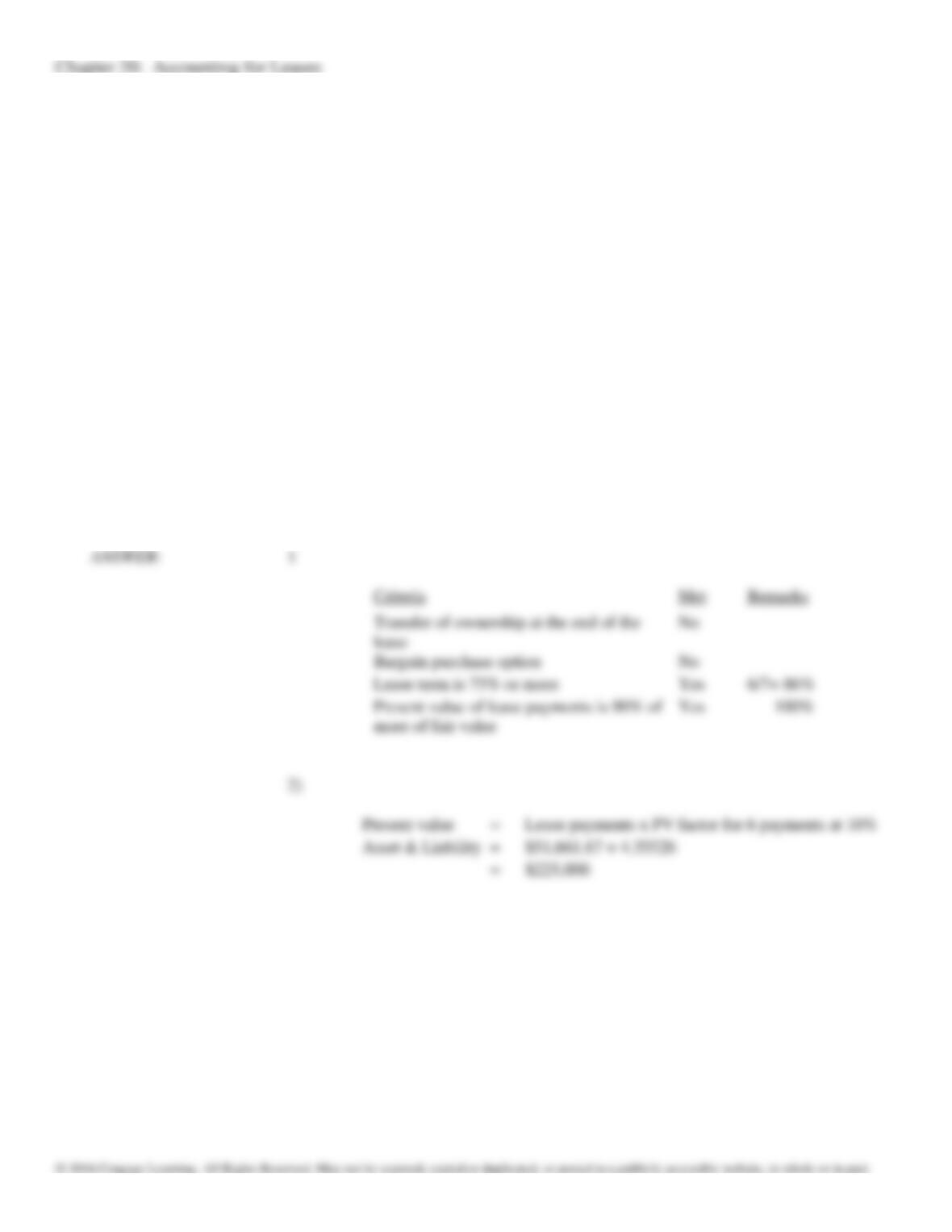
122. Timothy Company signs a lease agreement dated January 1, 2016 with Jasper Company for equipment. The lease
terms, provisions, and related events are as follows:
1) Timothy agrees to pay all executory costs.
2) The lease does not contain any renewal or bargain purchase options.
3) The lease term is 6 years. The lease is noncancelable and requires equal rental payments
to be made at the end of each year.
4) The equipment has an estimated useful life of 7 years, fair value of $225,000, and does
not have a residual value.
5) The annual payment is set by Jasper at $51,661.67 to earn a rate of return of 10%.
Timothy is aware of the rate and it is equal to its borrowing rate.
6) Timothy uses the straight line method of depreciation on all of its equipment.
Required:
1) Using the four criteria required for capitalization determine whether the lease is an operating lease or a capital
lease for the lessee.
2) Calculate the amount of the asset and liability of Timothy at the inception of the lease.
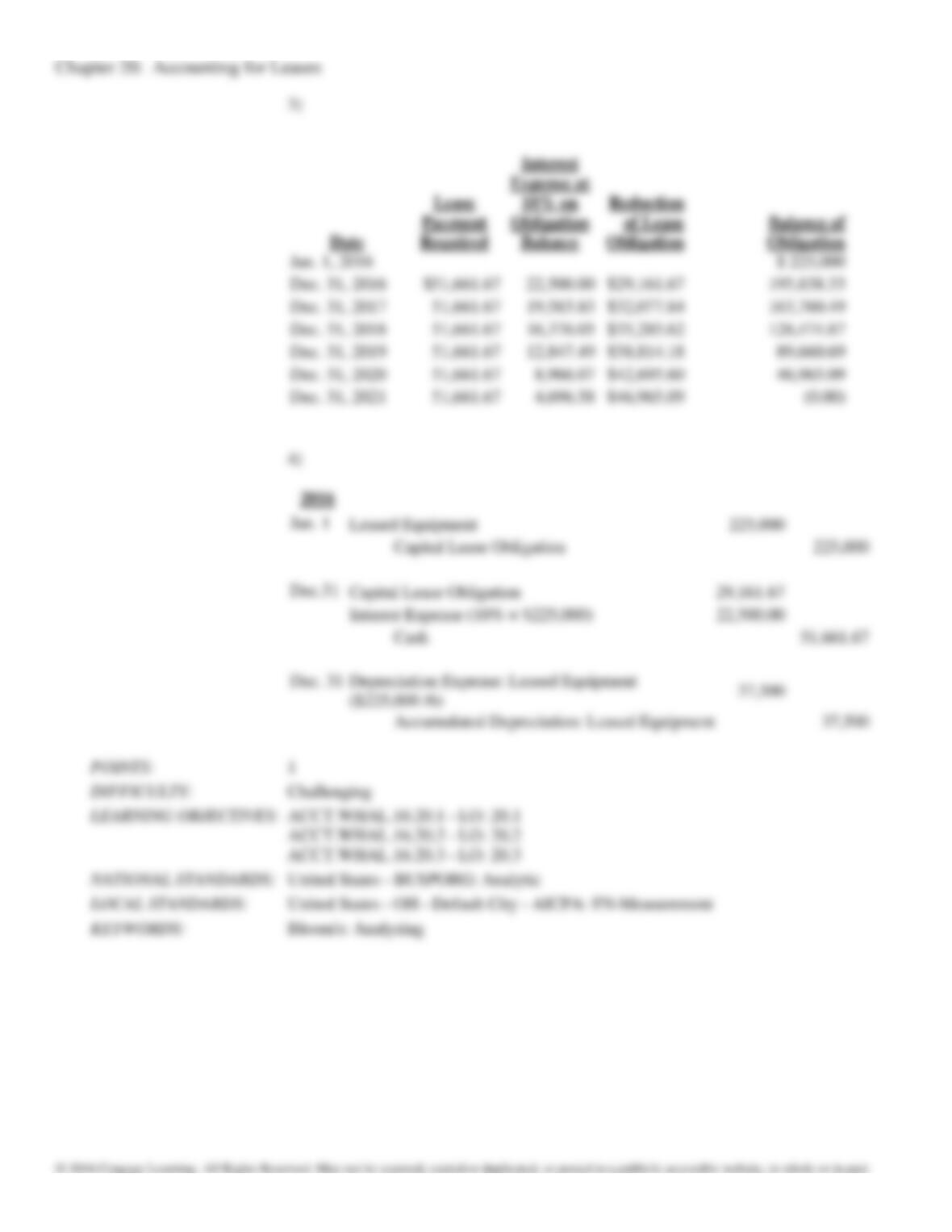
3) Prepare the amortization table for the lease and interest expense.
4) Prepare the journal entries for Timothy for 2016.
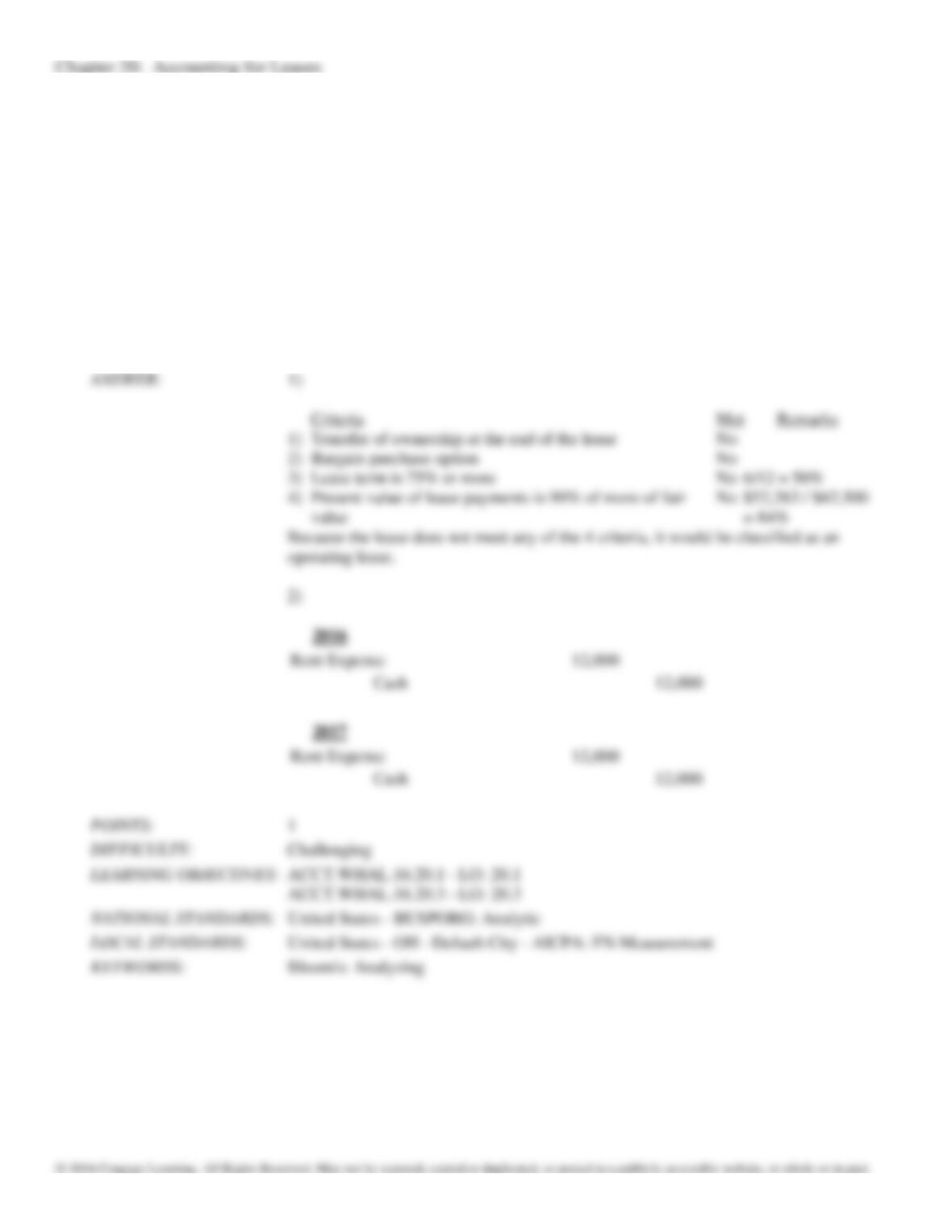
123. Maher has entered into a lease agreement with Johanson Company on January 1, 2016.
1) The lease reverts back to Johanson Company at the end of the lease. Johanson does not
offer a bargain purchase option.
2) The term of the lease is 6 years and requires annual payments of $12,000 at the end of the
year.
3) The present value of the lease payments is $52,263 using an incremental rate of 10%, the
equipment’s fair value at lease inception is $62,500.
4) The equipment has an estimated life of asset is 12 years.
Required:
1) Determine whether the lease qualifies as an operating or capital lease for Maher.
2) Prepare the journal entries that Maher would make for 2016 and 2017.
Criteria
1)
Transfer of ownership at the end of the lease
3)
Lease term is 75% or more
6/12 = 50%
4)
Present value of lease payments is 90% of more of fair
$52,263 / $62,500
Because the lease does not meet any of the 4 criteria, it would be classified as an
1
ACCT.WHAL.16.20.1 – LO: 20.1
United States – BUSPORG: Analytic
United States – OH – Default City – AICPA: FN-Measurement
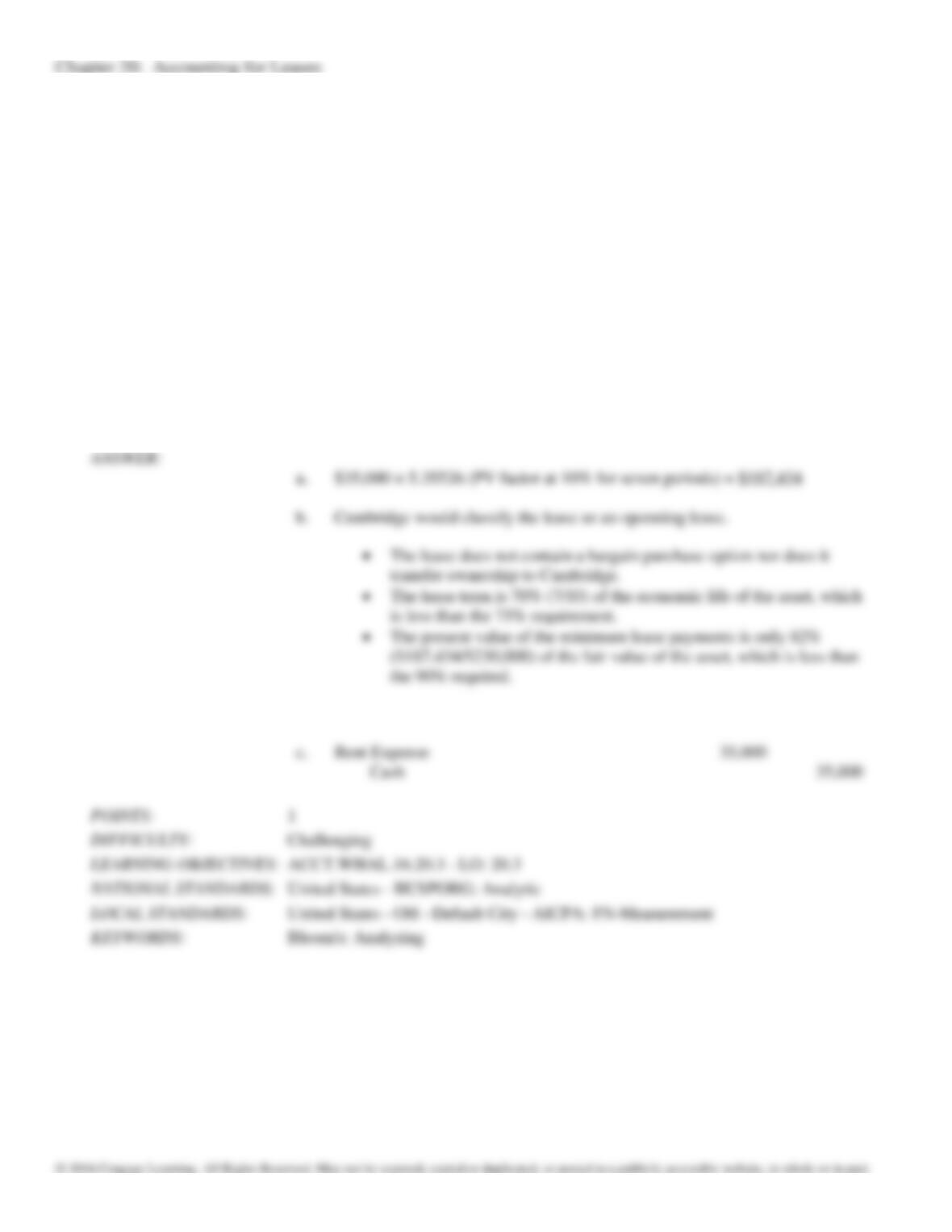
124. Cambridge Company leased equipment from Amherst Company on January 1, 2016. Information about the lease is
as follows:
Lease payments, due at the beginning of each year
$35,000
Lease term
7 years
Estimated useful life of the equipment
10 years
Cambridge’s incremental borrowing rate
12%
Interest rate implicit in the lease (known to Cambridge)
10%
Residual value (not guaranteed by Cambridge)
$20,000
Fair market value of the equipment.
$230,000
Cambridge’s depreciation method
Straight-line
No bargain purchase option; no transfer of ownership
Required:
a.
Compute the present value of the minimum lease payments.
b.
Classify the lease from the viewpoint of Cambridge Company, giving reasons.
c.
Prepare Cambridge’s journal entry or entries for the lease for 2016.
1
Challenging
ACCT.WHAL.16.20.3 – LO: 20.3
United States – BUSPORG: Analytic
United States – OH – Default City – AICPA: FN-Measurement
Bloom’s: Analyzing
125. On January 1, 2016, New Port News Company leased equipment from Scanner Company. The lease had a non-cancelable
ten-year term and required annual lease payments of $19,000 to be paid on January 1 of each year with the first payment
due January 1, 2016. The annual payment includes $1,000 for executory costs. New Port News guarantees a $15,000
residual value at the end of the lease term. The estimated economic life of the equipment is 12 years. The fair value of the
equipment on January 1, 2016 is $140,000. New Port News’s incremental borrowing rate is 10%, and Scanner’s implicit
interest rate is 9%, which is known by New Port News. Present value factors for interest rates of 9% and 10% are as
follows:
9%
10%
Present value of $1 for n = 1
0.917431
0.909091
Present value of $1 for n = 10
0.422411
0.385543
Present value of an ordinary annuity for n = 10
6.417658
6.144567
Present value of an annuity due for n = 10
6.995247
6.759024
New Port News uses straight-line depreciation for its plant assets.
Required:
a.
Compute the present value of the minimum lease payments. (Show
computations and round all amounts to the nearest dollar.)
b.
Classify the lease from the standpoint of the lessee, stating the reason for
the classification.
c.
Prepare each of the following journal entries on the lessee’s books.
(Show computations and round all amounts to the nearest dollar.)
(1)
Record the lease agreement on January 1, 2016.
(2)
Record the payment on January 1, 2016.
(3)
Record any adjusting entries on December 31, 2016, in
connection with the lease agreement.
126. Raleigh, Inc. leased some equipment from another company on January 1, 2016, for a three-year period. Payments of
$45,000 were due each December 31. The lease qualified as a capital lease. Assets were depreciated over the life of
the lease, using the straight-line method. The appropriate interest rate to use was 9%.
Required:
(For all answers, round to the nearest dollar.)
a.
Prepare all December 31, 2016, journal entries required on Raleigh’s books.
b.
At December 31, 2016, how much of the lease liability should be shown as current?
Compute two acceptable answers.
c.
If the first $45,000 payment were due January 1, 2016, what journal entries would be
required on Raleigh’s books on January 1, 2016?
d.
Assume again that the $45,000 payments are made on December 31. Assume, in addition,
that at the end of three years, the lessee guaranteed a residual value of $10,000. Compute
the amount of the lease obligation that should be recorded on January 1, 2016.
e.
Refer to Part d. Assume that on December 31, 2018, the leased equipment had a fair value
of only $6,500. Prepare all December 31, 2018, journal entries for the lessee.
1
Challenging
ACCT.WHAL.16.20.3 – LO: 20.3
United States – BUSPORG: Analytic
United States – OH – Default City – AICPA: FN-Measurement
Bloom’s: Analyzing
127. Wyoming Company leased some equipment from another company on January 1, 2016, for a four-year period.
Payments of $18,000 were due each December 31. The lease qualified as a capital lease. Assets were depreciated
straight-line over the life of the lease. The appropriate interest rate to use was 10%.
Required:
(For all answers, round to the nearest dollar.)
a.
Prepare all journal entries for 2016 required on Wyoming’s books.
b.
At December 31, 2016, how much of the lease liability should be shown as current?
Compute two acceptable answers.
c.
If the $18,000 payments were due on January 1, beginning in the year 2016, prepare
all January 1, 2016, entries for Wyoming.
d.
Assume again that the $18,000 lease payments are due on December 31. Assume, in
addition, that at the end of four years, Wyoming (the lessee) guarantees a residual
value of $3,000. At what amount should the lease obligation be recorded on January
1, 2016?
e.
Refer to Part d. Assume that at December 31, 2019, the leased equipment had a fair
value of only $1,000. Prepare all December 31, 2019 journal entries for Wyoming.