Cost Accounting: A Managerial Emphasis, 6e
Chapter 20 – Inventory Cost Management Strategies
63) Ralph was in the process of completing the quarterly planning for the purchasing department when a
major computer malfunction lost most of his data. For direct material XXX he was able to recover the
following:
Average inventory level of XXX
???
Orders per year
40
Average daily demand
48
Working days per year
250
Annual ordering costs
$4,000
Annual carrying costs
$30/unit
Ralph purchases at the EOQ quantity level.
Required:
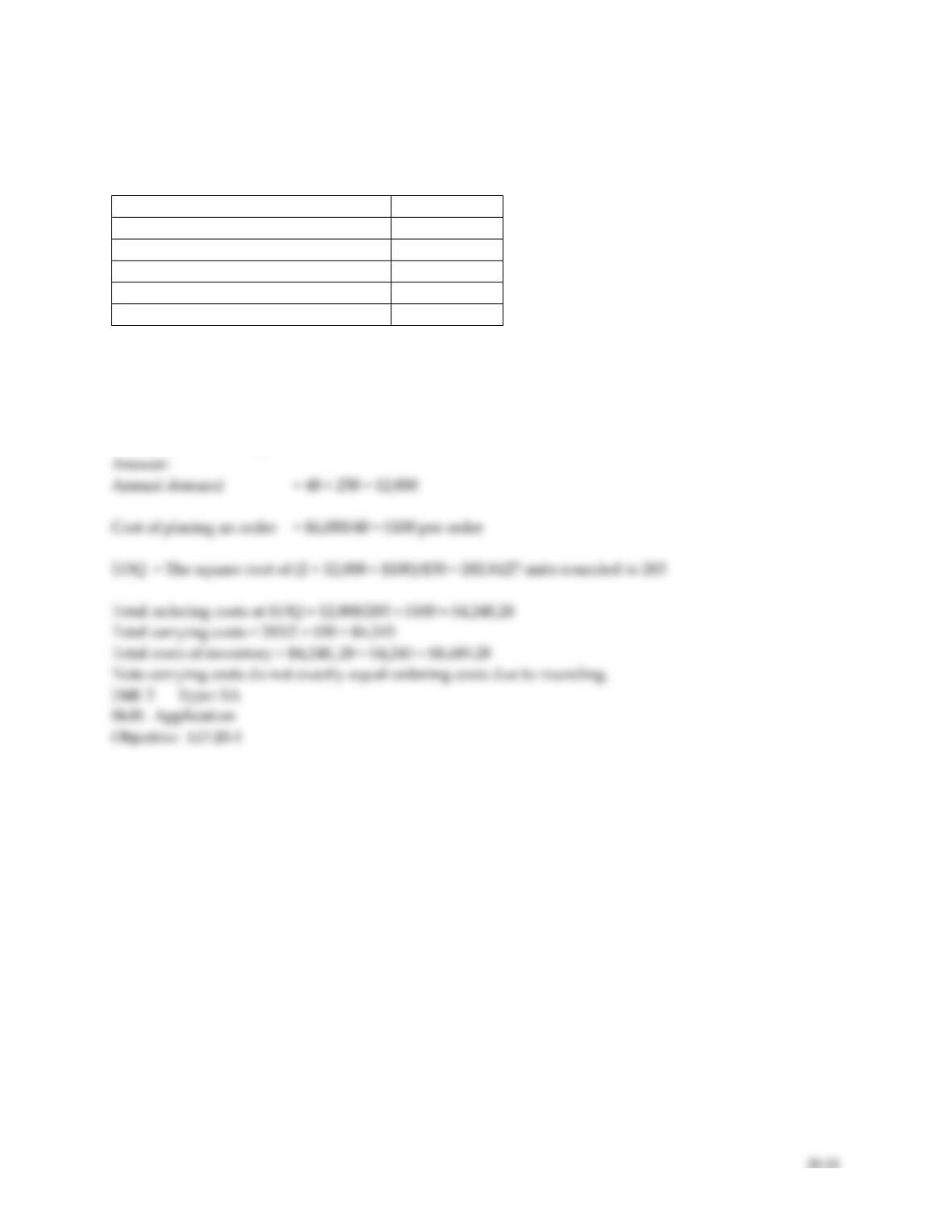
Determine the annual demand, the cost of placing an order, the economic order quantity and the annual
total costs of inventory.
Cost Accounting: A Managerial Emphasis, 6e
Chapter 20 – Inventory Cost Management Strategies
64) The IBP Grocery orders most of its items in lot sizes of 10 units. Average annual demand per side of
beef is 720 units per year. Ordering costs are $25 per order with an average purchasing price of $100.
Annual inventory carrying costs are estimated to be 40 percent of the unit cost.
Required:
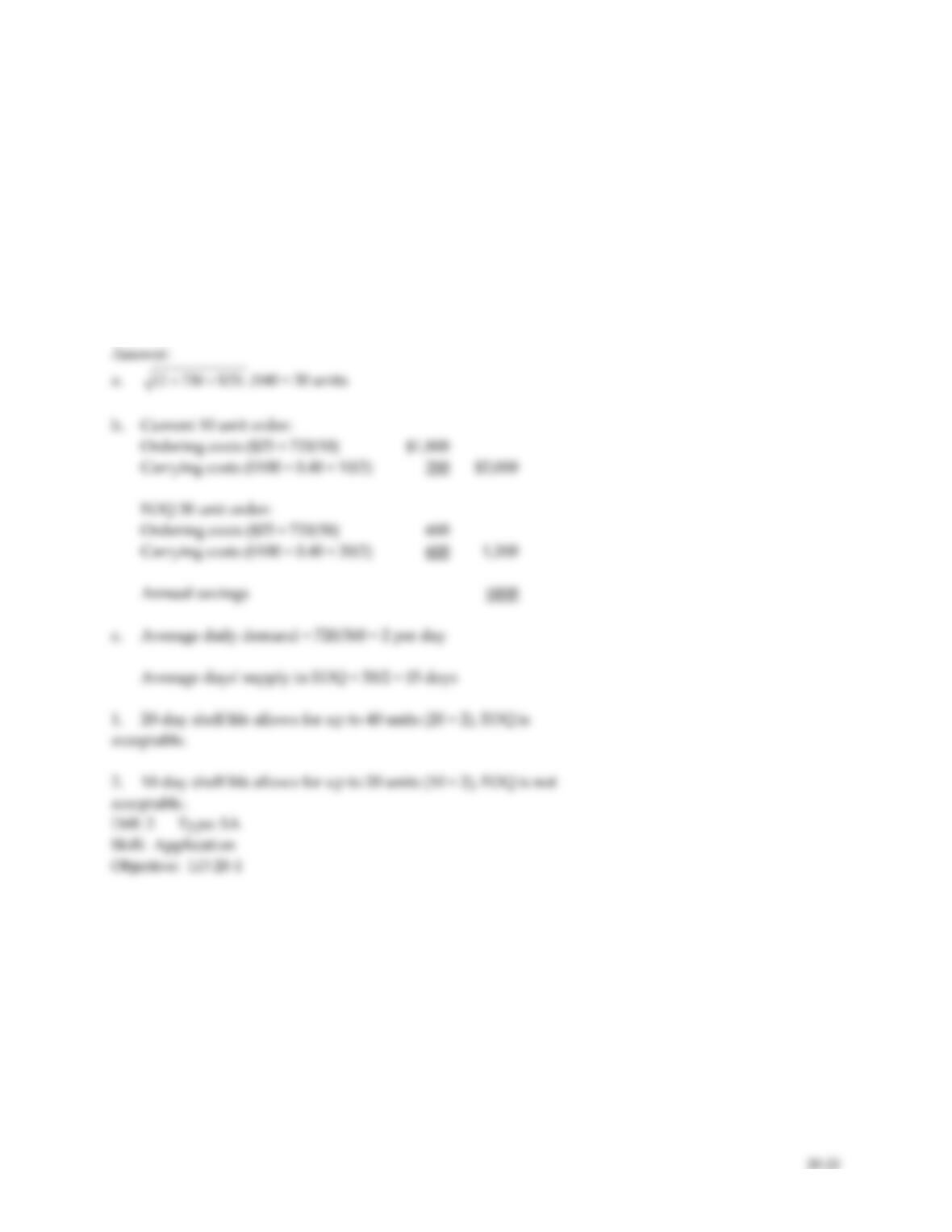
a. Determine the economic order quantity.
b. Determine the annual cost savings if the shop changes from an order size of 10 units to the economic
order quantity.
c. Since the shelf life is limited the IBP Grocery must keep the inventory moving. Assuming a 360–day
year, determine the optimal lot size under each of the following: (1) a 20-day shelf life and (2) a 10-day
shelf life.
Cost Accounting: A Managerial Emphasis, 6e
Chapter 20 – Inventory Cost Management Strategies
65) For supply item ABC, Andrews Company has been ordering 125 units based on the recommendation
of the salesperson who calls on the company monthly. A new purchasing agent has been hired by the
company who wants to start using the economic-order–quantity method and its supporting decision
elements. She has gathered the following information:
Annual demand in units
250
Days used per year
250
Lead time, in days
10
Ordering costs
$100
Annual unit carrying costs
$20
Required:
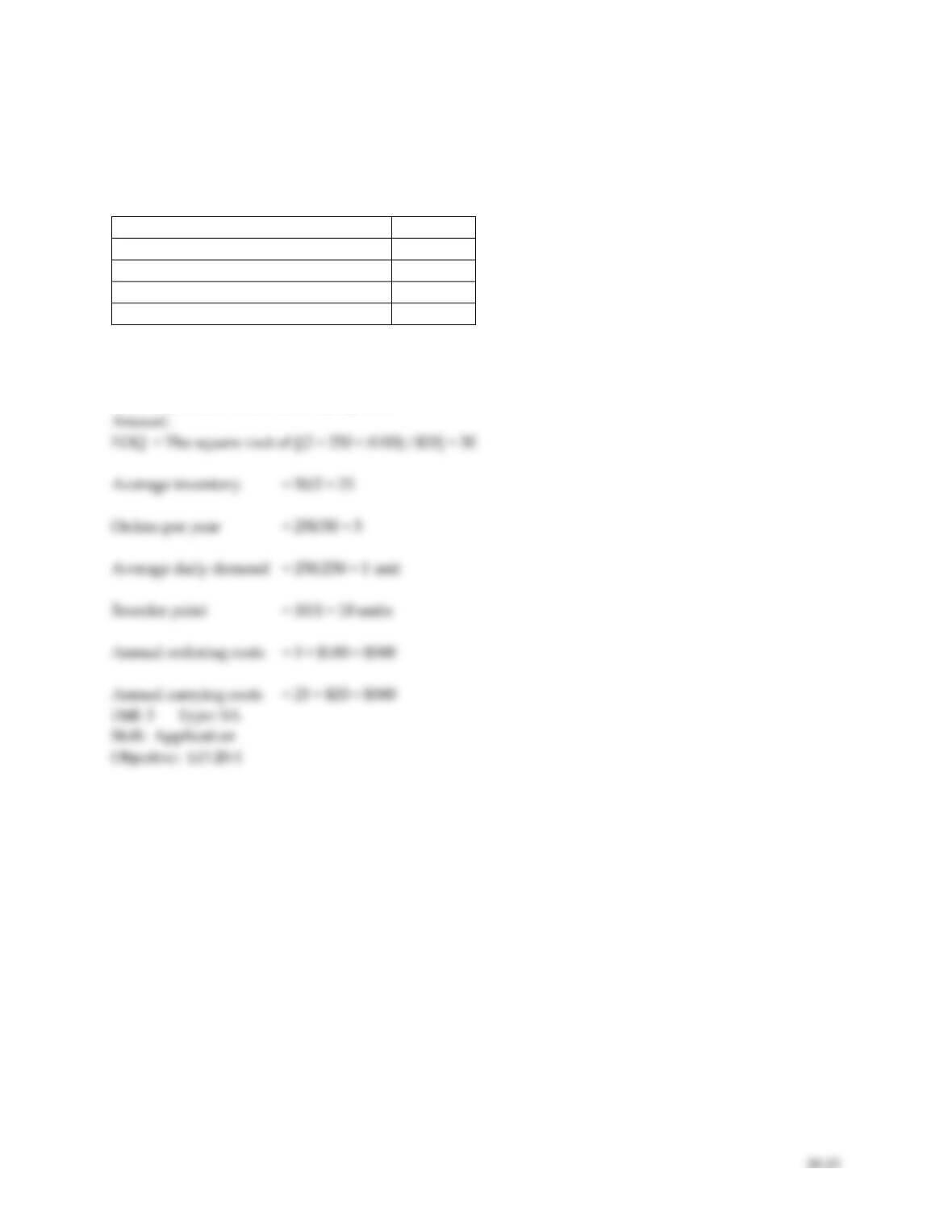
Determine the EOQ, average inventory, orders per year, average daily demand, reorder point, annual
ordering costs, and annual carrying costs.
Cost Accounting: A Managerial Emphasis, 6e
Chapter 20 – Inventory Cost Management Strategies
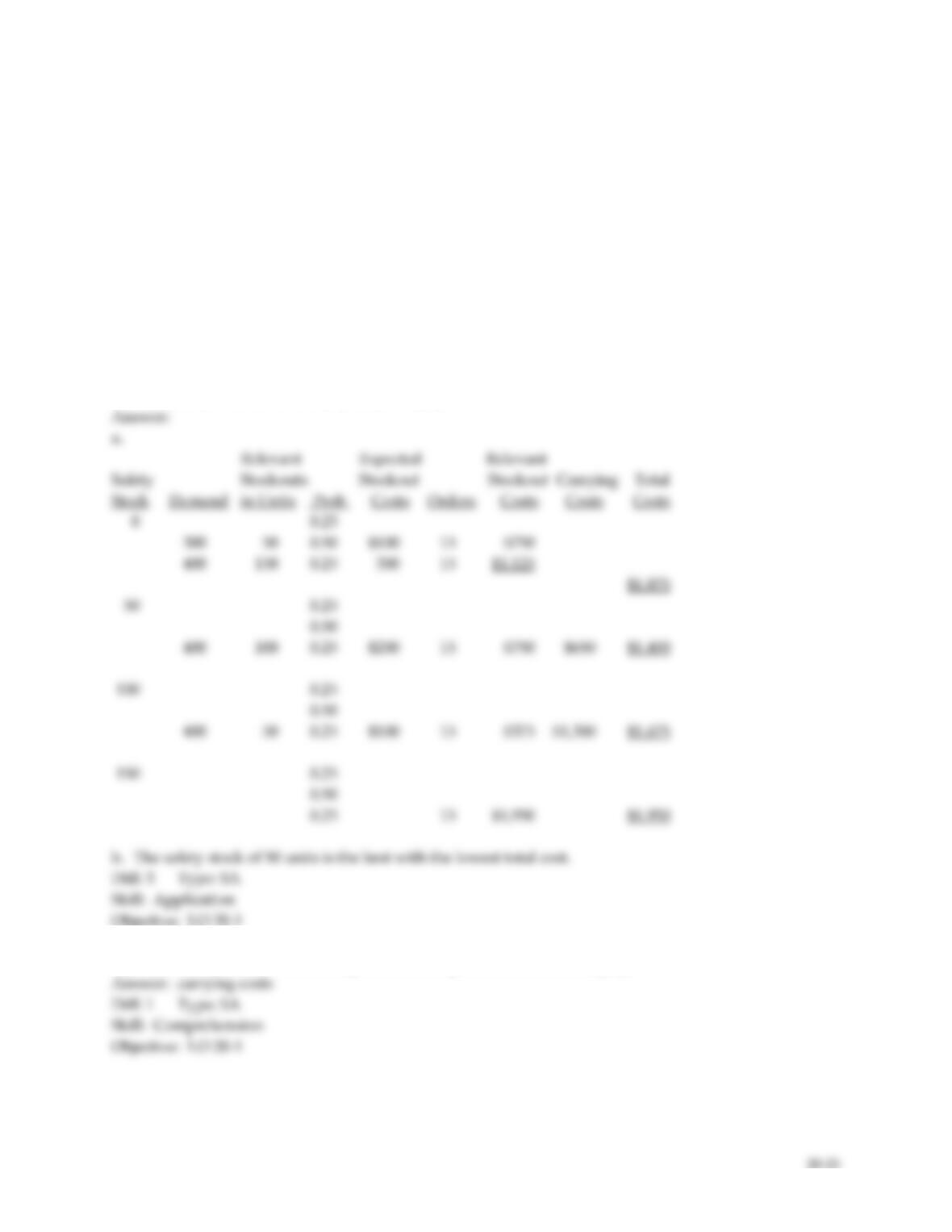
66) A jeweller orders gems in lot sizes of 1,250 gems. The annual demand for emeralds is 6,250 gems.
Ordering costs are $200 per order and carrying costs are $10 per unit annually.
Required:
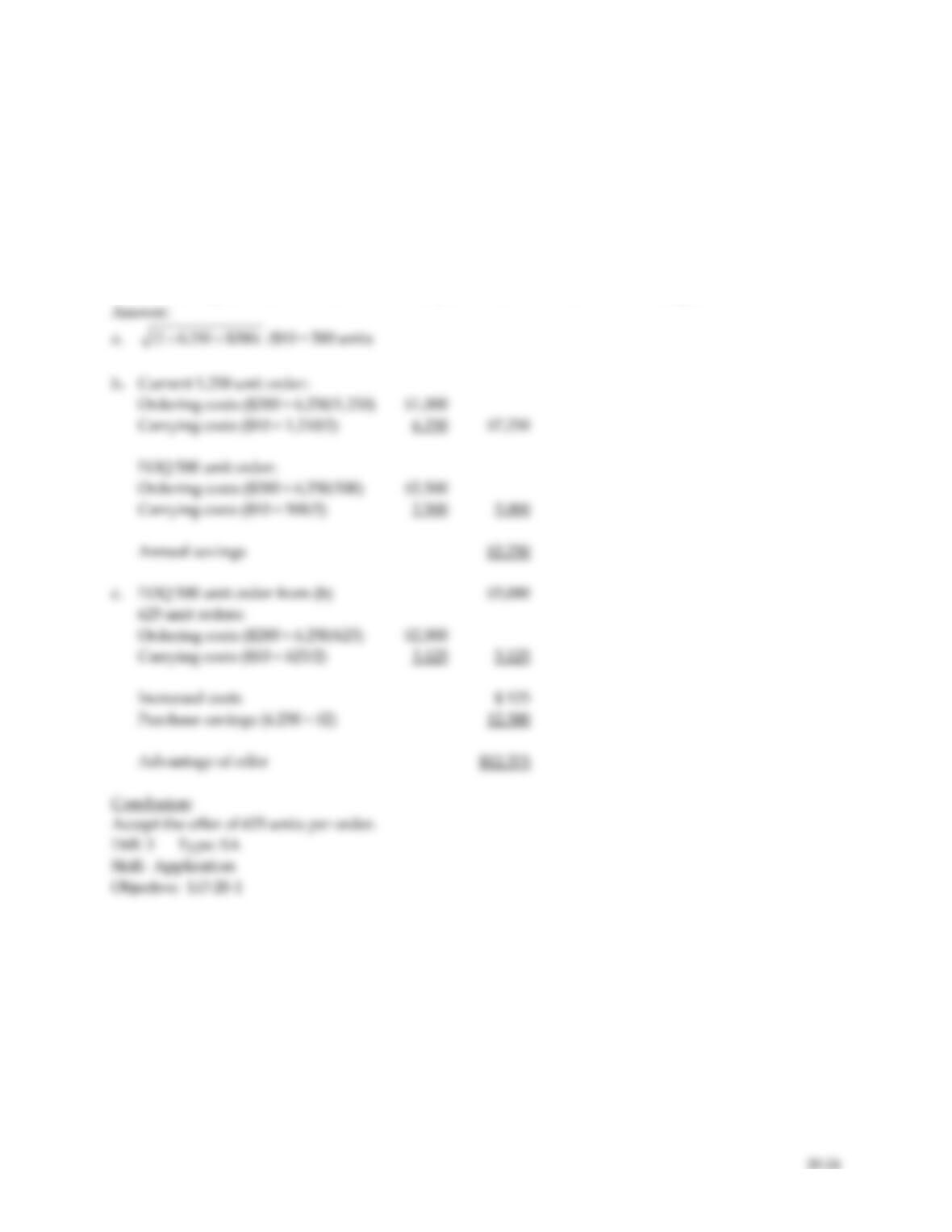
a. Determine the economic order quantity.
b. Determine the amount of annual cost savings if the company changes from an order size of 1,250
units to the economic order size.
c. One supplier offers a discount of $2 per unit off the purchase price of orders in lots of 625 units or
more. What impact would this have on the EOQ and should the order size be changed?
Cost Accounting: A Managerial Emphasis, 6e
Chapter 20 – Inventory Cost Management Strategies
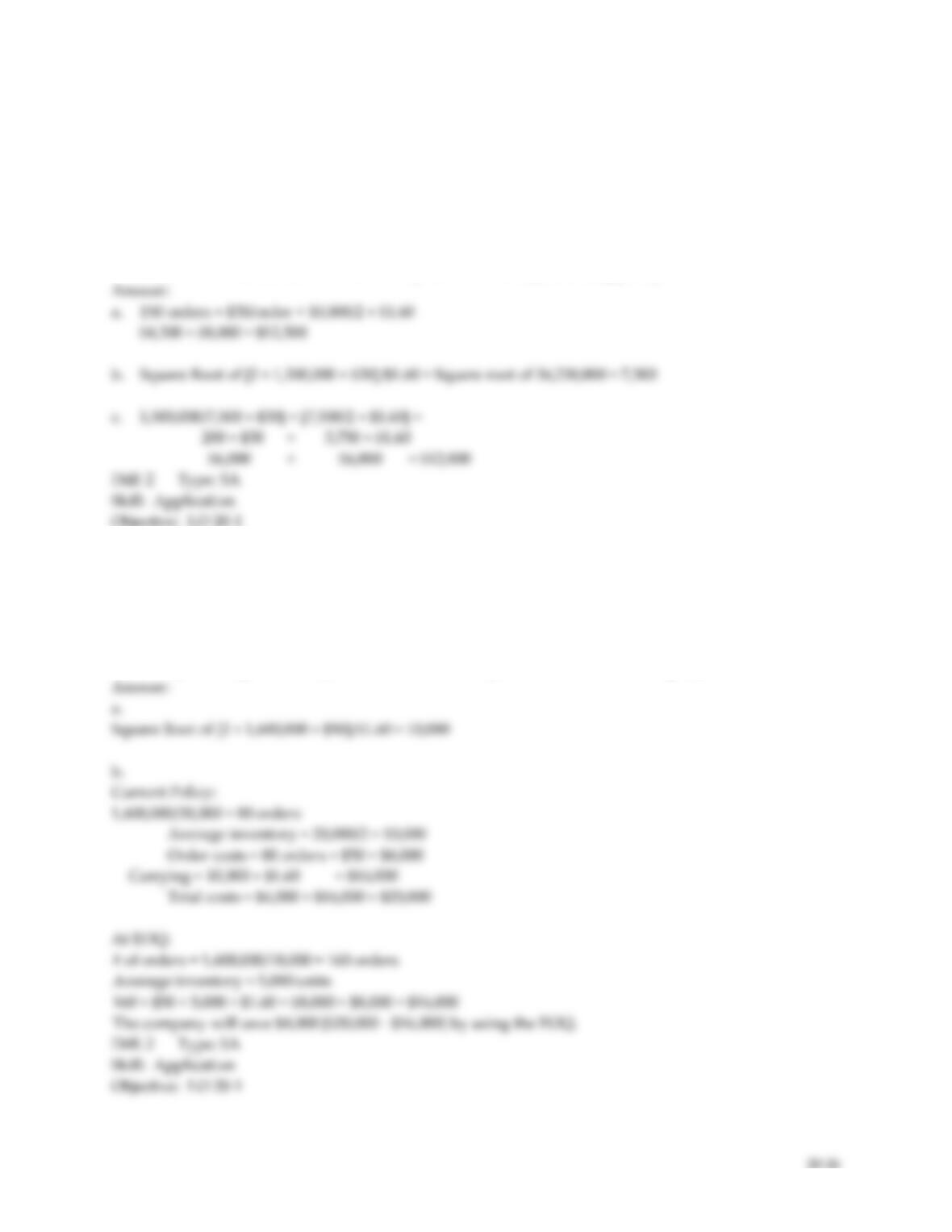
67) The annual demand for a company’s product is 3,750 units, and monthly demand varies from 200 to
400 units with the following probability of demand:
200 units have a 25 percent probability
300 units have a 50 percent probability
400 units have a 25 percent probability
The EOQ model provides an optimal order quantity of 250 units. The opportunity costs of being out of
stock are $2 per unit, with a carrying cost of $13 per unit, and the reorder point is 250 units.
Required:
a. Prepare a table showing stockouts, expected stockout costs, related carrying costs, and total costs, at
each level of demand if the selected safety stocks are: 0, 50, 100 and 150.
b. What is the best level of safety stock to carry?
68) The costs associated with storage are an example of which cost category?
Cost Accounting: A Managerial Emphasis, 6e
Chapter 20 – Inventory Cost Management Strategies
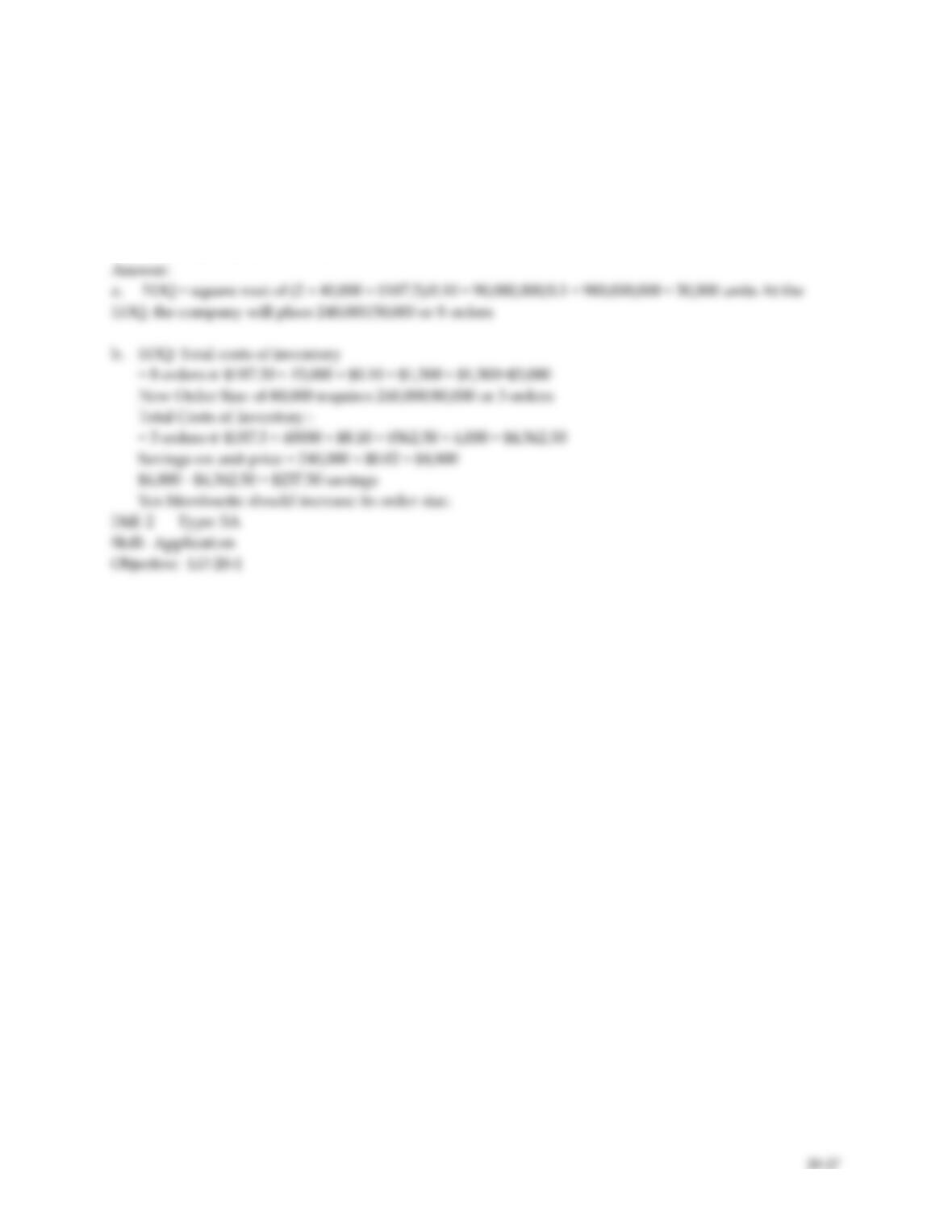
69) Hawthorne Ltd. purchases 1,500,000 units of its product every year. The ordering costs are $30 per
order and the annual carrying cost of one unit is $1.60. Under its current inventory policy, it purchases
the units 150 times during the year (in batches of 10,000 units per order).
Required:
a. What is the total cost per year of inventory under the current inventory policy?
b. Calculate the EOQ for Hawthorne Ltd.
c. What is the total annual cost of inventory under the EOQ purchasing policy?
70) Stanford Ltd. purchases 1,600,000 units of its product every year. The ordering costs are $50 per order
and the annual carrying cost of one unit is $1.60. Under its current inventory policy, it purchases the units
80 times during the year (in batches of 20,000 units per order).
Required:
a. Calculate the EOQ for Stanford Ltd.
b. By ordering at the EOQ, how much in inventory costs will Stanford save per year?
Cost Accounting: A Managerial Emphasis, 6e
Chapter 20 – Inventory Cost Management Strategies
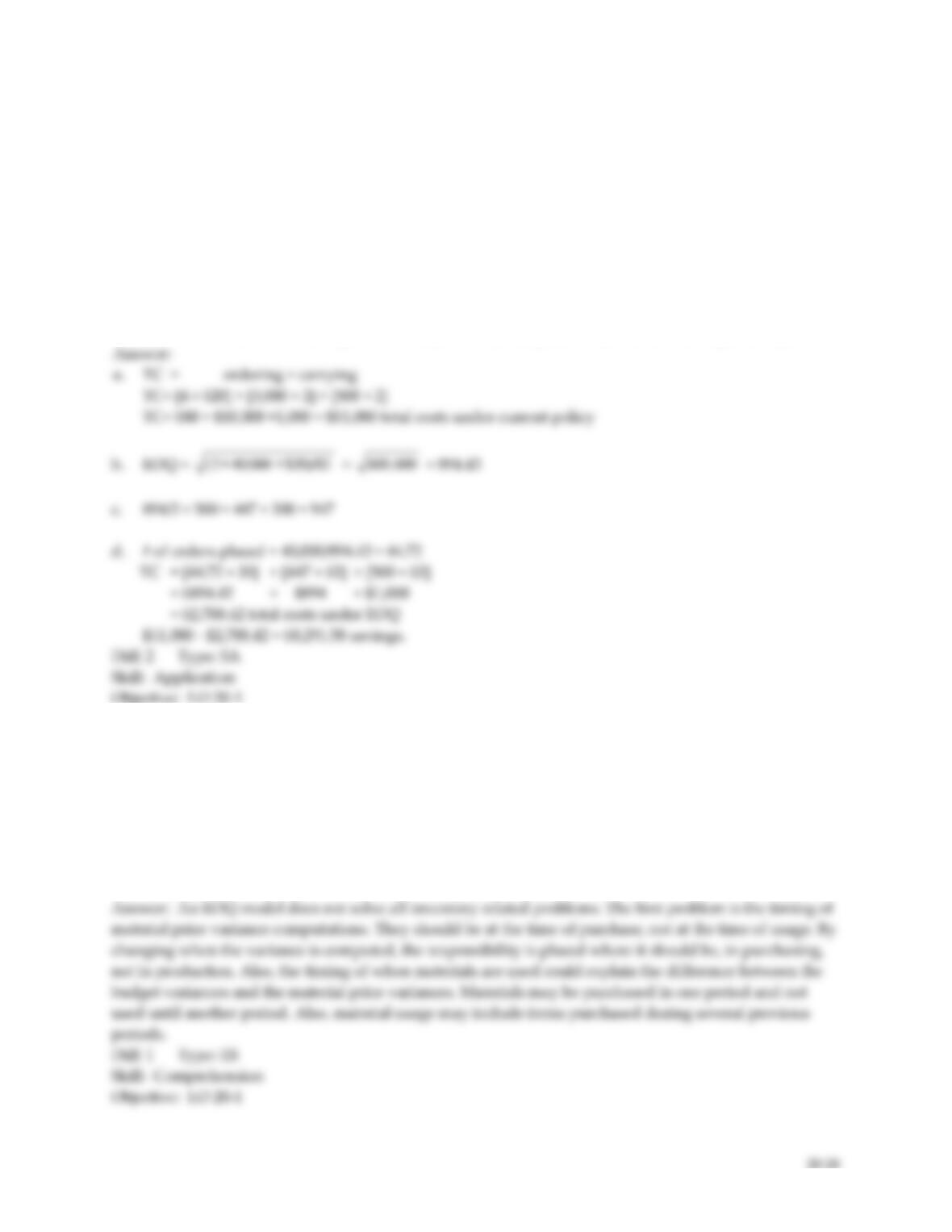
71) Morrissette Ltd. sells 240,000 units a year. Its carrying costs are $0.10 per unit and its ordering costs
are $187.50 per order.
Required:
a. Calculate the economic order quantity.
b. The supplier has offered a $0.02 discount per unit (on all units) if the order size is 80,000 units. Should
Morrissette increase its order size?
Cost Accounting: A Managerial Emphasis, 6e
Chapter 20 – Inventory Cost Management Strategies
72) Acme Industries is currently experiencing problems with its inventory of anvils. Its manager, Willy
Coy currently orders the anvils in batches of 10,000. Four orders are placed during the year to meet the
estimated sales demand of 40,000 units. Each order costs $20 and each unit costs $2 to carry. Mr. Coy
maintains a safety stock of 500 anvils.
Required:
a. What are Acme’s total annual costs (TC) of inventory under its current ordering policy?
b. What is the Economic Order Quantity for Acme Industries?
c. What is the average inventory if Acme uses the EOQ calculated in part b) and it still maintains its 500
units of safety stock?
d. What is Acme’s annual savings in inventory costs by using the EOQ and maintaining its safety stock?
73) The executive vice president of Robotics, Inc., is concerned because the cost of materials has not been
in line with the budget for several periods, even after implementing an EOQ model. The company has the
normal direct material variance computations of price and efficiency at the end of each month. The price
variance of the direct materials used is usually near expectations. The vice president does not understand
how the budget differences are always larger than the material price variances.
Required:
What explanation can you give for the evaluation problems presented?
Cost Accounting: A Managerial Emphasis, 6e
Chapter 20 – Inventory Cost Management Strategies
74) You are the new controller at Ralston Industries and you have noticed that the company seems to
carry a lot of inventory, both in direct materials and in finished goods. At a recent management meeting,
you raised this observation. The managers agreed with your observation but stated that it was company
policy to carry large inventories.
Required:
What reasons might these managers offer in support of carrying large inventories?
20.2 Resolve conflicts that can arise from the results of EOQ and performance models.
1) Goal-congruence problems may occur when an inconsistency evolves between the decision model used
and the model used to evaluate the performance of the person implementing the decision.
2) If annual carrying costs are excluded when evaluating the performance of managers, the managers
may favour purchasing in larger order quantities.
3) Companies can achieve significant gains by sharing information and coordinating activities throughout
the supply chain.
Cost Accounting: A Managerial Emphasis, 6e
Chapter 20 – Inventory Cost Management Strategies
4) When there is an inconsistency between the decision model and the model used to evaluate the
performance of the person implementing the model, ________ arise.
A) evaluation point issues
B) goal-congruence issues
C) labour issues
D) performance issues
E) management issues
5) The possibility of a conflict between the order quantity that an EOQ model recommends and the order
quantity that the purchasing manager regards as optimal is increased with
A) inventory costs which are computed with the FIFO method.
B) lower priced inventory items.
C) the absence of opportunity costs not being recorded in conventional accounting systems.
D) the absence of quality costs not being recorded in conventional accounting systems.
E) lower priced costs of goods sold.
Cost Accounting: A Managerial Emphasis, 6e
Chapter 20 – Inventory Cost Management Strategies
6) Party Animals sells stuffed tigers. Products, Inc. manufactures all sorts of stuffed animals. Party
Animals orders 10,400 tigers per year, 200 per week at $10 per tiger. The manufacturer covers all shipping
costs. Party Animals earns 12% on its cash investments. The purchase order lead time is 3 weeks. Party
Animals sells 210 tigers per week. The following data are available (based on management’s estimates):
Estimated ordering costs per purchase order
$10
Estimated insurance, materials handling,
breakage, and so on, per year
$3
Actual ordering costs per order
$15
What is the cost of the prediction error?
A) $19.58
B) $23.12
C) $1,144.82
D) $1,167.85
E) $1,237.92
20.3 Analyze the relevant benefits and costs of JIT alternatives.
1) Just-in–Time (JIT) Production is also called “lean production.”
Cost Accounting: A Managerial Emphasis, 6e
Chapter 20 – Inventory Cost Management Strategies
2) Just-in-Time (JIT) Production is a system in which each component on a production line is produced
immediately as needed by the next step in the production line.
3) The lack of buffer inventory in a demand-pull system means production staff has extra time to solve
problems.
4) Financial performance measures are the predominant measures of control in a Just–in-Time system.
5) Companies implementing Just-in-time production systems manage inventories by minimizing or
eliminating them.
6) Just-in-time purchasing is the purchase of goods or materials such that delivery immediately precedes
demand or use.
7) Just-in-time purchasing requires organizations to place smaller purchase orders with their suppliers.
8) Just-in-time purchasing is guided solely by the economic order quantity.
Cost Accounting: A Managerial Emphasis, 6e
Chapter 20 – Inventory Cost Management Strategies
9) A financial benefit of a just-in-time system is that inventory carrying costs are reduced.
10) Which of the following methods is used when production is driven by downstream workstations?
A) an activity-based systems
B) a just-in-time system
C) a product-need system
D) a station-priority system
E) safety system
11) All of the following are potential financial benefits of just-in-time EXCEPT
A) lower investments in inventories.
B) higher investments in “efficient” storage space.
C) reducing the risk of rework.
D) reducing the handling costs of inventories.
E) reducing manufacturing lead time.
12) Which of the following would NOT be typical when a JIT production system is used?
A) manufacturing cells
B) emphasis on reducing setup time
C) workers who specialize in one function or operation
D) TQM
E) JIT purchasing
Cost Accounting: A Managerial Emphasis, 6e
Chapter 20 – Inventory Cost Management Strategies
13) The management accountant must design performance measures to evaluate and control JIT
production. One of the dominant sources of information that the management accountant might use for
this would be the personal observations of production line workers and team leaders. Another dominant
source of information would be
A) inventory turnover ratio.
B) nonfinancial measures of time, inventory and quality.
C) material cost variances.
D) number of units sent to scrap / total scrap costs.
E) total setup time for machines / total number of units started and completed.
14) When goods and/or materials are purchased in such a manner as to immediately precede demand or
use, it is specifically called
A) inventory purchasing.
B) just-in-time purchasing.
C) materials purchasing.
D) stock purchasing.
E) safety purchasing.
15) Factors that are relevant in a JIT system, but not for the EOQ model, include
A) quality of materials.
B) timeliness of deliveries.
C) stockout costs.
D) carrying costs.
E) quality of materials, timeliness of deliveries, and stockout costs.
16) Primary components that manufacturers would use to evaluate suppliers under a just–in-time system
would include all of the following EXCEPT
A) on-time delivery.
B) production lead time.
C) purchase price.
D) quality costs.
E) long-term partnerships.
Cost Accounting: A Managerial Emphasis, 6e
Chapter 20 – Inventory Cost Management Strategies
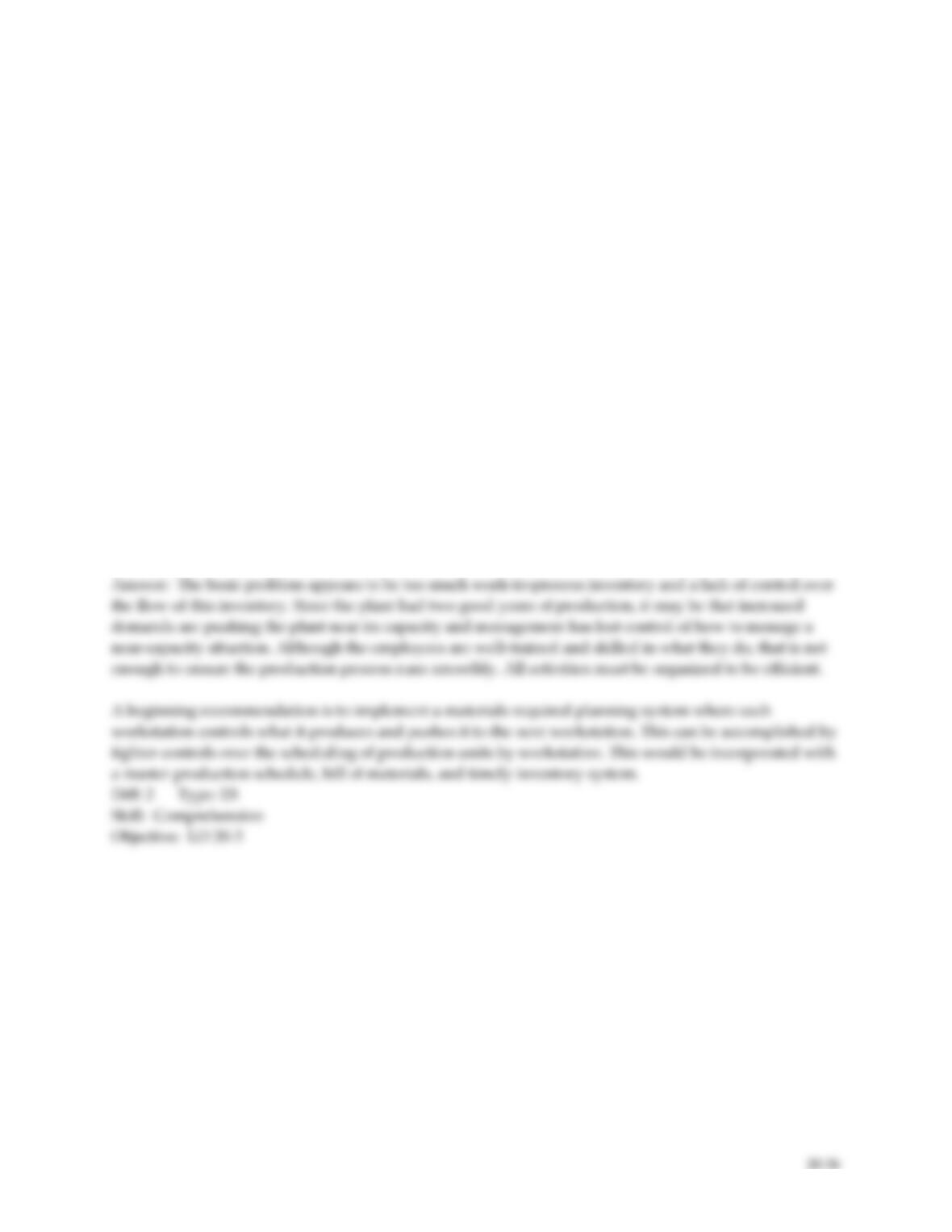
17) The Jarvis Corporation produces bucket loader assemblies for the tractor industry. The product has a
long term life expectancy. Jarvis has a traditional manufacturing and inventory system. Jarvis is
considering the installation of a just–in-time inventory system to improve its cost structure. In doing a full
study using its manufacturing engineering team as well as consulting with industry JIT experts and the
main vendors and suppliers of the components Jarvis uses to manufacture the bucket loader assemblies,
the following incremental cost-benefit relevant information is available for analysis:
The Jarvis cost of investment capital hurdle rate is 15%.
One time cost to rearrange the shop floor to create the manufacturing cell workstations is $275,000.
One time cost to retrain the existing workforce for the JIT required skills is $60,000.
Anticipated defect reduction is 40%. Currently there is a cost of quality defect assessment listed as
$150,000 per year.
The setup time for each of the existing functions will be reduced by 67%. Currently the forecast for setup
costs are $225,000 per year.
Jarvis will expect to save $200,000 per year in carrying costs as a result of having a lower inventory.
The suppliers will require a 15% premium over the current level of prices in order to position themselves
to supply the material on a smaller and more frequent schedule. Currently the materials purchases are
$1,500,000 per year.
Required:
Determine whether it is in the best interest of Jarvis Corporation to install a JIT system.
Cost Accounting: A Managerial Emphasis, 6e
Chapter 20 – Inventory Cost Management Strategies
18) The manufacturing manager of New Technology Company is concerned about the company’s newest
plant. When the plant began operations three years ago it had the best of everything. It had modern
equipment, well-trained employees, engineered work and assembly stations and a controlled
environment. During the first two years the evaluation results were very good with almost all cost
variances being favourable. However, recently things have turned negative.
In recent months everything seems to be operating in a crisis management mode. Although most cost
variances remain favourable, the plant’s segment contribution is declining and customers are
complaining about poor quality and slow delivery. Several customers have suggested that they may take
their business elsewhere if things do not improve.
The shop floor is in continual turmoil. In-process inventory is everywhere, production employees have
difficulty finding jobs that need to be worked on, and scheduling has requested a larger computer to keep
track of work in process.
The vice president of sales does not know where to begin with solving the customers’ problems. It seems
that everyone is working very hard and the plant has the best facilities and trained employees in the
industry.
Required:
What is the nature of the plant’s problems? What recommendation would you make to help improve the
situation?
Cost Accounting: A Managerial Emphasis, 6e
Chapter 20 – Inventory Cost Management Strategies
19) Sudbury Ore Company mines nickel ore for production into various metal products. During recent
years the company has had large fluctuations in its inventories of metal ingots. Much of the volatility of
the inventory levels is due to the variability of demand by the company’s largest customers, automobile
manufacturers. For large orders the company has the technology to quickly shift production from one
product to another.
Required:
Explain how the company can improve its inventory control system and give the advantages of whatever
you recommend.
Cost Accounting: A Managerial Emphasis, 6e
Chapter 20 – Inventory Cost Management Strategies
20) Kretzinger Company makes extensive use of financial performance reports for each of its
departments. Although most departments have been reporting favourable cost variances with the
company’s current inventory system, management is concerned about the overall performance of the
purchasing and production departments. For example, the following information is for the purchasing of
materials for a product the company has been manufacturing for several years:
Purchase
Year Quantity used Average inventory price variance
1 40,000 8,000 $1,000 F
2 60,000 15,000 10,000 F
3 60,000 20,000 12,000 F
4 50,000 12,500 20,000 U
5 54,000 18,000 8,000 F
6 58,000 23,200 9,500 F
Required:
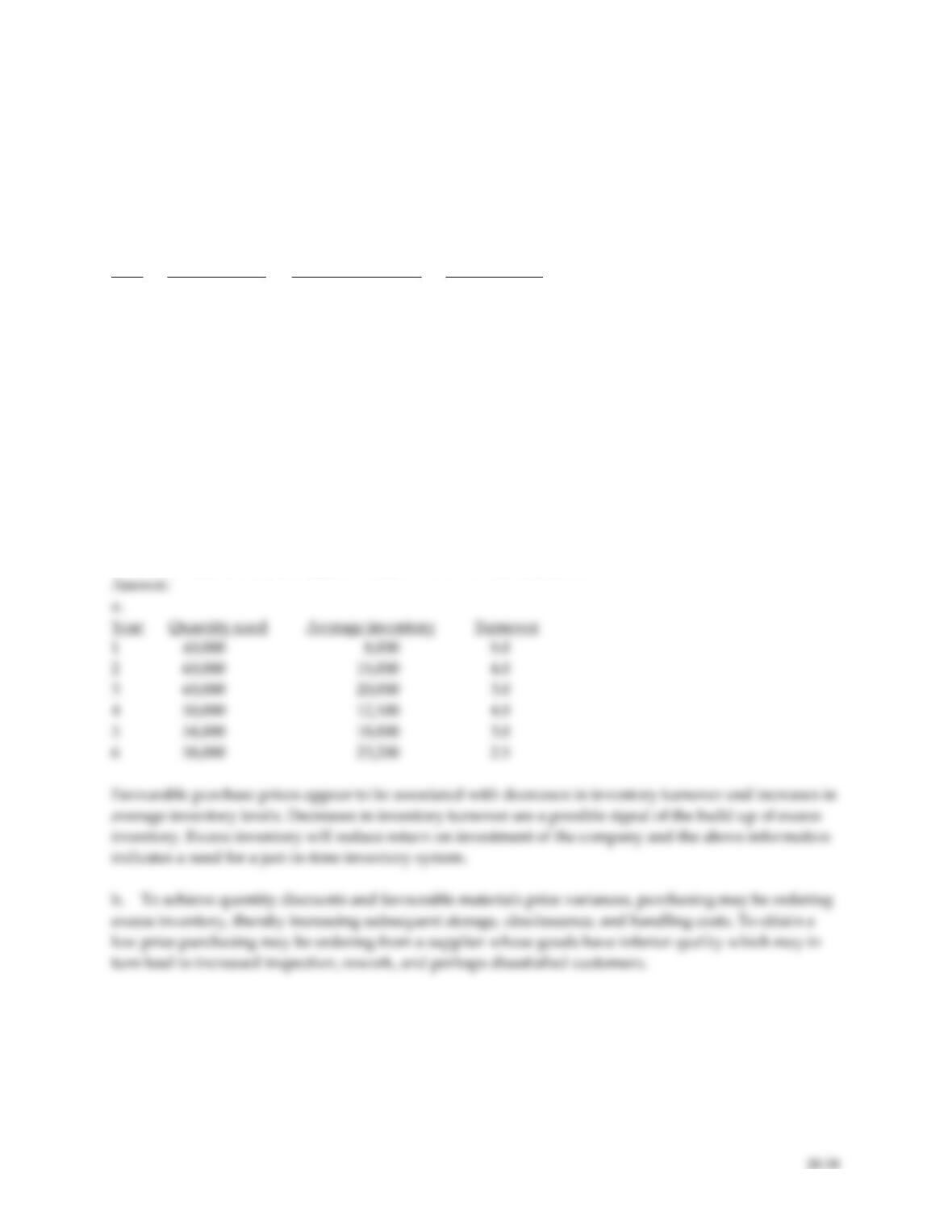
a. Compute the inventory turnover for each year. Can any conclusions be drawn for a yearly
comparison of the purchase price variance and the inventory turnover?
b. Identify problems likely to be caused by evaluating purchasing only on the basis of the purchase
price variance.
c. Management has been relying almost exclusively on variances for performance measurement. What
recommendations can you suggest to improve the evaluation process?
Cost Accounting: A Managerial Emphasis, 6e
Chapter 20 – Inventory Cost Management Strategies
c. It appears that two items may help improve the situation. First, consider the change to a just-in-time
inventory system which would greatly improve the inventory turnover and reduce the amount of
inventory carried. Second, additional measures should be used in the evaluation of the purchasing
department. Either other financial measures should be used or the addition of nonfinancial measures
should be implemented. Several measures are mentioned in the text, for example, manufacturing lead
time, units produced per hour, days’ inventory on hand.
Diff: 3 Type: ES
Skill: Application
Objective: LO 20-3
20.4 Differentiate a materials requirements planning (MRP) strategy from an enterprise
resource planning (ERP) strategy of supply-chain management.
1) The term, supply-chain, describes the flow of goods, services and information from cradle to grave,
regardless of whether those activities occur in the same organization or in other organizations.
2) An Enterprise Resource Planning (ERP) System comprises a single database that collects data and feeds
it into software applications supporting all of a company’s business activities.
3) Which of the following would be expected when using a supply-chain approach to inventory
management?
A) more stockouts (but at a lower cost overall)
B) less manufacturing of goods not subsequently ordered
C) fewer rush orders for manufacturing
D) more stockouts, less manufacturing of goods not subsequently ordered, and fewer rush orders for
manufacturing
E) fewer rush orders for manufacturing, less manufacturing of goods not subsequently ordered, and
lower inventory levels
Cost Accounting: A Managerial Emphasis, 6e
Chapter 20 – Inventory Cost Management Strategies
4) Which of the following is NOT a component in a materials requirement planning system?
A) lead times of all items to be purchased
B) master production schedule
C) bill of materials filed
D) standard construction times for all components produced externally
E) demand forecasts for finished goods
5) What is a supply chain, and what are the benefits of a supply chain analysis? Provide an example of
these benefits.
20.5 Evaluate and decide upon an appropriate backflush costing method.
1) Sequential tracking refers to a method of costing in which the accounting system entries occur at the
same order as actual purchases and products.
2) Backflush costing describes a costing system that omits recording some journal entries.
3) Backflush costing is an example of sequential tracking.