Chapter 20 – Genes Within Populations
Chapter 20
Genes Within Populations
Multiple Choice Questions
1. Natural selection for a certain phenotype will affect the _____ .
2. When fisheries managers move fish from one lake to another, this causes gene ______.
Chapter 20 – Genes Within Populations
3. Genotypes are said to be in ___________ equilibrium if there is random mating and no
other forces tend to alter the proportions of alleles from one generation to the next.
4. The key point in Darwin’s proposal is that the ___________ imposes the conditions that
determine the direction of selection.
5. The presence of the disease sickle cell anemia illustrates that natural selection does not
always eliminate _________ alleles.
Chapter 20 – Genes Within Populations
6. As a mechanism of evolution, natural selection acts on variants within populations and
ultimately leads to the evolution of different species was proposed by
7. Moths that can evade a bat’s echolocation have _____ that increase their likelihood of
survival and reproduction.
8. In the Hardy-Weinberg equation, p and q are _____.
Chapter 20 – Genes Within Populations
9. A restriction in genetic variability caused by a drastic reduction in population size is called
a
10. Reproductive success of an individual is known as:
11. Darwin proposed that natural selection occurs in an environment by
Chapter 20 – Genes Within Populations
12. In the Hardy-Weinberg equations, the frequencies of 2 alleles in a population (where
13. “The inheritance of acquired characteristics” proposal was put forward by
14. The frequency of a particular allele within a population can be changed, over time, by
Chapter 20 – Genes Within Populations
15. The genetic preservation of the features that increase the likelihood of survival and
reproduction of some individuals within a population is called the process of
16. There are more than 30 blood group genes in humans, in addition to the ABO locus. This
increases ____ in human populations.
17. Two parents who do not have sickle cell anemia have a child that has the disease. The
parents are both:
Chapter 20 – Genes Within Populations
Clarify Question
•
What is the key concept addressed by the question?
•
What type of thinking is required?
•
What key words does the question contain and what do they mean?
Gather Content
•
What do you already know about sickle cell anemia? How does it relate to the question?
Consider Possibilities
•
What other information is related to the question? Which information is most useful?
Choose Answer
•
Given what you now know, what information and/or problem solving approach is most
likely to produce the correct answer?
Reflect on Process
•
Did your problem-solving process lead you to the correct answer? If not, where did the
process break down or lead you astray? How can you revise your approach to produce a
more desirable result?
Chapter 20 – Genes Within Populations
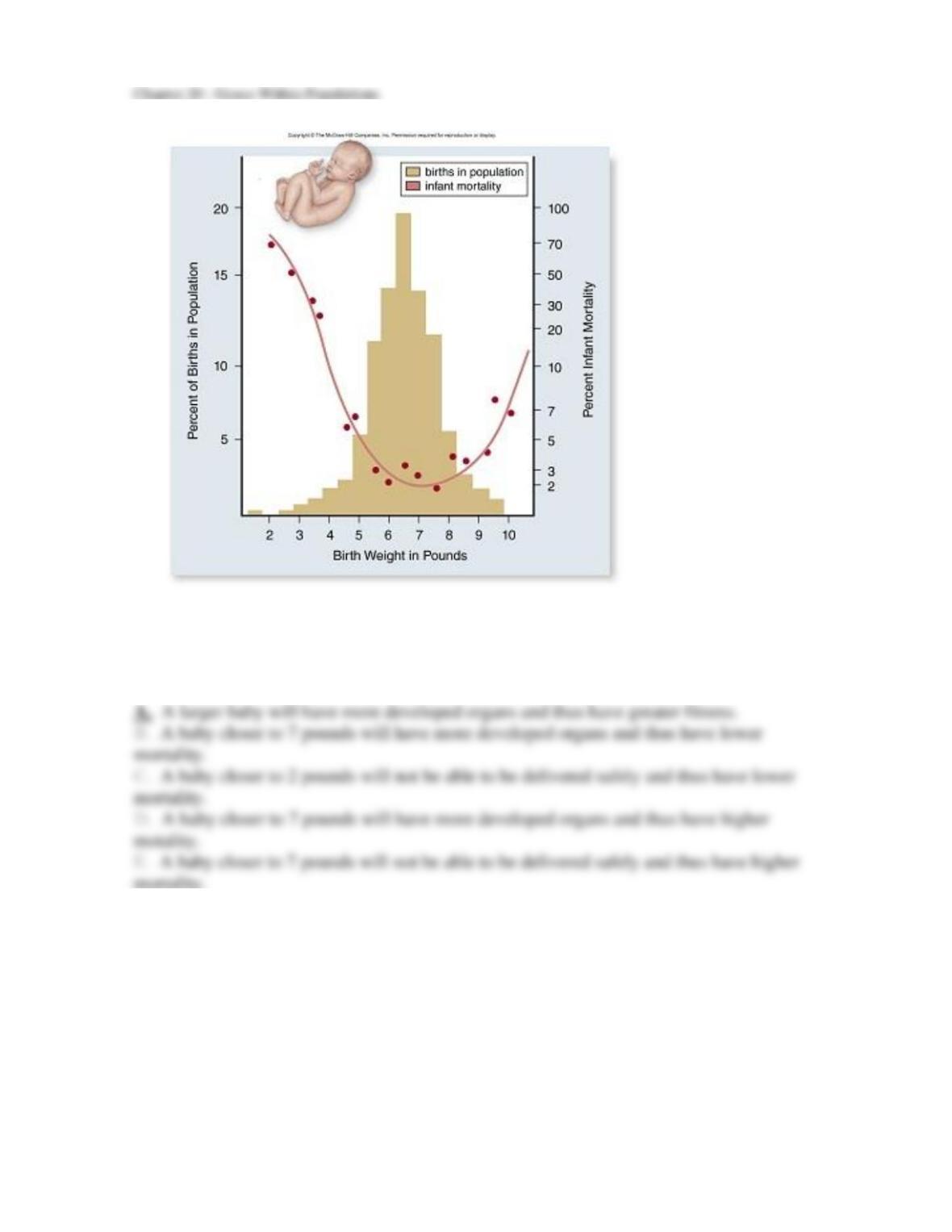
18.
In the graph above, how can the change in infant mortality be explained as birth weight
increases from 2 to 7 pounds?
Chapter 20 – Genes Within Populations
Clarify Question
•
What is the key concept addressed by the question?
a baby’s chances of survival based upon the birth weight.
•
What type of thinking is required?
•
What key words does the question contain and what do they mean?
Gather Content
•
What do you already know about fitness? How does it relate to the question?
Consider Possibilities
•
What other information is related to the question? Which information is most useful?
Choose Answer
•
Given what you now know, what information and/or problem solving approach is most
likely to produce the correct answer?
Reflect on Process
•
Did your problem-solving process lead you to the correct answer? If not, where did the
process break down or lead you astray? How can you revise your approach to produce a
Chapter 20 – Genes Within Populations
more desirable result?
Chapter 20 – Genes Within Populations
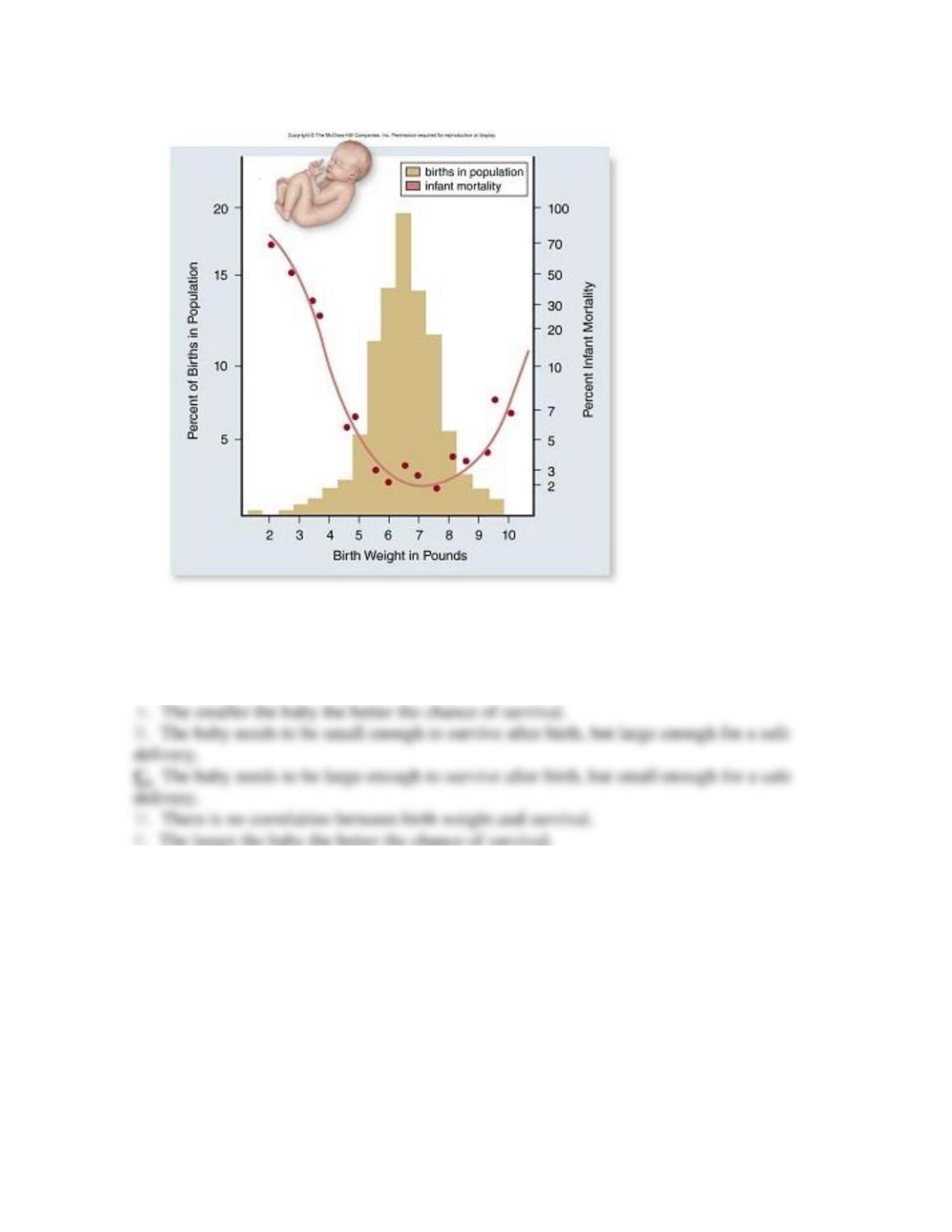
19.
In the graph above, which baby characteristics would explain the percent infant mortality
curve and any subsequent effects on fitness?
Chapter 20 – Genes Within Populations
Clarify Question
•
What is the key concept addressed by the question?
a baby’s chances of survival based upon the birth weight.
•
What type of thinking is required?
•
What key words does the question contain and what do they mean?
Gather Content
•
What do you already know about fitness? How does it relate to the question?
Consider Possibilities
•
What other information is related to the question? Which information is most useful?
Choose Answer
•
Given what you now know, what information and/or problem solving approach is most
likely to produce the correct answer?
Reflect on Process
•
Did your problem-solving process lead you to the correct answer? If not, where did the
process break down or lead you astray? How can you revise your approach to produce a
more desirable result?
Chapter 20 – Genes Within Populations
20. Hardy-Weinberg pointed out that the original proportions of the genotypes in a
population would remain constant from generation to generation if certain assumptions are
met. Which one of the following is not a Hardy-Weinberg condition?
Chapter 20 – Genes Within Populations
21. For a gene with two alternative alleles, A (with a frequency of p) and B (with a frequency
of q), the term in the algebraic form of the Hardy-Weinberg equilibrium for the heterozygote
genotype frequency is
22. The observation that most pureblood Native Americans have type O blood is best
explained by _____
23. In a small population of cockroaches living in your kitchen, only a few roaches mate in
one year. This can lead to random changes in allele frequency in the population through
______
Chapter 20 – Genes Within Populations
24. Female cardinals select male mates in part based on their bright red color. What effect
would this have on a cardinal population that was in Hardy-Weinberg equilibrium?
Chapter 20 – Genes Within Populations
Clarify Question
•
What is the key concept addressed by the question?
•
What type of thinking is required?
•
What key words does the question contain and what do they mean?
Gather Content
•
What do you already know about the Hardy-Weinberg principle? How does it relate to
the question?
Consider Possibilities
•
What other information is related to the question? Which information is most useful?
Choose Answer
•
Given what you now know, what information and/or problem solving approach is most
likely to produce the correct answer?
Chapter 20 – Genes Within Populations
Reflect on Process
•
Did your problem-solving process lead you to the correct answer? If not, where did the
process break down or lead you astray? How can you revise your approach to produce a
more desirable result?
25. You spray your kitchen with an insecticide to kill the cockroaches. A few survive and
reproduce, producing a large healthy population in a few generations that all have similar
genetic backgrounds. This is an example of _____
Chapter 20 – Genes Within Populations
26. Gene flow, defined as the movement of genes from one population to another, can take
place by migration, as well as
27. Some flowering plants cannot self-pollinate which increases their tendency to mate with
phenotypically different mates, a process called disassortative mating. What effect would this
have on a population in Hardy-Weinberg equilibrium?
28. ____ would keep a population in Hardy-Weinberg equilibrium.
Chapter 20 – Genes Within Populations
29. Being born with extra fingers on a hand is called polydactyly. This is more common in
some populations in North America than others due to ____.
30. In order for natural selection to occur within a population, certain conditions must be met.
One such condition is
31. About 80% of the alleles present in thoroughbred horses can be dated back to 31 known
ancestors from the late eighteenth century. As a result, one would expect _____