148. Moving Baby Company produces baby strollers. During the year 90,000 strollers were produced. The
actual labor used was 225,000 hours at $12.75 per hour. Moving Baby has the following labor standards: 2
hours at $13.00 per hour.
Required:
A. Compute the labor rate variance, indicating if it is favorable or unfavorable.
B. Compute the labor efficiency variance, indicating if it is favorable or unfavorable.
149. Starling Manufacturing has developed the following standards for one of its products.
Materials: 5 yards ´ $6 per yard
$30
Direct labor: 2 hours ´ $8 per hour
16
The company records materials price variances at the time of purchase.
The following activity occurred during December:
Materials purchased:
5,200 yards costing $29,900
Materials used:
4,750 yards
Units produced:
1,000 units
Direct labor:
2,100 hours costing $17,850
Required:
A.
Calculate the direct materials price variance.
B.
Calculate the direct materials usage variance.
C.
Calculate the direct labor rate variance.
D.
Calculate the direct labor efficiency variance.
A.
$1,300 F
$29,900 – (5,200 ´ $6)
$1,500 F
$6 ´ (4,750 – 5,000)
C.
$1,050 U
$17,850 – (2,100 ´ $8)
D.
$800 U
$8 ´ (2,100 – 2,000)
A.
LRV = (AR – SR) x AH
($12.75 – $13.00) x 225,000 = $56,250 F
LEV = (AH – SH) x SR
(225,000 – 180,000) x $13.00 = $585,000 U
150. Eastminster Company has the following information:
Direct Materials:
Direct
Labor:
Standard Quantity
10,000
Standard Hours
2,000
Actual Quantity
12,000
Actual Hours
1,875
Standard Price
$14
Standard Rate
$10
Actual Price
$12
Actual Rate
$11
A.
Determine the materials price variance and whether it is favorable or unfavorable.
B.
Determine the materials usage variance and whether it is favorable or unfavorable.
C.
Determine the labor rate variance and whether it is favorable or unfavorable.
D.
Determine the labor efficiency variance and whether it is favorable or unfavorable.
A.
= (AP – SP)AQ
= ($12 – $14)12,000
= $24,000 F
MUV
= (AQ – SQ)SP
= (12,000 – 10,000)$14
LRV
= (AR – SR)AH
= ($11 – $10)1,875
= $1,875 U
D.
= (AH – SH)SR
= (1,875 – 2,000)$10
= $1,250 F
151. Crawford Corporation has the following information:
Direct Materials:
Direct
Labor:
Standard Quantity
1,500
Standard Hours
500
Actual Quantity
1,400
Actual Hours
525
Standard Price
$20
Standard Rate
$14
Actual Price
$17.50
Actual Rate
$14
A.
Determine the materials price variance and whether it is favorable or unfavorable.
B.
Determine the materials usage variance and whether it is favorable or unfavorable.
C.
Determine the labor rate variance and whether it is favorable or unfavorable.
D.
Determine the labor efficiency variance and whether it is favorable or unfavorable.
A.
= (AP – SP)AQ
= ($17.50 – $20)1,400
= $3,500 F
MUV
= (AQ – SQ)SP
= (1,400 – 1,500)$20
= $2,000 F
LRV
= (AR – SR)AH
= ($14 – $14)525
= $0
D.
= (AH – SH)SR
= (525 – 500)$14
= $350 U
152. Allison Company adopted a standard cost system several years ago. The standard costs for the prime costs
of its single product follow:
Material: 10 kilograms @ $4.50 per kilogram
$45.00
Labor: 6 hours @ $8.50 per hour
$51.00
The following operating data were taken from the records for November:
1.
Units completed:
5,800 units
2.
Budgeted output:
6,000 units
3.
Materials purchased:
60,000 kilograms
4.
Total actual labor costs:
$306,600
5.
Actual hours of labor:
36,500 hours
6.
Material usage variance:
$2,250 U
7.
Total material variance:
$450 U
Compute the following:
A.
Labor rate variance
B.
Labor efficiency variance
C.
Actual kilograms of material used in the production process
D.
Actual cost paid per kilogram of material
153. Gardener’s Market manufactures hedgers. During the year, it manufactured 5,000 hedgers, using 4.2 hours
of direct labor per hedger at a rate of $8. The materials and labor standards for manufacturing the hedgers are:
Direct materials (10 units @ $2)
$20
Direct labor (4 hours @ $7.50 per hour)
30
Gardener’s Market actually purchased and used 53,000 units of direct materials at a price of $2.25 per unit.
Required:
A.
Determine the materials price variance and whether it is favorable or unfavorable.
B.
Determine the materials usage variance and whether it is favorable or unfavorable.
C.
Determine the labor rate variance and whether it is favorable or unfavorable.
D.
Determine the labor efficiency variance and whether it is favorable or unfavorable.
A.
MPV
= (AP – SP)AQ
= ($2.25 – $2.00)53,000
= $13,250 U
B.
MUV
= (AQ – SQ)SP
= (53,000 – 50,000)$2
C.
LRV
= (AR – SR)AH
= ($8.00 – $7.50)21,000
= $10,500 U
D.
= (AH – SH)SR
= (21,000 – 20,000)$7.50
= $7,500 U
154. Rhodes Corporation manufactures a product with the following standard costs:
Direct materials (20 yards @ $1.85 per yard)
$37.00
Direct labor (4 hours @ $12.00 per hour)
48.00
Standards are based on normal monthly production involving 2,000 direct labor hours (500 units of output).
The following information pertains to July:
Direct materials purchased (16,000 yards @ $1.80 per yard)
$28,800
Direct materials used (9,400 yards)
Direct labor (1,880 hours @ $12.20 per hour)
22,936
Actual production in July: 460 units
Required:
A.
Compute the following variances for the
month of July, indicating whether each
variance is favorable or unfavorable:
1.
Materials purchase price variance
2.
Materials usage variance
3.
Labor rate variance
4.
Labor efficiency variance
B.
Give potential reasons for each of the
variances. Be sure to consider inter-
relationships among variances.
Materials purchase price variance = (Actual unit price – standard unit price) ´ actual quantity of materials purchased
Materials purchase price variance = ($1.80 – $1.85) ´ 16,000 = $800 favorable
(actual price less than standard price)
Materials quantity variance = (Actual quantity of materials used – standard quantity of materials allowed) ´ standard unit price
Materials quantity variance = (9,400 – 9,200*) ´ $1.85 = $370 unfavorable
(actual quantity exceeds standard quantity)
* 460 units ´ 20 yards per unit = 9,200
Labor rate variance = (Actual rate per hour – standard rate per hour) ´ Actual hours worked
Labor rate variance = ($12.20 – $12.00) ´ $1,880 = $376 unfavorable
(actual rate exceeds standard rate)
Labor efficiency variance = (Actual hours worked – standard hours allowed) ´ standard rate
Labor efficiency variance = (1,880 – 1,840**) ´ $12.00 = $480 unfavorable
(actual hours exceed standard hours allowed)
** 460 units ´ 4 hours per unit = 1,840
production, which resulted in a higher average wage rate.
155. Dog’s Best Friend manufactures dog food. During the month, it manufactured 3,000 bags of kibble, using
0.25 hour of direct labor per bag at a rate of $9.00 per hour. The materials and labor standards for
manufacturing the bags of kibble are:
Direct materials (1 pound of beef @ $1.00 per pound)
$1.00
Direct materials (1 bag @ $0.25)
0.25
Direct labor (0.30 hour @ $9.00)
2.70
The company actually used 3,300 pounds of beef at a price of $1.10 per pound. It also purchased 3,000 bags at a price of $0.15 per bag.
A.
Determine the total materials price variance and whether it is favorable or unfavorable.
B.
Determine the materials usage variance for beef and whether it is favorable or unfavorable.
C.
Determine the labor rate variance and whether it is favorable or unfavorable.
D.
Determine the labor efficiency variance and whether it is favorable or unfavorable.
A.
MPV for Beef
= (AP – SP)AQ
= ($1.10 – $1.00)3,300
= $330 U
MPV for Bags
= ($0.15 – $0.25)3,000
= $300 F
Total MPV
= $30 U
B.
MUV
= (AQ – SQ)SP
= (3,300 – 3,000)$1.00
= $300 U
C.
LRV
= (AR – SR)AH
= ($9.00 – $9.00)750
= $0 Neither favorable nor unfavorable
D.
= (AH – SH)SR
= (750 – 900)$9.00
156. Mersey Company produced 1,000 trash cans during March using 450 direct labor hours and purchased and
used 3,100 pounds of rubber. Its materials and labor standards are:
Direct materials (3 pounds of rubber @ $0.50)
$1.50
Direct labor (0.5 hours @ $16.00)
3.00
Its materials price variance was a favorable $620 and its labor rate variance was an unfavorable $900.
A.
Calculate the actual price per unit.
B.
Calculate the actual labor rate.
C.
Determine the materials usage variance and whether it is favorable or unfavorable.
D.
Determine the labor efficiency variance and whether it is favorable or unfavorable.
A.
= (AP – SP)AQ
-$620
= (AP – $0.50)3,100
AP
= $0.30 per pound
B.
LRV
= (AR – SR)AH
$900
= (AR – $16.00)450
= $18.00 per hour
C.
MUV
= (AQ – SQ)SP
= (3,100 – 3,000)$0.50
= $50 U
D.
= (AH – SH)SR
= (450 – 500)$16
= $800 F
157. Pontefract Company produced 2,500 widgets during November using 4,000 units of materials at a cost of
$5.00 each. It also used 5,000 direct labor hours at a rate of $7.00. Its direct materials standard is 2 units per
widget. Its direct labor standard is 2.5 hours per widget.
Its materials price variance was a favorable $8,000 and its labor rate variance was an unfavorable $1,000.
A.
Calculate the standard materials price per unit.
B.
Calculate the standard labor rate.
C.
Determine the materials usage variance and whether it is favorable or unfavorable.
D.
Determine the labor efficiency variance and whether it is favorable or unfavorable.
A.
= (AP – SP)AQ
-$8,000
= ($5.00 – SP)4,000
= $7.00 per pound
B.
LRV
= (AR – SR)AH
$1,000
= ($7.00 – SR)5,000
C.
MUV
= (AQ – SQ)SP
= (4,000 – 5,000)$7.00
= $7,000 F
D.
= (AH – SH)SR
= (5,000 – 6,250)$6.80
= $8,500 F
158. Just Right Inc. produces jeans. The following standards have been established:
Direct materials (4 yards of denim @ $1.20)
$4.80
Direct labor (1.5 hours @ $9)
$13.50
Standard prime cost
$18.30
During the year 25,000 pairs of jeans were produced. 150,000 yards of denim were purchased and used at $1.23 per yard. Actual direct labor hours
were 36,800 at $9.25 per hour.
Required:
A. Compute the materials variances and indicate if they are favorable or unfavorable.
B. Compute the labor variances and indicate if they are favorable or unfavorable.
C. Prepare the journal entries for the following:
Purchase of raw materials
Issuance of raw materials
Addition of labor to Work in Process
Closing of variances to Cost of Goods Sold
MPV = (AP – SP) x AQ
($1.23 – $1.20) x 150,000 = $4,500 U
MUV = (AQ – SQ) x SP
(150,000 – 100,000) x $1.20 = $60,000 U
LRV = (AR- SR) x AH
($9.25 – $9.00) x 36,800 = $9,200 U
LEV = (AH – SH) x SR
(36,800 – 37,500) x $9 = $6,300 F
Materials
180,000
Materials Price Variance
4,500
Accounts Payable
184,500
Work in Process
120,000
Materials Usage Variance
60,000
Materials
180,000
Work in Process
337,500
Labor Rate Variance
9,200
Labor Efficiency Variance
6,300
Cost of Goods Sold
73,700
Materials Price Variance
4,500
Materials Usage Variance
60,000
Labor Rate Variance
9,200
159. During April, Rain Gear Unlimited produced 5,500 umbrellas from nylon that costs $0.45 per yard, which
is $0.05 cheaper than the standard cost. It also used 3,000 direct labor hours at a rate of $6.50. Its direct
materials standard is 1 yard per umbrella. Its direct labor standard is 0.5 hour per umbrella.
Its materials usage variance was a favorable $500 and its labor rate variance was a favorable $900.
A.
Calculate the actual quantity of materials.
B.
Calculate the standard labor rate.
C.
Determine the materials price variance and whether it is favorable or unfavorable.
D.
Determine the labor efficiency variance and whether it is favorable or unfavorable.
E.
Record the entries for the materials purchase, the issuance and usage of materials, and the labor variances.
F.
Provide the closing entries.
MUV
= (AQ – SQ)SP
-$500
= (AQ – 5,500)$0.50
AQ
= 4,500
B.
LRV
= (AR – SR)AH
-$900
= ($6.50 – SR)3,000
SR
= $6.80 per hour
C.
= (AP – SP)AQ
= $225 F
D.
LEV
= (AH – SH)SR
= (3,000 – 2,750)$6.80
= $1,700 U
E.
Materials
2,250
(4,500 ´ $0.50)
Materials Price Variance
Accounts Payable
2,025
Work in Process
2,750
Materials Usage Variance
Materials
2,250
Work in Process
18,700
(0.5 ´ 5,500 ´ $6.80)
Labor Rate Variance
Accrued Payroll
19,500
F.
Cost of Goods Sold
1,700
Labor Rate Variance
Cost of Goods Sold
1,625
160. Eider Company has the following information:
Direct Materials:
Direct
Labor:
Standard Quantity
100,000
Standard Hours
1,000
Actual Quantity
99,500
Actual Hours
1,050
Standard Price
$5
Standard Rate
$12
Actual Price
$4
Actual Rate
$13
A.
Determine the materials price variance and whether it is favorable or unfavorable.
B.
Determine the materials usage variance and whether it is favorable or unfavorable.
C.
Determine the labor rate variance and whether it is favorable or unfavorable.
D.
Determine the labor efficiency variance and whether it is favorable or unfavorable.
E.
Provide the journal entries to record the purchase of materials, the issuance and usage of materials, and direct labor variances.
F.
Provide the closing entries for the immaterial variances.
A.
= (AP – SP)AQ
= ($4 – $5)99,500
= $99,500 F
B.
MUV
= (AQ – SQ)SP
= (99,500 – 100,000)$5
= $2,500 F
C.
LRV
= (AR – SR)AH
= ($13 – $12)1,050
= $1,050 U
D.
LEV
= (AH – SH)SR
= (1,050 – 1,000)$12
= $600 U
E.
Materials
497,500
Materials Price Variance
99,500
Accounts Payable
398,000
Work in Process
500,000
Materials Usage Variance
2,500
Materials
497,500
Work in Process
12,000
Labor Efficiency Variance
600
Labor Rate Variance
1,050
Accrued Payroll
13,650
F.
Cost of Goods Sold
1,650
Labor Rate Variance
1,050
Materials Usage Variance
2,500
Cost of Goods Sold
2,500
161. The Cat’s Meow manufactures gourmet cat food. During the month, it manufactured 5,000 cans of tuna,
using 0.10 hour of direct labor per can at a rate of $8.00 per hour. The materials and labor standards for
manufacturing the cans of tuna are as follows:
Direct materials (1 pound of tuna @ $0.50 per pound)
$0.50
Direct materials (1 can @ $0.35)
0.35
Direct labor (0.20 hour @ $7.00)
1.40
The company actually used 4,900 pounds of tuna at a price of $0.65 per pound. It also purchased 5,000 cans at a price of $0.45 per can.
A.
Determine the total materials price variance and whether it is favorable or unfavorable.
B.
Determine the materials usage variance for tuna and whether it is favorable or unfavorable.
C.
Determine the labor rate variance and whether it is favorable or unfavorable.
D.
Determine the labor efficiency variance and whether it is favorable or unfavorable.
E.
Make all necessary journal entries to record the purchase of materials, the issuance and usage of materials, and the direct labor
variances.
F.
Provide the closing entries.
A.
MPV for Tuna
= (AP – SP)AQ
= ($0.65 – $0.50)4,900
= $735 U
MPV for Cans
= ($0.45 – $0.35)5,000
= $500 U
Total MPV
= $1,235 U
B.
MUV
= (AQ – SQ)SP
= (4,900 – 5,000)$0.50
= $50 F
C.
LRV
= (AR – SR)AH
= ($8.00 – $7.00)500
= $500 U
D.
= (AH – SH)SR
= (500 – 1,000)$7.00
= $3,500 F
Materials Price Variance
1,235
Accounts Payable
5,435
Materials Usage Variance
Work in Process
7,000
Labor Rate Variance
Labor Efficiency Variance
3,500
Accrued Payroll
4,000
F.
Cost of Goods Sold
1,735
Materials Price Variance
1,235
Labor Rate Variance

162. Grandma’s Attic Company produces soft pillows made from goose down. The company uses a standard
cost system and has set the following standards for materials and labor for each pillow:
Feathers from 5 large white geese (5 geese @ $5)
$25
Fabric to make pillow cases (3 yards @ $2)
6
Direct labor (5 hours @ $8)
40
Total prime cost
$71
During the month, the company produced 1,000 goose down pillows. Actual geese purchased were 5,100, at $4 per goose. Actual fabric purchased
was 2,900 yards at $2.10 per yard. There were no beginning or ending inventories of geese or fabric. Actual direct labor was 5,200 hours at $7.75 per
hour.
A.
Determine the total materials price variance and whether it is favorable or unfavorable.
B.
Determine the total materials usage variance and whether it is favorable or unfavorable.
C.
Determine the labor rate variance and whether it is favorable or unfavorable.
D.
Determine the labor efficiency variance and whether it is favorable or unfavorable.
E.
Make all necessary journal entries to record the purchase of materials, the issuance and usage of materials, and the direct labor
variances.
F.
Provide the closing entries.
163. Stratford Company inspects every steam iron it manufactures for safety issues. The standard labor cost is
$12 per hour. The maintenance standard at the beginning of the first quarter is 20 minutes per iron. Stratford is
implementing a new production process that will aid in reducing any potential electrical defects in the irons.
This will decrease the inspection time to 15 minutes per iron. After the end of the first quarter, the new process
had reduced the inspection time per iron from 20 minutes to 14 minutes.
A.
Identify the kaizen and maintenance labor standards in place at the beginning of the first quarter. Express the standards in both
physical and financial terms.
B.
Calculate the expected cost reduction and actual cost reduction.
B.
Expected cost reduction: $4.00 – $3.00 = $1.00 per unit
164. Wiltshire Limited produces woolen blankets and clothing. During Year 1, Wiltshire produced 10,000 items
of blankets and clothing using 4,250 bundles of wool at a price of $10 per bundle.
Standard bundles of wool
4,000
Standard price
$20 per bundle
The difference between the actual quantity of materials and the standard quantity of materials is due to waste. At the end of Year 1, Wiltshire
developed a new process that would cut down on the waste by 60 percent. By the end of Year 2, the company had actually cut down its waste by 50
percent.
A.
Identify the kaizen and materials standards in place at the beginning of Year 2. Express the standards in both physical and financial
terms.
B.
Calculate the expected cost reduction.
C.
Calculate the actual cost reduction.
Materials:
Physical standard:
4,000 bundles
Financial standard:
$85,000
($20 ´ 4,250)
Kaizen:
Physical standard:
4,100 bundles
[4,250 – ((4,250 – 4,000) ´ 60%)]
Financial standard:
$82,000
($20 ´ 4,100)
4,250 – ((4,250 – 4,000) ´ 50%) = 4,125
bundles
4,125 ´ $20 = $82,500
165. Overland Automotive Company is considering on manufacturing a new brand of car. Given the current
product and process designs, the cost data are:
Direct materials costs (per car)
$10,000
Direct labor costs (per car)
$ 3,000
Overhead costs (per car)
$ 4,000
The company expects the selling price to be $20,000 and has set a target profit of $5,000.
A supplier told Overland that it could purchase a couple of similar components under a different brand name at a lower price. This would result in
cost savings of $2,000 per car. Furthermore, the company found that it could redesign its manufacturing process to cut down on both inspection labor
and worker labor, which would result in cost savings of $1,000 per car.
A.
Calculate Overland’s target cost.
B.
Calculate the total costs per car after Overland redesigns its processes and schedules to buy cost-saving components.
C.
Should Overland manufacture the car? Calculate the expected profit after the cost savings are taken into account.
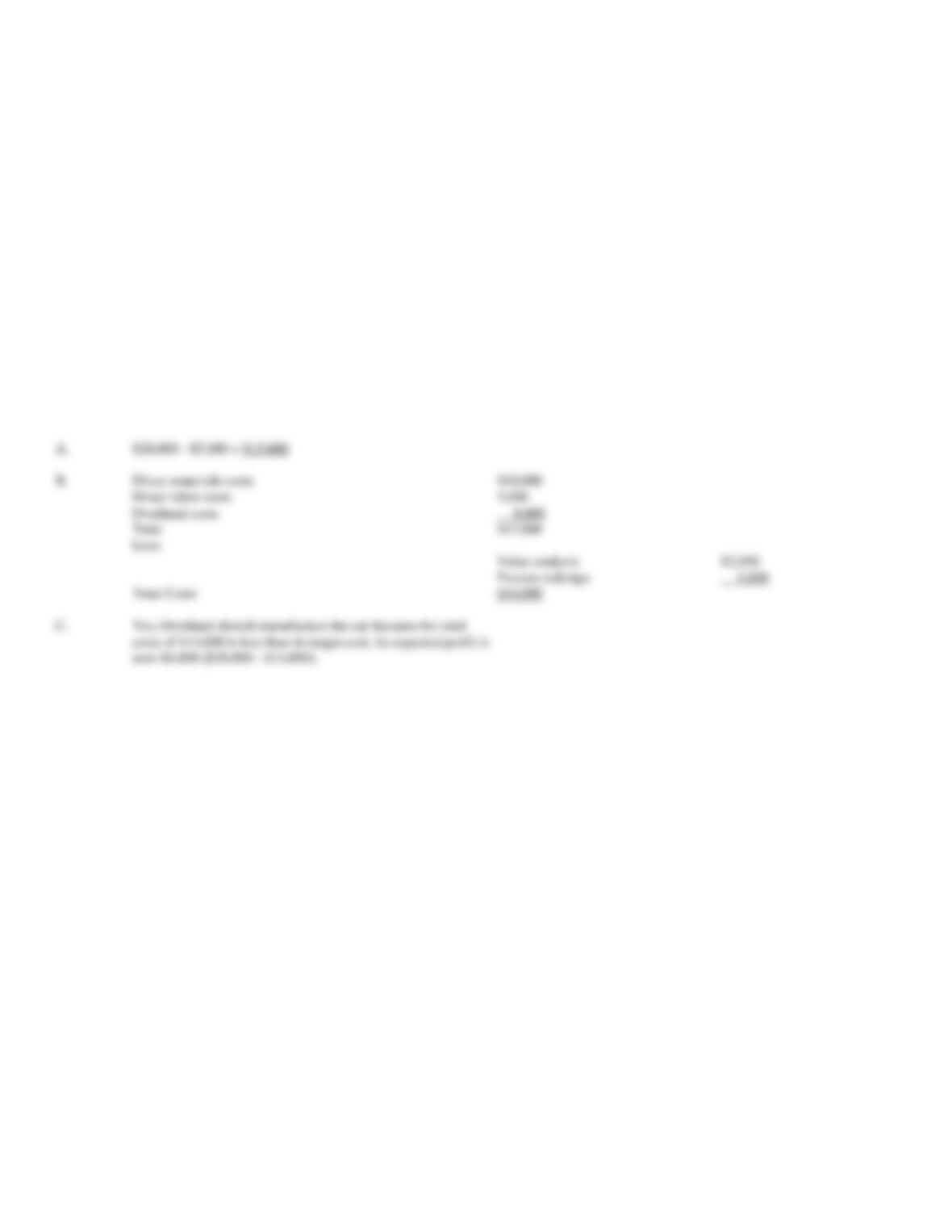
$20,000 – $5,000 = $15,000
Direct materials costs
$10,000
Direct labor costs
3,000
Overhead costs
4,000
Total
$17,000
Less:
Value analysis
$2,000
Process redesign
1,000
Total Costs
$14,000
166. Warwick Company has the following information concerning its direct labor:
Direct Labor:
Standard Hours
6,500
Actual Hours
6,350
Standard Rate
$15
Actual Rate
$18
A.
Determine the labor rate variance and whether it is favorable or unfavorable.
B.
Determine the labor efficiency variance and whether it is favorable or unfavorable.
C.
Provide the journal entry for the labor variances.
167. You decide
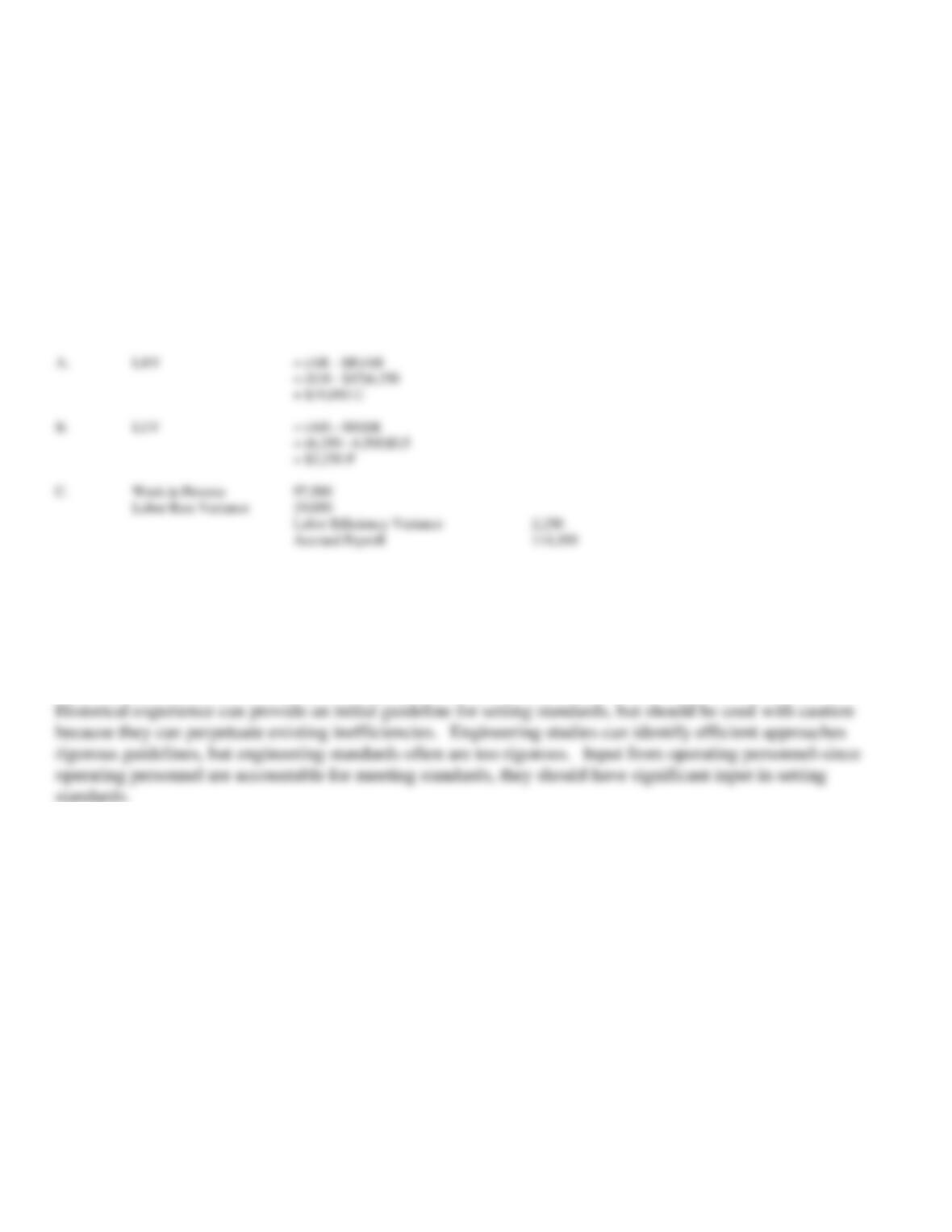
Explain the three potential sources of quantitative standards.
LRV
= (AR – SR)AH
= ($18 – $15)6,350
= $19,050 U
B.
= (AH – SH)SR
= (6,350 – 6,500)$15
= $2,250 F
C.
Work in Process
97,500
Labor Rate Variance
19,050
Labor Efficiency Variance
2,250
Accrued Payroll
114,300