Chapter 20 – The Reproductive Systembrad
True
51. The male sex act involves two components: erection and ejaculation.
a.
True
b.
False
True
52. An erection-generating center lies in the lower spinal cord.
a.
True
b.
False
True
53. The average volume of semen is 2.75 L, ranging from 2 to 6 L, the higher volumes following periods of elevated
sexual activity.
a.
True
b.
False
False
54. The ovaries perform the dual function of producing ova (oogenesis) and secreting the female sex hormones, estrogen
and progesterone.
a.
True
b.
False
True
55. Together, an oocyte and surrounding granulosa cells make up a primordial follicle.
a.
True
b.
False
True
56. The second stage of follicular development is conversion of selected primordial follicles into primary follicles.
a.
True
b.
False
False
57. The secreted estrogen, in addition to acting on sex-specific tissues such as the clitoris, inhibits the thalamus and
posterior pituitary in typical negative-feedback fashion.
a.
True
b.
False
False
58. The uterus consists of two main layers: the myometrium and the endometrium.
a.
True
b.
False
True
59. Puberty occurs in females around 16 years of age when hypothalamic GnRH activity increases dramatically.
a.
True
b.
False
False
60. Menopause is preceded by a period of progressive ovarian failure characterized by increasingly irregular cycles and
dwindling estrogen levels.
a.
True
b.
False
True
61. Fertilization, the union of male and female gametes, normally occurs in the ampulla, the upper third of the oviduct.
a.
True
b.
False
True
62. A blastocyst is a single-layer hollow ball of about 5 million cells encircling a fluid-filled cavity, with a dense mass of
cells known as the central cell mass grouped together at one side.
a.
True
b.
False
False
endometrium
63. The glycogen stores in the endometrium are sufficient to nourish the fetus for about three months.
a.
True
b.
False
False
64. The fetally derived portion of the placenta secretes hormones essential for maintaining pregnancy, primarily human
chorionic gonadotropin, estrogen, and progesterone.
a.
True
b.
False
True
65. The placental hormone human chorionic somatomammotropin (hCS) increases use of glucose by the mother and
mobilizes free amino acids from maternal adipose stores.
a.
True
b.
False
False
66. The primary reproductive organs, or __________, consist of a pair of __________ in the male and a pair of ovaries in
the female.
67. The major male accessory sex glands, whose secretions provide the bulk of the semen, are the __________ vesicles,
__________ gland, and bulbourethral glands.
68. In humans, gametes contain only one member of each homologous pair for a total of __________ chromosomes — the
__________ number.
23; haploid
69. __________ refers to the physical exchange of chromosome material between the homologous pairs before their
separation during the first meiotic division.
70. Genetic sex, which depends on the combination of sex chromosomes at the time of conception, in turn determines
__________ sex.
71. A small portion of testosterone secreted by the testes is converted to estrogen outside the testes by the enzyme
__________.
72. In humans, the spermatogonia divide __________ twice to form four identical primary __________.
Chapter 20 – The Reproductive Systembrad
73. The final release of mature spermatozoa from the Sertoli cells is a process called__________.
74. The testes are controlled by two __________hormones secreted by the__________.
75. During sexual arousal, the__________ glands secrete mucus that provides lubrication for sexual intercourse.
76. The penis consists almost entirely of __________made up of three columns or cords of sponge-like vascular spaces
extending the length of the organ.
77. During the __________phase following orgasm, sympathetic vasoconstrictor impulses slow the inflow of blood into
the penis.
78. Most of the clitoris is located internally and consists mainly of large, highly vascular __________that surround the
urethra and vagina.
79. The primary oocytes remain in a state of __________ for years until they are prepared for ovulation.
80. The oocyte and granulosa cells secrete glycoproteins that form a thick, gel-like __________ that covers the oocyte and
separates it from the surrounding granulosa cells.
81. The __________ is the inner lining of the uterus that contains numerous blood vessels and glands.
82. The __________ phase is the most overt phase, characterized by discharge of blood and endometrial debris from the
vagina.
83. Binding of the sperm head to ZP3 triggers the Ca2+-dependent __________ reaction.
84. Production of __________ cells, which doubles or triples in pregnancy, suppress maternal cytotoxic T cells that might
target the fetus.
85. The epithelial layer that encloses the amniotic cavity is called the amniotic sac, or __________.
86. One of the first endocrine events is secretion by the developing chorion of__________, a peptide hormone that
prolongs the life span of the corpus luteum.
87. After delivery, the uterus shrinks to its pregestational size, a process known as __________, which takes 4 to 6
__________ to complete.
88. A powerful uterine muscle stimulant, __________ plays the key role in the progression of labor.
89. __________ is the primary stimulant of milk secretion.
90. __________in breast milk promotes multiplication of the nonpathogenic microorganism Lactobacillus bifidus in the
infant’s digestive tract.
Chapter 20 – The Reproductive Systembrad
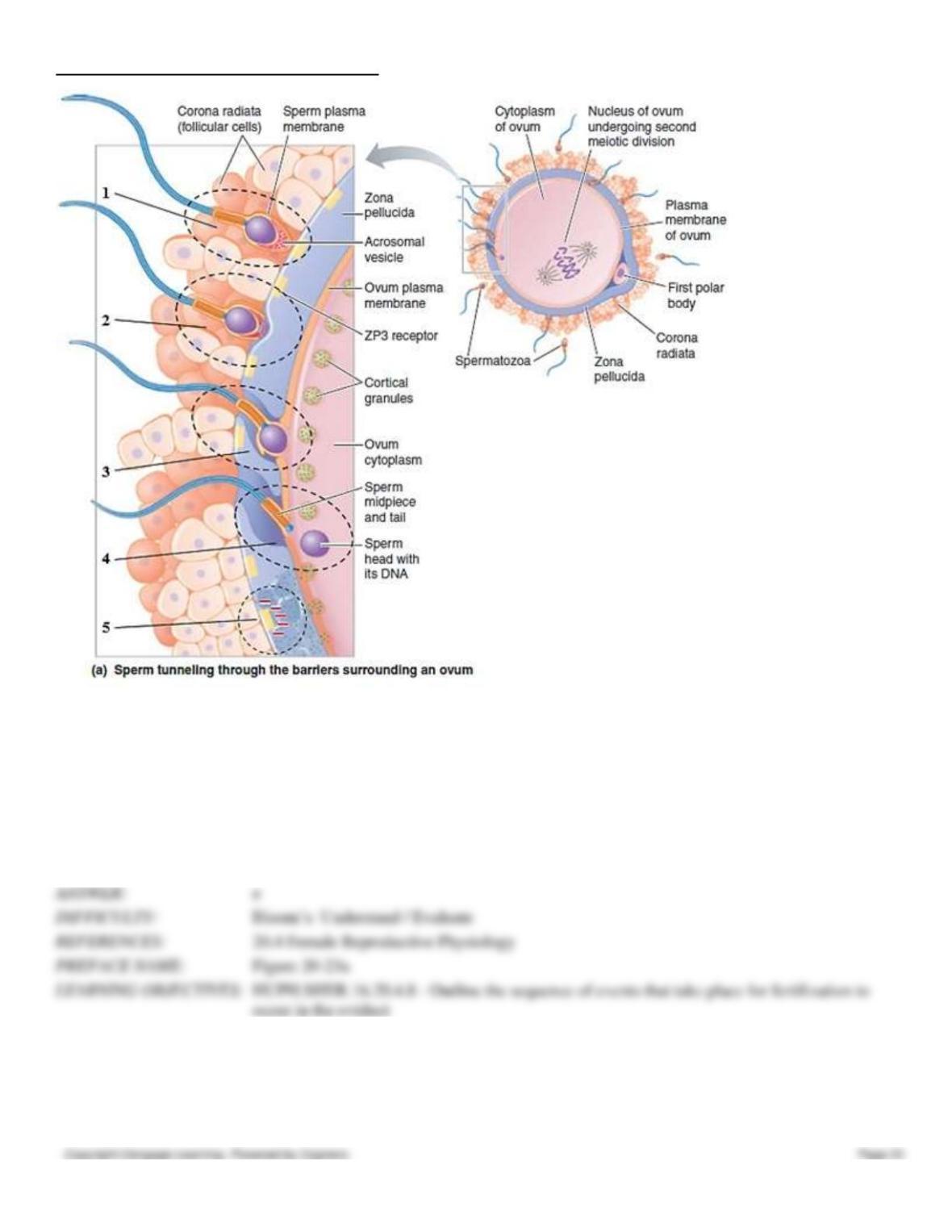
Use the figure above (Figure 20–23a) to answer the corresponding questions.
91. Which number in the figure represents inactivation of ZP3 receptors and hardening of the zona pellucida?
a.
1
b.
2
c.
3
d.
4
e.
5
92. Which number in the figure represents the pathway to the ovum created by acrosomal enzymes digesting the zona
pellucida?
a.
1
b.
2
Chapter 20 – The Reproductive Systembrad
c.
3
d.
4
e.
5
93. Which number in the figure represents sperm penetration of the corona radiata?
a.
1
b.
2
c.
3
d.
4
e.
5
94. Which number in the figure represents the sperm head entering the ovum cytoplasm?
a.
1
b.
2
c.
3
d.
4
e.
5
d
95. Which number in the figure represents hydrolytic enzymes being released into the zona pellucida?
a.
1
b.
2
c.
3
d.
4
e.
5
b
96. Describe secondary sexual characteristics in males and females.
97. Discuss the components of semen.
98. Describe the erection reflex.
99. Discuss the corpus luteum of pregnancy.
100. Describe the menstrual phase.