Chapter 20: Inventory Management: Economic Order Quantity, JIT, and the Theory of Constraints
95. The correct order for the four steps that must be followed to solve problems graphically is
a. Graph each constraint, Identify the feasible set of solutions, Identify all the corner-point values in the feasible set,
Select the corner point that yields the largest value for the objective function.
b. Identify the feasible set of solutions, Graph each constraint, Identify all the corner-point values in the feasible set,
Select the corner point that yields the largest value for the objective function.
c. Identify the feasible set of solutions, Identify all the corner-point values in the feasible set, Graph each
constraint, Select the corner point that yields the largest value for the objective function.
d. Graph each constraint, Identify all the corner-point values in the feasible set, Identify the feasible set of
solutions, Select the corner point that yields the largest value for the objective function.
96. A linear programming problem has an objective function of 12X + 14Y. If the optimal solution provided by the
model is to produce and sell 500 units of X and 1,250 units of Y, the expected return is
a. $1,750.
b. $23,500.
c. $15,000.
d. $27,000.
97. A linear programming model would NOT include which of the following items?
a. independent variables
b. networks
c. dependent variables
d. objective function
98. A linear programming problem has the following objective function: 20X + 40Y + 60Z.
If the optimal solution provided by the model is to produce and sell 100, 200, and 300 units of X, Y, and Z,
respectively, what is the expected return?
a. $36,000 b.
$28,000
c. $120
d. $24,000
Chapter 20: Inventory Management: Economic Order Quantity, JIT, and the Theory of Constraints
99. Hasselblad Company manufactures two different products, X and Y. The company has 100 pounds of materials and
300 direct labor hours available for production.
The time requirements and contribution margins per unit are as follows:
Product X
Product Y
Contribution margin per unit
$5
$6
Materials per unit (lbs.)
2
3
Direct labor hours per unit
5
3
What is the objective function for maximizing profits?
a. Minimize $5X + $6Y
b. Maximize $2X + $3Y
c. Maximize $5X + $6Y
d. Maximize $5X + $3Y
100. Hasselblad Company manufactures two different products, X and Y. The company has 100 pounds of materials and
300 direct labor hours available for production.
The time requirements and contribution margins per unit are as follows:
Product X
Product Y
Contribution margin per unit
$5
$6
Materials per unit (lbs.)
2
3
Direct labor hours per unit
5
3
What is the equation for the constraint on materials?
a. 5X + 6Y ≤ 300 b.
4X + 3Y ≤ 100 c.
5X + 6Y ≤ 100 d.
2X + 3Y ≤ 100
Chapter 20: Inventory Management: Economic Order Quantity, JIT, and the Theory of Constraints
101. Hasselblad Company manufactures two different products, X and Y. The company has 100 pounds of materials
and 300 direct labor hours available for production.
The time requirements and contribution margins per unit are as follows:
Product X
Product Y
Contribution margin per unit
$5
$6
Materials per unit (lbs.)
2
3
Direct labor hours per unit
5
3
What is the equation for the constraint on direct labor?
a. 2X + 3Y ≤ 300
b. 5X + 3Y ≤ 300
c. 5X + 6Y ≤ 100
d. 5X + 3Y ≤ 100
Figure 20-4
Montgomery Company produces A and B with contribution margins per unit of $40 and $30, respectively. Only 500
labor hours and 300 machine hours are available for production.
Time requirements to produce one unit of A and B are as follows:
Product A
Product B
Labor hours per unit
6
3
Machine hours per unit
2
5
102. Refer to Figure 20–4. What is the objective function to maximize profits for Montgomery Company?
a. Minimize 6A + 3B
b. Maximize 2A + 5B
c. Minimize 40A + 30B
d. Maximize 40A + 30B
103. Refer to Figure 20–4. What is the constraint on labor hours for Montgomery Company?
a. 6A + 3B ≤ 500
b. 6A + 2B ≤ 500
c. 2A + 5B ≤ 300
d. 40A + 30B ≤ 500
Chapter 20: Inventory Management: Economic Order Quantity, JIT, and the Theory of Constraints
104. Refer to Figure 20–4. What is the constraint on machine hours for Montgomery Company?
a. 2A + 5B ≤ 500
b. 2A + 5B ≤ 300
c. 6A + 3B ≤ 500
d. 40A + 30B ≤ 500
105. Knoxville Manufacturing Company produces X and Y with contribution margins per unit of $10 and $90,
respectively. Only 200 labor hours and 400 machine hours are available for production.
Time requirements to produce one unit of X and Y are as follows:
Product X
Product Y
Labor hours per unit
1
2
Machine hours per unit
5
1
What is the constraint on machine hours for Knoxville Manufacturing Company?
a. 10X + 90Y ≤ 200
b. 1X + 2Y ≤ 400
c. 5X + 1Y ≤ 400
d. 1X + 2Y ≤ 200
106. Knoxville Manufacturing Company produces X and Y with contribution margins per unit of $10 and $90,
respectively. Only 200 labor hours and 400 machine hours are available for production.
Time requirements to produce one unit of X and Y are as follows:
Product X
Product Y
Labor hours per unit
1
2
Machine hours per unit
5
1
What is the constraint on labor hours for Knoxville Manufacturing Company?
a. 1X + 2Y ≤ 200
b. 10X + 90Y ≤ 200
c. 1X + 2Y ≤ 400
d. 1X + 4Y ≤ 400
Chapter 20: Inventory Management: Economic Order Quantity, JIT, and the Theory of Constraints
107. Knoxville Manufacturing Company produces X and Y with contribution margins per unit of $10 and $90,
respectively. Only 200 labor hours and 400 machine hours are available for production.
Time requirements to produce one unit of X and Y are as follows:
Product X
Product Y
Labor hours per unit
1
2
Machine hours per unit
5
1
What is the objective function to maximize profits for Knoxville Manufacturing Company?
a. Minimize 10X + 90Y
b. Maximize 10X + 90Y
c. Maximize 1X + 2Y
d. Minimize 1X + 2Y
108. The following information is available for Woodside Furniture Company, which sells two products:
Chair X
Chair Y
Processing time
4 hours
6 hours
Metal used
30 sq. ft.
18 sq. ft.
Selling price
$200.00
$100.00
Variable cost
$150.00
$60.00
Fixed cost
$30.00
$30.00
There are 200 hours available in the plant and 200 square feet of metal available per operating period.
The constraint equation representing processing time available is
a. 4X + 6Y ≤ 200.
b. 4X + 6Y ≥ 200.
c. 30X + 18Y ≤ 200.
d. 4X + 6Y ≤ 400.
Chapter 20: Inventory Management: Economic Order Quantity, JIT, and the Theory of Constraints
Trailer A
Trailer B
Processing time
3 hours
5 hours
Vinyl cover used
17 sq. ft.
13 sq. ft.
Selling price
$60.00
$90.00
Variable cost
$45.00
$60.00
Fixed cost
$20.00
$30.00
109. The following information is available for Woodside Furniture Company, which sells two products:
Chair X
Chair Y
Processing time
4 hours
6 hours
Metal used
30 sq. ft.
18 sq. ft.
Selling price
$200.00
$100.00
Variable cost
$150.00
$60.00
Fixed cost
$30.00
$30.00
There are 200 hours available in the plant and 200 square feet of metal available per operating period.
What is the objective function for maximizing sales?
a. Minimize 200X + 100Y
b. Maximize 180X + 90Y
c. Maximize 50X + 40Y
d. Maximize 200X + 100Y
Figure 20 – 5
The Golden Wheels Trailer Company recorded the following information for two of their trailers:
There are 100 hours available in the plant and 75 square feet of vinyl available per operating period.
110. Refer to Figure 20–5. What is the objective function for maximizing profits?
a. Minimize $15A + $30B
b. Maximize $60A + $90B
c. Maximize $45A + $60B
d. Maximize $15A + $30B
Chapter 20: Inventory Management: Economic Order Quantity, JIT, and the Theory of Constraints
111. Refer to Figure 20–5. The constraint equation representing the materials available for the production processes is a.
3A + 5B ≥ 100.
b. 17A + 13B =75.
c. 17A + 13B ≤75.
d. 3A + 5B = 200.
112. Refer to Figure 20–5. Which of the following statements is INCORRECT?
a. The materials constraint favors Trailer B over Trailer A.
b. The time constraint favors Trailer A over Trailer B.
c. The objective function favors Trailer B over Trailer A.
d. The material constraint favors Trailer A over Trailer B.
113. Using the graphic approach to linear programming, the solution is usually
a. a corner point where two or more constraints intersect.
b. where the lines intersect farthest from zero.
c. the point farthest from the Y-axis.
d. the point farthest from the X-axis.
114. In the graphic method of solving a linear programming problem, which of the following is depicted on the graph?
a. coefficient of correlation
b. constraint
c. least–squares line of best fit
d. break–even point
115. Theory of constraints focuses on what three operation measures of system performance?
a. inventory, throughput, and loose constraints
b. throughput, operating expenses, and product mix
c. throughput, inventory, and operating expenses
d. throughput, operating expenses and contribution margin
116. The theory of constraints focuses on each of the following measures of organizational performance EXCEPT
a. revenues.
b. throughput.
c. operating expenses.
d. inventory.
Chapter 20: Inventory Management: Economic Order Quantity, JIT, and the Theory of Constraints
117. Which of the following is TRUE about the theory of constraints?
a. TOC recognizes that EOQ is important.
b. TOC recognizes that lowering inventory decreases carrying costs and thus decreases operating expenses
and improves net income.
c. TOC recognizes that lower inventories mean more defects.
d. TOC recognizes that lower inventories mean slower response to customers.
118. Which of the following is NOT a step in the methodology for improving performance under the theory of
constraints?
a. exploit the binding constraints
b. subordinate everything else to the decisions made to exploit binding constraints
c. elevate the organization’s binding constraints
d. analyze the product mix
119. The theory of constraints uses the following five steps to achieve its goal of improving organizational performance:
1. Exploit the binding constraints.
2. Elevate the organization’s binding constraints.
3. Identify an organization‘s constraints.
4. Repeat the process as a new constraint emerges to limit output.
5. Subordinate everything else to the decisions made when exploiting the binding constraints.
What is the correct order for performing these steps?
a. 3, 1, 5, 2, 4
b. 3, 5, 1, 2, 4
c. 1, 3, 5, 2, 4
d. 3, 1, 5, 4, 2
120. A drummer is(are)
a. the inventory needed to keep the constrained resource busy for a specified time interval.
b. the major binding constraint.
c. the minor binding constraint.
d. the actions taken to tie the rate at which materials are released into the plant (at the first operation) to the
production rate of the constrained resource.
Chapter 20: Inventory Management: Economic Order Quantity, JIT, and the Theory of Constraints
121. The shadow price
a. indicates the amount by which throughput will increase for one unit of unconstrained resource.
b. is the price paid on the black market for one unit of scarce resource.
c. is the price paid at night for a scarce resource.
d. indicates the amount by which contribution margin will increase for one unit of scarce resource.
122. The drum-buffer-rope system is another name for
a. a traditional inventory system.
b. a JIT inventory system.
c. a TOC inventory system.
d. both a and b.
123. Following is information pertaining to material that is used in the assembly of motorcycles:
Annual demand
5,000 units
Unit cost
$30
Cost of placing an order
$700
Carrying cost as a percentage of unit cost
Required:
12%
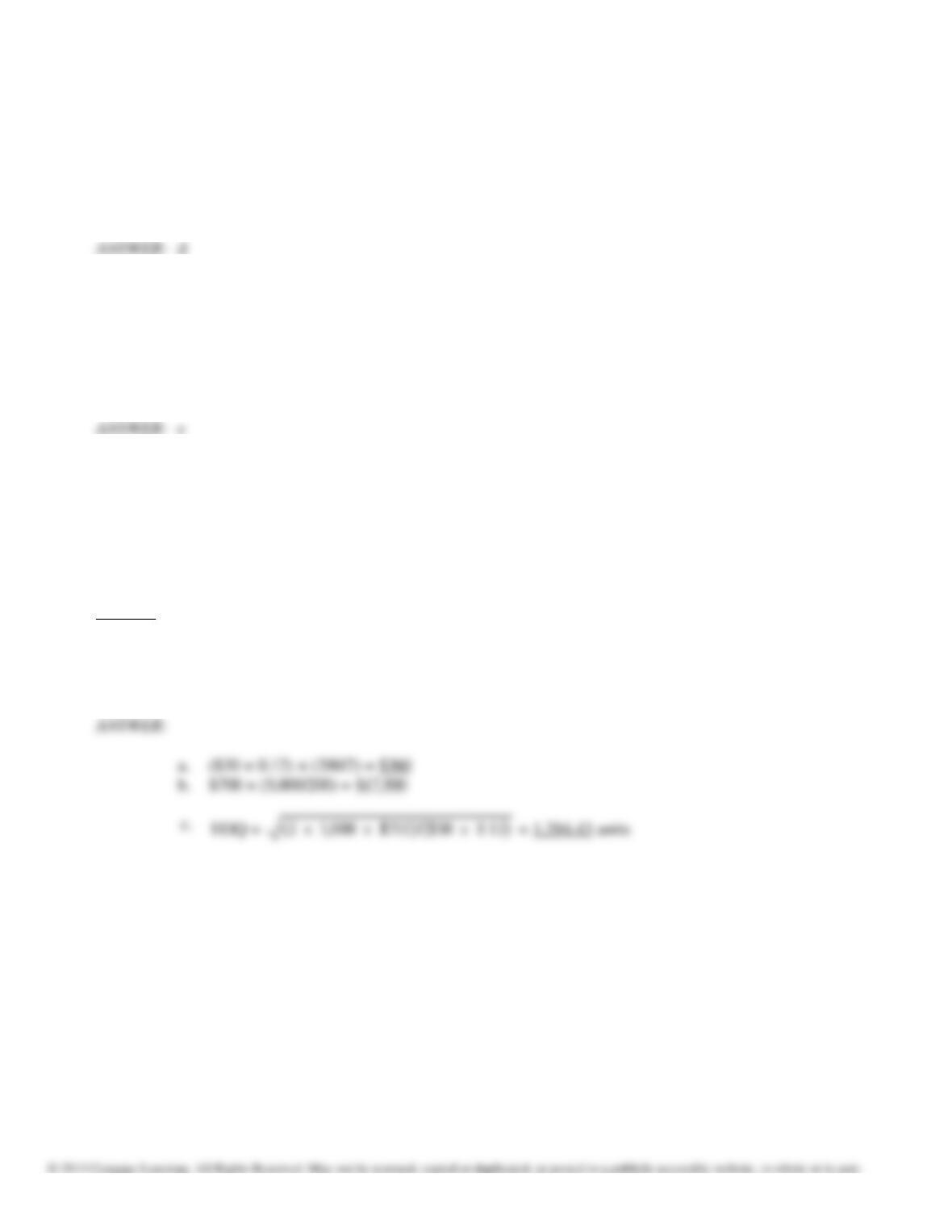
a. Calculate total annual carrying costs for an order quantity of 200 units per order.
b. Calculate total annual ordering costs for an order quantity of 200 units per order.
c. Determine the optimal order size.
Chapter 20: Inventory Management: Economic Order Quantity, JIT, and the Theory of Constraints
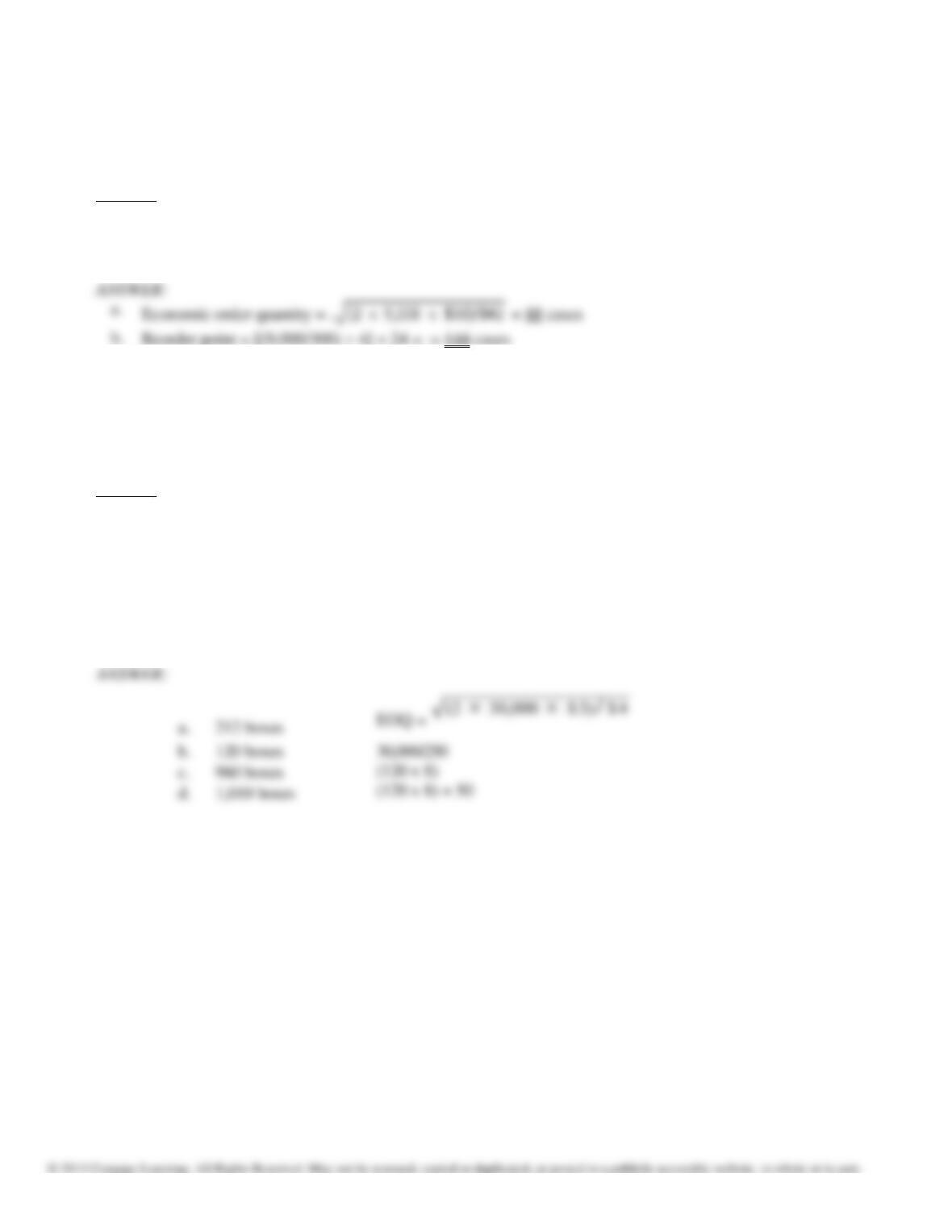
124. Harrisburg Company uses quantitative models for inventory control. For canned syrup, the annual demand is 9,000
cases. The supplier is 500 miles away, and it usually takes 4 days to get an order filled. The average order costs
$18 to process and the carrying cost per case is $42 per year. The store is open 300 days a year.
Required:
a. Determine the economic order quantity.
b. Determine the reorder point if a safety stock of 24 cases is desired.
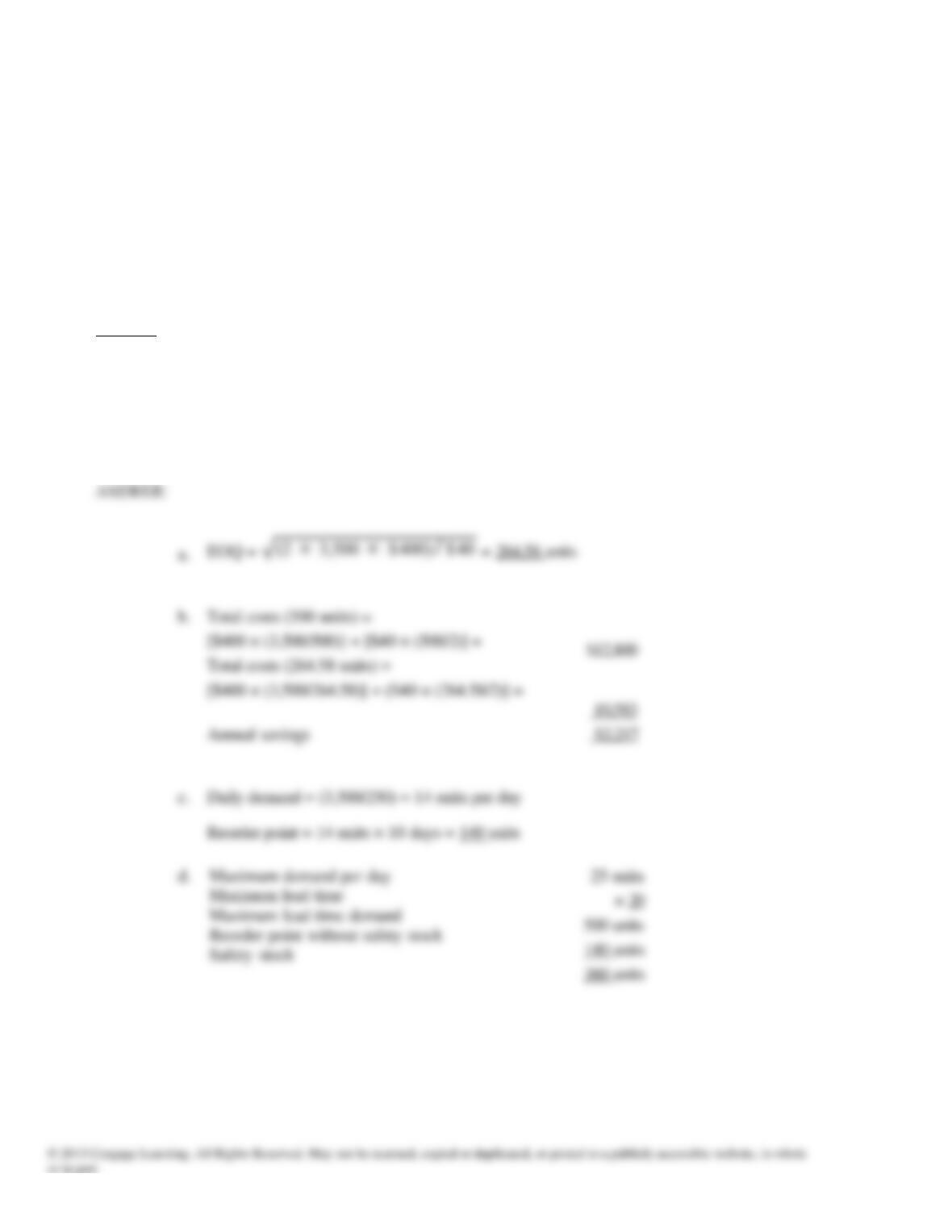
125. Sweet Tooth Company manufactures candy. The company buys chocolate used in the candy in 10-pound boxes
that cost $10 each. The company uses 30,000 of the boxes per year, and usage occurs evenly throughout the year.
The average cost to carry a 10–pound box in inventory per year is $4, and the cost to place an order is $3.
Required:
a. Determine the economic order quantity for the chocolate in terms of 10-pound boxes.
b. If the company works 250 days per year, on the average, how many boxes of chocolate are
used per working day?
c. If the lead time for an order is normally eight working days, determine the reorder point for
chocolate.
d. If 50 boxes of chocolate are carried as safety stock, determine the reorder point for the
chocolate.
Chapter 20: Inventory Management: Economic Order Quantity, JIT, and the Theory of Constraints
126. Harrowing Company has the following information:
Annual demand 3,500 units
Order size 500 units
Ordering cost per order $400
Carrying costs per unit for one year $40
Lead time (maximum 20 days) 10 days
Maximum daily use 25 units
Work year 250 days
Required:
a. Determine the economic order quantity for Harrowing.
b. What is the annual savings to Harrowing Company if it was to change from an order size of
1,000 to the economic order quantity?
c. What is the reorder point?
d. What is the safety stock needed to prevent stockouts?
Chapter 20: Inventory Management: Economic Order Quantity, JIT, and the Theory of Constraints
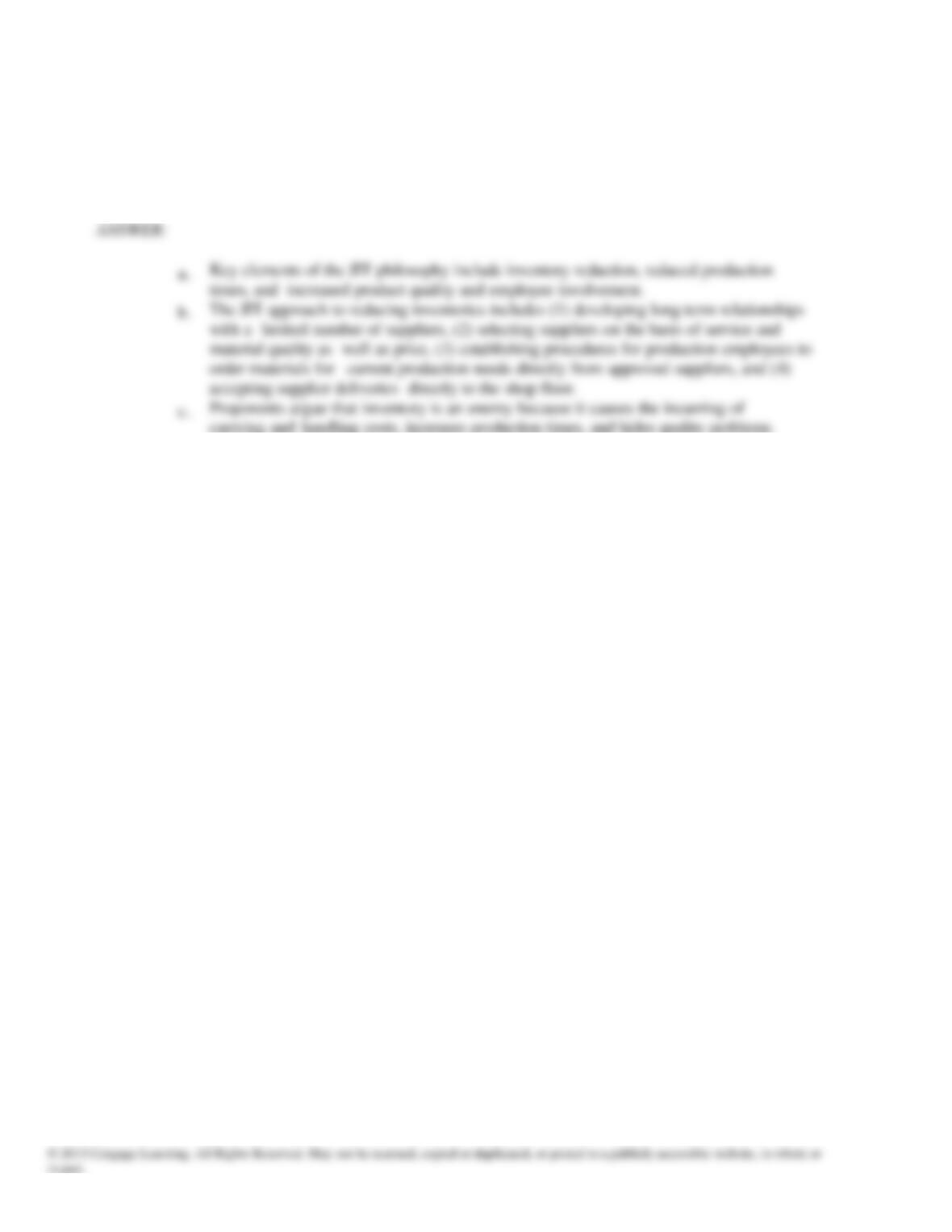
127. Answer the following questions pertaining to just–in–time inventory management:
a. What are key elements of the JIT philosophy?
b. What elements of the JIT approach contribute to reducing materials inventory?
c. Why do proponents of JIT believe inventory is an enemy?
128. The following reasons have been offered for holding inventories:
1. To balance ordering or setup costs and carrying costs.
2. To satisfy customer demand (e.g., meet delivery dates).
3. To avoid shutting down manufacturing facilities because of
(a) machine failure.
(b) defective parts.
(c) unavailable parts.
4. Unreliable production processes.
5. To take advantage of discounts.
6. To hedge against future price
increases.
Required:
a. Explain how the JIT approach responds to each of these reasons and, consequently,
argues for insignificant levels of inventories.
b. The theory of constraints (TOC) criticizes the JIT approach to inventory management,
arguing that it fails to protect throughput. Explain what this means and describe how
TOC addresses this issue.
Chapter 20: Inventory Management: Economic Order Quantity, JIT, and the Theory of Constraints
Chapter 20: Inventory Management: Economic Order Quantity, JIT, and the Theory of Constraints
129. Lexamoor Products Corporation produces two products. The manufacture of these products is partially automated.
Total available labor hours are 400, and the total available machine hours are 600. Time requirements and
contribution margins per unit for each product are as follows:
Product X
Product Y
Labor hours
2
3
Machine hours
4
2
Contribution margin per unit
Required:
$5
$4
a. What is the equation to be maximized?
b. What are the equations that express the constraints?
c. What is the greatest number of units of X that can be produced given the constraints?
d. What is the optimal solution?
130. Commonwealth Dry Cleaners has 400 hours a week available to use in dry cleaning or laundry. Four thousand
inches of hanging space is available. The average item that is dry cleaned takes six inches of hanging space,
whereas laundry items take up only three inches of hanging space. The contribution margin for laundry items
averages $3.50; dry cleaned items average $6.50. Fifty items can be washed per hour, whereas only twenty can be
dry cleaned.
Required:
a. Determine the objective function. Is it a minimization or maximization function?
b. Set up the constraint equations.
Chapter 20: Inventory Management: Economic Order Quantity, JIT, and the Theory of Constraints
131. Woodcrafters Corporation manufactures two different miniature models of furniture, a table and a chair.
The company has 500 feet of lumber, 400 machine hours, and 600 direct labor hours available for
production. The miniature tables and chairs provide $5 and $4 of contribution margin, respectively.
The time and lumber requirements to build a miniature table or chair are as follows:
Table
Chair
Feet of lumber per unit
5
2
Machine hours per unit
2
3
Direct labor hours per unit
Required:
4
2
a. What is the objective function being maximized?
b. What are the constraint equations?
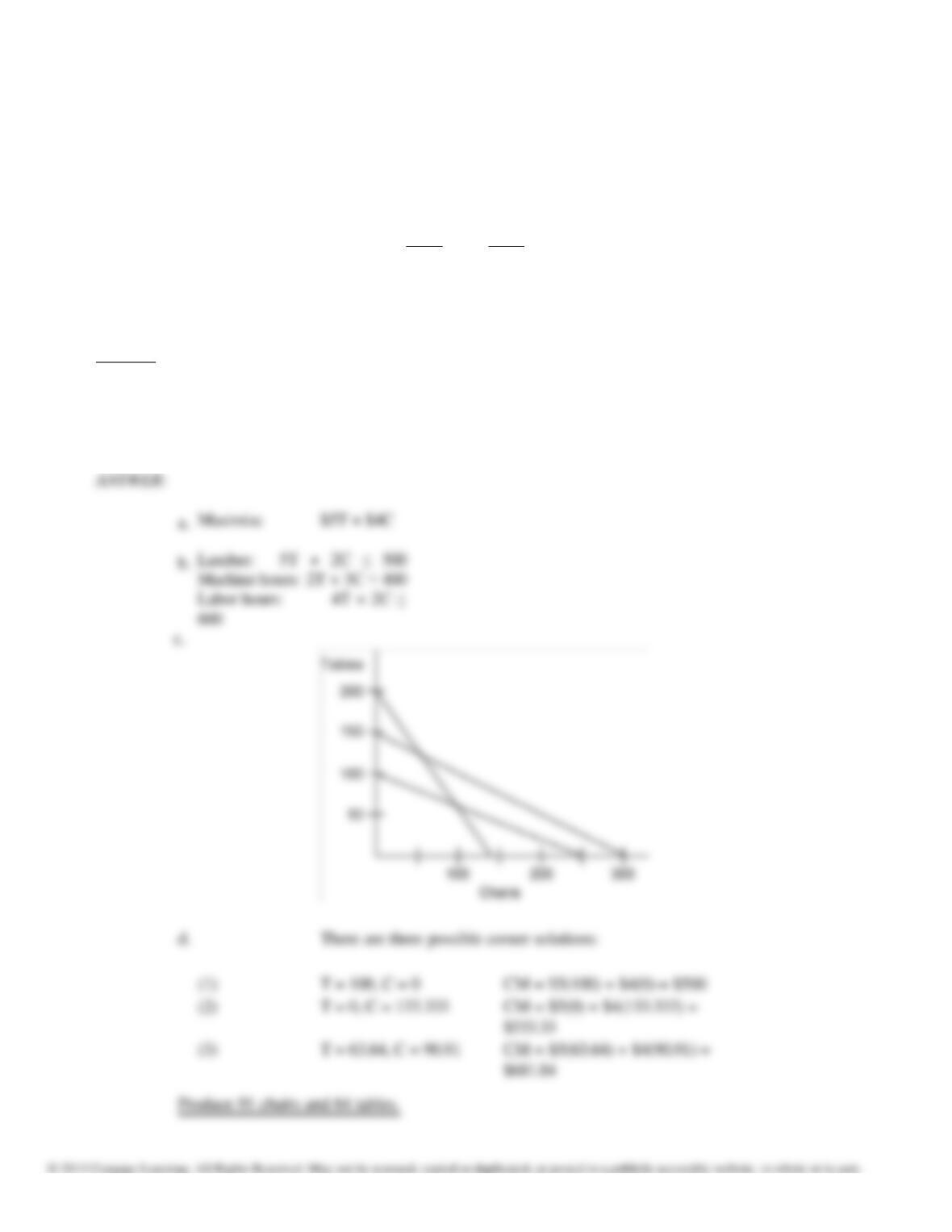
c. Graph the constraint equations. Identify the feasible region.
d. What is the optimal solution?
Chapter 20: Inventory Management: Economic Order Quantity, JIT, and the Theory of Constraints
132. Iron Horses Corporation produces two types of motorcycle frames, (Frame X and Frame Y). Frame X passes
through four processes: Cutting, Welding, Polishing, and Painting. Frame Y uses three of the same processes:
Cutting, Welding, and Painting. Each of the four processes employs forty workers who work eight hours each
day. Frame X sells for $80 per unit, and Frame Y sells for $110 per unit. Materials is the only unit–level variable
expense. The materials cost for Frame X is $40 per unit, and the materials cost for Frame Y is $50 per unit. Iron
Horses’ accounting system has provided the following additional information about its operations and products:
Resource Name
Resource Available
Resource
Usage/Unit
Frame X
Resource
Usage/Unit
Frame Y
Cutting labor
Welding labor
Polishing labor
Painting labor
19,200 minutes
19,200 minutes
19,200 minutes
19,200 minutes
30 minutes
30 minutes
30 minutes
20 minutes
20 minutes
60 minutes
–
30 minutes
Market demand: X
Market demand: Y
400 per day
200 per day
1 unit
–
–
1 unit
Iron Horses’ management has determined that any production interruptions can be corrected within two days.
Required:
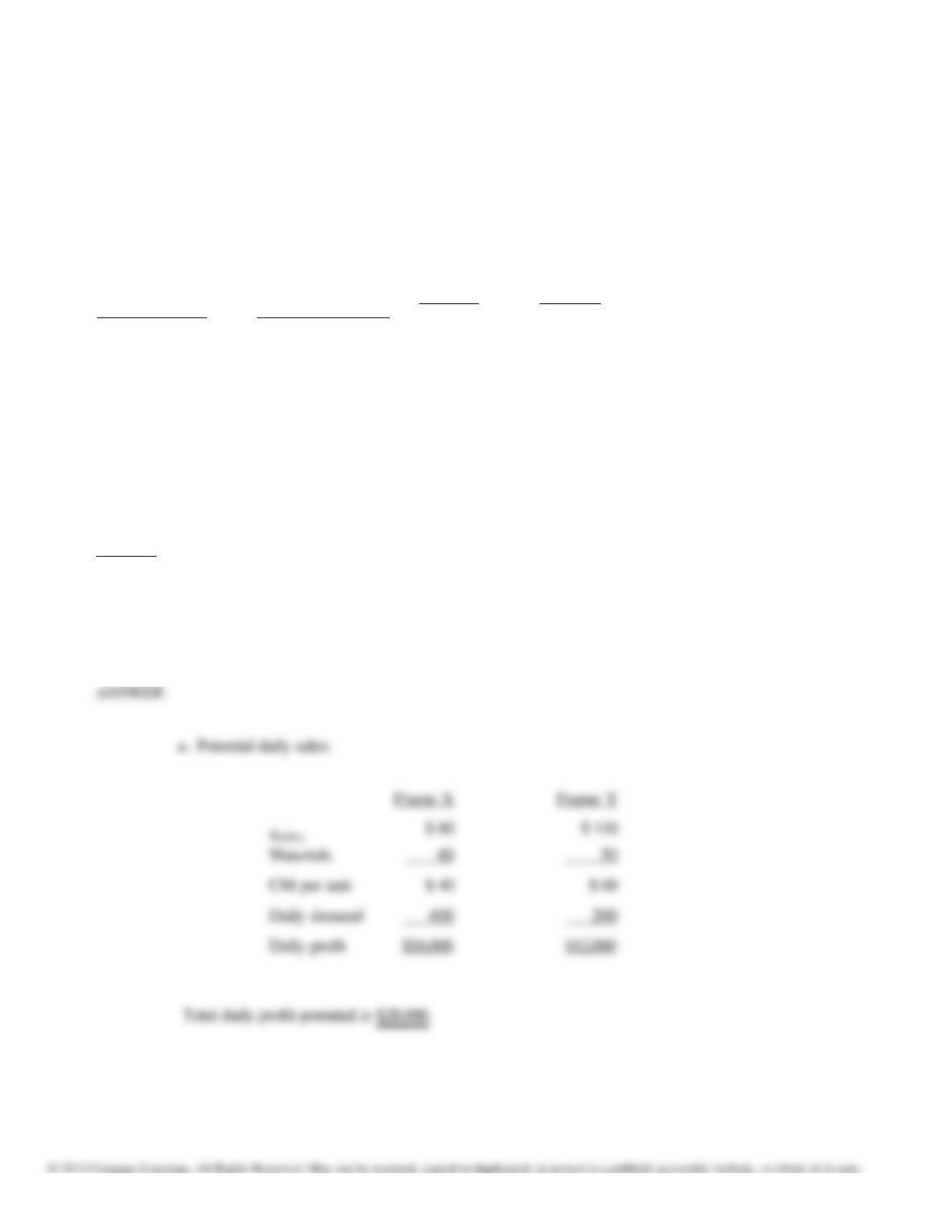
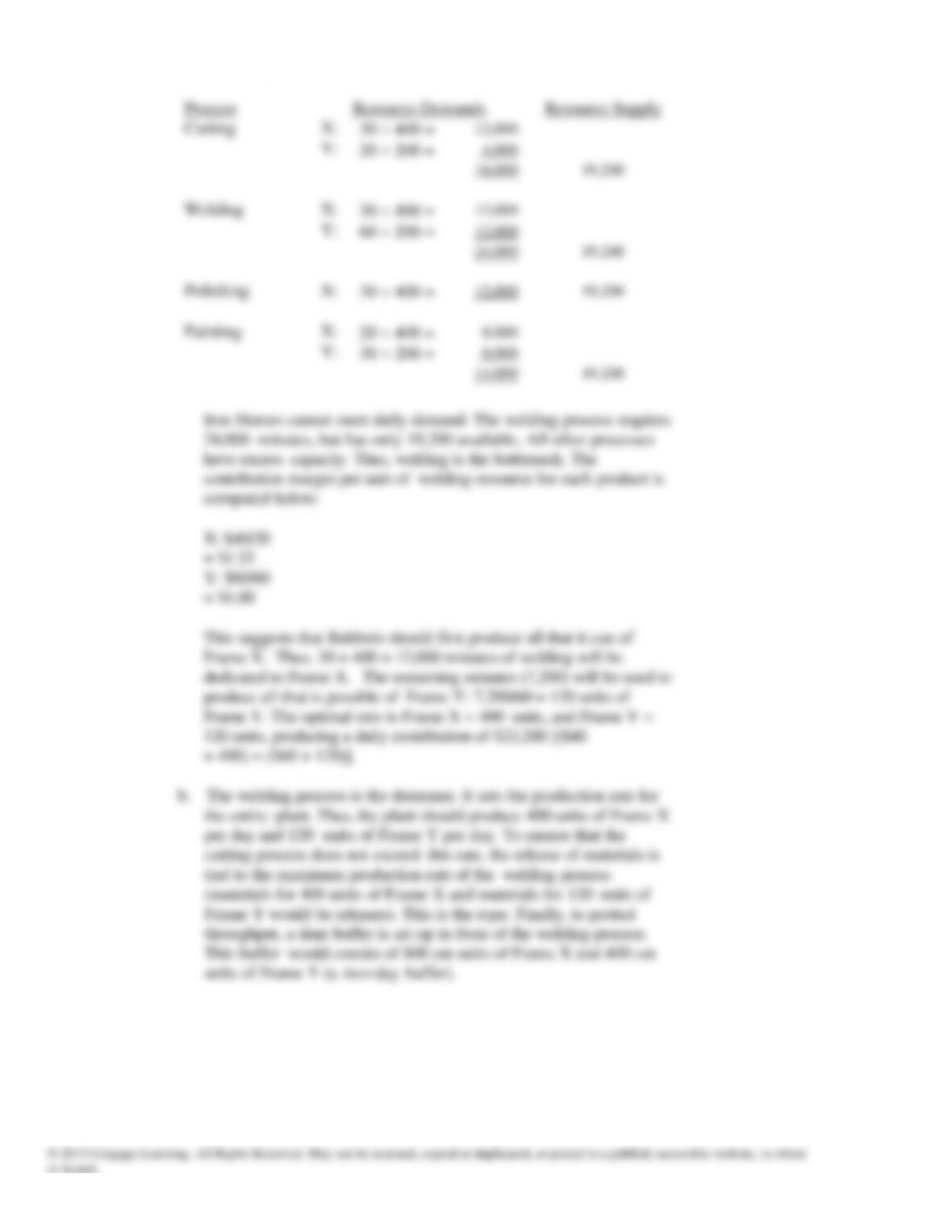
a. Assuming that Iron Horses can meet daily market demand, compute the potential daily profit.
Now compute the minutes needed for each process to meet the daily market demand. Can Iron
Horses meet daily market demand? If not, where is the bottleneck? Can you derive an optimal
mix without using a graphical solution? If so, explain how.
b. Explain how a drum-buffer-rope system would work for Iron Horses.
Chapter 20: Inventory Management: Economic Order Quantity, JIT, and the Theory of Constraints
Chapter 20: Inventory Management: Economic Order Quantity, JIT, and the Theory of Constraints
133. Grapevine Incorporated produces two different barrels used in wine making. (X and Y)
The company has three processes, cutting, forming, and curing. In cutting, the wood is cut to size and
prepared for forming. In forming, the wood
is bent to shape and connected together to form the barrel. In curing, the seams are finished and the oak
is left to process. In cutting, setup time
is 1/2 hour. The other two processes do not have any setup time. The demand for Component X is 90
units per day and the demand for Component Y
is 240 units per day. The minutes required per unit for each component are as follows:
Cutting
Forming
Curing
Component X
30
12
8
Component Y
20
15
6
The company operates one 8-hour shift. The cutting process employs 10 workers. Two hours of their
time is used for setup.
The forming process is the most labor intensive and has 15 workers. The curing department is not labor
intensive—the only significant unit-
level
variable costs are materials and power. The department only employs 6 associates. For component
X, the variable cost is $40 per unit and for Component Y, it is $30 per unit. The selling price per
barrel is $95 for Component X and $80 for Component Y.
Required:
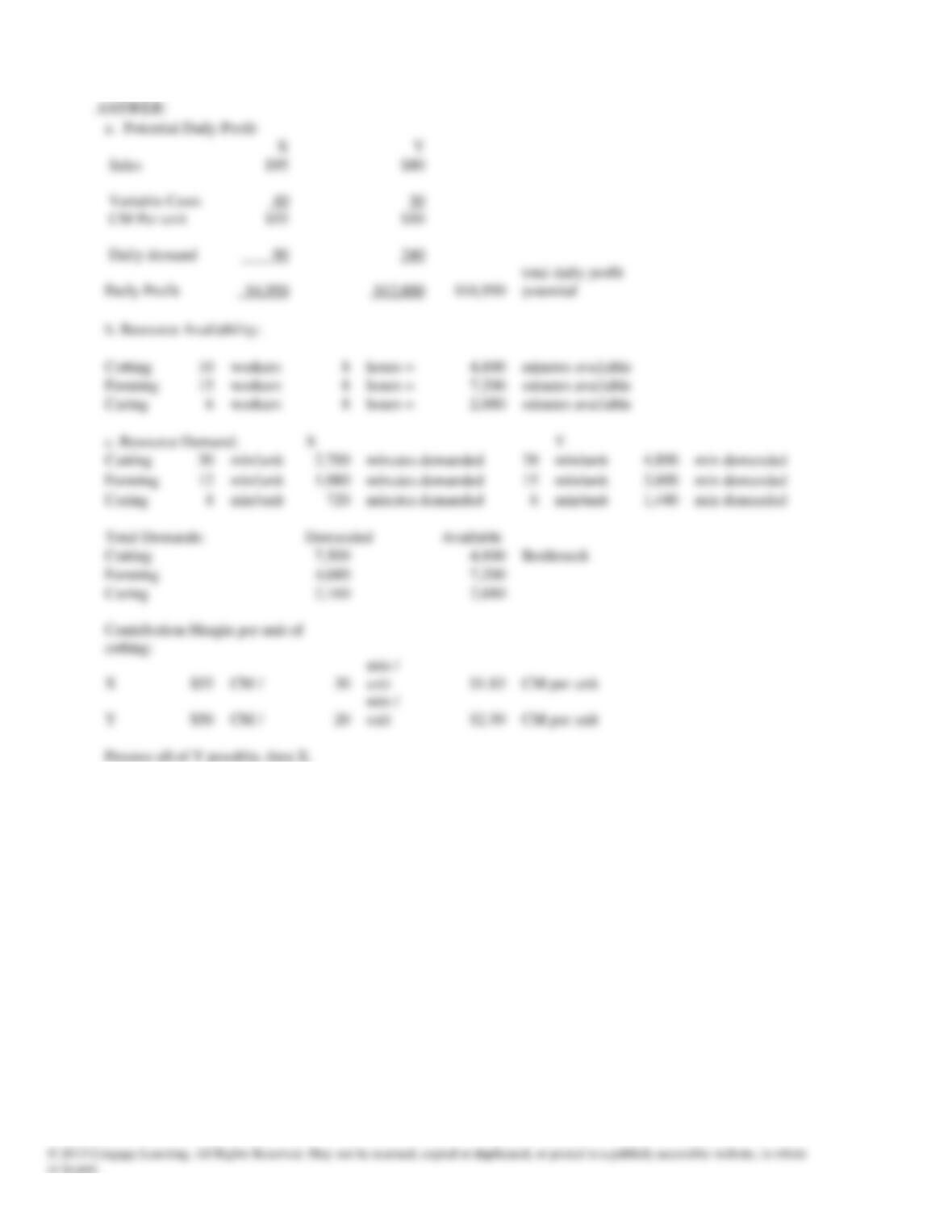
a. Calculate the estimated daily potential profit.
b. Calculate the resources available in minutes for each area.
c. Calculate the resources demanded in minutes for each area and identify any bottlenecks.
d. What is the contribution margin per unit of bottleneck resource and what does that imply?
Chapter 20: Inventory Management: Economic Order Quantity, JIT, and the Theory of Constraints