Chapter 20: Design and Analysis of Experiments and Observational Studies
Quiz A Name ________________
Use the following information for problems 1 through 5:
Management styles differ among organizations and may potentially affect employee’s job
satisfaction. A sample of employees was randomly selected from each of three
companies with different management styles (Authoritarian, Laissez faire and
Participative) and asked to rate their level of job satisfaction on a 10-point scale (10 being
the highest level of satisfaction). The data collected and partial ANOVA results appear
below.
One-way ANOVA: Authoritarian, Laissez, Participative
Source DF SS MS F P
Factor 2 97.40
Error 27 37.40
Total 29 134.80
20.6.3 Perform tests and state conclusions.
1. What are the null and alternative hypotheses (in words, not symbols)?
20.7.2 Determine if conditions for ANOVA are met.
2. Are the conditions / assumptions for ANOVA met?
20.6.3 Perform tests and state conclusions.
3. Calculate the F-statistic.
20.6.3 Perform tests and state conclusions.
4. The P-value for this statistic turns out to be < .001. State the conclusion.
20.2.1 Construct and analyze research designs.
5. Suppose that employees fall into several job categories, such as clerical, technical, or
professional. How might this affect the study results? Suggest how the design for the
study could have been improved.
20-2 Chapter 20 Design and Analysis of Experiments and Observational Studies
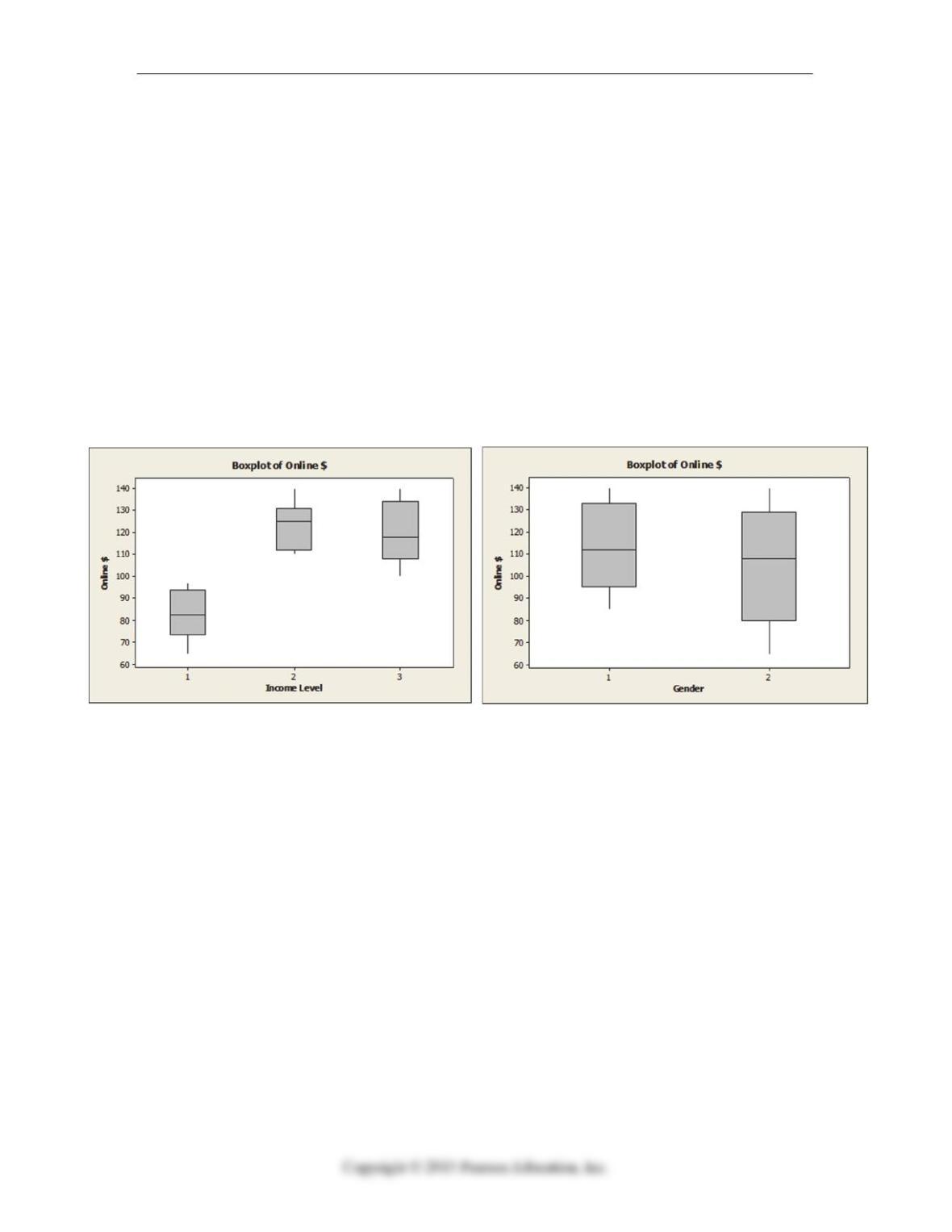
Use the following information for problems 6 through 10:
A survey of online consumers asked respondents to indicate how much money they spent
for online purchases during the most recent winter holiday season. These data were
analyzed to see if gender (1 = Female; 2 = Male) and income level (1 = Low, 2 = Middle,
3 = High) influence the amount consumers spend online for holiday shopping. The two
way ANOVA results appear below.
Two-way ANOVA: Online $ versus Income Level, Gender
Source DF SS MS F P
Income Level 2 10377.3 5188.63 140.42 0.000
Gender 1 681.6 681.63 18.45 0.000
Interaction 2 2355.3 1177.63 31.87 0.000
Error 24 886.8 36.95
Total 29 14301.0
20.3.1 Construct and analyze research designs.
6. Is this an experimental or observational study?
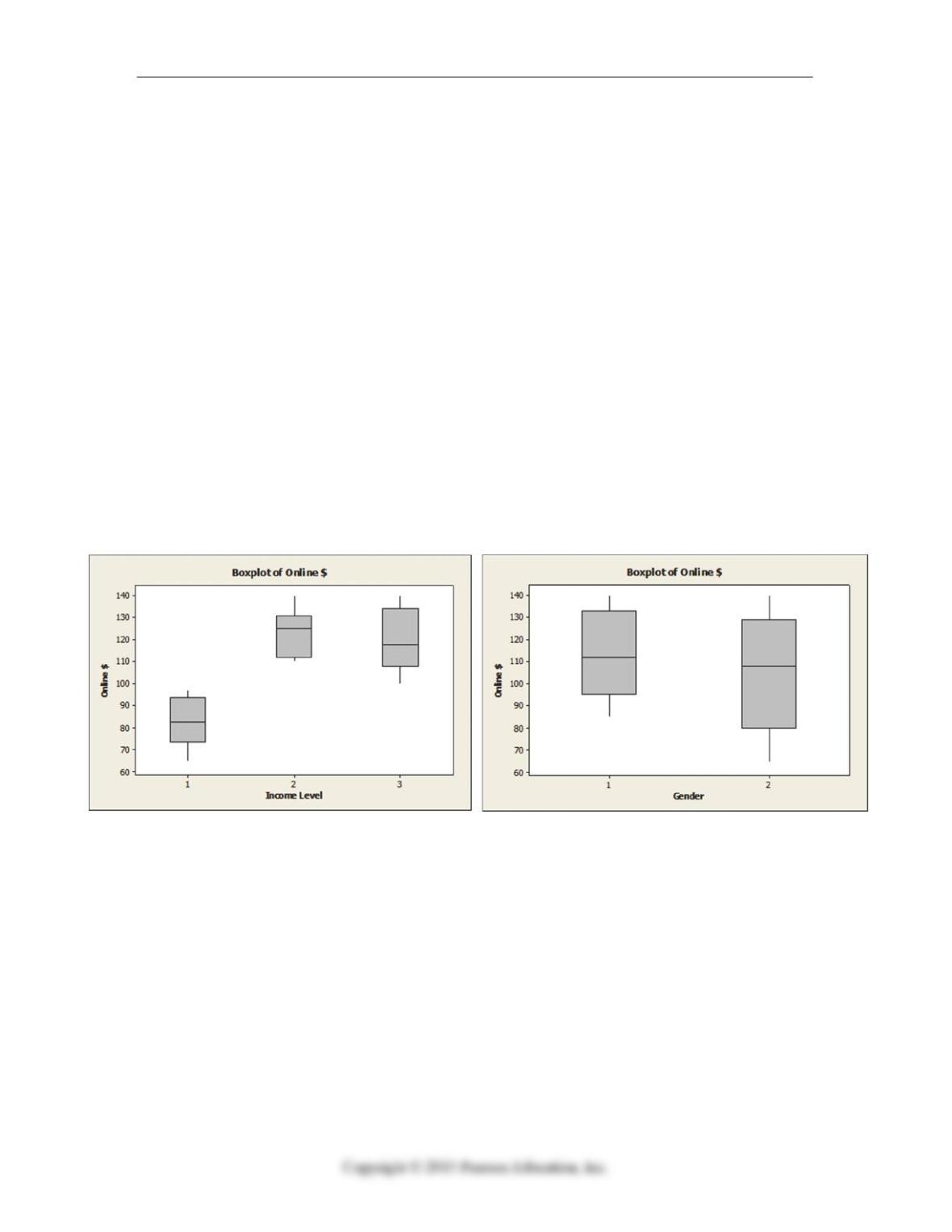
20.7.2 Determine if conditions for ANOVA are met.
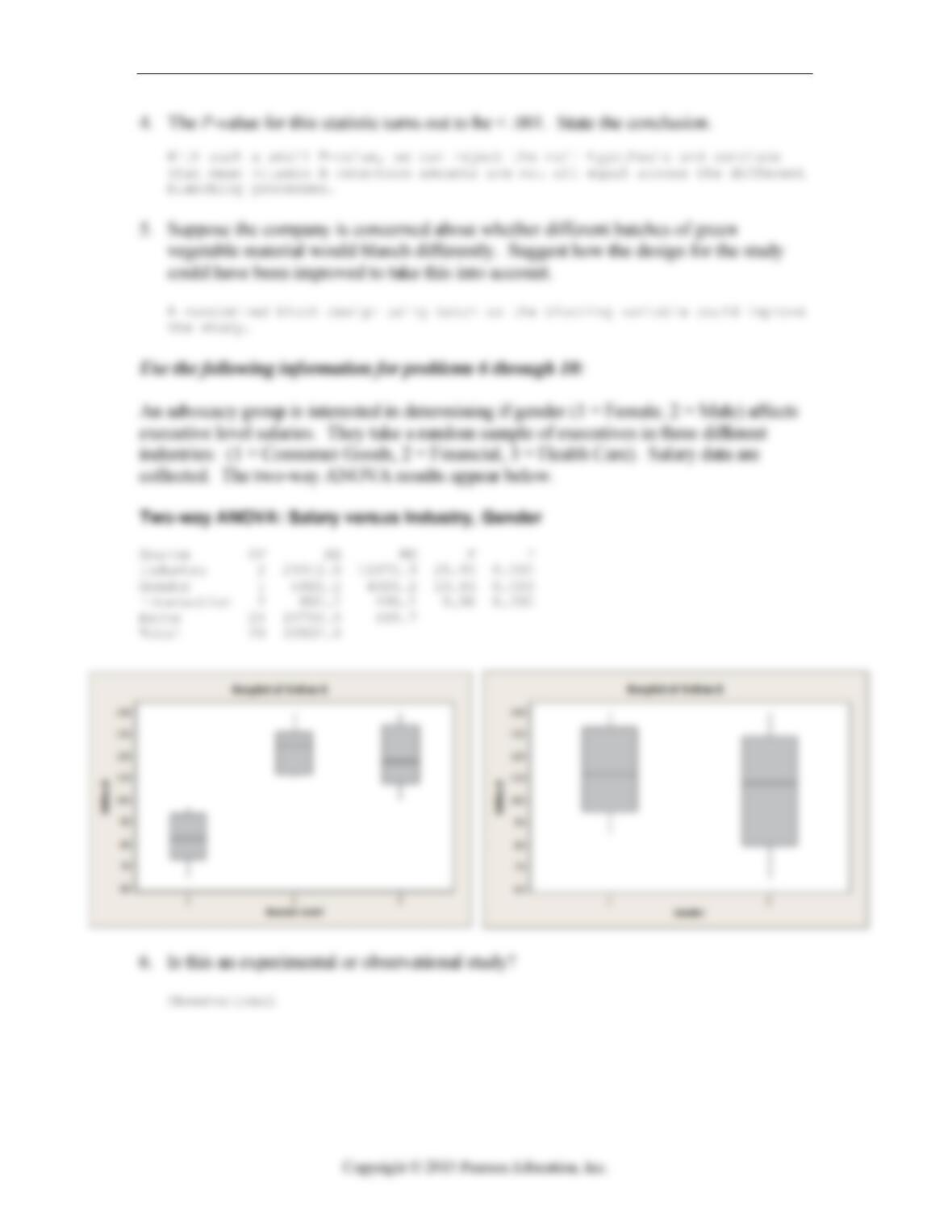
7. Are the conditions for two-way ANOVA met?
20.6.3 Perform tests and state conclusions.
8. If so, perform the hypothesis tests and state your conclusions in terms of amount
spent online, gender and income level.
20.9.3 Perform tests and state conclusions.
9. Is it appropriate to interpret the main effects in this case? Explain.
20.9.1 Construct and analyze research designs.
10. Identify possible variables that are not included in this data that may influence this
relationship. Label each as a possible confounding or a possible lurking variable.
Quiz A 20-3
Chapter 20: Design and Analysis of Experiments and Observational Studies
Quiz A – Key
20-4 Chapter 20 Design and Analysis of Experiments and Observational Studies
Quiz A 20-5
20-6 Chapter 20 Design and Analysis of Experiments and Observational Studies
Chapter 20: Design and Analysis of Experiments and Observational Studies
Quiz B Name ___________________
Use the following information for problems 1 through 5:
A health food company wants to determine the best process for blanching dark green
vegetable material so it can be added to other food products without losing vitamin A.
They are examining three different blanching processes to determine which is best in
terms of vitamin A retention (mg/100mg). The data collected and partial ANOVA results
appear below.
One-way ANOVA: Process 1, Process 2, Process 3
Source DF SS MS F P
Factor 2 1282.8
Error 21 578.9
Total 23 1861.6
20.6.3 Perform tests and state conclusions.
1. What are the null and alternative hypotheses (in words, not symbols)?
20.7.2 Determine if conditions for ANOVA are met.
2. Are the conditions / assumptions for ANOVA met?
20.6.3 Perform tests and state conclusions.
3. Calculate the F-statistic.
20.6.3 Perform tests and state conclusions.
4. The P-value for this statistic turns out to be < .001. State the conclusion.
Quiz B 21-7
20.2.1 Construct and analyze research designs.
5. Suppose the company is concerned about whether different batches of green
vegetable material would blanch differently. Suggest how the design for the study
could have been improved to take this into account.
Use the following information for problems 6 through 10:
An advocacy group is interested in determining if gender (1 = Female, 2 = Male) affects
executive level salaries. They take a random sample of executives in three different
industries: (1 = Consumer Goods, 2 = Financial, 3 = Health Care). Salary data are
collected. The two-way ANOVA results appear below.
Two-way ANOVA: Salary versus Industry, Gender
Source DF SS MS F P
Industry 2 23342.6 11671.3 25.95 0.000
Gender 1 4915.2 4915.2 10.93 0.003
Interaction 2 880.2 440.1 0.98 0.390
Error 24 10794.0 449.7
Total 29 39932.0
20.3.1 Construct and analyze research designs.
6. Is this an experimental or observational study?
20.7.2 Determine if conditions for ANOVA are met.
7. Are the conditions for two-way ANOVA met?
20.6.3 Perform tests and state conclusions.
8. If so, perform the hypothesis tests and state your conclusions in terms of amount
spent online, gender and income level.
20.9.3 Perform tests and state conclusions.
9. Is it appropriate to interpret the main effects in this case? Explain.

20-8 Chapter 20 Design and Analysis of Experiments and Observational Studies
20.9.1 Construct and analyze research designs.
10. Identify possible variables that are not included in this data that may influence this
relationship. Label each as a possible confounding or a possible lurking variable.
Quiz B 21-9
Chapter 20: Design and Analysis of Experiments and Observational Studies –
Quiz B – Key
20-10 Chapter 20 Design and Analysis of Experiments and Observational Studies
Quiz B 21-11
.

20-12 Chapter 20 Design and Analysis of Experiments and Observational Studies
Chapter 20: Design and Analysis of Experiments and Observational Studies
Quiz C – Multiple Choice Name________________________
20.6.1 Construct and analyze research designs.
1. A one-way ANOVA was carried out to determine whether management styles
(Authoritarian, Laissez faire and Participative) differ among organizations and may
potentially affect employee’s job satisfaction (measured on a 10-point scale where
10=high). The null hypothesis to be tested is
A. Mean employee job satisfaction ratings are equal across companies with different
management styles.
B. Mean employee job satisfaction ratings are not all equal across companies with
different management styles.
C. Management styles do not affect employee job satisfaction ratings.
D. Both A and C.
E. Both B and C.
20.6.1 Construct and analyze research designs.
2. Based on the partial ANOVA results shown below, the F statistic value is
One-way ANOVA: Authoritarian, Laissez, Participative
Source DF SS MS F P
Factor 2 97.40
Error 27 37.40
Total 29 134.80
A. F = 35.16
B. F = 2.604
C. F = 48.7
D. F = 1.385
E. None of the above
20.6.1 Construct and analyze research designs.
3. A one-way ANOVA was carried out to determine whether management styles
(Authoritarian, Laissez faire and Participative) differ among organizations and may
potentially affect employee’s job satisfaction. The results yield an F statistic with an
associated P-value of < .001. Therefore, at α = .05 we
A. Fail to reject the null hypothesis.
B. Reject the null hypothesis.
C. Conclude that mean employee job satisfaction ratings are all equal across
companies with different management styles.
D. Both A and C.
E. Both B and C.
Quiz C 21-13
20.5.1 Construct and analyze research designs.
4. A sample of 10 employees was randomly selected from each of three companies with
different management styles and asked to rate their level of job satisfaction on a 10-
point scale (10=high satisfaction). Suppose that employees fall into several job
categories, such as clerical, technical, or professional. Which of the following
statements is true?
A. Job category may be a confounding variable.
B. Job category may be an outlier variable.
C. A randomized block design using job category as the blocking variable might
improve the study.
D. Both A and C.
E. Both B and C.
20.7.2 Determine if conditions for ANOVA are met.
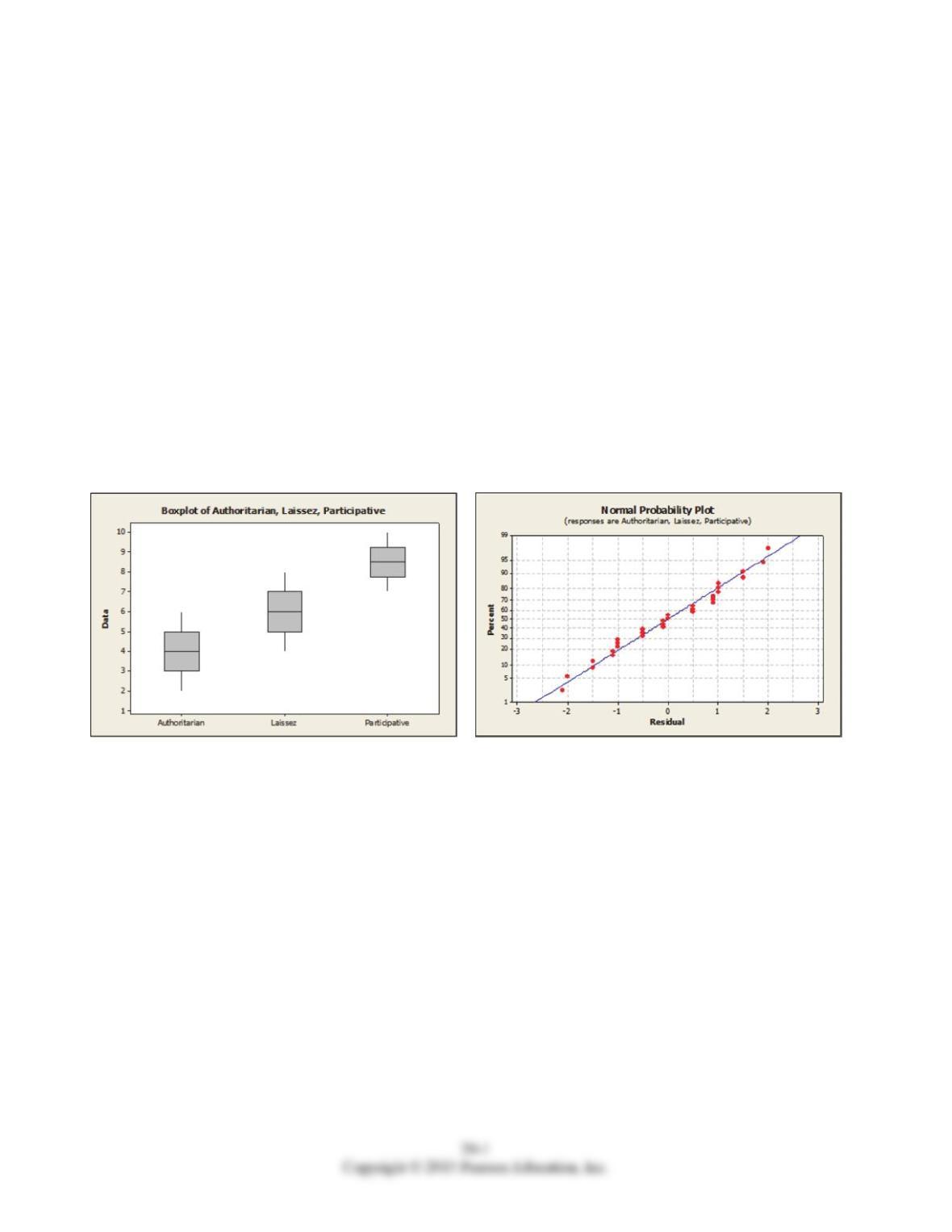
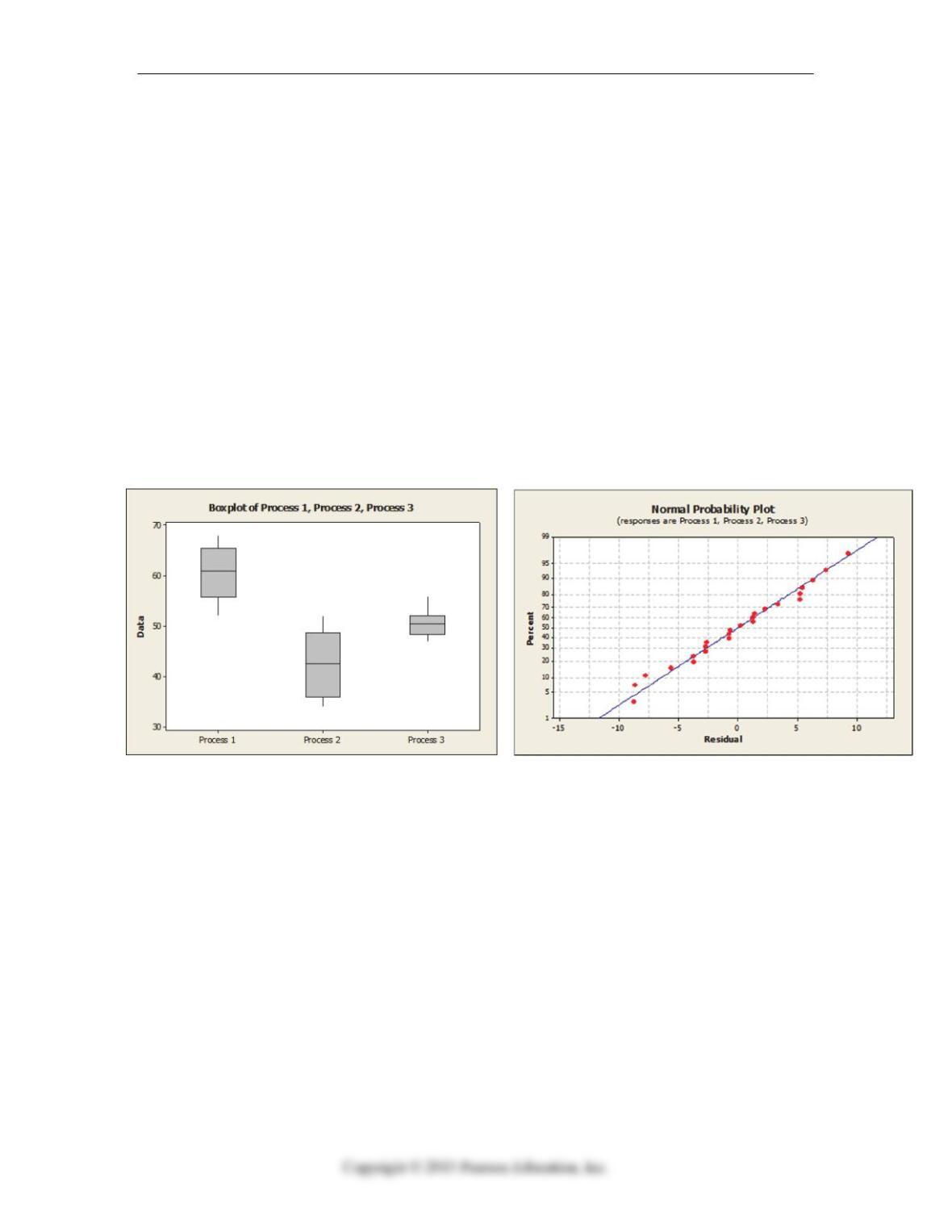
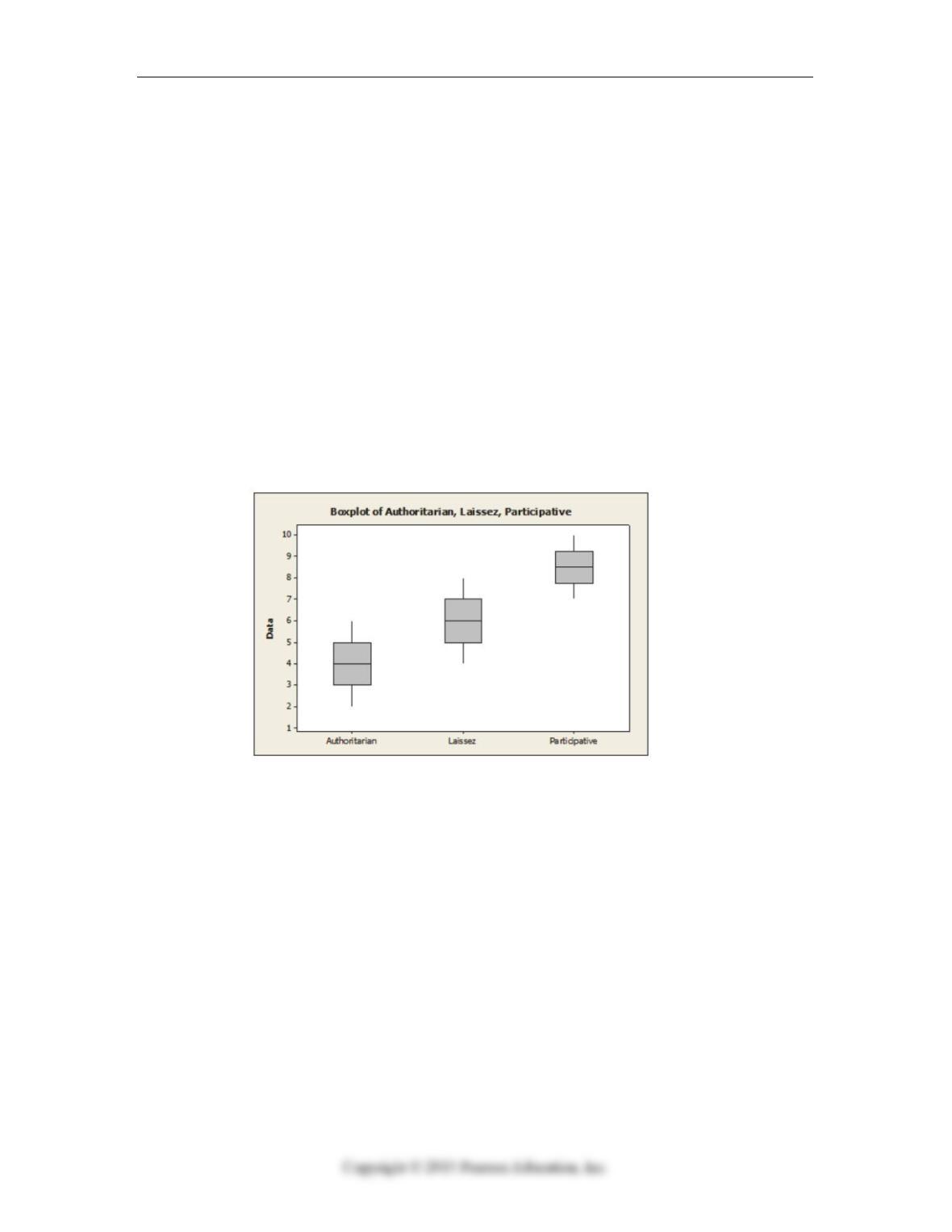
5. The boxplots of management styles (Authoritarian, Laissez faire and Participative)
shown below indicate that the
A. randomization condition is satisfied.
B. similar variance condition is satisfied.
C. distributions are symmetric.
D. both A and B.
E. both B and C.
20-14 Chapter 20 Design and Analysis of Experiments and Observational Studies
20.7.2 Determine if conditions for ANOVA are met.
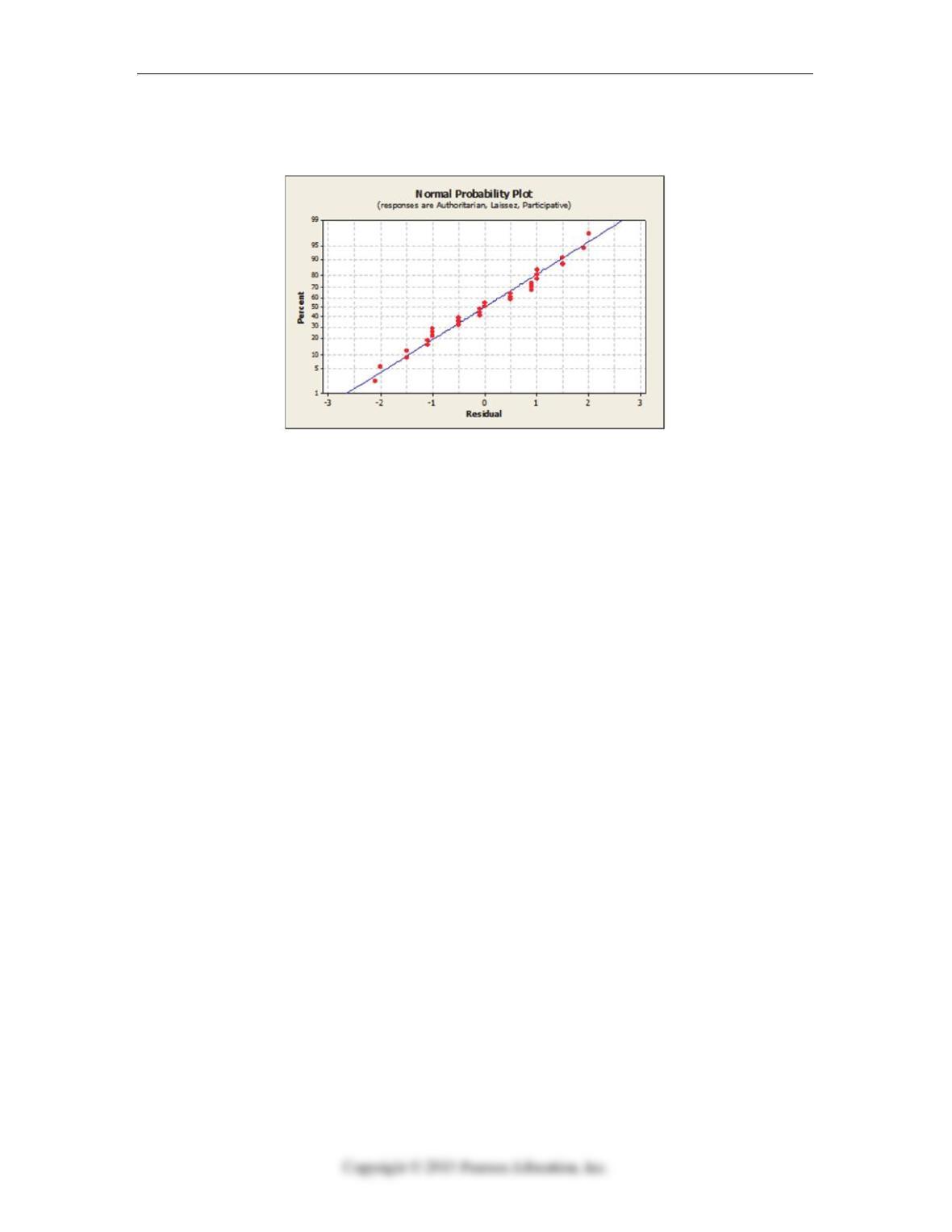
6. The plot of ANOVA residuals shown below indicates that the
A. nearly normal condition is satisfied.
B. randomization condition is satisfied.
C. similar variance condition is satisfied.
D. linearity condition is satisfied.
E. all of the above.
20.4.1 Construct and analyze research designs.
7. An advocacy group is interested in determining if gender (1 = Female, 2 = Male)
affects executive level salaries. They take a random sample of executives in three
different industries: (1 = Consumer Goods, 2 = Financial, 3 = Health Care). Salary
data are collected. Which of the following statements is true?
A. This is an experimental study.
B. This is an observational study.
C. This is a randomized block design.
D. Both A and C.
E. Both B and C.

Quiz C 21-15
20.10.3 Perform tests and state conclusions.
8. An advocacy group conducted a two-way ANOVA to determining if gender (1 =
Female, 2 = Male) affects executive level salaries in three different industries: (1 =
Consumer Goods, 2 = Financial, 3 = Health Care). Based on the results that appear
below, we can conclude (at α = 05) that
Two-way ANOVA: Salary versus Industry, Gender
Source DF SS MS F P
Industry 2 23342.6 11671.3 25.95 0.000
Gender 1 4915.2 4915.2 10.93 0.003
Interaction 2 880.2 440.1 0.98 0.390
Error 24 10794.0 449.7
Total 29 39932.0
A. mean executive salaries are not the same across the three different industry
sectors.
B. mean executive salaries are not the same for males and females.
C. there is a significant interaction effect.
D. Both A and B.
E. A, B and C.
20.10.3 Perform tests and state conclusions.
9. An advocacy group is interested in determining if gender (1 = Female, 2 = Male)
affects executive level salaries in three different industries: (1 = Consumer Goods, 2
= Financial, 3 = Health Care). The number of treatments in this example is
A. 2
B. 3
C. 5
D. 6
E. 9
20.3.1 Construct and analyze research designs.
10. Which of the following is not one of the four principles of experimental design?
A. Placebo
B. Control
C. Replicate
D. Randomize
E. Blocking
20-16 Chapter 20 Design and Analysis of Experiments and Observational Studies
Chapter 20: Design and Analysis of Experiments and Observational Studies
Quiz C – Key

Quiz D 20-17
Chapter 20: Design and Analysis of Experiments and Observational Studies
Quiz D – Multiple Choice
20.6.3 Perform tests and state conclusions.
1. A health food company is examining three different blanching processes to determine
which is best in terms of vitamin A retention (mg/100mg). The correct null
hypothesis is
A. Mean vitamin A retention amounts are not all equal across the three blanching
processes.
B. Mean vitamin A retention amounts are equal across the three blanching processes.
C. Blanching process has an effect on vitamin A retention.
D. Both A and C.
E. Both B and C.
20.6.3 Perform tests and state conclusions.
2. A health food company is examining three different blanching processes to determine
which is best in terms of vitamin A retention (mg/100mg) for dark green vegetable
material. The response variable is
A. blanching process.
B. dark green vegetable material.
C. vitamin A retention.
D. blanching time.
E. food products.
20.4.1 Construct and analyze research designs.
3. A health food company is examining three different blanching processes to determine
which is best in terms of vitamin A retention (mg/100mg). Suppose the company is
concerned about whether different batches of green vegetable material would blanch
differently. Which of the following statements is true?
A. Batch may be a confounding variable.
B. Batch may be an outlier variable.
C. A randomized block design using batch as the blocking variable might improve
the study.
D. Both A and C.
E. Both B and C.

20-18 Chapter 20 Design and Analysis of Experiments and Observational Studies
20.6.3 Perform tests and state conclusions.
4. Based on the partial ANOVA results shown below, the F statistic value is
One-way ANOVA: Process 1, Process 2, Process 3
Source DF SS MS F P
Factor 2 1282.8
Error 21 578.9
Total 23 1861.6
A. F = 23.27
B. F = 2.215
C. F = 27.57
D. F = 7.999
E. None of the above
20.6.3 Perform tests and state conclusions.
5. An ANOVA examining three different blanching processes to determine which is
best in terms of vitamin A retention (mg/100mg) yields an F statistic with an
associated P-value of < .001. Therefore, at α = .05 we
A. fail to reject the null hypothesis.
B. reject the null hypothesis.
C. conclude that mean vitamin A retention amounts are not all equal across the
different blanching processes.
D. Both A and C.
E. Both B and C.
20.2.1 Construct and analyze research designs.
6. A survey of online consumers asked respondents to indicate how much money they
spent for online purchases during the most recent Christmas holiday season. These
data were analyzed to see if gender and income level influence the amount consumers
spend online for holiday shopping. Which of the following statements is true?
A. This is an experimental study.
B. This is a randomized block design.
C. This is an observational study.
D. Both A and C.
E. Both B and C.

Quiz D 20-19
20.10.3 Perform tests and state conclusions.
7. Data from a survey of online consumers were analyzed to see if gender and income
level influence the amount consumers spend online for holiday shopping. Based on
the two way ANOVA results that appear below, we can conclude (at α = 0.05) that
Two-way ANOVA: Online $ versus Income Level, Gender
Source DF SS MS F P
Income Level 2 10377.3 5188.63 140.42 0.000
Gender 1 681.6 681.63 18.45 0.000
Interaction 2 2355.3 1177.63 31.87 0.000
Error 24 886.8 36.95
Total 29 14301.0
A. mean amounts spent online by consumers for holiday shopping are not same for
males and females.
B. mean amounts spent online by consumers for holiday shopping are not the same
for different levels of income.
C. there is a significant interaction effect.
D. Both A and B.
E. A, B and C.
20-20 Chapter 20 Design and Analysis of Experiments and Observational Studies
20.10.3 Perform tests and state conclusions.
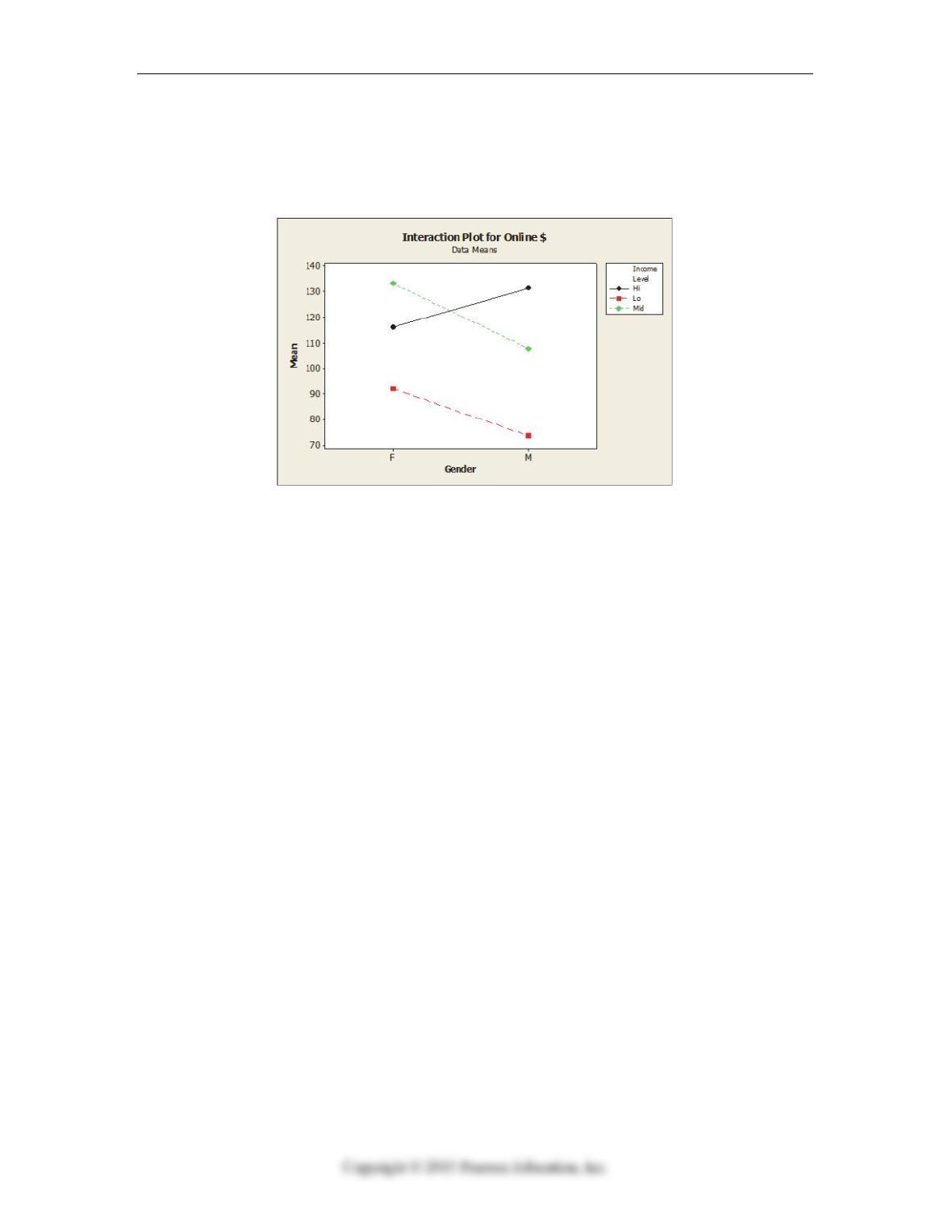
8. Data obtained from a survey of online customers were analyzed to see if gender and
income level influence the amount consumers spend online for holiday shopping.
The interaction plot shown below suggests that
A. consumers in the highest income level spend the most online for holiday
shopping.
B. females spend more online for holiday shopping than males.
C. males spend more online for holiday shopping than females except for those in
the highest income level.
D. females spend more online for holiday shopping than males except for those in
the highest income level.
E. None of the above.
20.10.1 Construct and analyze research designs.
9. Quality control engineers fire tiles made with a new material at three different
temperature settings (1500ºF, 1800ºF and 2200ºF) and for four different times (2
hours, 6 hours, 10 hours and 12 hours) to determine the optimal parameter settings for
firing that will result in tiles with high flexural strength.. The number of treatments in
this experiment is
A. 15
B. 12
C. 7
D. 4
E. 3

Quiz D 20-21
20.10.1 Construct and analyze research designs.
10. Quality control engineers fire tiles made with this new material at three different
temperature settings (1500ºF, 1800ºF and 2200ºF) and for four different times (2
hours, 6 hours, 10 hours and 12 hours) to determine the optimal parameter settings for
firing that will result in tiles with high flexural strength. The response variable in this
experiment is
A. flexural strength.
B. firing time.
C. firing temperature.
D. the new material.
E. tiles.
20-22 Chapter 20 Design and Analysis of Experiments and Observational Studies
Chapter 20: Design and Analysis of Experiments and Observational Studies
Quiz D –Key