Chapter 20 – Genes Within Populations
32. In a forest, trees that get more sunlight grow taller than other nearby trees. This is a form
of ______
33. For a gene with two alternative alleles, B and b, the term q2 in the Hardy-Weinberg equation represents
Chapter 20 – Genes Within Populations
34. Certain small towns in the western United States have remained isolated and inbred since
their settlement many years ago. Some alleles are more common in these communities as
compared to the rest of the population. This effect is known as
35. Cheetahs have been through a genetic bottleneck; evidence for this is that
36. Animals that select mates that are phenotypically similar will have _____ when compared
with Hardy-Weinberg predictions.
Chapter 20 – Genes Within Populations
37. If a population was in Hardy-Weinberg equilibrium, then ____ would occur in that population.
38. Large ears is a rare trait in a mainland population of mice. A female mice homozygous
for very large ears arrives at an island that already contains mice after sneaking onto a boat.
This will lead to a population with a higher incidence of big ears than the mainland population
because of ____
39. An island is on the migration route of sea birds. This island also has abundant tree nesting
birds that live on the island permanently and are not found on any other island. The tree
nesting birds are more likely than the sea birds to be in Hardy-Weinberg equilibrium
because:
Chapter 20 – Genes Within Populations
Clarify Question
•
What is the key concept addressed by the question?
•
What type of thinking is required?
•
What key words does the question contain and what do they mean?
Gather Content
•
What do you already know about the Hardy-Weinberg principle? How does it relate to
the question?
Consider Possibilities
•
What other information is related to the question? Which information is most useful?
Choose Answer
•
Given what you now know, what information and/or problem solving approach is most
likely to produce the correct answer?
Chapter 20 – Genes Within Populations
Reflect on Process
•
Did your problem-solving process lead you to the correct answer? If not, where did the
process break down or lead you astray? How can you revise your approach to produce a
more desirable result?
Chapter 20 – Genes Within Populations
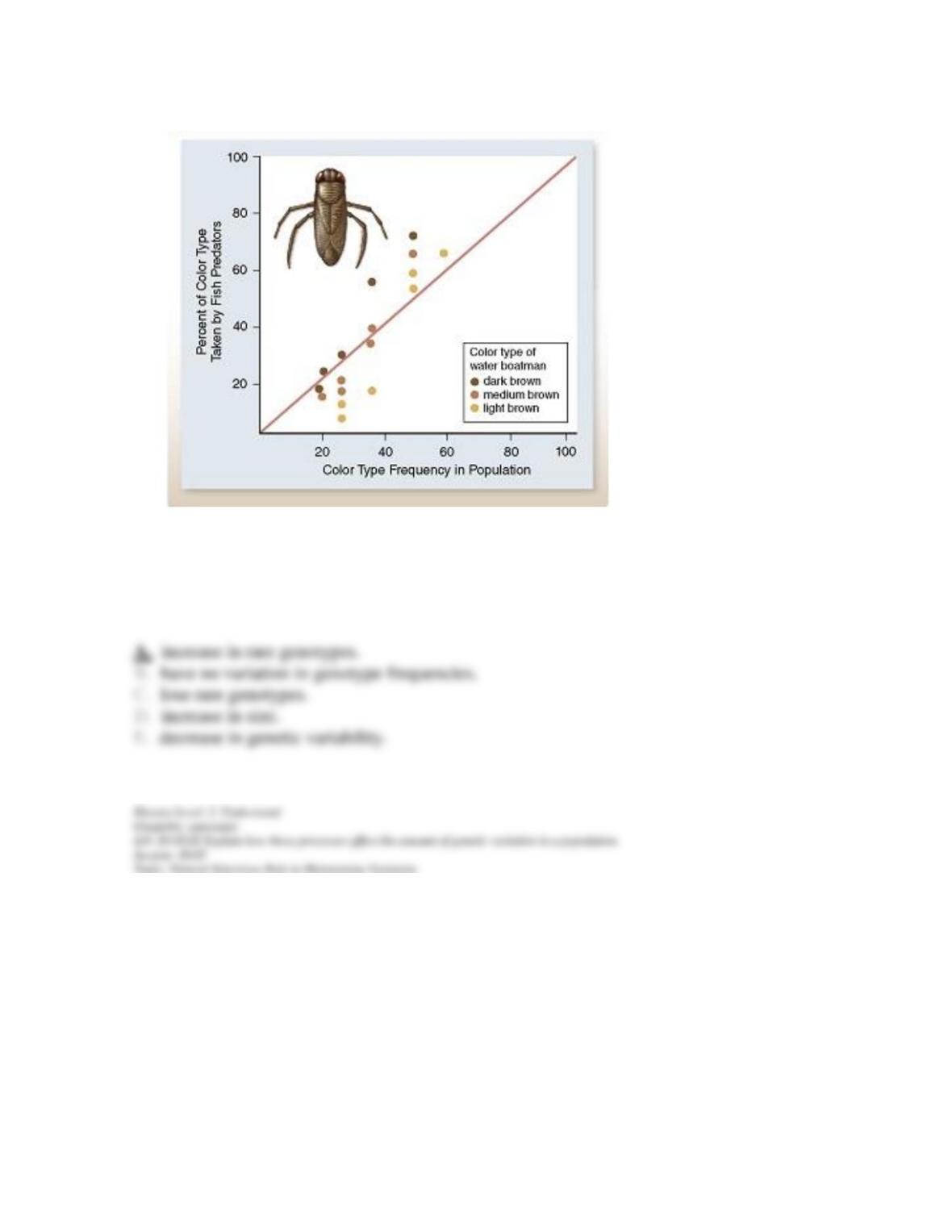
40.
The percentage of different colored water boatmen eaten by fish were graphed relative to the
frequency of that color in the population. Based on the graph, a population of water boatmen
would _____
Chapter 20 – Genes Within Populations
41. In some instances environmental change causes a situation where one phenotype is
favored for a period of time, and then a different phenotype is favored. This oscillating
selection causes
42. People homozygous for the sickle-cell anemia allele develop a life threatening disease,
while those homozygous for the normal allele are at the highest risk of dying
from malaria. Carriers have some resistance to malaria, but do not develop sickle cell
anemia. This is an example of ____
Chapter 20 – Genes Within Populations
43. In disruptive selection, over time
44. During a drought on the Galapagos islands, finches with larger beaks were able to crack
the large tough seeds produced by plants that survived the dry conditions. This is an example
of ____.
45. If the frequency of an autosomal recessive trait in humans is 1 out of 100 births, what
would be the expected frequency of heterozygote carriers for the trait if we assume that the
gene is in Hardy-Weinberg equilibrium?
Chapter 20 – Genes Within Populations
Clarify Question
•
What is the key concept addressed by the question?
•
What key words does the question contain and what do they mean?
Gather Content
•
What do you already know about the Hardy-Weinberg principle? How does it relate to
the question?
Consider Possibilities
•
What other information is related to the question? Which information is most useful?
Choose Answer
Chapter 20 – Genes Within Populations
•
Given what you now know, what information and/or problem solving approach is most
likely to produce the correct answer?
Reflect on Process
•
Did your problem-solving process lead you to the correct answer? If not, where did the
process break down or lead you astray? How can you revise your approach to produce a
more desirable result?
46. The recessive phenotype of a trait occurs in 16% of a population. What is the frequency
of the dominant allele?
Chapter 20 – Genes Within Populations
Clarify Question
•
What is the key concept addressed by the question?
•
What type of thinking is required?
•
What key words does the question contain and what do they mean?
Gather Content
•
What do you already know about the Hardy-Weinberg principle? How does it relate to
the question?
Consider Possibilities
•
What other information is related to the question? Which information is most useful?
Choose Answer
•
Given what you now know, what information and/or problem solving approach is most
likely to produce the correct answer?
Reflect on Process
•
Did your problem-solving process lead you to the correct answer? If not, where did the
process break down or lead you astray? How can you revise your approach to produce a
more desirable result?

Chapter 20 – Genes Within Populations
47. A human autosomal recessive trait appears in 1 in 100 births. What percent of people are
homozygous dominant for this trait?
Chapter 20 – Genes Within Populations
Clarify Question
•
What is the key concept addressed by the question?
population in Hardy-Weinberg equilibrium?
•
What type of thinking is required?
•
What key words does the question contain and what do they mean?
Gather Content
•
What do you already know about the Hardy-Weinberg principle? How does it relate to
the question?
Consider Possibilities
•
What other information is related to the question? Which information is most useful?
Choose Answer
Chapter 20 – Genes Within Populations
•
Given what you now know, what information and/or problem solving approach is most
likely to produce the correct answer?
Reflect on Process
•
Did your problem-solving process lead you to the correct answer? If not, where did the
process break down or lead you astray? How can you revise your approach to produce a
more desirable result?
48. A population of flowers is in Hardy-Weinberg equilibrium with an allele frequency for
white flowers (w) of 40%. What percentage of the flowers will have the colored or dominant
phenotype?
Chapter 20 – Genes Within Populations
Clarify Question
•
What is the key concept addressed by the question?
•
What type of thinking is required?
•
What key words does the question contain and what do they mean?
Gather Content
•
What do you already know about the Hardy-Weinberg principle? How does it relate to
the question?
Consider Possibilities
•
What other information is related to the question? Which information is most useful?
Choose Answer
•
Given what you now know, what information and/or problem solving approach is most
likely to produce the correct answer?
Chapter 20 – Genes Within Populations
Reflect on Process
•
Did your problem-solving process lead you to the correct answer? If not, where did the
process break down or lead you astray? How can you revise your approach to produce a
more desirable result?
49. In a large population of randomly reproducing rabbits, a recessive allele r comprises 80%
of the alleles for a gene. What percentage of the rabbits would you expect to have the
recessive phenotype?