Exam
Name___________________________________
TRUE/FALSE. Write ‘T’ if the statement is true and ‘F‘ if the statement is false.
1) Cash flow forecasts are conducted in order to determine whether a firm has a cash flow surplus or deficit
and whether such a surplus or deficit is temporary or permanent.
2) Firms need short–term financing to deal with seasonal working capital requirements, negative cash flow
shocks, or positive cash flow shocks.
MULTIPLE CHOICE. Choose the one alternative that best completes the statement or answers the question.
3) Which of the following are the three reasons that firms need short–term financing?
A) seasonalities, market frictions, and positive cash flow shocks
B) seasonalities, funding risk, and market frictions
C) negative cash flow shocks, positive cash flow shocks, and seasonalities
D) market frictions, negative cash flow shocks, and funding risk
4) Which of the following companies is most likely to have the greatest need for short–term financial planning?
A) a company that mines sand for use in glass–making
B) a company that manufacturers condiments such as ketchup
C) a company that produces advertisements for roadside billboards
D) a company that provides catering services for weddings
5) Which of the following companies has the smallest need for short–term financial planning?
A) A company that produces Christmas decorations.
B) A toy manufacturer.
C) A company that makes condiments such as ketchup.
D) A company that provides catering services for weddings.
6) How does seasonality create fluctuations in a firm’s net income over a year?
A) Cost of goods sold will rise and fall along with sales, while administrative and other costs will remain
relatively steady.
B) Cost of goods sold will rise when sales fall, and vice–versa, while administrative and other costs will
remain relatively steady.
C) Cost of goods sold, along with administrative and other costs, will rise when sales fall, and vice–versa.
D) Cost of goods sold, along with administrative and other costs, will rise and fall along with sales.
7) A company that makes decorations for Christmas trees has high sales in its fourth quarter but very low sales
during the rest of the year. It manufactures decorations steadily throughout the year, however. Which of the
following is NOT a likely consequence of this scenario?
A) The firm will need sources of short–term cash to fund inventory in the second and third quarters.
B) The firm will see negative net cash flows in the second and third quarter.
C) The firm will have a large short–term surplus in the fourth quarter.
D) Cash payables will rise from the first to fourth quarter.
8) Month J F M A M J J A S O N D
Net Income 8 5 6 6 6 6 6 6 6 42 20 7
Depreciation 2 2 1 2 2 1 2 2 2 2 2 2
Capital Expenditures 1 0 0 1 2 1 2 4 5 2 0 0
Accounts Receivable 16 2 3 2 1 1 2 1 3 18 22 12
Inventory 3 2 2 2 2 2 3 4 8 16 5 2
Accounts Payable 3 3 3 3 3 3 3 3 3 3 3 3
DressUp! is a clothing retailer specializing in costumery. The financial forecast for a year are shown in the
table above. All figures are in thousands of dollars. During which of the following months are the firm’s
working capital needs the greatest?
A) April
B) June
C) September
D) October
9) Month J F M A M J J A S O N D
Net Income 8 5 6 6 6 6 6 6 6 42 20 7
Depreciation 2 2 1 2 2 1 2 2 2 2 2 2
Capital Expenditures 1 0 0 1 2 1 2 4 5 2 0 0
Accounts Receivable 16 2 3 2 1 1 2 1 3 18 22 12
Inventory 3 2 2 2 2 2 3 4 8 16 5 2
Accounts Payable 3 3 3 3 3 3 3 3 3 3 3 3
DressUp! is a clothing retailer specializing in costumery. The financial forecast for a year are shown in the
table above. All figures are in thousands of dollars. During which of the following months does the firm
have surplus cash?
A) April
B) June
C) September
D) October
10) Q1: $1.8 million Q2: 2.4 million Q3: 8.4 million Q4: 3.2 million
Azamel Cosmetics specializes in cosmetics which have high levels of UV protection. The above figures show
the anticipated sales over the next four quarters. Azamel carries inventory equal to 30% of next quarter’s
sales, has accounts payable of 20% of next quarter’s sales, and accounts receivable of 25% of this quarter’s
sales. If its net income is 12% of sales, in which quarter is it expected that Azamel’s seasonal working capital
needs will be the greatest?
A) Q1
B) Q2
C) Q3
D) Q4
11) Q1: $2.0 million Q2: 0.3 million Q3: 0.4 million Q4: 4.2 million
Glenside Industries is a domestic machinery manufacturer which specializes in the production of
snowblowers. The above figures show the anticipated sales over the next four quarters. Glenside carries
inventory equal to 25% of next quarter’s sales, has accounts payable of 15% of next quarter’s sales, and
accounts receivable of 23% of this quarter’s sales. If its net income is 10% of sales, in which quarter is it
expected that Glenside’s seasonal working capital needs will be the greatest?
A) Q1
B) Q2
C) Q3
D) Q4
12) Occasionally, a company will encounter circumstances in which cash flows are temporarily negative for an
unexpected reason. We refer to such a situation as a
A) a liquidity shock.
B) negative cash flow shock.
C) a negative liquidity shock.
D) a cash crunch.
13) When a company analyzes its short–term financing needs, it typically examines cash flows at
A) monthly intervals.
B) yearly intervals.
C) quarterly intervals.
D) weekly intervals.
14) Which of the following firms is likely to have the highest short–term financing needs?
A) a pharmaceutical manufacturer
B) a grocery store
C) an electric utility
D) a toy store
15) Which of the following statements is FALSE?
A) If a company anticipates an ongoing surplus of cash, it may choose to increase its dividend payout.
B) Seasonal sales can create large short–term cash flow deficits and surpluses.
C) The first step in short–term financial planning is to forecast the company’s future net working capital.
D) Deficits resulting from investments in long–term projects are often financed using long–term sources of
capital, such as equity or long–term bonds.
16) Which of the following statements is FALSE?
A) Firms with seasonal cash flows may find themselves with a surplus of cash during some months that is
sufficient to compensate for a shortfall during other months. However, because of timing differences,
such firms often have short–term financing needs.
B) A company forecasts its cash flows to determine whether it will have surplus cash or a cash deficit for
each period.
C) Positive cash flow shocks cannot create short–term financing needs.
D) When sales are concentrated during a few months, sources and uses of cash are also likely to be
seasonal.
Use the table for the question(s) below.
The quarterly working capital levels for Hasbeen Toys are presented in the following table (in $ millions):
Quarter
1
2
3
4
Cash
605
625
175
1000
Accounts Receivable
585
745
1260
760
Inventory
410
540
725
375
Accounts Payable
835
910
1055
1145
17) In which quarter are Hasbeen’s seasonal working capital needs the greatest?
A) 4
B) 2
C) 3
D) 1
Quarter
3
Cash
605
625
175
1000
Accounts Receivable
585
745
1260
760
Inventory
410
540
725
375
Accounts Payable
835
910
1055
1145
Working capital
765
1000
1105
990
18) In which quarter are Hasbeen’s seasonal working capital needs the smallest?
A) 4
B) 2
C) 3
D) 1
Use the table for the question(s) below.
The quarterly working capital levels for Fancy Weddings, Inc are presented in the following table (in $ millions):
Quarter
1
2
3
4
Cash
825
175
175
900
Accounts Receivable
585
1,245
1,760
800
Inventory
160
250
250
115
Accounts Payable
735
910
1,255
945
19) In which quarter are Fancy‘s seasonal working capital needs the greatest?
A) 1
B) 2
C) 3
D) 4
Quarter
1
2
3
4
Cash
825
175
175
900
Accounts Receivable
585
1,245
1,760
800
Inventory
160
250
250
115
Accounts Payable
735
910
1,255
945
Working capital
835
760
930
870
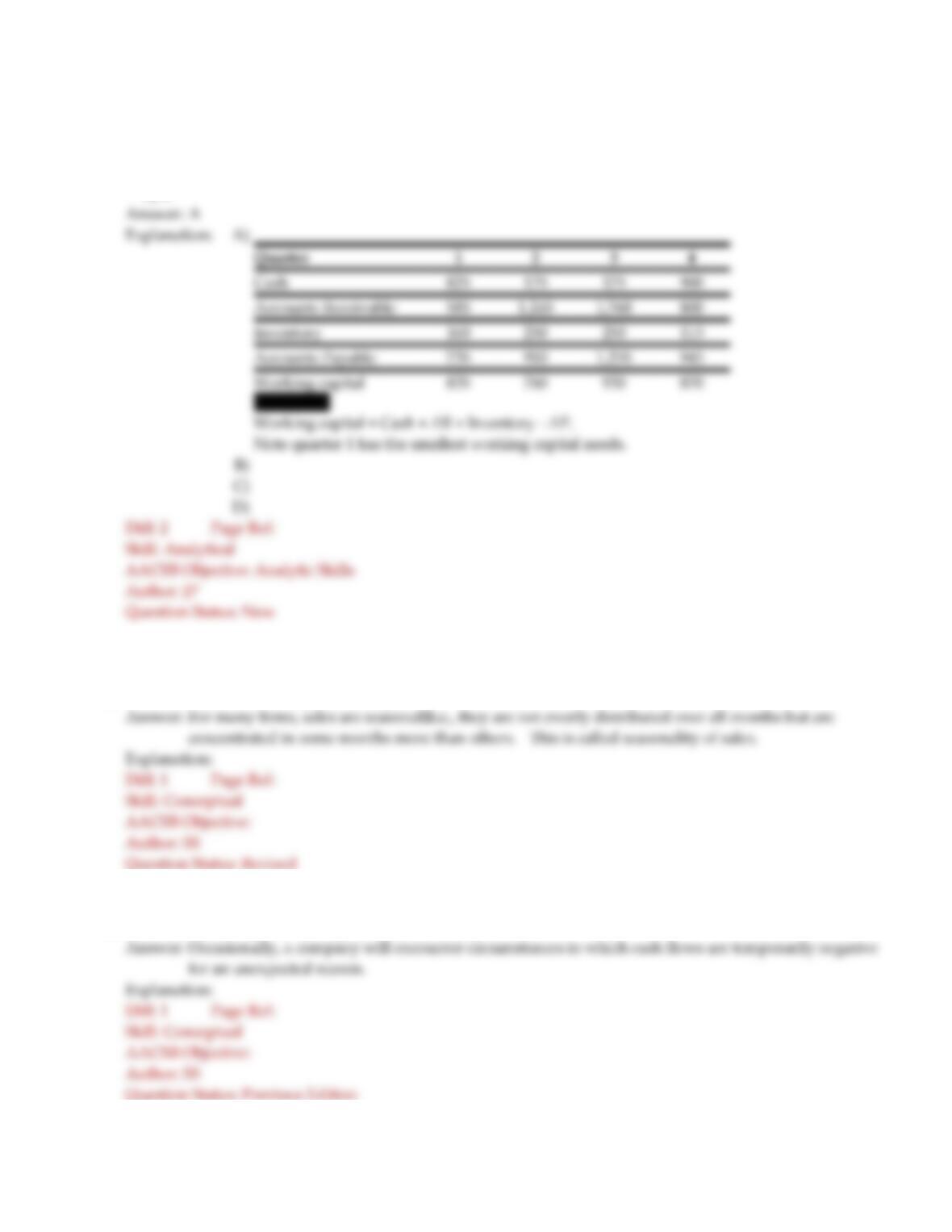
Quarter
1
2
3
4
Cash
605
625
175
Accounts Receivable
585
745
760
Inventory
410
540
725
375
Accounts Payable
835
910
Working capital
765
990
20) In which quarter are Hasbeen’s seasonal working capital needs the smallest?
A) 1
B) 2
C) 3
D) 4
SHORT ANSWER. Write the word or phrase that best completes each statement or answers the question.
21) What do we understand by seasonality?
22) What do we understand by negative cash flow shocks?
23) What do we understand by positive cash flow shocks?
TRUE/FALSE. Write ‘T’ if the statement is true and ‘F‘ if the statement is false.
24) According to the matching principle, short–term needs for funds should be financed by short–term sources of
funds; long–term need for funds should be financed by long–term sources of funds.
MULTIPLE CHOICE. Choose the one alternative that best completes the statement or answers the question.
25) Which short–term financing policy states that short–term cash needs should be financed with short–term debt
and long–term cash needs should be financed with long–term sources of funds?
A) aggressive policy
B) evergreen credit
C) matching principle
D) conservatism principle
26) What is permanent working capital?
A) the amount that a firm must keep invested in its short–term assets to support its continuing operations
B) the difference between the actual level of investment in short–term assets and the amount that a firm
must keep invested in its short–term assets to support its continuing operations
C) the amount that a firm keeps invested in its short–term assets to support its continuing operations
which are financed by short–term debt
D) the amount that a firm keeps invested in its short–term assets to support its continuing operations
which are financed by long–term debt
27) What is temporary working capital?
A) the amount that a firm must keep invested in its short–term assets to support its continuing operations
B) the difference between the actual level of investment in short–term assets and the amount that a firm
must keep invested in its short–term assets to support its continuing operations
C) the amount that a firm keeps invested in its short–term assets to support its continuing operations
which are financed by short–term debt
D) the amount that a firm keeps invested in its short–term assets to support its continuing operations
which are financed by long–term debt
28) Which of the following statements regarding how a firm should finance its cash needs is true?
A) Permanent working capital should be financed by long–term sources of funds, while temporary
working capital should be financed by short–term sources of funds.
B) Permanent working capital should be financed by short–term sources of funds, while temporary
working capital should be financed by long–term sources of funds.
C) Both permanent working capital and temporary working capital should be financed by short–term
sources of funds.
D) Both permanent working capital and temporary working capital should be financed by long–term
sources of funds.
29) Q1 Q2 Q3 Q4
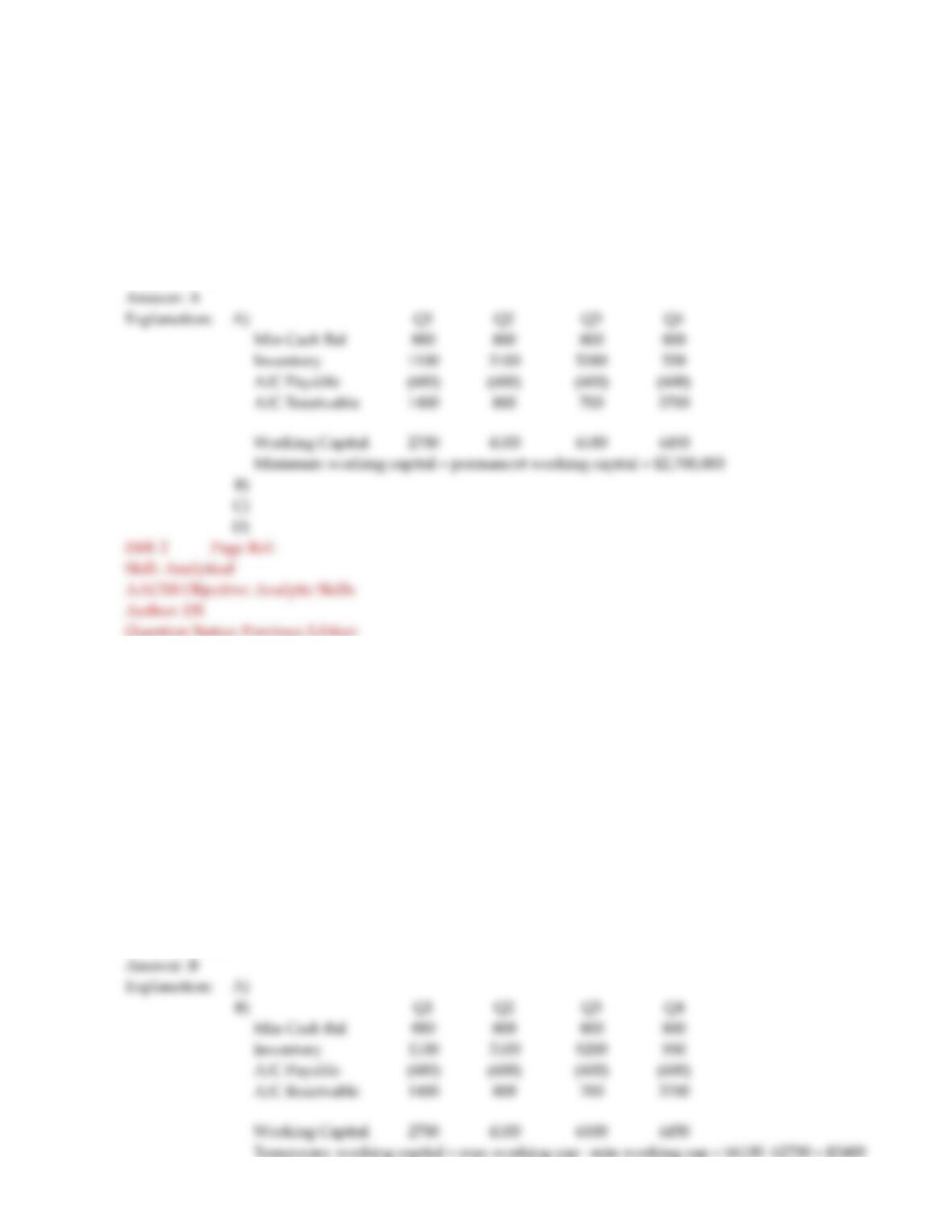
Minimu
m Cash
Balance 800 800 800 800
Account
s
Receiva
ble 1400 800 700 3700
Inventory 1100 3100 5200 550
Accounts Payable (600) (600) (600) (600)
The data above shows the net working capital requirements for Blunderstone Shoes, a company that makes
waterproof boots. All figures are in thousands of dollars. What can be considered the firm’s permanent
working capital?
A) $2,700,000
B) $3,300,000
C) $4,100,000
D) $4,450,000
30) Q1 Q2 Q3 Q4
Minimum Cash Balance 800 800 800 800
Accounts Receivable 1400 800 700 3700
Inventory 1100 3100 5200 550
Accounts Payable (600) (600) (600) (600)
The data above shows the net working capital requirements for Blunderstone Shoes, a company that makes
waterproof boots. All figures are in thousands of dollars. What are Blunderstone’s temporary working
capital requirements in the third quarter?
A) $2,700,000
B) $3,400.000
C) $5,450,000
D) $6,100,000
31) Q1 Q2 Q3 Q4
Minimum Cash Balance 300 300 300 300
Accounts Receivable 80 640 360 100
Inventory 1060 420 60 440
Accounts Payable (330) (330) (330) (330)
The data above shows the net working capital requirements for Flinder’s Camping, a company that makes
tents. All figures are in thousands of dollars. What can be considered the firm’s permanent working capital?
A) $390,000
B) $510,000
C) $720,000
D) $1,030,000
32) Q1 Q2 Q3 Q4
Minimum Cash Balance 300 300 300 300
Accounts Receivable 80 640 360 100
Inventory 1060 420 60 440
Accounts Payable (330) (330) (330) (330)
The data above shows the net working capital requirements for Flinder’s Camping, a company that makes
tents. All figures are in thousands of dollars. What are Flinder’s temporary working capital needs in the
quarter in which they are greatest?
A) $390,000
B) $510,000
C) $720,000
D) $1,111,000
33) Which of the following best describes an aggressive financing policy?
A) financing part or all of the permanent working capital with short–term debt
B) financing part or all of the permanent working capital with long–term debt
C) financing part or all of the temporary working capital with short–term debt
D) financing part or all of the temporary working capital with long–term debt
34) Which of the following best describes an conservative financing policy?
A) financing part or all of the permanent working capital with short–term debt
B) financing part or all of the permanent working capital with long–term debt
C) financing part or all of the temporary working capital with short–term debt
D) financing part or all of the temporary working capital with long–term debt
35) Which of the following is NOT a reason why a firm would choose to follow an aggressive financing policy?
A) to reduce sensitivity to the firm’s credit quality
B) to reduce agency costs
C) to take advantage of lower interest rates
D) to reduce exposure to funding risk
36) Bradford Maintenance, a firm which provides lawn care services, has some seasonal variations in its cash
flow needs, since much of the demand for its services is in the summer months. It uses long–term sources of
funds to finance its assets such as its fleet of vehicles and lawn–care equipment and for the permanent funds
that it must have at all times. For its peak seasonal needs it uses some short–term debt. What best describes
the financial policy being followed by Bradford?
A) matching
B) conservative
C) integrated
D) seasonal
Use the information for the question(s) below.
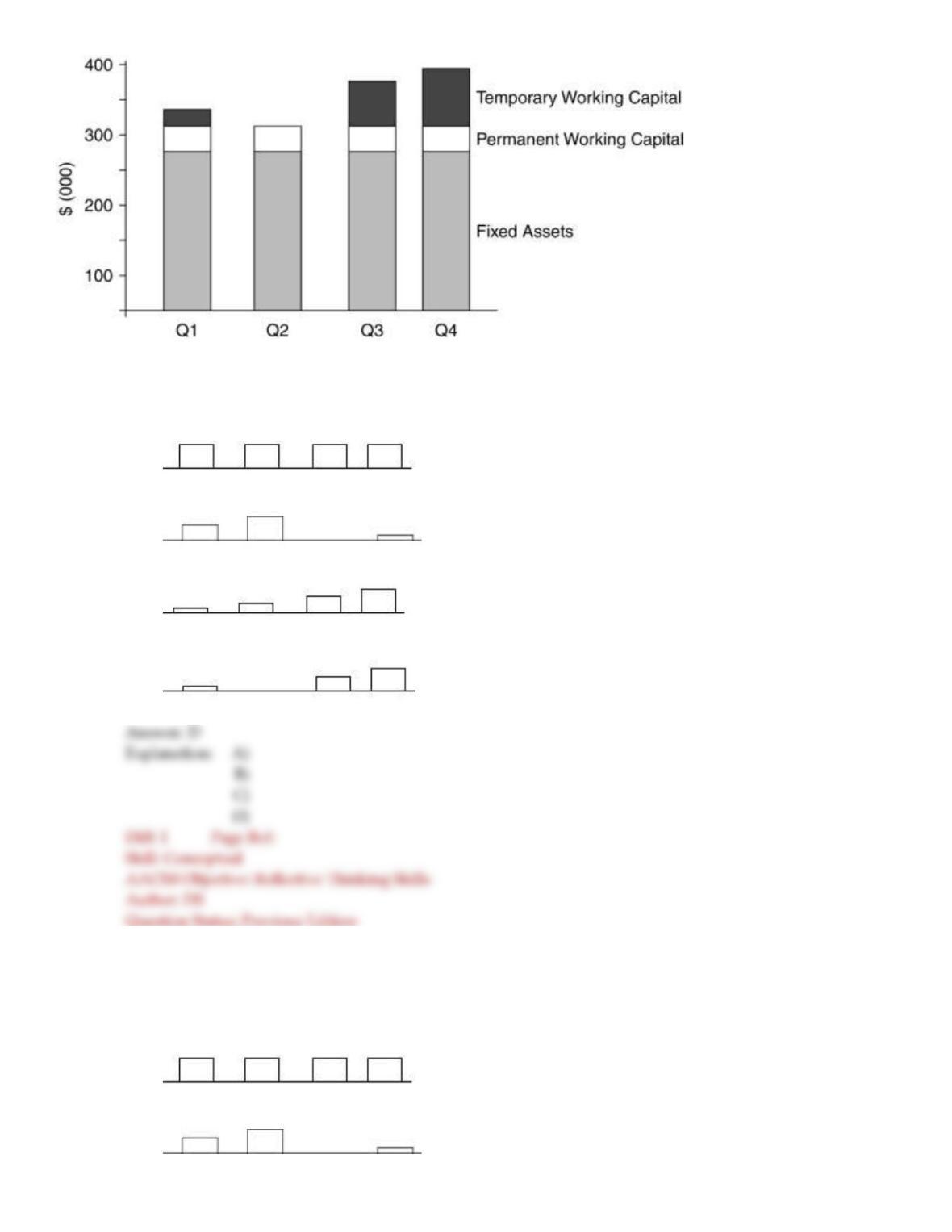
37) The above graph shows the levels of fixed assets, permanent working capital and temporary working capital
for a certain company. If the graphs below show the level of short–term debt that the firm borrows each
quarter, which best illustrates an aggressive financing policy?
A)
B)
C)
D)
38) The above graph shows the levels of fixed assets, permanent working capital and temporary working capital
for a certain company. If the graphs below show the excess cash reserves on hand each quarter, which best
illustrates a conservative financing policy?
A)
B)
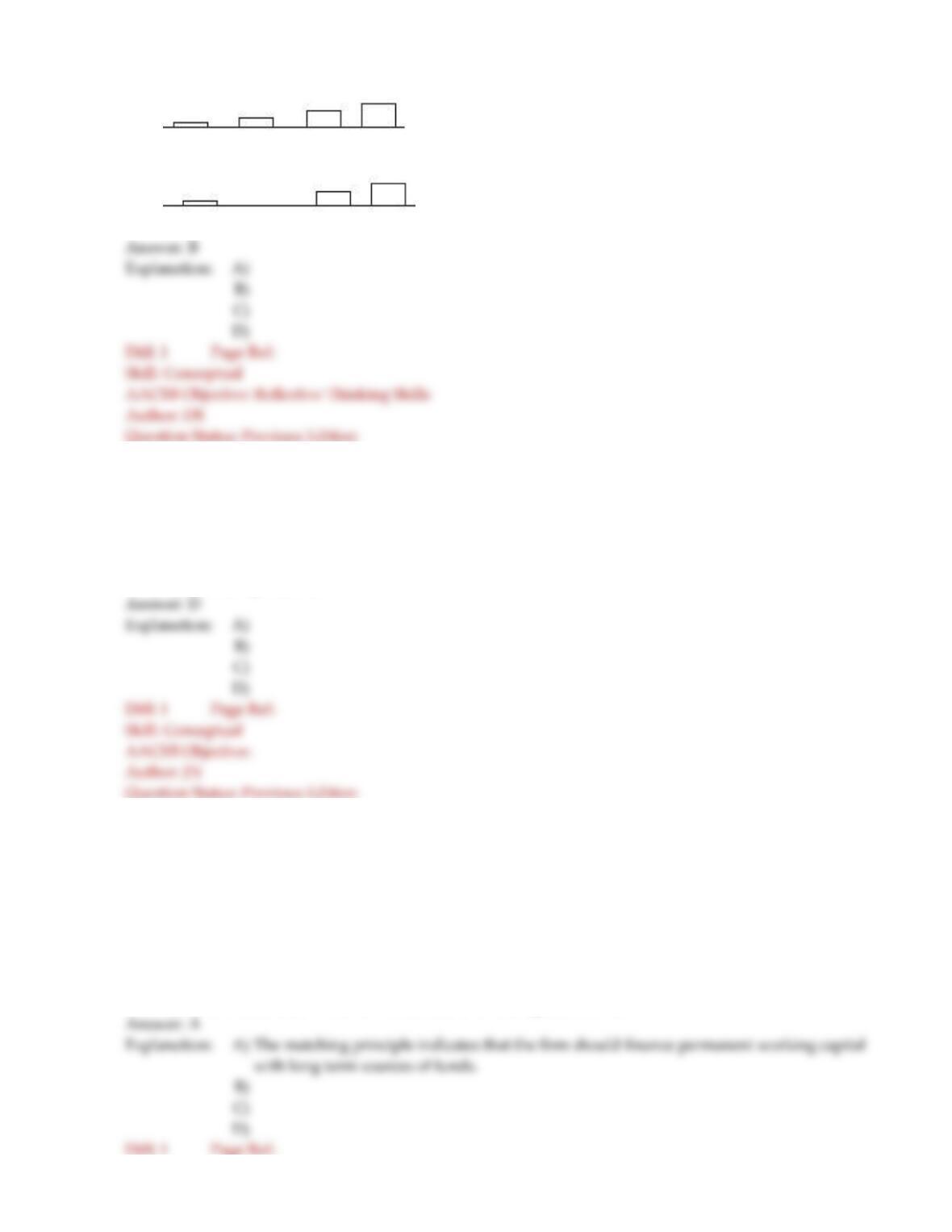
C)
D)
39) Which of the following is not a specific financing option for temporary working capital?
A) secured financing
B) commercial paper
C) bank loans
D) repurchase agreements
40) Which of the following statements is FALSE?
A) The matching principle indicates that the firm should finance permanent working capital with
short–term sources of funds.
B) Following the matching principle should, in the long run, help minimize a firm’s transaction costs.
C) In a perfect capital market, the choice of financing is irrelevant; thus how the firm chooses to finance its
short–term cash needs cannot affect value.
D) A portion of a firm’s investment in its accounts receivable and inventory is temporary and results from
seasonal fluctuations in the firm’s business or unanticipated shocks.
41) Which of the following statements is FALSE?
A) Because investment in permanent working capital is required so long as the firm remains in business, it
constitutes a long–term investment.
B) Because temporary working capital represents a short–term need, the firm should finance this portion
of its investment with short–term financing.
C) Temporary working capital is the difference between the lowest level of investment in short–term assets
and the permanent working capital investment.
D) The matching principle states that short–term needs should be financed with short–term debt and
long–term needs should be financed with long–term sources of funds.
42) Which of the following statements is FALSE?
A) With a discount loan, the borrower is required to pay the interest at the end of the loan period.
B) Bridge loans are often quoted as discount loans with fixed interest rates.
C) A bridge loan is another type of short–term bank loan that is often used to “bridge the gap” until a firm
can arrange for long–term financing.
D) After a natural disaster, lenders may provide businesses with short–term loans to serve as bridges until
they receive insurance payments or long–term disaster relief.
43) Which of the following statements is FALSE?
A) Financing part or all of the permanent working capital with short–term debt is known as an aggressive
financing policy.
B) When the yield curve is downward sloping, the interest rate on short–term debt is lower than the rate
on long–term debt. In that case, short–term debt may appear cheaper than long–term debt.
C) The value of short–term debt is less sensitive to the firm’s credit quality than long–term debt; therefore,
its value will be less affected by management’s actions or information.
D) Permanent working capital is the amount that a firm must keep invested in its short–term assets to
support its continuing operations.
44) Which of the following statements is FALSE?
A) By relying on short–term debt the firm exposes itself to funding risk, which is the risk of incurring
financial distress costs should the firm not be able to refinance its debt in a timely manner or at a
reasonable rate.
B) An ultra–conservative policy would involve financing even some of the plant, property, and equipment
with short–term sources of funds.
C) With a conservative financing policy, the firm would use short–term debt very sparingly to meet its
peak seasonal needs.
D) Short–term debt can have lower agency and lemons costs than long–term debt, and an aggressive
financing policy can benefit shareholders.
45) Which of the following statements is FALSE?
A) When following a conservative financing policy, a firm would use long–term sources of funds to finance
its fixed assets, permanent working capital, and some of its seasonal needs.
B) An aggressive financing policy also increases the possibility that managers of the firm will use this
excess cash nonproductively—for example, on perquisites for themselves.
C) A firm could finance its short–term needs with long–term debt, a practice known as a conservative
financing policy.
D) To implement a conservative financing policy effectively, there will necessarily be periods when excess
cash is available—those periods when the firm requires little or no investment in temporary working
capital.
Use the table for the question(s) below.
The quarterly working capital levels for Hasbeen Toys are presented in the following table (in $ millions):
Quarter
1
2
3
4
Cash
605
625
175
1000
Accounts Receivable
585
745
1260
760
Inventory
410
540
725
375
Accounts Payable
835
910
1055
1145
46) The permanent working capital needs for Hasbeen Toys is closest to:
A) $1,100 million
B) $2,435 million
C) $1,275 million
D) $770 million
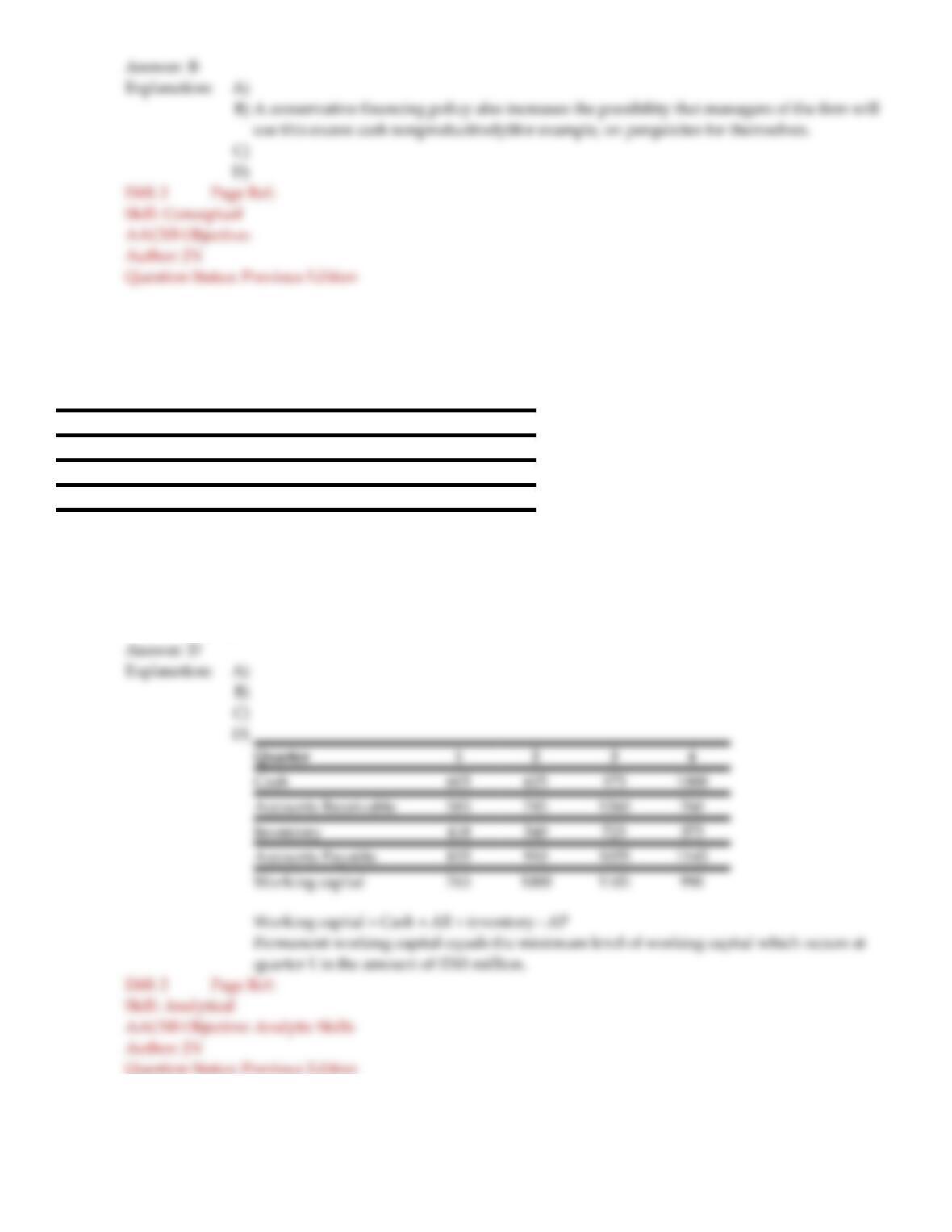
Quarter
1
2
3
4
Cash
605
625
175
1000
Accounts Receivable
585
745
1260
760
Inventory
410
540
725
375
Accounts Payable
835
910
1055
1145
Working capital
765
1000
1105
990
47) The temporary working capital needs for Hasbeen Toys in quarter 1 is closest to:
A) $0 million