Cost Accounting: A Managerial Emphasis, 6e
Chapter 20 – Inventory Cost Management Strategies
23) Corry Corporation manufactures filters for cars, vans, and trucks. A backflush costing system is used
and standard costs for a filter are as follows:
Direct materials
$2.60
Conversion costs
4.20
Total
$6.80
Filters are scheduled for production only after orders are received, and are shipped immediately upon
completion. This results in product costs being charged directly to cost of goods sold. In December, 3,000
filters were produced and shipped. Materials were purchased at a cost of $8,450 and actual conversion
costs of $13,650 were recorded.
Required:
Prepare journal entries to record December’s costs for the production of the filters.
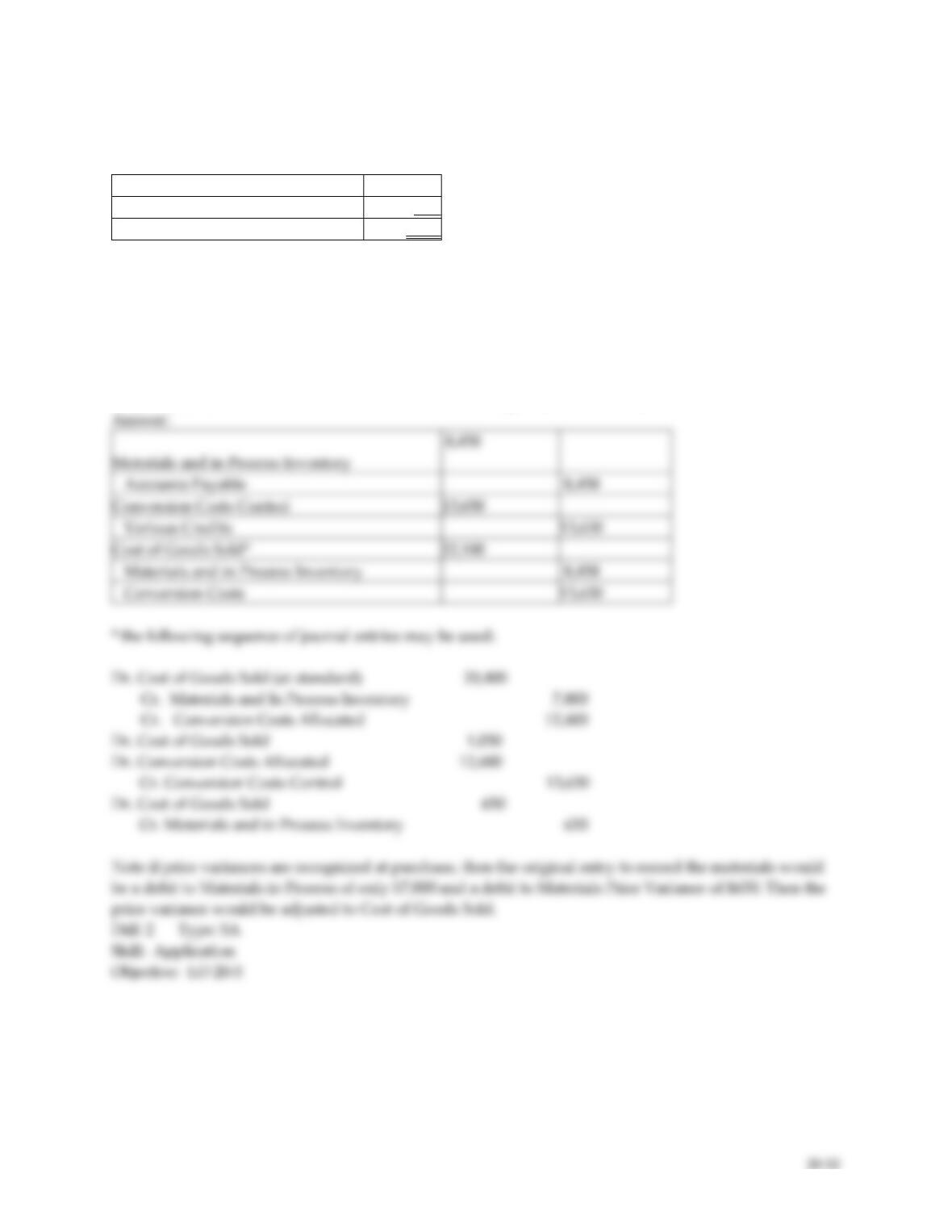
Materials and in Process Inventory
8,450
Conversion Costs Control
13,650
13,650
Cost of Goods Sold*
22,100
Materials and in Process Inventory
8,450
13,650
Cost Accounting: A Managerial Emphasis, 6e
Chapter 20 – Inventory Cost Management Strategies
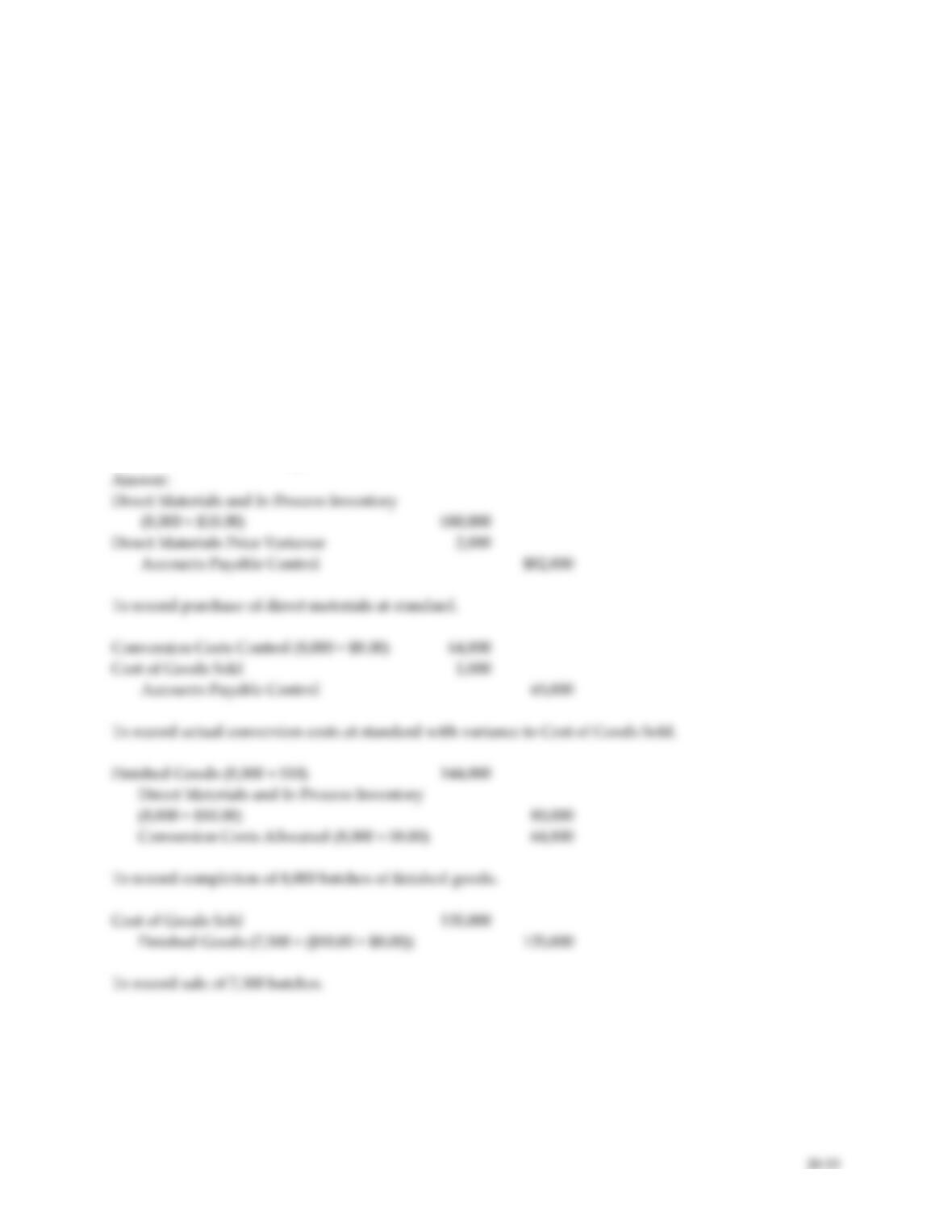
24) Dutch Oven is a bakery company. All processing is in batches of 6 dozen. For March, there were no
beginning inventories. Ending direct materials totalled $1,500. Conversion Costs and Direct Materials are
the only baking cost accounts. Direct Materials are purchased under a just-in-time system. The company
uses backflush costing with three trigger points at purchase of raw materials, completion of finished
goods, and sale of finished goods. Additional information for the month is as follows:
Actual direct materials $82,000
Actual conversion costs $65,000
Standard materials cost per batch $10.00
Standard conversion cost per batch $8.00
Batches produced 8,000
Batches sold 7,500
Required:
Record all journal entries for the monthly activities related to the above transactions if backflush costing
is used. The company uses a standard costing system for recording the purchase and use of direct
materials and the recording of conversion costs.
Cost Accounting: A Managerial Emphasis, 6e
Chapter 20 – Inventory Cost Management Strategies
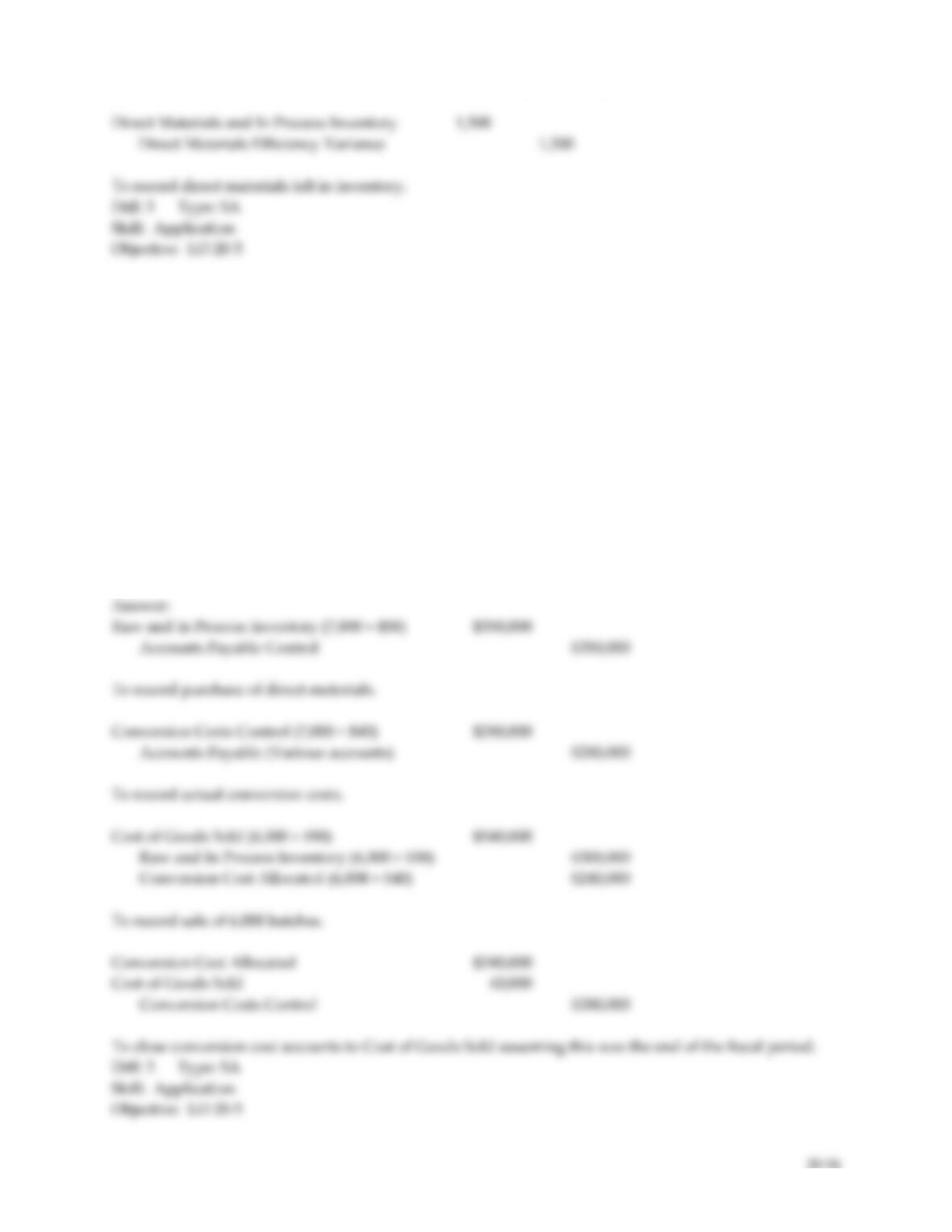
25) Key Smith Company manufactures all types of locks for exterior doors. All processing is in batches of
100 and is initiated when an order is received. For August there were no beginning inventories. Each type
of knob uses the same direct materials although the processing steps are slightly different. Conversion
Costs and Direct Materials are the only manufacturing cost accounts. Direct Materials are purchased
under a just-in-time system. Standard costs and actual costs were the same for the month. Backflush
costing is used with purchase and sale trigger points. Additional information for the month is as follows:
Standard materials cost per batch $50
Standard conversion cost per batch $40
Batches produced 7,000
Batches sold 6,000
Required:
Record all journal entries for the monthly activities related to the above transactions if backflush costing
is used.
Cost Accounting: A Managerial Emphasis, 6e
Chapter 20 – Inventory Cost Management Strategies
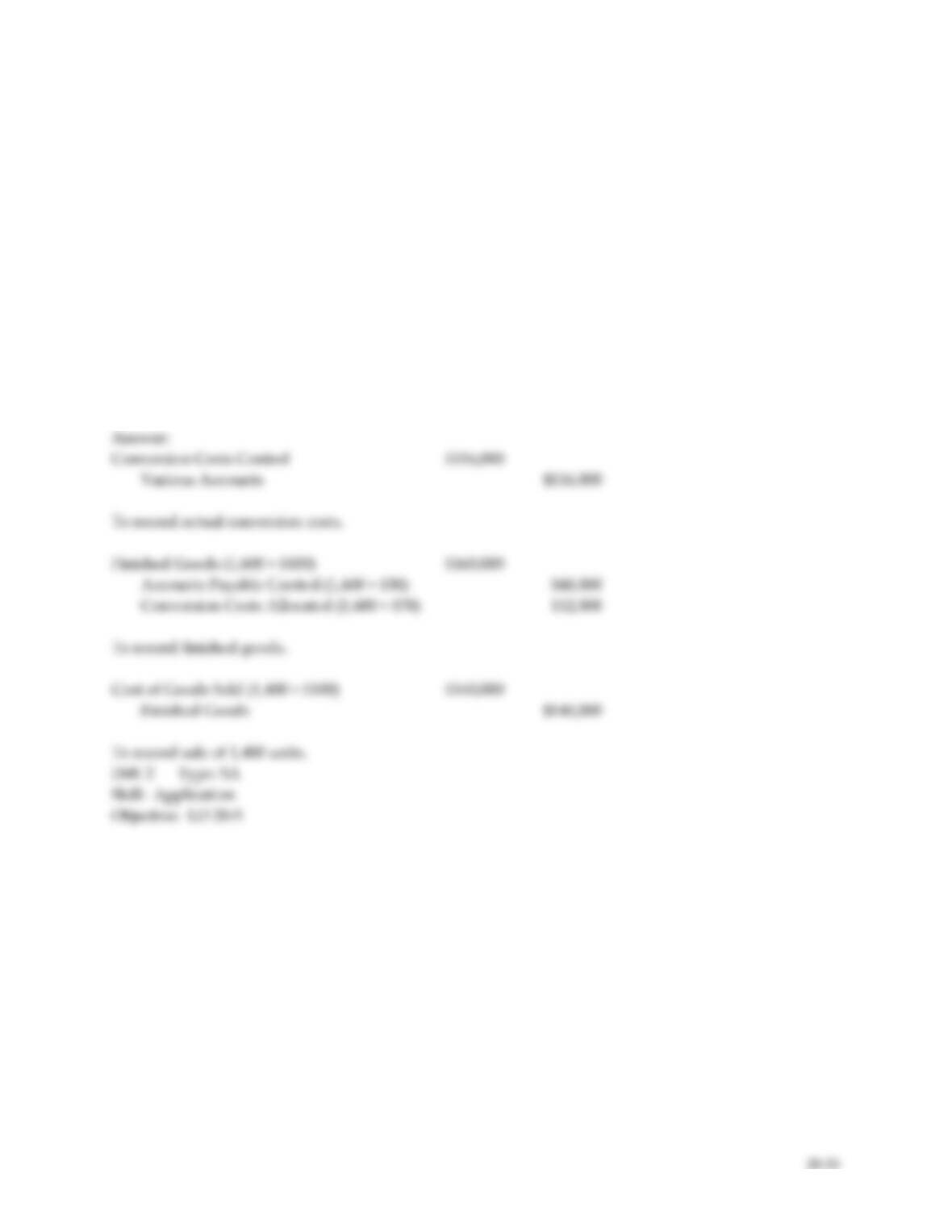
26) Cyclone Electronics manufactures automobile radios. All processing is initiated when an order is
received. For March there were no beginning inventories. Conversion Costs and Direct Materials are the
only manufacturing cost accounts. Direct Materials are purchased under a just–in-time system. Backflush
costing is used with a finished goods trigger point (i.e., one trigger point). Additional information for the
month is as follows:
Actual conversion costs $116,000
Standard materials cost per unit $30
Standard conversion cost per unit $70
Units produced 1,600
Units sold 1,400
Required:
Record all journal entries for the monthly activities related to the above transactions if backflush costing
is used.
Cost Accounting: A Managerial Emphasis, 6e
Chapter 20 – Inventory Cost Management Strategies
27) Corry Corporation manufactures filters for cars, vans, and trucks. A backflush costing system is used.
Filters are scheduled for production only after orders are received and are shipped immediately upon
completion. This results in product costs being charged directly to cost of goods sold. In December, 3,000
filters were produced and shipped. Materials were purchased at a cost of $8,450, and actual conversion
costs of $13,650 were recorded.
Required:
Prepare journal entries to record December’s costs for the production of the filters, assuming there was no
over/under allocated conversion cost.
Cost Accounting: A Managerial Emphasis, 6e
Chapter 20 – Inventory Cost Management Strategies
28) Dolls “R” Us manufactures children‘s plastic dolls. For January there were no beginning inventories of
direct materials, and no beginning or ending work in process. Conversion Costs and Direct Materials are
the only manufacturing cost accounts. Journal entries are recorded when materials are purchased and
when conversion costs are allocated at the end of the manufacturing process using backflush costing.
Since February is the first month of the fiscal year, all actual costs are as budgeted. Additional
information for the month is as follows:
February
Standard materials cost per unit $6.00
Standard conversion cost per unit $4.00
Units produced 200,000
Units sold 190,000
There were no variances during the month.
Required:
a. Record the journal entry for the purchase of direct materials.
b. Record the journal entry for actual conversion costs.
c. Record the journal entry for finished goods for the month.
d. Record the journal entry for the costs of goods sold for the month.
Cost Accounting: A Managerial Emphasis, 6e
Chapter 20 – Inventory Cost Management Strategies
29) Falcon Industries manufactures customized industrial compounds. All processing is initiated when an
order is received. For April there were no beginning inventories. Conversion Costs and Direct Materials
are the only manufacturing cost accounts. Direct Materials are purchased under a just–in-time system.
Backflush costing is used with a finished goods trigger point. Additional information is as follows:
Actual conversion costs
$478,000
Standard materials costs per unit
$30
Standard conversion cost per unit
$78
Units produced
6,200
Units sold
5,800
Required:
Record all journal entries for the monthly activities related to the above transactions if backflush costing
is used. There were no materials variances during the period. Determine the amount of under or
overallocated conversion costs.
Conversion Costs Control
478,000
478,000
Finished Goods (6,200 × $108)
669,600
186,000
483,600
Cost of Finished Goods Sold (5,800 × 108)
626,400

Cost Accounting: A Managerial Emphasis, 6e
Chapter 20 – Inventory Cost Management Strategies
30) Backflush costing does not strictly adhere to generally accepted accounting principles. Explain why.
Also, describe the types of businesses that might use backflush costing.
Cost Accounting: A Managerial Emphasis, 6e
Chapter 20 – Inventory Cost Management Strategies
31) Arrow Manufacturing Ltd. distributes golf clubs. Its annual demand for next year is forecasted at
14,000 sets at an average cost of $425 per set. In reviewing its historical ordering costs for the past 3 years
it noted that costs were $12,900, $16,400 and $20,100 at order volumes of 20, 50 and 80 respectively.
Arrow is forecasting an increase of 10% in its fixed ordering costs and a 15% increase in its variable
ordering costs. The fixed ordering costs relate to allocations of supervisory time, computer time, and
warehouse space. In addition to the order processing, the company must receive and inspect the units.
Receiving and inspecting activities require 5 hours per order at a direct labour rate of $12 per hour.
Variable overhead related to receiving and inspecting activities is applied at a rate of 40% of direct labour
dollars.
In reviewing its other activities, Arrow came up with the following estimates for next year:
Annual storage costs $12.50 per set
Estimated annual damage/loss $0.80 per set
Annual inventory insurance costs $1.50 per set
Annual building insurance costs $1.20 per set (allocated based on square metres)
Opportunity cost 12%
The company is closed for two weeks in the summer and again for 2 weeks over Christmas. This results
in 48 work weeks in the year and the company operates 5 days per week.
Required:
a. Determine the Economic Order Quantity (EOQ) for Arrow for next year. What are the total annual
inventory costs at the EOQ?
b. Determine the reorder point in units assuming that the lead time is 7 days.
c. Now assume the company has found a new supplier that is willing to supply on a just in time basis.
Inspection and receiving time would be lowered to 1.5 hours per order and the annual estimated damage
would be cut by 75%. Storage and inventory insurance would drop to $4.50 and $0.60 respectively. The
variable ordering cost would drop to $65 due to integrated ordering systems. However, the annual cost to
purchase the golf sets will increase to $428. Determine the new EOQ. Should the company go with the
new supplier or maintain its current arrangements?
Cost Accounting: A Managerial Emphasis, 6e
Chapter 20 – Inventory Cost Management Strategies
20–61