Cost Accounting: A Managerial Emphasis, 6e
Chapter 20 – Inventory Cost Management Strategies
4) Backflush costing uses normal or standard costs.
5) A trigger point refers to the inventory level at which a reorder is generated.
6) A firm using a backflush costing system will always use actual costs rather than standard costs.
7) The “flush” in backflush refers to the fact that there are no variances in a backflush costing system
using standard costs.
8) Companies that have fast manufacturing lead times usually find that a version of backflush costing
will report cost numbers similar to what a sequential costing approach would report.
9) A positive aspect of backflush costing is the presence of the visible audit trail.
Cost Accounting: A Managerial Emphasis, 6e
Chapter 20 – Inventory Cost Management Strategies
10) Traditional budgeted and standard costing systems use
A) backflush costing.
B) delayed costing.
C) post-deduct costing.
D) synchronous tracking.
E) variable costing.
Use the information below to answer the following question(s).
Fun ‘N’ Games manufactures various board games. For January there were no beginning inventories of
direct materials, and no beginning or ending work in process. Only one indirect manufacturing cost
category is currently in use, “Conversion Costs.” Journal entries are recorded when materials are
purchased and when conversion costs are allocated under backflush costing.
Actual Conversion costs – January
$400,000
Direct materials purchased – January
$1,070,000
Units produced – January
58,800
Units sold – January
41,800
11) Which of the following journal entries properly records the purchase of direct materials?
A)
Accounts Payable Control
$1,070,000
Inventory: Raw and in Process Control
$1,070,000
B)
Inventory: Raw and in Process Control
$1,070,000
Accounts Payable Control
$1,070,000
C)
Inventory: Raw and in Process Control
$1,070,000
Conversion Costs
$1,070,000
D)
Conversion Costs
$1,070,000
Inventory: Raw and in Process Control
$1,070,000
E)
Accounts Payable Control
$1,070,000
Finished Goods Inventory
$1,070,000
Cost Accounting: A Managerial Emphasis, 6e
Chapter 20 – Inventory Cost Management Strategies
12) Which of the journal entries properly records the incurrence of conversion costs?
A)
Conversion Costs
$400,000
Various accounts
$400,000
B)
Various accounts
$400,000
Conversion Costs
$400,000
C)
Conversion Costs
$400,000
Inventory: Direct Materials
$400,000
D)
Inventory: Direct Materials
$400,000
Conversion Costs
$400,000
E)
Cost of Goods Sold
$400,000
Conversion Costs
$400,000
Cost Accounting: A Managerial Emphasis, 6e
Chapter 20 – Inventory Cost Management Strategies
13) Which of the following entries properly records the cost of goods sold for the month?
A)
Finished Goods control
$1,045,000
Work in Process
$1,045,000
B)
Cost of Goods Sold
$1,045,000
Finished Goods control
$1,045,000
C)
Finished Goods control
$1,045,000
Cost of Goods Sold
$1,045,000
D)
Cost of Goods Sold
$1,045,000
Work in Process
$1,045,000
E)
Cost of Goods Sold
$1,045,000
Conversion costs control
$1,045,000
Cost Accounting: A Managerial Emphasis, 6e
Chapter 20 – Inventory Cost Management Strategies
14) Acme, Inc., manufactures air compressors. For July there were no beginning inventories of direct
materials, and no beginning or ending work in process. Only one indirect manufacturing cost category is
currently in use, “conversion costs.” Journal entries are recorded when materials are purchased and when
units are transferred to finished goods. Conversion costs are allocated under backflush costing.
Conversion costs – July
$350,000
Direct materials purchased – July
$650,000
Units produced – July
100,000
Units sold – July
90,500
Direct materials – price variance
$100,000 Favourable
Direct materials are budgeted at 5 units per compressor; however, actual results reflect that 6 units were
required per compressor. Under allocated or Over allocated Conversion Costs are written off against Cost
of Goods Sold on a monthly basis. The difference between actual conversion costs incurred and standard
conversion costs allocated is $50,000.
Which of the following journal entries properly reflects Acme’s write– off of conversion costs?
A)
Conversion Costs Allocated
$350,000
Conversion Costs control
$350,000
B)
Conversion Costs control
$350,000
Conversion Costs Allocated
$300,000
Cost of Goods Sold
50,000
C)
Conversion Costs control
$350,000
Conversion Costs Allocated
$350,000
D)
Conversion Costs Allocated
$300,000
Cost of Goods Sold
$50,000
Conversion Costs control
$350,000
E)
Cost of Goods Sold
$350,000
Conversion costs control
$350,000
Cost Accounting: A Managerial Emphasis, 6e
Chapter 20 – Inventory Cost Management Strategies
15) Complete Microfilm Products manufactures microfilm cameras. For October there were no beginning
inventories of direct materials, and no beginning or ending work in process. Only one indirect
manufacturing cost category is currently in use, “Conversion Costs.” Journal entries are recorded when
materials are purchased and when units are sold.
Conversion costs – October
$90,400
Direct materials purchased – October
$250,400
Units produced – October
80,000 units
Units sold – October
75,000 units
Selling price
$10.00 each
Which of the following journal entries would be recorded when units are sold for the month?
A)
Cost of Goods Sold
$319,500
Inventory control
$319,500
B)
Cost of Goods Sold
$319,500
Inventory control
$234,750
Conversion Costs Allocated
84,750
C)
Inventory control
$234,750
Conversion Costs Allocated
84,750
Cost of Goods Sold
$319,500
D)
Cost of Goods Sold
$319,500
Inventory control
$229,500
Conversion Costs Allocated
90,000
E)
Cost of Goods Sold
$319,500
Conversion Costs Allocated
$319,500
Cost Accounting: A Managerial Emphasis, 6e
Chapter 20 – Inventory Cost Management Strategies
16) Complete Microfilm Products manufactures microfilm cameras. For October there were no beginning
inventories of direct materials, and no beginning or ending work in process. Only one indirect
manufacturing cost category is currently in use, “Conversion Costs.”
Conversion costs – October
$90,400
Direct materials purchased – October
$250,400
Units produced – October
80,000 units
Units sold – October
75,000 units
Selling price
$10.00 each
Which of the following entries would occur if the only trigger point is the production of finished units?
A)
Cost of Goods Sold
$319,500
Inventory: Raw and In-Process Control
$229,500
Conversion Costs Allocated
90,000
B)
Inventory: Raw and In-Process Control
$319,500
Cost of Goods Sold
$319,500
C)
Finished Goods control
$340,800
Accounts Payable Control
$250,400
Conversion Costs Allocated
90,400
D)
Accounts Payable Control
$250,400
Conversion Costs Allocated
90,400
Finished Goods control
$340,800
E)
Accounts Payable Control
$90,400
Cost of Goods Sold
$90,400

Cost Accounting: A Managerial Emphasis, 6e
Chapter 20 – Inventory Cost Management Strategies
17) A backflush costing system that journalizes only when raw materials are purchased and when
finished goods are sold, will have which of the following results?
A) it will encourage managers to produce safety stock
B) conversion costs become period costs
C) income is increased if managers produce more output than is sold
D) increased inventoriable costs
E) produce more safety stock, and conversion costs become period costs
18) Criticism of backflush accounting included all of the following EXCEPT
A) WIP exists but is not recorded.
B) GAAP is not followed for external reporting purposes.
C) there is an absence of audit trails.
D) the accounting system cannot pinpoint the uses of resources.
E) managers can keep track of operations by personal observation.
19) A trigger point is defined as
A) a stage in the cycle going from the purchase of direct materials to the sale of finished goods at which
point journal entries are made in the accounting system.
B) a stage in the cycle going from the purchase of accounting software to the sale of finished goods at
which point journal entries are made in the new accounting system.
C) a stage in the cycle going from the sale of finished goods at which point journal entries are made in the
accounting system.
D) a stage in the cycle going from the purchase of direct materials at which journal entries are made in the
accounting system.
E) a stage in the cycle going from the purchase of direct materials to the sale of finished goods at which
no journal entries are made in the accounting system.
Cost Accounting: A Managerial Emphasis, 6e
Chapter 20 – Inventory Cost Management Strategies
Answer the following question(s) using the information below.
Walton Industries uses backflush costing. For March, there were no beginning inventories of direct
materials and no beginning or ending work in process. Conversion costs is the only indirect
manufacturing cost category currently used. Journal entries are recorded when materials are purchased
and when conversion costs are allocated under backflush costing.
Conversion costs — March
$800,000
Direct materials purchased — March
$2,140,000
Units produced — March
117,600
Units sold — March
83,600
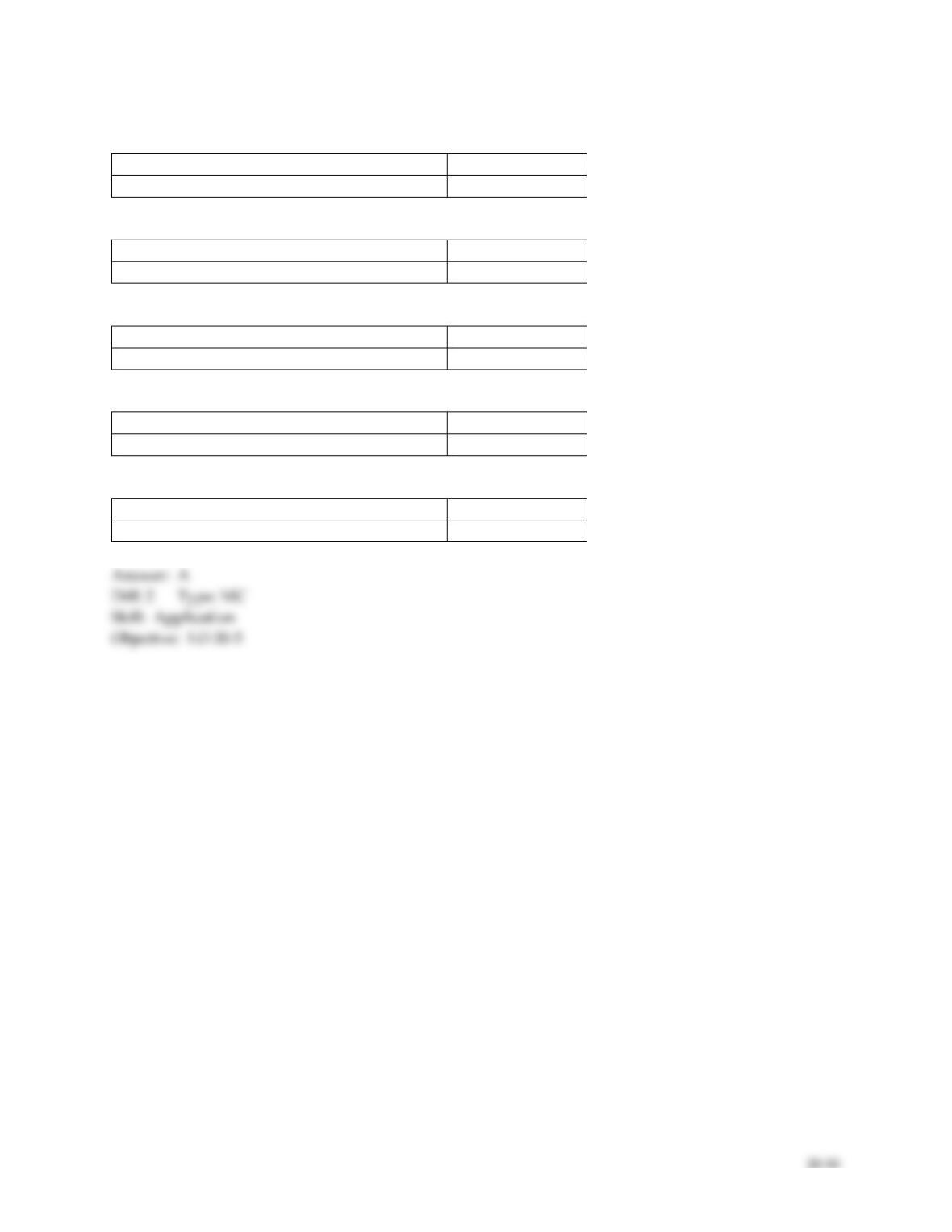
20) Which of the following journal entries properly records the purchase of direct materials?
A)
Accounts Payable Control
2,140,000
Inventory: Raw and In-Process Control
2,140,000
B)
Inventory: Raw and In-Process Control
2,140,000
Accounts Payable Control
2,140,000
C)
Inventory: Raw and In-Process Control
2,140,000
Conversion Costs Allocated
2,140,000
D)
Conversion Costs Control
2,140,000
Inventory: Raw and In-Process Control
2,140,000
E)
Conversion Costs Allocated
2,140,000
Inventory: Raw and In-Process Control
2,140,000
Cost Accounting: A Managerial Emphasis, 6e
Chapter 20 – Inventory Cost Management Strategies
21) Which of the journal entries properly records conversion costs?
A)
Conversion Costs Control
800,000
Various Accounts
800,000
B)
Various Accounts
800,000
Conversion Costs
800,000
C)
Conversion Costs Allocated
800,000
Inventory: Raw and In-Process Control
800,000
D)
Inventory: Direct Materials
800,000
Conversion Costs
800,000
E)
Conversion Costs Control
800,000
Inventory: Raw and In-Process Control
800,000
Cost Accounting: A Managerial Emphasis, 6e
Chapter 20 – Inventory Cost Management Strategies
22) Tornado Electronics manufactures CD players. All processing is initiated when an order is received.
For April there were no beginning inventories. Conversion Costs and Direct Materials are the only
manufacturing cost accounts. Direct Materials are purchased under a just–in-time system. Backflush
costing is used with a finished goods trigger point. Additional information is as follows:
Actual conversion costs
$232,000
Standard materials costs per unit
60
Standard conversion cost per unit
140
Units produced
3,200
Units sold
2,800
Required:
Record all journal entries for the monthly activities related to the above transactions if backflush costing
is used.
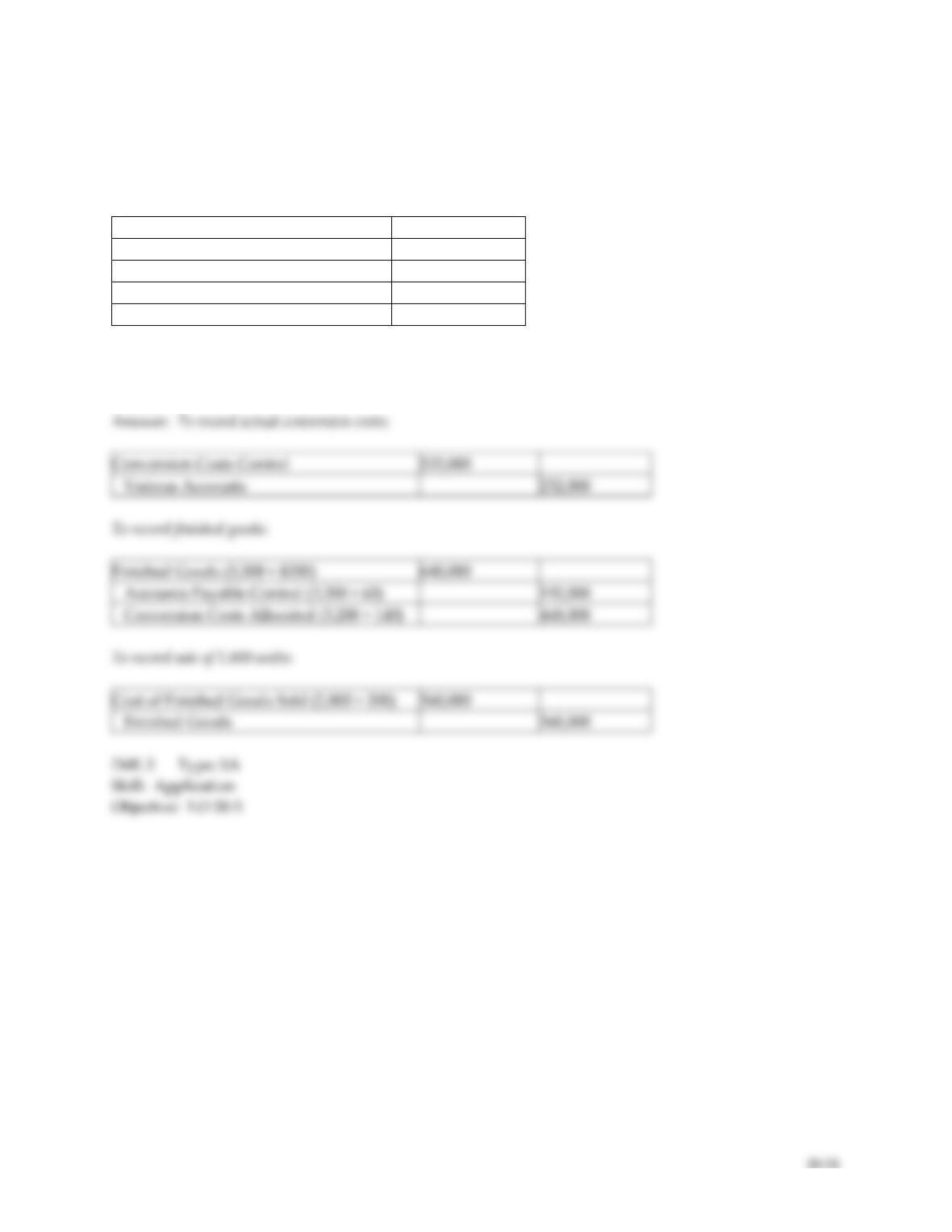
Conversion Costs Control
232,000
232,000
Finished Goods (3,200 × $200)
640,000
192,000
448,000
Cost of Finished Goods Sold (2,800 × 200)
560,000
560,000