408)
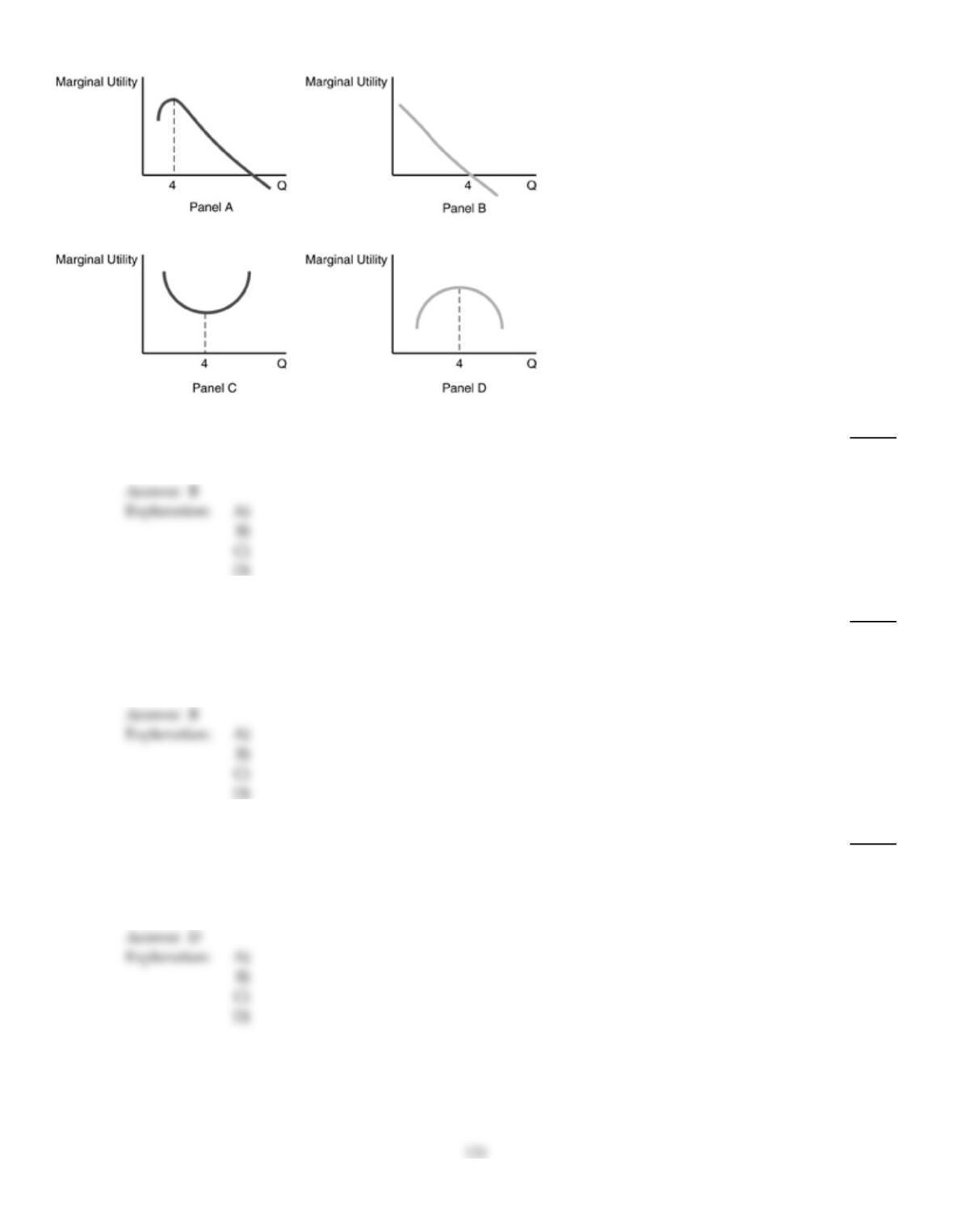
Refer to the above figures. Amy’s total utility for chocolate chip cookies reaches a maximum at 4
cookies. Which panel best represents marginal utility?
408)
A)
Panel A
B)
Panel B
C)
Panel C
D)
Panel D
409)
Why are diamonds more expensive than water?
409)
A)
because water is a necessity
B)
because the last diamond has higher marginal utility than the last glass of water
C)
because the last glass of water has higher marginal utility than the last diamond
D)
because you get more total utility from diamonds
410)
Typically, an individual takes only one newspaper from the bin because
410)
A)
total utility will rise with consumption of more than one newspaper.
B)
marginal utility increases with the first consumption of newspapers.
C)
there are limited amounts of newspapers in the bin.
D)
of the low marginal utility of additional newspapers.
411)
At the point at which total utility is at a maximum
411)
A)
marginal utility is at a minimum.
B)
marginal utility is negative.
C)
marginal utility is equal to total utility.
D)
marginal utility is zero.
412)
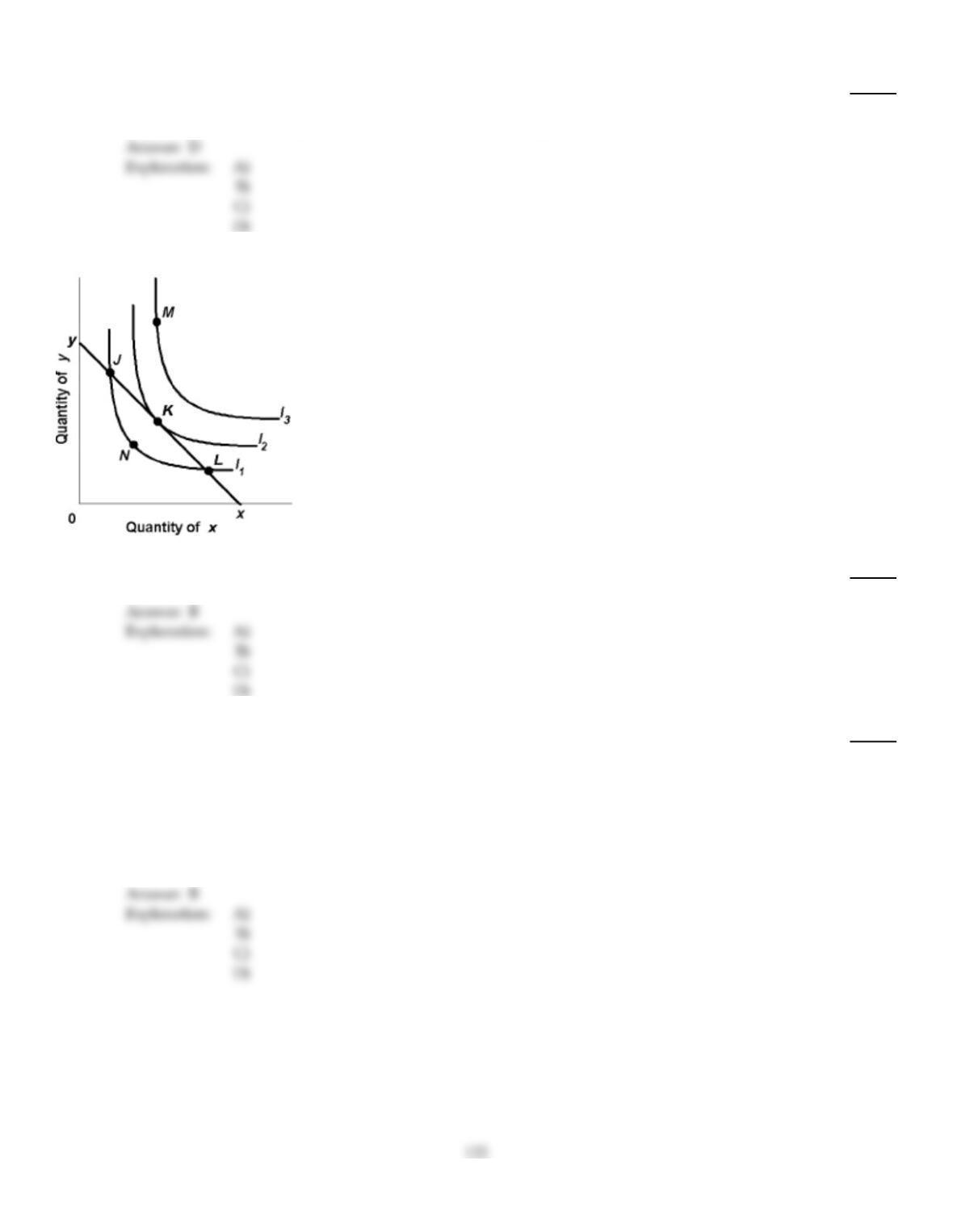
Use the above figure. The optimal position for the consumer is at
412)
A)
N.
B)
K.
C)
J or L.
D)
M.
413)
On a hot summer day, a construction worker enters a McDonald’s fast–food restaurant. He orders
the first Big Mac. He consumes it within 3 minutes. He then orders a second Big Mac and consumes
it in 10 minutes. He eats only half of the third one in 18 minutes and throws away the rest. The store
manager offers him the fourth for free. The construction worker says: “No thanks.” Why?
413)
A)
The law of diminishing marginal utility does not apply to consumption of Big Macs.
B)
Marginal utility declined as he consumed additional Big Macs.
C)
For the construction worker, total utility increased at an increasing rate.
D)
Marginal utility increased at an increasing rate.
414)
The diamond–water paradox is an example that shows that
414)
A)
there are exceptions to the law of diminishing marginal utility.
B)
necessities like water should have a higher price.
C)
marginal utility rather than total utility determines what people are willing to pay for a good.
D)
marginal utility can initially increase and then decrease.
Quantity Total Utility
0 0
115
235
355
475
585
690
415)
Refer to the above table. At what quantity does diminishing marginal utility set in?
415)
A)
After 4
B)
1st
C)
After 5
D)
After 6
A
Explanation:
416)
When Bonnie increases the consumption of Good A and decrease the consumption of Good B, her
marginal utility of
416)
A)
A increases and the marginal utility of B will fall.
B)
both A and B will increase.
C)
A falls and the marginal utility of B will increase.
D)
both A and B will decrease.
C
Explanation:
417)
If the price of a good is zero, a rational consumer will
417)
A)
consume the good up to the point where total utility is just below zero.
B)
buy all of the units available.
C)
stop consuming the good when total utility is maximized.
D)
not consume the good at all since it must not be valuable if it has a zero price.
C
Explanation:
C
Explanation:
Quantity of Total Quantity of Total
Magazines/Wk Utility Paperbacks/Wk Utility
0 0 0 0
160 1200
2100 2400
3130 3500
4 140 4550
5142 5575
6142 6 580
418)
Refer to the above table. If the price of a magazine is $2 and the price of a paperback book is $5 and
the consumer has $19, the rational consumer will purchase
418)
A)
6 magazines and 6 books.
B)
2 magazines and 3 books.
C)
5 magazines and 6 books.
D)
2 magazines and 2 books.
419)
The real–income effect is typically small because
419)
A)
real–incomes are always rising.
B)
price changes tend to balance out over time.
C)
income has no relation to consumption.
D)
the change in price of one particular item has little effect on total purchasing power.
Quantity of Movies Michelle’s Total Robert’s Total
Watched per Week Utility per Week Utility per Week
0 0 0
1100 100
2195 190
3270 270
4340 340
5390 400
6420 350
7435 390
8445 420
9450 440
10 440 450
420)
Refer to the above table. The marginal utility of the 6th movie for Michelle is
420)
A)
25 units of utility.
B)
35 units of utility.
C)
30 units of utility.
D)
40 units of utility.
421)
The principle of diminishing marginal utility suggests that
421)
A)
the consumer will never tire of additional units of a good.
B)
the rate at which utility increases diminishes as more of a good is consumed.
C)
total utility falls with additional consumption.
D)
total utility is usually negative.
422)
Observations of violations of consumer optimum predicted by consumer choice theory could
provide support for
I. utility analysis
II. bounded rationality
III. behavioral economics
422)
A)
I only.
B)
III only.
C)
both I and II.
D)
both II and III.
423)
The law of diminishing marginal utility implies that the marginal utility for a particular product
423)
A)
decreases as more of the product is consumed.
B)
remains constant as long as the product is still considered useful.
C)
remains constant, regardless of how much of the product is consumed.
D)
increases as more of the product is consumed.
424)
Marginal utility can be thought of as
424)
A)
the additional cost of that next good purchased.
B)
the opportunity cost of buying the next good.
C)
the incremental change in a person’s total satisfaction level from the buying of a good.
D)
the total change in satisfaction from buying a good.
425)
Peter consumes bags of potato chips and cans of soft drink. The marginal utility of bags of potato
chips is 10 utils per bag and the marginal utility of cans of soft drink is 50 utils per can. Potato chips
cost $0.50 a bag, and a can of soft drink costs $1.00. What should Peter do?
425)
A)
Peter should buy more soft drink, because it costs less.
B)
Peter should eat more chips, because they cost less.
C)
Peter should buy more chips and less soft drink.
D)
Peter should buy more soft drink and fewer potato chips.
426)
Along an indifference curve,
426)
A)
the prices of all goods are equal.
B)
the marginal utility/price ratios of all items are equal.
C)
the total satisfaction is the same.
D)
the marginal utility of all items is equal.
427)
The set of goods and services that maximizes the level of satisfaction for each consumer subject to
limited income is
427)
A)
the consumer optimum.
B)
substitution effect.
C)
diminishing marginal utility.
D)
increasing marginal utility.
428)
If the price of a product increases, then
428)
A)
the budget line shifts inward and the optimal quantity demanded, which corresponds to the
higher price, increases.
B)
the budget line shifts outward and the optimal quantity demanded, which corresponds to the
higher price, decreases.
C)
the budget line rotates and the optimal quantity demanded, which corresponds to the higher
price, increases.
D)
the budget line rotates and the optimal quantity demanded, which corresponds to the higher
price, decreases.
D
429)
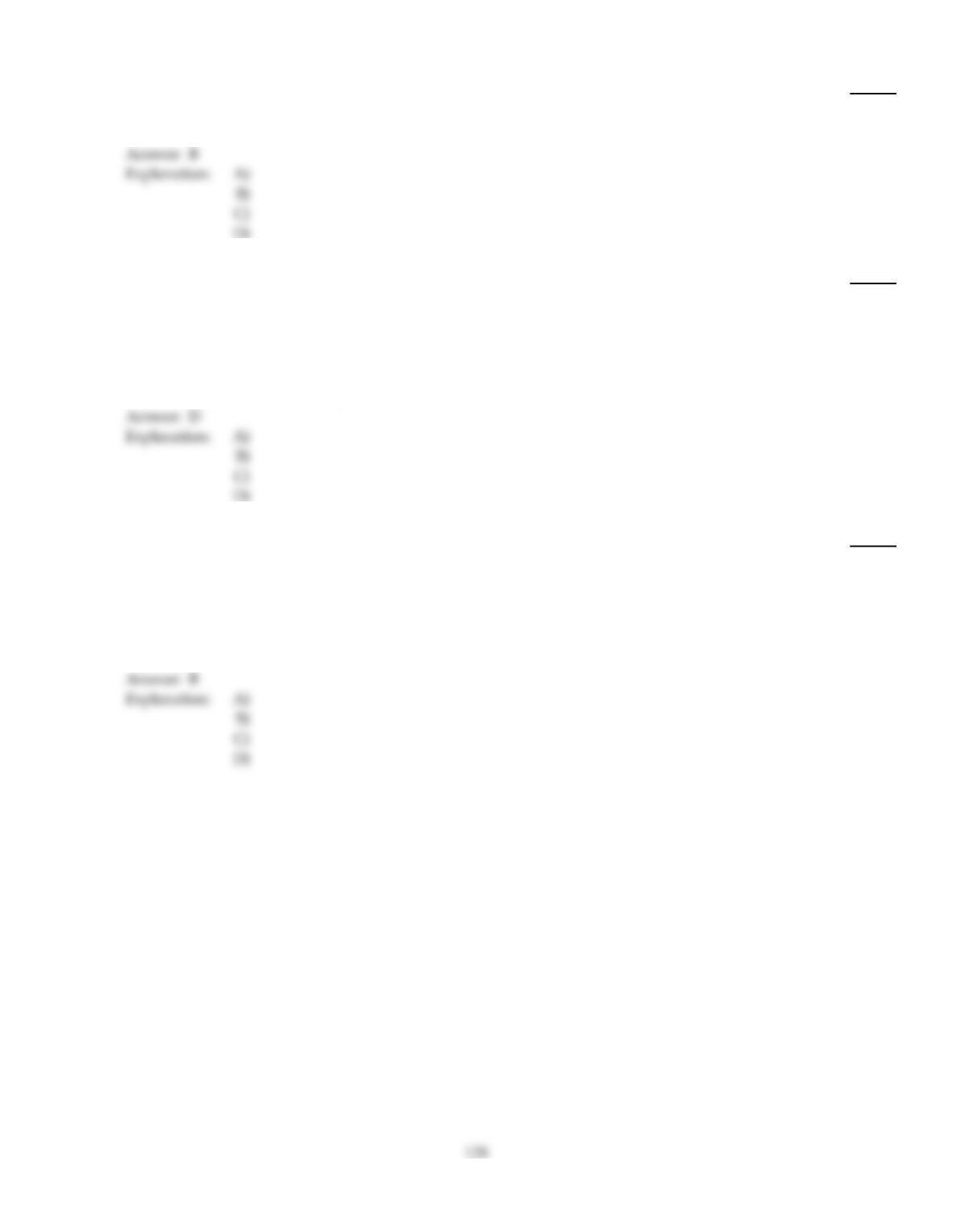
Refer to the above figure. Given the indifference map and budget constraint represented above,
what are all possible points at which that the individual can consume?
429)
A)
points A and C only
B)
point B only
C)
point D only
D)
points A, B and C only
D
A
430)
Initially, a consumer is at an optimum. Then the price of X increases. Consequently,
430)
A)
MUX> MUY.
B)
MUX/PX< MUY/PY.
C)
MUX/PX> MUY/PY.
D)
MUX/PX= MUY/PY.
431)
The substitution effect argues that a consumer
431)
A)
will not purchase more of a good when its price falls.
B)
will always use the additional purchasing power from a price decrease to purchase more of
both goods.
C)
will purchase less of both goods if his or her real income increases.
D)
will purchase more of a good that has become relatively cheaper, and less of a good that has
become relatively more expensive.
432)
Suppose that the quantity of hamburgers is measured along the vertical axis and that the quantity
of popcorn is measured along the horizontal axis. The vertical intercept is 10 hamburgers, and the
slope of the budget line is –2. If the price of popcorn falls from $1 to $0.50, then we know that
432)
A)
the vertical intercept shifts to 5 hamburgers.
B)
the horizontal intercept shifts to 10 bags of popcorn.
C)
the horizontal intercept shifts to 20 bags of popcorn.
D)
the vertical intercept shifts to 20 hamburgers.
Quantity Total Utility
Per Week Amy Robert David Michelle
0 0 0 0 0
15.0 100 600 60
2 9.9 190 1200 130
314.7 270 1800 220
419.4 340 2400 310
524.0 400 3000 425
628.5 450 3600 575
732.9 490 4200 900
837.2 520 4800 1275
941.4 510 5400 1770
433)
Refer to the above table. Robert’s utility schedule shows
433)
A)
initially decreasing marginal utility and then increasing marginal utility.
B)
diminishing marginal utility throughout the entire schedule.
C)
increasing marginal utility throughout the entire schedule.
D)
initially increasing marginal utility and then decreasing marginal utility.
ESSAY. Write your answer in the space provided or on a separate sheet of paper.
434)
What is utility analysis? What is the goal of this analysis?
435)
What is marginal utility? Why is the term “marginal” important in utility analysis?
436)
What is the marginal rate of substitution between two goods and how is it related to the indifference curve?
437)
“As an individual consumes more units of a good, her total utility falls because of the law of diminishing
marginal utility.” Do you agree or disagree? Explain.
438)
What is utility and what are its characteristics?
439)
Suppose that Jacob is going to a buffet restaurant that allows him to eat as many chicken wings as he wants at a
fixed price. How would you predict the number of chicken wings that Jacob will eat using utility theory?
440)
Restaurants that allow customers to eat as much as they want for a fixed price must make money or they would
not remain in business. How can they earn profits when people can always eat more so that the restaurant’s
costs keep getting higher? What practice that regular restaurants use will not be used by all–you–can–eat
places?
441)
What is the principle of diminishing marginal utility?
442)
Explain how utility analysis can be used to derive a downward sloping demand curve.
443)
Why is water much cheaper than diamonds even though water is essential to human lives while diamonds are
not?
444)
What are the key properties of indifference curves?
445)
Explain how a consumer maximizes utility.
446)
What do we know about total utility when marginal utility is zero?
447)
Use the law of diminishing marginal utility to explain the diamond–water paradox.
448)
Jill likes lobsters but she does not eat lobsters in every meal. How can utility theory explain this?
449)
Why does a price increase of a product result in a decrease in the quantity demanded of that product, according
to utility analysis?
450)
Discuss the substitution and real–income effects of a price decrease.
451)
Suppose that an individual consumes only two goods. What will happen to the individual if her last dollar
spent on one good yields more marginal utility than that from another good?
452)
What is consumer optimum according to utility theory?
453)
Why does total utility rise at a decreasing rate as an individual’s consumption of an item increases?
454)
Suppose a consumer is at an optimum, consuming 6 hamburgers a week at a price of $1.50 each and 10 donuts a
week at 50 cents a donut. If the price of a hamburger increases to $2.00, what will the consumer do to arrive at a
new equilibrium? Why?
455)
Suppose a family purchases 10,000 gallons of water a year at 20 cents a gallon and one diamond ring at a price
of $1000. Can we conclude that the diamond ring provides more utility to the family than water? Explain.
456)
How does an increase in the price of an individual good or service affect a consumer optimum, and how does
this help explain the law of demand?
457)
Why can’t an indifference curve be a straight line?
458)
What is the relationship between marginal utility and total utility? What happens to total utility as marginal
utility declines?