275)
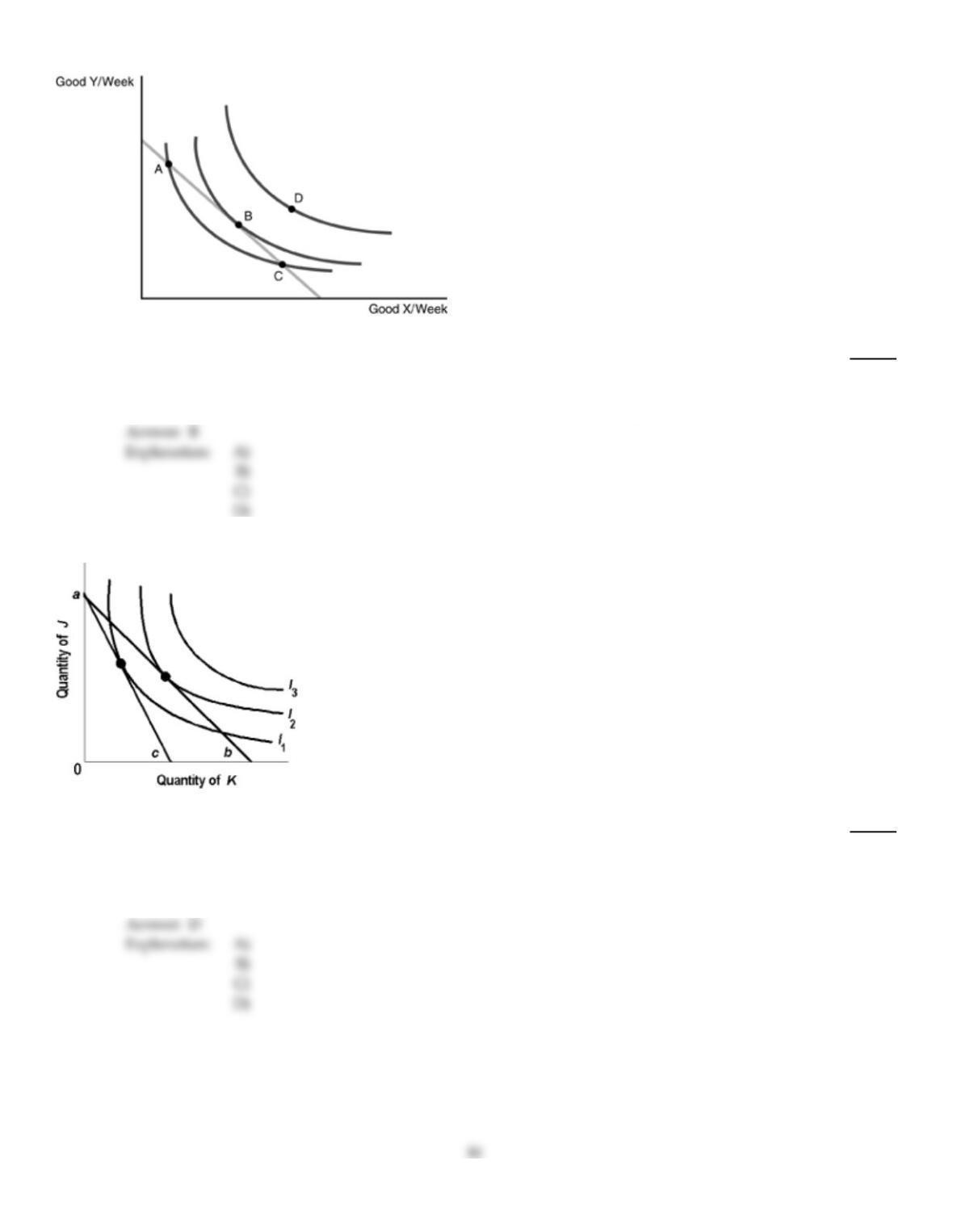
Refer to the above figure. Given the indifference map and budget constraint represented above,
what would make all possible points attainable for the individual to consume?
275)
A)
a decrease in income
B)
a decrease in the price of Good X
C)
an increase in the price of Good X
D)
an increase in the price of Good Y
276)
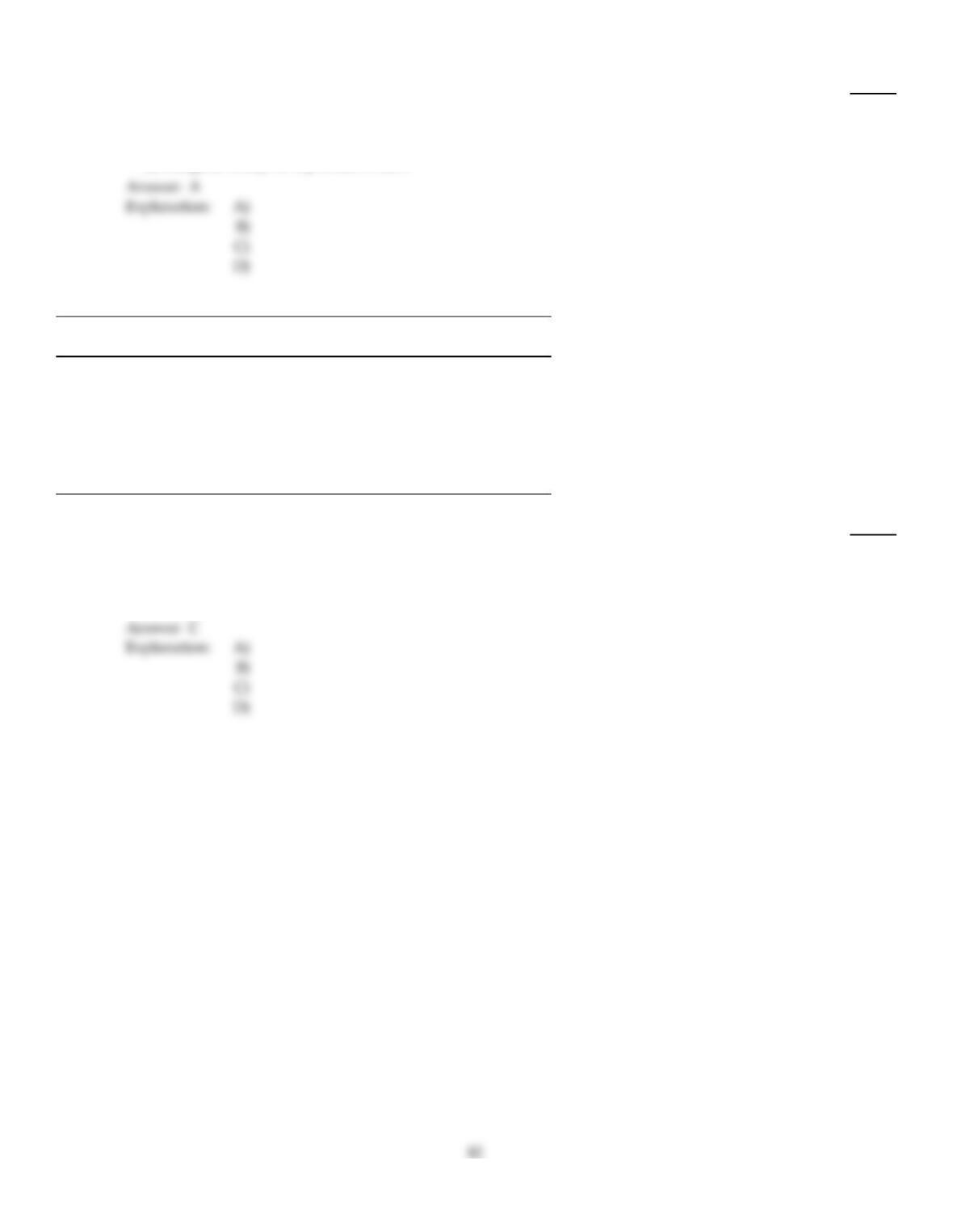
Use the above figure. When the budget line rotates from “c” to “b”
276)
A)
the price of product K increases and the quantity demanded of product K decreases.
B)
the price of product J increases and the quantity demanded of product J decreases.
C)
the price of product J decreases and the quantity demanded of product J increases.
D)
the price of product K decreases and the quantity demanded of product K increases.
D
B
277)
The state of consumer optimum is reached when the consumer’s
277)
A)
marginal utility/price ratios for all items are equal.
B)
total utility/price ratio for all items is equal.
C)
total utility/marginal utility ratio for all items is equal.
D)
marginal utility for a product is zero.
Quantity of Total Quantity of Total
Magazines/Wk Utility Paperback Books/Wk Utility
0 0 0 0
150 1 300
290 2 500
3120 3 600
4130 4 650
5132 5 675
6132 6 680
278)
Refer to the above table. If a consumer’s optimum consists of 3 magazines and 6 books, then
278)
A)
the price of a book is more than five times more than the price of a magazine.
B)
the price of a magazine is three times more than the price of a book.
C)
the price of a magazine is six times more than the price of a book.
D)
the price of a book is six times more than the price of a magazine.
Quantity Total Utility
Per Week Amy Robert David Michelle
0 0 0 0 0
15.0 100 600 60
2 9.9 190 1200 130
314.7 270 1800 220
419.4 340 2400 310
524.0 400 3000 425
628.5 450 3600 575
732.9 490 4200 900
837.2 520 4800 1275
941.4 510 5400 1770
279)
Refer to the above table. Amy’s utility schedule shows
279)
A)
initially decreasing marginal utility and then increasing marginal utility.
B)
initially increasing marginal utility and then decreasing marginal utility.
C)
diminishing marginal utility throughout the entire schedule.
D)
increasing marginal utility throughout the entire schedule.
280)
Increases in total utility from the consumption of a good decrease as more is consumed. This
statement is
280)
A)
the law of average utility.
B)
false.
C)
the consumer optimum.
D)
the law of diminishing marginal utility.
D
281)
As an individual consumes more of a particular commodity, the total level of utility derived from
that consumption usually
281)
A)
increases at a decreasing rate.
B)
increases at an increasing rate.
C)
decreases at an increasing rate.
D)
increases at a constant rate.
A
C
282)
Consumers usually buy fewer units of a good than the quantity that would maximize total utility
from consuming the good because
282)
A)
of the law of demand.
B)
they are not rational.
C)
marginal utility becomes zero after just a few units of the good.
D)
they have limited incomes.
283)
Assume that the marginal utility from good x is 10 units and that the price of good x is $5 per unit.
The marginal utility from good y is 15 units and its unit price is $7. In this situation, a
utility–maximizing consumer should
283)
A)
consume only good y.
B)
consume more of good y.
C)
consume neither x nor y.
D)
consume more of good x.
284)
Let the quantity of hamburgers be measured along the vertical axis and the quantity of movies be
measured along the horizontal axis. If the price of a hamburger is $1.50 and the price of a movie is
$6, then the slope of the budget line is
284)
A)
–0.25.
B)
–6.
C)
–4.
D)
–3.
285)
Assume that good X and good Y each have diminishing marginal utility for a consumer. In this
case,
285)
A)
an indifference curve linking the two goods will have a constant slope.
B)
an indifference curve will be convex to the origin.
C)
the demand curves for these goods will be horizontal.
D)
the demand curves for these goods will be positively sloped.
286)
Marginal utility is
286)
A)
the utility received from consuming the first unit of a good.
B)
the change in total utility from consuming an additional unit of a good.
C)
the utility received by the last consumer of a good.
D)
the total utility received from consuming a given quantity of a good divided by the number of
units consumed.
287)
The consumer optimum (for two goods, a and b) is reached when
287)
A)
TUa/Pa= TUb/Pb.
B)
MUa/Pa= MUb/Pb.
C)
MUa= MUb.
D)
TUa= TUb.
B
288)
The change in people’s purchasing power that occurs when the price of one good that they
purchase changes is the
288)
A)
law of diminishing marginal utility.
B)
real–income effect.
C)
price income effect.
D)
substitution effect.
B
Quantity Total Utility
0 0
110
225
345
460
568
672
289)
Refer to the above table. At what quantity does diminishing marginal utility set in?
289)
A)
after 2
B)
after 15
C)
after 3
D)
after 10
C
B
290)
If a consumer is initially at an optimum, and then the price of Y increases, then
290)
A)
MUX/PX= MUY/PY.
B)
MUX/PX> MUY/PY.
C)
MUX/MUY> PY/PX.
D)
MUX/PX< MUY/PY.
291)
Behavioral economics suggests that people face human limitations that prevent them from
examining every possible choice available to them, with the implication that
291)
A)
marginal utility is always equal to zero.
B)
the consumer optimum implied by utility theory is an appropriate approach to deriving
demand curves.
C)
marginal utility is always negative.
D)
the consumer optimum implied by utility theory is an inappropriate approach to deriving
demand curves.
292)
If marginal utility is negative
292)
A)
the consumer will want to consume the unit only if it is free.
B)
the consumer likes the commodity, but not as much as he or she once did.
C)
total utility increases at a decreasing rate.
D)
the consumer considers extra units of the commodity to be a “bad.”
Pepsi MU of Pepsi Pizza MU of Pizza
1st can 18 1st slice 7
2nd can 15 2nd slice 6
3rd can 12 3rd slice 4
4th can 9 4th slice 3
5th can 6 5th slice 0
293)
Using the above table, if the price of Pepsi is $3, how many cans of Pepsi would have to be
consumed in order to have a marginal utility to price ratio of 3?
293)
A)
one can
B)
two cans
C)
three cans
D)
four cans
294)
Suppose a consumer is at an optimum. What happens when the price of one good she has been
consuming increases?
294)
A)
The value of the marginal utility of the last unit consumed increases.
B)
The marginal utility per dollar spent on the last unit consumed of that good is now smaller
than the marginal utility per dollar spent on other goods the person consumes.
C)
The marginal utility per dollar spent on the last unit consumed of that good increases by the
same proportion as the price increases.
D)
The value of the marginal utility of the last unit consumed decreases.
Quantity of Total Quantity of Total
Magazines/Wk Utility Paperbacks/Wk Utility
0 0 0 0
160 1200
2100 2400
3130 3500
4 140 4550
5142 5575
6142 6 580
295)
Refer to the above table. If the consumer‘s equilibrium consists of 4 magazines and 4 books, then we
know that
295)
A)
the price of a magazine is 5 times more than the price of a book.
B)
the price of a book is 3 times more than the price of a magazine.
C)
the price of a magazine is 6 times more than the price of a book.
D)
the price of a book is 5 times more than the price of a magazine.
Quantity of Total Quantity of Total
Hamburgers/Wk Utility Movies/Wk Utility
140 1400
2 60 2 700
376 3 850
486 4950
5 91 51000
693 61025
296)
Refer to the above table. Suppose the price of a movie is $5 and the income of the consumer is $29.
What are the quantities demanded of hamburger at prices of $2 and $1 respectively?
296)
A)
3; 5
B)
1; 2
C)
2; 4
D)
0; 1
297)
Which of the following statements is FALSE regarding consumer choice?
297)
A)
Each change in price has a substitution effect and a real income effect.
B)
When price falls, the consumer chooses in favor of the cheaper good.
C)
Purchasing power has an inverse relationship with the rise in income.
D)
Diminishing marginal utility is one reason for a downward sloping demand curve.
298)
The diamond–water paradox illustrates the idea that ________ determines what consumers are
willing to pay for a particular good.
298)
A)
total utility
B)
marginal utility
C)
the real–income effect
D)
the substitution effect
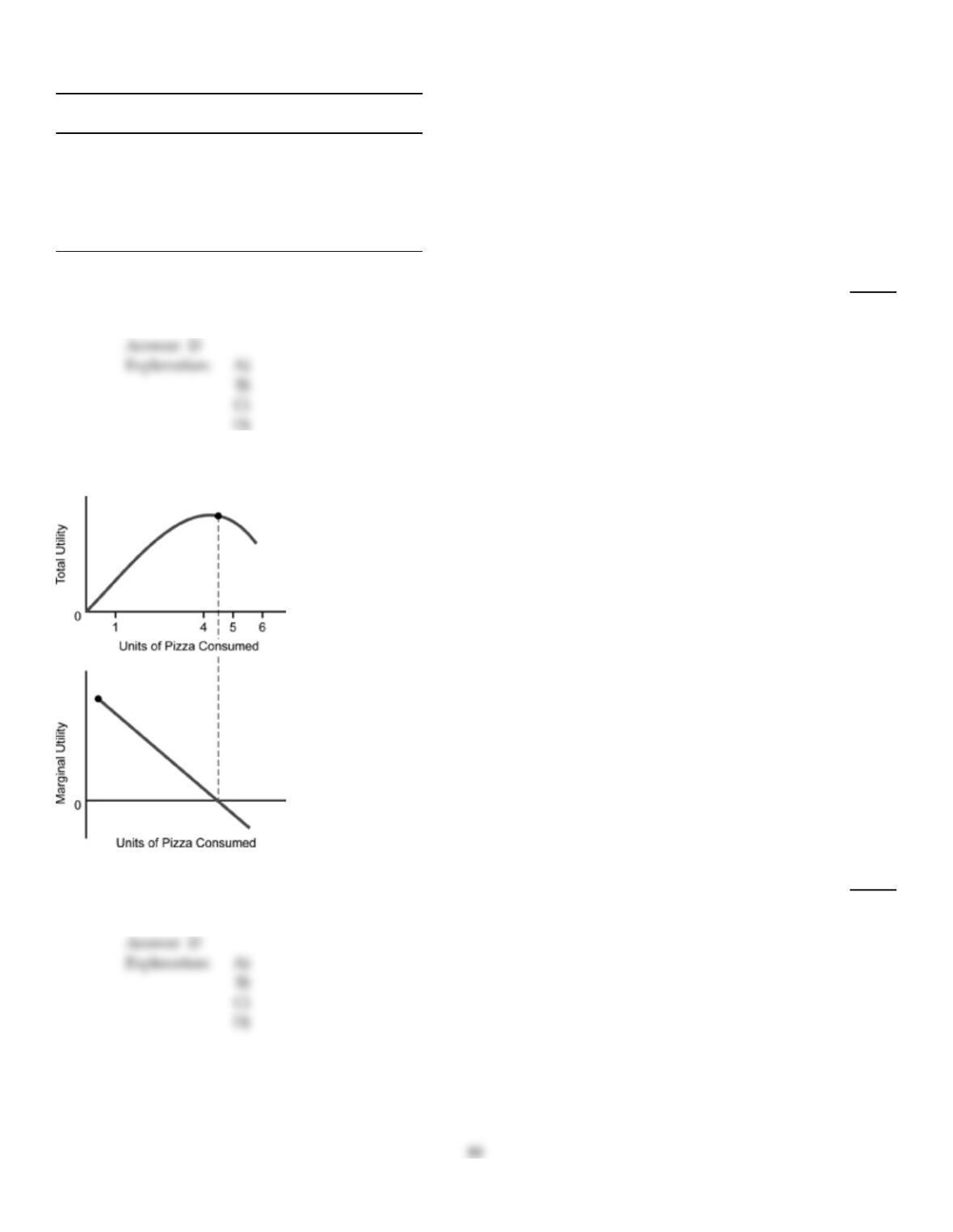
Glasses of
Water Total Utility Marginal Utility
1100
2175
3225
4250
5260
6255
299)
Using the above table, diminishing marginal utility begins after the ________ glass of water is
consumed.
299)
A)
6th
B)
2nd
C)
5th
D)
1st
300)
Given the above figure, marginal utility becomes negative when Joey consumes the ________ piece
of pizza.
300)
A)
1st
B)
3rd
C)
4th
D)
5th
Quantity of Total Quantity of Total
Hamburgers/Wk Utility Movies/Wk Utility
140 1400
2 60 2 700
376 3 850
486 4950
5 91 51000
693 61025
301)
Refer to the above table. Suppose the price of a hamburger is $2, the price of a movie is $5, and the
income of the consumer is $29. How many hamburgers and movies will this consumer buy to be at
an optimum?
301)
A)
2 hamburgers and 5 movies
B)
1 hamburger and 5 movies
C)
4 hamburgers and 4 movies
D)
6 hamburgers and 3 movies
302)
Which of the following is FALSE about indifference curves?
302)
A)
They are downward sloping.
B)
They intersect.
C)
They can shift.
D)
They are convex to the origin.
303)
One piece of evidence that possibly supports the bounded–rationality assumption of behavioral
economics is that experiments appear to have shown that
303)
A)
total utility is declining when marginal utility is negative.
B)
people make the same decisions in calm situations than in situations in which emotions come
into play.
C)
total utility is maximized when marginal utility is equal to zero.
D)
people make different decisions in calm situations than in situations in which emotions come
into play.
304)
The price of a good that Joe is currently consuming has increased.
304)
A)
Joe will stop consuming this good.
B)
Joe will experience a shift in the demand curve of the good whose price has increased.
C)
Joe has experienced a decrease in purchasing power.
D)
Joe will experience increasing marginal utility.
305)
John has just eaten another potato chip and his total utility decreased. This means that John’s
marginal utility for this additional potato chip is
305)
A)
positive.
B)
negative.
C)
zero.
D)
not determinable without more information.
Quantities MUapples(Adam) MUoranges(Adam) Quantities MUapples(Eve) MUoranges(Eve)
1 40 30 1 15 20
230 20 2 10 15
325 15 3 8 12
420 12 4 5 10
306)
Adam has 3 apples and 3 oranges. Eve has 2 apples and 2 oranges. The marginal utilities for Adam
and Eve are summarized in the above table. Adam asks Eve to exchange one of her apples for an
orange.
306)
A)
Eve will be unwilling to make the exchange, because she loses 5 utils of satisfaction.
B)
Eve will be unwilling to make the exchange, because she loses 15 utils of satisfaction.
C)
Eve will be willing to make the exchange, because her total satisfaction will increase.
D)
Eve will be willing to make the exchange, because her total satisfaction will remain
unchanged.
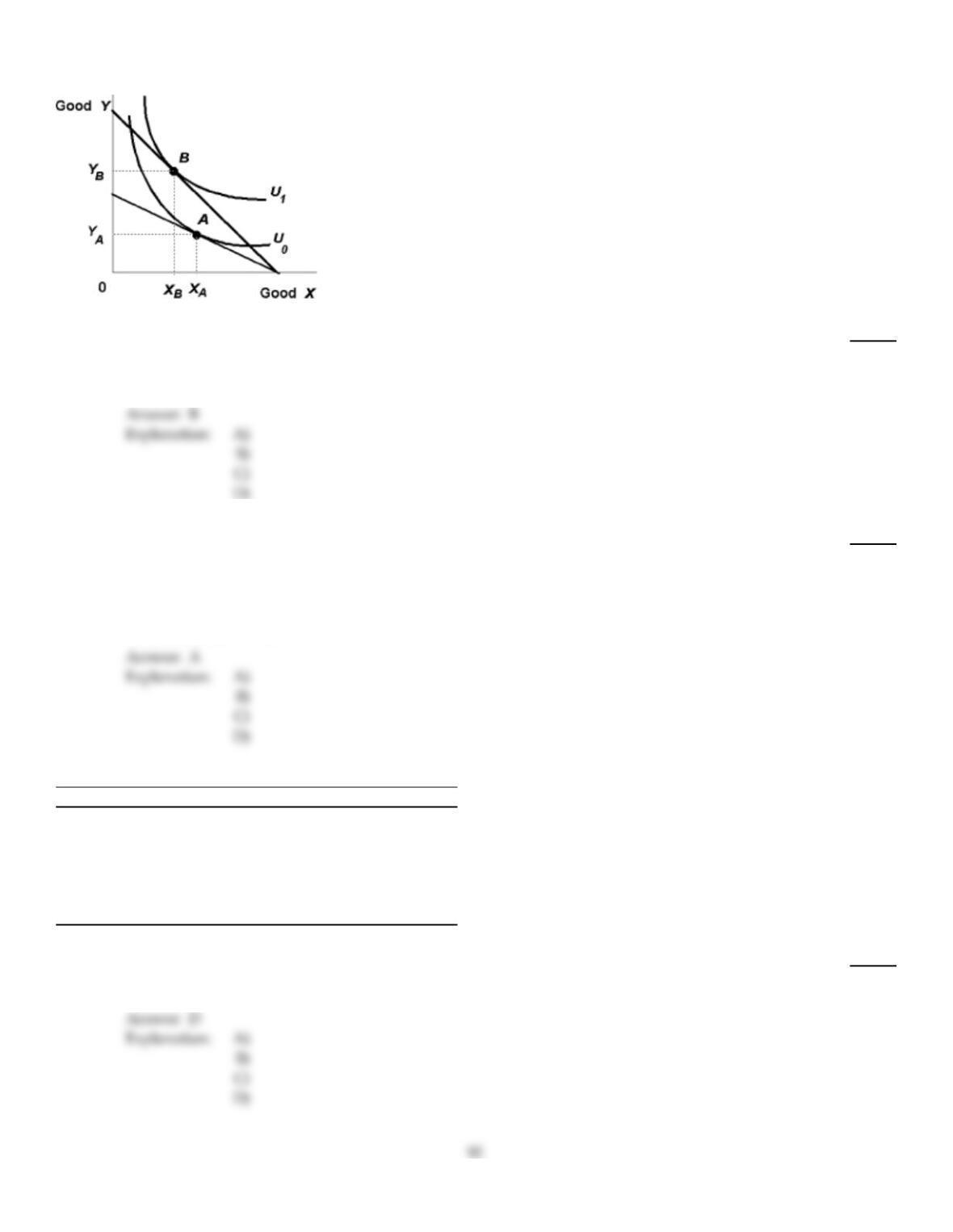
307)
Use the above figure. Last week Joe consumed combination “B” of goods “X” and “Y.” This week he
purchased combination “A.” The reason for this change is that the
307)
A)
price of good Y has decreased.
B)
price of good Y has increased.
C)
price of good X has increased.
D)
price of good X has decreased.
308)
Using the utility–optimizing model, which of the following would induce a consumer to increase
consumption of good x, a normal good?
308)
A)
an increase in the marginal utility of x
B)
an increase in the marginal utility of good y
C)
a decrease in the total utility of y
D)
a decrease in income
Slices of Pizza Total Utility Marginal Utility
0 0 –
120
250
320
410
5 0
309)
In the above table, marginal utility begins to diminish after consumption of the
309)
A)
fifth slice of pizza.
B)
third slice of pizza.
C)
fourth slice of pizza.
D)
second slice of pizza.
310)
If the marginal utility of each good is constant as consumption increases, the indifference curves are
310)
A)
straight lines.
B)
horizontal.
C)
positively sloped.
D)
vertical.
311)
The principle that “as more of a good is consumed, its extra benefit declines” is known as
311)
A)
the law of diminishing marginal utility.
B)
the law of comparative advantage.
C)
the law of demand.
D)
the law of diminishing marginal product.
312)
If the budget line rotates, then we know that
312)
A)
the consumer was not maximizing their utility.
B)
the price of one of the goods had changed.
C)
their has been a change in the consumer’s tastes.
D)
income has changed.
313)
The marginal utility of good A is 6 and the marginal utility of good B is 15. The price of good A is
$2. The price of good B must be ________ if the consumer is optimizing her utility.
313)
A)
$5
B)
$15
C)
$45
D)
$2
314)
If an individual consumes only two goods and consumption of one good increases, then in order to
keep the consumer on the same indifference curve, consumption of the other good must
314)
A)
become negative.
B)
decrease.
C)
increase proportionately.
D)
increase.
315)
If an individual‘s utility from consuming two goods increases, then there must be
315)
A)
a downward rotation of the individual’s indifference curve.
B)
in inward shift of the individual’s indifference curve.
C)
an outward shift of the individual’s indifference curve.
D)
an inward rotation of the individual’s indifference curve.
316)
The inverse relationship between quantity demanded and price of a good or service can be
explained, in part, by
316)
A)
diminishing marginal utility and the rule of equal marginal utilities per dollar.
B)
diminishing marginal utility only.
C)
a shift in the demand curve.
D)
the real income effect.
317)
Observations of real–world situations that appear to violate a consumer optimum could be offered
as evidence favoring
317)
A)
utility analysis.
B)
zero marginal utility at a utility–maximizing point.
C)
bounded rationality.
D)
diminishing marginal utility.
318)
A rational individual will never consume a unit of a good if its
318)
A)
marginal utility is diminishing.
B)
marginal utility is negative.
C)
marginal utility is less than average utility.
D)
marginal utility is increasing.
319)
An indifference curve between one dozen eggs and several dozens of eggs would be
319)
A)
bowed in to the origin.
B)
a downward sloping straight line.
C)
a straight line from the origin.
D)
bowed out from the origin.
320)
Using indifference curve analysis, an optimum is characterized by
320)
A)
the marginal rate of substitution being equal to zero.
B)
the marginal rate of substitution being equal to the ratio of the prices of the two goods.
C)
the marginal rate of substitution of one good divided by its price equal to the marginal rate of
substitution of the other good divided by its price.
D)
the marginal rate of substitution being equal to one.
321)
Utility analysis is the analysis of
321)
A)
the formation of tastes and preferences.
B)
the differences of tastes and preferences across individuals.
C)
how consumers determine the utility they receive from consumption.
D)
the consumption decisions of people based on utility maximization.
322)
A consumer has been buying 5 magazines and 2 books a month for many months. The price of
books then increases. To attain a new optimum, the consumer will
322)
A)
buy the same number of books and magazines as before because they provide different types
of utility.
B)
buy fewer books than before because they are relatively more expensive than they were
before.
C)
buy more magazines because they are now relatively more valuable than they were before,
while continuing to buy the same number of books.
D)
buy more books because they are now relatively more valuable than they were before.
323)
Use the above figure. The consumer’s choice changes from YB to YA. Which of the following
statements about good Y is TRUE?
323)
A)
price has decreased and the quantity demanded has fallen.
B)
price has increased and the quantity demanded has risen.
C)
price has decreased and the quantity demanded has risen.
D)
price has increased and the quantity demanded has fallen.
324)
If an individual’s total utility from consuming two goods decreases, then there must be
324)
A)
a downward rotation of the individual’s indifference curve.
B)
an outward shift of the individual’s indifference curve.
C)
an inward shift of the individual’s indifference curve.
D)
an inward rotation of the individual’s indifference curve.
325)
Olga buys a bag of potato chips every day after her economics class. The first potato chip always
tastes wonderful. The second does not taste quite as good as the first. The third does not taste quite
as good as the second. Olga is experiencing
325)
A)
irrational behavior.
B)
the substitution effect.
C)
the law of diminishing marginal utility.
D)
the income effect.
326)
John is currently spending all of his income. For the last unit of Good A consumed John gets 20 utils
and for the last unit of Good B consumed he gets 10 utils. The price of Good A is $10. The price of
Good B is $5. If John wants to maximize his utility he should
326)
A)
continue to purchase the same amount of Good A and Good B.
B)
increase the consumption of Good A and decrease the consumption of Good B.
C)
decrease the consumption of Good A and increase the consumption of Good B.
D)
decrease the consumption of Good A and decrease the consumption of Good B.
327)
Your allergies are bad this summer so your allergist writes you a prescription to relieve your
symptoms. When you get to the pharmacy, you notice the name brand allergy medicine is more
expensive than its generic equivalent. You purchase the generic equivalent and demonstrate all of
the following EXCEPT
327)
A)
the principle of substitution of one product for another.
B)
when price decreases, the quantity demanded increases.
C)
the principle of diminishing marginal utility.
D)
a price change may affect consumer optimum.
328)
The real–income effect refers to
328)
A)
the want–satisfying power of a good or service.
B)
the law of diminishing marginal utility.
C)
substitution of less expensive commodities for more expensive commodities.
D)
the change in purchasing power when the price of a good changes.
Explanation:
329)
You consider yourself to be wise consumer. The marginal utility/price ratio of coffee is 12 utils per
dollar. If the price of a donut is $0.75, you should only buy the donut if it gives you at least
329)
A)
12 utils of satisfaction.
B)
16 utils of satisfaction.
C)
9 utils of satisfaction.
D)
The answer cannot be determined with this information.
Explanation:
330)
Economists use what term to describe the want–satisfying power of a good?
330)
A)
marginal propensity to consume
B)
demand
C)
utility
D)
income elasticity
Explanation:
Explanation:
331)
Utility analysis assumes that the consumer’s tastes and preferences are
331)
A)
dependent on income and education.
B)
predetermined and stable.
C)
dependent on geographic location.
D)
dependent on national origin.
332)
Along a given indifference curve, a consumer reduces the quantity of one good in favor of more
units of the other. In this situation
332)
A)
the marginal utility of the first rises and the marginal utility of the second good falls.
B)
the marginal rate of substitution falls.
C)
total utility rises.
D)
both A and B are correct.
333)
An indifference curve provides the set of consumption alternatives that
333)
A)
can be purchased for the same amount of money.
B)
yield the same marginal utility for the last unit consumed of each good.
C)
yield the same total amount of satisfaction.
D)
maximize the utility of the consumer.
334)
The consumption possibilities curve is the
334)
A)
demand curve.
B)
supply curve.
C)
budget constraint.
D)
indifference curve.
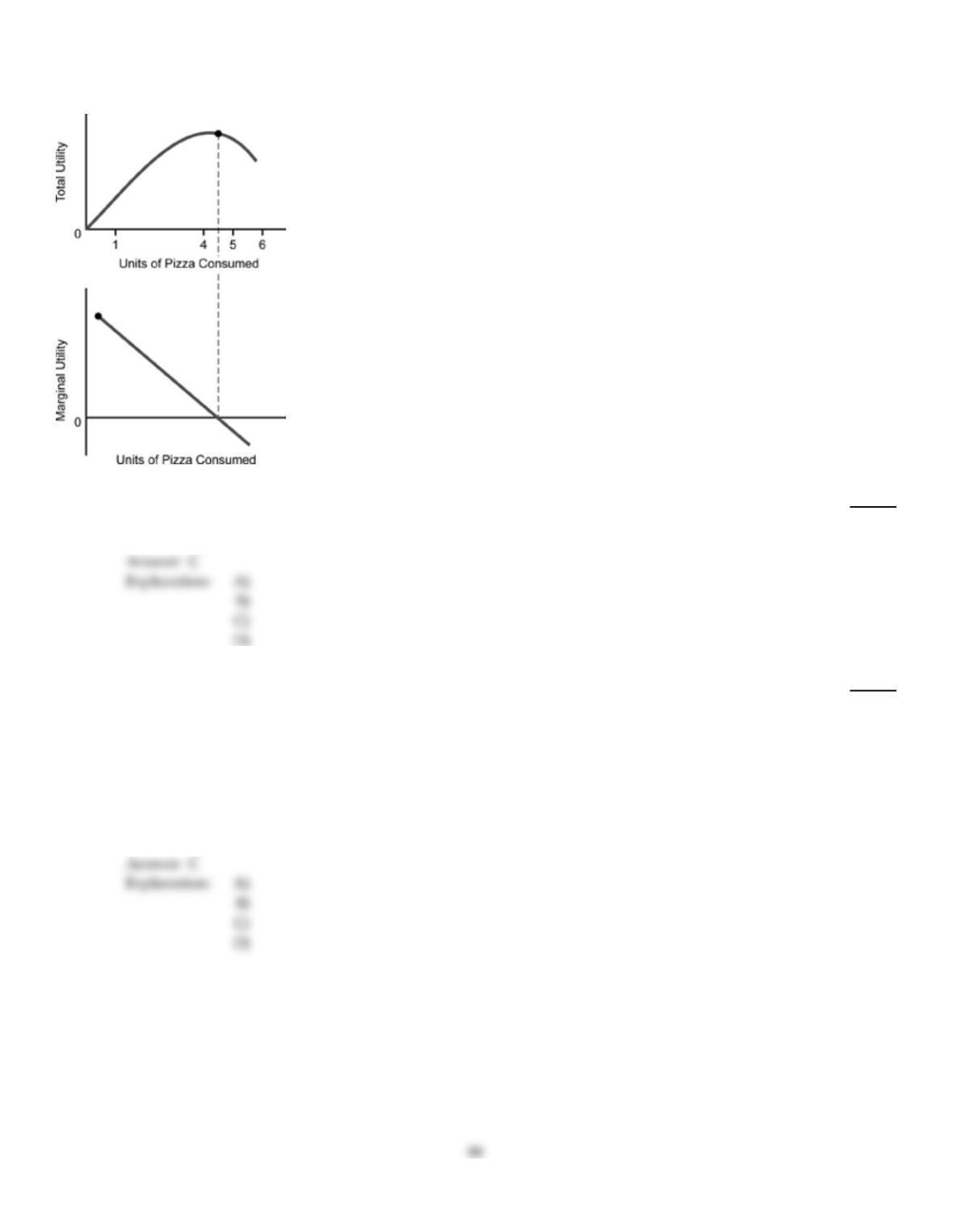
335)
Given the above figure, if Joey was a rational consumer he would NOT eat more than ________
piece(s) of pizza.
335)
A)
1
B)
5
C)
4
D)
6
336)
The price of hamburgers is $2 and the price of movies is $4. The consumer has $16 of income. The
consumer is purchasing 3 hamburgers and receiving 20 utils for the last hamburger. He is also
purchasing 2 movies and receiving 40 utils for the last movie. This set of goods
336)
A)
is not an optimum because the marginal utility per dollar spent is greater for hamburgers
than for movies.
B)
is an optimum since the entire income is spent and the marginal utility per dollar spent is the
same for the last unit of each good.
C)
is not an optimum because the consumer has not spent all of his money.
D)
is an optimum since the entire income is spent and total utility is maximized.
337)
Basket of goods A is on an indifference curve that lies closer to the origin than basket B. From this
we know that
337)
A)
the satisfaction from consuming A is more than the satisfaction from consuming B.
B)
the marginal utility from consuming A is less than the marginal utility from
consuming B.
C)
the prices of the goods in A are less than the prices of the goods in B.
D)
the satisfaction from consuming A is less than the satisfaction from consuming B.
338)
An indifference curve
338)
A)
must be concave to the origin.
B)
may be convex or concave to the origin.
C)
depends on the prices of the products and the consumer’s income.
D)
must be convex to the origin.
D
Quantity of Total Quantity of Total
Hamburgers/Wk Utility Movies/Wk Utility
0 0 0 0
125 1 200
2 45 2260
3 55 3300
460 4320
5 61 5325
339)
Refer to the above table. Assume the consumer spends his entire income. If the consumer’s
optimum at the current price of a movie is at 4 hamburgers and 4 movies, and the price of a
hamburger is $1, what is the consumer’s income?
339)
A)
$16
B)
$28
C)
$40
D)
$20
D
340)
To derive the demand curve for good X, all the following are constant EXCEPT
340)
A)
tastes and preferences.
B)
the price of good X.
C)
income.
D)
the price of good Y.
B
D