
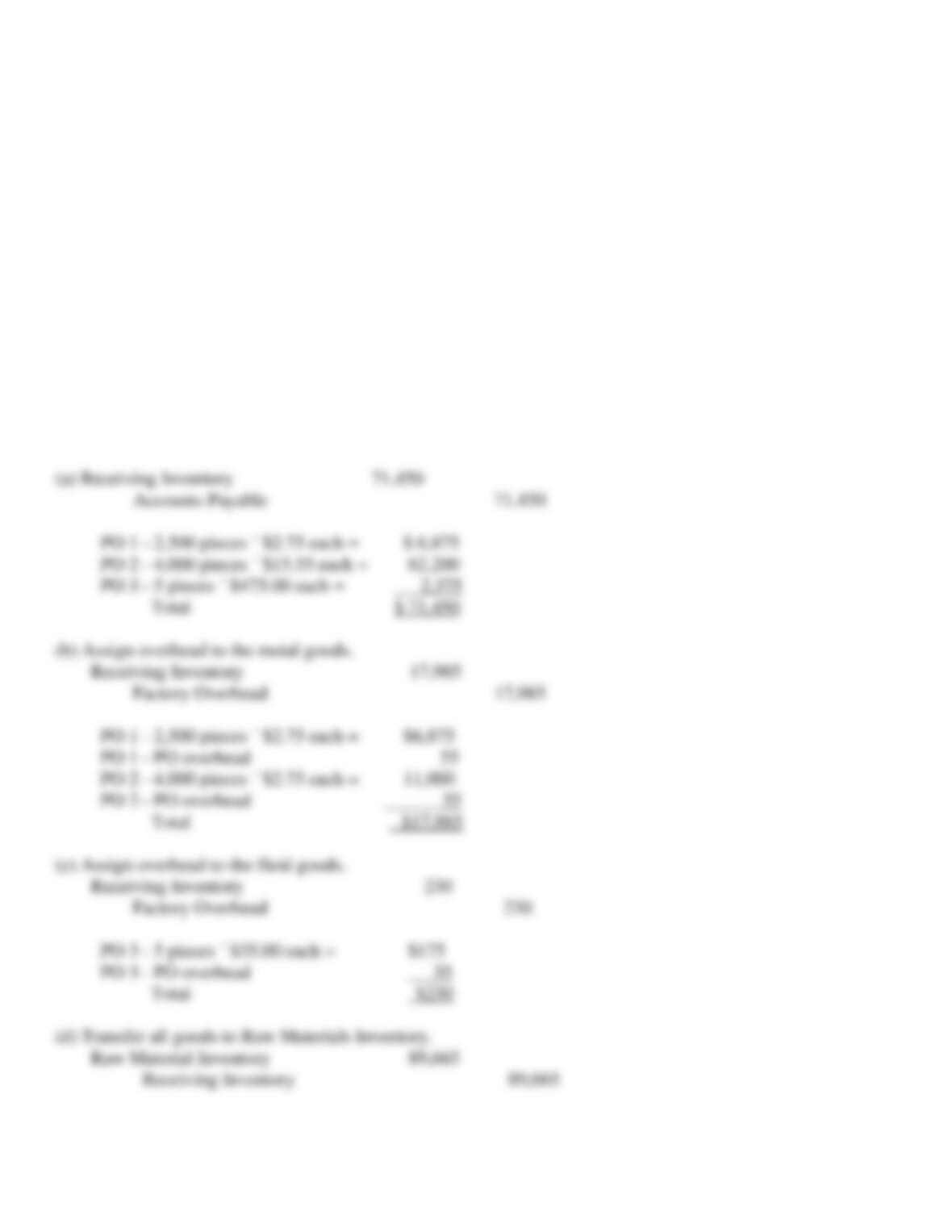
171. Tough Hardware purchases raw materials and processes those purchases through a receiving/inspection
process prior to stocking for production. Tough places 3 purchase orders for materials for production and
receives the goods that day. The first PO is for 2,500 1/2”´ 96” milling blanks at $2.75 each. The second is for
4,000 pieces of 48” ´ 96” ´ 1” sheet steel at $15.55 each. The third PO is for five 55 gallon drums of Milling
Lubrication Oil at $475.00 per barrel.
The receiving/inspection process is completed and the goods are transferred from Receiving Inventory to Raw
Materials. The Receiving/Inspection Department assigns manufacturing overhead of $55.00 per purchase order
as well as $2.75 per piece on metal goods and $35.00 per container on fluids. All labor is allocated through
overhead.
(a) Write the journal entry to purchase and receive these items to Receiving Inventory on account.
(b) Assign overhead to the metal goods.
(c) Assign overhead to the fluid goods.
(d) Transfer all goods to Raw Materials Inventory.
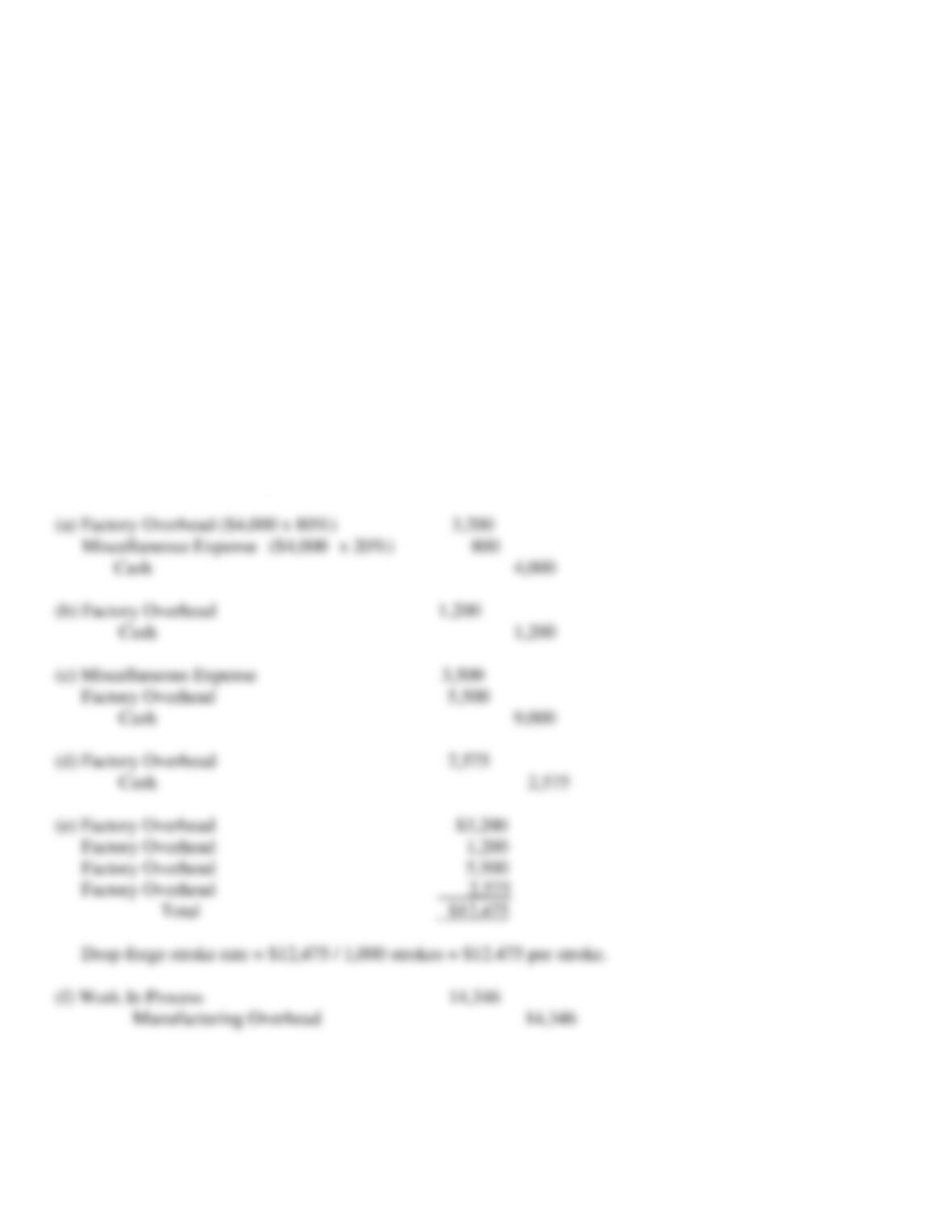
172. The Brass Works is in the process of determining manufacturing overhead. Journalize events (a) – (d) to
Factory Overhead, Miscellaneous Expense, or allocated between the two as appropriate. All items were paid in
cash at the time of acquisition. Next calculate the overhead application rate and apply overhead to
Work-in-Process.
(a)
Brass Works purchases an insurance policy for $4,000. It is computed that 80% of the value of the policy protects production, the
balance protects the administrative offices.
(b)
The electric bill is received showing an amount due of $1,200. This meter is utilized only by production as the office spaces have
their own meter.
(c)
Payroll reports that the sales manager’s salary for the period is $3,500 and that production supervisors wages for the period are
$5,500.
(d)
The stockroom reports that $2,575 in materials were purchased for the production maintenance department.
(e)
If the driver for the application of overhead is drop-forge strokes and there are expected to be 1,000 strokes in this period, what is
the rate per stroke? Do not round your answer.
(f)
Assuming that there are 1,150 drop-forge strokes in this period, apply factory overhead to Work In Process. Round your answers to
nearest dollar.
Round overhead rate to four decimal places and total cost to nearest dollar.
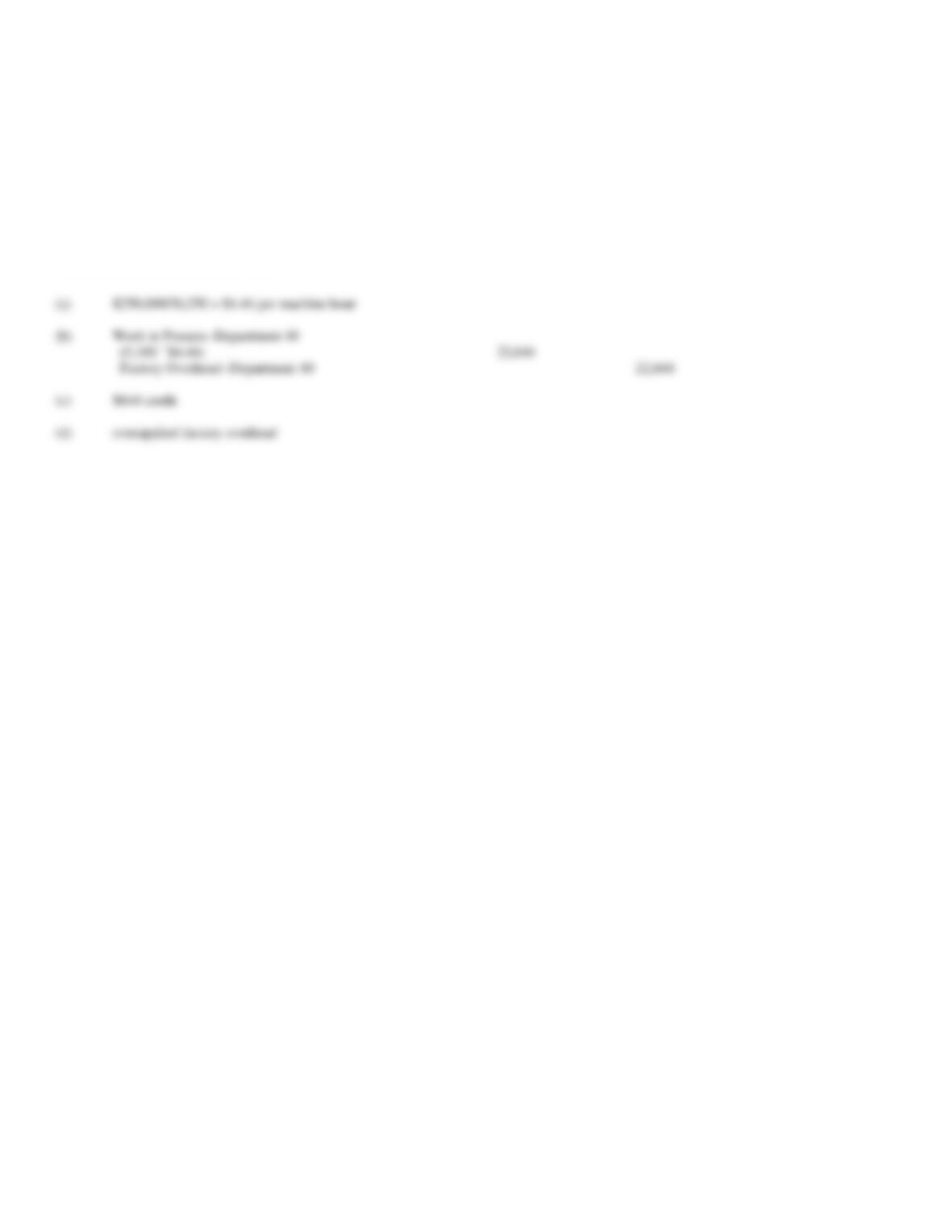
173. The estimated total factory overhead cost and total machine hours for Department 40 for the current year
are $250,000 and 56,250 respectively. During January, the first month of the current year, actual machine
hours used totaled 5,100 and factory overhead cost incurred totaled $22,000.
(a)
Determine the factory overhead rate based on machine hours.
(b)
Present the entry to apply factory overhead to production in Department 40 for January.
(c)
What is the balance of Factory Overhead – Department 40 at January 31?
(d)
Does the balance of Factory Overhead – Department 40 at January 31 represent overapplied or underapplied factory overhead?
Round total cost to nearest dollar value.
(a)
$250,000/56,250 = $4.44 per machine hour
(b)
Work in Process—Department 40
(5,100 ´ $4.44)
22,644
Factory Overhead—Department 40
22,644
(c)
$644 credit
(d)
overapplied factory overhead
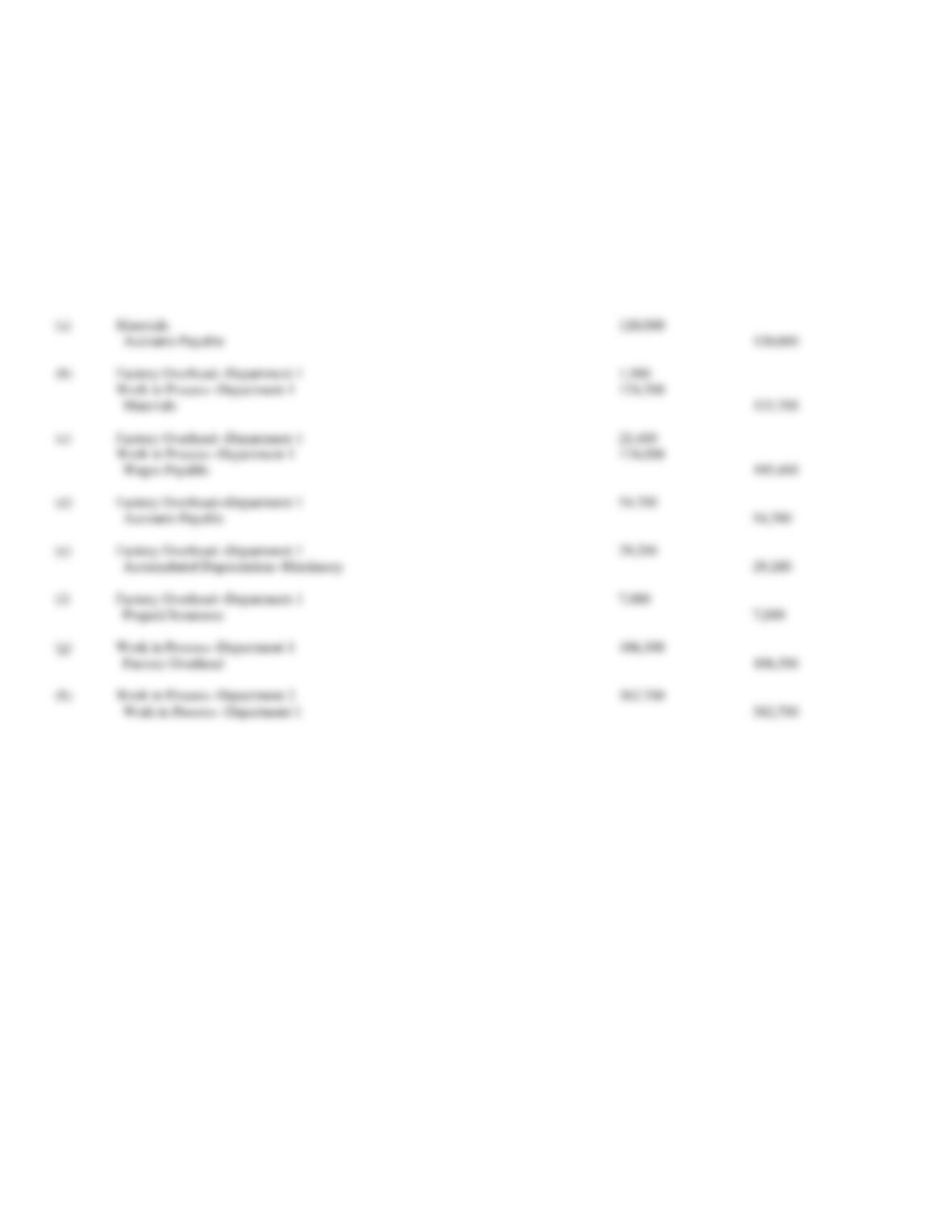
174. A firm produces its products by a continuous process involving three production departments, 1 through 3.
Present entries to record the following selected transactions related to production during August:
(a)
Materials purchased on account, $120,000.
(b)
Material requisitioned for use in Department 1, $125,700, of which $124,200 entered directly into the product.
(c)
Labor cost incurred in Department 1, $195,400, of which $174,000 was used directly in the manufacture of the product.
(d)
Factory overhead costs for Department 1 incurred on account, $54,700.
(e)
Depreciation on machinery in Department 1, $29,200.
(f)
Expiration of prepaid insurance chargeable to Department 1, $7,000.
(g)
Factory overhead applied to production, $106,300.
(h)
Output of Department 1 transferred to Department 2, $362,700.
(a)
Materials
120,000
Accounts Payable
120,000
(b)
Factory Overhead—Department 1
1,500
Work in Process—Department 1
124,200
Materials
125,700
(c)
Factory Overhead—Department 1
21,400
Work in Process—Department 1
174,000
Wages Payable
195,400
(d)
Factory Overhead—Department 1
54,700
Accounts Payable
54,700
(e)
Factory Overhead—Department 1
29,200
Accumulated Depreciation—Machinery
29,200
(f)
Factory Overhead—Department 1
7,000
Prepaid Insurance
7,000
Factory Overhead
106,300
(h)
Work in Process—Department 2
362,700
Work in Process—Department 1
362,700
175. Fast-Flow Paints produces mixer base paint through a two stage process, Mixing and Packaging. The
following events depict the movement of value into and out of production. Journalize each event if appropriate,
if not, provide a short narrative reason as to why you choose not to journalize that action. Bob, the Production
Manager, accepts an order to continue processing the current run of mixer base paint.
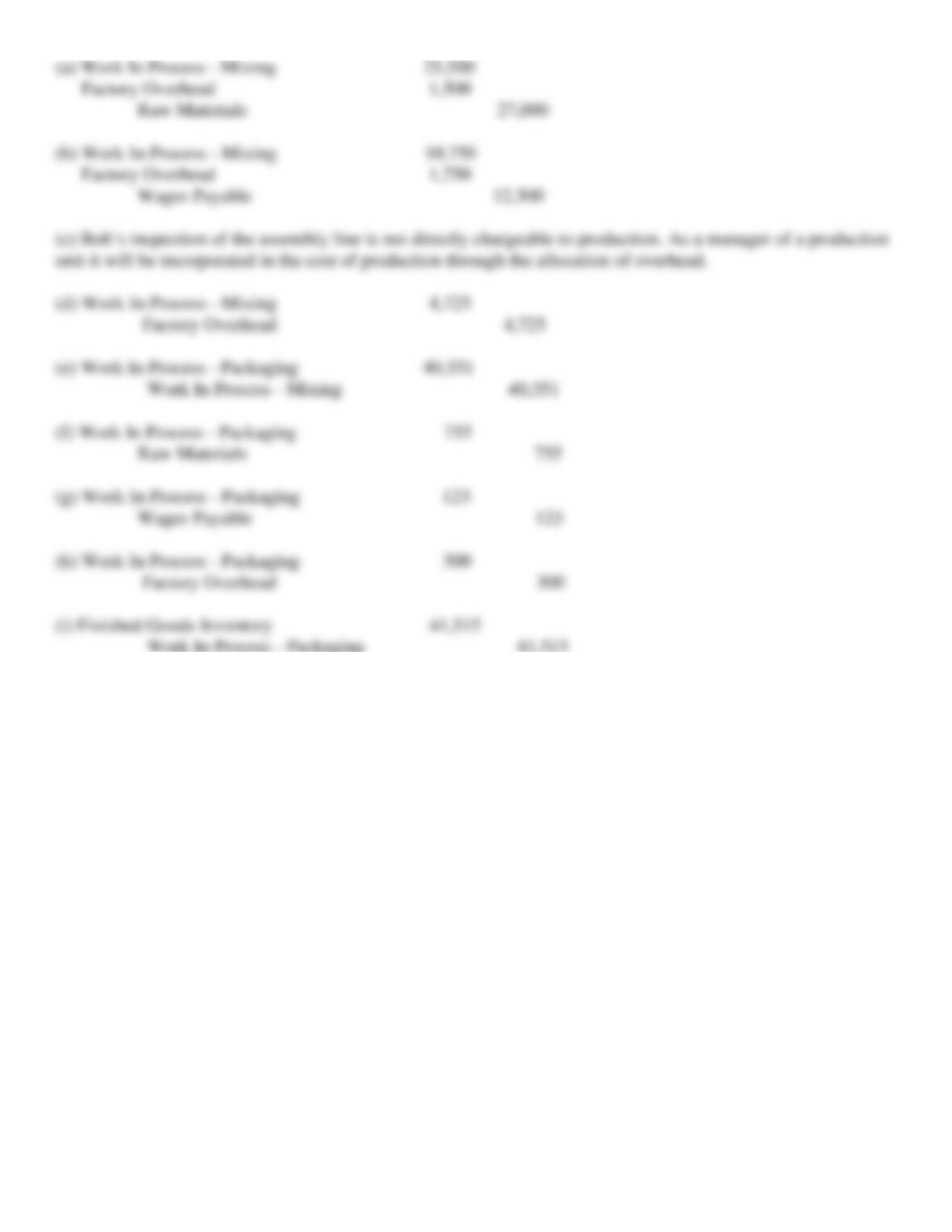
(a)
$27,000.00 worth of materials are withdrawn from Raw Materials inventory. Of this amount, $25,500.00 will be issued to the
Mixing Department and the balance will be issued to the Maintenance Department to be used on production line machines.
(b)
Bob calculates that labor for the period is $12,500.00. Of this value $1,750.00 is for maintenance and indirect labor. The
remainder is directly associated with mixing.
(c)
Bob, who is paid a salary but earns about $35.00 / hour, spends 1 hour inspecting the production line.
(d)
The manufacturing overhead drivers for Mixing are (1) hours of mixer time at $575.00 per hour, and material movements from
Raw Materials at $125.00 per movement. An inspection of the machine timers reveals that a total of 8 hours has been consumed in
making this product. An inspection of “Stocking Orders” indicates that only one material movement was utilized to “load” the raw
materials. (Note: All values have been journalized to Factory Overhead, you need only apply it to the production run.)
(e)
Within Fast-Flow items are transferred between departments at a standard cost or value. This production run has created 4,015
gallons of mixer base paint. This paint is transferred to Packaging at a standard cost of $10.05 per gallon.
(f)
Packaging draws $755.00 in raw materials for packaging of this production run.
(g)
Packaging documents that 12 hours of direct labor at $10.25 per hour were consumed in the packaging of this production run.
(h)
Packaging uses a driver of direct labor hours to allocate manufacturing overhead at the rate of $25.00 per hour.
(i)
Packaging transfers these 4,015 gallons of packaged goods to Finished Goods Inventory at a standard cost of $10.34 per gallon.
Round total cost to nearest dollar value.
176. Zang Co. manufacturers its products in a continuous process involving two departments, Machining and
Assembly. Present entries to record the following selected transactions related to production during June:
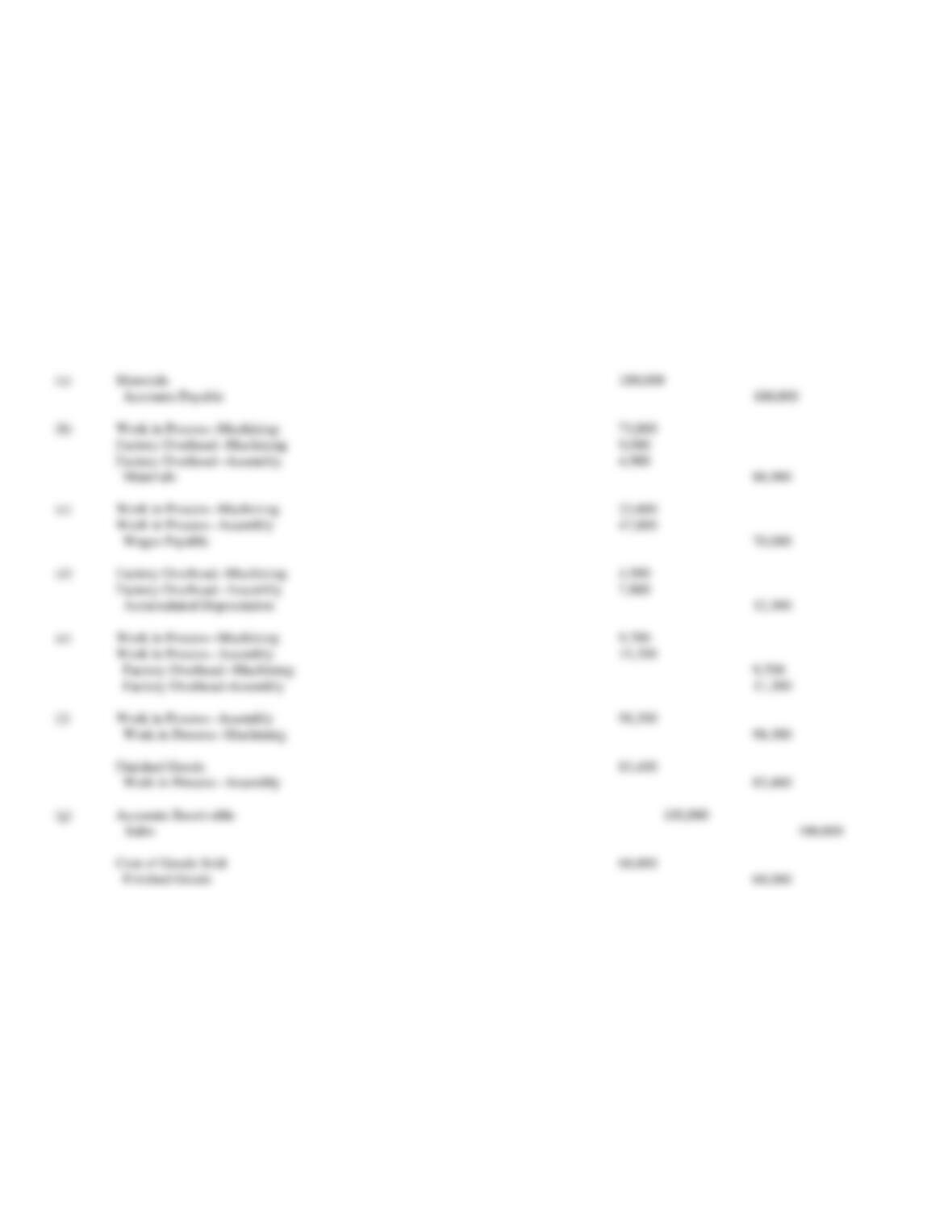
(a)
Materials purchased on account, $180,000.
(b)
Materials requisitioned by: Machining, $73,000 direct and $9,000 indirect materials; Assembly, $4,900 indirect materials.
(c)
Direct labor used by Machining, $23,000, Assembly, $47,000.
(d)
Depreciation expenses: Machining, $4,500; Assembly, $7,800.
(e)
Factory overhead applied: Machining, $9,700; Assembly, $11,300.
(f)
Machining Department transferred $98,300 to Assembly Department; Assembly Department transferred $83,400 to finished goods.
(g)
Sold goods on account, $100,000. Cost of goods sold, $68,000.
(a)
Materials
180,000
Accounts Payable
180,000
(b)
Work in Process—Machining
73,000
Factory Overhead—Machining
9,000
Factory Overhead—Assembly
4,900
Materials
86,900
(c)
Work in Process—Machining
23,000
Work in Process—Assembly
47,000
Wages Payable
70,000
(d)
Factory Overhead—Machining
4,500
Factory Overhead—Assembly
7,800
Accumulated Depreciation
12,300
(e)
Work in Process—Machining
9,700
Work in Process—Assembly
11,300
Factory Overhead—Machining
9,700
Factory Overhead-Assembly
11,300
Work in Process—Assembly
98,300
Work in Process—Machining
98,300
Finished Goods
83,400
Work in Process—Assembly
83,400
(g)
Accounts Receivable
100,000
Sales
100,000
Cost of Goods Sold
68,000
Finished Goods
68,000
177. The inventory at June 1 and costs charged to Work in Process – Department 60 during June are as follows:
3,800 units, 80% completed ($25,000 Materials, $35,400 conversion)
$ 60,400
Direct materials, 32,000 units
368,000
Direct labor
244,000
Factory overhead
188,000
Total cost to be accounted for
$860,400
During June, 32,000 units were placed into production and 31,200 units were completed, including those in inventory on June 1. On June 30, the
inventory of work in process consisted of 4,600 units which were 40% completed. Inventories are costed by the average cost method and all materials
are added at the beginning of the process.
Determine the following, presenting your computations:
(a)
equivalent units of production for conversion cost
(b)
conversion cost per equivalent unit and material cost per equivalent unit.
(c)
total and unit cost of finished goods completed in the current period
(d)
total cost of work in process inventory at June 30
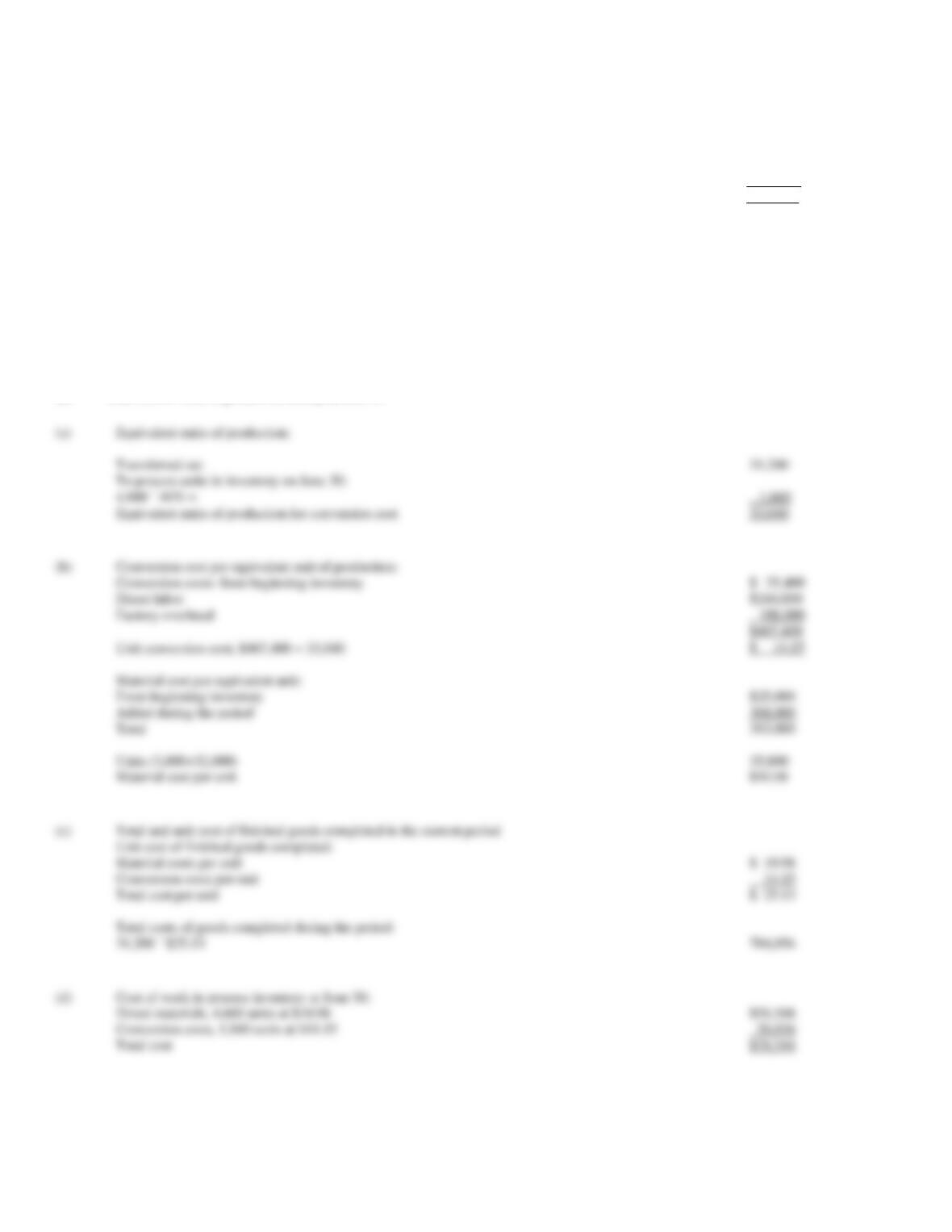
(a)
Equivalent units of production:
Transferred out
31,200
To process units in inventory on June 30:
4,600 ´ 40% =
1,840
Equivalent units of production for conversion cost
33,040
(b)
Conversion cost per equivalent unit of production:
Conversion costs: from beginning inventory
$ 35,400
Direct labor
$244,000
Factory overhead
188,000
$467,400
Material cost per equivalent unit:
From beginning inventory
$25,000
Added during the period
368,000
Total
393,000
Units (3,800+32,000)
35,800
Material cost per unit
$10.98
(c)
Total and unit cost of finished goods completed in the current period
Unit cost of finished goods completed:
Material costs per unit
$ 10.98
Conversion costs per unit
14.15
Total cost per unit
$ 25.13
Total costs of goods completed during the period:
31,200 ´ $25.13
784,056
(d)
Cost of work in process inventory at June 30:
Direct materials, 4,600 units at $10.98
$50,508
Conversion costs, 1,840 units at $14.15
26,036
Total cost
$76,544
178. On August 1, Jones Corporation’s packaging department had Work in Process inventory of 8,000 units that
were 75% complete with respect to materials and 30% complete with respect to conversion costs. The cost of
these units was $99,525 ($62,000 transferred-in from previous departments, $28,775 in materials, and $8,750 in
labor and overhead). During August, 125,000 units were transferred into the department. These units had
accumulated costs in previous departments of $1,418,560. The packaging department incurred costs of
$799,225 for materials and $498,010 for conversion costs in August and transferred 131,000 units out of the
department. The 2,000 units remaining in ending inventory are 50% complete with respect to materials and
20% complete with respect to conversion costs. Jones Corporation uses the average cost method to cost its
inventories.
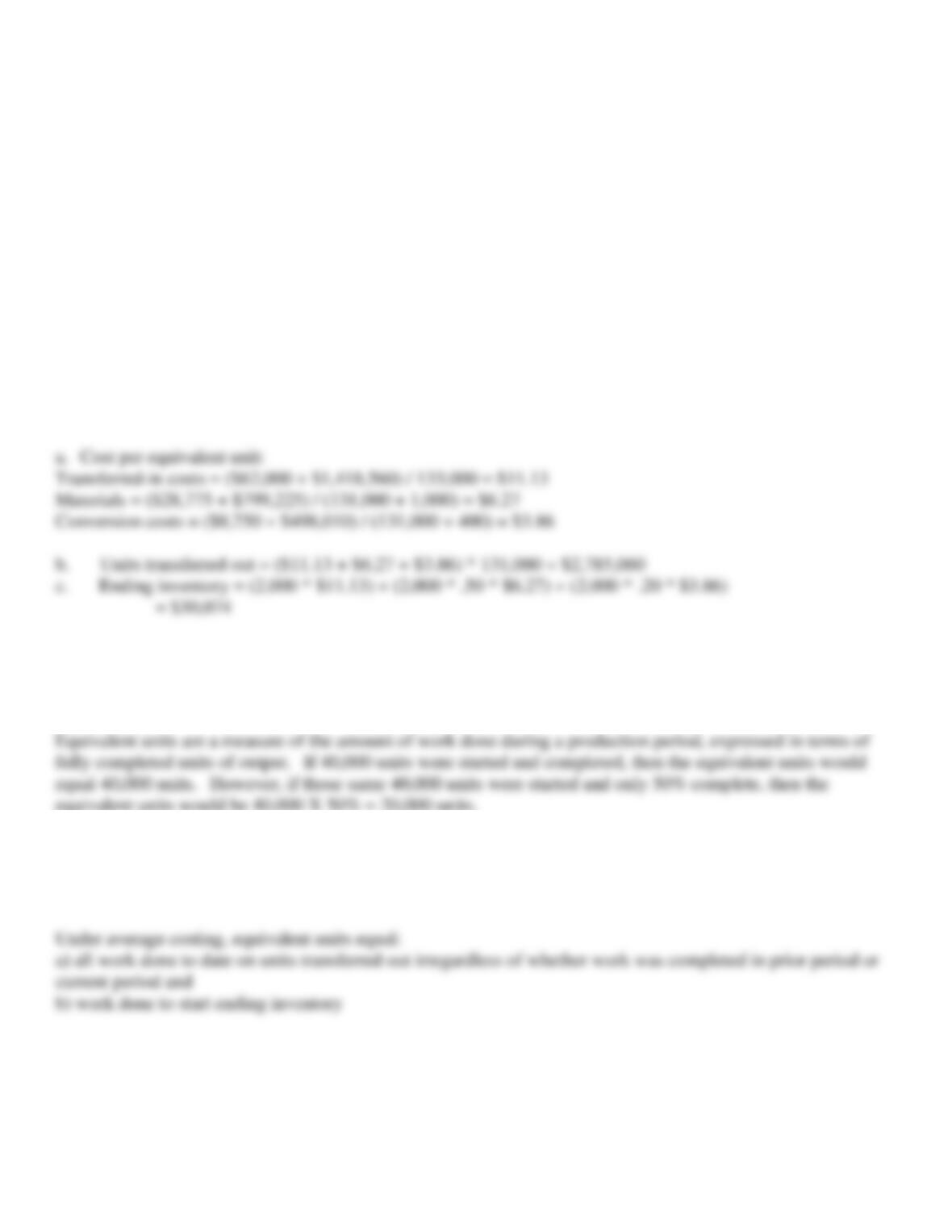
Required
a. Calculate the cost per equivalent unit for transferred-in costs, materials, and conversion costs.
b. Calculate the cost of the units transferred out of the department.
c. Calculate the cost of the ending inventory.
179. Explain the concept of equivalent units. Give an example to validate your explanation.
180. Discuss how equivalent units are computed under the average cost method.
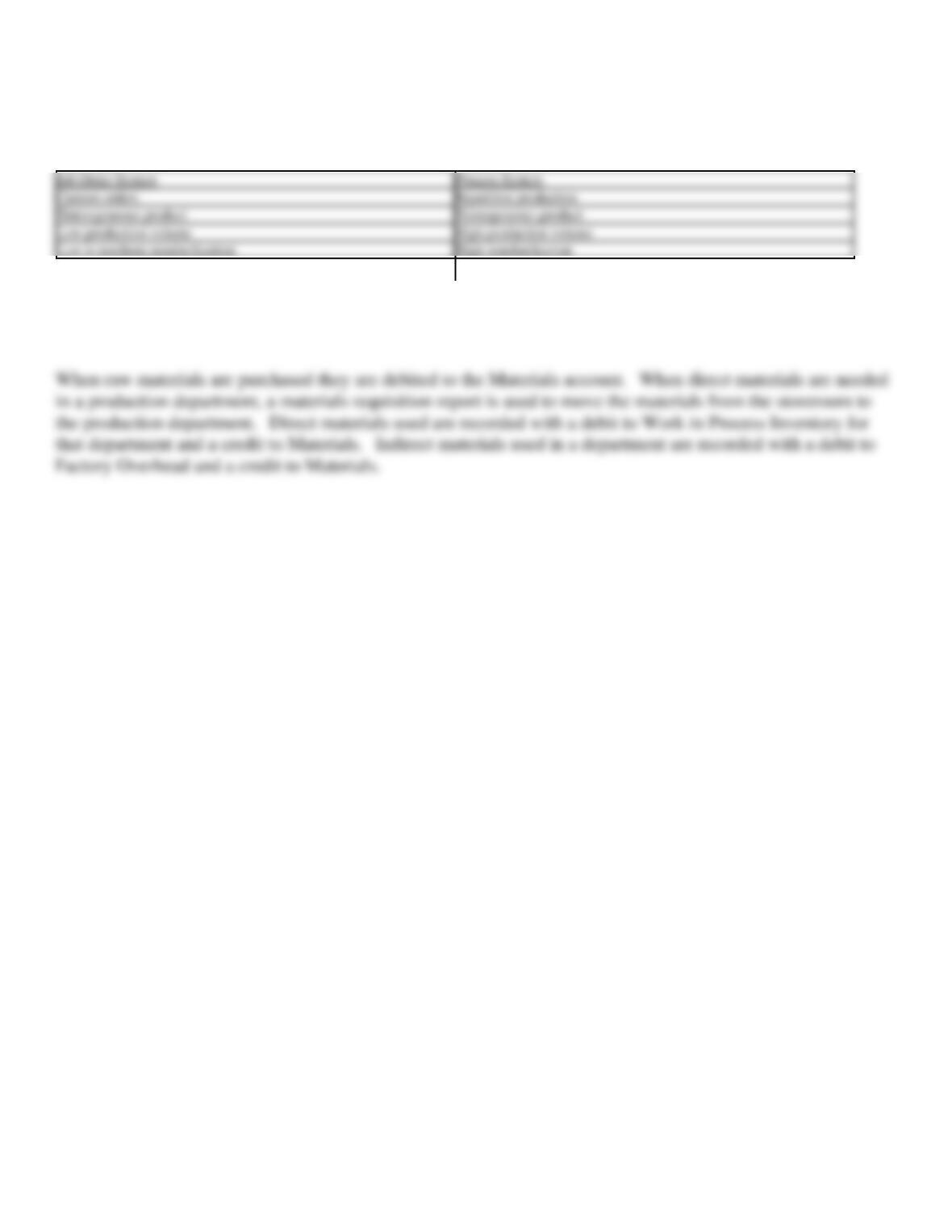
181. Job order manufacturing and process manufacturing are two major costing systems used in
manufacturing. Briefly contrast the characteristics of these two systems.
182. Describe the flow of materials in a process cost accounting system.