211)
Dave is undecided about whether to eat at a restaurant or to order pizza at home. He then obtains a
coupon for 20 percent off at the restaurant and decides to go there to eat. This is an example of
211)
A)
a lower price leading a consumer to buy more of a good because of the income effect.
B)
a lower price leading a consumer to substitute more of the less expensive good for the
relatively more expensive good.
C)
someone using criteria other than price to make a consumption decision.
D)
a consumer making a decision irrationally.
212)
Suppose Lois usually buys two cups of coffee for two dollars each and one scone for two dollars
each. If the price of scones falls to one dollar each and she now buys two cups of coffee and two
scones, this illustrates the
212)
A)
real–income effect.
B)
substitution effect.
C)
marginal rate of substitution.
D)
total utility effect.
213)
In economics, the term “marginal” refers to
213)
A)
negative.
B)
inverse.
C)
total.
D)
a change in the total.
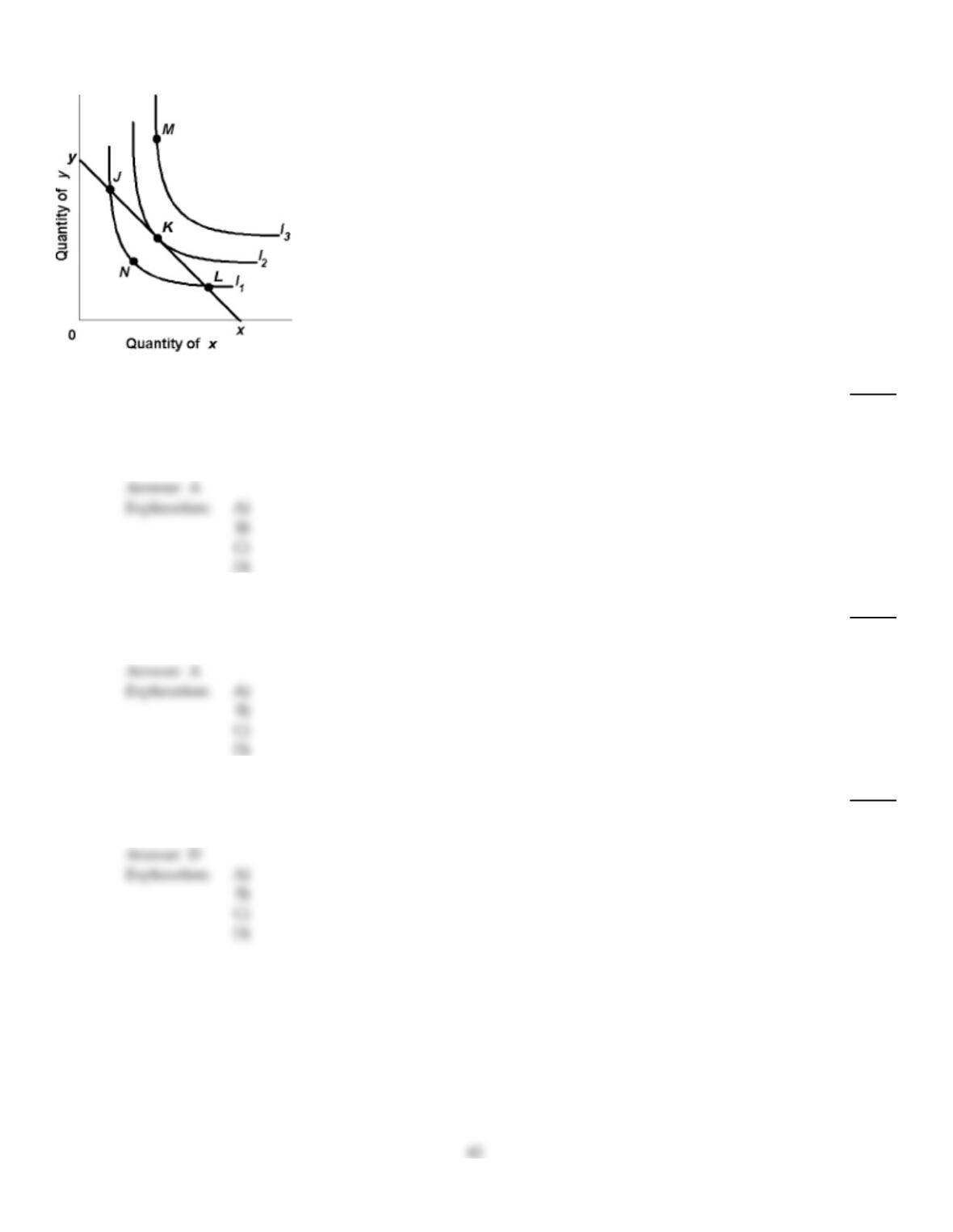
214)
Using the above figure, we can conclude that
214)
A)
K is the optimal combination of goods.
B)
the consumer is indifferent between J and M.
C)
the consumer will purchase goods at combination M.
D)
L is preferred to K.
215)
The consumer optimum is found by using
215)
A)
marginal utility.
B)
total utility.
C)
total utils.
D)
total utility minus marginal utility.
216)
A representative unit by which utility is measured is
216)
A)
ordinal utility.
B)
marginal utility.
C)
utility.
D)
a util.
217)
A rational consumer will NEVER purchase a product when its
217)
A)
total utility is decreasing at an increasing rate.
B)
marginal utility is decreasing.
C)
total utility is increasing at a decreasing rate.
D)
marginal utility is negative.
218)
If a consumer concludes that the marginal utility of the last dollar spent on vegetables exceeds the
marginal utility of the last dollar spent on junk food, he will respond by
218)
A)
consuming relatively more junk food and fewer vegetables.
B)
halting consumption of junk food altogether.
C)
consuming relatively more vegetables and less junk food.
D)
consuming equal amounts of vegetables and junk food.
C
219)
Economists infer that a consumer receives more utility from one good than another by
219)
A)
the logic of the models used.
B)
observing the consumer’s behavior.
C)
giving consumers surveys about the utility they receive from the goods.
D)
means of introspection and speculation.
B
220)
If marginal utility is positive but diminishing, then
220)
A)
average utility must be negative.
B)
marginal utility must be more than total utility.
C)
total utility must be positive.
D)
marginal utility must be above–average utility.
C
D
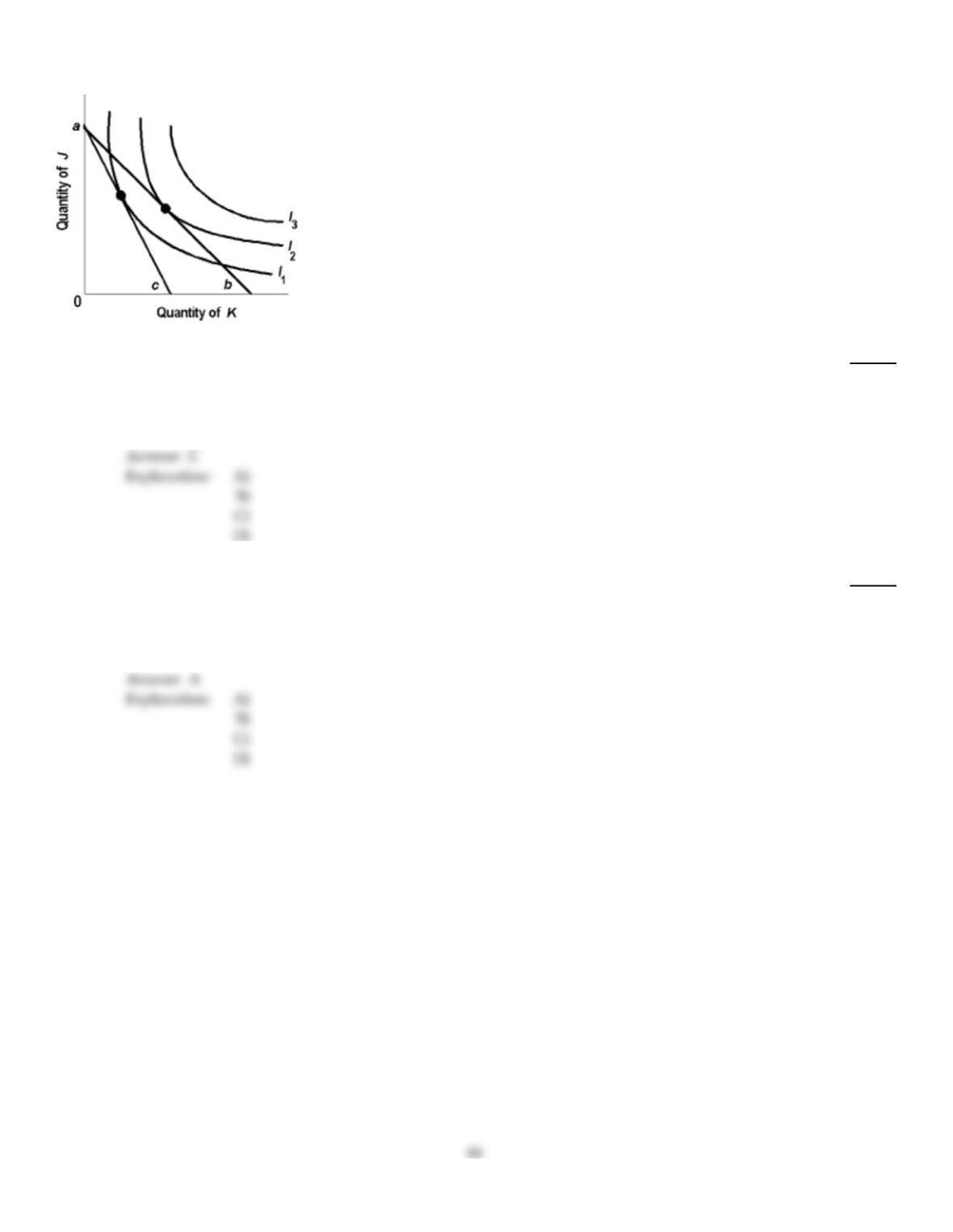
221)
Use the above figure. When the budget line rotates from “b” to “c”
221)
A)
the price of product J decreases and the quantity demanded of product J increases.
B)
the price of product K decreases and the quantity demanded of product K increases.
C)
the price of product K increases and the quantity demanded of product K decreases.
D)
the price of product J increases and the quantity demanded of product J decreases.
222)
The real–income and the substitution effects reinforce each other by
222)
A)
decreasing the consumption of good x when the price of good x increases.
B)
increasing the consumption of both goods x and y when income increases.
C)
increasing the consumption of good y when the price of x falls.
D)
decreasing the consumption of good x when the price of good y falls.
A
C
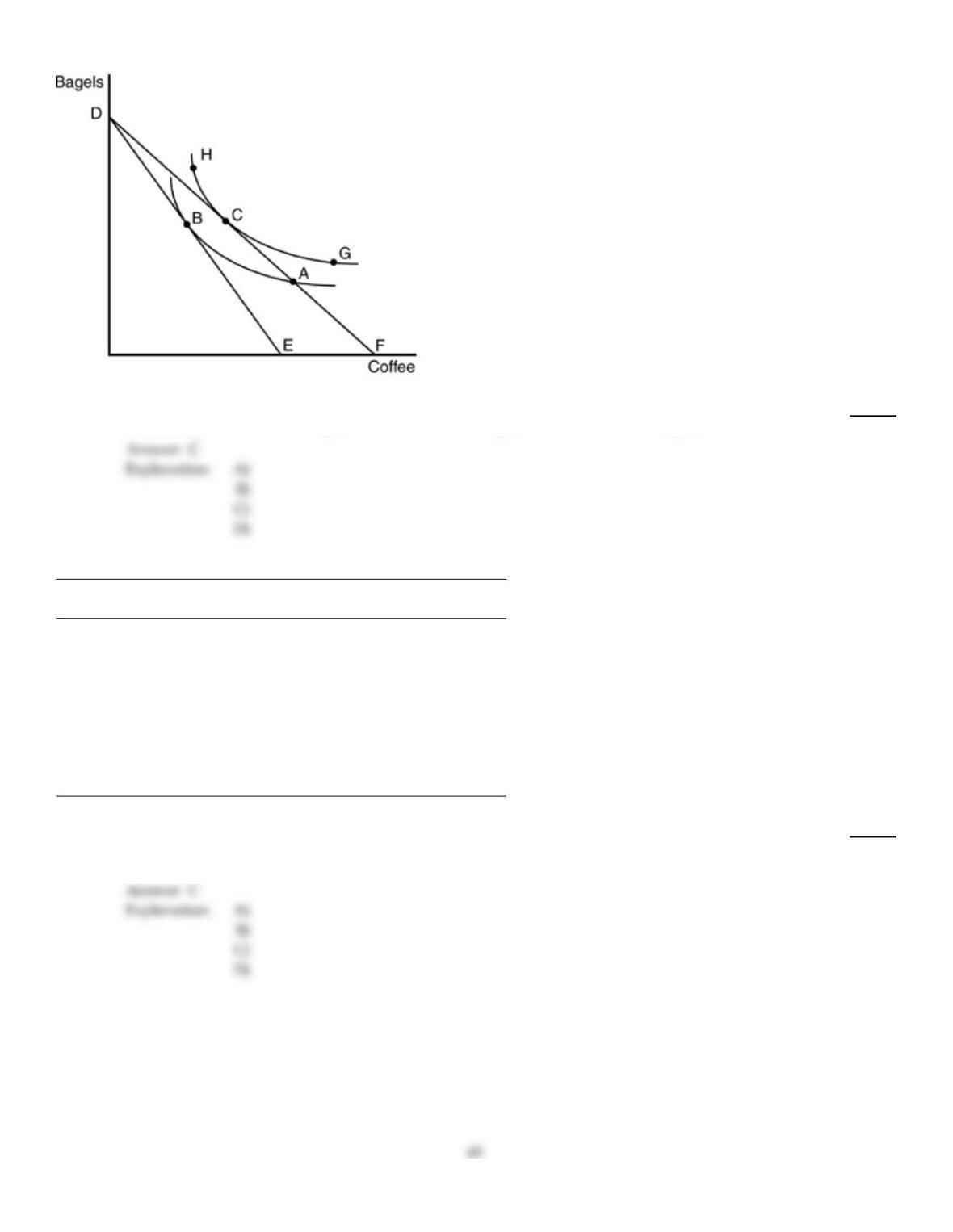
223)
In the above figure, if the budget line is the line DF, the consumer will maximize utility at point
223)
A)
A.
B)
B.
C)
C.
D)
G.
Quantity of Total Utility Total Utility
Movies Mary John
3100 190
4140 250
5170 300
6190 340
7200 370
8210 390
9210 405
10 200 415
11 190 420
224)
According to the above table, Mary’s marginal utility from watching the 6th movie is
224)
A)
40 units of utility.
B)
190 units of utility.
C)
20 units of utility.
D)
10 units of utility.
Quantities MUapples(Adam) MUoranges(Adam) Quantities MUapples(Eve) MUoranges(Eve)
1 40 30 1 15 20
230 20 2 10 15
325 15 3 8 12
420 12 4 5 10
225)
Use the above table. Adam has 3 apples and 3 oranges. Eve has 2 apples and 2 oranges. Eve asks
Adam to give her an apple in exchange for an orange. Should Eve go through with this exchange?
225)
A)
Yes. She is indifferent between consuming apples and oranges.
B)
Yes. This way she will have 3 apples, which will give her more total satisfaction.
C)
No. She gives up more satisfaction than she gets.
D)
No. Adam likes apples more than oranges.
226)
The amount of pleasure or satisfaction derived from consumption of a good is called
226)
A)
elasticity.
B)
demand.
C)
consumer surplus.
D)
utility.
D
227)
Which of the following is NOT consistent with the law of diminishing marginal utility?
227)
A)
Newspaper vending machines are not as secure as soft drink machines.
B)
A student selects to eat at an all–you–can–eat restaurant rather than at a restaurant that
charges for refills.
C)
A symphony has free throat lozenges in their lobby.
D)
A student’s enjoyment of opera increases the more she listens to it.
D
C
228)
John is currently spending all of his income. For the last unit of Good A consumed John gets 20 utils
and for the last unit of Good B consumed he gets 10 utils. The price of Good A is $1. The price of
Good B is $10. If John wants to maximize his utility he should
228)
A)
continue to purchase the same amount of Good A and Good B.
B)
increase the consumption of Good A and decrease the consumption of Good B.
C)
decrease the consumption of Good A and increase the consumption of Good B.
D)
decrease the consumption of Good A and decrease the consumption of Good B.
229)
To derive the demand curve from the indifference map
229)
A)
vary the price of one good while holding the price of the other good and income constant.
B)
vary the price of one good and income while holding the price of the other good constant.
C)
vary income while holding the prices constant.
D)
vary the prices of both goods while holding income constant.
230)
Economists once believed utility could be measured. The philosophical school based on the thought
known as utilitarianism was developed by the English philosopher
230)
A)
Jeremy Bentham.
B)
John Lennon.
C)
Henri Leconte.
D)
Bernard Mandeville.
231)
All possible combinations of goods that can be purchased at fixed prices with a specific income is
231)
A)
a budget constraint.
B)
a marginal utility curve.
C)
a total utility curve.
D)
an indifference curve.
232)
The total utility from consuming 8 units of a good is 155. The marginal utility of the 8th unit is 7
and the marginal utility of the 7th unit is 11. The total utility from consuming 6 units of the good is
232)
A)
144.
B)
173.
C)
137.
D)
130.
Number of Bottles of Soda Total Utility Marginal Utility
1100
2 20
315
4140
233)
Using the above table, what is the total utility of consuming 2 bottles of soda?
233)
A)
120
B)
140
C)
240
D)
115
234)
Your annual review is given to you at your place of employment, and you get a raise of 3 percent
for the next year. On the subway home though, you read an article stating the price of homes in the
area you are looking to buy will increase by 6 percent during the coming year. You determine from
the article that if you buy in your favorite neighborhood
234)
A)
your real income actually increases.
B)
consumer optimum is reached.
C)
quantity demanded will increase.
D)
your purchasing power declines.
D
235)
An indifference map shows
235)
A)
that curves closer to the origin represent higher levels of utility.
B)
that utility is at a maximum at the origin.
C)
that money income is constant, but product prices may change.
D)
that curves further from the origin represent higher levels of utility.
D
236)
A consumer will achieve the highest level of utility possible when she consumes
236)
A)
at the point at which the highest indifference curve is tangent to the budget constraint.
B)
at a point to the left of the budget constraint.
C)
at the point at which the indifference curve crosses the budget constraint.
D)
just below the point where the indifference curve crosses the budget constraint.
A
A
237)
Suppose that Dillon derives 40 utils of total utility from eating 3 hotdogs and 50 utils of total utility
from eating 4 hotdogs. What is Dillon’s marginal utility from eating the 4th hotdog?
237)
A)
40
B)
50
C)
5
D)
10
238)
Which of the following best describes the consumer optimum?
238)
A)
MUa/Pa= TUb/Pb
B)
change in TU/change in P = MU
C)
MUa/TUa=Pa
D)
MUa/Pa= MUb/Pb= . . . = MUz/Pz.
D
239)
When the price of a good that a person is consuming falls, other things being constant, there is
239)
A)
a real income effect.
B)
no change in purchasing power.
C)
a decline in purchasing power.
D)
a decline in real income.
A
240)
A good synonym for “utility” is
240)
A)
satisfaction.
B)
marginal.
C)
need.
D)
practical.
A
241)
Suppose a consumer is currently buying 5 goods so that utility is maximized. The price of one of
the goods falls while the prices of the other 4 goods do not change. The consumer should
241)
A)
buy more of the good that has experienced the fall in price to get to the optimal position.
B)
buy more of all of the goods but the one that experiences the decline in price, to get to the
optimal position.
C)
buy less of all goods being consumed to get to the optimal position.
D)
buy more of all goods being consumed to get to the optimal position.
A
D
Bob’s Marginal Utility for consuming beer and pizza with $8.00 in income
Quantity Marginal Quantity of Marginal
of Pizza Utility Beer Utility
1 45 1 40
2 40 2 40
3 30 3 35
4 15 410
5 –5 5 0
242)
In the above table, Bob experiences diminishing marginal utility after consuming how many pieces
of pizza?
242)
A)
1
B)
2
C)
3
D)
4
243)
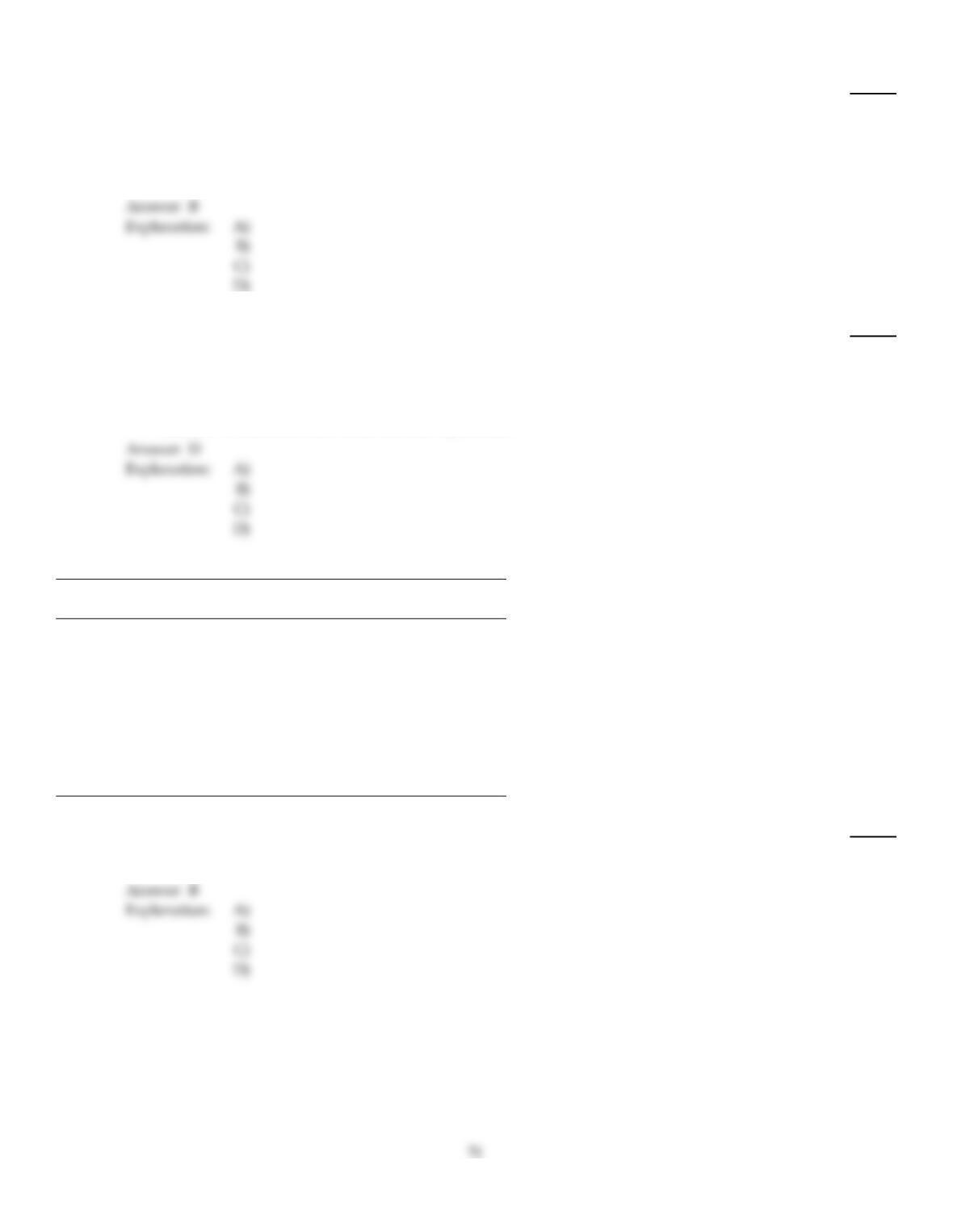
Refer to the above figure. All of the following are true concerning the diamond–water paradox
EXCEPT
243)
A)
since the price of diamonds is high, demand is great.
B)
the demand for water exceeds the demand for diamonds.
C)
the price of diamonds exceeds the price of water.
D)
marginal utility of diamond consumption is relatively high.
244)
When Stephanie increases the consumption of pizza and decrease the consumption of soda, her
marginal utility of
244)
A)
both pizza and soda will increase.
B)
pizza falls and the marginal utility of soda will increase.
C)
pizza increases and the marginal utility of soda will fall.
D)
both pizza and soda will decrease.
245)
The reason that diamonds cost more than water is
245)
A)
most consumers consume little water.
B)
diamonds are more beautiful than water.
C)
water is a necessity.
D)
the marginal utility of each diamond a consumer purchases is quite high due to the small
amount of diamonds that most consumers purchase.
Quantity of Total Utility Total Utility
Movies Mary John
3100 190
4140 250
5170 300
6190 340
7200 370
8210 390
9210 405
10 200 415
11 190 420
246)
Refer to the above table. What is the marginal utility for the 10th unit for Mary and for John?
246)
A)
Mary: 10; John 10
B)
Mary: –10; John: 10
C)
Mary: 0; John: 0
D)
Mary: 220; John 450
247)
The price of a hamburger is $1, and the price of a movie is $6. The consumer has purchased 2
hamburgers and 2 movies, and her marginal utility from the second hamburger is 20 and from the
second movie is 120. The consumer has an income of $21. This combination of goods
247)
A)
maximizes utility and is an optimum because the marginal utility of the last dollar spent on
each good is the same.
B)
is not an optimum because the consumer has not spent all of her money.
C)
is not an optimum because the marginal utility of the last dollar spent on each good is not the
same.
D)
maximizes utility because the marginal utility of the last dollar spent on each good is the
same, but it is not an equilibrium because marginal utility is not zero.
248)
A consumer is buying the optimal amount of goods when
248)
A)
the marginal utility from the purchases of all the goods is equal to 1.
B)
the marginal utility from the purchases of all the goods purchased is the same.
C)
the total utility from the purchases on all the goods purchased is the same.
D)
the marginal utility per last dollar spent on all of the goods purchased is the same.
D
249)
Suppose Isaac’s marginal utility from attending his 5th White Sox game was 40 and the marginal
utility from attending his 1st Rihanna concert was 200. Assume that the price of a White Sox ticket
is $20 and the price of a Rihanna ticket is $120. Which of the following would be TRUE?
249)
A)
Isaac would attend more White Sox games and less Rihanna concerts.
B)
Isaac would attend less of both White Sox games and Rihanna concerts.
C)
Isaac would not alter his behavior.
D)
Isaac would attend more Rihanna concerts and less White Sox games.
A
250)
In economics, utility is defined as
250)
A)
the usefulness of a good or service.
B)
the want–satisfying power of a good or service.
C)
the objective measure of the desirability of a good or service.
D)
the utilitarian value of a good or service.
B
B
Bob’s Marginal Utility for consuming beer and pizza with $8.00 in income
Quantity Marginal Quantity of Marginal
of Pizza Utility Beer Utility
1 45 1 40
2 40 2 40
3 30 3 35
4 15 410
5 –5 5 0
251)
In the above table, how much total utility does Bob get from consuming 4 beers?
251)
A)
10 utils
B)
125 utils
C)
45 utils
D)
115 utils
252)
Other things being equal, when the money price of a good increases, its relative price
252)
A)
increases.
B)
falls to zero.
C)
decreases.
D)
stays the same.
Pepsi MU of Pepsi Pizza MU of Pizza
1st can 18 1st slice 7
2nd can 15 2nd slice 6
3rd can 12 3rd slice 4
4th can 9 4th slice 3
5th can 6 5th slice 0
253)
Assume that Catherine has the preferences shown in the above table. Also assume that the price of
a can of Pepsi is $3.00 and that the price of a slice of pizza is $2.00. If she has $16 available to spend,
what combination of Pepsi and pizza will be her consumer optimum?
253)
A)
6 cans of Pepsi, 0 slices of pizza
B)
1 can of Pepsi, 4 slices of pizza
C)
2 cans of Pepsi, 5 slices of pizza
D)
4 cans of Pepsi, 2 slices of pizza
254)
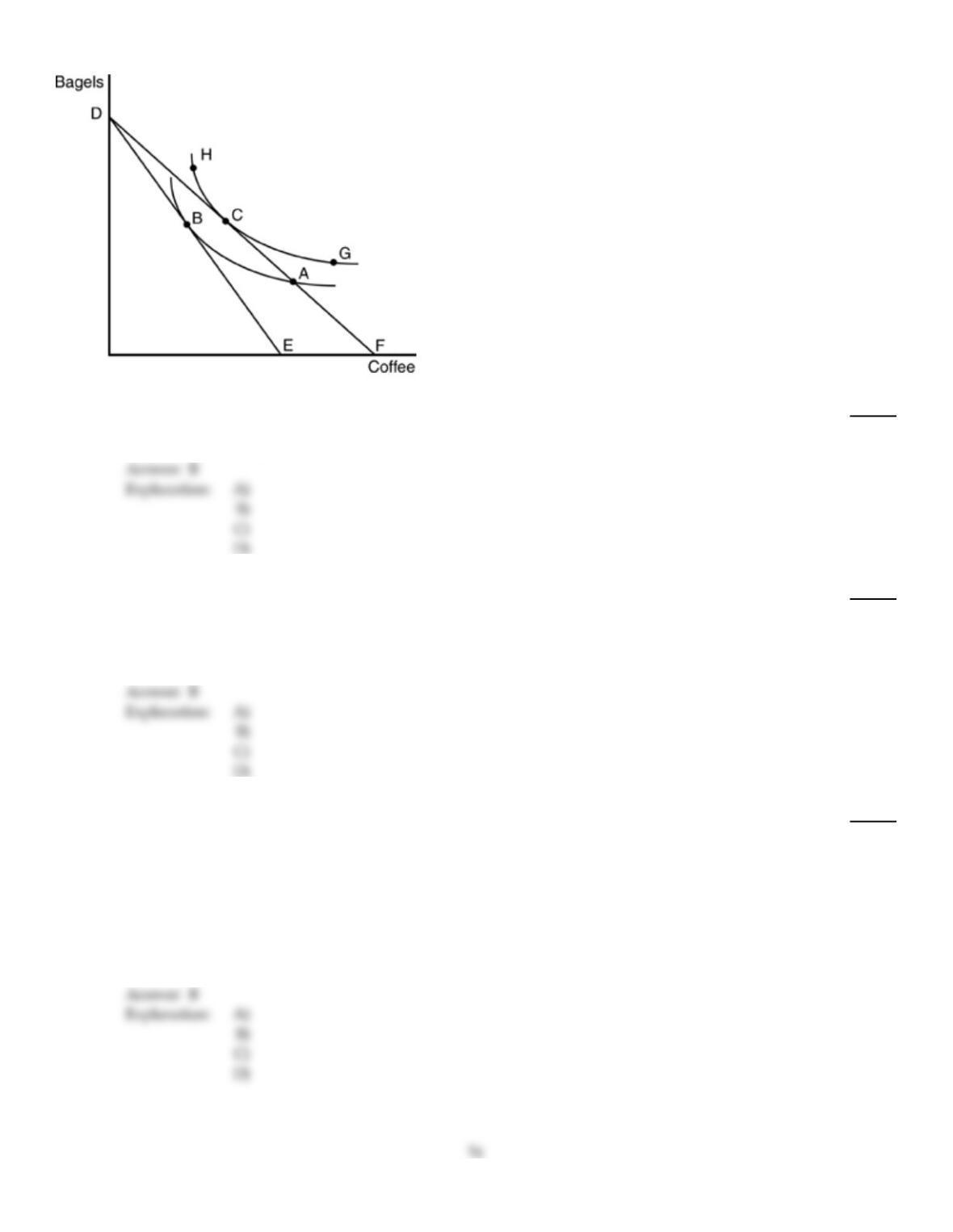
In the above figure, the budget line will change from line DE to line DF when
254)
A)
income rises.
B)
the price of coffee decreases.
C)
the price of bagels increases.
D)
the price of coffee increases.
255)
Consumers do not buy as many units of each good as they want because
255)
A)
they do not know what they want in all situations.
B)
they have limited incomes.
C)
eventually marginal utility equals zero.
D)
of the law of diminishing marginal utility.
256)
On a hot summer day, a construction worker enters a McDonald’s fast–food restaurant. He orders
the first Big Mac. He consumes it within 3 minutes. He then orders a second Big Mac and consumes
it in 10 minutes. He eats only half of the third one in 18 minutes and throws away the rest. The store
manager offers him the fourth for free. The construction worker says: “No thanks.” For the
construction worker described above, we can say that
256)
A)
diminishing marginal utility did not occur, he simply wanted to quit eating.
B)
diminishing marginal utility began as soon as he had eaten the first Big Mac.
C)
the law of diminishing marginal utility only applies to durable goods.
D)
diminishing marginal utility set in only after he had consumed the second Big Mac.
257)
The change in people’s purchasing power that occurs when the price of a good they purchase
changes, assuming all else is held constant is known as
257)
A)
the multiplier effect.
B)
the substitution effect.
C)
the real income effect.
D)
the elasticity effect.
258)
The quantity of good M is measured along the vertical axis, and the quantity of good N is measured
along the horizontal axis. If the prices of both goods M and N declines by 50% each, then the
budget line
258)
A)
shifts outward to the right by 100%.
B)
shifts inward to the left by 50%.
C)
shifts outward to the right by 50%.
D)
rotates clockwise by 180 degrees.
259)
The price of a can of soft drink is $1.25 and the marginal utility of the second can consumed is 10
utils. The marginal utility of the third donut is 4 utils. You should only consume the third donut if
the price of the donut is less than or equal to
259)
A)
$0.25.
B)
$0.625.
C)
$0.50.
D)
$0.41.
260)
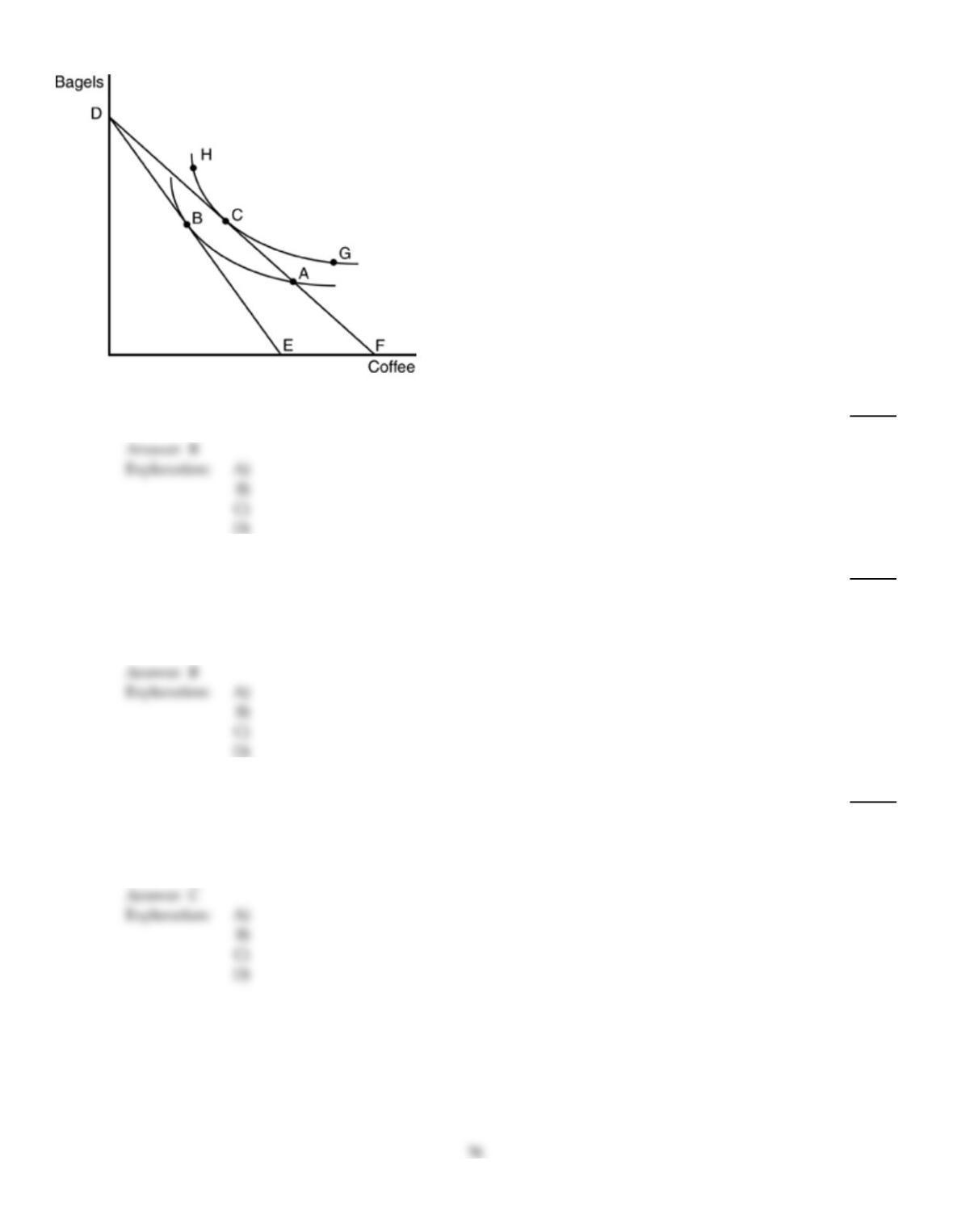
In the above figure, if the budget line is the line DE, the consumer will maximize utility at point
260)
A)
A.
B)
B.
C)
C.
D)
G.
261)
Which of the following is NOT true about indifference curves?
261)
A)
Indifference curves slope downward.
B)
Indifference curves shift when prices change.
C)
Indifference curves are not straight lines because the marginal rate of substitution falls.
D)
Indifference curves show equally preferred combinations of two goods.
B
262)
The budget constraint shows that
262)
A)
the consumer can have as many goods as he wants.
B)
total income equals total spending on one good.
C)
the consumer faces a trade–off in the consumption of goods.
D)
as consumers spend more on one good, they spend more on others.
C
B
263)
The fact that consumers will purchase more of a good that has become relatively cheaper
263)
A)
is called the substitution effect.
B)
leads to an upward sloping demand curve.
C)
is called the nominal income effect.
D)
leads to negative marginal utility.
264)
Carol is very hungry. She has just sat down to eat. Her first bite gives her a certain level of utility.
Her second bite increases her utility by more than the first bite. Her third bite increases her utility
by more than the second bite. Carol has 40 bites left before she finishes. Which of the following
statements is TRUE about Carol?
264)
A)
Carol is being inconsistent with the law of diminishing marginal utility.
B)
Carol’s total utility decreases with each bite.
C)
Carol will eventually experience diminishing marginal utility by the time she finishes eating,
if her marginal utility begins to decline.
D)
Carol‘s marginal utility will be negative when she takes her last bite.
Quantity of Total Quantity of Total
Magazines/Wk Utility Paperbacks/Wk Utility
0 0 0 0
160 1200
2100 2400
3130 3500
4 140 4550
5142 5575
6142 6 580
265)
Refer to the above table If the price of a magazine is $2 and the price of a paperback book is $5 and
the consumer has $40, the rational consumer will purchase
265)
A)
6 magazines and 6 books.
B)
2 magazines and 2 books.
C)
5 magazines and 6 books.
D)
2 magazines and 3 books.
266)
According to utility theory, consumer purchase decisions are made such that
266)
A)
the total utility of the last unit purchased is equal to the price of that unit.
B)
the value of the ratio of marginal utility to price for the last units purchased and consumed is
equal.
C)
the total utility from consuming the good is less than the marginal utility of the last unit
consumed.
D)
the difference between the value of the marginal utility of the last unit purchased and the
price paid is maximized.
267)
As more of a product is consumed, total utility increases up to a point at which
267)
A)
marginal utility decreases.
B)
marginal utility will initially decrease, then increase.
C)
marginal utility increases at an increasing rate.
D)
marginal utility increases at a constant rate.
Slices of Pizza Total Utility Marginal Utility
1 50
2 90
3 120
4 130
5 137
6 120
268)
In the above table, what is the marginal utility of the second slice of pizza consumed?
268)
A)
30
B)
10
C)
40
D)
90
269)
Suppose that a consumer is at an optimum consuming X and Y. If the price of X falls, then to get to
a new equilibrium the consumer must
269)
A)
purchase more X.
B)
purchase less X and more Y.
C)
purchase less Y and less X.
D)
purchase more Y.
270)
When the marginal utility per dollar of good x exceeds the marginal utility per dollar of good y,
270)
A)
good y must have a negative marginal utility.
B)
the consumer is consuming too much of good x.
C)
the consumer is in an optimal situation if the price of good x exceeds the price of good y.
D)
the consumer should consume more of good x.
271)
An individual‘s demand curve slopes down because
271)
A)
of the rule that the marginal utility of the last unit must equal the price.
B)
marginal utility falls as price falls.
C)
of the law of diminishing marginal utility and the rule of equal marginal utilities per dollar.
D)
the value of the marginal utility falls as the price falls.
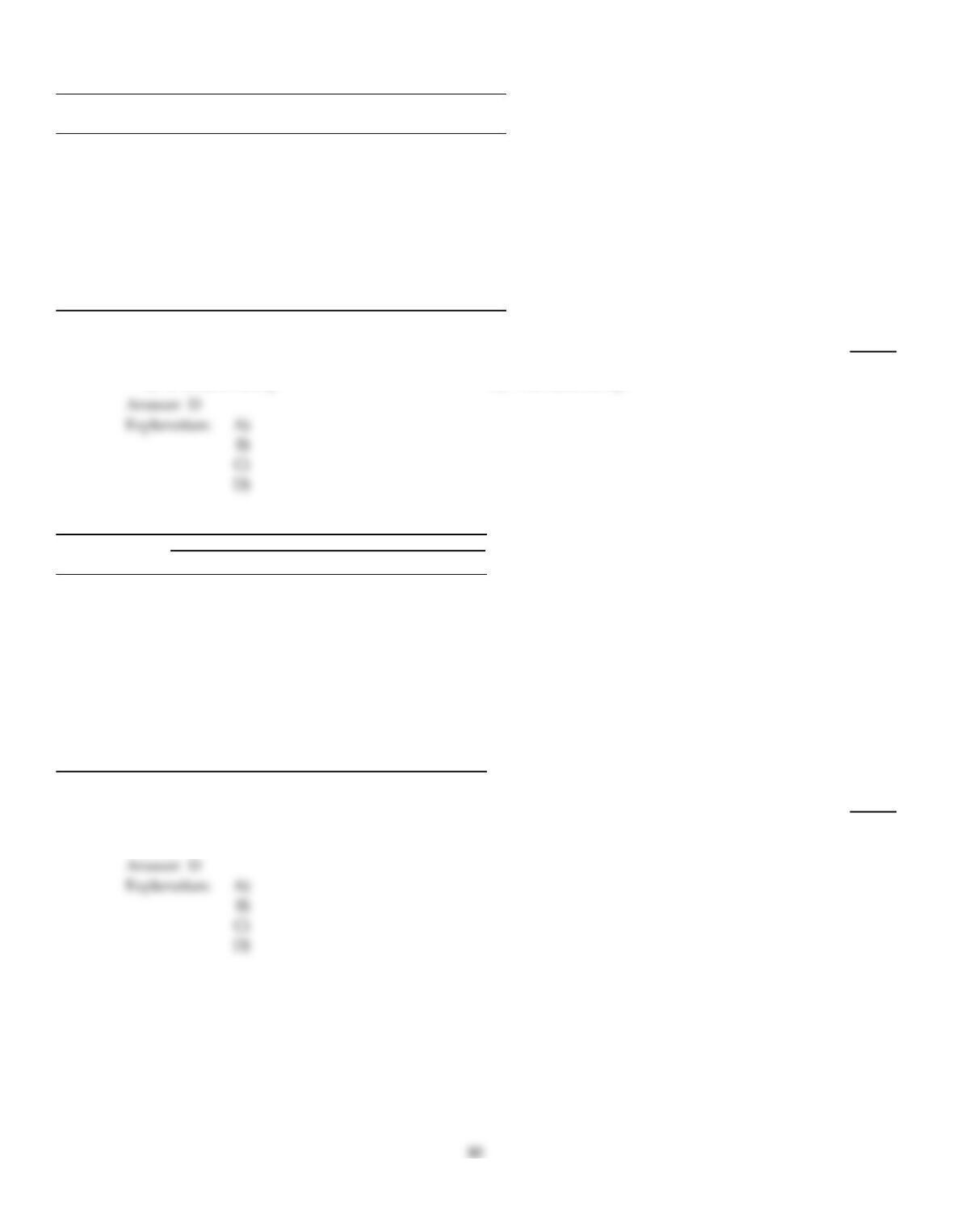
272)
Given the above figure, when Joey eats a third piece of pizza his marginal utility is ________ and
his total utility is ________.
272)
A)
falling; rising
B)
rising; rising
C)
rising; falling
D)
falling; falling
Quantity of Total Utility Total Utility
Movies Mary John
3100 190
4140 250
5170 300
6190 340
7200 370
8210 390
9210 405
10 200 415
11 190 420
273)
According to the above table, John‘s marginal utility from watching the 9th movie is
273)
A)
0 units of utility.
B)
405 units of utility.
C)
10 units of utility.
D)
15 units of utility.
Quantity Total Utility
Per Week Amy Robert David Michelle
0 0 0 0 0
15.0 100 600 60
2 9.9 190 1200 130
314.7 270 1800 220
419.4 340 2400 310
524.0 400 3000 425
628.5 450 3600 575
732.9 490 4200 900
837.2 520 4800 1275
941.4 510 5400 1770
274)
Refer to the above table. Michelle’s utility schedule is characterized by
274)
A)
constant marginal utility.
B)
constant total utility.
C)
diminishing marginal utility.
D)
increasing marginal utility.