Test Bank for Intermediate Accounting, Sixteenth Edition
20–48
Pr. 20-123 (cont.)
Instructions
(a) Determine the missing amounts in the 2018 pension worksheet, indicating whether the
amounts are debits or credits.
(b) Prepare the journal entry to record 2018 pension expense for Elias Inc.

Accounting for Pensions and Postretirement Benefits
20–49
Pr. 20-124 – Pension Worksheet
Howard Corp. sponsors a defined-benefit pension plan for its employees. On January 1, 2018,
the following balances related to this plan.
Plan assets (fair value) $2,200,000
Projected benefit obligation 2,400,000
Pension asset/liability 200,000 Cr.
Prior service cost 300,000
OCI – Loss 260,000
As a result of the operation of the plan during 2018, the actuary provided the following additional
data at December 31, 2018.
Service cost for 2018 $280,000
Actual return on plan assets in 2018 180,000
Amortization of prior service cost 60,000
Contributions in 2018 460,000
Benefits paid retirees in 2018 320,000
Settlement rate 7%
Expected return rate 8%
Average remaining service life of active employees 10 years
Instructions
(a) Compute pension expense for Howard Corp. for the year 2018 by preparing a pension
worksheet.
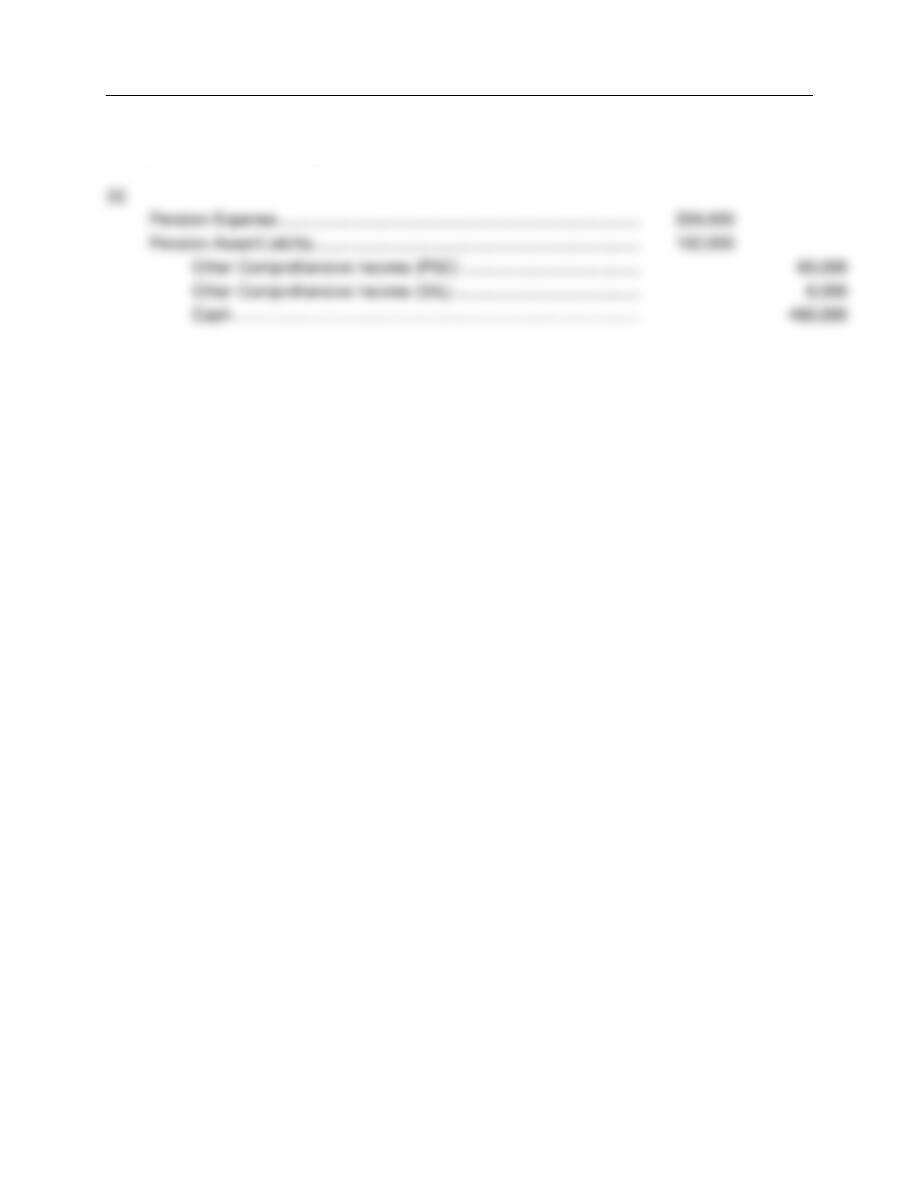
(b) Prepare the journal entry for pension expense.
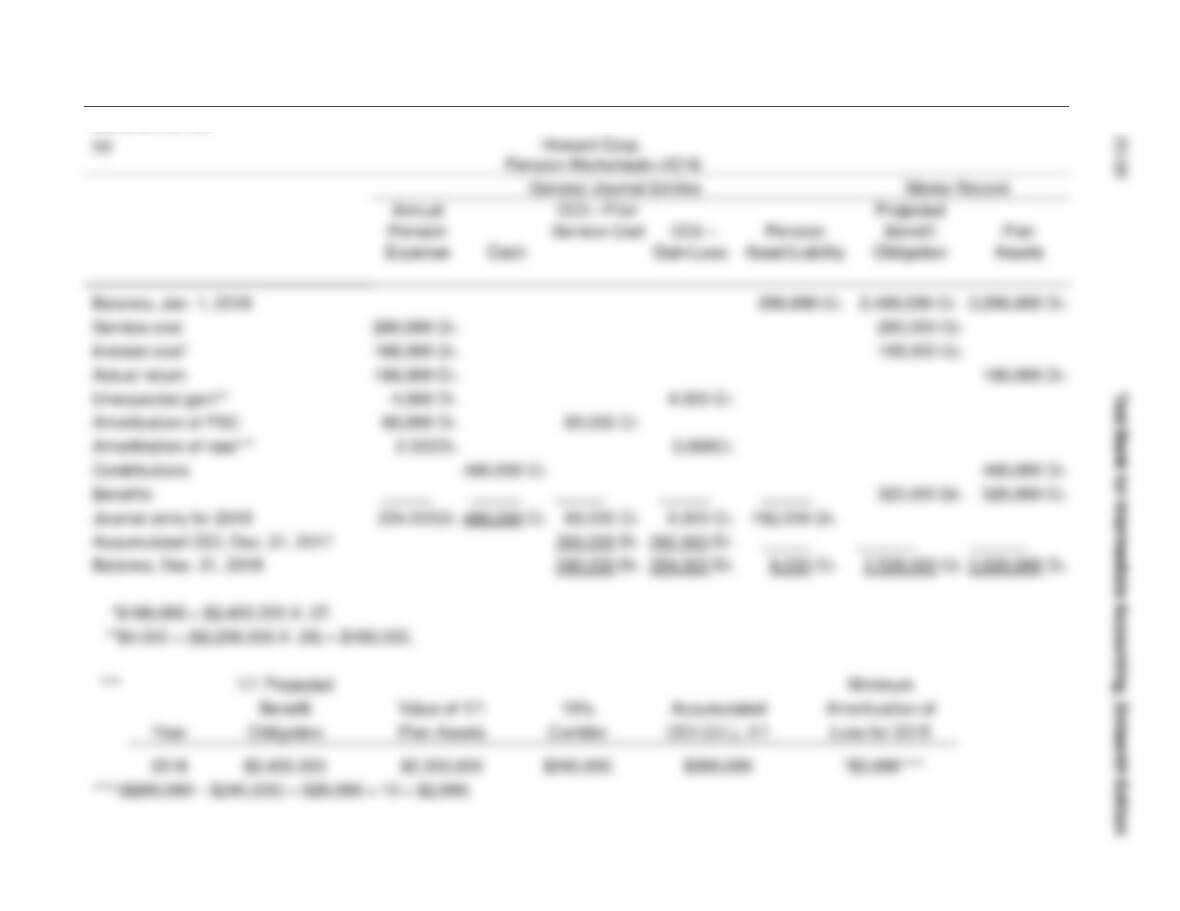
Solution 20-124
Accounting for Pensions and Postretirement Benefits
20–51
Solution 20–124 (Continued)
Test Bank for Intermediate Accounting, Sixteenth Edition
20–52
IFRS QUESTIONS
True/False
1. The accounting for defined–benefit pension plans is the same under GAAP and IFRS.
2. Prior service cost is recognized on the balance sheet under both GAAP and IFRS.
3. Prior service cost is amortized into income over the expected service lives of employees
under both GAAP and IFRS.
4. Under IFRS companies may recognize actuarial gains and losses in income immediately.
5. Under GAAP companies may either recognize actuarial gains and losses in income
immediately or amortize them over the expected service lives of employees.
Answers to True/False:
Multiple Choice
6. The International Accounting Standards Board has proposed changes to IFRS pension
accounting including all of the following except
a. elimination of smoothing via the corridor approach.
b. different presentation of pension costs in the income statement.
c. requiring recognition of actuarial gains and losses over the expected service lives of
employees.
d. a new category of pensions for accounting purpose – “contribution–based promises.”

Accounting for Pensions and Postretirement Benefits
20–53
7. Midland Company follows GAAP for its external financial reporting whereas Bailey
Company follows IFRS for its external financial reporting. The amount contributed by
Midland for its defined contribution plan for 2018 amounted to $55,000 and the amount
contributed by Bailey for its defined contribution plan for 2018 amounted to $76,000. The
remaining service lives of employees at both firms is estimated to be 10 years. What is the
amount of expense related to pension costs recognized by each company in its income
statement for the year ended December 31, 2018?
Midland Bailey
a. $ 5,500 $76,000
b. $55,000 $76,000
c. $55,000 $ 7,600
d. $ 5,500 $ 7,600
8. Midland Company follows GAAP for its external financial reporting whereas Bailey
Company follows IFRS for its external financial reporting. Both companies have defined-
benefit pension plans. At December 31, 2018, prior to any adjusting entries, Midland
Company’s actuarial loss subject to amortization/recognition amounted to $55,000 and
Bailey Company’s actuarial loss subject to amortization/recognition amounted to $76,000.
The remaining services lives of employees at both firms is estimated to be 10 years. What
is the maximum amount of loss that could be recognized by each company in its income
statement for the year ended December 31, 2018?
Midland Bailey
a. $ 5,500 $76,000
b. $55,000 $76,000
c. $55,000 $ 7,600
d. $ 5,500 $ 7,600
9. Which of the following is true with regard to pension accounting under GAAP and IFRS?
a. Accounting for defined-benefit pensions is typically a less important issue in the U. S.
than in other parts of the world.
b. The accounting for defined-benefit pension plans is the same under GAAP and IFRS.
c. Prior service cost is recognized on the balance sheet under both GAAP and IFRS.
d. Prior service cost is amortized into income over the expected service lives of
employees under both GAAP and IFRS.
10. Which of the following is false regarding the accounting for pensions under IFRS and
GAAP?
a. Prior service cost is recognized on the balance sheet under GAAP only.
b. Under GAAP companies must amortize actuarial gains and losses over the expected
service lives of employees.
c. Prior service cost is amortized into income over the expected service lives of
employees under GAAP only.
d. Under IFRS companies may recognize actuarial gains and losses in income
immediately.

Test Bank for Intermediate Accounting, Sixteenth Edition
20–54
11. Midland Company follows GAAP for its external financial reporting whereas Bailey
Company follows IFRS for its external financial reporting. The remaining service lives of
employees at both firms is estimated to be 10 years. The following information is available
for each company at December 31, 2018 related to their respective defined–benefit
pension plans.
Midland Bailey
Net of pension assets and liabilities $110,000 $140,000
Prior service cost $230,000 $175,000
What is the amount of prior service cost recognized by each company in its income
statement for the year ended December 31, 2018?
Midland Bailey
a. $230,000 $175,000
b. $ 23,000 $175,000
c. $ 23,000 $ 17,500
d. $230,000 $ 17,500
12. Midland Company follows GAAP for its external financial reporting whereas Bailey
Company follows IFRS for its external financial reporting. The remaining service lives of
employees at both firms is estimated to be 10 years. The following information is available
for each company at December 31, 2018 related to their respective defined–benefit
pension plans.
Midland Bailey
Net of pension assets and liabilities $110,000 $140,000
Prior service cost $220,000 $175,000
What is the amount of Pension Asset/Liability recognized by each company in its balance
sheet at December 31, 2018?
Midland Bailey
a. $110,000 $140,000
b. $ 11,000 $140,000
c. $110,000 $ 14,000
d. $ 11,000 $ 14,000

Accounting for Pensions and Postretirement Benefits
20–55
13. Midland Company follows GAAP for its external financial reporting whereas Bailey
Company follows IFRS for its external financial reporting. The remaining service lives of
employees at both firms is estimated to be 10 years. The following information is available
for each company at December 31, 2018 related to their respective defined–benefit
pension plans.
Midland Bailey
Net of pension assets and liabilities $110,000 $140,000
Prior service cost (after amortization, if any) $230,000 $175,000
What is the amount of Prior Service Cost recognized by each company on its balance
sheet at December 31, 2018?
Midland Bailey
a. $230,000 $175,000
b. $-0- $175,000
c. $-0- $-0-
d. $230,000 $-0-
14. The IASB and the FASB are studying several issues related to accounting for pensions
including all of the following except
a. eliminating smoothing provisions.
b. requiring companies to report actual asset returns and any actuarial gains and losses
directly in the income statement.
c. requiring companies to report various components of pension expense, such as
interest cost, separately in the income statement along with other interest expense.
d. adding smoothing provisions.
Answers to Multiple Choice:

Test Bank for Intermediate Accounting, Sixteenth Edition
20–56
Short Answer
15. Briefly describe some of the similarities and differences between GAAP and IFRS with
respect to the accounting for pensions.
The primary IFRS literature has recently been amended, resulting in significant convergence
between IFRS and GAAP in this area. For example, IFRS and GAAP separate pension plans into
defined contribution plans and defined benefit plans. The accounting for defined contribution
plans is similar. For defined benefit plans, both IFRS and GAAP recognize the net of the pension
assets and liabilities on the balance sheet and both IFRS and GAAP amortize prior service costs
into income over the expected service lives of employees.
Notable differences are that (1) Unlike GAAP, which recognizes prior service cost on the
balance sheet (as an element of Accumulated Other Comprehensive Income), IFRS does
not recognize prior service costs on the balance sheet, (2) Under IFRS companies have
the choice of recognizing actuarial gains and losses in income immediately or amortizing
them over the expected remaining working lives of employees. GAAP does not permit this
choice; actuarial gains and losses (and prior service cost) are recognized in Accumulated
Other Comprehensive Income and amortized to income over remaining service lives.